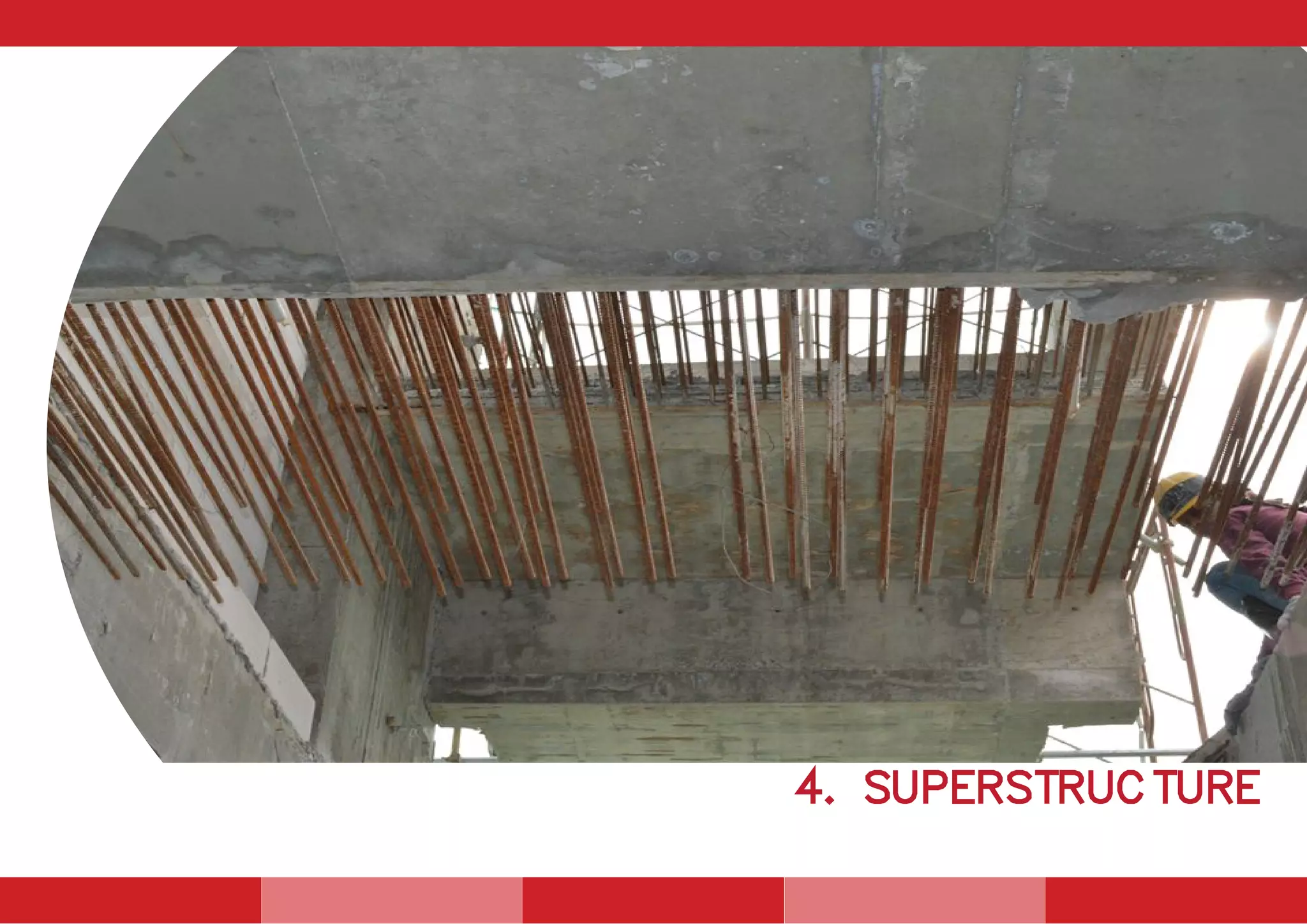
4. SUPERSTRUCTURE
4.1 BEAM AND COLUMN
TEY THIEN HEE -27-
BEAM
Beam is the horizontal member of a structure, carrying and
transferring transverse loads across space to supporting elements. It
is commonly reinforced with rebar.
CONCRETE BEAM
For our site, the beams are mostly made of concrete. There are
two disctinc types of concrete beams, which are Pre cast and In
Situ. Pre cast being beams that are pre casted off site and brought
on site to be assembled on to the structure and In-Situ being
casted on site using form work which was what mostly used in our
site.
The beams and columns are built on site and are affected by the
site conditions. The in-situ concrete structure mostly contains steel
reinforcements for stronger support. Reinforced concrete beams are
designed to act together with longitudinal and web reinforcement in
resisting applied forces.
4.1 BEAM AND COLUMN
TEY THIEN HEE -28-
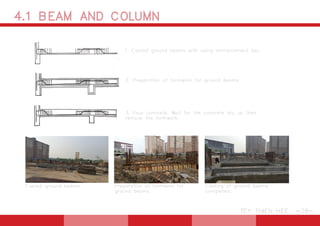
Casted ground beams Preparation of formwork for
ground beams
Casting of ground beams
completed.
1. Casted ground beams with using reinforcement bar.
2. Preparation of formwork for ground beams
3. Pour concrete. Wait for the concrete dry up then
remove the formwork.
4.1 BEAM AND COLUMN
TEY THIEN HEE -29-
COLUMNS
Columns are rigid, relatively slender structural members designed primarily to support axial compressive loads applied
to the ends of the members. The concrete column that is built in our site was built along with the concrete beam
and slab.
Fix the
reinforcement
bar for the
concrete
column
Fix the
formwork for
the concrete
column
Pour concrete,
wait for it to
be cured then
remove the
formwork.
Concrete
column section
CONCRETE COLUMN CONSTRUCTION PROCESS
Re-bards/formwork for columns
in progress
The column that is applied in our
site is concrete column.
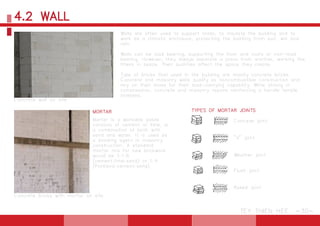
Walls are often used to support loads, to insulate the building and to
work as a climatic enclosure, protecting the building from sun, win and
rain.
Walls can be load bearing, supporting the floor and roofs or non-load
bearing. However, they always separate a place from another, working like
filters in space. Their qualities affect the space they create.
Type of bricks that used in the building are mostly concrete bricks.
Concrete and masonry walls qualify as noncombustible construction and
rely on their mass for their load-carrying capability. While strong in
compression, concrete and masonry require reinforcing o handle tensile
stresses.
MORTAR
Mortar is a workable paste
consists of cement or lime, or
a combination of both with
sand and water. It is used as
a bonding agent in masonry
construction. A standard
mortar mix for new brickwork
would be 1:1:6
(cement:lime:sand) or 1:4
(Portland:cement:sand)
TYPES OF MORTAR JOINTS
4.2 WALL
TEY THIEN HEE -30-
Concrete bricks with mortar on site
Concave joint
"V" joint
Weather joint
Flush joint
Raked joint
Concrete wall on site
4.2 WALL
TEY THIEN HEE -31-
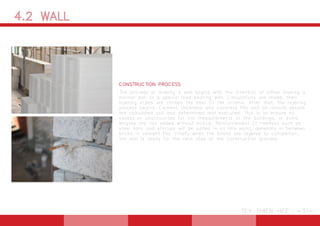
CONSTRUCTION PROCESS
The process of making a wall begins with the intention of either making a
normal wall or a special load bearing wall. Calculations are made, then
layering styles are chosen the best fit the criteria. After that, the layering
process begins. Cement thickness and concrete fills and all minute details
are calculated out and determined and executed. This is to ensure no
excess or unaccounted for the measurements to the buildings, or extra
lengths are not added without notice. Reinforcement (if needed) such as
steel bars and stirrups will be added in at this point, generally in between
bricks in cement fills. Finally when the bricks are layered to completion,
the wall is ready for the next step of the construction process.
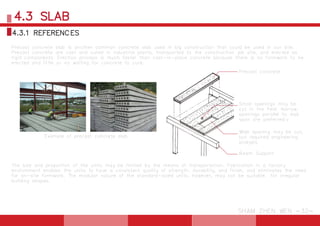
The size and proportion of the units may be limited by the means of transportation. Fabrication in a factory
environment enables the units to have a consistent quality of strength, durability, and finish, and eliminates the need
for on-site formwork. The modular nature of the standard-sized units, however, may not be suitable for irregular
building shapes.
Example of precast concrete slab
Small openings may be
cut in the field. Narrow
openings parallel to slab
span are preferred.v
Precast concrete
Wide opening may be cut,
but required engineering
analysis
Beam Support
Precast concrete slab is another common concrete slab used in big construction that could be used in our site.
Precast concrete are cast and cured in industrial plants, transported to the construction job site, and erected as
rigid components. Erection process is much faster than cast-in-place concrete because there is no formwork to be
erected and little or no waiting for concrete to cure.
4.3 SLAB
SHAM ZHEN WEN -32-
4.3.1 REFERENCES
4.3 SLAB
SHAM ZHEN WEN -33-
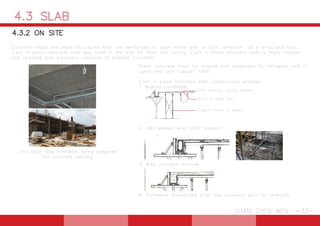
Fresh concrete must be shaped and supported by formwork until it
cures and can support itself.
Cast in place concrete slab construction process:
1. Making Formwork.
2. Add welded wire fabric support.
3. Add concrete mixture.
4. Formwork dismantled after the concrete gain its strength.
2nd floor slab formwork being prepared
for concrete casting.
Concrete slabs are plate structures that are reinforced to span either one or both direction of a structural bay.
Cast in place concrete slab was used in the site for floor and ceiling. Cast in place concrete slab is more reliable
and required less transport compare to precast concrete.
4.3.2 ON SITE
Slab sheating, usually plywood
Metal or wood joist
Support (wood or steel)
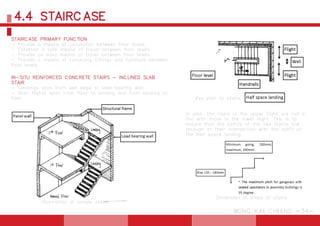
STAIRCASE PRIMARY FUNCTION
- Provide a means of circulation between floor levels.
- Establish a safe means of travel between floor levels.
- Provide an easy means of travel between floor levels.
- Provide a means of conveying fittings and furniture between
floor levels.
IN-SITU REINFORCED CONCRETE STAIRS - INCLINED SLAB
STAIR
- Landings span from well edge to load bearing wall.
- Stair flights span from floor to landing and from landing to
floor.
4.4 STAIRCASE
WONG KAI CHIANG -34-
Illustration of simple stairs
Key plan to stairs
Dimension of steps of stairs.
In plan, the risers in the upper flight are not in
line with those in the lower flight. This is to
ensure that the soffits of the two flights line
through at their intersection with the soffit of
the half space landing.
4.4 STAIRCASE
WONG KAI CHIANG -35-
asd
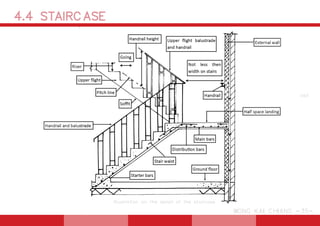
Illustration on the detail of the staircase
4.4 STAIRCASE
WONG KAI CHIANG -36-
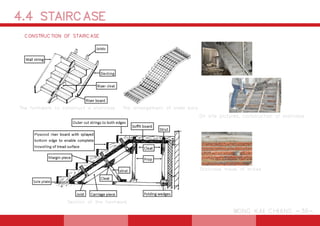
The formwork to construct a staircase The arrangement of steel bars
Section of the formwork
Staircase made of bricks
On site pictures, construction of staircase
CONSTRUCTION OF STAIRCASE

04. superstructure

  • 1.
  • 2.
    4.1 BEAM ANDCOLUMN TEY THIEN HEE -27- BEAM Beam is the horizontal member of a structure, carrying and transferring transverse loads across space to supporting elements. It is commonly reinforced with rebar. CONCRETE BEAM For our site, the beams are mostly made of concrete. There are two disctinc types of concrete beams, which are Pre cast and In Situ. Pre cast being beams that are pre casted off site and brought on site to be assembled on to the structure and In-Situ being casted on site using form work which was what mostly used in our site. The beams and columns are built on site and are affected by the site conditions. The in-situ concrete structure mostly contains steel reinforcements for stronger support. Reinforced concrete beams are designed to act together with longitudinal and web reinforcement in resisting applied forces.
  • 3.
    4.1 BEAM ANDCOLUMN TEY THIEN HEE -28- Casted ground beams Preparation of formwork for ground beams Casting of ground beams completed. 1. Casted ground beams with using reinforcement bar. 2. Preparation of formwork for ground beams 3. Pour concrete. Wait for the concrete dry up then remove the formwork.
  • 4.
    4.1 BEAM ANDCOLUMN TEY THIEN HEE -29- COLUMNS Columns are rigid, relatively slender structural members designed primarily to support axial compressive loads applied to the ends of the members. The concrete column that is built in our site was built along with the concrete beam and slab. Fix the reinforcement bar for the concrete column Fix the formwork for the concrete column Pour concrete, wait for it to be cured then remove the formwork. Concrete column section CONCRETE COLUMN CONSTRUCTION PROCESS Re-bards/formwork for columns in progress The column that is applied in our site is concrete column.
  • 5.
    Walls are oftenused to support loads, to insulate the building and to work as a climatic enclosure, protecting the building from sun, win and rain. Walls can be load bearing, supporting the floor and roofs or non-load bearing. However, they always separate a place from another, working like filters in space. Their qualities affect the space they create. Type of bricks that used in the building are mostly concrete bricks. Concrete and masonry walls qualify as noncombustible construction and rely on their mass for their load-carrying capability. While strong in compression, concrete and masonry require reinforcing o handle tensile stresses. MORTAR Mortar is a workable paste consists of cement or lime, or a combination of both with sand and water. It is used as a bonding agent in masonry construction. A standard mortar mix for new brickwork would be 1:1:6 (cement:lime:sand) or 1:4 (Portland:cement:sand) TYPES OF MORTAR JOINTS 4.2 WALL TEY THIEN HEE -30- Concrete bricks with mortar on site Concave joint "V" joint Weather joint Flush joint Raked joint Concrete wall on site
  • 6.
    4.2 WALL TEY THIENHEE -31- CONSTRUCTION PROCESS The process of making a wall begins with the intention of either making a normal wall or a special load bearing wall. Calculations are made, then layering styles are chosen the best fit the criteria. After that, the layering process begins. Cement thickness and concrete fills and all minute details are calculated out and determined and executed. This is to ensure no excess or unaccounted for the measurements to the buildings, or extra lengths are not added without notice. Reinforcement (if needed) such as steel bars and stirrups will be added in at this point, generally in between bricks in cement fills. Finally when the bricks are layered to completion, the wall is ready for the next step of the construction process.
  • 7.
    The size andproportion of the units may be limited by the means of transportation. Fabrication in a factory environment enables the units to have a consistent quality of strength, durability, and finish, and eliminates the need for on-site formwork. The modular nature of the standard-sized units, however, may not be suitable for irregular building shapes. Example of precast concrete slab Small openings may be cut in the field. Narrow openings parallel to slab span are preferred.v Precast concrete Wide opening may be cut, but required engineering analysis Beam Support Precast concrete slab is another common concrete slab used in big construction that could be used in our site. Precast concrete are cast and cured in industrial plants, transported to the construction job site, and erected as rigid components. Erection process is much faster than cast-in-place concrete because there is no formwork to be erected and little or no waiting for concrete to cure. 4.3 SLAB SHAM ZHEN WEN -32- 4.3.1 REFERENCES
  • 8.
    4.3 SLAB SHAM ZHENWEN -33- Fresh concrete must be shaped and supported by formwork until it cures and can support itself. Cast in place concrete slab construction process: 1. Making Formwork. 2. Add welded wire fabric support. 3. Add concrete mixture. 4. Formwork dismantled after the concrete gain its strength. 2nd floor slab formwork being prepared for concrete casting. Concrete slabs are plate structures that are reinforced to span either one or both direction of a structural bay. Cast in place concrete slab was used in the site for floor and ceiling. Cast in place concrete slab is more reliable and required less transport compare to precast concrete. 4.3.2 ON SITE Slab sheating, usually plywood Metal or wood joist Support (wood or steel)
  • 9.
    STAIRCASE PRIMARY FUNCTION -Provide a means of circulation between floor levels. - Establish a safe means of travel between floor levels. - Provide an easy means of travel between floor levels. - Provide a means of conveying fittings and furniture between floor levels. IN-SITU REINFORCED CONCRETE STAIRS - INCLINED SLAB STAIR - Landings span from well edge to load bearing wall. - Stair flights span from floor to landing and from landing to floor. 4.4 STAIRCASE WONG KAI CHIANG -34- Illustration of simple stairs Key plan to stairs Dimension of steps of stairs. In plan, the risers in the upper flight are not in line with those in the lower flight. This is to ensure that the soffits of the two flights line through at their intersection with the soffit of the half space landing.
  • 10.
    4.4 STAIRCASE WONG KAICHIANG -35- asd Illustration on the detail of the staircase
  • 11.
    4.4 STAIRCASE WONG KAICHIANG -36- The formwork to construct a staircase The arrangement of steel bars Section of the formwork Staircase made of bricks On site pictures, construction of staircase CONSTRUCTION OF STAIRCASE