BUILDING MATERIALS AND
CONSTRUCTION - II
Prepared by: Aleena Joseph
Assistant Professor
Marian College of Architecture and Planning
Menamkulam, Trivandrum
2
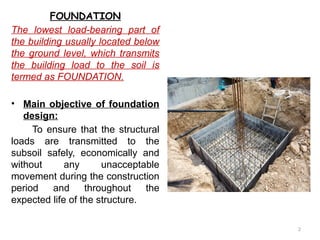
FOUNDATION
The lowest load-bearing part of
the building usually located below
the ground level, which transmits
the building load to the soil is
termed as FOUNDATION.
• Main objective of foundation
design:
To ensure that the structural
loads are transmitted to the
subsoil safely, economically and
without any unacceptable
movement during the construction
period and throughout the
expected life of the structure.
3
• Foundation: part of the structure that is in direct contact with the
soil to which the loads are transferred
• The soil which is located immediately below the base of the
foundation is called the sub-soil and the lowermost portion of the
foundation which is in direct contact with the soil is called footing
• Essential requirements of a good foundation:
• Foundation shall be constructed to sustain the dead and imposed
loads and transmit these loads to the sub-soil in such a way that
the pressure on it will not cause any settlement that causes any
adverse effect on the structure
• Foundation base should be rigid so that differential settlement is
minimized, specially in case where the loads are not evenly
distributed
• Foundation should be taken sufficiently deep to guard the building
against damage caused by swelling or shrinkage of sub-soil
4
Foundation(Contd….)
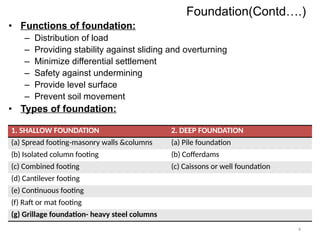
• Functions of foundation:
– Distribution of load
– Providing stability against sliding and overturning
– Minimize differential settlement
– Safety against undermining
– Provide level surface
– Prevent soil movement
• Types of foundation:
1. SHALLOW FOUNDATION 2. DEEP FOUNDATION
(a) Spread footing-masonry walls &columns (a) Pile foundation
(b) Isolated column footing (b) Cofferdams
(c) Combined footing (c) Caissons or well foundation
(d) Cantilever footing
(e) Continuous footing
(f) Raft or mat footing
(g) Grillage foundation- heavy steel columns
5
Foundation(Contd….)
1. SHALLOW FOUNDATION
A foundation is said to be shallow if the depth of the
foundation is less than or equal to its width.
• Provided if hard strata of soil is available at a depth upto 3m.
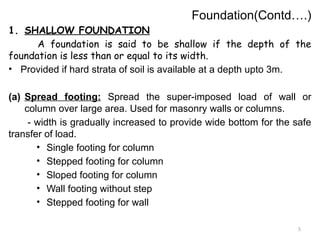
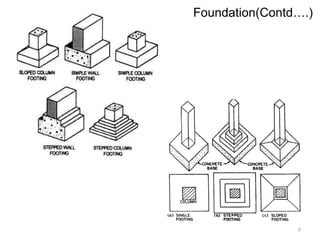
(a) Spread footing: Spread the super-imposed load of wall or
column over large area. Used for masonry walls or columns.
- width is gradually increased to provide wide bottom for the safe
transfer of load.
• Single footing for column
• Stepped footing for column
• Sloped footing for column
• Wall footing without step
• Stepped footing for wall
6
Foundation(Contd….)
7
Foundation(Contd….)
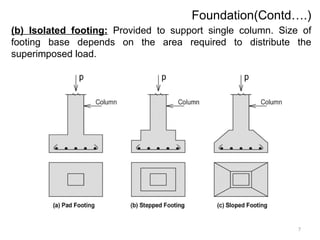
(b) Isolated footing: Provided to support single column. Size of
footing base depends on the area required to distribute the
superimposed load.
8
Foundation(Contd….)
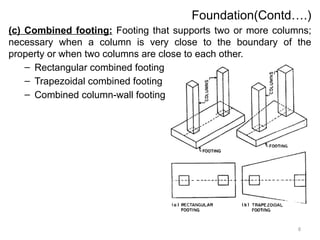
(c) Combined footing: Footing that supports two or more columns;
necessary when a column is very close to the boundary of the
property or when two columns are close to each other.
– Rectangular combined footing
– Trapezoidal combined footing
– Combined column-wall footing
9
Foundation(Contd….)
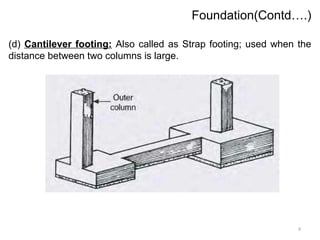
(d) Cantilever footing: Also called as Strap footing; used when the
distance between two columns is large.
10
Foundation(Contd….)
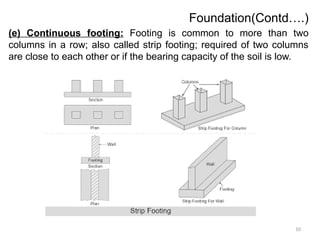
(e) Continuous footing: Footing is common to more than two
columns in a row; also called strip footing; required of two columns
are close to each other or if the bearing capacity of the soil is low.
11
Foundation(Contd….)
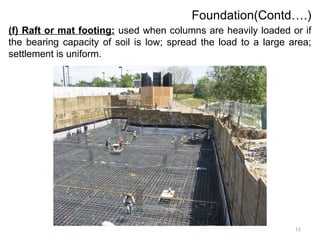
(f) Raft or mat footing: used when columns are heavily loaded or if
the bearing capacity of soil is low; spread the load to a large area;
settlement is uniform.
12
Foundation(Contd….)
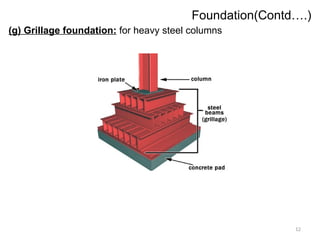
(g) Grillage foundation: for heavy steel columns
13
Foundation(Contd….)
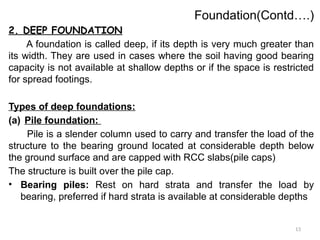
2. DEEP FOUNDATION
A foundation is called deep, if its depth is very much greater than
its width. They are used in cases where the soil having good bearing
capacity is not available at shallow depths or if the space is restricted
for spread footings.
Types of deep foundations:
(a) Pile foundation:
Pile is a slender column used to carry and transfer the load of the
structure to the bearing ground located at considerable depth below
the ground surface and are capped with RCC slabs(pile caps)
The structure is built over the pile cap.
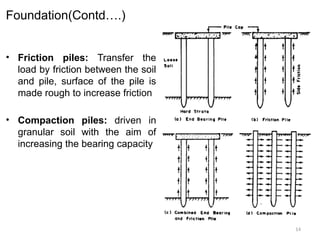
• Bearing piles: Rest on hard strata and transfer the load by
bearing, preferred if hard strata is available at considerable depths
14
Foundation(Contd….)
• Friction piles: Transfer the
load by friction between the soil
and pile, surface of the pile is
made rough to increase friction
• Compaction piles: driven in
granular soil with the aim of
increasing the bearing capacity
15
Foundation(Contd….)
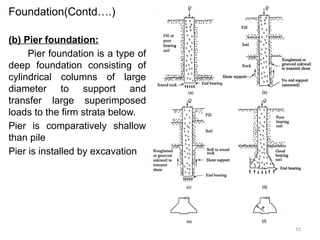
(b) Pier foundation:
Pier foundation is a type of
deep foundation consisting of
cylindrical columns of large
diameter to support and
transfer large superimposed
loads to the firm strata below.
Pier is comparatively shallow
than pile
Pier is installed by excavation
16
Foundation(Contd….)
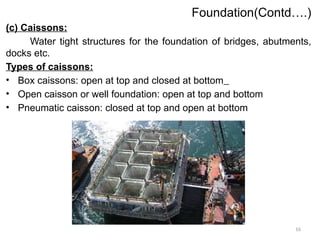
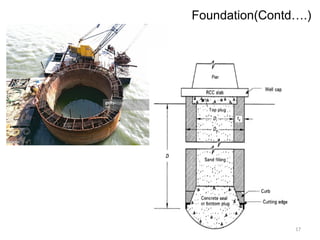
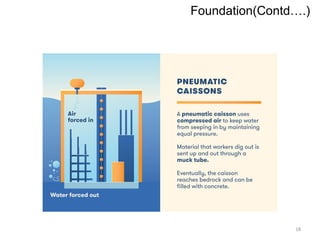
(c) Caissons:
Water tight structures for the foundation of bridges, abutments,
docks etc.
Types of caissons:
• Box caissons: open at top and closed at bottom
• Open caisson or well foundation: open at top and bottom
• Pneumatic caisson: closed at top and open at bottom
17
Foundation(Contd….)
18
Foundation(Contd….)
19
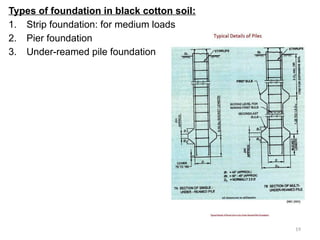
Types of foundation in black cotton soil:
1. Strip foundation: for medium loads
2. Pier foundation
3. Under-reamed pile foundation
20
GENERAL DESIGN CRITERIA FOR FOUNDATION
• Loads on structure:
 Loading condition is influenced by the type of building, construction
materials, environmental factors and earthquake susceptibility
 Selection of material such as bricks, stone, steel, and concrete for
construction affect the selection of foundation
• Soil bearing capacity:
 Crucial criteria that affect the type of foundation
 Decision can be made to choose shallow or deep foundation based
on the soil bearing pressure
 An allowable bearing pressure of at least 100kN/m² or higher is
effective for shallow foundations up to 4 stories
 Higher structures can consider a raft foundation provided that the
modulus of subgrade reaction does not exceed the permissible limit
21
• Soil type:
 Clayey soil: great capacity for water retention – large expansion and
contraction are expected in this soil. As a result, foundation can
experience large settlement and uplift pressure. Raft or mat foundation
is best suitable in this soil
 Peat soil: considerably porous, easily compressible, and dark brown or
black color soil which is commonly present near wetlands. It undergoes
expansion and shrinkage due to moisture fluctuation, extremely weak in
terms or load carrying capacity. Strip foundation is good option in this
case
 Silt: Smooth to touch, is generally not suitable for foundation structure
because of its expansion which exert pressure against foundation and
damage it. The silt retain moisture and does not drain water easily.
Reinforced concrete spread and isolated pad footings are appropriate if
silt or silty clay is stiff and extends to a great depth
 Sand and gravel: Sand and gravel allow water drainage that is why do
not cause structural movement. Moist compaction of soil and sand make
good support for foundation structure. Dry compact gravel, or gravel and
sand sub-soils are adequate for spread and strip foundations
22
• Ease of construction:
 The choice of foundation should be made keeping in mind the ease
with which it can be executed/constructed at the site
 The construction of different types of foundation requires labor of
different skillset and different level of skills
• Water table level:
 Significant criterion that affect the foundation selection. foundation
should not be placed on soil that undergo expansion and contraction
due to water table fluctuation
 If the groundwater table is located below the formation level of the
foundation, then a shallow footing like isolated or combined footing
should be chosen. Moreover, for higher water table, raft/mat footing
should be proposed
23
• Adjoining structures/water tables/slopes:
 Adjoining structures, water bodies, slopes are parameters that need
to be considered for selection of foundation types
 If the foundations of an adjoining structure are very near to the
target foundation, it may affect the choice as the safety of adjoining
structure is of much importance
 The selection of proper foundation type would be more challenging
if the neighboring structure is high rise building or an old property
 Isolated RCC pad foundations under stilts are usually preferred for
buildings on sloping grounds
 No residential buildings should be constructed on slopes steeper
than 25 degrees
• Natural disaster and extreme weather
• Economic design

24
THANK YOU

BMC-II.pptx building materials and construction

  • 1.
    BUILDING MATERIALS AND CONSTRUCTION- II Prepared by: Aleena Joseph Assistant Professor Marian College of Architecture and Planning Menamkulam, Trivandrum
  • 2.
    2 FOUNDATION The lowest load-bearingpart of the building usually located below the ground level, which transmits the building load to the soil is termed as FOUNDATION. • Main objective of foundation design: To ensure that the structural loads are transmitted to the subsoil safely, economically and without any unacceptable movement during the construction period and throughout the expected life of the structure.
  • 3.
    3 • Foundation: partof the structure that is in direct contact with the soil to which the loads are transferred • The soil which is located immediately below the base of the foundation is called the sub-soil and the lowermost portion of the foundation which is in direct contact with the soil is called footing • Essential requirements of a good foundation: • Foundation shall be constructed to sustain the dead and imposed loads and transmit these loads to the sub-soil in such a way that the pressure on it will not cause any settlement that causes any adverse effect on the structure • Foundation base should be rigid so that differential settlement is minimized, specially in case where the loads are not evenly distributed • Foundation should be taken sufficiently deep to guard the building against damage caused by swelling or shrinkage of sub-soil
  • 4.
    4 Foundation(Contd….) • Functions offoundation: – Distribution of load – Providing stability against sliding and overturning – Minimize differential settlement – Safety against undermining – Provide level surface – Prevent soil movement • Types of foundation: 1. SHALLOW FOUNDATION 2. DEEP FOUNDATION (a) Spread footing-masonry walls &columns (a) Pile foundation (b) Isolated column footing (b) Cofferdams (c) Combined footing (c) Caissons or well foundation (d) Cantilever footing (e) Continuous footing (f) Raft or mat footing (g) Grillage foundation- heavy steel columns
  • 5.
    5 Foundation(Contd….) 1. SHALLOW FOUNDATION Afoundation is said to be shallow if the depth of the foundation is less than or equal to its width. • Provided if hard strata of soil is available at a depth upto 3m. (a) Spread footing: Spread the super-imposed load of wall or column over large area. Used for masonry walls or columns. - width is gradually increased to provide wide bottom for the safe transfer of load. • Single footing for column • Stepped footing for column • Sloped footing for column • Wall footing without step • Stepped footing for wall
  • 6.
  • 7.
    7 Foundation(Contd….) (b) Isolated footing:Provided to support single column. Size of footing base depends on the area required to distribute the superimposed load.
  • 8.
    8 Foundation(Contd….) (c) Combined footing:Footing that supports two or more columns; necessary when a column is very close to the boundary of the property or when two columns are close to each other. – Rectangular combined footing – Trapezoidal combined footing – Combined column-wall footing
  • 9.
    9 Foundation(Contd….) (d) Cantilever footing:Also called as Strap footing; used when the distance between two columns is large.
  • 10.
    10 Foundation(Contd….) (e) Continuous footing:Footing is common to more than two columns in a row; also called strip footing; required of two columns are close to each other or if the bearing capacity of the soil is low.
  • 11.
    11 Foundation(Contd….) (f) Raft ormat footing: used when columns are heavily loaded or if the bearing capacity of soil is low; spread the load to a large area; settlement is uniform.
  • 12.
  • 13.
    13 Foundation(Contd….) 2. DEEP FOUNDATION Afoundation is called deep, if its depth is very much greater than its width. They are used in cases where the soil having good bearing capacity is not available at shallow depths or if the space is restricted for spread footings. Types of deep foundations: (a) Pile foundation: Pile is a slender column used to carry and transfer the load of the structure to the bearing ground located at considerable depth below the ground surface and are capped with RCC slabs(pile caps) The structure is built over the pile cap. • Bearing piles: Rest on hard strata and transfer the load by bearing, preferred if hard strata is available at considerable depths
  • 14.
    14 Foundation(Contd….) • Friction piles:Transfer the load by friction between the soil and pile, surface of the pile is made rough to increase friction • Compaction piles: driven in granular soil with the aim of increasing the bearing capacity
  • 15.
    15 Foundation(Contd….) (b) Pier foundation: Pierfoundation is a type of deep foundation consisting of cylindrical columns of large diameter to support and transfer large superimposed loads to the firm strata below. Pier is comparatively shallow than pile Pier is installed by excavation
  • 16.
    16 Foundation(Contd….) (c) Caissons: Water tightstructures for the foundation of bridges, abutments, docks etc. Types of caissons: • Box caissons: open at top and closed at bottom • Open caisson or well foundation: open at top and bottom • Pneumatic caisson: closed at top and open at bottom
  • 17.
  • 18.
  • 19.
    19 Types of foundationin black cotton soil: 1. Strip foundation: for medium loads 2. Pier foundation 3. Under-reamed pile foundation
  • 20.
    20 GENERAL DESIGN CRITERIAFOR FOUNDATION • Loads on structure:  Loading condition is influenced by the type of building, construction materials, environmental factors and earthquake susceptibility  Selection of material such as bricks, stone, steel, and concrete for construction affect the selection of foundation • Soil bearing capacity:  Crucial criteria that affect the type of foundation  Decision can be made to choose shallow or deep foundation based on the soil bearing pressure  An allowable bearing pressure of at least 100kN/m² or higher is effective for shallow foundations up to 4 stories  Higher structures can consider a raft foundation provided that the modulus of subgrade reaction does not exceed the permissible limit
  • 21.
    21 • Soil type: Clayey soil: great capacity for water retention – large expansion and contraction are expected in this soil. As a result, foundation can experience large settlement and uplift pressure. Raft or mat foundation is best suitable in this soil  Peat soil: considerably porous, easily compressible, and dark brown or black color soil which is commonly present near wetlands. It undergoes expansion and shrinkage due to moisture fluctuation, extremely weak in terms or load carrying capacity. Strip foundation is good option in this case  Silt: Smooth to touch, is generally not suitable for foundation structure because of its expansion which exert pressure against foundation and damage it. The silt retain moisture and does not drain water easily. Reinforced concrete spread and isolated pad footings are appropriate if silt or silty clay is stiff and extends to a great depth  Sand and gravel: Sand and gravel allow water drainage that is why do not cause structural movement. Moist compaction of soil and sand make good support for foundation structure. Dry compact gravel, or gravel and sand sub-soils are adequate for spread and strip foundations
  • 22.
    22 • Ease ofconstruction:  The choice of foundation should be made keeping in mind the ease with which it can be executed/constructed at the site  The construction of different types of foundation requires labor of different skillset and different level of skills • Water table level:  Significant criterion that affect the foundation selection. foundation should not be placed on soil that undergo expansion and contraction due to water table fluctuation  If the groundwater table is located below the formation level of the foundation, then a shallow footing like isolated or combined footing should be chosen. Moreover, for higher water table, raft/mat footing should be proposed
  • 23.
    23 • Adjoining structures/watertables/slopes:  Adjoining structures, water bodies, slopes are parameters that need to be considered for selection of foundation types  If the foundations of an adjoining structure are very near to the target foundation, it may affect the choice as the safety of adjoining structure is of much importance  The selection of proper foundation type would be more challenging if the neighboring structure is high rise building or an old property  Isolated RCC pad foundations under stilts are usually preferred for buildings on sloping grounds  No residential buildings should be constructed on slopes steeper than 25 degrees • Natural disaster and extreme weather • Economic design
  • 24.