ALTERNATE BUILDING MATERIALS
&
TECHNOLOGICALALTERNATIVES IN CONSTRUCTION
Kolli Rajesh M.City Planning, B.Arch
kollirajesh888@gmail.com
BUILDING MATERIALS
ALTERNATE
INTRODUCTION :
• Construction and civil engineering activities have experienced a rapid
growth due to improvements in procurement of building materials.
• However, the current scenario in the developing construction industry has
posed many challenges due to some unsustainable aspects of the highly
polluting and the exhaustive nature of building materials.
• At the same time, it has also created opportunities for innovative and
unconventional resources to emerge due to the widening gap in demand
and supply of building materials, as well as the need for energy efficient
and economical methods of construction.
NEED OF ALTERNATE BUILDING MATERIALS :
• Demand - The demand for building materials has been continuously rising
with the increasing need for housing both in rural and urban areas.
• Ecofriendly - The resources used to manufacture construction materials
affect the environment. So, eco-conscious consumers can make good choices
by adapting some of alternative building materials.
• Commercial Exploitation – The traditional building materials are being
exploited by various industries that has aggravated the situation.
• Time Factor – It is a crucial part in determining how to build. Many
alternative building methods can go up in just days or weeks, dramatically
shortening the building time.
• Strength & Weight - Stick building methods require specific amounts of
material and lot size to construct. Many alternative building materials are
extremely strong, yet extremely lightweight at the same time.
CHALLENGES IN CONSTRUCTION OF LARGE SCALE PROJECTS -
• Construction Time & Cost
• Impact on Environment.
 KEY FACTORS FOR CONSIDERING ALTERNATIVE MATERIALS :
• Cost of the materials
• Technical input and labour to implement it.
• Availability of materials.
• The views of the community aid or hinder the success of a proposed alternative.
• Durability with suitability of weather conditions.
• Performance - Where in it should support building loads.
• Maintenance – They should be easy to maintain for more period of time
• Energy efficiency.
• Flexibility of spaces.
 LIST OF ALTERNATE BUILDING MATERIALS :
• Hollow Concrete Blocks
• Soil Cement Blocks
• Fly Ash Bricks
• Rice Husk Ash
• Ferro-cement
• Aerated Autoclaved Concrete Blocks (AAC)
• EPS (Expanded Polystyrene)
• Synthetic Fiber
• Plastic Wood
• Precast Cement Concrete Blocks
• Cellular Light-weight Concrete Blocks
• Glass-fiber Reinforced Concrete (GFRC) Panel
• Compressed Stabilized Earth Blocks (CSEB):
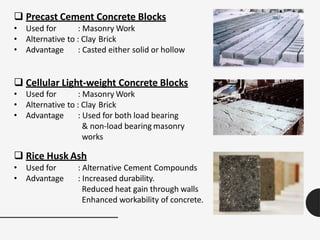
 Precast Cement Concrete Blocks
• Used for : Masonry Work
• Alternative to : Clay Brick
• Advantage : Casted either solid or hollow
 Cellular Light-weight Concrete Blocks
• Used for : Masonry Work
• Alternative to : Clay Brick
• Advantage : Used for both load bearing
& non-load bearing masonry
works
 Rice Husk Ash
• Used for
• Advantage
: Alternative Cement Compounds
: Increased durability.
Reduced heat gain through walls
Enhanced workability of concrete.
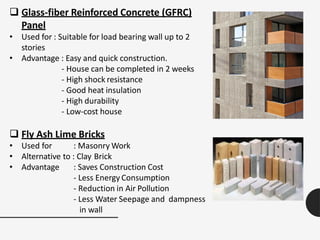
 Glass-fiber Reinforced Concrete (GFRC)
Panel
• Used for : Suitable for load bearing wall up to 2
stories
• Advantage : Easy and quick construction.
- House can be completed in 2 weeks
- High shock resistance
- Good heat insulation
- High durability
- Low-cost house
 Fly Ash Lime Bricks
• Used for : Masonry Work
• Alternative to : Clay Brick
• Advantage : Saves Construction Cost
- Less Energy Consumption
- Reduction in Air Pollution
- Less Water Seepage and dampness
in wall
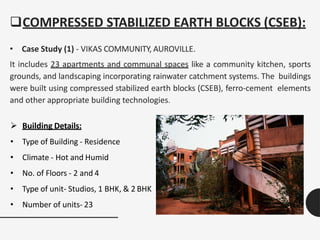
COMPRESSED STABILIZED EARTH BLOCKS (CSEB):
• Case Study (1) - VIKAS COMMUNITY, AUROVILLE.
It includes 23 apartments and communal spaces like a community kitchen, sports
grounds, and landscaping incorporating rainwater catchment systems. The buildings
were built using compressed stabilized earth blocks (CSEB), ferro-cement elements
and other appropriate building technologies.
 Building Details:
• Type of Building - Residence
• Climate - Hot and Humid
• No. of Floors - 2 and 4
• Type of unit- Studios, 1 BHK, & 2 BHK
• Number of units- 23
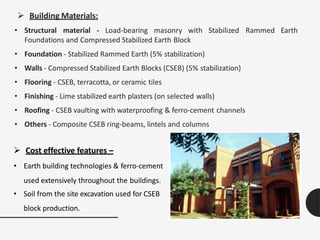
 Building Materials:
• Structural material - Load-bearing masonry with Stabilized Rammed Earth
Foundations and Compressed Stabilized Earth Block
• Foundation - Stabilized Rammed Earth (5% stabilization)
• Walls - Compressed Stabilized Earth Blocks (CSEB) (5% stabilization)
• Flooring - CSEB, terracotta, or ceramic tiles
• Finishing - Lime stabilized earth plasters (on selected walls)
• Roofing - CSEB vaulting with waterproofing & ferro-cement channels
• Others - Composite CSEB ring-beams, lintels and columns
 Cost effective features –
• Earth building technologies & ferro-cement
used extensively throughout the buildings.
• Soil from the site excavation used for CSEB
block production.
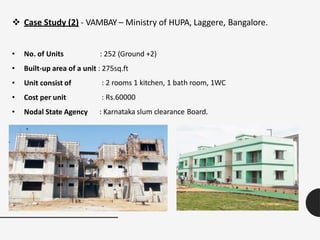
 Case Study (2) - VAMBAY – Ministry of HUPA, Laggere, Bangalore.
• No. of Units : 252 (Ground +2)
• Built-up area of a unit : 275sq.ft
• Unit consist of
• Cost per unit
• Nodal State Agency
: 2 rooms 1 kitchen, 1 bath room, 1WC
: Rs.60000
: Karnataka slum clearance Board.
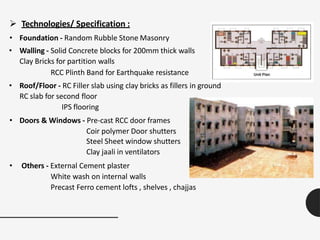
 Technologies/ Specification :
• Foundation - Random Rubble Stone Masonry
• Walling - Solid Concrete blocks for 200mm thick walls
Clay Bricks for partition walls
RCC Plinth Band for Earthquake resistance
• Roof/Floor - RC Filler slab using clay bricks as fillers in ground
RC slab for second floor
IPS flooring
• Doors & Windows - Pre-cast RCC door frames
Coir polymer Door shutters
Steel Sheet window shutters
Clay jaali in ventilators
• Others - External Cement plaster
White wash on internal walls
Precast Ferro cement lofts , shelves , chajjas
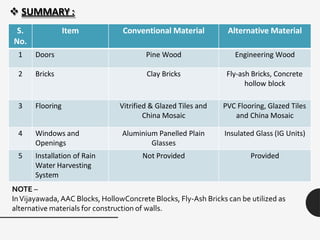
S.
No.
Item Conventional Material Alternative Material
1 Doors Pine Wood Engineering Wood
2 Bricks Clay Bricks Fly-ash Bricks, Concrete
hollow block
3 Flooring Vitrified & Glazed Tiles and
China Mosaic
PVC Flooring, Glazed Tiles
and China Mosaic
4 Windows and
Openings
Aluminium Panelled Plain
Glasses
Insulated Glass (IG Units)
5 Installation of Rain
Water Harvesting
System
Not Provided Provided
 SUMMARY :
NOTE –
InVijayawada,AAC Blocks, HollowConcrete Blocks, Fly-Ash Bricks can be utilized as
alternative materials for construction of walls.
TECHNOLOGICAL
ALTERNATIVES IN
CONSTRUCTION
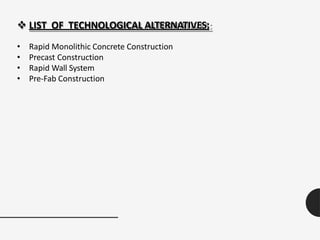
 LIST OF TECHNOLOGICAL ALTERNATIVES:
• Rapid Monolithic Concrete Construction
• Precast Construction
• Rapid Wall System
• Pre-Fab Construction
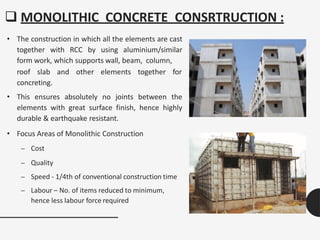
roof slab and other elements together for
concreting.
• This ensures absolutely no joints between the
elements with great surface finish, hence highly
durable & earthquake resistant.
• Focus Areas of Monolithic Construction
– Cost
– Quality
– Speed - 1/4th of conventional construction time
– Labour – No. of items reduced to minimum,
hence less labour force required
 MONOLITHIC CONCRETE CONSRTRUCTION :
• The construction in which all the elements are cast
together with RCC by using aluminium/similar
form work, which supports wall, beam, column,
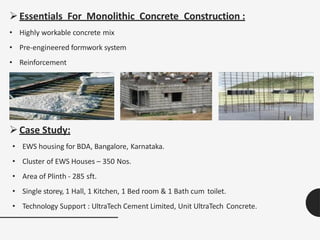
Essentials For Monolithic Concrete Construction :
• Highly workable concrete mix
• Pre-engineered formwork system
• Reinforcement
Case Study:
• EWS housing for BDA, Bangalore, Karnataka.
• Cluster of EWS Houses – 350 Nos.
• Area of Plinth - 285 sft.
• Single storey, 1 Hall, 1 Kitchen, 1 Bed room & 1 Bath cum toilet.
• Technology Support : UltraTech Cement Limited, Unit UltraTech Concrete.
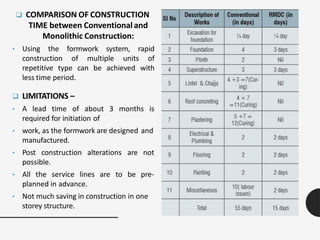
 COMPARISON OF CONSTRUCTION
TIME between Conventional and
Monolithic Construction:
• Using the formwork system, rapid
construction of multiple units of
repetitive type can be achieved with
less time period.
 LIMITATIONS –
• A lead time of about 3 months is
required for initiation of
• work, as the formwork are designed and
manufactured.
• Post construction alterations are not
possible.
• All the service lines are to be pre-
planned in advance.
• Not much saving in construction in one
storey structure.
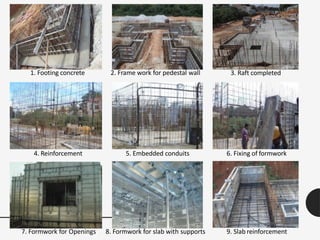
1. Footing concrete 2. Frame work for pedestal wall 3. Raft completed
4. Reinforcement 5. Embedded conduits 6. Fixing of formwork
7. Formwork for Openings 8. Formwork for slab with supports 9. Slab reinforcement
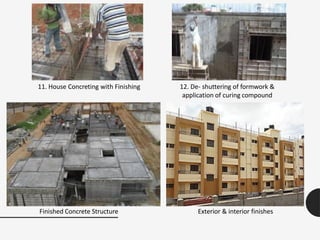
11. House Concreting with Finishing 12. De- shuttering of formwork &
application of curing compound
Finished Concrete Structure Exterior & interior finishes
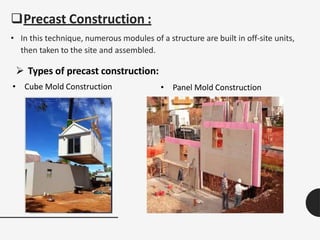
Precast Construction :
• In this technique, numerous modules of a structure are built in off-site units,
then taken to the site and assembled.
• Panel Mold Construction
 Types of precast construction:
• Cube Mold Construction
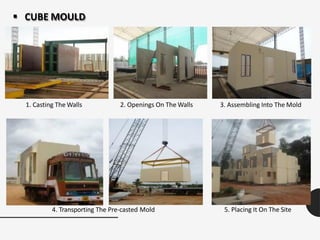
 CUBE MOULD
1. Casting The Walls 2. Openings On The Walls 3. Assembling Into The Mold
4. Transporting The Pre-casted Mold 5. Placing It On The Site
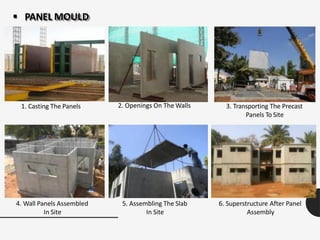
1. Casting The Panels 2. Openings On The Walls 3. Transporting The Precast
Panels To Site
4. Wall Panels Assembled
In Site
6. Superstructure After Panel
Assembly
5. Assembling The Slab
In Site
 PANEL MOULD
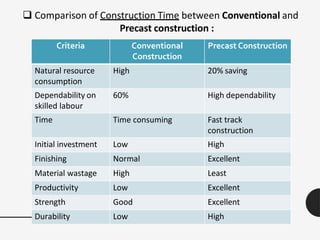
Criteria Conventional
Construction
Precast Construction
Natural resource
consumption
High 20% saving
Dependability on
skilled labour
60% High dependability
Time Time consuming Fast track
construction
Initial investment Low High
Finishing Normal Excellent
Material wastage High Least
Productivity Low Excellent
Strength Good Excellent
Durability Low High
 Comparison of Construction Time between Conventional and
Precast construction :
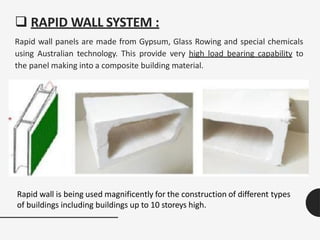
 RAPID WALL SYSTEM :
Rapid wall panels are made from Gypsum, Glass Rowing and special chemicals
using Australian technology. This provide very high load bearing capability to
the panel making into a composite building material.
Rapid wall is being used magnificently for the construction of different types
of buildings including buildings up to 10 storeys high.
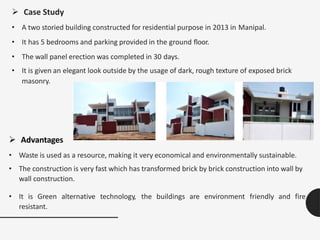
 Case Study
• A two storied building constructed for residential purpose in 2013 in Manipal.
• It has 5 bedrooms and parking provided in the ground floor.
• The wall panel erection was completed in 30 days.
• It is given an elegant look outside by the usage of dark, rough texture of exposed brick
masonry.
 Advantages
• Waste is used as a resource, making it very economical and environmentally sustainable.
• The construction is very fast which has transformed brick by brick construction into wall by
wall construction.
• It is Green alternative technology, the buildings are environment friendly and fire
resistant.
• Very less labour force is required in the building construction process.
• The overall weight of structure is very less.
• More carpet area is available for the same built up area.
• There is no need of plastering, thus further reducing the cost in finishing.
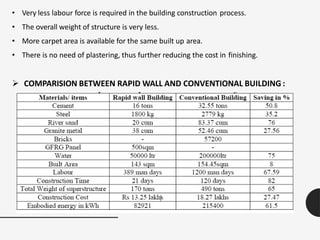
 COMPARISION BETWEEN RAPID WALL AND CONVENTIONAL BUILDING :
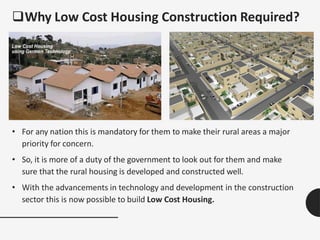
Why Low Cost Housing Construction Required?
• For any nation this is mandatory for them to make their rural areas a major
priority for concern.
• So, it is more of a duty of the government to look out for them and make
sure that the rural housing is developed and constructed well.
• With the advancements in technology and development in the construction
sector this is now possible to build Low Cost Housing.
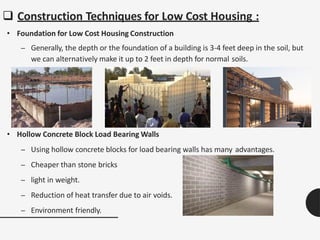
 Construction Techniques for Low Cost Housing :
• Foundation for Low Cost Housing Construction
– Generally, the depth or the foundation of a building is 3-4 feet deep in the soil, but
we can alternatively make it up to 2 feet in depth for normal soils.
• Hollow Concrete Block Load Bearing Walls
– Using hollow concrete blocks for load bearing walls has many advantages.
– Cheaper than stone bricks
– light in weight.
– Reduction of heat transfer due to air voids.
– Environment friendly.
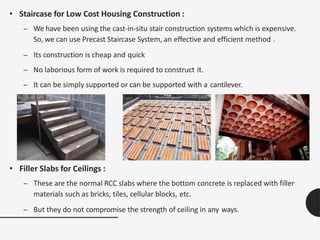
• Staircase for Low Cost Housing Construction :
– We have been using the cast-in-situ stair construction systems which is expensive.
So, we can use Precast Staircase System, an effective and efficient method .
– Its construction is cheap and quick
– No laborious form of work is required to construct it.
– It can be simply supported or can be supported with a cantilever.
• Filler Slabs for Ceilings :
– These are the normal RCC slabs where the bottom concrete is replaced with filler
materials such as bricks, tiles, cellular blocks, etc.
– But they do not compromise the strength of ceiling in any ways.
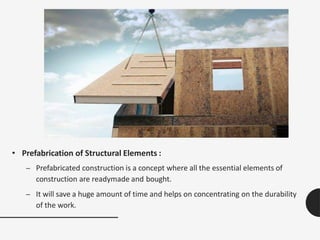
• Prefabrication of Structural Elements :
– Prefabricated construction is a concept where all the essential elements of
construction are readymade and bought.
– It will save a huge amount of time and helps on concentrating on the durability
of the work.
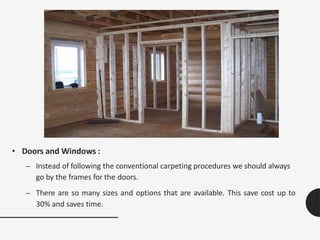
• Doors and Windows :
– Instead of following the conventional carpeting procedures we should always
go by the frames for the doors.
– There are so many sizes and options that are available. This save cost up to
30% and saves time.
 References :
 IACSIT International Journal of Engineering and Technology, Vol. 6, No. 1, February
2014
 Mr M G Somashekar_PG Setty Construction Technology Pvt Ltd
 http://www.bmtpc.org/topics.aspx?mid=55&Mid1=90
ThankYou
Kolli Rajesh M.City Planning, B.Arch
kollirajesh888@gmail.com

ALTERNATE BUILDING MATERIALS & TECHNOLOGICAL ALTERNATIVES IN CONSTRUCTION

  • 1.
    ALTERNATE BUILDING MATERIALS & TECHNOLOGICALALTERNATIVESIN CONSTRUCTION Kolli Rajesh M.City Planning, B.Arch kollirajesh888@gmail.com
  • 2.
  • 3.
    INTRODUCTION : • Constructionand civil engineering activities have experienced a rapid growth due to improvements in procurement of building materials. • However, the current scenario in the developing construction industry has posed many challenges due to some unsustainable aspects of the highly polluting and the exhaustive nature of building materials. • At the same time, it has also created opportunities for innovative and unconventional resources to emerge due to the widening gap in demand and supply of building materials, as well as the need for energy efficient and economical methods of construction.
  • 4.
    NEED OF ALTERNATEBUILDING MATERIALS : • Demand - The demand for building materials has been continuously rising with the increasing need for housing both in rural and urban areas. • Ecofriendly - The resources used to manufacture construction materials affect the environment. So, eco-conscious consumers can make good choices by adapting some of alternative building materials. • Commercial Exploitation – The traditional building materials are being exploited by various industries that has aggravated the situation. • Time Factor – It is a crucial part in determining how to build. Many alternative building methods can go up in just days or weeks, dramatically shortening the building time. • Strength & Weight - Stick building methods require specific amounts of material and lot size to construct. Many alternative building materials are extremely strong, yet extremely lightweight at the same time.
  • 5.
    CHALLENGES IN CONSTRUCTIONOF LARGE SCALE PROJECTS - • Construction Time & Cost • Impact on Environment.  KEY FACTORS FOR CONSIDERING ALTERNATIVE MATERIALS : • Cost of the materials • Technical input and labour to implement it. • Availability of materials. • The views of the community aid or hinder the success of a proposed alternative. • Durability with suitability of weather conditions. • Performance - Where in it should support building loads. • Maintenance – They should be easy to maintain for more period of time • Energy efficiency. • Flexibility of spaces.
  • 6.
     LIST OFALTERNATE BUILDING MATERIALS : • Hollow Concrete Blocks • Soil Cement Blocks • Fly Ash Bricks • Rice Husk Ash • Ferro-cement • Aerated Autoclaved Concrete Blocks (AAC) • EPS (Expanded Polystyrene) • Synthetic Fiber • Plastic Wood • Precast Cement Concrete Blocks • Cellular Light-weight Concrete Blocks • Glass-fiber Reinforced Concrete (GFRC) Panel • Compressed Stabilized Earth Blocks (CSEB):
  • 7.
     Precast CementConcrete Blocks • Used for : Masonry Work • Alternative to : Clay Brick • Advantage : Casted either solid or hollow  Cellular Light-weight Concrete Blocks • Used for : Masonry Work • Alternative to : Clay Brick • Advantage : Used for both load bearing & non-load bearing masonry works  Rice Husk Ash • Used for • Advantage : Alternative Cement Compounds : Increased durability. Reduced heat gain through walls Enhanced workability of concrete.
  • 8.
     Glass-fiber ReinforcedConcrete (GFRC) Panel • Used for : Suitable for load bearing wall up to 2 stories • Advantage : Easy and quick construction. - House can be completed in 2 weeks - High shock resistance - Good heat insulation - High durability - Low-cost house  Fly Ash Lime Bricks • Used for : Masonry Work • Alternative to : Clay Brick • Advantage : Saves Construction Cost - Less Energy Consumption - Reduction in Air Pollution - Less Water Seepage and dampness in wall
  • 9.
    COMPRESSED STABILIZED EARTHBLOCKS (CSEB): • Case Study (1) - VIKAS COMMUNITY, AUROVILLE. It includes 23 apartments and communal spaces like a community kitchen, sports grounds, and landscaping incorporating rainwater catchment systems. The buildings were built using compressed stabilized earth blocks (CSEB), ferro-cement elements and other appropriate building technologies.  Building Details: • Type of Building - Residence • Climate - Hot and Humid • No. of Floors - 2 and 4 • Type of unit- Studios, 1 BHK, & 2 BHK • Number of units- 23
  • 10.
     Building Materials: •Structural material - Load-bearing masonry with Stabilized Rammed Earth Foundations and Compressed Stabilized Earth Block • Foundation - Stabilized Rammed Earth (5% stabilization) • Walls - Compressed Stabilized Earth Blocks (CSEB) (5% stabilization) • Flooring - CSEB, terracotta, or ceramic tiles • Finishing - Lime stabilized earth plasters (on selected walls) • Roofing - CSEB vaulting with waterproofing & ferro-cement channels • Others - Composite CSEB ring-beams, lintels and columns  Cost effective features – • Earth building technologies & ferro-cement used extensively throughout the buildings. • Soil from the site excavation used for CSEB block production.
  • 11.
     Case Study(2) - VAMBAY – Ministry of HUPA, Laggere, Bangalore. • No. of Units : 252 (Ground +2) • Built-up area of a unit : 275sq.ft • Unit consist of • Cost per unit • Nodal State Agency : 2 rooms 1 kitchen, 1 bath room, 1WC : Rs.60000 : Karnataka slum clearance Board.
  • 12.
     Technologies/ Specification: • Foundation - Random Rubble Stone Masonry • Walling - Solid Concrete blocks for 200mm thick walls Clay Bricks for partition walls RCC Plinth Band for Earthquake resistance • Roof/Floor - RC Filler slab using clay bricks as fillers in ground RC slab for second floor IPS flooring • Doors & Windows - Pre-cast RCC door frames Coir polymer Door shutters Steel Sheet window shutters Clay jaali in ventilators • Others - External Cement plaster White wash on internal walls Precast Ferro cement lofts , shelves , chajjas
  • 13.
    S. No. Item Conventional MaterialAlternative Material 1 Doors Pine Wood Engineering Wood 2 Bricks Clay Bricks Fly-ash Bricks, Concrete hollow block 3 Flooring Vitrified & Glazed Tiles and China Mosaic PVC Flooring, Glazed Tiles and China Mosaic 4 Windows and Openings Aluminium Panelled Plain Glasses Insulated Glass (IG Units) 5 Installation of Rain Water Harvesting System Not Provided Provided  SUMMARY : NOTE – InVijayawada,AAC Blocks, HollowConcrete Blocks, Fly-Ash Bricks can be utilized as alternative materials for construction of walls.
  • 14.
  • 15.
     LIST OFTECHNOLOGICAL ALTERNATIVES: • Rapid Monolithic Concrete Construction • Precast Construction • Rapid Wall System • Pre-Fab Construction
  • 16.
    roof slab andother elements together for concreting. • This ensures absolutely no joints between the elements with great surface finish, hence highly durable & earthquake resistant. • Focus Areas of Monolithic Construction – Cost – Quality – Speed - 1/4th of conventional construction time – Labour – No. of items reduced to minimum, hence less labour force required  MONOLITHIC CONCRETE CONSRTRUCTION : • The construction in which all the elements are cast together with RCC by using aluminium/similar form work, which supports wall, beam, column,
  • 17.
    Essentials For MonolithicConcrete Construction : • Highly workable concrete mix • Pre-engineered formwork system • Reinforcement Case Study: • EWS housing for BDA, Bangalore, Karnataka. • Cluster of EWS Houses – 350 Nos. • Area of Plinth - 285 sft. • Single storey, 1 Hall, 1 Kitchen, 1 Bed room & 1 Bath cum toilet. • Technology Support : UltraTech Cement Limited, Unit UltraTech Concrete.
  • 18.
     COMPARISON OFCONSTRUCTION TIME between Conventional and Monolithic Construction: • Using the formwork system, rapid construction of multiple units of repetitive type can be achieved with less time period.  LIMITATIONS – • A lead time of about 3 months is required for initiation of • work, as the formwork are designed and manufactured. • Post construction alterations are not possible. • All the service lines are to be pre- planned in advance. • Not much saving in construction in one storey structure.
  • 19.
    1. Footing concrete2. Frame work for pedestal wall 3. Raft completed 4. Reinforcement 5. Embedded conduits 6. Fixing of formwork 7. Formwork for Openings 8. Formwork for slab with supports 9. Slab reinforcement
  • 20.
    11. House Concretingwith Finishing 12. De- shuttering of formwork & application of curing compound Finished Concrete Structure Exterior & interior finishes
  • 21.
    Precast Construction : •In this technique, numerous modules of a structure are built in off-site units, then taken to the site and assembled. • Panel Mold Construction  Types of precast construction: • Cube Mold Construction
  • 22.
     CUBE MOULD 1.Casting The Walls 2. Openings On The Walls 3. Assembling Into The Mold 4. Transporting The Pre-casted Mold 5. Placing It On The Site
  • 23.
    1. Casting ThePanels 2. Openings On The Walls 3. Transporting The Precast Panels To Site 4. Wall Panels Assembled In Site 6. Superstructure After Panel Assembly 5. Assembling The Slab In Site  PANEL MOULD
  • 24.
    Criteria Conventional Construction Precast Construction Naturalresource consumption High 20% saving Dependability on skilled labour 60% High dependability Time Time consuming Fast track construction Initial investment Low High Finishing Normal Excellent Material wastage High Least Productivity Low Excellent Strength Good Excellent Durability Low High  Comparison of Construction Time between Conventional and Precast construction :
  • 25.
     RAPID WALLSYSTEM : Rapid wall panels are made from Gypsum, Glass Rowing and special chemicals using Australian technology. This provide very high load bearing capability to the panel making into a composite building material. Rapid wall is being used magnificently for the construction of different types of buildings including buildings up to 10 storeys high.
  • 26.
     Case Study •A two storied building constructed for residential purpose in 2013 in Manipal. • It has 5 bedrooms and parking provided in the ground floor. • The wall panel erection was completed in 30 days. • It is given an elegant look outside by the usage of dark, rough texture of exposed brick masonry.  Advantages • Waste is used as a resource, making it very economical and environmentally sustainable. • The construction is very fast which has transformed brick by brick construction into wall by wall construction. • It is Green alternative technology, the buildings are environment friendly and fire resistant.
  • 27.
    • Very lesslabour force is required in the building construction process. • The overall weight of structure is very less. • More carpet area is available for the same built up area. • There is no need of plastering, thus further reducing the cost in finishing.  COMPARISION BETWEEN RAPID WALL AND CONVENTIONAL BUILDING :
  • 28.
    Why Low CostHousing Construction Required? • For any nation this is mandatory for them to make their rural areas a major priority for concern. • So, it is more of a duty of the government to look out for them and make sure that the rural housing is developed and constructed well. • With the advancements in technology and development in the construction sector this is now possible to build Low Cost Housing.
  • 29.
     Construction Techniquesfor Low Cost Housing : • Foundation for Low Cost Housing Construction – Generally, the depth or the foundation of a building is 3-4 feet deep in the soil, but we can alternatively make it up to 2 feet in depth for normal soils. • Hollow Concrete Block Load Bearing Walls – Using hollow concrete blocks for load bearing walls has many advantages. – Cheaper than stone bricks – light in weight. – Reduction of heat transfer due to air voids. – Environment friendly.
  • 30.
    • Staircase forLow Cost Housing Construction : – We have been using the cast-in-situ stair construction systems which is expensive. So, we can use Precast Staircase System, an effective and efficient method . – Its construction is cheap and quick – No laborious form of work is required to construct it. – It can be simply supported or can be supported with a cantilever. • Filler Slabs for Ceilings : – These are the normal RCC slabs where the bottom concrete is replaced with filler materials such as bricks, tiles, cellular blocks, etc. – But they do not compromise the strength of ceiling in any ways.
  • 31.
    • Prefabrication ofStructural Elements : – Prefabricated construction is a concept where all the essential elements of construction are readymade and bought. – It will save a huge amount of time and helps on concentrating on the durability of the work.
  • 32.
    • Doors andWindows : – Instead of following the conventional carpeting procedures we should always go by the frames for the doors. – There are so many sizes and options that are available. This save cost up to 30% and saves time.
  • 33.
     References : IACSIT International Journal of Engineering and Technology, Vol. 6, No. 1, February 2014  Mr M G Somashekar_PG Setty Construction Technology Pvt Ltd  http://www.bmtpc.org/topics.aspx?mid=55&Mid1=90
  • 34.
    ThankYou Kolli Rajesh M.CityPlanning, B.Arch kollirajesh888@gmail.com