Introduction
Introduction
This industry isone of the heaviest industry in terms of
This industry is one of the heaviest industry in terms of
manufacturing, consumption and dollar value.
manufacturing, consumption and dollar value.
By manufacturing means lot of products are produced.
By manufacturing means lot of products are produced.
Regarding consumer means all consumer products depends upon
Regarding consumer means all consumer products depends upon
chloralkali industry.
chloralkali industry.
Regarding dollar value, the Chlor-alkali products compete the H
Regarding dollar value, the Chlor-alkali products compete the H2
2SO
SO4
4
and NH
and NH4
4 which are two economy dependent products.
which are two economy dependent products.
The major alkalis are
The major alkalis are
soda Ash(Na
soda Ash(Na2
2CO
CO3
3),
),
Caustic soda (NaOH),
Caustic soda (NaOH),
Baking soda (NaHCO
Baking soda (NaHCO3
3)
)
and Chlorine (Cl
and Chlorine (Cl2).
2).
3.
Soda Ash
Soda Ash(Na
(Na2
2CO
CO3
3),
),
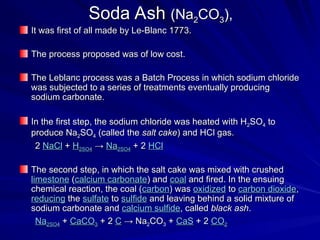
It was first of all made by Le-Blanc 1773.
It was first of all made by Le-Blanc 1773.
The process proposed was of low cost.
The process proposed was of low cost.
The Leblanc process was a Batch Process in which sodium chloride
The Leblanc process was a Batch Process in which sodium chloride
was subjected to a series of treatments eventually producing
was subjected to a series of treatments eventually producing
sodium carbonate.
sodium carbonate.
In the first step, the sodium chloride was heated with H
In the first step, the sodium chloride was heated with H2
2SO
SO4
4 to
to
produce Na
produce Na2
2SO
SO4
4 (called the
(called the salt cake
salt cake) and HCl gas.
) and HCl gas.
2
2 NaCl
NaCl +
+ H
H2
2SO
SO4
4 →
→ Na
Na2
2SO
SO4
4 + 2
+ 2 HCl
HCl
The second step, in which the salt cake was mixed with crushed
The second step, in which the salt cake was mixed with crushed
limestone
limestone (
(calcium carbonate
calcium carbonate) and
) and coal
coal and fired. In the ensuing
and fired. In the ensuing
chemical reaction, the coal (
chemical reaction, the coal (carbon
carbon) was
) was oxidized
oxidized to
to carbon dioxide
carbon dioxide,
,
reducing
reducing the
the sulfate
sulfate to
to sulfide
sulfide and leaving behind a solid mixture of
and leaving behind a solid mixture of
sodium carbonate and
sodium carbonate and calcium sulfide
calcium sulfide, called
, called black ash
black ash.
.
Na
Na2
2SO
SO4
4 +
+ CaCO
CaCO3
3 + 2
+ 2 C
C → Na
→ Na2
2CO
CO3
3 +
+ CaS
CaS + 2
+ 2 CO
CO2
2
4.
Continued……..
Continued……..
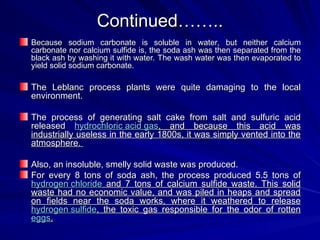
Because sodium carbonateis soluble in water, but neither calcium
Because sodium carbonate is soluble in water, but neither calcium
carbonate nor calcium sulfide is, the soda ash was then separated from the
carbonate nor calcium sulfide is, the soda ash was then separated from the
black ash by washing it with water. The wash water was then evaporated to
black ash by washing it with water. The wash water was then evaporated to
yield solid sodium carbonate.
yield solid sodium carbonate.
The Leblanc process plants were quite damaging to the local
The Leblanc process plants were quite damaging to the local
environment.
environment.
The process of generating salt cake from salt and sulfuric acid
The process of generating salt cake from salt and sulfuric acid
released
released hydrochloric acid gas
hydrochloric acid gas, and because this acid was
, and because this acid was
industrially useless in the early 1800s, it was simply vented into the
industrially useless in the early 1800s, it was simply vented into the
atmosphere.
atmosphere.
Also, an insoluble, smelly solid waste was produced.
Also, an insoluble, smelly solid waste was produced.
For every 8 tons of soda ash, the process produced 5.5 tons of
For every 8 tons of soda ash, the process produced 5.5 tons of
hydrogen chloride
hydrogen chloride and 7 tons of calcium sulfide waste. This solid
and 7 tons of calcium sulfide waste. This solid
waste had no economic value, and was piled in heaps and spread
waste had no economic value, and was piled in heaps and spread
on fields near the soda works, where it weathered to release
on fields near the soda works, where it weathered to release
hydrogen sulfide
hydrogen sulfide, the toxic gas responsible for the odor of rotten
, the toxic gas responsible for the odor of rotten
eggs
eggs.
.
5.
Continued……..Solvay Process
Continued……..Solvay Process
TheBlanc Process was replaced by solvay process by
The Blanc Process was replaced by solvay process by
Ernest
Ernest Solvay
Solvay during the 1860s.
during the 1860s.
The
The Solvay process
Solvay process, also referred to as the
, also referred to as the ammonia-
ammonia-
soda process,
soda process, is the major industrial process for the
is the major industrial process for the
production of
production of soda ash
soda ash (
(sodium carbonate
sodium carbonate).
).
The ingredients for this process are readily available and
The ingredients for this process are readily available and
inexpensive: salt brine (from inland sources or from the
inexpensive: salt brine (from inland sources or from the
sea) and
sea) and limestone
limestone (from mines).
(from mines).
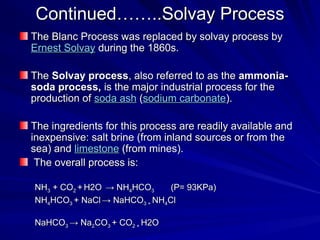
The overall process is:
The overall process is:
NH
NH3
3 + CO
+ CO2
2 +
+ H2O
H2O → NH
→ NH4
4HCO
HCO3
3 (P= 93KPa)
(P= 93KPa)
NH
NH4
4HCO
HCO3
3 + NaCl
+ NaCl → NaHCO
→ NaHCO3 +
3 + NH
NH4
4Cl
Cl
NaHCO
NaHCO3
3 → Na
→ Na2
2CO
CO3
3 + CO
+ CO2 +
2 + H2O
H2O
6.
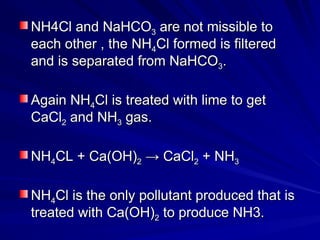
NH4Cl and NaHCO
NH4Cland NaHCO3
3 are not missible to
are not missible to
each other , the NH
each other , the NH4
4Cl formed is filtered
Cl formed is filtered
and is separated from NaHCO
and is separated from NaHCO3
3.
.
Again NH
Again NH4
4Cl is treated with lime to get
Cl is treated with lime to get
CaCl
CaCl2
2 and NH
and NH3
3 gas.
gas.
NH
NH4
4CL + Ca(OH)
CL + Ca(OH)2
2 → CaCl
→ CaCl2
2 + NH
+ NH3
3
NH
NH4
4Cl is the only pollutant produced that is
Cl is the only pollutant produced that is
treated with Ca(OH)
treated with Ca(OH)2
2 to produce NH3.
to produce NH3.
7.
The success ofthe solvay process
The success of the solvay process
depends upon the raw material
depends upon the raw material
regenerated.
regenerated.
If proper proportion of NH3:CO2:H2O is
If proper proportion of NH3:CO2:H2O is
used we can get 99.9% product.
used we can get 99.9% product.
The CO2 emitted can be absorbed in
The CO2 emitted can be absorbed in
ethanol amine.
ethanol amine.
Ammoina soda process is synthetic so it is
Ammoina soda process is synthetic so it is
expensive .
expensive .
Another process is natural mining process
Another process is natural mining process
from natural ore TRONA.
from natural ore TRONA.
8.
Solvay Process
Solvay Process
NaCl+
+ CO2 +
+ NH3 +
+ H2O →
→ NaHCO3 +
+ NH4Cl (I)
(I)
CaCO3 →
→ CO2 +
+ CaO (II).
(II).
2
2 NH4Cl +
+ CaO → 2
→ 2 NH3 +
+ CaCl2 +
+ H2O (III)
(III)
•2
2 NaHCO3 → Na2CO3 + H2O + CO2 (IV)
9.
Continued……..
Continued……..
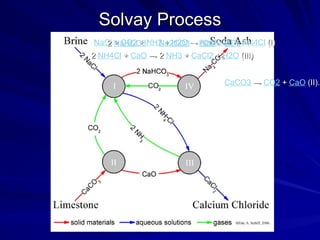
A
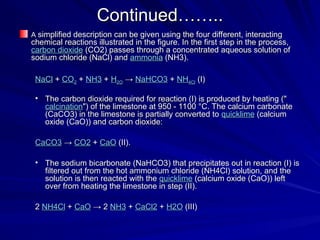
A simplified descriptioncan be given using the four different, interacting
simplified description can be given using the four different, interacting
chemical reactions illustrated in the figure. In the first step in the process,
chemical reactions illustrated in the figure. In the first step in the process,
carbon dioxide
carbon dioxide (CO2) passes through a concentrated aqueous solution of
(CO2) passes through a concentrated aqueous solution of
sodium chloride (NaCl) and
sodium chloride (NaCl) and ammonia
ammonia (NH3).
(NH3).
NaCl
NaCl +
+ CO
CO2
2 +
+ NH3
NH3 +
+ H
H2
2O
O →
→ NaHCO3
NaHCO3 +
+ NH
NH4
4Cl
Cl (I)
(I)
• The carbon dioxide required for reaction (I) is produced by heating ("
The carbon dioxide required for reaction (I) is produced by heating ("
calcination
calcination") of the limestone at 950 - 1100 °C. The calcium carbonate
") of the limestone at 950 - 1100 °C. The calcium carbonate
(CaCO3) in the limestone is partially converted to
(CaCO3) in the limestone is partially converted to quicklime
quicklime (calcium
(calcium
oxide (CaO)) and carbon dioxide:
oxide (CaO)) and carbon dioxide:
CaCO3
CaCO3 →
→ CO2
CO2 +
+ CaO
CaO (II).
(II).
• The sodium bicarbonate (NaHCO3) that precipitates out in reaction (I) is
The sodium bicarbonate (NaHCO3) that precipitates out in reaction (I) is
filtered out from the hot ammonium chloride (NH4Cl) solution, and the
filtered out from the hot ammonium chloride (NH4Cl) solution, and the
solution is then reacted with the
solution is then reacted with the quicklime
quicklime (calcium oxide (CaO)) left
(calcium oxide (CaO)) left
over from heating the limestone in step (II).
over from heating the limestone in step (II).
2
2 NH4Cl
NH4Cl +
+ CaO
CaO → 2
→ 2 NH3
NH3 +
+ CaCl2
CaCl2 +
+ H2O
H2O (III)
(III)
10.
Continued……..
Continued……..
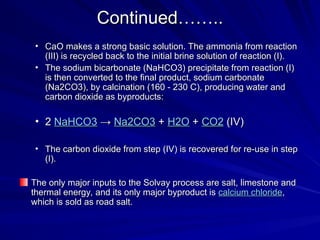
• CaO makesa strong basic solution. The ammonia from reaction
CaO makes a strong basic solution. The ammonia from reaction
(III) is recycled back to the initial brine solution of reaction (I).
(III) is recycled back to the initial brine solution of reaction (I).
• The sodium bicarbonate (NaHCO3) precipitate from reaction (I)
The sodium bicarbonate (NaHCO3) precipitate from reaction (I)
is then converted to the final product, sodium carbonate
is then converted to the final product, sodium carbonate
(Na2CO3), by calcination (160 - 230 C), producing water and
(Na2CO3), by calcination (160 - 230 C), producing water and
carbon dioxide as byproducts:
carbon dioxide as byproducts:
• 2
2 NaHCO3
NaHCO3 →
→ Na2CO3
Na2CO3 +
+ H2O
H2O +
+ CO2
CO2 (IV)
(IV)
• The carbon dioxide from step (IV) is recovered for re-use in step
The carbon dioxide from step (IV) is recovered for re-use in step
(I).
(I).
The only major inputs to the Solvay process are salt, limestone and
The only major inputs to the Solvay process are salt, limestone and
thermal energy, and its only major byproduct is
thermal energy, and its only major byproduct is calcium chloride
calcium chloride,
,
which is sold as road salt.
which is sold as road salt.
11.
Uses of SodaAsh
Uses of Soda Ash
Soda ash is used in many industrial processes, and its
Soda ash is used in many industrial processes, and its
production is sometimes used as an indicator of
production is sometimes used as an indicator of
economic health. The principal current uses include:
economic health. The principal current uses include:
Glass making: More than half the worldwide production
Glass making: More than half the worldwide production
of soda ash is used to make glass. Bottle and window
of soda ash is used to make glass. Bottle and window
glass (
glass (Soda-lime glass
Soda-lime glass) is made by melting a mixture of
) is made by melting a mixture of
sodium carbonate, calcium carbonate and silica sand (
sodium carbonate, calcium carbonate and silica sand (
silicon dioxide
silicon dioxide (SiO2)).
(SiO2)).
Water treatment: Sodium carbonate is used to soften
Water treatment: Sodium carbonate is used to soften
water (precipitates out Mg2+ and Ca2+ carbonates).
water (precipitates out Mg2+ and Ca2+ carbonates).
This is used both industrially and domestically (in some
This is used both industrially and domestically (in some
washing powders).
washing powders).
Making soaps and detergents: Often sodium carbonate
Making soaps and detergents: Often sodium carbonate
is used as a cheaper alternative to lye (
is used as a cheaper alternative to lye (sodium hydroxide
sodium hydroxide
(NaOH)).
(NaOH)).
Paper making: Sodium carbonate is used to make
Paper making: Sodium carbonate is used to make
sodium
sodium bisulfite
bisulfite (NaHSO3) for the "sulfite" method of
(NaHSO3) for the "sulfite" method of
separating
separating lignin
lignin from cellulose.
from cellulose.
12.
USES
USES
As a commonbase in many chemical factories because
As a common base in many chemical factories because
it is cheaper than
it is cheaper than NaOH
NaOH and far safer to handle.
and far safer to handle.
Making
Making sodium bicarbonate
sodium bicarbonate: NaHCO3 is used in baking
: NaHCO3 is used in baking
soda and fire extinguishers. Although NaHCO3 is
soda and fire extinguishers. Although NaHCO3 is
produced in the Solvay process, heating it to remove the
produced in the Solvay process, heating it to remove the
ammonia it is contaminated with decomposes some
ammonia it is contaminated with decomposes some
NaHCO3, so it is actually cheaper to react the finished
NaHCO3, so it is actually cheaper to react the finished
Na2CO3 product with CO2.
Na2CO3 product with CO2.
Removing
Removing sulfur dioxide
sulfur dioxide (SO2) from flue gases in power
(SO2) from flue gases in power
stations. This is becoming more common, especially
stations. This is becoming more common, especially
where stations have to meet stringent emission controls.
where stations have to meet stringent emission controls.
13.
Natural Mining processfor Na
Natural Mining process for Na2
2CO
CO3
3
Trona
Trona (trisodium hydrogendicarbonate dihydrate);
(trisodium hydrogendicarbonate dihydrate); Na
Na3
3H
H(
(
C
CO
O3
3)
)2
2·
·2
2H
H2
2O
O is an
is an evaporite
evaporite mineral
mineral.
.
It is
It is mined
mined as the primary source of
as the primary source of sodium carbonate
sodium carbonate in
in
the
the United States
United States, where it has replaced the
, where it has replaced the Solvay
Solvay
process
process used in most of the rest of the world for sodium
used in most of the rest of the world for sodium
carbonate production.
carbonate production.
The product of chlor alkali are sold by its Na2O content,
The product of chlor alkali are sold by its Na2O content,
with synthetic process it is 58% of Na
with synthetic process it is 58% of Na2
2O, natural process
O, natural process
76%.
76%.
Both processes need heat the amount of energy
Both processes need heat the amount of energy
required to produce 1 ton of soda ash is 1.8 GJ and
required to produce 1 ton of soda ash is 1.8 GJ and
natural is 8.4 GJ.
natural is 8.4 GJ.
14.
II. Caustic Soda(NaOH)
II. Caustic Soda (NaOH)
USES
USES
It is used in many industries, mostly as a
It is used in many industries, mostly as a
strong
strong chemical
chemical base
base in the manufacture
in the manufacture
of
of pulp
pulp and
and paper
paper,
, textiles
textiles,
, drinking water
drinking water,
,
soaps
soaps and
and detergents
detergents and as a
and as a
drain cleaner
drain cleaner.
.
15.
Preparation
Preparation
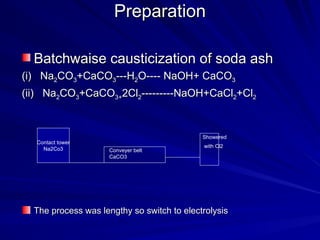
Batchwaise causticization ofsoda ash
Batchwaise causticization of soda ash
(i) Na
(i) Na2
2CO
CO3
3+CaCO
+CaCO3
3---H
---H2
2O---- NaOH+ CaCO
O---- NaOH+ CaCO3
3
(ii) Na
(ii) Na2
2CO
CO3
3+CaCO
+CaCO3+
3+2Cl
2Cl2
2---------NaOH+CaCl
---------NaOH+CaCl2
2+Cl
+Cl2
2
The process was lengthy so switch to electrolysis
The process was lengthy so switch to electrolysis
Contact tower
Na2Co3 Conveyer belt
CaCO3
Showered
with Cl2
16.
Electrolysis
Electrolysis
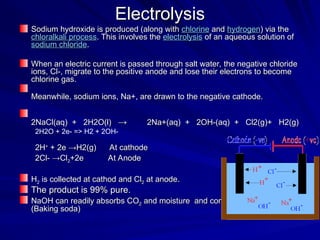
Sodium hydroxide isproduced (along with
Sodium hydroxide is produced (along with chlorine
chlorine and
and hydrogen
hydrogen) via the
) via the
chloralkali
chloralkali process
process. This involves the
. This involves the electrolysis
electrolysis of an aqueous solution of
of an aqueous solution of
sodium chloride
sodium chloride.
.
When an electric current is passed through salt water, the negative chloride
When an electric current is passed through salt water, the negative chloride
ions, Cl-, migrate to the positive anode and lose their electrons to become
ions, Cl-, migrate to the positive anode and lose their electrons to become
chlorine gas.
chlorine gas.
Meanwhile, sodium ions, Na+, are drawn to the negative cathode.
Meanwhile, sodium ions, Na+, are drawn to the negative cathode.
2NaCl(aq) + 2H2O(l)
2NaCl(aq) + 2H2O(l) →
→ 2Na+(aq) + 2OH-(aq) + Cl2(g)+ H2(g)
2Na+(aq) + 2OH-(aq) + Cl2(g)+ H2(g)
2H2O + 2e- => H2 + 2OH-
2H
2H+
+
+ 2e →H2(g) At cathode
+ 2e →H2(g) At cathode
2Cl- →Cl
2Cl- →Cl2
2+2e At Anode
+2e At Anode
H
H2
2 is collected at cathod and Cl
is collected at cathod and Cl2
2 at anode
at anode.
.
The product is 99% pure.
The product is 99% pure.
NaOH can readily absorbs CO
NaOH can readily absorbs CO2
2 and moisture and converted to NaHCO
and moisture and converted to NaHCO3
3
(Baking soda)
(Baking soda)
Continued…….
Continued…….
To produce NaOHit is necessary to
To produce NaOH it is necessary to
prevent reaction of the NaOH with the Cl
prevent reaction of the NaOH with the Cl2
2.
.
This is typically done in one of three ways.
This is typically done in one of three ways.
Mercury cell process
Mercury cell process
Diaphragm cell process
Diaphragm cell process
Membrane cell process
Membrane cell process
The membrane cell process is economically
The membrane cell process is economically
the most viable.
the most viable.
19.
Mercury cell process
Mercurycell process
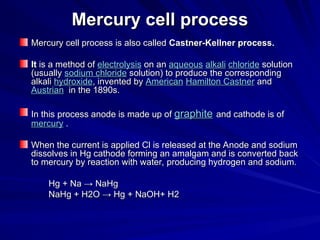
Mercury cell process is also called
Mercury cell process is also called Castner-Kellner process.
Castner-Kellner process.
It
It is a method of
is a method of electrolysis
electrolysis on an
on an aqueous
aqueous alkali
alkali chloride
chloride solution
solution
(usually
(usually sodium chloride
sodium chloride solution) to produce the corresponding
solution) to produce the corresponding
alkali
alkali hydroxide
hydroxide, invented by
, invented by American
American Hamilton
Hamilton Castner
Castner and
and
Austrian
Austrian in the 1890s.
in the 1890s.
In this process anode is made up of
In this process anode is made up of graphite
graphite and cathode is of
and cathode is of
mercury
mercury .
.
When the current is applied Cl is released at the Anode and sodium
When the current is applied Cl is released at the Anode and sodium
dissolves in Hg cathode forming an amalgam and is converted back
dissolves in Hg cathode forming an amalgam and is converted back
to mercury by reaction with water, producing hydrogen and sodium.
to mercury by reaction with water, producing hydrogen and sodium.
Hg + Na → NaHg
Hg + Na → NaHg
NaHg + H2O → Hg + NaOH+ H2
NaHg + H2O → Hg + NaOH+ H2
20.
Membrane cell process
Membranecell process
Development of this technology began in 1970s.
Development of this technology began in 1970s.
The electrolysis cell is divided in to two rooms by a cation permeable
The electrolysis cell is divided in to two rooms by a cation permeable
membrane.
membrane.
The cation permeable membrane only allows Na+ to pass and Rejects the
The cation permeable membrane only allows Na+ to pass and Rejects the
Cl- ions.
Cl- ions.
Saturated NaCl (50ppm produces 28% NaOH) soln is passed through the
Saturated NaCl (50ppm produces 28% NaOH) soln is passed through the
anode compartment.
anode compartment.
Sodium hydroxide soln. is circulated through the cathode department,
Sodium hydroxide soln. is circulated through the cathode department,
exiting at a higher concentration.
exiting at a higher concentration.
In the
In the membrane cell
membrane cell, the anode and cathode are separated by an ion-
, the anode and cathode are separated by an ion-
permeable membrane. Saturated brine is fed to the compartment with the
permeable membrane. Saturated brine is fed to the compartment with the
anode (the anolyte). A DC current is passed through the cell and the NaCl
anode (the anolyte). A DC current is passed through the cell and the NaCl
splits into its constituent components. The membrane passes Na+ ions to
splits into its constituent components. The membrane passes Na+ ions to
the cathode compartment (catholyte), where it forms sodium hydroxide in
the cathode compartment (catholyte), where it forms sodium hydroxide in
solution. The chloride ions are oxidised to chlorine gas at the anode, which
solution. The chloride ions are oxidised to chlorine gas at the anode, which
is collected, purified and stored. Hydrogen gas and Hydroxide ions are
is collected, purified and stored. Hydrogen gas and Hydroxide ions are
formed at the cathode.
formed at the cathode.
21.
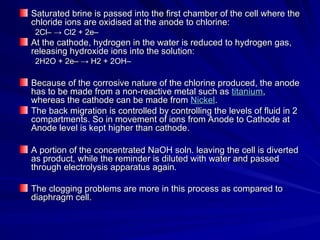
Saturated brine ispassed into the first chamber of the cell where the
Saturated brine is passed into the first chamber of the cell where the
chloride ions are oxidised at the anode to chlorine:
chloride ions are oxidised at the anode to chlorine:
2Cl– → Cl2 + 2e–
2Cl– → Cl2 + 2e–
At the cathode, hydrogen in the water is reduced to hydrogen gas,
At the cathode, hydrogen in the water is reduced to hydrogen gas,
releasing hydroxide ions into the solution:
releasing hydroxide ions into the solution:
2H2O + 2e– → H2 + 2OH–
2H2O + 2e– → H2 + 2OH–
Because of the corrosive nature of the chlorine produced, the anode
Because of the corrosive nature of the chlorine produced, the anode
has to be made from a non-reactive metal such as
has to be made from a non-reactive metal such as titanium
titanium,
,
whereas the cathode can be made from
whereas the cathode can be made from Nickel
Nickel.
.
The back migration is controlled by controlling the levels of fluid in 2
The back migration is controlled by controlling the levels of fluid in 2
compartments. So in movement of ions from Anode to Cathode at
compartments. So in movement of ions from Anode to Cathode at
Anode level is kept higher than cathode.
Anode level is kept higher than cathode.
A portion of the concentrated NaOH soln. leaving the cell is diverted
A portion of the concentrated NaOH soln. leaving the cell is diverted
as product, while the reminder is diluted with water and passed
as product, while the reminder is diluted with water and passed
through electrolysis apparatus again.
through electrolysis apparatus again.
The clogging problems are more in this process as compared to
The clogging problems are more in this process as compared to
diaphragm cell.
diaphragm cell.
22.
The non-permeable
The non-permeableion exchange membrane
ion exchange membrane at the
at the
center of the cell allows the
center of the cell allows the sodium
sodium ions (Na+) to pass to
ions (Na+) to pass to
the second chamber where they react with the hydroxide
the second chamber where they react with the hydroxide
ions to produce
ions to produce caustic soda
caustic soda (NaOH). The overall
(NaOH). The overall
reaction for the electrolysis of brine is thus:
reaction for the electrolysis of brine is thus:
2NaCl + 2H2O → Cl2 + H2 + 2NaOH
2NaCl + 2H2O → Cl2 + H2 + 2NaOH
A membrane cell is used to prevent the reaction between
A membrane cell is used to prevent the reaction between
the chlorine and hydroxide ions. If this reaction were to
the chlorine and hydroxide ions. If this reaction were to
occur the chlorine would be
occur the chlorine would be disproportionated
disproportionated to form
to form
chloride and
chloride and hypochlorite
hypochlorite ions:
ions:
– Cl2 + 2OH– → Cl– + ClO– + H2O
Cl2 + 2OH– → Cl– + ClO– + H2O
At higher temperatures, 333K,
At higher temperatures, 333K, chlorate
chlorate can be formed:
can be formed:
3Cl2 + 6OH– → 5Cl– + ClO3– + 3H2O
3Cl2 + 6OH– → 5Cl– + ClO3– + 3H2O
Diaphragm cell
Diaphragm cell
Inthe diaphragm cell process, there are two compartments separated by a
In the diaphragm cell process, there are two compartments separated by a
permeable diaphragm, often made of
permeable diaphragm, often made of asbestos fibers
asbestos fibers.
.
The anode is made up of graphite and cathode cast iron
The anode is made up of graphite and cathode cast iron
Brine is introduced into the anode compartment and flows into the cathode
Brine is introduced into the anode compartment and flows into the cathode
compartment.
compartment.
The movement is from Anode to cathode , this process avoids the formation
The movement is from Anode to cathode , this process avoids the formation
of by-products.
of by-products.
Similarly to the Membrane Cell, chloride ions are oxidized at the anode to
Similarly to the Membrane Cell, chloride ions are oxidized at the anode to
produce chlorine, and at the cathode, water is split into caustic soda and
produce chlorine, and at the cathode, water is split into caustic soda and
hydrogen.
hydrogen.
The diaphragm prevents the reaction of the caustic soda with the chlorine. A
The diaphragm prevents the reaction of the caustic soda with the chlorine. A
diluted caustic brine leaves the cell. The caustic soda must usually be
diluted caustic brine leaves the cell. The caustic soda must usually be
concentrated to 50% and the salt removed.
concentrated to 50% and the salt removed.
This is done using an evaporative process with about three tonnes of steam
This is done using an evaporative process with about three tonnes of steam
per tonne of caustic soda.
per tonne of caustic soda.
25.
If the castiron of cathode is replaced by Ti or
If the cast iron of cathode is replaced by Ti or
coated with earthoxide (Na, K, Al oxides) or any
coated with earthoxide (Na, K, Al oxides) or any
noble metal the life of diaphragm extends.
noble metal the life of diaphragm extends.
Clogging of diaphragm occurs because of the
Clogging of diaphragm occurs because of the
voltage drop or high hydrostatic pressure of
voltage drop or high hydrostatic pressure of
brine solution.
brine solution.
The advantage of diaphragm cell is that it can
The advantage of diaphragm cell is that it can
work with diluted soln (20%) when diluted
work with diluted soln (20%) when diluted
solutions are used the product is only 11 % and
solutions are used the product is only 11 % and
have to use multiple effect evaporators to
have to use multiple effect evaporators to
produce 50% product.
produce 50% product.
The disadvantage is the asbestos which can be
The disadvantage is the asbestos which can be
replaced
replaced
Energy of electrolyticcell
Energy of electrolytic cell
1.12 V is the energy used by any electrolytic cell.
1.12 V is the energy used by any electrolytic cell.
Calculated by putting the values in GIBB-
Calculated by putting the values in GIBB-
HELMHOLZ equation.
HELMHOLZ equation.
E= -J ∆H + T dE
E= -J ∆H + T dE
nF dT
nF dT
28.
Baking Soda
Baking Soda
producedby
produced by
Na
Na2
2CO
CO3
3+ CO
+ CO2
2 +H
+H2
2O → NaHCO
O → NaHCO3
3 produced in the
produced in the
form of suspension.
form of suspension.
The suspension is removed from the bottom of
The suspension is removed from the bottom of
the contact tower →filtered →dried in rotary
the contact tower →filtered →dried in rotary
drum at 40
drum at 40o
o
C →centrifuged →Conveyer belt and
C →centrifuged →Conveyer belt and
dried at 70
dried at 70o
o
C.
C.