PRESENTED TO;
PROF. DR. HUMA BANO
PRESENTED BY; JAHANZAIB
ALTAF
REGISTRATION NO; B1F17BSCH0069
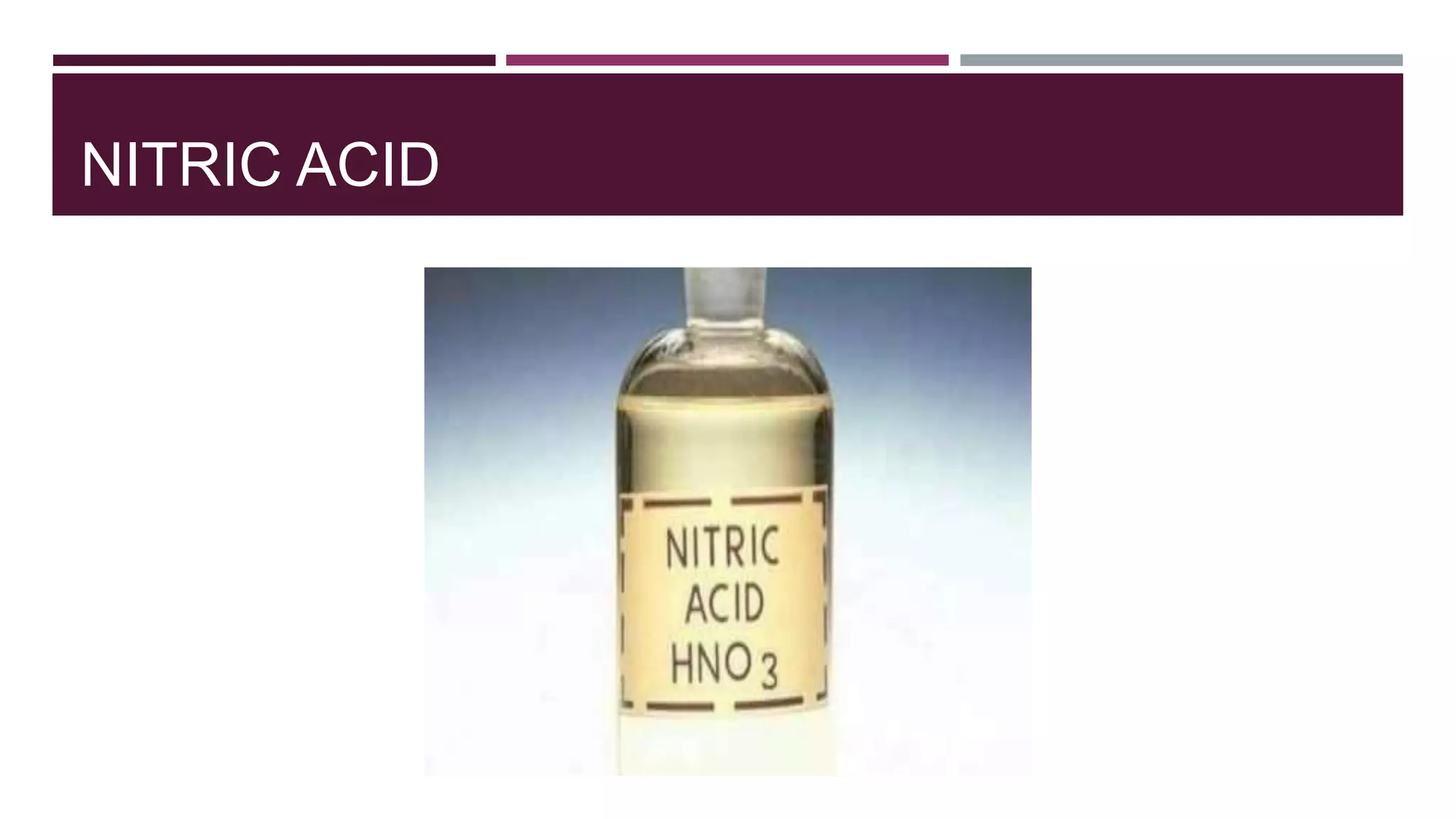
NITRIC ACID
INTRODUCTION
 Nitric acid is a colorless liquid that is used in the manufacture of inorganic and organic nitrates
and nitro compounds for fertilizers, dye intermediates, explosives, and many different organic
chemicals.
 It is a strong oxidizing agent and can oxidize metals and nonmetals easily.
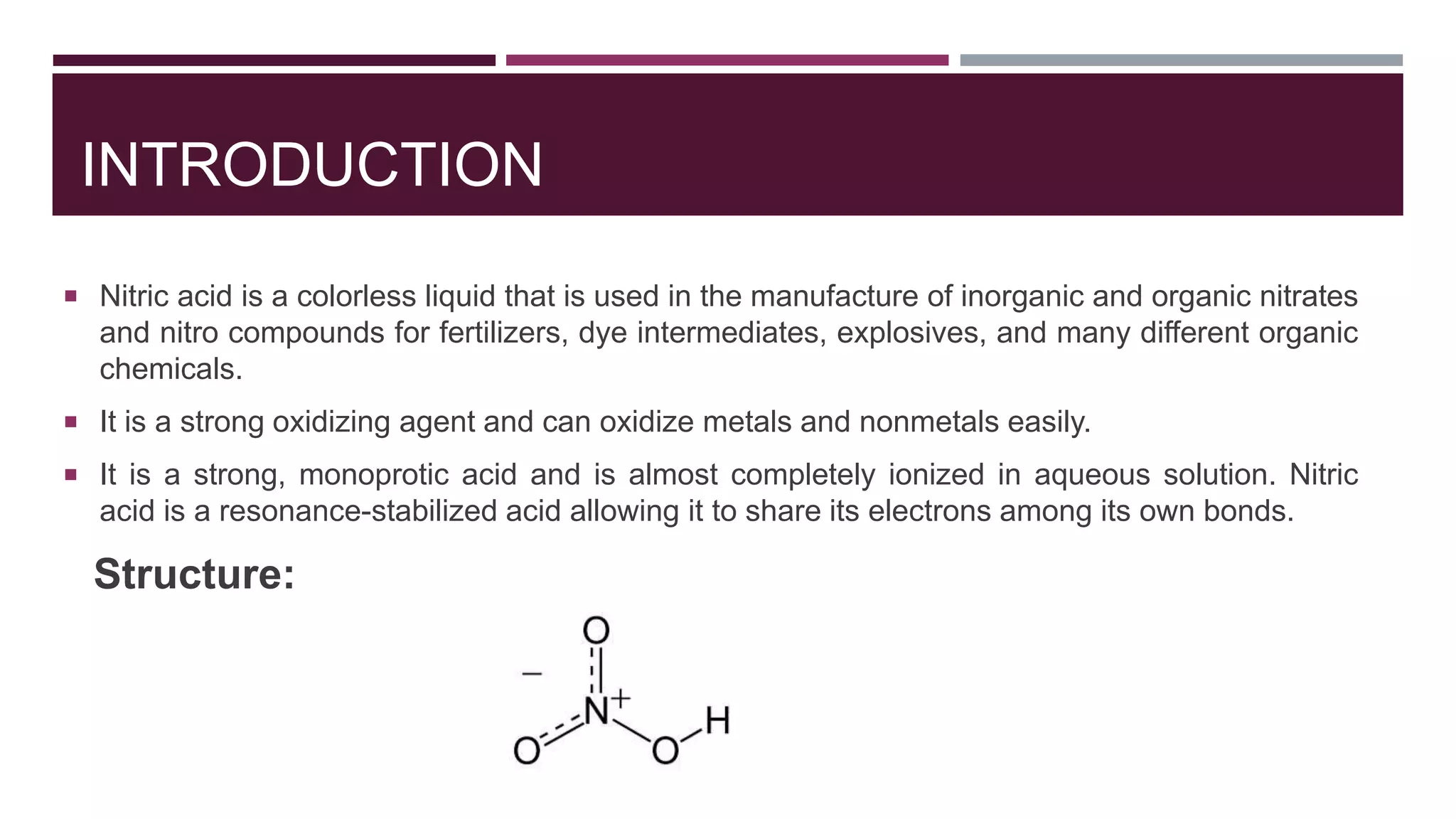
 It is a strong, monoprotic acid and is almost completely ionized in aqueous solution. Nitric
acid is a resonance-stabilized acid allowing it to share its electrons among its own bonds.
Structure:
PROPERTIES
 Molar mass: 63g/mol
 Color: Pure nitric acid is a colorless liquid but commercial nitric acid may be yellowish
brown due to presence of dissolved nitrogen dioxide.
 Odour: Nitric acid is a fuming & hygroscopic liquid.
 Acidity: Nitric acid is a strong acid and dissociates very highly and is very corrosive. Ka
value is 28.
 Taste: It is sour in taste due to acidic in nature.
 Density:1.513gcm-3 at 20° C.
TYPES OF NITRIC ACID
 Strong nitric acid:
Density; 1.4; Percentage Concentration; 65% HNO3.
 Fuming nitric acid:
A red liquid made by passing NO2 gas through concentrated HNO3.
 Concentrated nitric acid:
Density 1.5; Percentage Concentration; 98% HNO3.
PREPARATION METHODS
 CHILE SALTPETRE METHOD BY NANO3
 BRIKLAND EYDE’S METHOD BY USING AIR
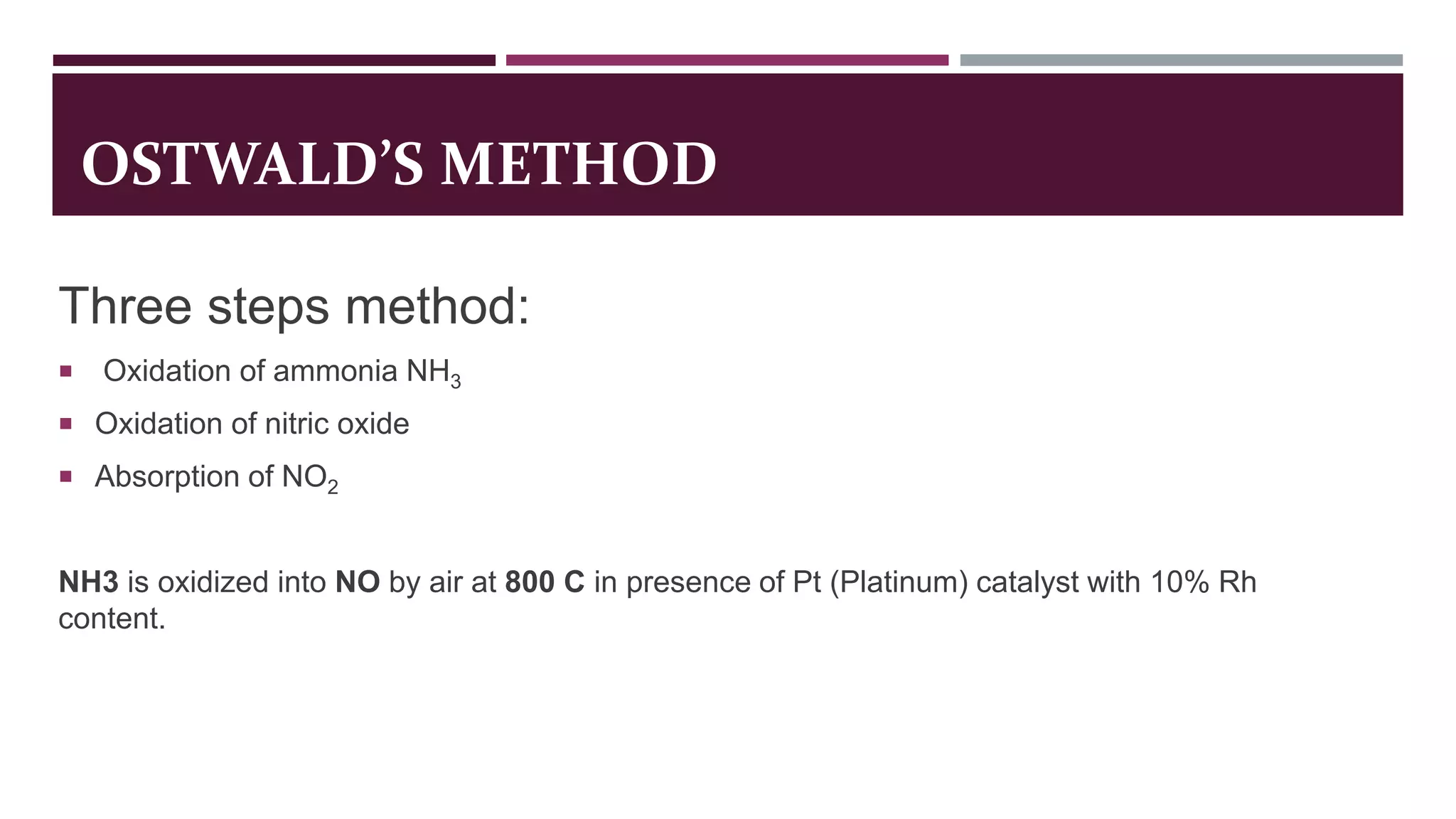
 OSTWALD’S METHOD BY USING AMMONIA
OSTWALD’S METHOD
Three steps method:
 Oxidation of ammonia NH3
 Oxidation of nitric oxide
 Absorption of NO2
NH3 is oxidized into NO by air at 800 C in presence of Pt (Platinum) catalyst with 10% Rh
content.
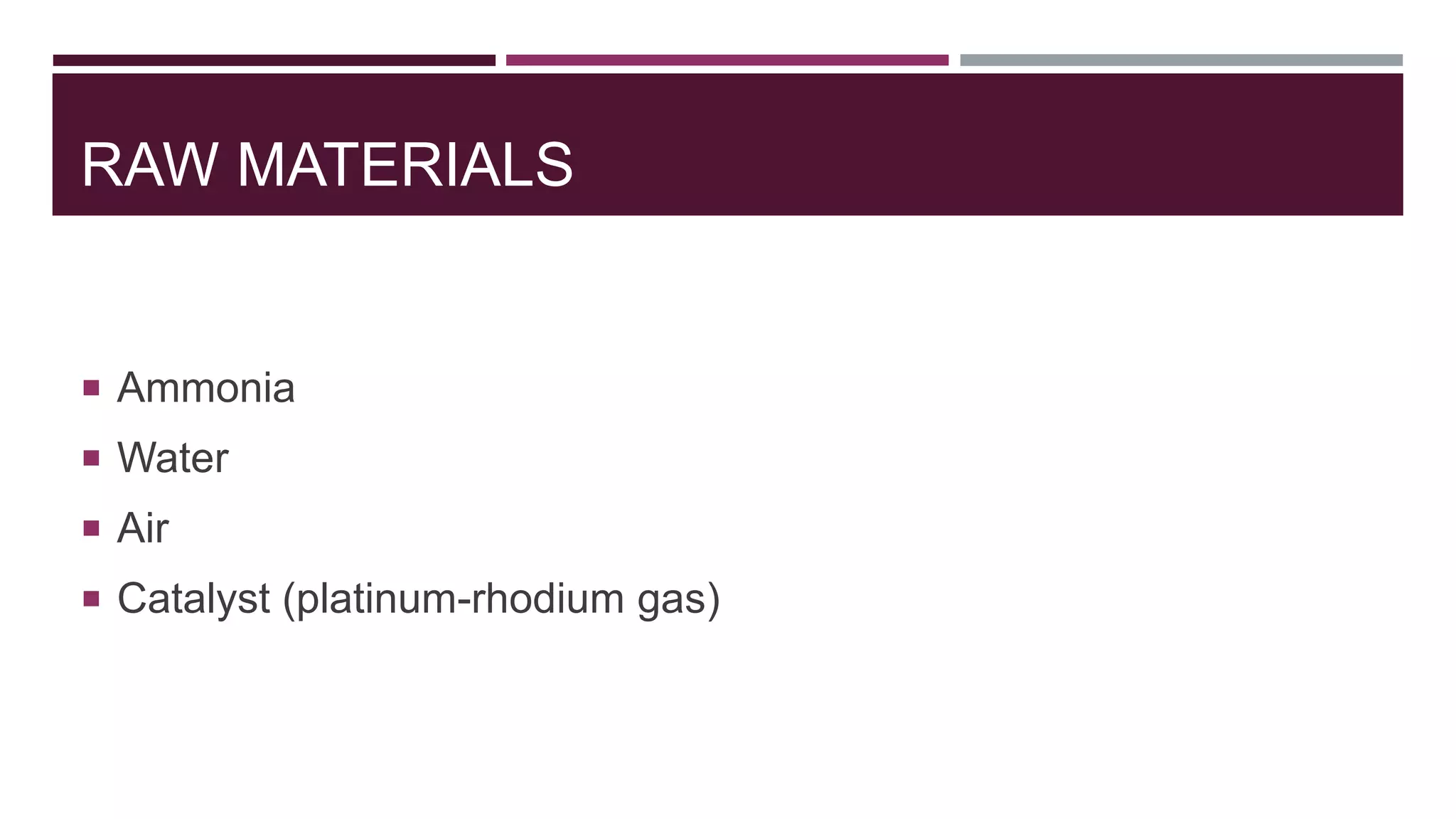
RAW MATERIALS
 Ammonia
 Water
 Air
 Catalyst (platinum-rhodium gas)
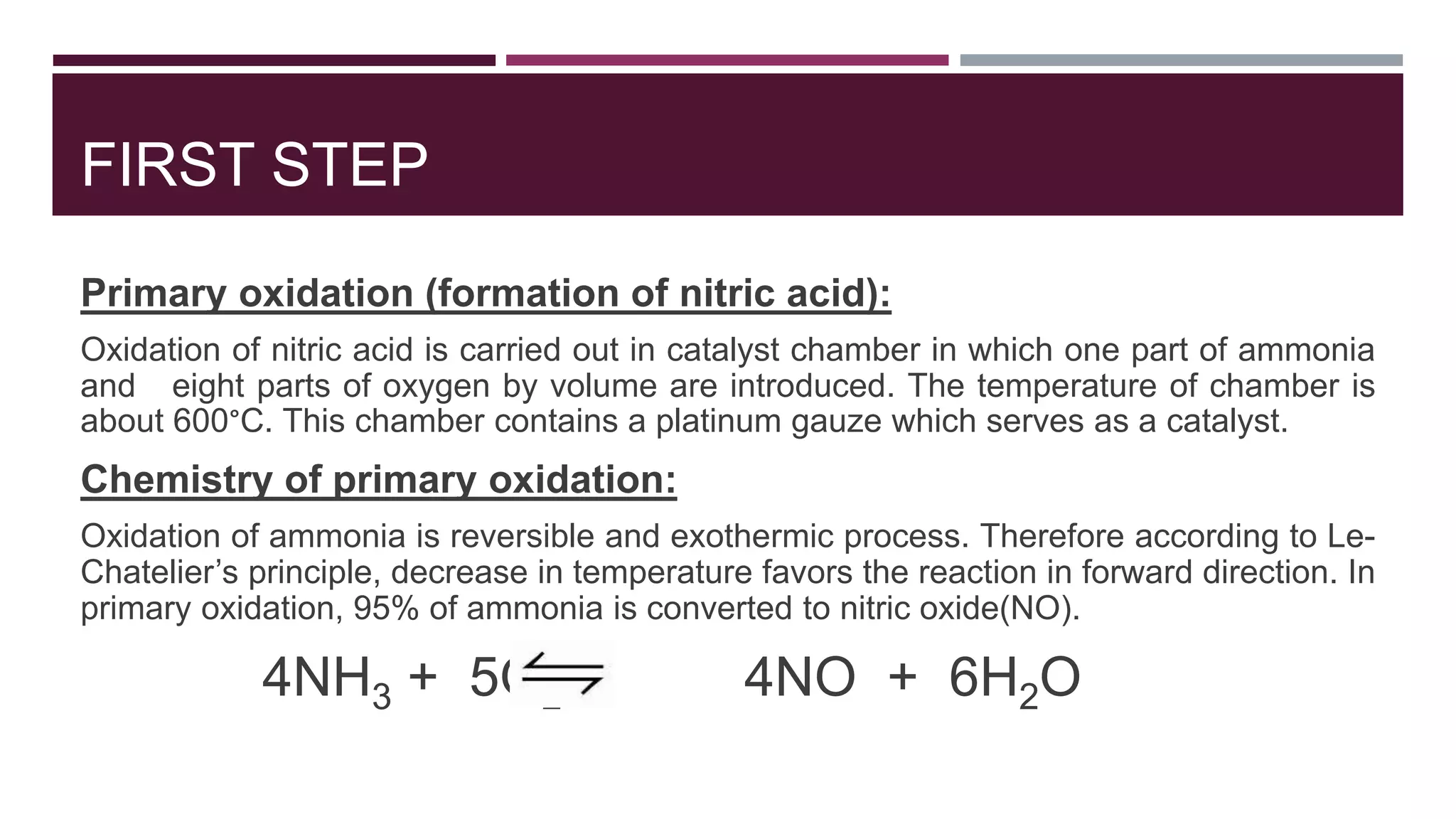
FIRST STEP
Primary oxidation (formation of nitric acid):
Oxidation of nitric acid is carried out in catalyst chamber in which one part of ammonia
and eight parts of oxygen by volume are introduced. The temperature of chamber is
about 600°C. This chamber contains a platinum gauze which serves as a catalyst.
Chemistry of primary oxidation:
Oxidation of ammonia is reversible and exothermic process. Therefore according to Le-
Chatelier’s principle, decrease in temperature favors the reaction in forward direction. In
primary oxidation, 95% of ammonia is converted to nitric oxide(NO).
4NH3 + 5O2 4NO + 6H2O
SECOND STEP
Secondary oxidation (formation of nitrogen dioxide):
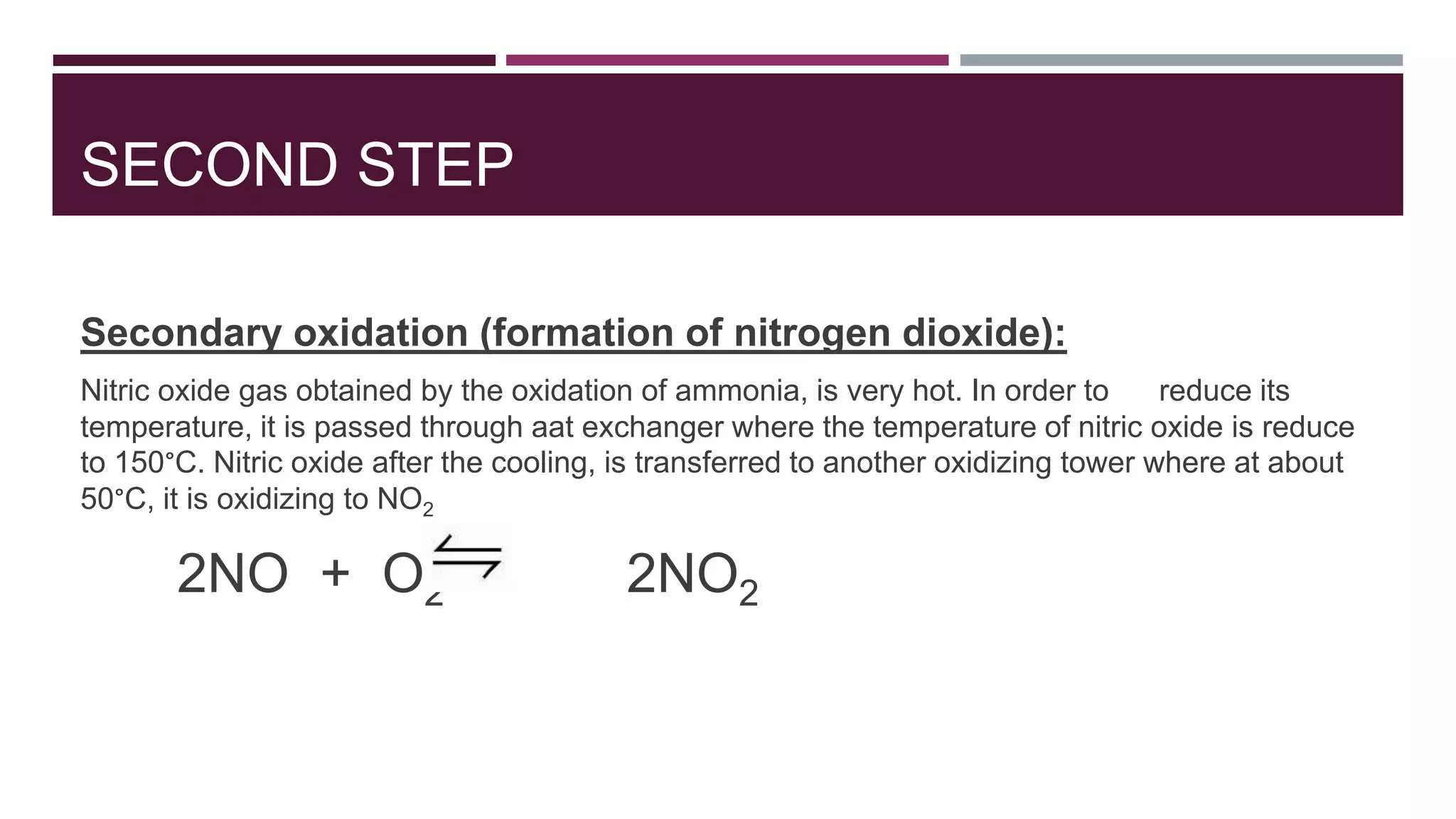
Nitric oxide gas obtained by the oxidation of ammonia, is very hot. In order to reduce its
temperature, it is passed through aat exchanger where the temperature of nitric oxide is reduce
to 150°C. Nitric oxide after the cooling, is transferred to another oxidizing tower where at about
50°C, it is oxidizing to NO2
2NO + O2 2NO2
FINAL STEP
Absorption of NO2 ( formation of HNO3):
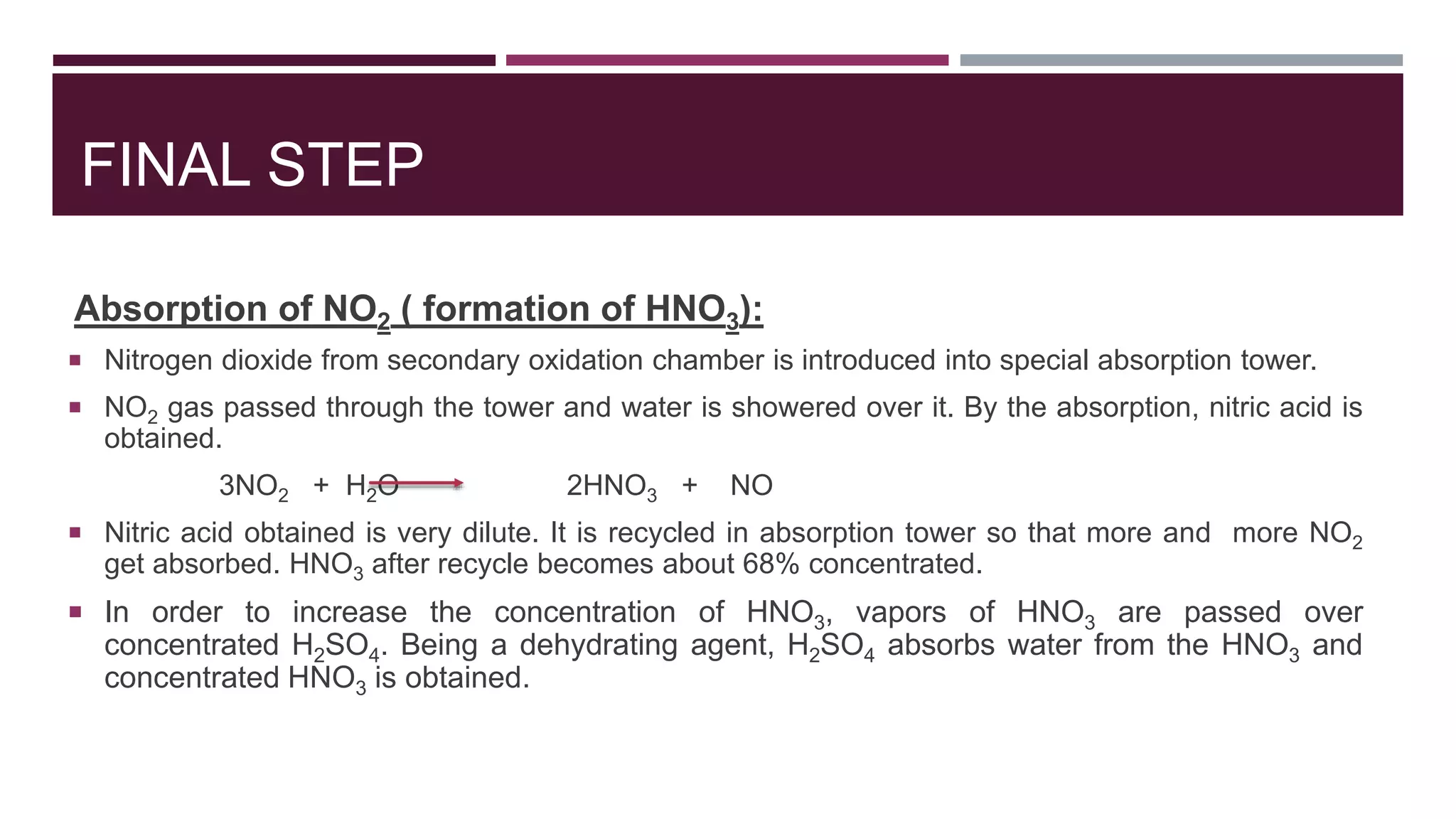
 Nitrogen dioxide from secondary oxidation chamber is introduced into special absorption tower.
 NO2 gas passed through the tower and water is showered over it. By the absorption, nitric acid is
obtained.
3NO2 + H2O 2HNO3 + NO
 Nitric acid obtained is very dilute. It is recycled in absorption tower so that more and more NO2
get absorbed. HNO3 after recycle becomes about 68% concentrated.
 In order to increase the concentration of HNO3, vapors of HNO3 are passed over
concentrated H2SO4. Being a dehydrating agent, H2SO4 absorbs water from the HNO3 and
concentrated HNO3 is obtained.
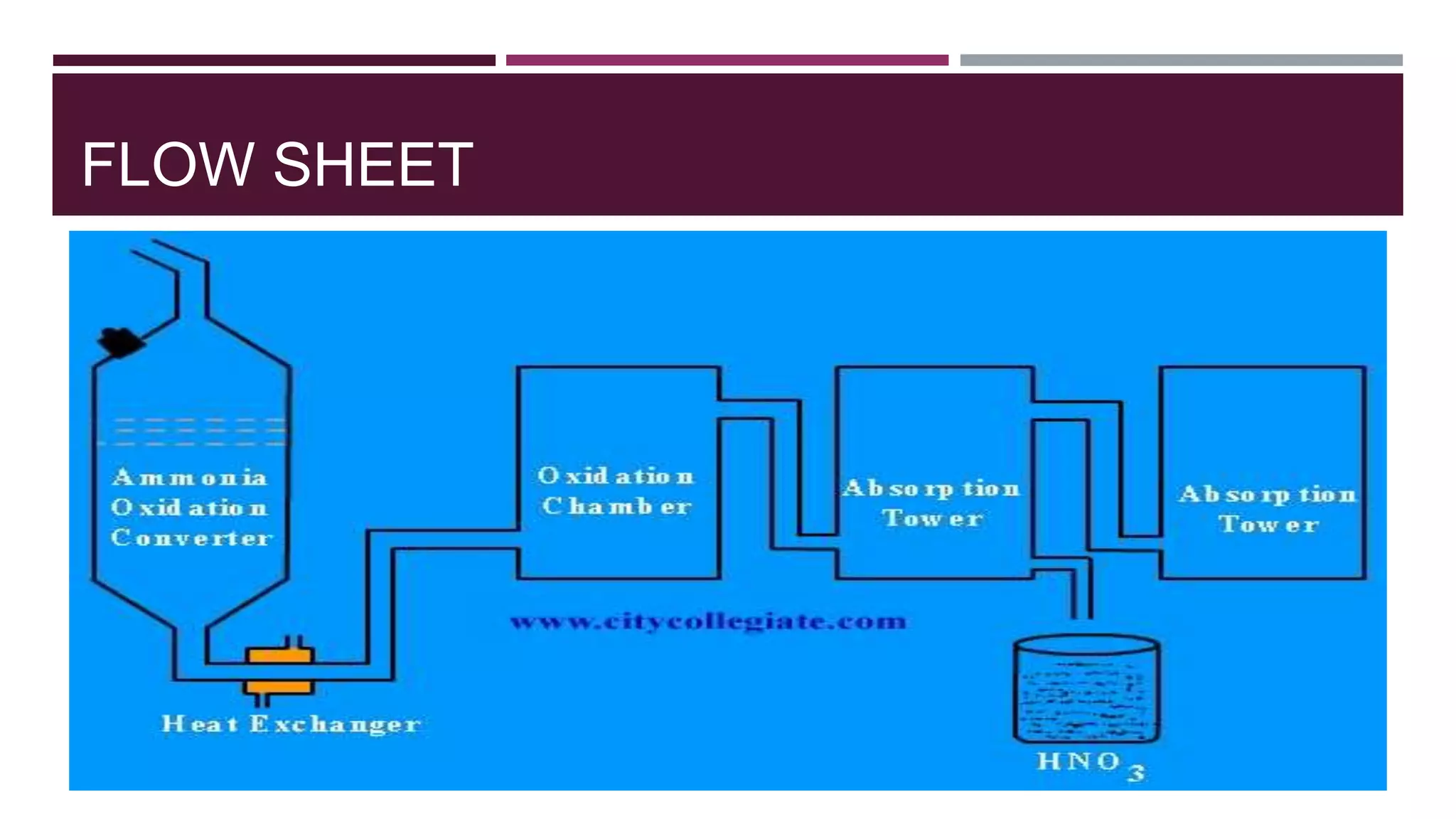
FLOW SHEET
STORAGE AND PRESERVATION:-
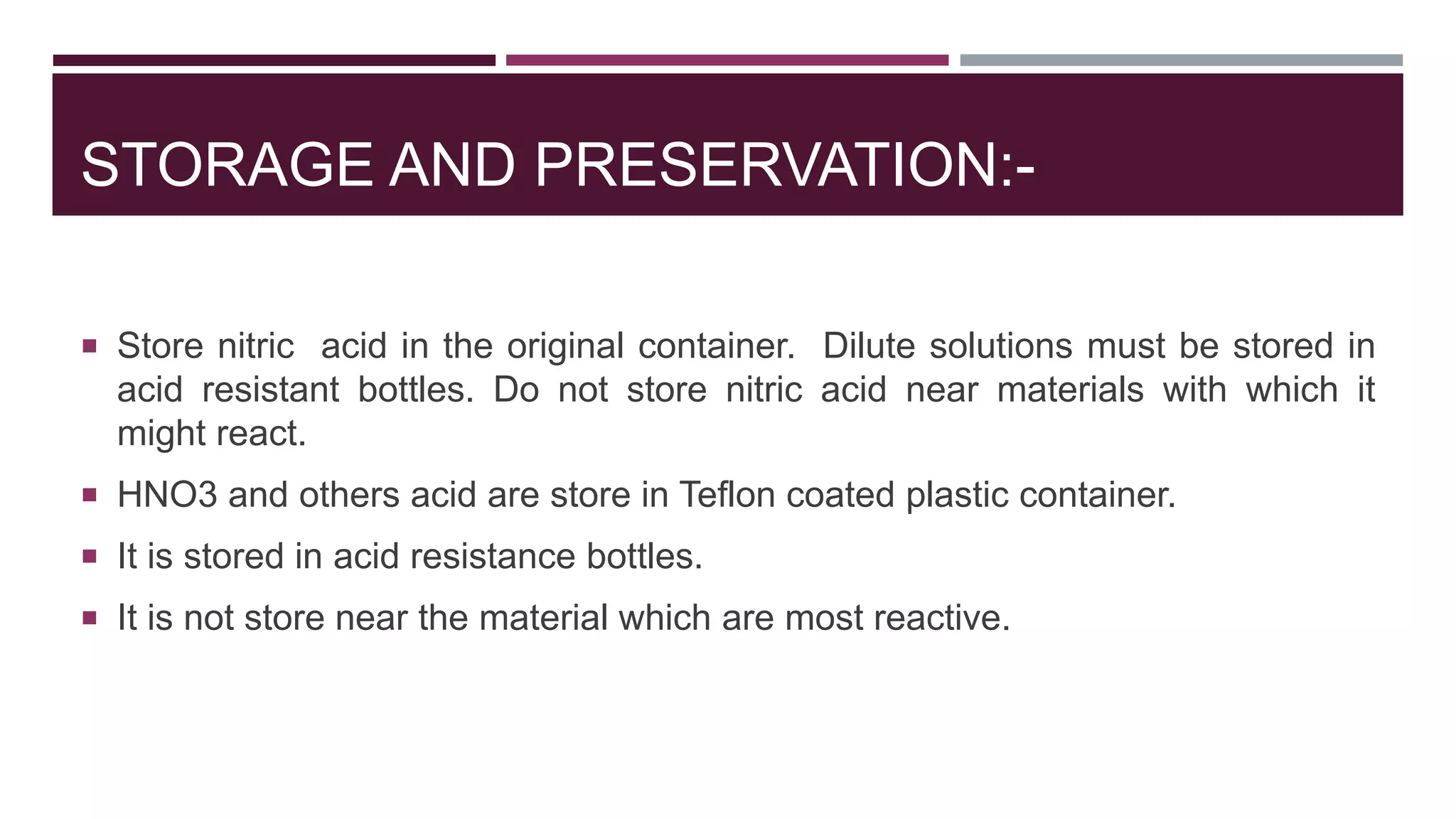
 Store nitric acid in the original container. Dilute solutions must be stored in
acid resistant bottles. Do not store nitric acid near materials with which it
might react.
 HNO3 and others acid are store in Teflon coated plastic container.
 It is stored in acid resistance bottles.
 It is not store near the material which are most reactive.
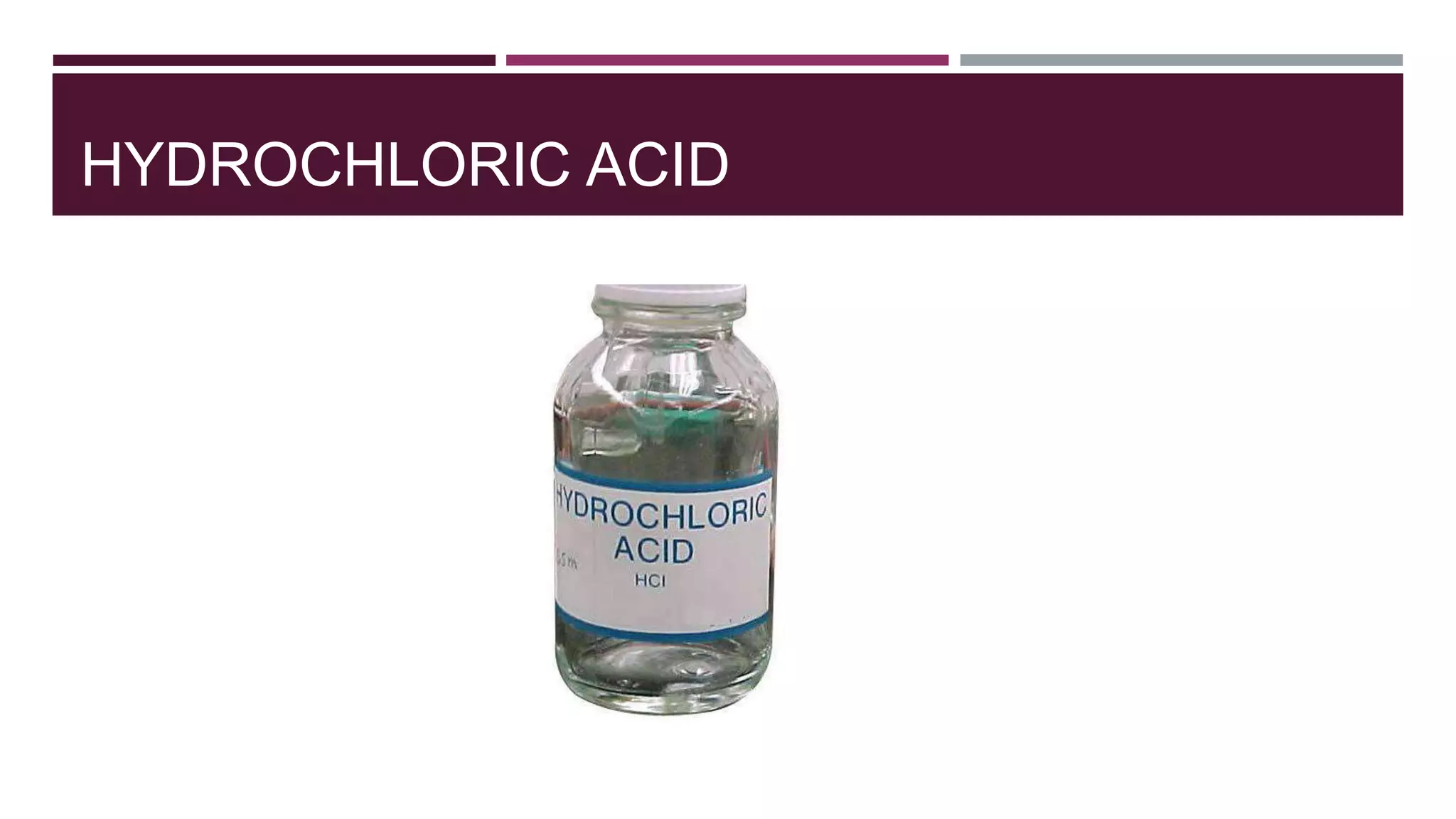
HYDROCHLORIC ACID
INTRODUCTION
 Hydrochloric acid is a clear, colorless, highly pungent solution of hydrogen chloride (HCl) in
water. It is a highly corrosive, strong mineral acid with many industrial uses. Hydrochloric acid
is found naturally in gastric acid.
 About 20 million tons of hydrochloric acid are produced worldwide annually.
 Hydrochloric acid (HCl) is listed as a Title III Hazardous Air Pollutant.
 Hydrochloric acid is a versatile chemical used in a variety of chemical processes, including
hydrometallurgical processing (e. g., production of alumina and/or titanium dioxide), chlorine
dioxide synthesis, hydrogen production, activation of petroleum wells, and miscellaneous
cleaning/etching operations including metal cleaning (e. g., steel pickling).Also known as
muriatic acid
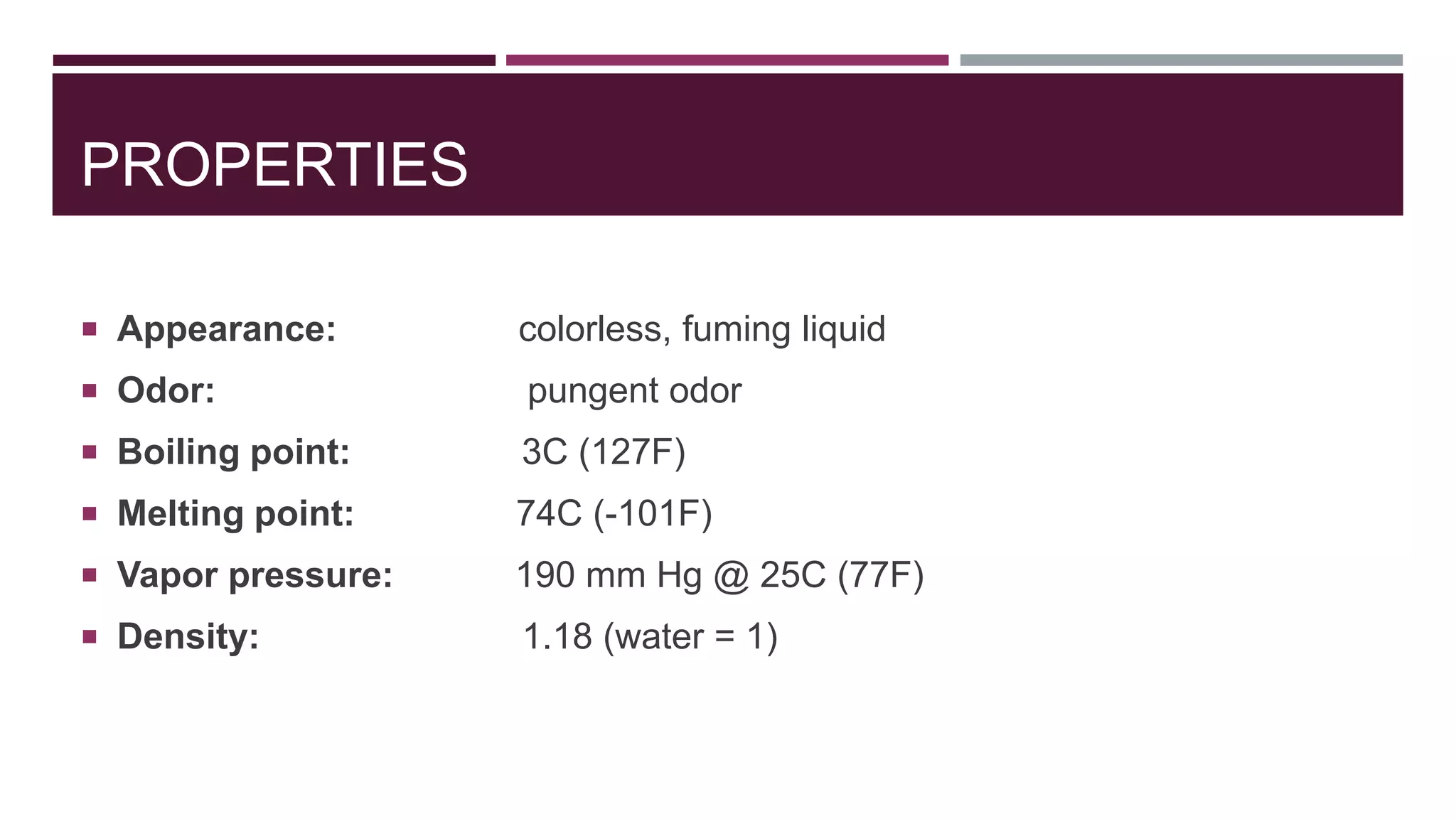
PROPERTIES
 Appearance: colorless, fuming liquid
 Odor: pungent odor
 Boiling point: 3C (127F)
 Melting point: 74C (-101F)
 Vapor pressure: 190 mm Hg @ 25C (77F)
 Density: 1.18 (water = 1)
PREPARATION METHODS
 Synthesis from elements (Burning Process)
 Organic By-product Synthesis.
 Metallic chlorides with Sulfuric acid.
 Waste Incineration.
 Thermal decomposition of hydrated heavy metals
Hydrochloric acid may be manufactured by several different processes, although over 90
percent of the HCl produced in the world is a byproduct of the chlorination reaction.
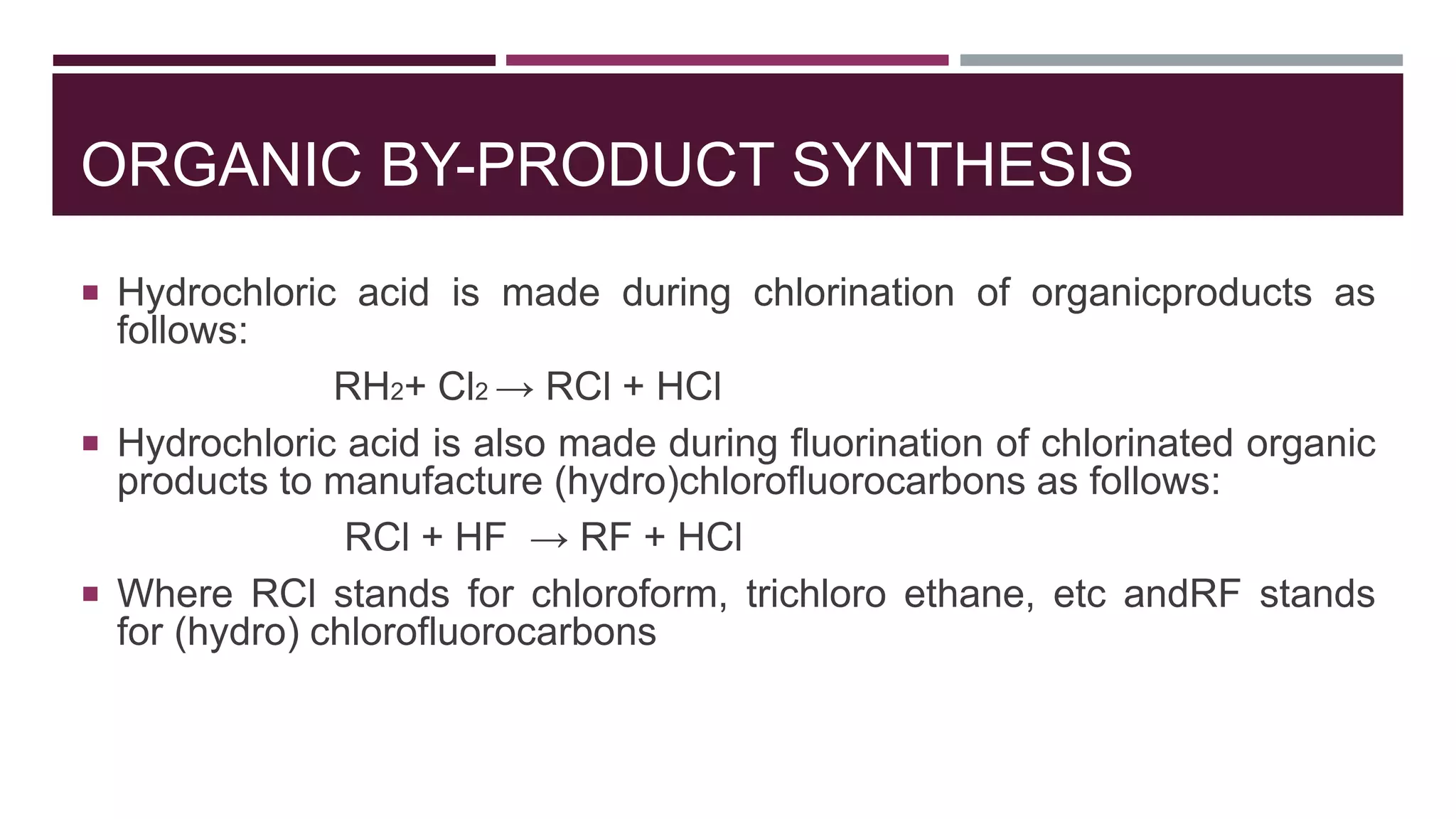
ORGANIC BY-PRODUCT SYNTHESIS
 Hydrochloric acid is made during chlorination of organicproducts as
follows:
RH2+ Cl2 → RCl + HCl
 Hydrochloric acid is also made during fluorination of chlorinated organic
products to manufacture (hydro)chlorofluorocarbons as follows:
RCl + HF → RF + HCl
 Where RCl stands for chloroform, trichloro ethane, etc andRF stands
for (hydro) chlorofluorocarbons
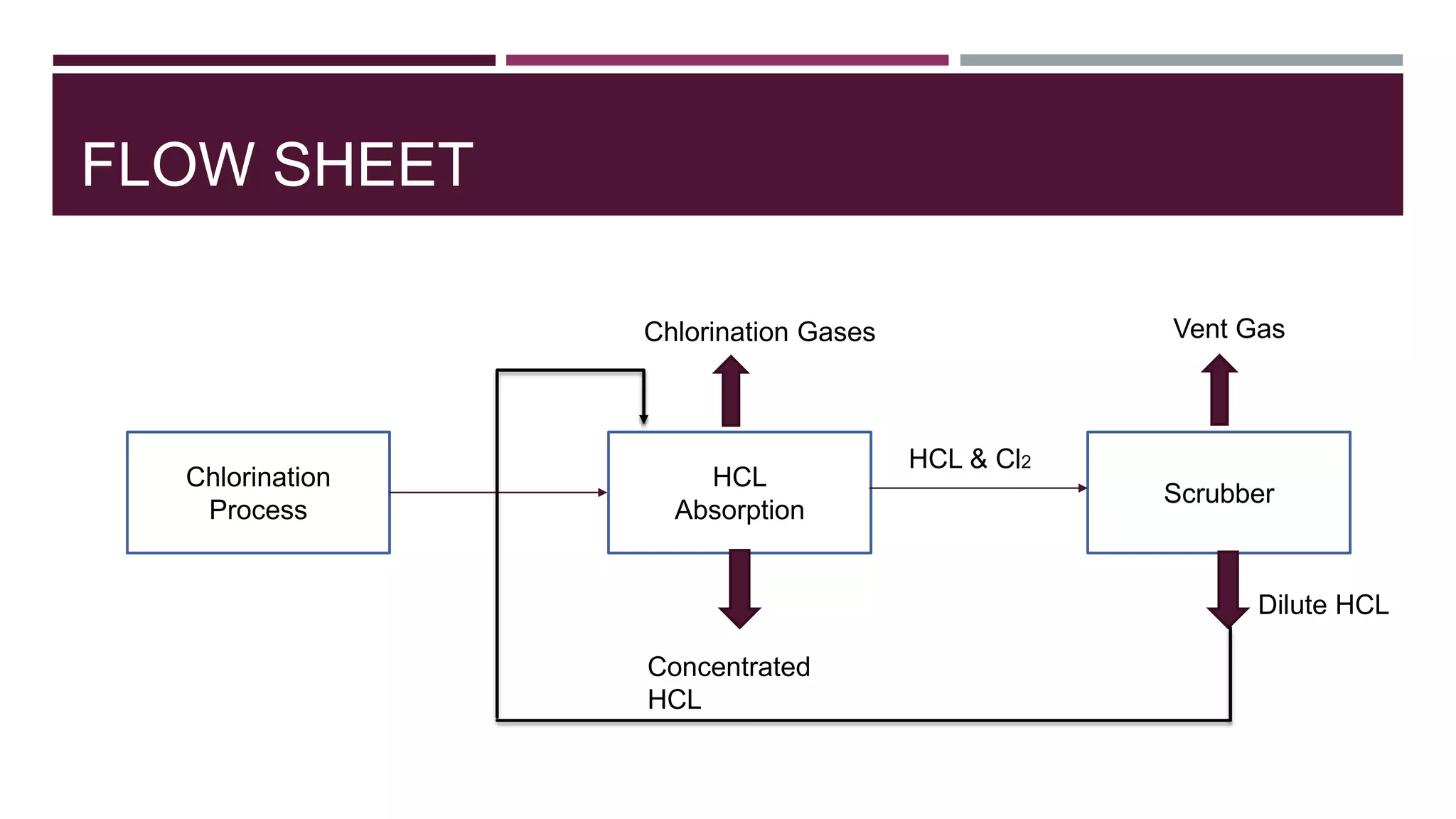
FLOW SHEET
Chlorination
Process
HCL
Absorption
Scrubber
HCL & Cl2
Chlorination Gases Vent Gas
Dilute HCL
Concentrated
HCL
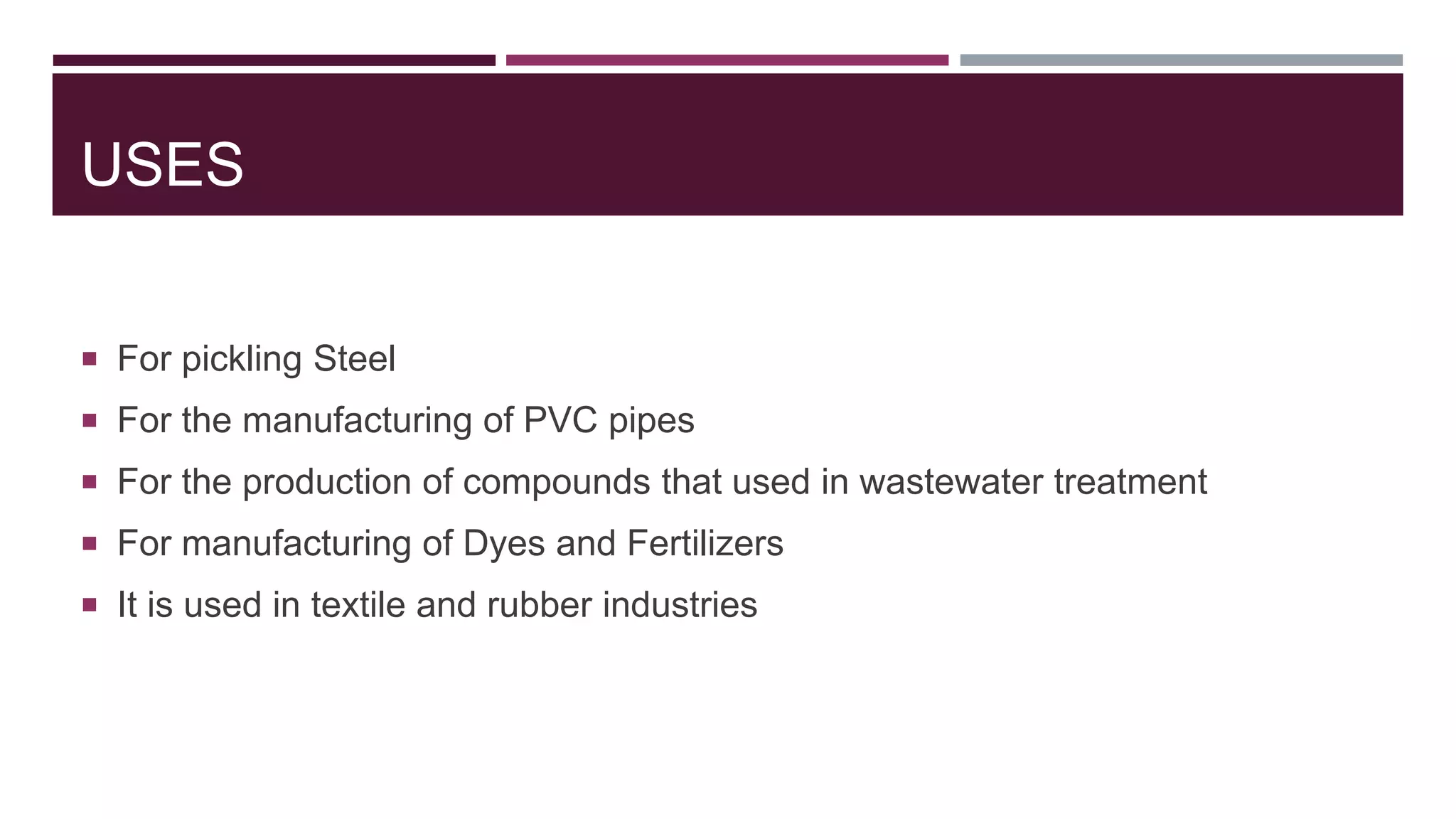
USES
 For pickling Steel
 For the manufacturing of PVC pipes
 For the production of compounds that used in wastewater treatment
 For manufacturing of Dyes and Fertilizers
 It is used in textile and rubber industries
HEALTH SAFETY & ENVIRONMENT
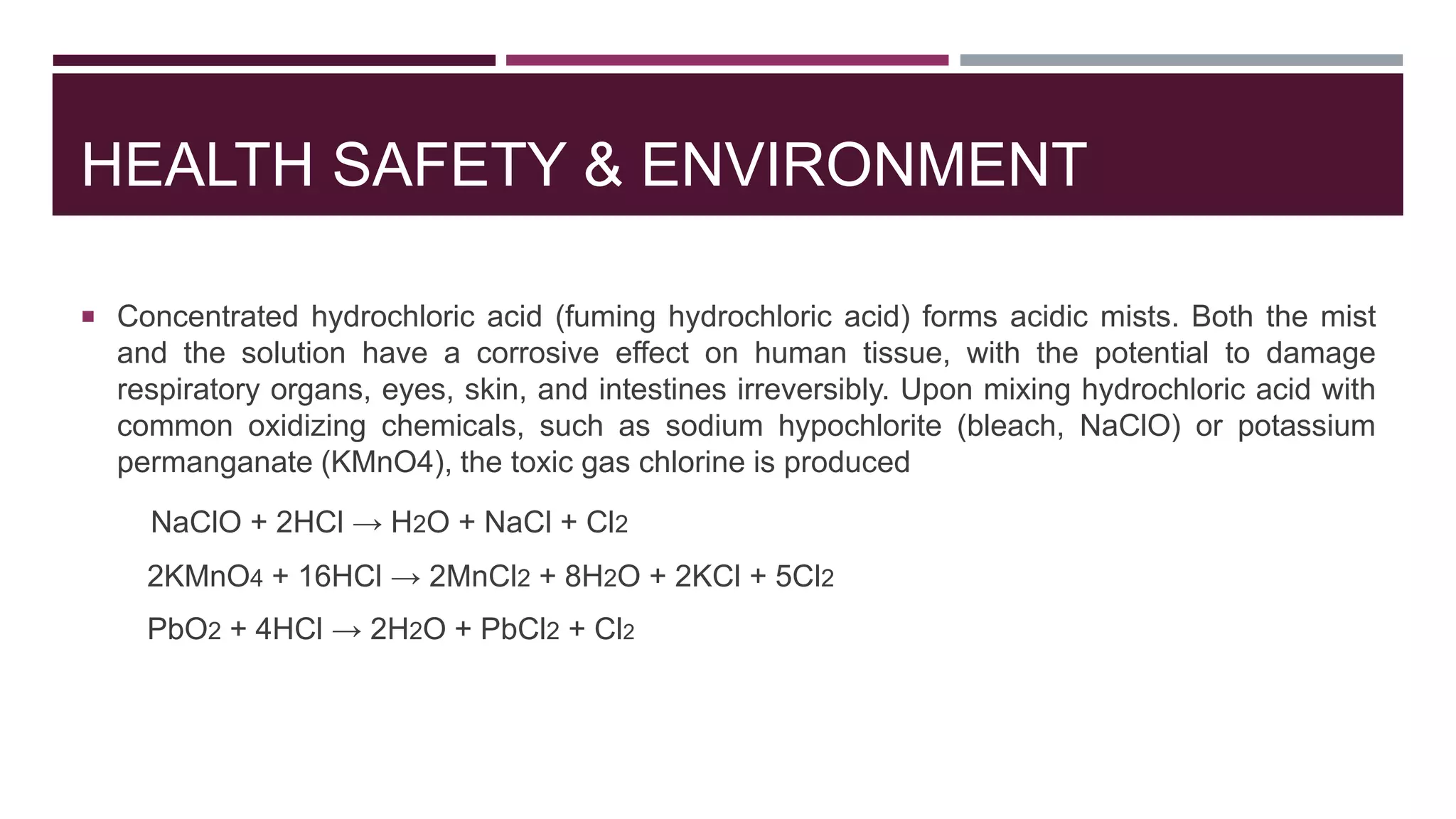
 Concentrated hydrochloric acid (fuming hydrochloric acid) forms acidic mists. Both the mist
and the solution have a corrosive effect on human tissue, with the potential to damage
respiratory organs, eyes, skin, and intestines irreversibly. Upon mixing hydrochloric acid with
common oxidizing chemicals, such as sodium hypochlorite (bleach, NaClO) or potassium
permanganate (KMnO4), the toxic gas chlorine is produced
NaClO + 2HCl → H2O + NaCl + Cl2
2KMnO4 + 16HCl → 2MnCl2 + 8H2O + 2KCl + 5Cl2
PbO2 + 4HCl → 2H2O + PbCl2 + Cl2
STORAGE AND PRESERVATION
 Store in a cool, dry, ventilated storage area with acid resistant floors and good
drainage.
 XLPE tanks are recommended but HDPE, LDPE, FRP, rubber-lined steel and
polypropylene tanks can also store HCL.
 The tanks use for storage of HCL its specific gravity should be 1.9
 Employ fume scrubbers for HCL vapor mitigation.
Nitric acid Preparation & Uses Raw materials, Flow sheet diagram unit operation and unit process of nitric acid and hcl

Nitric acid Preparation & Uses Raw materials, Flow sheet diagram unit operation and unit process of nitric acid and hcl

  • 2.
    PRESENTED TO; PROF. DR.HUMA BANO PRESENTED BY; JAHANZAIB ALTAF REGISTRATION NO; B1F17BSCH0069
  • 3.
  • 4.
    INTRODUCTION  Nitric acidis a colorless liquid that is used in the manufacture of inorganic and organic nitrates and nitro compounds for fertilizers, dye intermediates, explosives, and many different organic chemicals.  It is a strong oxidizing agent and can oxidize metals and nonmetals easily.  It is a strong, monoprotic acid and is almost completely ionized in aqueous solution. Nitric acid is a resonance-stabilized acid allowing it to share its electrons among its own bonds. Structure:
  • 5.
    PROPERTIES  Molar mass:63g/mol  Color: Pure nitric acid is a colorless liquid but commercial nitric acid may be yellowish brown due to presence of dissolved nitrogen dioxide.  Odour: Nitric acid is a fuming & hygroscopic liquid.  Acidity: Nitric acid is a strong acid and dissociates very highly and is very corrosive. Ka value is 28.  Taste: It is sour in taste due to acidic in nature.  Density:1.513gcm-3 at 20° C.
  • 6.
    TYPES OF NITRICACID  Strong nitric acid: Density; 1.4; Percentage Concentration; 65% HNO3.  Fuming nitric acid: A red liquid made by passing NO2 gas through concentrated HNO3.  Concentrated nitric acid: Density 1.5; Percentage Concentration; 98% HNO3.
  • 7.
    PREPARATION METHODS  CHILESALTPETRE METHOD BY NANO3  BRIKLAND EYDE’S METHOD BY USING AIR  OSTWALD’S METHOD BY USING AMMONIA
  • 8.
    OSTWALD’S METHOD Three stepsmethod:  Oxidation of ammonia NH3  Oxidation of nitric oxide  Absorption of NO2 NH3 is oxidized into NO by air at 800 C in presence of Pt (Platinum) catalyst with 10% Rh content.
  • 9.
    RAW MATERIALS  Ammonia Water  Air  Catalyst (platinum-rhodium gas)
  • 10.
    FIRST STEP Primary oxidation(formation of nitric acid): Oxidation of nitric acid is carried out in catalyst chamber in which one part of ammonia and eight parts of oxygen by volume are introduced. The temperature of chamber is about 600°C. This chamber contains a platinum gauze which serves as a catalyst. Chemistry of primary oxidation: Oxidation of ammonia is reversible and exothermic process. Therefore according to Le- Chatelier’s principle, decrease in temperature favors the reaction in forward direction. In primary oxidation, 95% of ammonia is converted to nitric oxide(NO). 4NH3 + 5O2 4NO + 6H2O
  • 11.
    SECOND STEP Secondary oxidation(formation of nitrogen dioxide): Nitric oxide gas obtained by the oxidation of ammonia, is very hot. In order to reduce its temperature, it is passed through aat exchanger where the temperature of nitric oxide is reduce to 150°C. Nitric oxide after the cooling, is transferred to another oxidizing tower where at about 50°C, it is oxidizing to NO2 2NO + O2 2NO2
  • 12.
    FINAL STEP Absorption ofNO2 ( formation of HNO3):  Nitrogen dioxide from secondary oxidation chamber is introduced into special absorption tower.  NO2 gas passed through the tower and water is showered over it. By the absorption, nitric acid is obtained. 3NO2 + H2O 2HNO3 + NO  Nitric acid obtained is very dilute. It is recycled in absorption tower so that more and more NO2 get absorbed. HNO3 after recycle becomes about 68% concentrated.  In order to increase the concentration of HNO3, vapors of HNO3 are passed over concentrated H2SO4. Being a dehydrating agent, H2SO4 absorbs water from the HNO3 and concentrated HNO3 is obtained.
  • 13.
  • 14.
    STORAGE AND PRESERVATION:- Store nitric acid in the original container. Dilute solutions must be stored in acid resistant bottles. Do not store nitric acid near materials with which it might react.  HNO3 and others acid are store in Teflon coated plastic container.  It is stored in acid resistance bottles.  It is not store near the material which are most reactive.
  • 15.
  • 16.
    INTRODUCTION  Hydrochloric acidis a clear, colorless, highly pungent solution of hydrogen chloride (HCl) in water. It is a highly corrosive, strong mineral acid with many industrial uses. Hydrochloric acid is found naturally in gastric acid.  About 20 million tons of hydrochloric acid are produced worldwide annually.  Hydrochloric acid (HCl) is listed as a Title III Hazardous Air Pollutant.  Hydrochloric acid is a versatile chemical used in a variety of chemical processes, including hydrometallurgical processing (e. g., production of alumina and/or titanium dioxide), chlorine dioxide synthesis, hydrogen production, activation of petroleum wells, and miscellaneous cleaning/etching operations including metal cleaning (e. g., steel pickling).Also known as muriatic acid
  • 17.
    PROPERTIES  Appearance: colorless,fuming liquid  Odor: pungent odor  Boiling point: 3C (127F)  Melting point: 74C (-101F)  Vapor pressure: 190 mm Hg @ 25C (77F)  Density: 1.18 (water = 1)
  • 18.
    PREPARATION METHODS  Synthesisfrom elements (Burning Process)  Organic By-product Synthesis.  Metallic chlorides with Sulfuric acid.  Waste Incineration.  Thermal decomposition of hydrated heavy metals Hydrochloric acid may be manufactured by several different processes, although over 90 percent of the HCl produced in the world is a byproduct of the chlorination reaction.
  • 19.
    ORGANIC BY-PRODUCT SYNTHESIS Hydrochloric acid is made during chlorination of organicproducts as follows: RH2+ Cl2 → RCl + HCl  Hydrochloric acid is also made during fluorination of chlorinated organic products to manufacture (hydro)chlorofluorocarbons as follows: RCl + HF → RF + HCl  Where RCl stands for chloroform, trichloro ethane, etc andRF stands for (hydro) chlorofluorocarbons
  • 20.
    FLOW SHEET Chlorination Process HCL Absorption Scrubber HCL &Cl2 Chlorination Gases Vent Gas Dilute HCL Concentrated HCL
  • 21.
    USES  For picklingSteel  For the manufacturing of PVC pipes  For the production of compounds that used in wastewater treatment  For manufacturing of Dyes and Fertilizers  It is used in textile and rubber industries
  • 22.
    HEALTH SAFETY &ENVIRONMENT  Concentrated hydrochloric acid (fuming hydrochloric acid) forms acidic mists. Both the mist and the solution have a corrosive effect on human tissue, with the potential to damage respiratory organs, eyes, skin, and intestines irreversibly. Upon mixing hydrochloric acid with common oxidizing chemicals, such as sodium hypochlorite (bleach, NaClO) or potassium permanganate (KMnO4), the toxic gas chlorine is produced NaClO + 2HCl → H2O + NaCl + Cl2 2KMnO4 + 16HCl → 2MnCl2 + 8H2O + 2KCl + 5Cl2 PbO2 + 4HCl → 2H2O + PbCl2 + Cl2
  • 23.
    STORAGE AND PRESERVATION Store in a cool, dry, ventilated storage area with acid resistant floors and good drainage.  XLPE tanks are recommended but HDPE, LDPE, FRP, rubber-lined steel and polypropylene tanks can also store HCL.  The tanks use for storage of HCL its specific gravity should be 1.9  Employ fume scrubbers for HCL vapor mitigation.