SODAASH AND BAKING SODA
INDUSTRY
USAMA PERVAIZ
BS CHEMICAL ENGINEER
Department of Chemical Engineering, CIIT Lahore
PRODUCTION OF
SODIUM CARBONATE/BICARBONATE
• Uses and History
• Raw materials
• Process flow diagram
• Steps involved in production
•
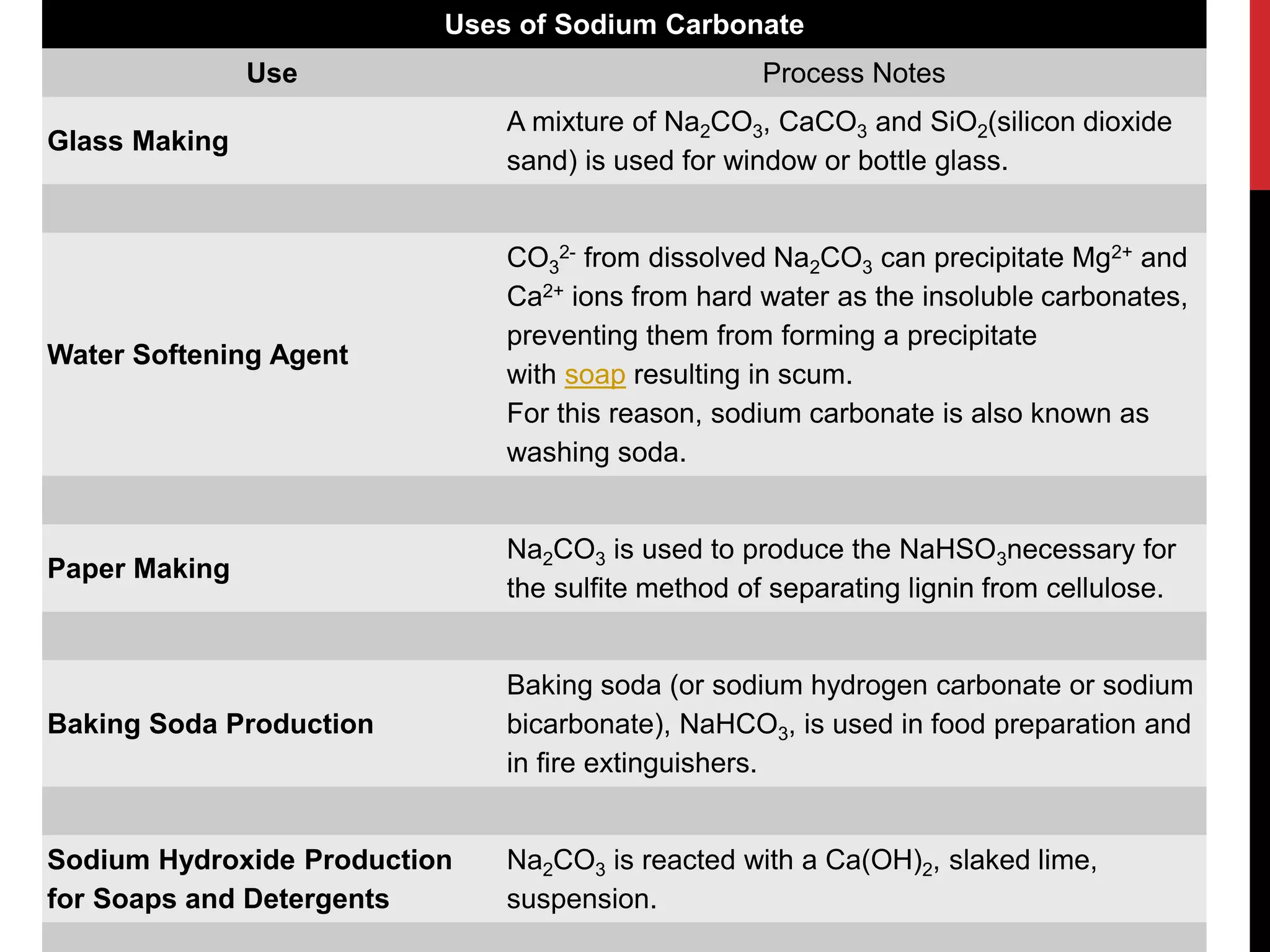
Uses of Sodium Carbonate
Use Process Notes
Glass Making
A mixture of Na2CO3, CaCO3 and SiO2(silicon dioxide
sand) is used for window or bottle glass.
Water Softening Agent
CO3
2- from dissolved Na2CO3 can precipitate Mg2+ and
Ca2+ ions from hard water as the insoluble carbonates,
preventing them from forming a precipitate
with soap resulting in scum.
For this reason, sodium carbonate is also known as
washing soda.
Paper Making
Na2CO3 is used to produce the NaHSO3necessary for
the sulfite method of separating lignin from cellulose.
Baking Soda Production
Baking soda (or sodium hydrogen carbonate or sodium
bicarbonate), NaHCO3, is used in food preparation and
in fire extinguishers.
Sodium Hydroxide Production
for Soaps and Detergents
Na2CO3 is reacted with a Ca(OH)2, slaked lime,
suspension.
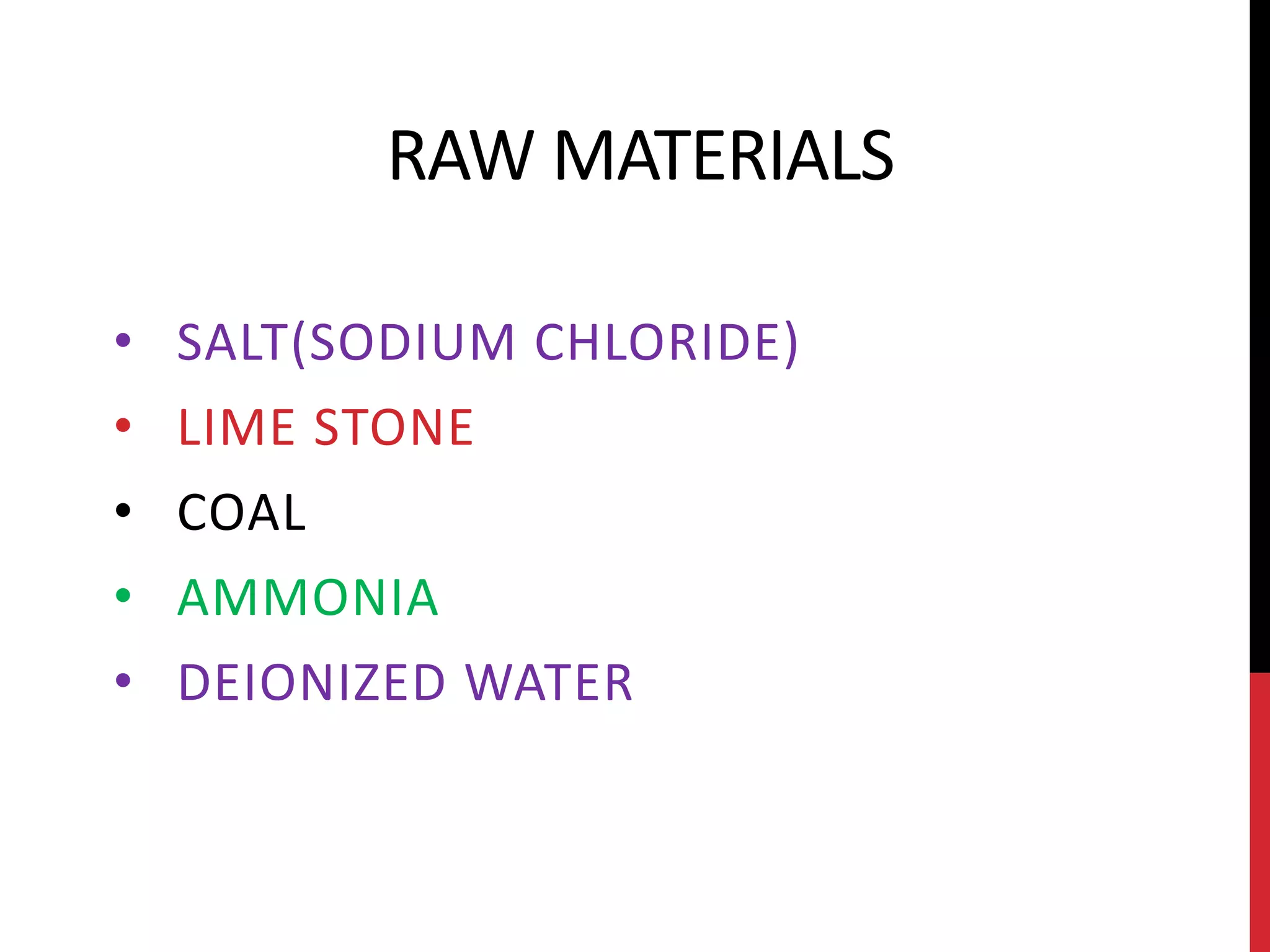
RAW MATERIALS
• SALT(SODIUM CHLORIDE)
• LIME STONE
• COAL
• AMMONIA
• DEIONIZED WATER
THE OVERALL
REACTION
NaCl+CaCO3 Na2CO3 +CaCl2
However……..
PROCESS FLOW
DIAGRAM
STEPS INVOLVED IN THE PRODUCTION
OF NA2CO3 /NAHCO3 BY SOLVAY
PROCESS
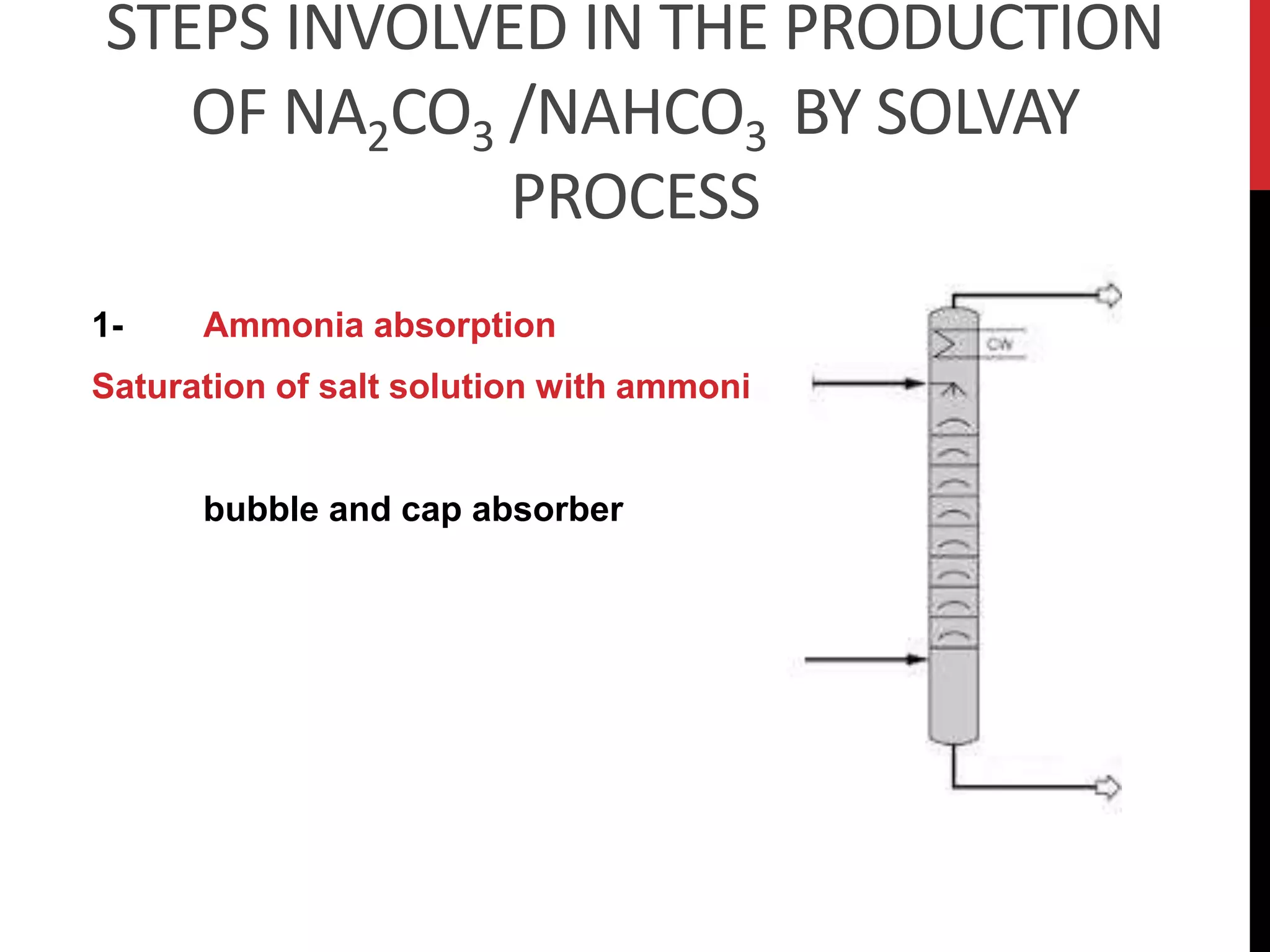
1- Ammonia absorption
Saturation of salt solution with ammonia
bubble and cap absorber
1.Trayed towers (plate columns). 2.Packed columns.
perforated valve cap Bubble cap
SOLVAY
PROCESS……….CONTD.
2- Burning of limestone to produce carbon dioxide and
lime
• Combustion of C to CO2 (highly exothermic and produces
96.5 Kcal/mole of C burnt)
• Decomposition of 1 mole of CaCO3 need 43.44 Kcal
Thus mixing lime with coke…….
SOLVAY PROCESS
CONTD.
3- The Solvay tower/carbonation of ammoniated brine
SOLVAY
PROCESS………..CONTD.
4- Separation of Sodium Bicarbonate
Filtering and washing of precipitated bicarbonate
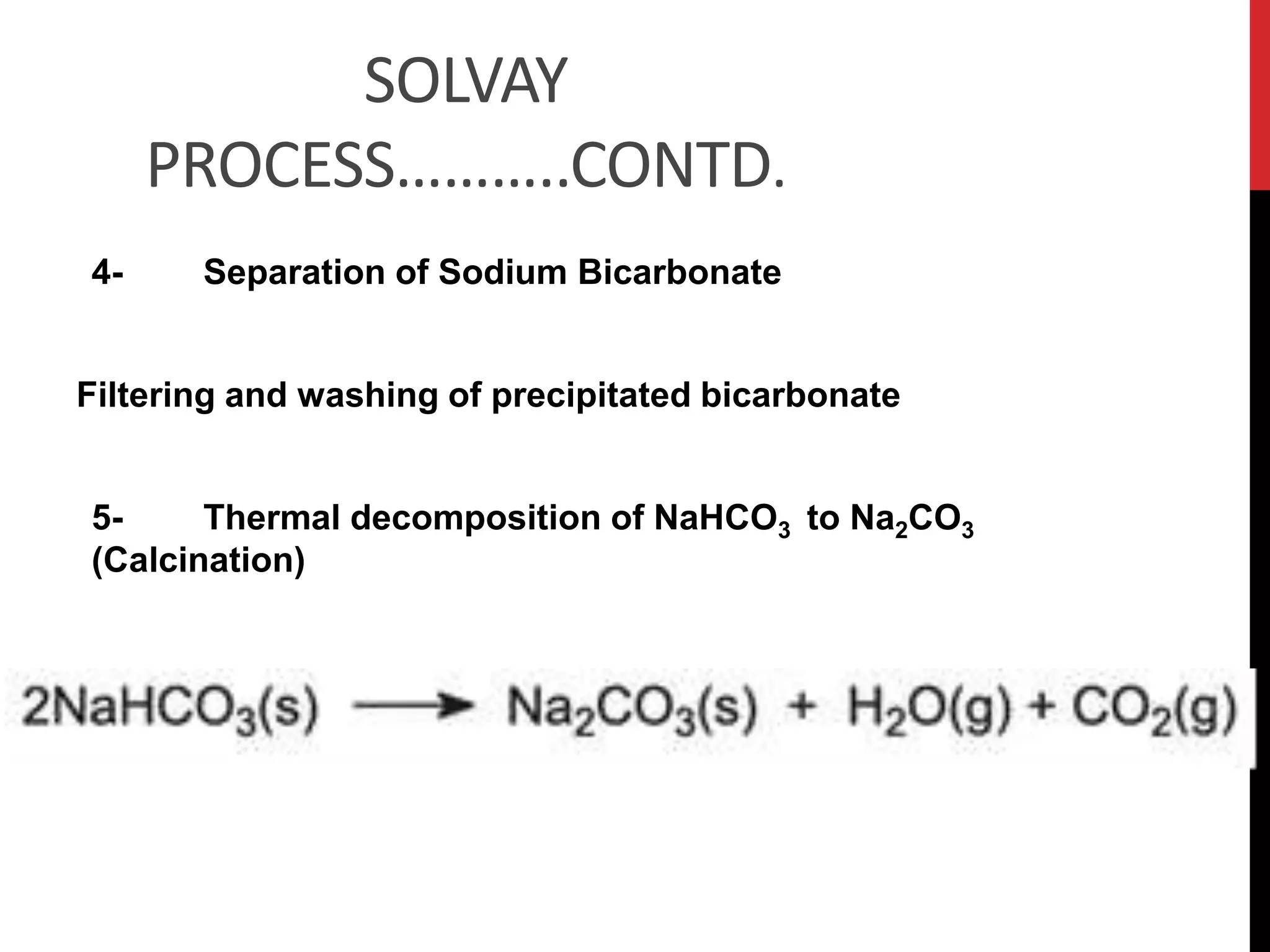
5- Thermal decomposition of NaHCO3 to Na2CO3
(Calcination)
SOLVAY
PROCESS……….CONTD.
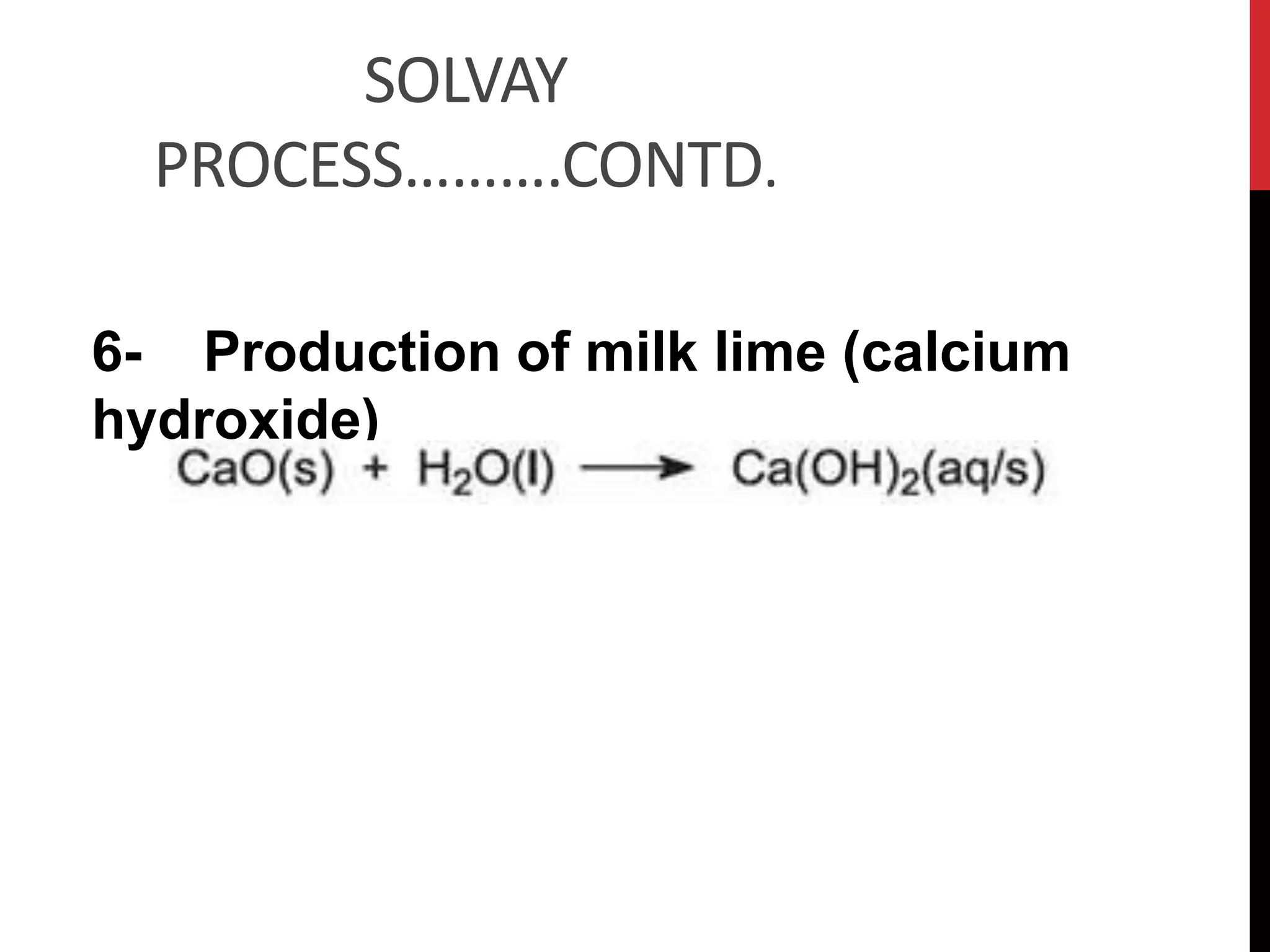
6- Production of milk lime (calcium
hydroxide)
SOLVAY
PROCESS……….CONTD.
7- Regeneration of ammonia
LIGHT VS HEAVY
SODA ASH
Soda ash can be classified into two forms –
heavy and light.
Product after calcination is called light form is obtained first and some is then converted into
the heavy form containing less than 0.5% sodium chloride.
Heavy sodium carbonate is obtained by hydrating light sodium carbonate to the monohydrate
(Na2CO3.H2O) and then dehydrating it to give a product with an increased crystal size and
density.
The two grades have different uses.
The major uses of heavy sodium carbonate are as a solid, particularly in making glass, where
it is used as a flux in the melting of silica (sand).
The uses for light sodium carbonate are traditionally where the chemical is required in
solution.
Sodium carbonate, is used
In the manufacture of glass, paper, rayon, soaps, and
detergents.
As a water softener
To control pH (carbonate solutions neutralize acids,
producing only carbon dioxide and water).
In the chemical industry to synthesize many different
sodium compounds, including sodium bicarbonate (baking
soda), sodium silicate (used in detergents), sodium
tripolyphosphate (a detergent builder), sodium hydroxide
(lye), sodium chromate and sodium dichromate (used in
chrome plating), sodium aluminate (used in refining
aluminum), and sodium cyanide (for electroplating).
Q-1
Why sodium carbonate called as washing soda?
Q-2
Identify the raw materials used in the Solvay process and
name the products
Q-3
Describe the uses of sodium carbonate
Q-4
Identify the sequence of steps used in the Solvay process
and describe the chemistry involved in:
brine purification
hydrogen carbonate formation
formation of sodium carbonate
ammonia recovery.
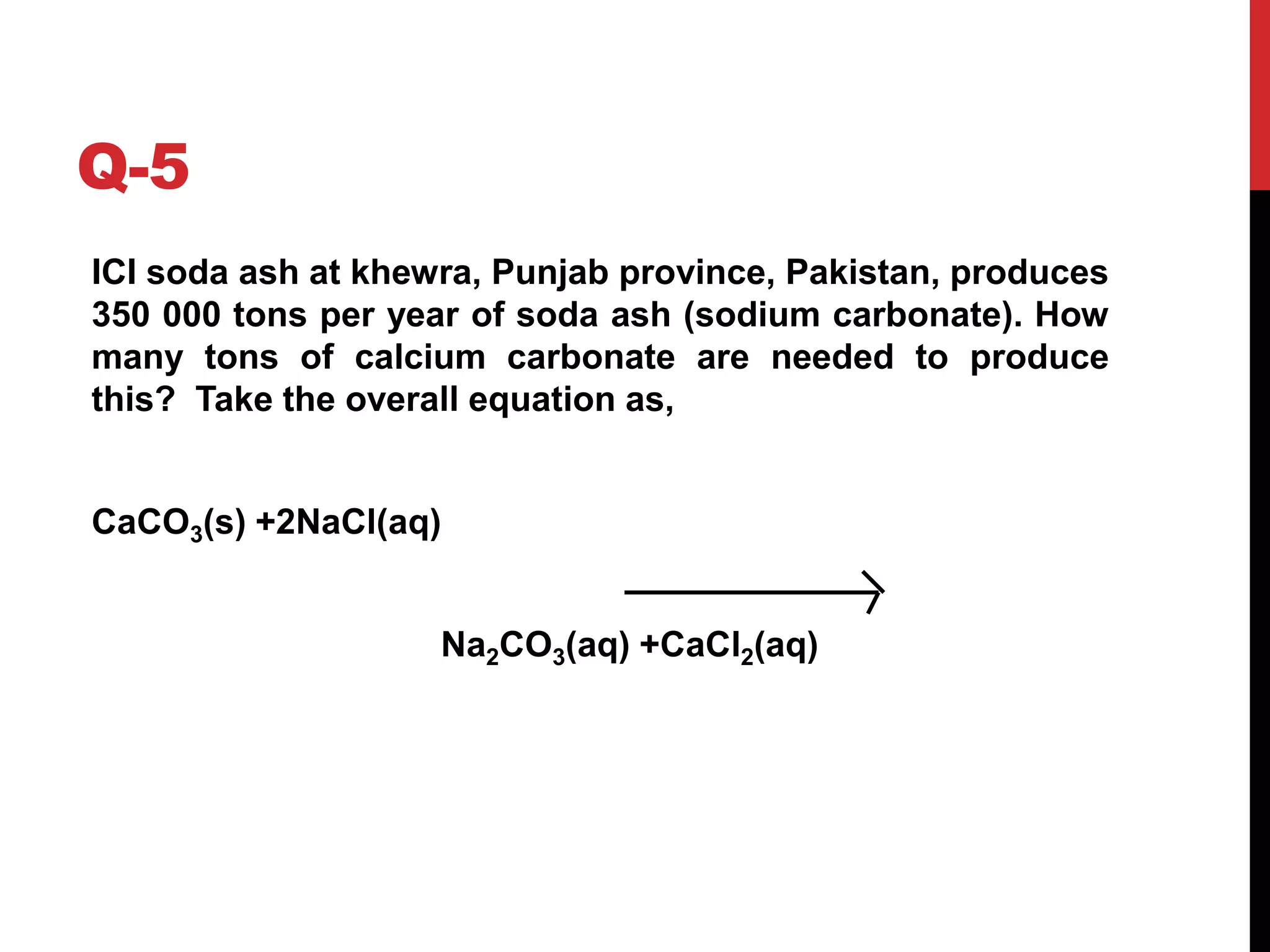
Q-5
ICI soda ash at khewra, Punjab province, Pakistan, produces
350 000 tons per year of soda ash (sodium carbonate). How
many tons of calcium carbonate are needed to produce
this? Take the overall equation as,
CaCO3(s) +2NaCl(aq)
Na2CO3(aq) +CaCl2(aq)
Q-6
Evaporative basins at Dry Creek near Adelaide produce an
average of 650 000 tons per year of salt. This is purified,
then dissolved to form a saturated brine solution that is
pumped to the Solvay plant.
Ammonia is dissolved in the brine solution and then the
ammoniated brine is reacted with carbon dioxide.
I. Write an equation for this reaction.
II. If 50% of the original salt is sodium chloride, what mass
of ammonia will be needed to react with it?
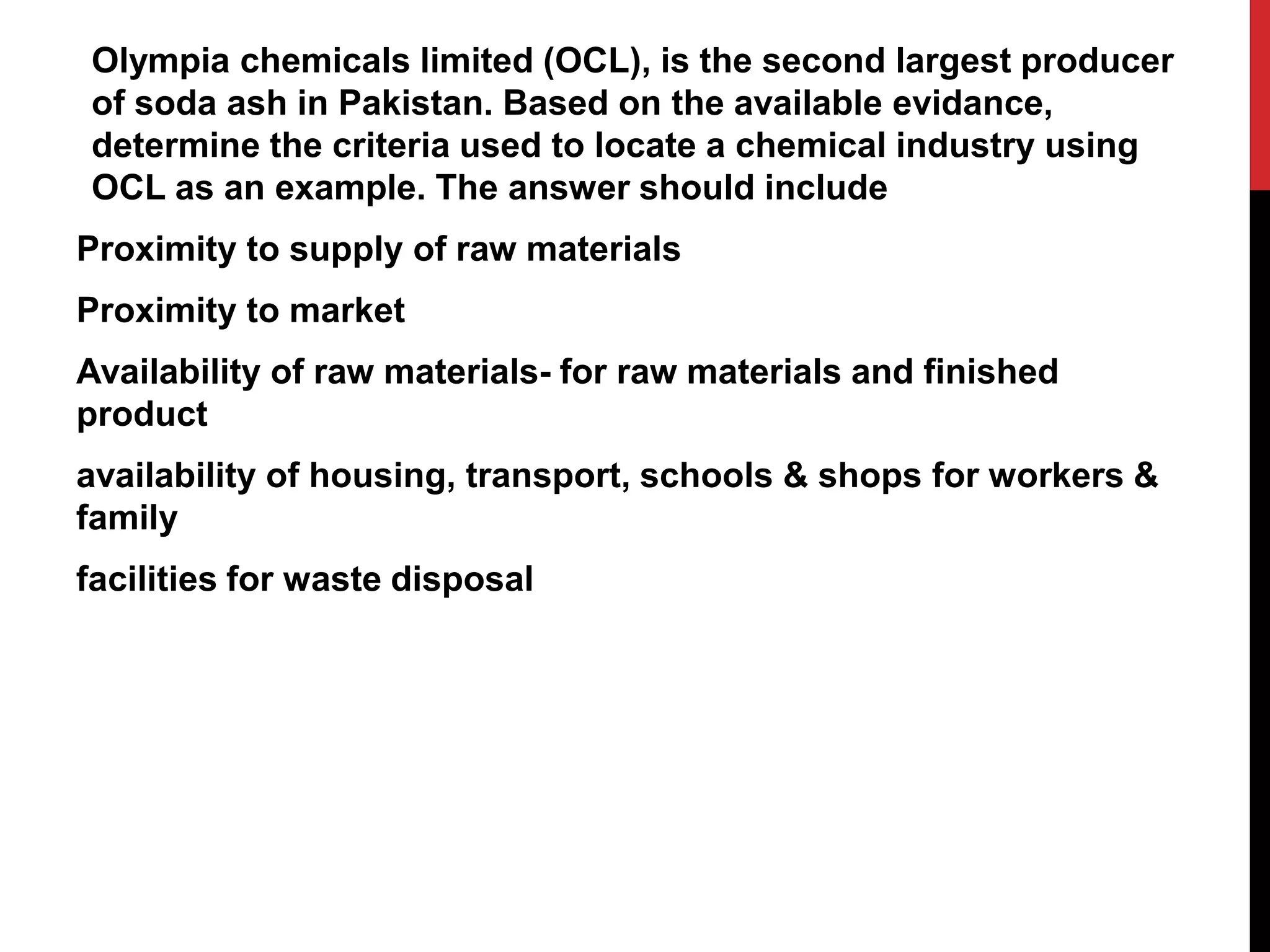
Olympia chemicals limited (OCL), is the second largest producer
of soda ash in Pakistan. Based on the available evidance,
determine the criteria used to locate a chemical industry using
OCL as an example. The answer should include
Proximity to supply of raw materials
Proximity to market
Availability of raw materials- for raw materials and finished
product
availability of housing, transport, schools & shops for workers &
family
facilities for waste disposal
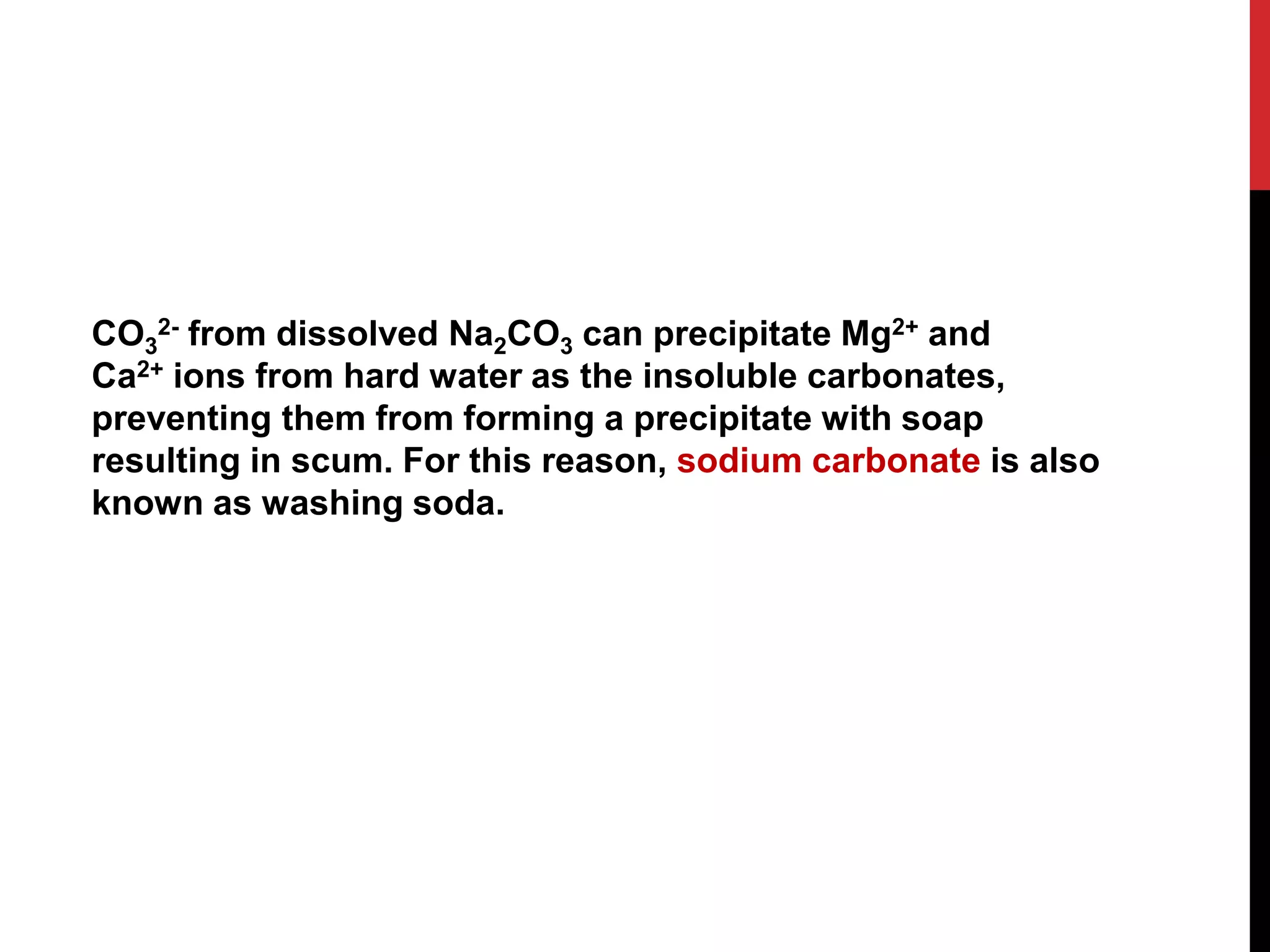
CO3
2- from dissolved Na2CO3 can precipitate Mg2+ and
Ca2+ ions from hard water as the insoluble carbonates,
preventing them from forming a precipitate with soap
resulting in scum. For this reason, sodium carbonate is also
known as washing soda.
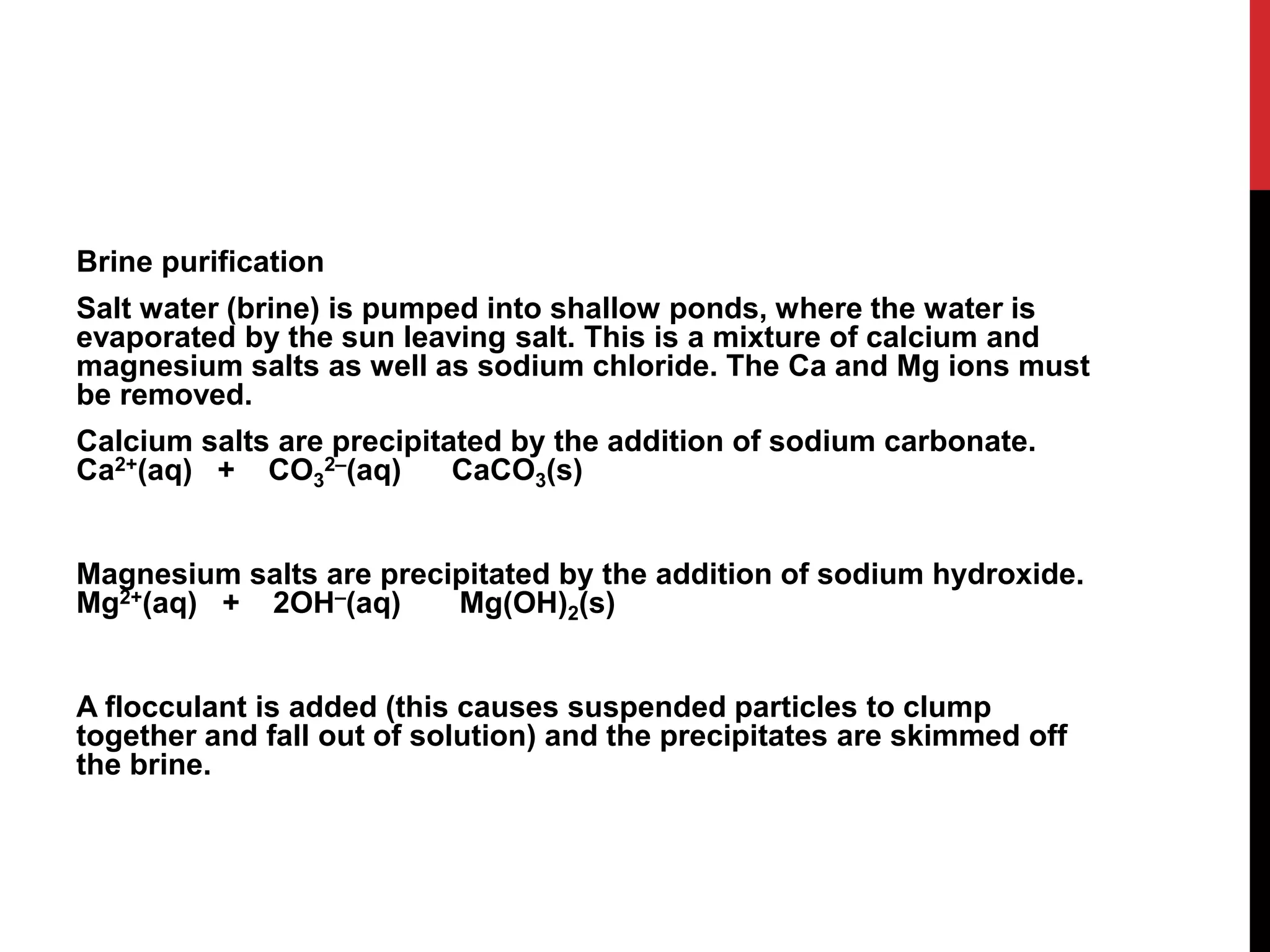
Brine purification
Salt water (brine) is pumped into shallow ponds, where the water is
evaporated by the sun leaving salt. This is a mixture of calcium and
magnesium salts as well as sodium chloride. The Ca and Mg ions must
be removed.
Calcium salts are precipitated by the addition of sodium carbonate.
Ca2+(aq) + CO3
2–(aq) CaCO3(s)
Magnesium salts are precipitated by the addition of sodium hydroxide.
Mg2+(aq) + 2OH–(aq) Mg(OH)2(s)
A flocculant is added (this causes suspended particles to clump
together and fall out of solution) and the precipitates are skimmed off
the brine.
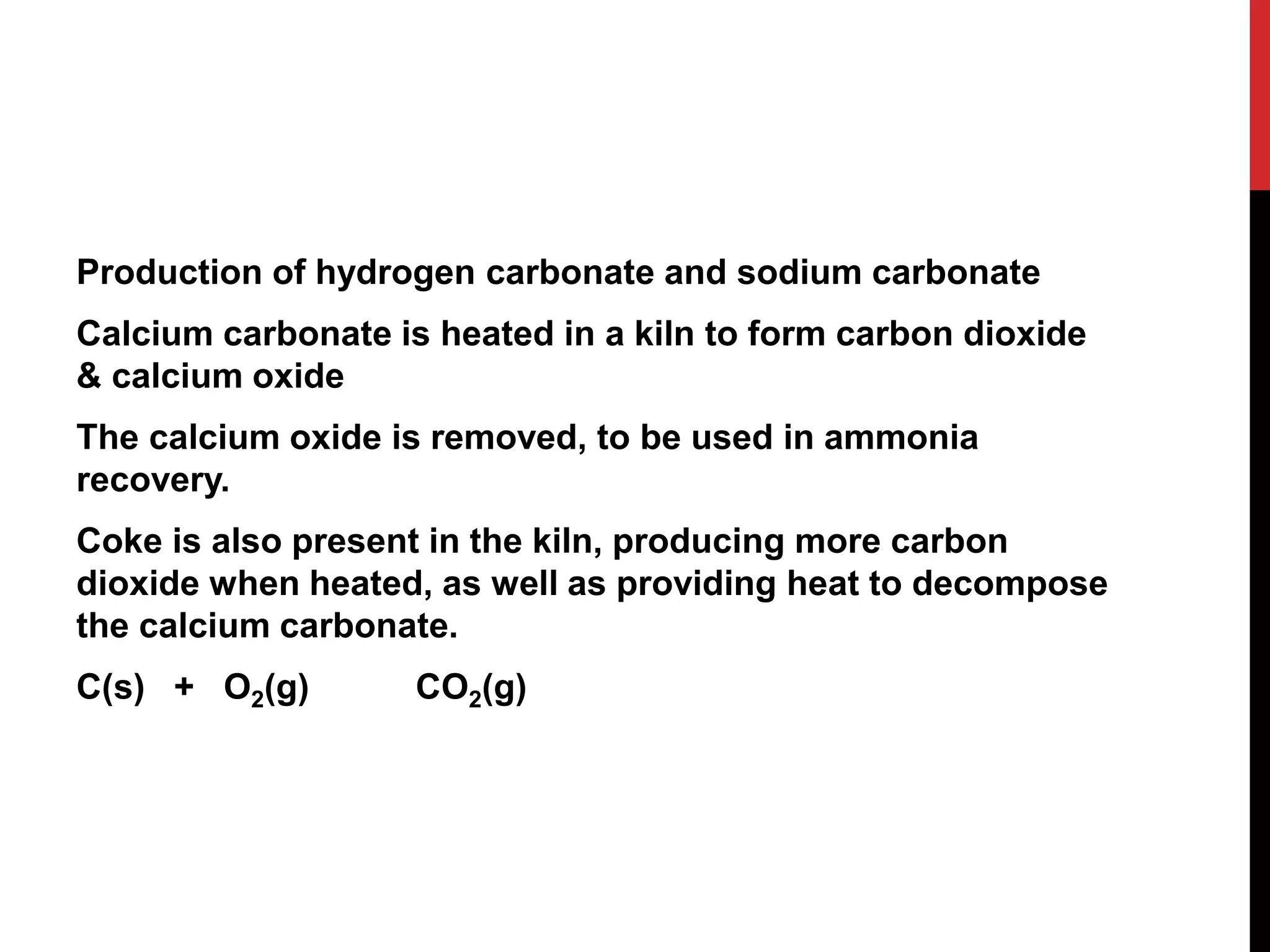
Production of hydrogen carbonate and sodium carbonate
Calcium carbonate is heated in a kiln to form carbon dioxide
& calcium oxide
The calcium oxide is removed, to be used in ammonia
recovery.
Coke is also present in the kiln, producing more carbon
dioxide when heated, as well as providing heat to decompose
the calcium carbonate.
C(s) + O2(g) CO2(g)
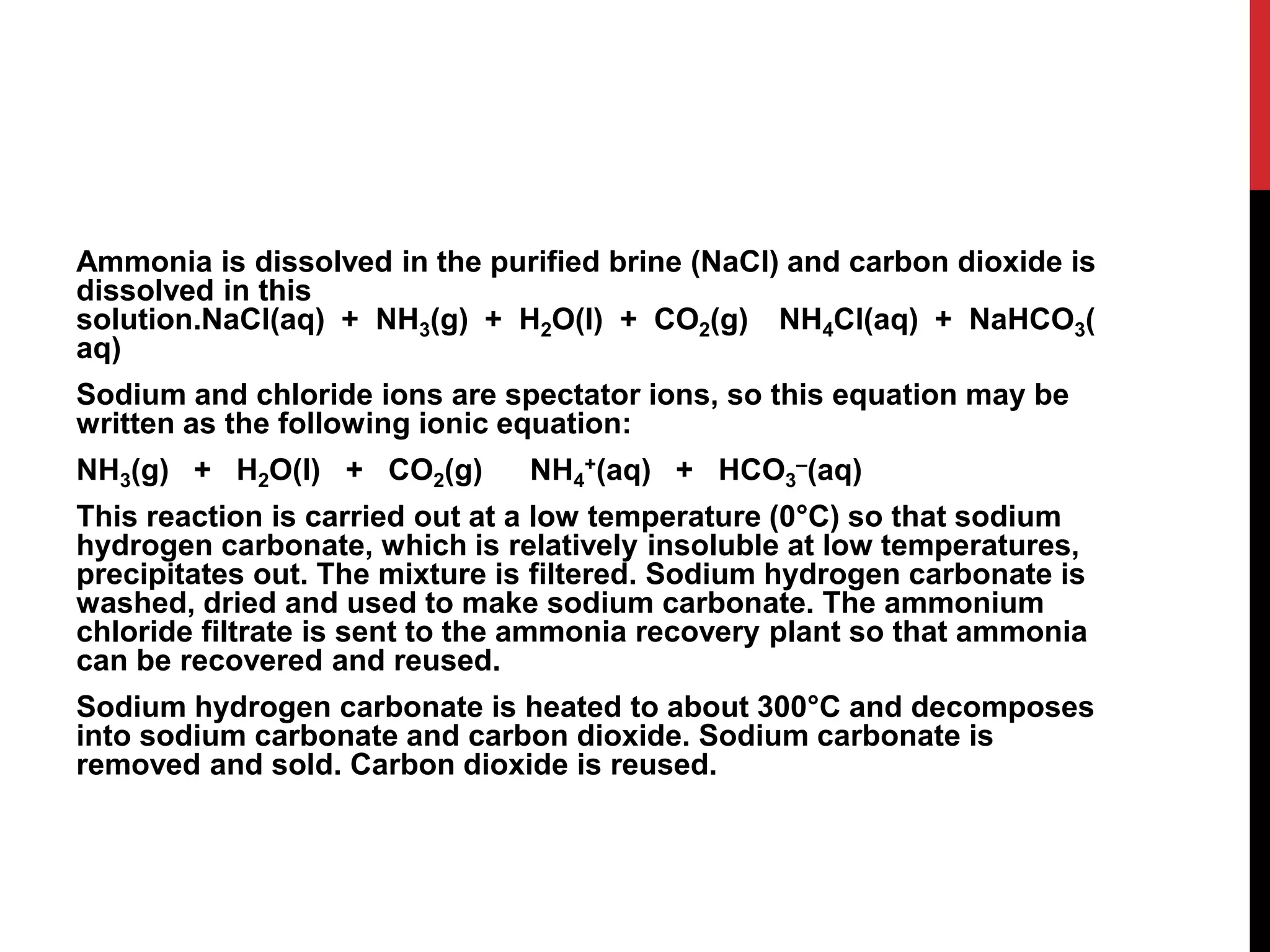
Ammonia is dissolved in the purified brine (NaCl) and carbon dioxide is
dissolved in this
solution.NaCl(aq) + NH3(g) + H2O(l) + CO2(g) NH4Cl(aq) + NaHCO3(
aq)
Sodium and chloride ions are spectator ions, so this equation may be
written as the following ionic equation:
NH3(g) + H2O(l) + CO2(g) NH4
+(aq) + HCO3
–(aq)
This reaction is carried out at a low temperature (0°C) so that sodium
hydrogen carbonate, which is relatively insoluble at low temperatures,
precipitates out. The mixture is filtered. Sodium hydrogen carbonate is
washed, dried and used to make sodium carbonate. The ammonium
chloride filtrate is sent to the ammonia recovery plant so that ammonia
can be recovered and reused.
Sodium hydrogen carbonate is heated to about 300°C and decomposes
into sodium carbonate and carbon dioxide. Sodium carbonate is
removed and sold. Carbon dioxide is reused.
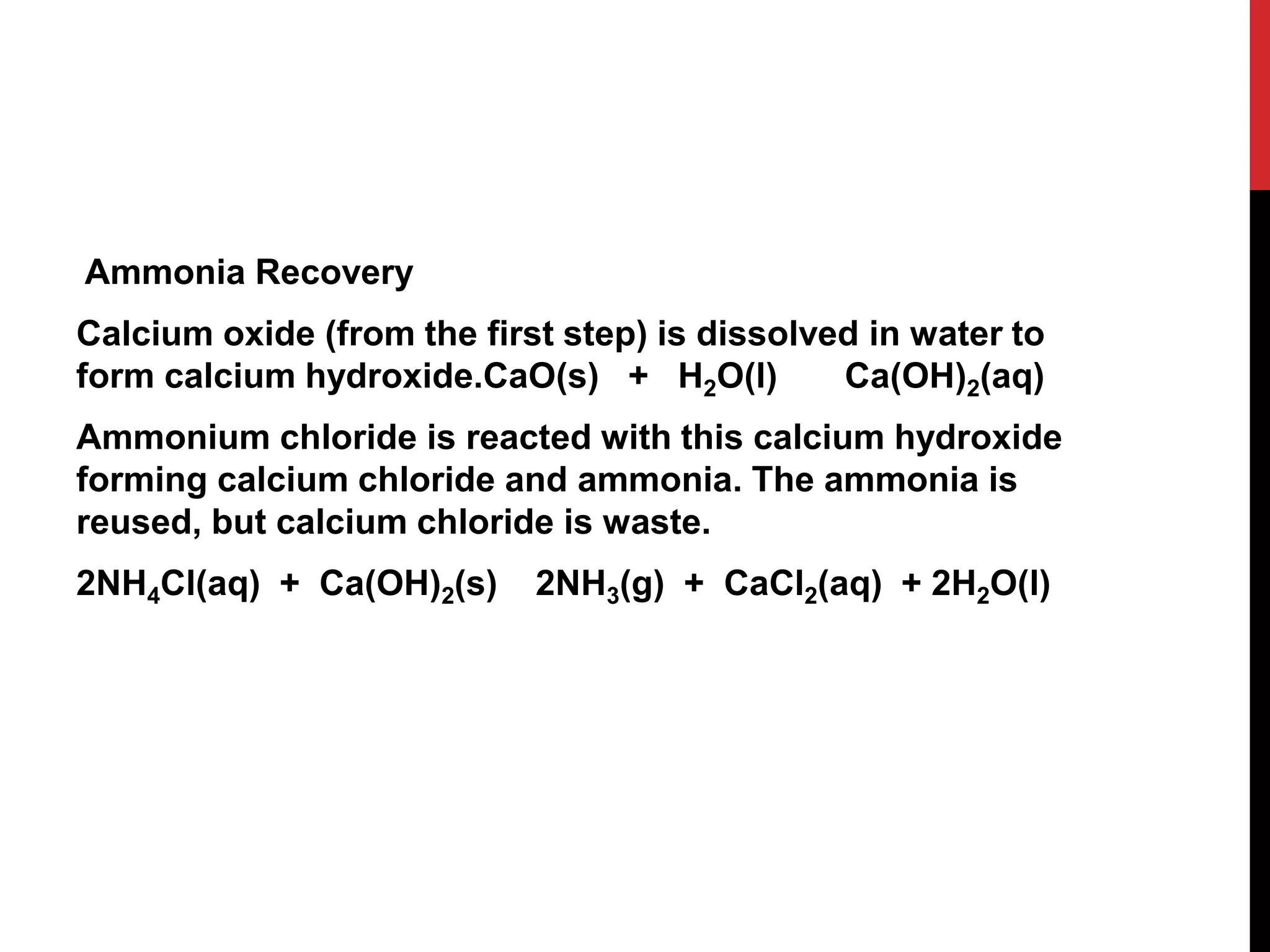
Ammonia Recovery
Calcium oxide (from the first step) is dissolved in water to
form calcium hydroxide.CaO(s) + H2O(l) Ca(OH)2(aq)
Ammonium chloride is reacted with this calcium hydroxide
forming calcium chloride and ammonia. The ammonia is
reused, but calcium chloride is waste.
2NH4Cl(aq) + Ca(OH)2(s) 2NH3(g) + CaCl2(aq) + 2H2O(l)
Calculate moles
From the periodic table, molar mass of Na2CO3 = 2 x 22.99
+ 12.01 + 3 x 16.00 = 105.99 g
no mol in 325 000 tonnes = 325 000 x 1 000 000/105.99 =
3066 327 000 mol
From the equation:
1 mol Na2CO3 produced from 1 mol CaCO3
3 066 327 000 mol Na2CO3 produced from 3 066 327 000 mol
CaCO3
Moles to mass
1 mol CaCO3 = 40.08 + 12.01 + 3 x 16.00 = 100.09 g
3 066 327 000 mol CaCO3 = 100.08 x 3 066 327 000 = 306 878
006 200 g = 306 878 tonnes CaCO3
Q6
NaCl(aq) + NH3(g) + H2O(l) + CO2(g) NH4Cl(aq) +
NaHCO3(aq)
50% 650 000 = 325 000 tonnes
Calculate moles
1 mol NaCl = 22.99 + 35.45 = 58.44 g
325 000 tonnes = 325.000 x 1 000 000/58.44 = 5 561 259 411
mol NaCl
From the equation
1 mol NaCl reacts with 1 mol NH3
5 561 259 411 mol NaCl reacts with 5 561259 411 mol NH3
Moles to mass
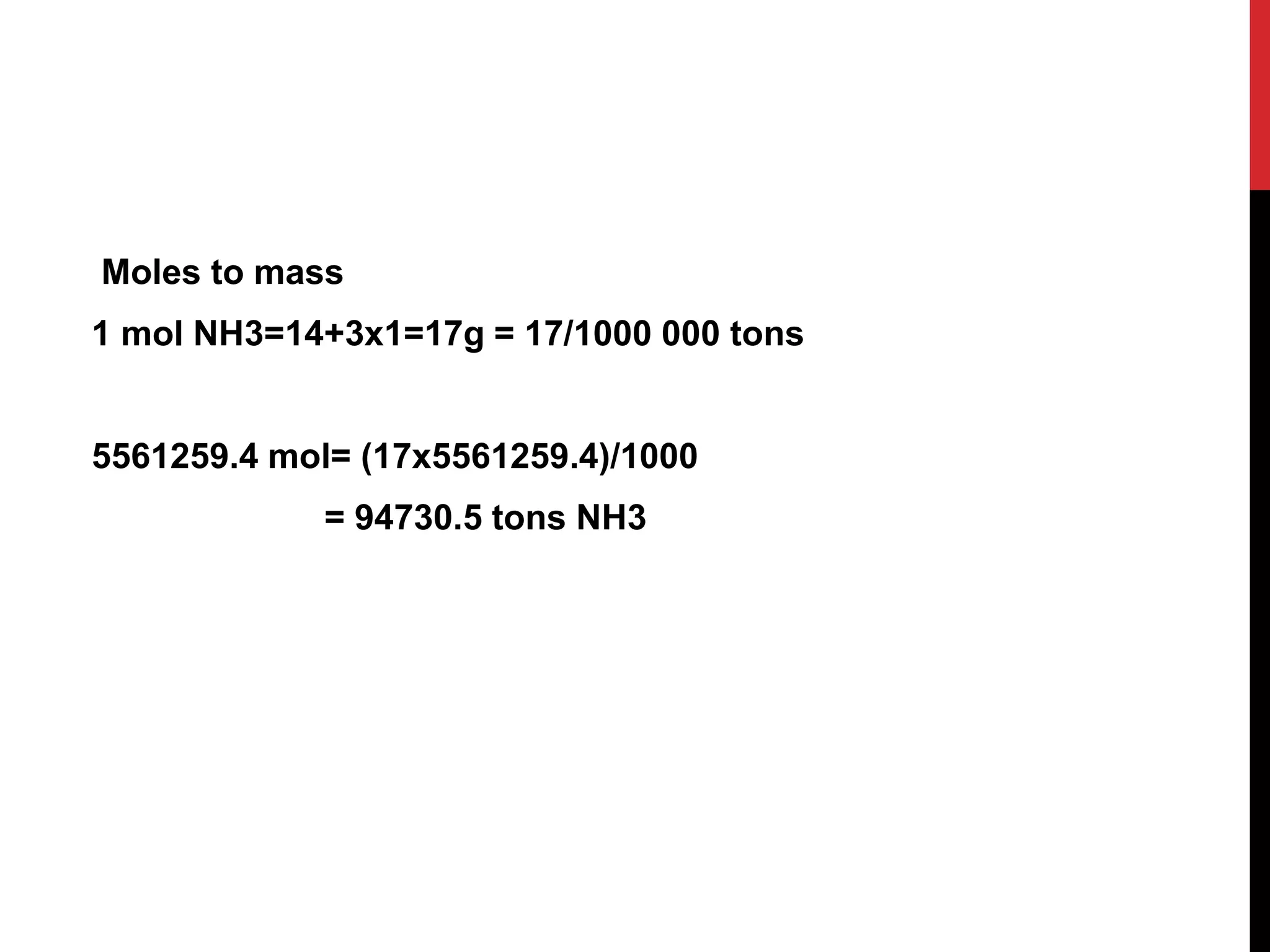
Moles to mass
1 mol NH3=14+3x1=17g = 17/1000 000 tons
5561259.4 mol= (17x5561259.4)/1000
= 94730.5 tons NH3

Soda ash manufacturing and process flow diagram

  • 1.
    SODAASH AND BAKINGSODA INDUSTRY USAMA PERVAIZ BS CHEMICAL ENGINEER Department of Chemical Engineering, CIIT Lahore
  • 2.
    PRODUCTION OF SODIUM CARBONATE/BICARBONATE •Uses and History • Raw materials • Process flow diagram • Steps involved in production •
  • 3.
    Uses of SodiumCarbonate Use Process Notes Glass Making A mixture of Na2CO3, CaCO3 and SiO2(silicon dioxide sand) is used for window or bottle glass. Water Softening Agent CO3 2- from dissolved Na2CO3 can precipitate Mg2+ and Ca2+ ions from hard water as the insoluble carbonates, preventing them from forming a precipitate with soap resulting in scum. For this reason, sodium carbonate is also known as washing soda. Paper Making Na2CO3 is used to produce the NaHSO3necessary for the sulfite method of separating lignin from cellulose. Baking Soda Production Baking soda (or sodium hydrogen carbonate or sodium bicarbonate), NaHCO3, is used in food preparation and in fire extinguishers. Sodium Hydroxide Production for Soaps and Detergents Na2CO3 is reacted with a Ca(OH)2, slaked lime, suspension.
  • 4.
    RAW MATERIALS • SALT(SODIUMCHLORIDE) • LIME STONE • COAL • AMMONIA • DEIONIZED WATER
  • 5.
  • 6.
  • 7.
    STEPS INVOLVED INTHE PRODUCTION OF NA2CO3 /NAHCO3 BY SOLVAY PROCESS 1- Ammonia absorption Saturation of salt solution with ammonia bubble and cap absorber
  • 8.
    1.Trayed towers (platecolumns). 2.Packed columns.
  • 9.
  • 10.
    SOLVAY PROCESS……….CONTD. 2- Burning oflimestone to produce carbon dioxide and lime • Combustion of C to CO2 (highly exothermic and produces 96.5 Kcal/mole of C burnt) • Decomposition of 1 mole of CaCO3 need 43.44 Kcal Thus mixing lime with coke…….
  • 11.
    SOLVAY PROCESS CONTD. 3- TheSolvay tower/carbonation of ammoniated brine
  • 12.
    SOLVAY PROCESS………..CONTD. 4- Separation ofSodium Bicarbonate Filtering and washing of precipitated bicarbonate 5- Thermal decomposition of NaHCO3 to Na2CO3 (Calcination)
  • 13.
  • 14.
  • 15.
    LIGHT VS HEAVY SODAASH Soda ash can be classified into two forms – heavy and light. Product after calcination is called light form is obtained first and some is then converted into the heavy form containing less than 0.5% sodium chloride. Heavy sodium carbonate is obtained by hydrating light sodium carbonate to the monohydrate (Na2CO3.H2O) and then dehydrating it to give a product with an increased crystal size and density. The two grades have different uses. The major uses of heavy sodium carbonate are as a solid, particularly in making glass, where it is used as a flux in the melting of silica (sand). The uses for light sodium carbonate are traditionally where the chemical is required in solution.
  • 16.
    Sodium carbonate, isused In the manufacture of glass, paper, rayon, soaps, and detergents. As a water softener To control pH (carbonate solutions neutralize acids, producing only carbon dioxide and water). In the chemical industry to synthesize many different sodium compounds, including sodium bicarbonate (baking soda), sodium silicate (used in detergents), sodium tripolyphosphate (a detergent builder), sodium hydroxide (lye), sodium chromate and sodium dichromate (used in chrome plating), sodium aluminate (used in refining aluminum), and sodium cyanide (for electroplating).
  • 17.
    Q-1 Why sodium carbonatecalled as washing soda?
  • 18.
    Q-2 Identify the rawmaterials used in the Solvay process and name the products
  • 19.
    Q-3 Describe the usesof sodium carbonate
  • 20.
    Q-4 Identify the sequenceof steps used in the Solvay process and describe the chemistry involved in: brine purification hydrogen carbonate formation formation of sodium carbonate ammonia recovery.
  • 21.
    Q-5 ICI soda ashat khewra, Punjab province, Pakistan, produces 350 000 tons per year of soda ash (sodium carbonate). How many tons of calcium carbonate are needed to produce this? Take the overall equation as, CaCO3(s) +2NaCl(aq) Na2CO3(aq) +CaCl2(aq)
  • 22.
    Q-6 Evaporative basins atDry Creek near Adelaide produce an average of 650 000 tons per year of salt. This is purified, then dissolved to form a saturated brine solution that is pumped to the Solvay plant. Ammonia is dissolved in the brine solution and then the ammoniated brine is reacted with carbon dioxide. I. Write an equation for this reaction. II. If 50% of the original salt is sodium chloride, what mass of ammonia will be needed to react with it?
  • 23.
    Olympia chemicals limited(OCL), is the second largest producer of soda ash in Pakistan. Based on the available evidance, determine the criteria used to locate a chemical industry using OCL as an example. The answer should include Proximity to supply of raw materials Proximity to market Availability of raw materials- for raw materials and finished product availability of housing, transport, schools & shops for workers & family facilities for waste disposal
  • 24.
    CO3 2- from dissolvedNa2CO3 can precipitate Mg2+ and Ca2+ ions from hard water as the insoluble carbonates, preventing them from forming a precipitate with soap resulting in scum. For this reason, sodium carbonate is also known as washing soda.
  • 25.
    Brine purification Salt water(brine) is pumped into shallow ponds, where the water is evaporated by the sun leaving salt. This is a mixture of calcium and magnesium salts as well as sodium chloride. The Ca and Mg ions must be removed. Calcium salts are precipitated by the addition of sodium carbonate. Ca2+(aq) + CO3 2–(aq) CaCO3(s) Magnesium salts are precipitated by the addition of sodium hydroxide. Mg2+(aq) + 2OH–(aq) Mg(OH)2(s) A flocculant is added (this causes suspended particles to clump together and fall out of solution) and the precipitates are skimmed off the brine.
  • 26.
    Production of hydrogencarbonate and sodium carbonate Calcium carbonate is heated in a kiln to form carbon dioxide & calcium oxide The calcium oxide is removed, to be used in ammonia recovery. Coke is also present in the kiln, producing more carbon dioxide when heated, as well as providing heat to decompose the calcium carbonate. C(s) + O2(g) CO2(g)
  • 27.
    Ammonia is dissolvedin the purified brine (NaCl) and carbon dioxide is dissolved in this solution.NaCl(aq) + NH3(g) + H2O(l) + CO2(g) NH4Cl(aq) + NaHCO3( aq) Sodium and chloride ions are spectator ions, so this equation may be written as the following ionic equation: NH3(g) + H2O(l) + CO2(g) NH4 +(aq) + HCO3 –(aq) This reaction is carried out at a low temperature (0°C) so that sodium hydrogen carbonate, which is relatively insoluble at low temperatures, precipitates out. The mixture is filtered. Sodium hydrogen carbonate is washed, dried and used to make sodium carbonate. The ammonium chloride filtrate is sent to the ammonia recovery plant so that ammonia can be recovered and reused. Sodium hydrogen carbonate is heated to about 300°C and decomposes into sodium carbonate and carbon dioxide. Sodium carbonate is removed and sold. Carbon dioxide is reused.
  • 28.
    Ammonia Recovery Calcium oxide(from the first step) is dissolved in water to form calcium hydroxide.CaO(s) + H2O(l) Ca(OH)2(aq) Ammonium chloride is reacted with this calcium hydroxide forming calcium chloride and ammonia. The ammonia is reused, but calcium chloride is waste. 2NH4Cl(aq) + Ca(OH)2(s) 2NH3(g) + CaCl2(aq) + 2H2O(l)
  • 29.
    Calculate moles From theperiodic table, molar mass of Na2CO3 = 2 x 22.99 + 12.01 + 3 x 16.00 = 105.99 g no mol in 325 000 tonnes = 325 000 x 1 000 000/105.99 = 3066 327 000 mol From the equation: 1 mol Na2CO3 produced from 1 mol CaCO3 3 066 327 000 mol Na2CO3 produced from 3 066 327 000 mol CaCO3 Moles to mass 1 mol CaCO3 = 40.08 + 12.01 + 3 x 16.00 = 100.09 g 3 066 327 000 mol CaCO3 = 100.08 x 3 066 327 000 = 306 878 006 200 g = 306 878 tonnes CaCO3
  • 30.
    Q6 NaCl(aq) + NH3(g)+ H2O(l) + CO2(g) NH4Cl(aq) + NaHCO3(aq) 50% 650 000 = 325 000 tonnes Calculate moles 1 mol NaCl = 22.99 + 35.45 = 58.44 g 325 000 tonnes = 325.000 x 1 000 000/58.44 = 5 561 259 411 mol NaCl From the equation 1 mol NaCl reacts with 1 mol NH3 5 561 259 411 mol NaCl reacts with 5 561259 411 mol NH3 Moles to mass
  • 31.
    Moles to mass 1mol NH3=14+3x1=17g = 17/1000 000 tons 5561259.4 mol= (17x5561259.4)/1000 = 94730.5 tons NH3