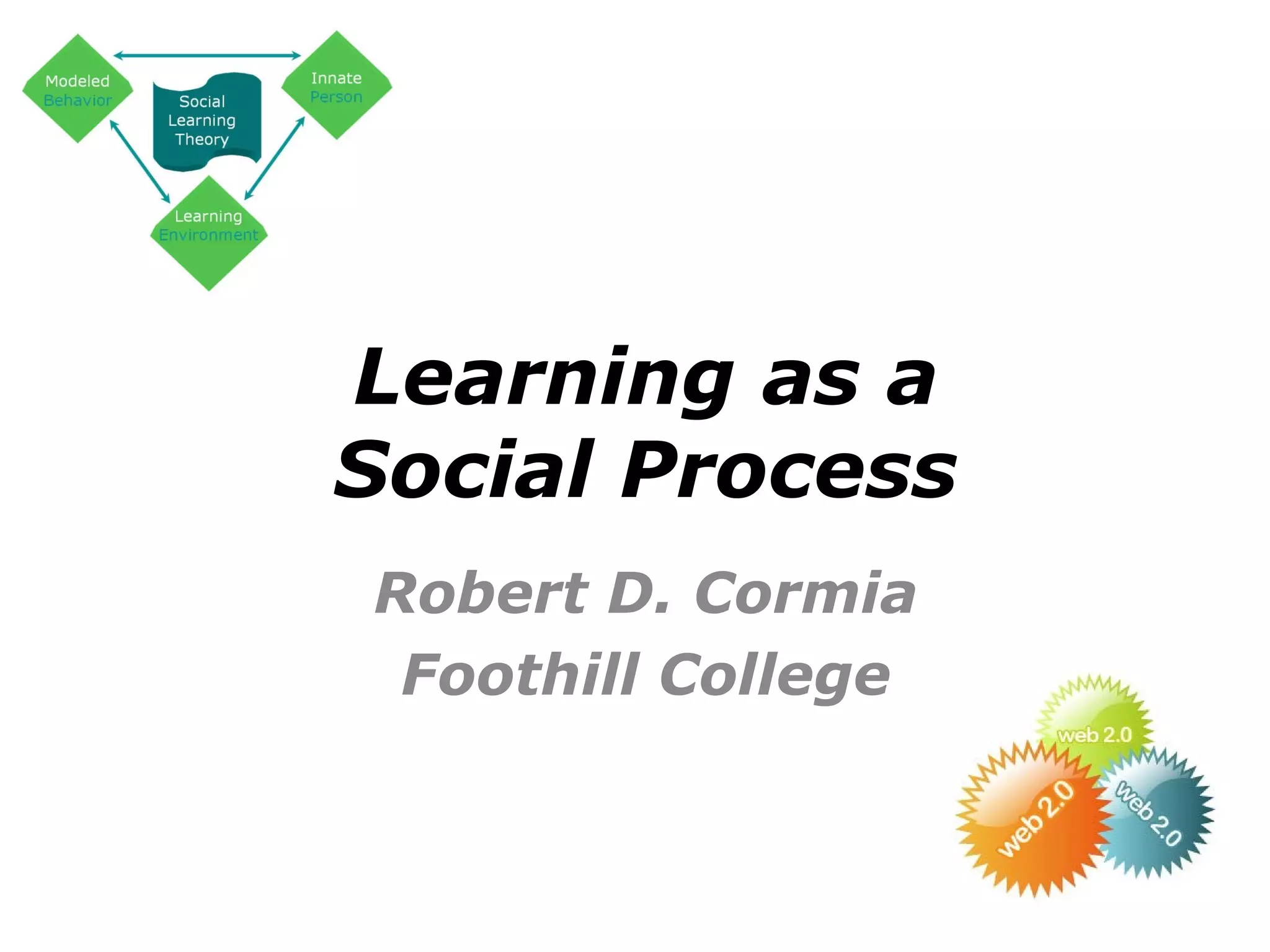
Learning as a Social Process Robert D. Cormia Foothill College
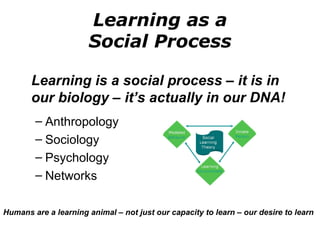
Learning as a Social Process Learning is a social process – it is in our biology – it’s actually in our DNA! Anthropology Sociology Psychology Networks Humans are a learning animal – not just our capacity to learn – our desire to learn
Social Learning is the Tail of the Learning Process Posted by:  John  in  social learning   Kevin Jones  (from the  Cascadia   blog  , but not this time) has presented at the  ASTD TechKnowledge   Conference  in San Antonio this week and shows the role of  Social Learning  as the tail of the  learning  process.  http://frontlinelearning.edublogs.org/tag/cascadia/
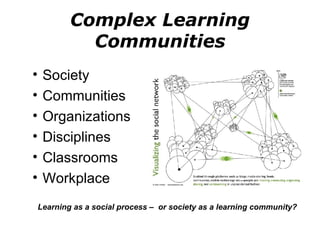
Complex Learning Communities Society Communities Organizations Disciplines Classrooms Workplace  Learning as a social process –  or society as a learning community?
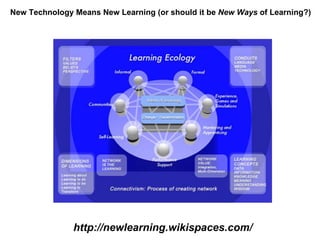
http://newlearning.wikispaces.com/ New Technology Means New Learning (or should it be  New Ways  of Learning?)
Actively engaging students in the learning process  rather than allowing them to be  passive recipients  of content. Experts proposed that  interaction, participation, and social learning experiences  might be key factors that  promote connection and less isolation . http://activeinstruction.com/custom3.html  What is Social Constructivist Learning?
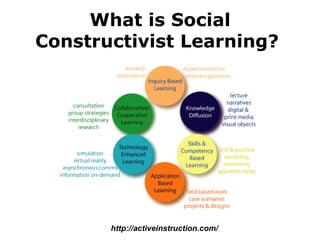
What is Social Constructivist Learning?  http://activeinstruction.com/
Social Computing Social computing  is a general term for an area of  computer science  that is concerned with the intersection of  social behavior  and  computational systems . It is used in two ways. Technology mediated social transactions Augmented social cognition (PARC) Think, reason, and remember ( Wisdom of Crowds ) http://en.wikipedia.org/wiki/Social_computing
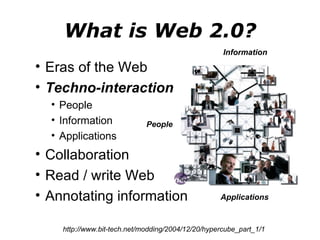
What is Web 2.0? Eras of the Web Techno-interactions: People Information Applications Collaboration Read / write Web Annotating information http://www.bit-tech.net/modding/2004/12/20/hypercube_part_1/1 People Applications Information
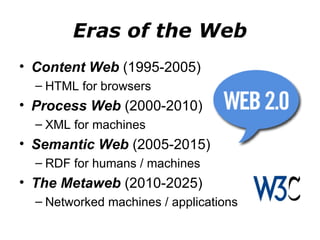
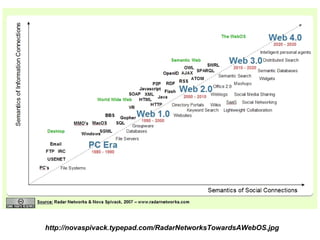
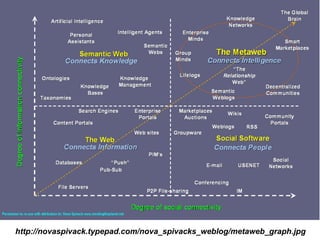
Eras of the Web Content Web  (1995-2005) HTML for browsers Process Web  (2000-2010) XML for machines Semantic Web  (2005-2015) RDF for humans / machines The Metaweb  (2010-2025) Networked machines / applications
http://novaspivack.typepad.com/RadarNetworksTowardsAWebOS.jpg
http://novaspivack.typepad.com/nova_spivacks_weblog/metaweb_graph.jpg
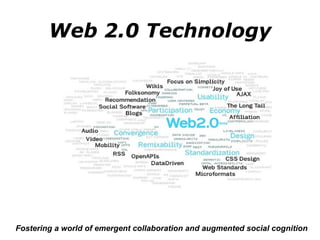
Web 2.0 Technology Fostering a world of emergent collaboration and augmented social cognition
What is Web 2.0? Web 2.0 is ‘made of people’ It is both  human  and  ‘emergent’ Augmented social cognition A lot like  ‘pre-web’  AOL and BBS More powerful, and ‘generational’ Web 2.0 tools    social process
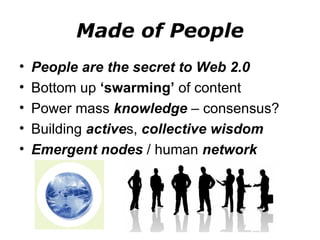
Made of People People are the secret to Web 2.0 Bottom up  ‘swarming’  of content Power mass  knowledge  – consensus? Building  active s,  collective wisdom Emergent nodes  / human  network
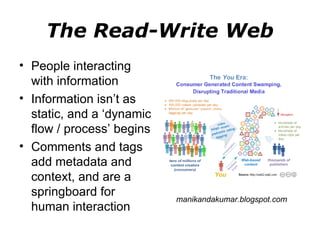
The Read-Write Web People interacting with information Information isn’t as static, and a ‘dynamic flow / process’ begins Comments and tags add metadata and context, and are a springboard for human interaction manikandakumar.blogspot.com
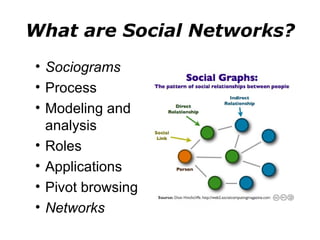
What are Social Networks? Sociograms   Process Modeling and analysis Roles Applications Pivot browsing Networks
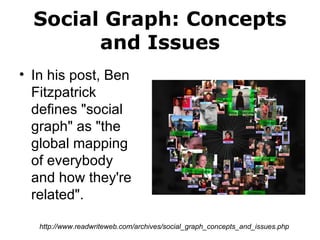
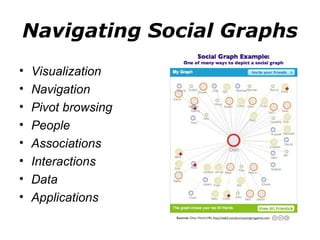
Social Graph: Concepts and Issues In his post, Ben Fitzpatrick defines "social graph" as "the global mapping of everybody and how they're related". http://www.readwriteweb.com/archives/social_graph_concepts_and_issues.php
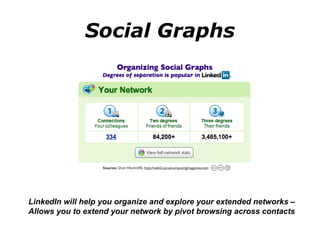
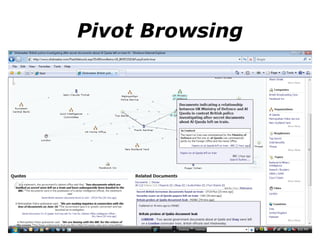
Social Graphs LinkedIn will help you organize and explore your extended networks –  Allows you to extend your network by pivot browsing across contacts
Navigating Social Graphs Visualization Navigation Pivot browsing People Associations Interactions Data Applications
Pivot Browsing
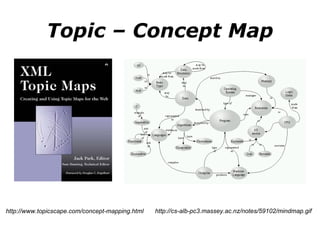
Topic – Concept Map http://cs-alb-pc3.massey.ac.nz/notes/59102/mindmap.gif http://www.topicscape.com/concept-mapping.html
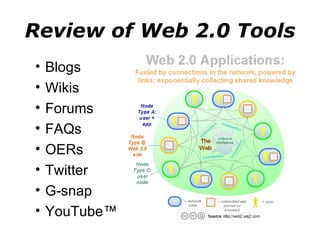
Review of Web 2.0 Tools Blogs Wikis Forums FAQs OERs Twitter G-snap YouTube™
Blogs Personal and group publishing You publish – readers comment Basis of ‘citizen journalism’ Early and ‘informal’ reporting  ‘ Bottom up’ vs. ‘top down’ Easy Web publishing / templates Blogger.com WordPress.org
RSS Really Simple Syndication Publishing news and content alerts CNN news alerts Snippet publishing News, alerts, lists iTunes top 10 list Addendum to blogging Notification of new posts
Wikis MediaWiki Wikipedia Wikibooks Wikiversity WikiProject http://www.mediawiki.org/wiki/MediaWiki
Wikipatterns Optimizing: Adoption Productivity Collaboration Interactions Flows Conflict Management Goals Outcomes http://www.wikipatterns.com/display/wikipatterns/Wikipatterns
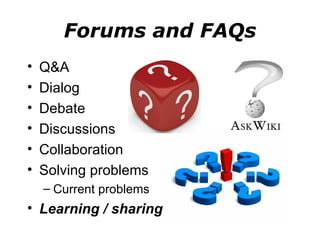
Forums and FAQs Q&A Dialog Debate Discussions  Collaboration Solving problems Current problems Learning / sharing
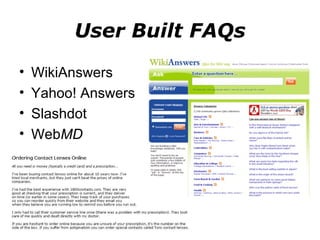
User Built FAQs WikiAnswers Yahoo! Answers Slashdot  Web MD
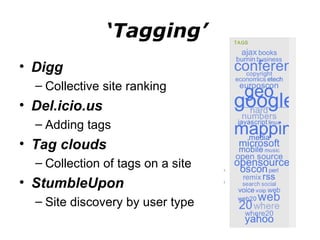
‘ Tagging’  Digg Collective site ranking Del.icio.us Adding tags Tag clouds Collection of tags on a site StumbleUpon Site discovery by user type
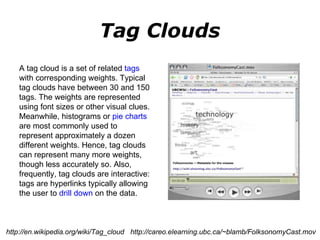
Tag Clouds A tag cloud is a set of related  tags  with corresponding weights. Typical tag clouds have between 30 and 150 tags. The weights are represented using font sizes or other visual clues. Meanwhile, histograms or  pie charts  are most commonly used to represent approximately a dozen different weights. Hence, tag clouds can represent many more weights, though less accurately so. Also, frequently, tag clouds are interactive: tags are hyperlinks typically allowing the user to  drill down  on the data. http://en.wikipedia.org/wiki/Tag_cloud  http://careo.elearning.ubc.ca/~blamb/FolksonomyCast.mov
Social Media  Meets Social Learning Image from http://www.biojobblog.com/ Trademarks property of respective owners
Social Media Properties YouTube™ MySpace Facebook Wikipedia LinkedIn Del.ico.us StumbleUpon Second Life
Twitter SMS ‘ IM cast’ 140 characters Tweets Follow people Searchable Twitter is a service for friends, family, and co–workers to communicate and stay connected through the exchange of quick, frequent answers to one simple question:  What are you doing? http://www.twitter.com/
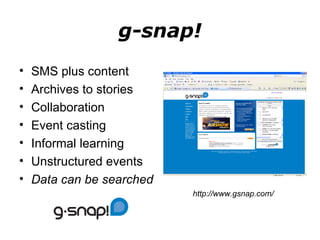
g-snap! SMS plus content Archives to stories Collaboration  Event casting Informal learning Unstructured events Data can be searched http://www.gsnap.com/
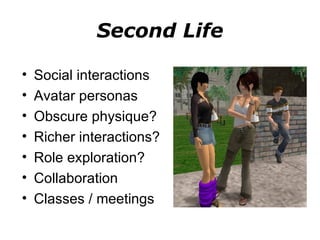
Second Life Social interactions Avatar personas Obscure physique? Richer interactions? Role exploration? Collaboration Classes / meetings
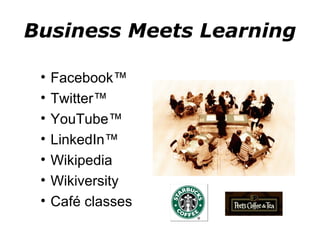
Business Meets Learning Facebook™ Twitter™ YouTube™ LinkedIn™ Wikipedia Wikiversity Café classes
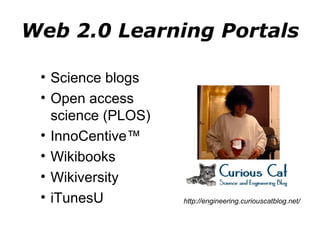
Web 2.0 Learning Portals Science blogs Open access science (PLOS) InnoCentive™ Wikibooks Wikiversity iTunesU http://engineering.curiouscatblog.net/
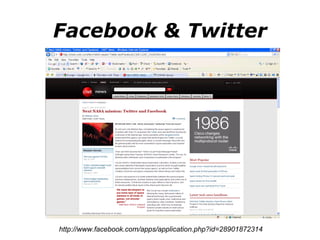
Facebook & Twitter http://www.facebook.com/apps/application.php?id=28901872314
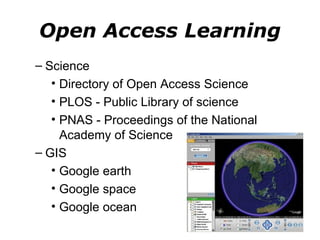
Open Access Learning Science Directory of Open Access Science PLOS - Public Library of science PNAS - Proceedings of the National Academy of Science GIS Google earth Google space Google ocean
 
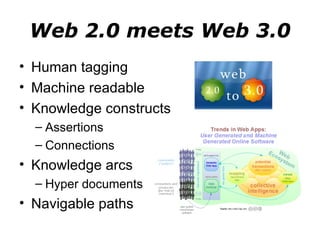
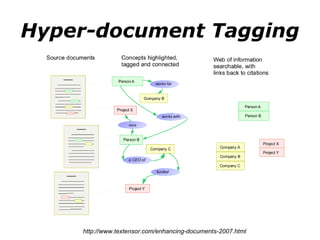
Web 2.0 meets Web 3.0 Human tagging Machine readable Knowledge constructs Assertions Connections Knowledge arcs Hyper documents Navigable paths
Semantic Wiki Project WikiProteins Google Knol™ Semantic Web One Notebook™ One Textbook™ http://meta.wikimedia.org/wiki/Semantic_MediaWiki
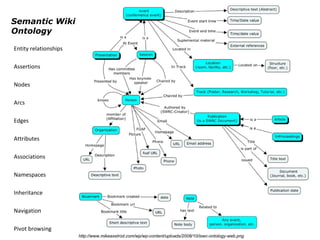
Semantic Wiki Ontology Entity relationships Assertions Nodes Arcs Edges Attributes Associations Namespaces Inheritance Navigation Pivot browsing http://www.mikeaxelrod.com/wp/wp-content/uploads/2008/10/iswc-ontology-web.png
Hyper-document Tagging http://www.textensor.com/enhancing-documents-2007.html
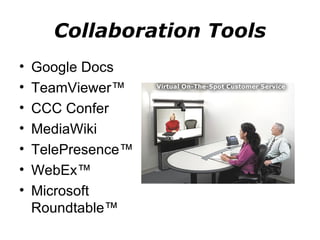
Collaboration Tools Google Docs TeamViewer™ CCC Confer MediaWiki TelePresence™ WebEx™ Microsoft Roundtable™
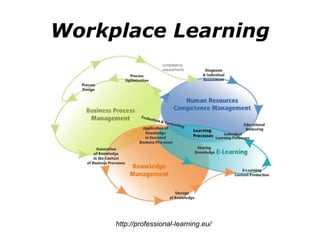
Workplace Learning http://professional-learning.eu/
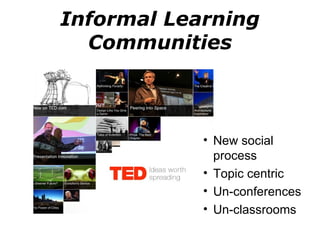
Informal Learning Communities New social process Topic centric Un-conferences Un-classrooms
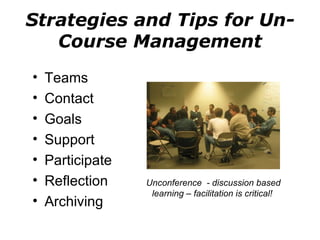
Strategies and Tips for Un-Course Management Teams Contact Goals Support Participate Reflection Archiving Unconference  - discussion based learning – facilitation is critical!
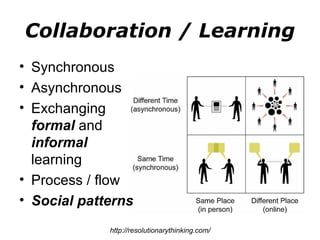
Collaboration / Learning Synchronous Asynchronous Exchanging  formal  and  informal  learning Process / flow Social patterns http://resolutionarythinking.com/
Knowledge Work Evolves Impersonal knowledge  is those ideas and pieces of information made explicit in documents and files  ( sometimes email ). Personal knowledge  is the tacit learning locked inside our heads (not written down). Interpersonal knowledge  is implicit between  and among individuals and embedded in conversations and connections (esp. email).
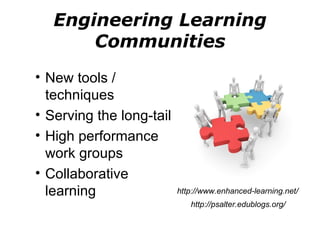
Engineering Learning Communities New tools / techniques Serving the long-tail High performance work groups Collaborative learning http://www.enhanced-learning.net/ http://psalter.edublogs.org/
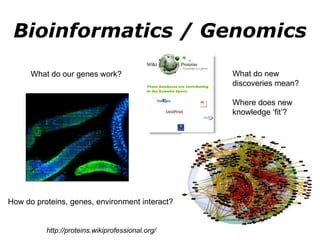
Bioinformatics / Genomics What do our genes work? What do new discoveries mean? Where does new knowledge ‘fit’? How do proteins, genes, environment interact? http://proteins.wikiprofessional.org/
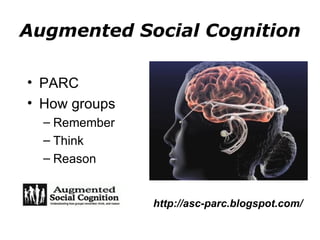
Augmented Social Cognition PARC How groups Remember Think Reason http://asc-parc.blogspot.com/
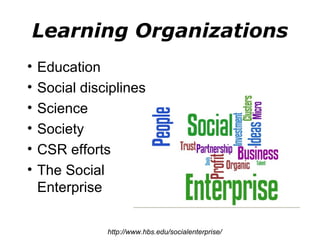
Learning Organizations Education Social disciplines Science Society CSR efforts The Social Enterprise http://www.hbs.edu/socialenterprise/
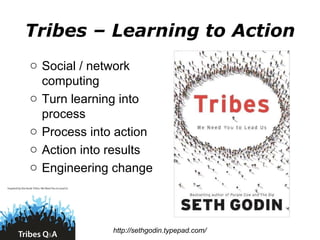
Tribes – Learning to Action Social / network computing Turn learning into process Process into action Action into results Engineering change http://sethgodin.typepad.com/
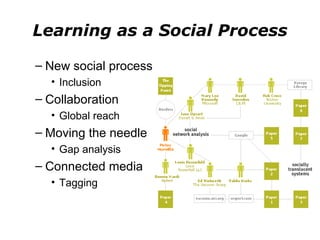
Learning as a Social Process New social process Inclusion Collaboration Global reach Moving the needle Gap analysis Connected media Tagging
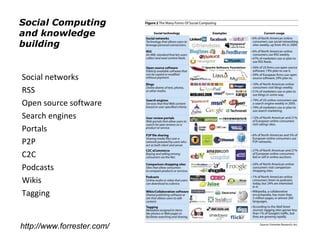
Social Computing and knowledge building Social networks RSS Open source software Search engines Portals P2P C2C Podcasts Wikis Tagging http://www.forrester.com/
Summary Learning is a social process Web 2.0 tools  strengthen social transactions  and  collaboration Informal  and  workplace learning  is significant in a  knowledge economy Adult learners and  knowledge workers  need tools for  learning
References PARC –  http://www.parc.com/ Google –  http://www.google.com/ W3C – http://www.w3c.org/ MediaWiki –  http://www.mediawiki.org/ WikiProject –  http://en.wikipedia.org/wiki/Semantic_wiki/ Open Educational Resources –  http://www.oercommons.org/

Learning as a Social Process

  • 1.
    Learning as aSocial Process Robert D. Cormia Foothill College
  • 2.
    Learning as aSocial Process Learning is a social process – it is in our biology – it’s actually in our DNA! Anthropology Sociology Psychology Networks Humans are a learning animal – not just our capacity to learn – our desire to learn
  • 3.
    Social Learning isthe Tail of the Learning Process Posted by: John in social learning Kevin Jones (from the Cascadia blog , but not this time) has presented at the ASTD TechKnowledge Conference in San Antonio this week and shows the role of Social Learning as the tail of the learning process. http://frontlinelearning.edublogs.org/tag/cascadia/
  • 4.
    Complex Learning CommunitiesSociety Communities Organizations Disciplines Classrooms Workplace Learning as a social process – or society as a learning community?
  • 5.
    http://newlearning.wikispaces.com/ New TechnologyMeans New Learning (or should it be New Ways of Learning?)
  • 6.
    Actively engaging studentsin the learning process rather than allowing them to be passive recipients of content. Experts proposed that interaction, participation, and social learning experiences might be key factors that promote connection and less isolation . http://activeinstruction.com/custom3.html What is Social Constructivist Learning?
  • 7.
    What is SocialConstructivist Learning? http://activeinstruction.com/
  • 8.
    Social Computing Socialcomputing is a general term for an area of computer science that is concerned with the intersection of social behavior and computational systems . It is used in two ways. Technology mediated social transactions Augmented social cognition (PARC) Think, reason, and remember ( Wisdom of Crowds ) http://en.wikipedia.org/wiki/Social_computing
  • 9.
    What is Web2.0? Eras of the Web Techno-interactions: People Information Applications Collaboration Read / write Web Annotating information http://www.bit-tech.net/modding/2004/12/20/hypercube_part_1/1 People Applications Information
  • 10.
    Eras of theWeb Content Web (1995-2005) HTML for browsers Process Web (2000-2010) XML for machines Semantic Web (2005-2015) RDF for humans / machines The Metaweb (2010-2025) Networked machines / applications
  • 11.
  • 12.
  • 13.
    Web 2.0 TechnologyFostering a world of emergent collaboration and augmented social cognition
  • 14.
    What is Web2.0? Web 2.0 is ‘made of people’ It is both human and ‘emergent’ Augmented social cognition A lot like ‘pre-web’ AOL and BBS More powerful, and ‘generational’ Web 2.0 tools  social process
  • 15.
    Made of PeoplePeople are the secret to Web 2.0 Bottom up ‘swarming’ of content Power mass knowledge – consensus? Building active s, collective wisdom Emergent nodes / human network
  • 16.
    The Read-Write WebPeople interacting with information Information isn’t as static, and a ‘dynamic flow / process’ begins Comments and tags add metadata and context, and are a springboard for human interaction manikandakumar.blogspot.com
  • 17.
    What are SocialNetworks? Sociograms Process Modeling and analysis Roles Applications Pivot browsing Networks
  • 18.
    Social Graph: Conceptsand Issues In his post, Ben Fitzpatrick defines "social graph" as "the global mapping of everybody and how they're related". http://www.readwriteweb.com/archives/social_graph_concepts_and_issues.php
  • 19.
    Social Graphs LinkedInwill help you organize and explore your extended networks – Allows you to extend your network by pivot browsing across contacts
  • 20.
    Navigating Social GraphsVisualization Navigation Pivot browsing People Associations Interactions Data Applications
  • 21.
  • 22.
    Topic – ConceptMap http://cs-alb-pc3.massey.ac.nz/notes/59102/mindmap.gif http://www.topicscape.com/concept-mapping.html
  • 23.
    Review of Web2.0 Tools Blogs Wikis Forums FAQs OERs Twitter G-snap YouTube™
  • 24.
    Blogs Personal andgroup publishing You publish – readers comment Basis of ‘citizen journalism’ Early and ‘informal’ reporting ‘ Bottom up’ vs. ‘top down’ Easy Web publishing / templates Blogger.com WordPress.org
  • 25.
    RSS Really SimpleSyndication Publishing news and content alerts CNN news alerts Snippet publishing News, alerts, lists iTunes top 10 list Addendum to blogging Notification of new posts
  • 26.
    Wikis MediaWiki WikipediaWikibooks Wikiversity WikiProject http://www.mediawiki.org/wiki/MediaWiki
  • 27.
    Wikipatterns Optimizing: AdoptionProductivity Collaboration Interactions Flows Conflict Management Goals Outcomes http://www.wikipatterns.com/display/wikipatterns/Wikipatterns
  • 28.
    Forums and FAQsQ&A Dialog Debate Discussions Collaboration Solving problems Current problems Learning / sharing
  • 29.
    User Built FAQsWikiAnswers Yahoo! Answers Slashdot Web MD
  • 30.
    ‘ Tagging’ Digg Collective site ranking Del.icio.us Adding tags Tag clouds Collection of tags on a site StumbleUpon Site discovery by user type
  • 31.
    Tag Clouds Atag cloud is a set of related tags with corresponding weights. Typical tag clouds have between 30 and 150 tags. The weights are represented using font sizes or other visual clues. Meanwhile, histograms or pie charts are most commonly used to represent approximately a dozen different weights. Hence, tag clouds can represent many more weights, though less accurately so. Also, frequently, tag clouds are interactive: tags are hyperlinks typically allowing the user to drill down on the data. http://en.wikipedia.org/wiki/Tag_cloud http://careo.elearning.ubc.ca/~blamb/FolksonomyCast.mov
  • 32.
    Social Media Meets Social Learning Image from http://www.biojobblog.com/ Trademarks property of respective owners
  • 33.
    Social Media PropertiesYouTube™ MySpace Facebook Wikipedia LinkedIn Del.ico.us StumbleUpon Second Life
  • 34.
    Twitter SMS ‘IM cast’ 140 characters Tweets Follow people Searchable Twitter is a service for friends, family, and co–workers to communicate and stay connected through the exchange of quick, frequent answers to one simple question: What are you doing? http://www.twitter.com/
  • 35.
    g-snap! SMS pluscontent Archives to stories Collaboration Event casting Informal learning Unstructured events Data can be searched http://www.gsnap.com/
  • 36.
    Second Life Socialinteractions Avatar personas Obscure physique? Richer interactions? Role exploration? Collaboration Classes / meetings
  • 37.
    Business Meets LearningFacebook™ Twitter™ YouTube™ LinkedIn™ Wikipedia Wikiversity Café classes
  • 38.
    Web 2.0 LearningPortals Science blogs Open access science (PLOS) InnoCentive™ Wikibooks Wikiversity iTunesU http://engineering.curiouscatblog.net/
  • 39.
    Facebook & Twitterhttp://www.facebook.com/apps/application.php?id=28901872314
  • 40.
    Open Access LearningScience Directory of Open Access Science PLOS - Public Library of science PNAS - Proceedings of the National Academy of Science GIS Google earth Google space Google ocean
  • 41.
  • 42.
    Web 2.0 meetsWeb 3.0 Human tagging Machine readable Knowledge constructs Assertions Connections Knowledge arcs Hyper documents Navigable paths
  • 43.
    Semantic Wiki ProjectWikiProteins Google Knol™ Semantic Web One Notebook™ One Textbook™ http://meta.wikimedia.org/wiki/Semantic_MediaWiki
  • 44.
    Semantic Wiki OntologyEntity relationships Assertions Nodes Arcs Edges Attributes Associations Namespaces Inheritance Navigation Pivot browsing http://www.mikeaxelrod.com/wp/wp-content/uploads/2008/10/iswc-ontology-web.png
  • 45.
  • 46.
    Collaboration Tools GoogleDocs TeamViewer™ CCC Confer MediaWiki TelePresence™ WebEx™ Microsoft Roundtable™
  • 47.
  • 48.
    Informal Learning CommunitiesNew social process Topic centric Un-conferences Un-classrooms
  • 49.
    Strategies and Tipsfor Un-Course Management Teams Contact Goals Support Participate Reflection Archiving Unconference - discussion based learning – facilitation is critical!
  • 50.
    Collaboration / LearningSynchronous Asynchronous Exchanging formal and informal learning Process / flow Social patterns http://resolutionarythinking.com/
  • 51.
    Knowledge Work EvolvesImpersonal knowledge is those ideas and pieces of information made explicit in documents and files ( sometimes email ). Personal knowledge is the tacit learning locked inside our heads (not written down). Interpersonal knowledge is implicit between and among individuals and embedded in conversations and connections (esp. email).
  • 52.
    Engineering Learning CommunitiesNew tools / techniques Serving the long-tail High performance work groups Collaborative learning http://www.enhanced-learning.net/ http://psalter.edublogs.org/
  • 53.
    Bioinformatics / GenomicsWhat do our genes work? What do new discoveries mean? Where does new knowledge ‘fit’? How do proteins, genes, environment interact? http://proteins.wikiprofessional.org/
  • 54.
    Augmented Social CognitionPARC How groups Remember Think Reason http://asc-parc.blogspot.com/
  • 55.
    Learning Organizations EducationSocial disciplines Science Society CSR efforts The Social Enterprise http://www.hbs.edu/socialenterprise/
  • 56.
    Tribes – Learningto Action Social / network computing Turn learning into process Process into action Action into results Engineering change http://sethgodin.typepad.com/
  • 57.
    Learning as aSocial Process New social process Inclusion Collaboration Global reach Moving the needle Gap analysis Connected media Tagging
  • 58.
    Social Computing andknowledge building Social networks RSS Open source software Search engines Portals P2P C2C Podcasts Wikis Tagging http://www.forrester.com/
  • 59.
    Summary Learning isa social process Web 2.0 tools strengthen social transactions and collaboration Informal and workplace learning is significant in a knowledge economy Adult learners and knowledge workers need tools for learning
  • 60.
    References PARC – http://www.parc.com/ Google – http://www.google.com/ W3C – http://www.w3c.org/ MediaWiki – http://www.mediawiki.org/ WikiProject – http://en.wikipedia.org/wiki/Semantic_wiki/ Open Educational Resources – http://www.oercommons.org/