
Andy Coverdale

Academic Web 2.0
An Introduction to Social and Participatory Media

Commonwealth Scholars Conference
Engineering & Science Graduate Centre
University of Nottingham
27 March 2012
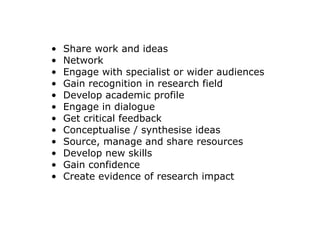
•   Share work and ideas
•   Network
•   Engage with specialist or wider audiences
•   Gain recognition in research field
•   Develop academic profile
•   Engage in dialogue
•   Get critical feedback
•   Conceptualise / synthesise ideas
•   Source, manage and share resources
•   Develop new skills
•   Gain confidence
•   Create evidence of research impact
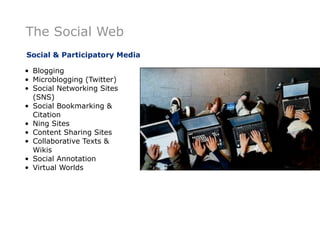
The Social Web
Social & Participatory Media

• Blogging
• Microblogging (Twitter)
• Social Networking Sites
  (SNS)
• Social Bookmarking &
  Citation
• Ning Sites
• Content Sharing Sites
• Collaborative Texts &
  Wikis
• Social Annotation
• Virtual Worlds
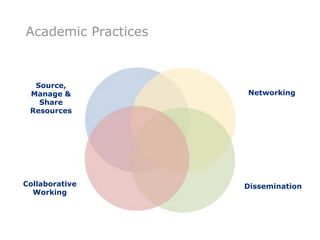
Academic Practices


  Source,
 Manage &            Networking
   Share
 Resources


Collaborative        Dissemination
  Working
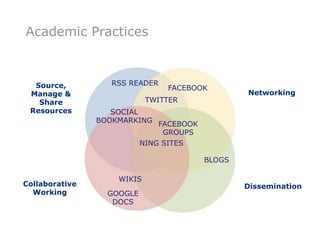
Academic Practices


  Source,          RSS READER
                                FACEBOOK
 Manage &                                       Networking
   Share                    TWITTER
 Resources         SOCIAL
                BOOKMARKING FACEBOOK
                               GROUPS
                          NING SITES

                                        BLOGS

                    WIKIS
Collaborative                                   Dissemination
  Working         GOOGLE
                   DOCS
Tools and Spaces
Blogging

Blogs
• e.g. Wordpress http://wordpress.org
• e.g. Blogger http://www.blogger.com

‘Tumblogs’
• e.g. Tumblr http://www.tumblr.com
• e.g. Posterous https://posterous.com

Hosting
• Developer-hosted
• Self-hosted

Technologies
• Increasingly multimedia – links, tags, RSS feeds, images & video
• New forms of blogging – e.g. audio & video blogging
Blogging: Blog Writing

Writing Skills
• Regularity – writing discipline
• Informality – opportunities to experiment with different writing styles
• Generality – writing to a wider audience

Writing Contexts
• Shape ideas, formulate thoughts, and concepts
• Work in progress – raw content for thesis, journal article or conference
  paper
• Subjective and biographical – emphasis on personal perspective,
  opinion and experience
Blogging: Impact and Peer Review

The ‘Blogosphere’
• Blogging community – reading, linking to, and commenting on other
  blogs
• Comments and pingbacks – feedback and peer review

Informal, Distributed and Frequent
• Establish sustainable channels of discussion, feedback and peer
  support
• Extend beyond immediate research community – geographically and
  disciplinary
Blogging: Process and Reflection

Narrative
• Journal style entry provides narrative structure (e.g. doctoral experience)

Reflective and Evidential
• Demonstration and documentation of process

Navigation
• Searchable facility
• Chronological (time-based) – by date, month, year
• Conceptual (ideas-based) – by category or tags
Twitter

Features
•   Microcontent – ‘tweets’ (maximum 140 characters)
•   Following and followers
•   Retweeting, direct messaging and replies
•   Lists, favourites and hashtags

Twitter Technologies
• Twitter clients and services – interfaces, content support, tracking and
  visualisation etc.
• Interconnectivity with other social media – e.g. linking to blogs
Twitter: Academic Practice

• Knowledge / resource sharing – posting, accessing and ‘retweeting’
  links
• Notification – new blog posts, publications and bookmarks, events, call
  for papers, announcements etc.
• Self-promotion
• ‘Crowdsourcing’ – asking questions, making enquiries, seeking
  solutions
• Real-time social networking and interaction
• Real-time search engine
• Events and conferences – the ‘backchannel’ and remote conferencing
• Institutions and organisations
Tagging: Bookmarking
Personal Bookmarking
• Personal organisation / management of Bookmarks
• Searchable – Tag List / Cloud
• Further Organisation Tools – Bundle Tags / Multiple Sites

Social Bookmarking
• Use as search engine – keyword / user
• Search other users bookmarks
• Subscriptions, networks etc.
• http://delicious.com
• http://pinboard.in
• http://evernote.com

Tagging Content
• Tagging also used in blogging, and content sharing sites
  (e.g. Flickr, YouTube, Slideshare etc.)
Content Sharing

•   Sharing of academic content in different forms / media
•   Dissemination of work to a wider audience
•   Tagging and annotation of content
•   Content can be linked to / embedded on other sites (e.g. blogs)

Presentations
• e.g. Slideshare http://www.slideshare.net

Papers / Documents
• e.g. Scribd http://www.scribd.com

Networking Sites
• e.g. Academia http://academia.edu
Syndication and Aggregation

The navigation and management of digital environments through the
syndication and aggregation of multiple sites, tools and services.

RSS (Really Simple Syndication)
Subscribe to blogs, websites, podcasts etc.

Types of RSS / Feed Readers
• Desktop-based
• Browser-based
• Web-based

Web Portals
Integration between applications
(e.g. http://google/ig, http://netvibes.com etc.)
Collaborative Editing

Google Docs
• Collaborative real-time editing of texts and documents
• Basic chat functionality
• https://docs.google.com/

Wikis
• Collaborative text development
• Collaborative project work and text development
• Resource sharing
• http://www.wikispaces.com/
• http://pbworks.com/
• https://sites.google.com/
Digital Identity
“The persona an individual
presents across all the digital
communities in which he or she
is represented”

http://thisisme.reading.ac.uk
Digital Identit(y/ies): Identity in Practice

Identity Dichotomies
•   Public & Private
•   Work & Recreational
•   Professional & Personal
•   Formal & Informal

Contexts
• Social, cultural and professional
• Physical, online and virtual
• Communities and networks
• Social interactions are increasingly distributed
  – 'networked individualism’
• Multiple domains – multi-membership
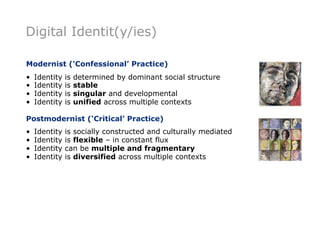
Digital Identit(y/ies)

Modernist (‘Confessional’ Practice)
•   Identity   is   determined by dominant social structure
•   Identity   is   stable
•   Identity   is   singular and developmental
•   Identity   is   unified across multiple contexts

Postmodernist (‘Critical’ Practice)
•   Identity   is socially constructed and culturally mediated
•   Identity   is flexible – in constant flux
•   Identity   can be multiple and fragmentary
•   Identity   is diversified across multiple contexts
Digital Identity and Reputation

Identity Control
•   Personal profiles
•   Digital / online CVs and e-Portfolios
•   Password management (e.g. Open ID)
•   Ownership and intellectual property

Digital Artefacts
• Records of social interaction – blog posts, tweets, etc.
• Permanence - digital artifacts are increasingly searchable / traceable

Modality
• Textual, visual etc.
• Multimedia – images, video etc.
Summary

• Social media both challenges and augments established academic
  practices
• Effectiveness of social media is situated in individual practices and
  disciplinary knowledge cultures
• Should be embedded in everyday academic practice
• Researchers need to develop their own strategies and develop context
  specific solutions
• Effective use of social media requires developing reflective and
  critical practices
Reflective and Critical Practices
• Identifying appropriate tools and platforms and evaluating their
  affordances
• Developing self- and collaborative organisational and time-management
  skills
• Identifying appropriate training needs and training opportunities
• Transference to lifelong learning and professional development contexts
• Engaging in opportunities for sharing practice
• Developing potential for individual, participatory and collaborative design
• Negotiating new socio-technical academic communities and networks
• Boundary-crossing of disciplinary and interdisciplinary contexts
• Recognising shifts in academic protocols; new modes and means of
  production, peer review and knowledge resources
• Adapting to new practices in academic integrity and responsibility -
  referencing and attribution of digital sources and artefacts
• Negotiating institutional, proprietary, freeware and open-source tools and
  platforms
• Understanding emerging multimedia and multimodal literacies
• Managing online identities and reputation
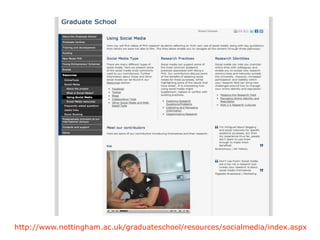
http://www.nottingham.ac.uk/graduateschool/resources/socialmedia/index.aspx
Thanks


Andy Coverdale
http://phdblog.net
Twitter: andycoverdale
ttxac20@nottingham.ac.uk

Academic Web 2.0: An Introduction to Social and Participatory Media

  • 1.
    Andy Coverdale Academic Web2.0 An Introduction to Social and Participatory Media Commonwealth Scholars Conference Engineering & Science Graduate Centre University of Nottingham 27 March 2012
  • 2.
    Share work and ideas • Network • Engage with specialist or wider audiences • Gain recognition in research field • Develop academic profile • Engage in dialogue • Get critical feedback • Conceptualise / synthesise ideas • Source, manage and share resources • Develop new skills • Gain confidence • Create evidence of research impact
  • 4.
    The Social Web Social& Participatory Media • Blogging • Microblogging (Twitter) • Social Networking Sites (SNS) • Social Bookmarking & Citation • Ning Sites • Content Sharing Sites • Collaborative Texts & Wikis • Social Annotation • Virtual Worlds
  • 5.
    Academic Practices Source, Manage & Networking Share Resources Collaborative Dissemination Working
  • 6.
    Academic Practices Source, RSS READER FACEBOOK Manage & Networking Share TWITTER Resources SOCIAL BOOKMARKING FACEBOOK GROUPS NING SITES BLOGS WIKIS Collaborative Dissemination Working GOOGLE DOCS
  • 7.
  • 8.
    Blogging Blogs • e.g. Wordpresshttp://wordpress.org • e.g. Blogger http://www.blogger.com ‘Tumblogs’ • e.g. Tumblr http://www.tumblr.com • e.g. Posterous https://posterous.com Hosting • Developer-hosted • Self-hosted Technologies • Increasingly multimedia – links, tags, RSS feeds, images & video • New forms of blogging – e.g. audio & video blogging
  • 9.
    Blogging: Blog Writing WritingSkills • Regularity – writing discipline • Informality – opportunities to experiment with different writing styles • Generality – writing to a wider audience Writing Contexts • Shape ideas, formulate thoughts, and concepts • Work in progress – raw content for thesis, journal article or conference paper • Subjective and biographical – emphasis on personal perspective, opinion and experience
  • 10.
    Blogging: Impact andPeer Review The ‘Blogosphere’ • Blogging community – reading, linking to, and commenting on other blogs • Comments and pingbacks – feedback and peer review Informal, Distributed and Frequent • Establish sustainable channels of discussion, feedback and peer support • Extend beyond immediate research community – geographically and disciplinary
  • 11.
    Blogging: Process andReflection Narrative • Journal style entry provides narrative structure (e.g. doctoral experience) Reflective and Evidential • Demonstration and documentation of process Navigation • Searchable facility • Chronological (time-based) – by date, month, year • Conceptual (ideas-based) – by category or tags
  • 12.
    Twitter Features • Microcontent – ‘tweets’ (maximum 140 characters) • Following and followers • Retweeting, direct messaging and replies • Lists, favourites and hashtags Twitter Technologies • Twitter clients and services – interfaces, content support, tracking and visualisation etc. • Interconnectivity with other social media – e.g. linking to blogs
  • 13.
    Twitter: Academic Practice •Knowledge / resource sharing – posting, accessing and ‘retweeting’ links • Notification – new blog posts, publications and bookmarks, events, call for papers, announcements etc. • Self-promotion • ‘Crowdsourcing’ – asking questions, making enquiries, seeking solutions • Real-time social networking and interaction • Real-time search engine • Events and conferences – the ‘backchannel’ and remote conferencing • Institutions and organisations
  • 14.
    Tagging: Bookmarking Personal Bookmarking •Personal organisation / management of Bookmarks • Searchable – Tag List / Cloud • Further Organisation Tools – Bundle Tags / Multiple Sites Social Bookmarking • Use as search engine – keyword / user • Search other users bookmarks • Subscriptions, networks etc. • http://delicious.com • http://pinboard.in • http://evernote.com Tagging Content • Tagging also used in blogging, and content sharing sites (e.g. Flickr, YouTube, Slideshare etc.)
  • 15.
    Content Sharing • Sharing of academic content in different forms / media • Dissemination of work to a wider audience • Tagging and annotation of content • Content can be linked to / embedded on other sites (e.g. blogs) Presentations • e.g. Slideshare http://www.slideshare.net Papers / Documents • e.g. Scribd http://www.scribd.com Networking Sites • e.g. Academia http://academia.edu
  • 16.
    Syndication and Aggregation Thenavigation and management of digital environments through the syndication and aggregation of multiple sites, tools and services. RSS (Really Simple Syndication) Subscribe to blogs, websites, podcasts etc. Types of RSS / Feed Readers • Desktop-based • Browser-based • Web-based Web Portals Integration between applications (e.g. http://google/ig, http://netvibes.com etc.)
  • 17.
    Collaborative Editing Google Docs •Collaborative real-time editing of texts and documents • Basic chat functionality • https://docs.google.com/ Wikis • Collaborative text development • Collaborative project work and text development • Resource sharing • http://www.wikispaces.com/ • http://pbworks.com/ • https://sites.google.com/
  • 18.
    Digital Identity “The personaan individual presents across all the digital communities in which he or she is represented” http://thisisme.reading.ac.uk
  • 19.
    Digital Identit(y/ies): Identityin Practice Identity Dichotomies • Public & Private • Work & Recreational • Professional & Personal • Formal & Informal Contexts • Social, cultural and professional • Physical, online and virtual • Communities and networks • Social interactions are increasingly distributed – 'networked individualism’ • Multiple domains – multi-membership
  • 20.
    Digital Identit(y/ies) Modernist (‘Confessional’Practice) • Identity is determined by dominant social structure • Identity is stable • Identity is singular and developmental • Identity is unified across multiple contexts Postmodernist (‘Critical’ Practice) • Identity is socially constructed and culturally mediated • Identity is flexible – in constant flux • Identity can be multiple and fragmentary • Identity is diversified across multiple contexts
  • 21.
    Digital Identity andReputation Identity Control • Personal profiles • Digital / online CVs and e-Portfolios • Password management (e.g. Open ID) • Ownership and intellectual property Digital Artefacts • Records of social interaction – blog posts, tweets, etc. • Permanence - digital artifacts are increasingly searchable / traceable Modality • Textual, visual etc. • Multimedia – images, video etc.
  • 22.
    Summary • Social mediaboth challenges and augments established academic practices • Effectiveness of social media is situated in individual practices and disciplinary knowledge cultures • Should be embedded in everyday academic practice • Researchers need to develop their own strategies and develop context specific solutions • Effective use of social media requires developing reflective and critical practices
  • 23.
    Reflective and CriticalPractices • Identifying appropriate tools and platforms and evaluating their affordances • Developing self- and collaborative organisational and time-management skills • Identifying appropriate training needs and training opportunities • Transference to lifelong learning and professional development contexts • Engaging in opportunities for sharing practice • Developing potential for individual, participatory and collaborative design • Negotiating new socio-technical academic communities and networks • Boundary-crossing of disciplinary and interdisciplinary contexts • Recognising shifts in academic protocols; new modes and means of production, peer review and knowledge resources • Adapting to new practices in academic integrity and responsibility - referencing and attribution of digital sources and artefacts • Negotiating institutional, proprietary, freeware and open-source tools and platforms • Understanding emerging multimedia and multimodal literacies • Managing online identities and reputation
  • 24.
  • 25.