If They Build It, They Will Come: Creating Opportunities for E-learning Communities of Practice Keith Kirkwood The University of Melbourne Australia Language and Learning Skills Unit http://slideshare.net/sitkasitchensis/if-they-build-it-they-will-come
Outline of Talk Web 2.0  Communities of Practice (CoPs) E-learning Communities of Practice (ElCoPs) Platforms for ElCoPs to emerge
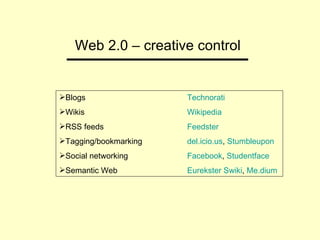
Web 2.0 – creative control Blogs    Technorati Wikis  Wikipedia RSS feeds Feedster Tagging/bookmarking del.icio.us ,  Stumbleupon Social networking Facebook ,  Studentface Semantic Web Eurekster Swiki ,  Me. dium
“ Continual beta, engaging users as co-developers, and principles of harnessing collective intelligence.”   -- Mazurek (in O'Reilly, 2006b, n.p.)
Communities of Practice - CoPs  Informal, bottom-up, fluid groupings of people who share a common practice. Self-organizing and self-regulating Knowledge sharing Neither a team nor a network
“ A community of practice exists because it produces a shared practice as members engage in a collective process of learning”.  --Etienne Wenger (1998, n.p.)
Supporting Pedagogies Constructivism and Constructionism : Learner agency Learners construct artefacts Learners construct knowledge Social interaction Connectivism  (Siemens 2006):  Knowledge rests in the network Learning fluid and multi-focused traditional lecture not current enough Changing nature of knowledge-making Recognize patterns, make connections, contextualization
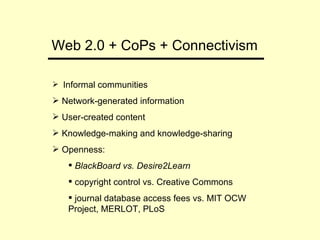
Web 2.0 + CoPs + Connectivism Informal communities Network-generated information User-created content Knowledge-making and knowledge-sharing Openness: BlackBoard vs. Desire2Learn copyright control vs. Creative Commons  journal database access fees vs. MIT OCW  Project, MERLOT, PLoS
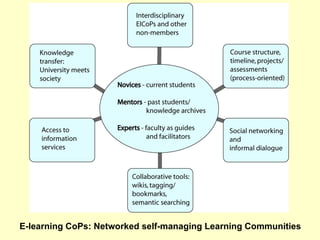
E-learning CoPs: Networked self-managing Learning Communities
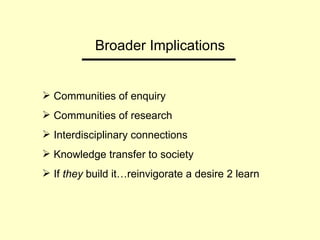
Broader Implications Communities of enquiry Communities of research Interdisciplinary connections Knowledge transfer to society If  they  build it…reinvigorate a desire 2 learn
References Jafari, A., McGee, P., & Carmean, C. (2006). Managing Courses, Defining Learning: What  Faculty, Students, and Administrators Want [Electronic Version].  Educause  Review , 41, 50-71. Retrieved 4 November 2006 from  http://www.educause.edu/apps/er/erm06/erm0643.asp . O'Reilly, T. (2006b). Web 2.0 Principles and Best Practices [Weblog Entry]. O'Reilly®  Radar.  07 November 2006. Retrieved 7 November 2006 from  http://radar.oreilly.com/archives/2006/11/web_20_principl_1.html . Siemens, G. (2004). Connectivism: A Learning Theory for the Digital Age [Electronic Version].  elearnspace . Retrieved 2 November 2006 from  http://www.elearnspace.org/Articles/connectivism.htm . http://www. elearnspace . org/media/Connectivism_IOC/player .html   Wenger, E. (1998). Communities of Practice: Learning as a Social System [Electronic  Version], no pagination. Retrieved 5 November 2006 from  http://www.co-i-l.com/coil/knowledge-garden/cop/lss.shtml   Wenger, E., White, N., Smith, J. D., & Rowe, K. (2005). Technology for communities  [Electronic Version] from  http: //technologyforcommunities .com/ .

If They Build It They Will Come

  • 1.
    If They BuildIt, They Will Come: Creating Opportunities for E-learning Communities of Practice Keith Kirkwood The University of Melbourne Australia Language and Learning Skills Unit http://slideshare.net/sitkasitchensis/if-they-build-it-they-will-come
  • 2.
    Outline of TalkWeb 2.0 Communities of Practice (CoPs) E-learning Communities of Practice (ElCoPs) Platforms for ElCoPs to emerge
  • 3.
    Web 2.0 –creative control Blogs Technorati Wikis Wikipedia RSS feeds Feedster Tagging/bookmarking del.icio.us , Stumbleupon Social networking Facebook , Studentface Semantic Web Eurekster Swiki , Me. dium
  • 4.
    “ Continual beta,engaging users as co-developers, and principles of harnessing collective intelligence.” -- Mazurek (in O'Reilly, 2006b, n.p.)
  • 5.
    Communities of Practice- CoPs Informal, bottom-up, fluid groupings of people who share a common practice. Self-organizing and self-regulating Knowledge sharing Neither a team nor a network
  • 6.
    “ A communityof practice exists because it produces a shared practice as members engage in a collective process of learning”. --Etienne Wenger (1998, n.p.)
  • 7.
    Supporting Pedagogies Constructivismand Constructionism : Learner agency Learners construct artefacts Learners construct knowledge Social interaction Connectivism (Siemens 2006): Knowledge rests in the network Learning fluid and multi-focused traditional lecture not current enough Changing nature of knowledge-making Recognize patterns, make connections, contextualization
  • 8.
    Web 2.0 +CoPs + Connectivism Informal communities Network-generated information User-created content Knowledge-making and knowledge-sharing Openness: BlackBoard vs. Desire2Learn copyright control vs. Creative Commons journal database access fees vs. MIT OCW Project, MERLOT, PLoS
  • 9.
    E-learning CoPs: Networkedself-managing Learning Communities
  • 10.
    Broader Implications Communitiesof enquiry Communities of research Interdisciplinary connections Knowledge transfer to society If they build it…reinvigorate a desire 2 learn
  • 11.
    References Jafari, A.,McGee, P., & Carmean, C. (2006). Managing Courses, Defining Learning: What Faculty, Students, and Administrators Want [Electronic Version]. Educause Review , 41, 50-71. Retrieved 4 November 2006 from http://www.educause.edu/apps/er/erm06/erm0643.asp . O'Reilly, T. (2006b). Web 2.0 Principles and Best Practices [Weblog Entry]. O'Reilly® Radar. 07 November 2006. Retrieved 7 November 2006 from http://radar.oreilly.com/archives/2006/11/web_20_principl_1.html . Siemens, G. (2004). Connectivism: A Learning Theory for the Digital Age [Electronic Version]. elearnspace . Retrieved 2 November 2006 from http://www.elearnspace.org/Articles/connectivism.htm . http://www. elearnspace . org/media/Connectivism_IOC/player .html Wenger, E. (1998). Communities of Practice: Learning as a Social System [Electronic Version], no pagination. Retrieved 5 November 2006 from http://www.co-i-l.com/coil/knowledge-garden/cop/lss.shtml Wenger, E., White, N., Smith, J. D., & Rowe, K. (2005). Technology for communities [Electronic Version] from http: //technologyforcommunities .com/ .

Editor's Notes

  • #2 Introduction: self, LSU, title 7-11, KFC: what if?: intelligent evolution. KFC more popular AIRport: attract more Websites students like: MySpace, Wikipedia; how different? Do something, change this website, tell your friends, meet friends Encourage content-creation and community building E-commerce trend: user control, co-partners in innovation, build community. “ crowdsurfing”: thinktank If students help build e-learning sites…tools, structures, metadata…