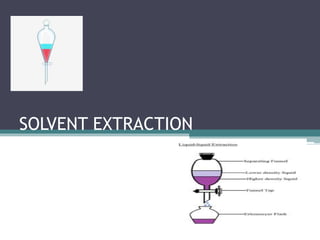
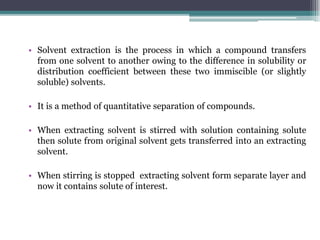
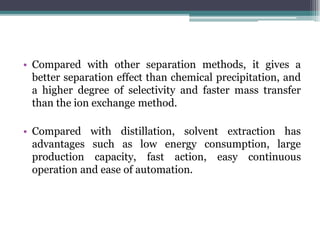
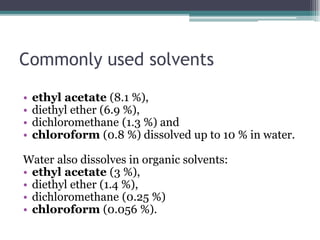
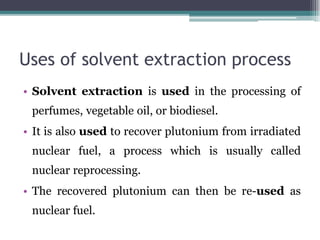
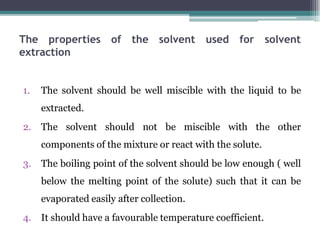
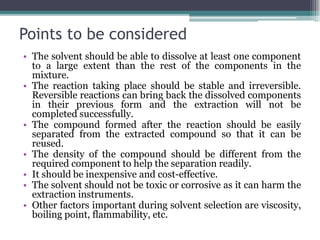
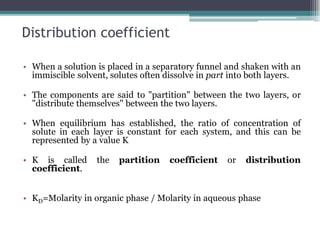
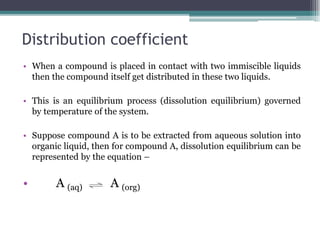
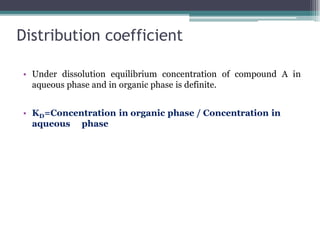
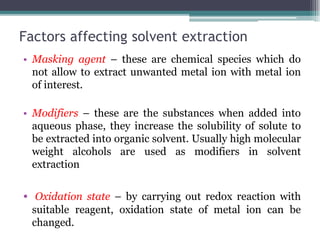
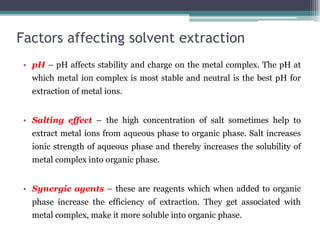
Solvent extraction is a method of quantitative separation of compounds using two immiscible liquids. When a solution containing a solute is mixed with an extracting solvent, the solute transfers from one solvent to the other based on differences in solubility. This process establishes an equilibrium defined by the distribution coefficient, which represents the ratio of solute concentrations in each solvent layer. Factors like pH, temperature, and addition of chelating or synergistic agents can influence the extraction efficiency. Solvent extraction is commonly used for purification in industries like oil processing and nuclear reprocessing due to advantages of low energy use, high throughput, and ease of automation compared to other separation methods.
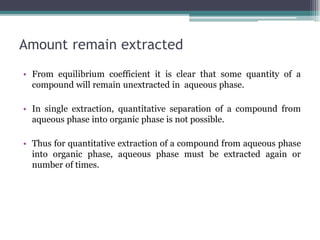
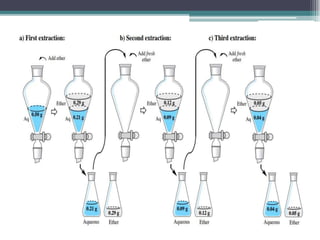
![Equation
Xn = Xa [ ]
Where,
n- no. of times solute is extracted from aqueous phase
Xn - quantity of solute remained in aqueous phase after n extractions
Xa - millimoles of solute taken in aqueous phase
KD - distribution coefficient
Vaq – volume of aqueous phase taken for extraction
V0 – Volume of organic phase used for extraction at a time in multiple
extraction
Vaq
KD V0 + Vaq](https://image.slidesharecdn.com/bsc821ch1-230211202727-63c53f96/85/BSC-821-Ch-1-pdf-15-320.jpg)
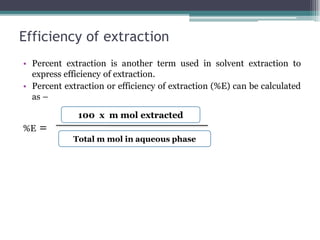
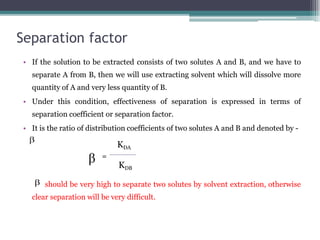
![Distribution ratio
• Many substances undergo dissociation in aqueous phase like weak
carboxylic acid such as benzoic acid, phenol, etc.
• Now consider the weak acid HA which will dissociate in aqueous
phase as follows –
HA A- + H+
• The substances which undergo by accounting dissociation in
aqueous layer the distribution coefficient in modified form can be
defined as distribution ratio (D)
• D =
[HA ] org
[A-]aq + [HA] aq](https://image.slidesharecdn.com/bsc821ch1-230211202727-63c53f96/85/BSC-821-Ch-1-pdf-18-320.jpg)


![[DSC Europe 25] Andrzej Kowalczyk - AI - how to start small and grow in the f...](https://cdn.slidesharecdn.com/ss_thumbnails/oy1zmo94qv6vpcqjvno2-andrzej-kowalczyk-ai-how-to-start-small-and-grow-in-the-future-1-260119121559-cf093b23-thumbnail.jpg?width=640&height=640&fit=bounds)


![[DSC Europe 25] Ivan Lukovic & Marija Djukic - From Data to Value: Why Maturi...](https://cdn.slidesharecdn.com/ss_thumbnails/ahrfps8xr6knowwhacxh-1-ivan-marija-dsc-2025-ld-v1-presentation-260115093812-be21adfc-thumbnail.jpg?width=640&height=640&fit=bounds)
![[DSC Europe 25] Slobodan Dolinic - Smart and Intelligent Green Region.pptx](https://cdn.slidesharecdn.com/ss_thumbnails/0bribinjsp6ghwtvsvor-2-sigre-slobodan-dolinic-260115093812-c9c10e90-thumbnail.jpg?width=640&height=640&fit=bounds)