Downloaded 30 times





![This is based on an inorganic crystal doped with a small amount of ions of a
different valency to create vacant sites.
For instance, in a F- ion electrode, a LaF₃ crystal is doped with EuF₂ so that
there are anion vacancies for the migration of F through the LaF3 crystal,
Response of F- ion electrode .
E = constant - (0.05916) log (AF-, outside)
= constant - (0.05916) log ᵞF- - (0.05916) log [F- ] , At high pH, there is
interference by OH- (Note kf-, OH- = 0.1) At low pH, F- is converted to HF
(pKa = 3.17) to which the electrode is insensitive.](https://image.slidesharecdn.com/ion-selectiveelectrodehw85-200919100118/85/Ion-selective-electrode-hw-85-9-320.jpg)
![The analyte solution is usually diluted in a high m buffer to keep the pH (at 5.5)
and m constant. E = constant´ - (0.05916) log [F- ]
Therefore, a plot of E versus log [F- ]
should yield a straight line with a negative slope,](https://image.slidesharecdn.com/ion-selectiveelectrodehw85-200919100118/85/Ion-selective-electrode-hw-85-10-320.jpg)


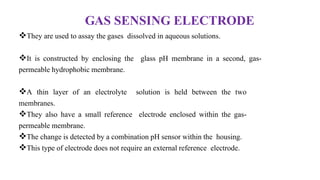




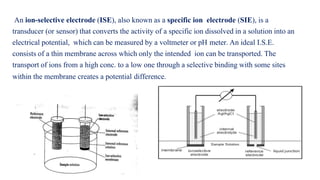
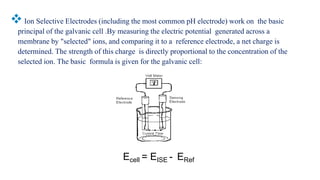
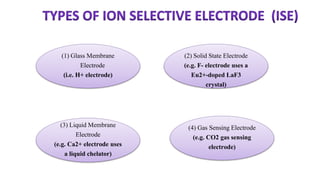
Ion-selective electrodes (ISE) respond directly to specific ions in solution and convert their activity into measurable electrical potential. They consist of various types of membranes (glass, liquid, gas sensing) and are widely used in applications such as pollution monitoring, agriculture, and biomedical labs. While ISEs are relatively inexpensive and easy to use, they have limitations such as sensitivity to interfering ions and a fragile nature.


