FLASH
CHROMATOGRAPY
By: M. SANDEEP
Depratment of Pharmaceutical Chemistry
G. PULLAREDDY COLLEGE OF PHARMACY
Roll no.170118884006
CONTENTS
Theory
• Principle – selection of stationay phase – adsorbent – properties of flash
solvents selection of column
Instrumentation of Flash Chromatography
• Parts of Flash Chromatography --Pump Systems --Sample Injection System --
Columns --Pre Columns --Fraction Collector --Detectors
Procedure for Micro scale Flash Column Chromatography
• Load the sample onto the silica gel column --Wet Loading Method --
Dry Loading Method --Elute the Column  Advantages  Apllications
FLASH CHROMATOGRAPHY
 Flash chromatography, also known as medium
pressure chromatography. “An air pressure driven
hybrid of medium and short column chromatography
optimized for rapid separation" It was popularized
several years ago by Clark Still of Columbia University.
An alternative to slow and often inefficient gravity-fed
chromatography
INTRODUCTION
Differs from the conventional technique in 2 ways:
 Slightly smaller silica gel particles (250-400 mesh) are
used, and  Due to restricted flow of solvent caused by
the small gel particles, pressurized gas (10-15 psi) used
to drive the solvent through the column of stationary
phase The net result is a rapid “over in a flash” and high
resolution chromatography
o Glass columns with silica gel
o Separation is very slow (typically many hours)
o End of the run, silica gel must be removed
o Both time consuming and hazardous
o Pre-packed plastic cartridges
o Solvent is pumped through the cartridge and separation is
rapid
o Much quicker and more reproducible
o Remaining solvent flushed out of the column using pressurized
gas
THEORY
 Chromatography exploits the differences in
partitioning behaviour between a mobile phase and a
stationary phase to separate the components in a
mixture.
 Compounds of the mixture interact with the
stationary phase based on charge, relative solubility or
adsorption.
 The retention is a measure of the speed at which a
substance moves in a chromatographic system
PRINCIPLE
o The principle is that the eluent is, under gas pressure
(normally nitrogen or compressed air) rapidly pushed
through a short glass column.
o The glass column is packed with an adsorbent of defined
particle size with large inner diameter.
o The most used stationary phase is silica gel 40 –63 μm, but
obviously packing with other particle sizes can be used as
well.
PRINCIPLE
o Particles smaller than 25 μm should only be used with
very low viscosity mobile phases, because otherwise the
flow rate would be very low.
o Normally gel beds are about 15 cm high with working
pressures of 1.5 – 2.0 bars.
o In the meantime, however, and parallel to HPLC,
reversed phase materials are used more frequently in
flash chromatography.
oThe computerized system control the Working of Flash
chromatography.
SELECTION OF THE STATIONARY PHASE
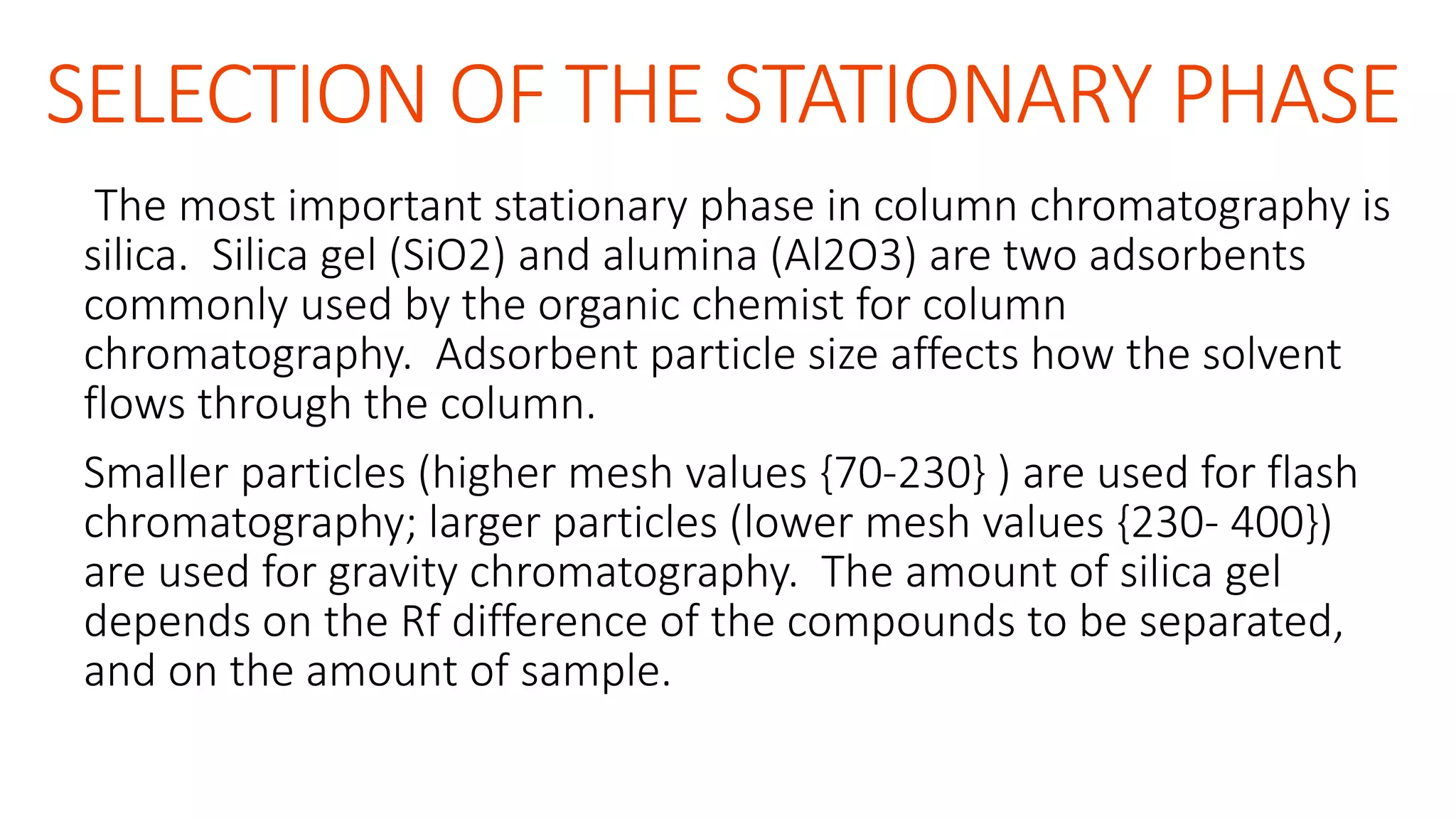
The most important stationary phase in column chromatography is
silica. Silica gel (SiO2) and alumina (Al2O3) are two adsorbents
commonly used by the organic chemist for column
chromatography. Adsorbent particle size affects how the solvent
flows through the column.
Smaller particles (higher mesh values {70-230} ) are used for flash
chromatography; larger particles (lower mesh values {230- 400})
are used for gravity chromatography. The amount of silica gel
depends on the Rf difference of the compounds to be separated,
and on the amount of sample.
ADSORBENTS WHICH ARE MAINLY USED
IN FLASH CHROMATOGRAPHY
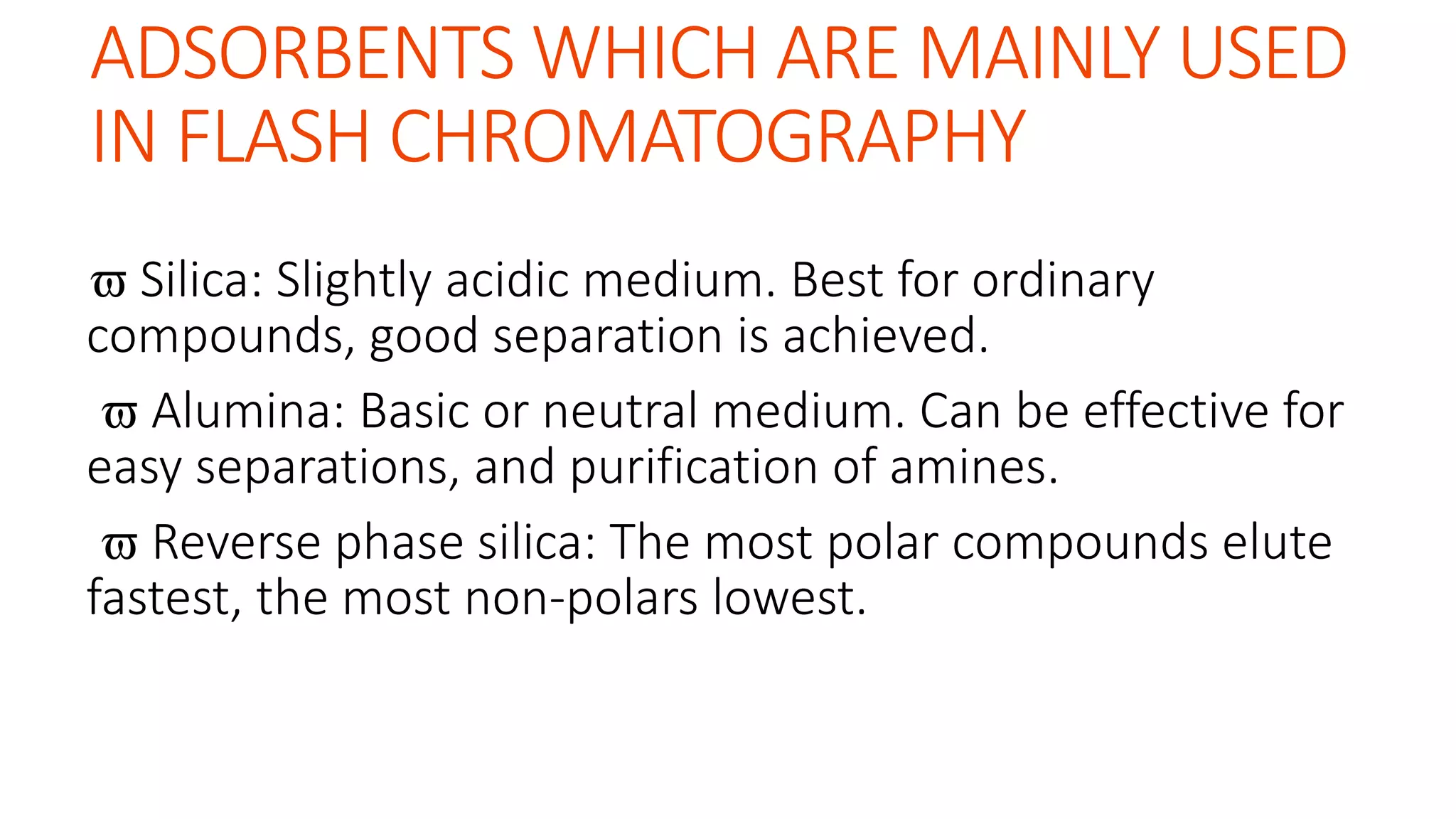
 Silica: Slightly acidic medium. Best for ordinary
compounds, good separation is achieved.
 Alumina: Basic or neutral medium. Can be effective for
easy separations, and purification of amines.
 Reverse phase silica: The most polar compounds elute
fastest, the most non-polars lowest.
THE PROPERTIES OF COMMONLY
USED FLASH SOLVENTS
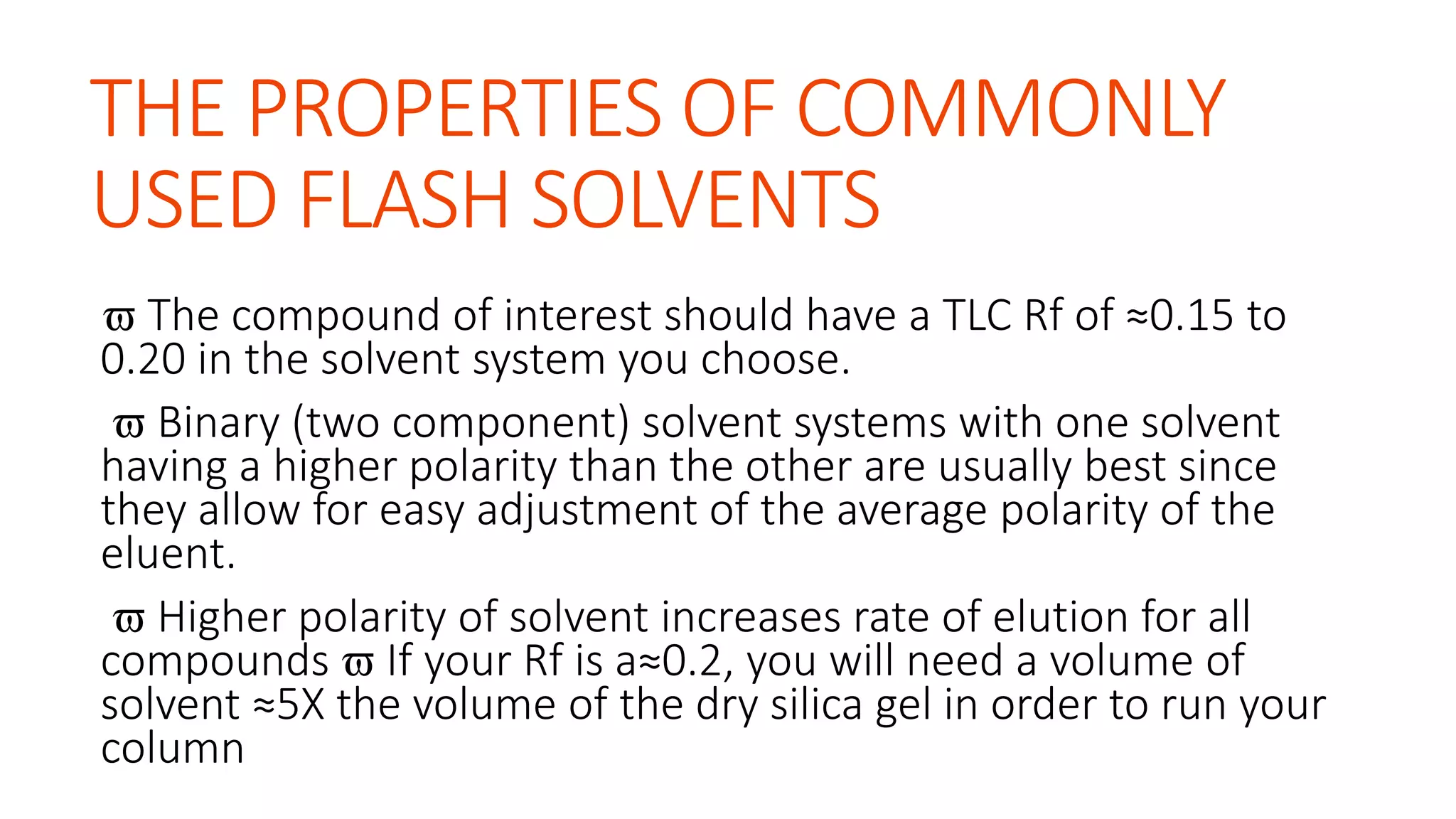
 The compound of interest should have a TLC Rf of ≈0.15 to
0.20 in the solvent system you choose.
 Binary (two component) solvent systems with one solvent
having a higher polarity than the other are usually best since
they allow for easy adjustment of the average polarity of the
eluent.
 Higher polarity of solvent increases rate of elution for all
compounds  If your Rf is a≈0.2, you will need a volume of
solvent ≈5X the volume of the dry silica gel in order to run your
column
SOLVENT SYSTEMS
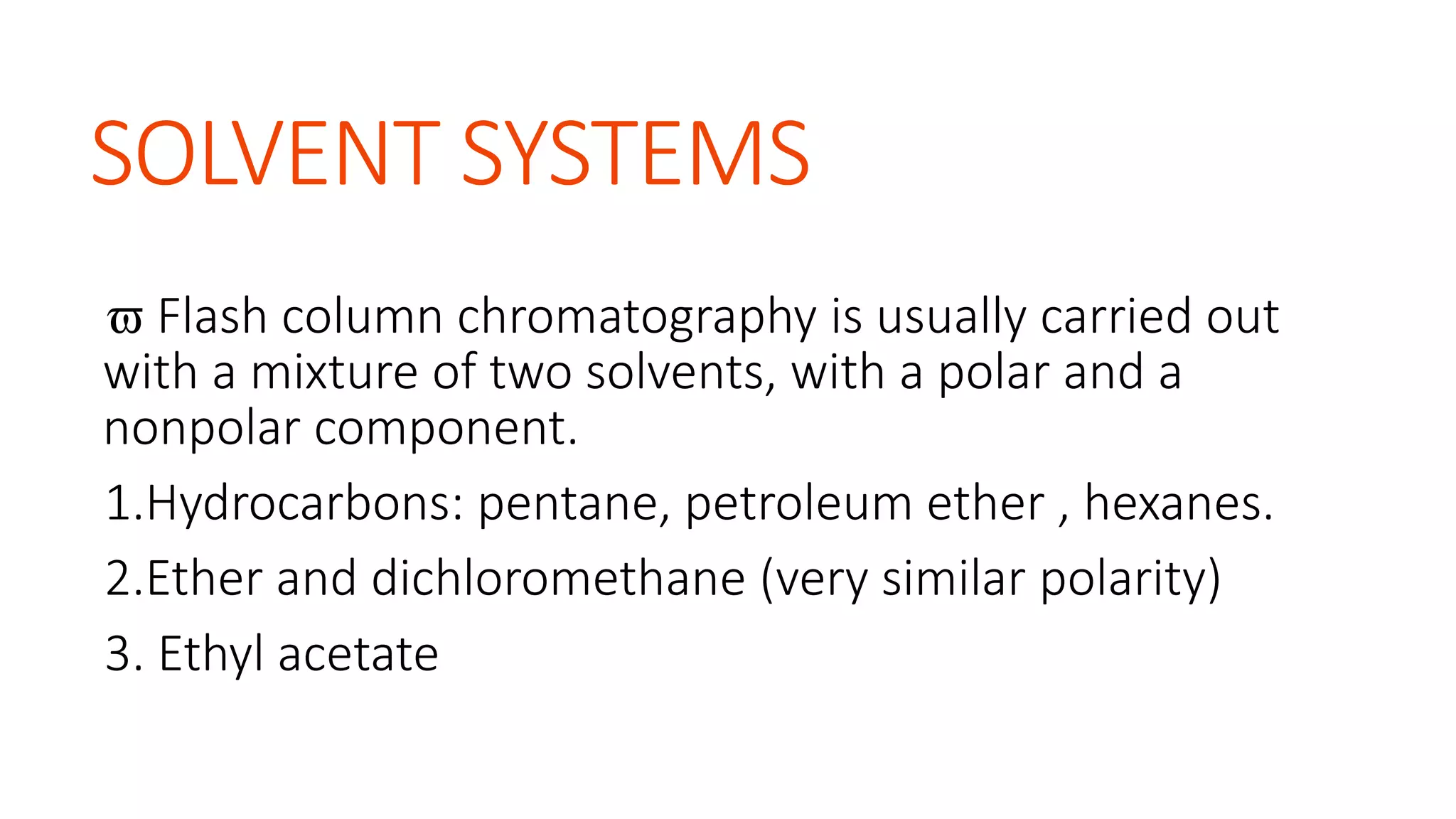
 Flash column chromatography is usually carried out
with a mixture of two solvents, with a polar and a
nonpolar component.
1.Hydrocarbons: pentane, petroleum ether , hexanes.
2.Ether and dichloromethane (very similar polarity)
3. Ethyl acetate
INSTRUMENTATION OF FLASH
CHROMATOGRAPHY
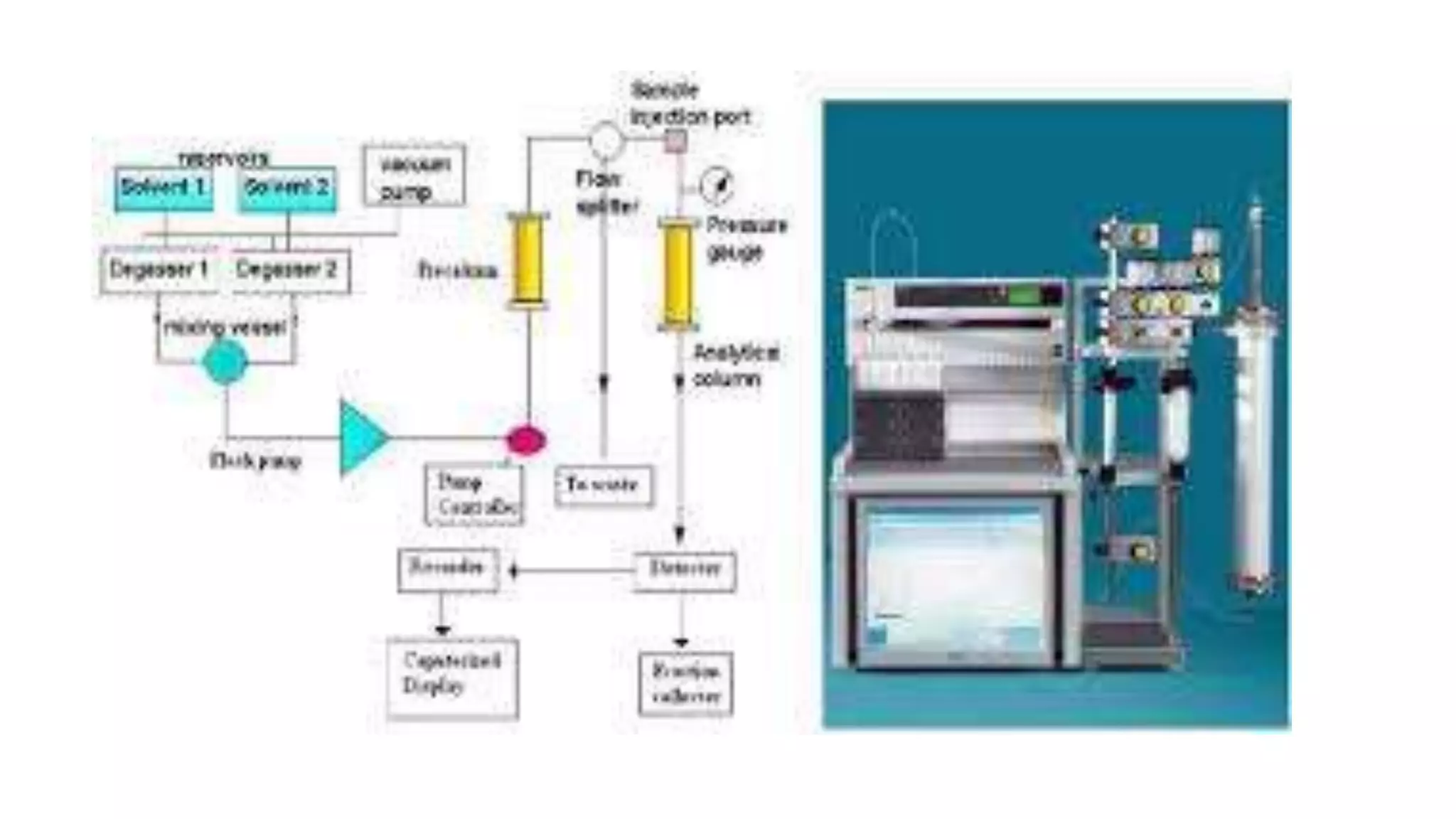
1.Pump Systems. -- Pump Controller.
2. Sample Injection Systems.
3.Glass Columns, Filling Sets & Column Valves.
4. Pre columns.
5.Fraction Collector.
6. Detectors and Chart Recorders.
7.Computerize LCD Display.
PUMP SYSTEMS
 A pressure range up to either 10 bar or 50 bar gives optimum
separation results for a broad range of applications.
 The pump modules can be controlled by three different units.
 Pump Controller C610
 Pump Manager C615
 Control Unit C620
SAMPLE INJECTION SYSTEMS
 Injection systems are designed to facilitate column loading
with liquids and low solubility oils and solids.
COLUMNS
Glass Columns :-
A wide range of columns offer maximum flexibility for every situation. Depending on
the nature and the quantity of the sample offers a series of column types which vary in
form, size and performance.
Plastic +Glass Column :-
Plastic+Glass-coated Glass Columns are available for larger amounts of samples and
higher pressure applications on a high safety level.
PRECOLUMNS
Pre column are minimizing dead volumes and enhance the life time of the main
column by trapping contaminants. The small Pre column, fits to Glass Columns of
inner diameter of ID 15, 26, 36 and 49 mm. The large Pre column, fits to Glass
Columns of ID 70 and 100 mm inner diameter.
DETECTORS AND
RECORDERS/SOFTWARE
 For most applications one of the robust UV/Vis detectors would be sufficient for the
systems detection needs.
 Both detectors are delivered in combination with a preparative flow cell.  UV
Monitor C-630  UV Photometer C-635
LOAD THE SAMPLE ONTO THE SILICA GEL
COLUMN
Two different methods are used to load the column
1. Wet method
2. Dry method
Wet loading method :-
In the wet method, the sample to be purified(or separated into components) is
dissolved in a small amount of solvent, such as hexanes, acetone, or other solvent.
This solution is loaded onto the column.
 Sometimes the solvent choice to load the sample onto the column is more polar
than the eluting solvents.
Wet loading method
 In this case, if we use the wet method of column loading, it is critical that we only
use a few drops of solvent to load the sample.
 If we use too much solvent, the loading solvent will interfere with the elution and
hence the purification or separation of the mixture.
 In such cases, the dry method of column loading is recommended
DRY LOADING METHOD
 First dissolve the sample to be analysed in the minimum amount of solvent and add
about 100 mg of silica gel.
 The mixture until the solvent evaporates and only a dry powder remains.
 Place the dry powder on a folded piece of weighing paper and transfer it to the top
of the prepared column.
 Add fresh eluting solvent to the top now we are ready to begin the elution process.
ELUTE THE COLUMN
 Add a good part of elution solvent to the column.
 Apply pressure to force the solvent through the column by pressing with a pipette
bulb.
 The pressure should be the minimum necessary to keep a steady stream coming
out of the column.
 The collection beaker is changed as soon as the colored compound begins to elute.
 The process is complicated if the compound is not colored.
 In such experiments, equal sized fractions are collected sequentially and carefully
labelled for later analysis.
ADVANTAGES
 Fast and economic methods for the synthesis laboratory.
 Ideal for the separation of compounds up to gram quantities.
 No expensive equipment required.
 ideal way transfers results from TLC to CLC.
 Automated changes between normal phase and reversed phase chromatography.
APPLICATIONS OF FLASH CHROMATOGRAPHY
 Natural Products/Nutraceuticals Application:
 Separation and Isolation of α-Santalol and β-Santalol from Sandalwood Extraction.
 Isolation and Purification of Flavonoids from Ginkgo Biloba Leaves Extract.
 Isolation and Purification of Catechins from Green Tea Extract .
 In Purification of GallaChinensis.
 Isolation and Purification of Ginsenosides from Red Panax Ginseng Extract.
Carbohydrate Application :
Purification of Conjugated Quercetin and Rutinose.
 Impurity Isolation of Valproic Acid from Cyclodextrine During Encapsulation.
Isolation ofAminosugar and Acarbose .
 Isolation of Aminoglycoside Antibiotics.
Lipids Application:
 1.Purification of Fatty Acid Methyl Esters (FAMEs).
 2. Purification of a Mixture of Glycerides, Mono- , Di-, and Tristearin.
 3. Purification of Sterols.
Pharmaceutical/Small Molecules Application:
 In Anti-malarial Drug Purification in Drug Discovery.
 Mestranol Purification During Chemical Synthesis.
 In Impurity Isolation During Drug Purification.
 Bile Acid Purification During Lead Generation in Drug Discovery.
CONCLUSION
 Purification of drug is an important step in any branch of research.
 Preparative chromatography is used to separate the components of a mixture for
more advanced use and is thus a form of purification.
 Flash Chromatography can be alternative to preparative HPLC as it saves time and
solvent.
REFERENCES
 http://www.labhut.com/education-centre/flash-chroma
 tography/what-is-flash-chromatography.html
 http://www.pharmatutor.org/articles/flash-chromatography-area- applications
 http://www.ijprr.com/File_Folder/45-49.pd
Flash cromatography

Flash cromatography

  • 1.
    FLASH CHROMATOGRAPY By: M. SANDEEP Depratmentof Pharmaceutical Chemistry G. PULLAREDDY COLLEGE OF PHARMACY Roll no.170118884006
  • 2.
    CONTENTS Theory • Principle –selection of stationay phase – adsorbent – properties of flash solvents selection of column Instrumentation of Flash Chromatography • Parts of Flash Chromatography --Pump Systems --Sample Injection System -- Columns --Pre Columns --Fraction Collector --Detectors Procedure for Micro scale Flash Column Chromatography • Load the sample onto the silica gel column --Wet Loading Method -- Dry Loading Method --Elute the Column  Advantages  Apllications
  • 3.
    FLASH CHROMATOGRAPHY  Flashchromatography, also known as medium pressure chromatography. “An air pressure driven hybrid of medium and short column chromatography optimized for rapid separation" It was popularized several years ago by Clark Still of Columbia University. An alternative to slow and often inefficient gravity-fed chromatography
  • 4.
    INTRODUCTION Differs from theconventional technique in 2 ways:  Slightly smaller silica gel particles (250-400 mesh) are used, and  Due to restricted flow of solvent caused by the small gel particles, pressurized gas (10-15 psi) used to drive the solvent through the column of stationary phase The net result is a rapid “over in a flash” and high resolution chromatography
  • 5.
    o Glass columnswith silica gel o Separation is very slow (typically many hours) o End of the run, silica gel must be removed o Both time consuming and hazardous o Pre-packed plastic cartridges o Solvent is pumped through the cartridge and separation is rapid o Much quicker and more reproducible o Remaining solvent flushed out of the column using pressurized gas
  • 6.
    THEORY  Chromatography exploitsthe differences in partitioning behaviour between a mobile phase and a stationary phase to separate the components in a mixture.  Compounds of the mixture interact with the stationary phase based on charge, relative solubility or adsorption.  The retention is a measure of the speed at which a substance moves in a chromatographic system
  • 7.
    PRINCIPLE o The principleis that the eluent is, under gas pressure (normally nitrogen or compressed air) rapidly pushed through a short glass column. o The glass column is packed with an adsorbent of defined particle size with large inner diameter. o The most used stationary phase is silica gel 40 –63 μm, but obviously packing with other particle sizes can be used as well.
  • 8.
    PRINCIPLE o Particles smallerthan 25 μm should only be used with very low viscosity mobile phases, because otherwise the flow rate would be very low. o Normally gel beds are about 15 cm high with working pressures of 1.5 – 2.0 bars. o In the meantime, however, and parallel to HPLC, reversed phase materials are used more frequently in flash chromatography. oThe computerized system control the Working of Flash chromatography.
  • 9.
    SELECTION OF THESTATIONARY PHASE The most important stationary phase in column chromatography is silica. Silica gel (SiO2) and alumina (Al2O3) are two adsorbents commonly used by the organic chemist for column chromatography. Adsorbent particle size affects how the solvent flows through the column. Smaller particles (higher mesh values {70-230} ) are used for flash chromatography; larger particles (lower mesh values {230- 400}) are used for gravity chromatography. The amount of silica gel depends on the Rf difference of the compounds to be separated, and on the amount of sample.
  • 10.
    ADSORBENTS WHICH AREMAINLY USED IN FLASH CHROMATOGRAPHY  Silica: Slightly acidic medium. Best for ordinary compounds, good separation is achieved.  Alumina: Basic or neutral medium. Can be effective for easy separations, and purification of amines.  Reverse phase silica: The most polar compounds elute fastest, the most non-polars lowest.
  • 11.
    THE PROPERTIES OFCOMMONLY USED FLASH SOLVENTS  The compound of interest should have a TLC Rf of ≈0.15 to 0.20 in the solvent system you choose.  Binary (two component) solvent systems with one solvent having a higher polarity than the other are usually best since they allow for easy adjustment of the average polarity of the eluent.  Higher polarity of solvent increases rate of elution for all compounds  If your Rf is a≈0.2, you will need a volume of solvent ≈5X the volume of the dry silica gel in order to run your column
  • 12.
    SOLVENT SYSTEMS  Flashcolumn chromatography is usually carried out with a mixture of two solvents, with a polar and a nonpolar component. 1.Hydrocarbons: pentane, petroleum ether , hexanes. 2.Ether and dichloromethane (very similar polarity) 3. Ethyl acetate
  • 13.
    INSTRUMENTATION OF FLASH CHROMATOGRAPHY 1.PumpSystems. -- Pump Controller. 2. Sample Injection Systems. 3.Glass Columns, Filling Sets & Column Valves. 4. Pre columns. 5.Fraction Collector. 6. Detectors and Chart Recorders. 7.Computerize LCD Display.
  • 15.
    PUMP SYSTEMS  Apressure range up to either 10 bar or 50 bar gives optimum separation results for a broad range of applications.  The pump modules can be controlled by three different units.  Pump Controller C610  Pump Manager C615  Control Unit C620
  • 16.
    SAMPLE INJECTION SYSTEMS Injection systems are designed to facilitate column loading with liquids and low solubility oils and solids.
  • 17.
    COLUMNS Glass Columns :- Awide range of columns offer maximum flexibility for every situation. Depending on the nature and the quantity of the sample offers a series of column types which vary in form, size and performance. Plastic +Glass Column :- Plastic+Glass-coated Glass Columns are available for larger amounts of samples and higher pressure applications on a high safety level. PRECOLUMNS Pre column are minimizing dead volumes and enhance the life time of the main column by trapping contaminants. The small Pre column, fits to Glass Columns of inner diameter of ID 15, 26, 36 and 49 mm. The large Pre column, fits to Glass Columns of ID 70 and 100 mm inner diameter.
  • 18.
    DETECTORS AND RECORDERS/SOFTWARE  Formost applications one of the robust UV/Vis detectors would be sufficient for the systems detection needs.  Both detectors are delivered in combination with a preparative flow cell.  UV Monitor C-630  UV Photometer C-635
  • 19.
    LOAD THE SAMPLEONTO THE SILICA GEL COLUMN Two different methods are used to load the column 1. Wet method 2. Dry method Wet loading method :- In the wet method, the sample to be purified(or separated into components) is dissolved in a small amount of solvent, such as hexanes, acetone, or other solvent. This solution is loaded onto the column.  Sometimes the solvent choice to load the sample onto the column is more polar than the eluting solvents.
  • 20.
    Wet loading method In this case, if we use the wet method of column loading, it is critical that we only use a few drops of solvent to load the sample.  If we use too much solvent, the loading solvent will interfere with the elution and hence the purification or separation of the mixture.  In such cases, the dry method of column loading is recommended
  • 21.
    DRY LOADING METHOD First dissolve the sample to be analysed in the minimum amount of solvent and add about 100 mg of silica gel.  The mixture until the solvent evaporates and only a dry powder remains.  Place the dry powder on a folded piece of weighing paper and transfer it to the top of the prepared column.  Add fresh eluting solvent to the top now we are ready to begin the elution process.
  • 22.
    ELUTE THE COLUMN Add a good part of elution solvent to the column.  Apply pressure to force the solvent through the column by pressing with a pipette bulb.  The pressure should be the minimum necessary to keep a steady stream coming out of the column.  The collection beaker is changed as soon as the colored compound begins to elute.  The process is complicated if the compound is not colored.  In such experiments, equal sized fractions are collected sequentially and carefully labelled for later analysis.
  • 23.
    ADVANTAGES  Fast andeconomic methods for the synthesis laboratory.  Ideal for the separation of compounds up to gram quantities.  No expensive equipment required.  ideal way transfers results from TLC to CLC.  Automated changes between normal phase and reversed phase chromatography.
  • 24.
    APPLICATIONS OF FLASHCHROMATOGRAPHY  Natural Products/Nutraceuticals Application:  Separation and Isolation of α-Santalol and β-Santalol from Sandalwood Extraction.  Isolation and Purification of Flavonoids from Ginkgo Biloba Leaves Extract.  Isolation and Purification of Catechins from Green Tea Extract .  In Purification of GallaChinensis.  Isolation and Purification of Ginsenosides from Red Panax Ginseng Extract. Carbohydrate Application : Purification of Conjugated Quercetin and Rutinose.  Impurity Isolation of Valproic Acid from Cyclodextrine During Encapsulation. Isolation ofAminosugar and Acarbose .  Isolation of Aminoglycoside Antibiotics.
  • 25.
    Lipids Application:  1.Purificationof Fatty Acid Methyl Esters (FAMEs).  2. Purification of a Mixture of Glycerides, Mono- , Di-, and Tristearin.  3. Purification of Sterols. Pharmaceutical/Small Molecules Application:  In Anti-malarial Drug Purification in Drug Discovery.  Mestranol Purification During Chemical Synthesis.  In Impurity Isolation During Drug Purification.  Bile Acid Purification During Lead Generation in Drug Discovery.
  • 26.
    CONCLUSION  Purification ofdrug is an important step in any branch of research.  Preparative chromatography is used to separate the components of a mixture for more advanced use and is thus a form of purification.  Flash Chromatography can be alternative to preparative HPLC as it saves time and solvent.
  • 27.
    REFERENCES  http://www.labhut.com/education-centre/flash-chroma  tography/what-is-flash-chromatography.html http://www.pharmatutor.org/articles/flash-chromatography-area- applications  http://www.ijprr.com/File_Folder/45-49.pd