Organic Pedagogical Electronic
Network
Isotopic Labeling
Kristina Melnik & Stephanie Felten
University of Utah
Isotopic Labeling
References: http://en.wikipedia.org/wiki/Isotopic_labeling, http://en.wikipedia.org/wiki/Crossover_experiment_%28chemistry%29,
http://www.chemgapedia.de/vsengine/vlu/vsc/de/ch/12/oc/vlu_organik/aufklaerung/aufklaerung.vlu/Page/vsc/de/ch/12/oc/aufklaerung/a6_isotopen
markierung2/a6isotopenmarkierung2.vscml.html
Overview:
Technique that is used to elucidate mechanism of a reaction or in a metabolic pathway and in a cell. The
labeling takes place by exchanging a specific atom with their isotope. The detecting of the isotopes in the
product helps to understand the possible mechanism and the stereochemistry in this sequence of the reaction.
The detection of the isotopic labels is dependent on the kind of isotope. Radioactive isotopes like 3H 14C are
measured radiochemical. Stable isotopes like 2H and 13C are detected for example with NMR- and IR-
spectroscopy.
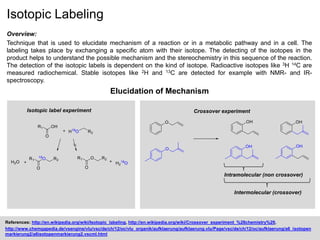
Elucidation of Mechanism
Isotopic label experiment Crossover experiment
Intramolecular (non crossover)
Intermolecular (crossover)
Isotopic Labeling
Overview:
Technique that is used to elucidate mechanism of a reaction or in a metabolic pathway and in a cell. The
labeling takes place by exchanging a specific atom with their isotope. The detecting of the isotopes in the
product helps to understand the possible mechanism and the stereochemistry in this sequence of the reaction.
The detection of the isotopic labels is dependent on the kind of isotope. Radioactive isotopes like 3H 14C are
measured radiochemical. Stable isotopes like 2H and 13C are detected for example with NMR- and IR-
spectroscopy.
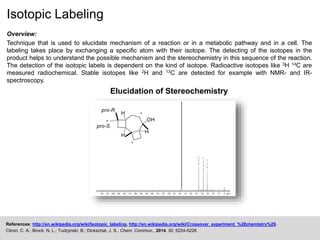
Elucidation of Stereochemistry
References: http://en.wikipedia.org/wiki/Isotopic_labeling, http://en.wikipedia.org/wiki/Crossover_experiment_%28chemistry%29.
Citron, C. A.; Brock, N. L.; Tudzynski, B.; Dickschat, J. S., Chem. Commun., 2014, 50, 5224-5226.
Application of Isotopic labeling in metabolic pathway
References: Brock, N. L.; Mencke, M.; Klapschinski, T. ; Dickschat, J. S., Org. Biomol. Chem., 2014, 12, 4318-4323; Brock, N. L.; Citron, C. A.; Zell,
C.;Berger, M.; Wagner-Doebler, I.; Petersen, J.; Brinkhoff, T.; Simon, M.; Dickschat, J. S., Beilstein J. Org. Chem., 2013, 9, 942-950.
Case Study 1: Sulfur volatiles production from the Roseobacter clade
Dimethylsulfoniopropionate (DMSP) is one of the most important organic sulfur metabolite in marine environment and is degraded
by marine bacteria in two competing pathways. Demethylation Pathway forms methanethiol (MeSH), while the Cleavage Pathway
forms dimethylsulfide (DMS). For the distinct conclusion on the sulfur source for the volatile sulfur compounds, [34S]DMSP was
synthesized and used in a feeding experiment.
Demethylation
Pathway
Cleavage
Pathway
The sulfur volatiles emitted by the bacteria were analysed by GC-MS and the data revealed that DMSP is efficiently degraded to
MeSH via Demethylation pathway.
Application of Isotopic labeling in metabolic pathway
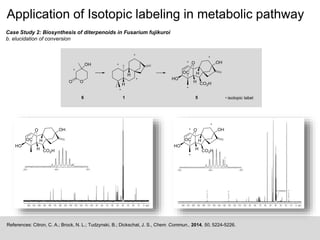
References: Citron, C. A.; Brock, N. L.; Tudzynski, B.; Dickschat, J. S., Chem. Commun., 2014, 50, 5224-5226.
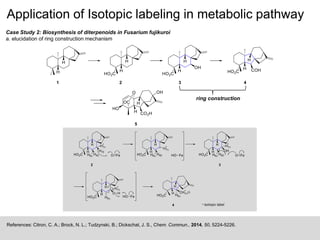
Case Study 2: Biosynthesis of diterpenoids in Fusarium fujikuroi
a. elucidation of ring construction mechanism
ring construction
Application of Isotopic labeling in metabolic pathway
References: Citron, C. A.; Brock, N. L.; Tudzynski, B.; Dickschat, J. S., Chem. Commun., 2014, 50, 5224-5226.
Case Study 2: Biosynthesis of diterpenoids in Fusarium fujikuroi
b. elucidation of conversion
Problems
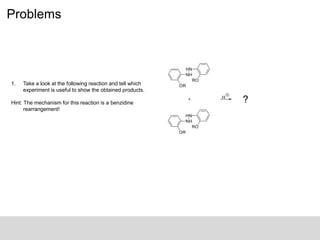
1. Take a look at the following reaction and tell which
experiment is useful to show the obtained products.
Hint: The mechanism for this reaction is a benzidine
rearrangement!
Problems
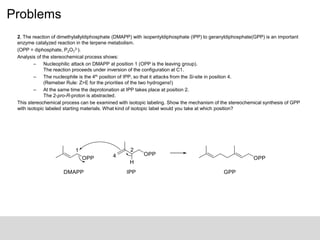
2. The reaction of dimethylallyldiphosphate (DMAPP) with isopentyldiphosphate (IPP) to geranyldiphosphate(GPP) is an important
enzyme catalyzed reaction in the terpene metabolism.
(OPP = diphosphate, P2O7
3-).
Analysis of the stereochemical process shows:
– Nucleophilic attack on DMAPP at position 1 (OPP is the leaving group).
The reaction proceeds under inversion of the configuration at C1.
– The nucleophile is the 4th position of IPP, so that it attacks from the Si-site in position 4.
(Remeber Rule: Z>E for the priorities of the two hydrogens!)
– At the same time the deprotonation at IPP takes place at position 2.
The 2-pro-R-proton is abstracted.
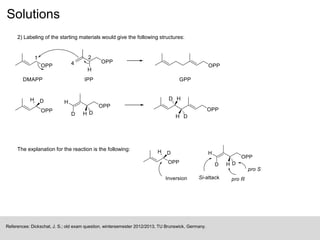
This stereochemical process can be examined with isotopic labeling. Show the mechanism of the stereochemical synthesis of GPP
with isotopic labeled starting materials. What kind of isotopic label would you take at which position?
Solutions
References: http://www.chemgapedia.de/vsengine/vlu/vsc/en/ch/12/oc/vlu_organik/aufklaerung/aufklaerung_e_kreuz_kinetik.vlu.html
Shine, H.J.; Zmuda, H.: Park, K.H.; Kwart, H.; Horgan, A.G.; Brechbiel, M. J. Am. Chem. Soc., 1982, 104, 2501-2509.
Laue, A.; Plagens, A., Namen- und Schlagwort-Reaktionen, 5. Auflage, Teubner, Wiesbaden 2006, S. 40.
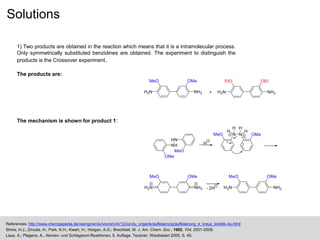
1) Two products are obtained in the reaction which means that it is a intramolecular process.
Only symmetrically substituted benzidines are obtained. The experiment to distinguish the
products is the Crossover experiment.
The products are:
The mechanism is shown for product 1:
Solutions
2) Labeling of the starting materials would give the following structures:
References: Dickschat, J. S.; old exam question, wintersemester 2012/2013, TU Brunswick, Germany.
The explanation for the reaction is the following:
This work is licensed under a
Creative Commons Attribution-
ShareAlike 4.0 International
License.
Contributed by:
Kristina Melnik & Stephanie Felten (Undergraduate Students)
University of Utah
2014

Isotopic labeling

  • 1.
    Organic Pedagogical Electronic Network IsotopicLabeling Kristina Melnik & Stephanie Felten University of Utah
  • 2.
    Isotopic Labeling References: http://en.wikipedia.org/wiki/Isotopic_labeling,http://en.wikipedia.org/wiki/Crossover_experiment_%28chemistry%29, http://www.chemgapedia.de/vsengine/vlu/vsc/de/ch/12/oc/vlu_organik/aufklaerung/aufklaerung.vlu/Page/vsc/de/ch/12/oc/aufklaerung/a6_isotopen markierung2/a6isotopenmarkierung2.vscml.html Overview: Technique that is used to elucidate mechanism of a reaction or in a metabolic pathway and in a cell. The labeling takes place by exchanging a specific atom with their isotope. The detecting of the isotopes in the product helps to understand the possible mechanism and the stereochemistry in this sequence of the reaction. The detection of the isotopic labels is dependent on the kind of isotope. Radioactive isotopes like 3H 14C are measured radiochemical. Stable isotopes like 2H and 13C are detected for example with NMR- and IR- spectroscopy. Elucidation of Mechanism Isotopic label experiment Crossover experiment Intramolecular (non crossover) Intermolecular (crossover)
  • 3.
    Isotopic Labeling Overview: Technique thatis used to elucidate mechanism of a reaction or in a metabolic pathway and in a cell. The labeling takes place by exchanging a specific atom with their isotope. The detecting of the isotopes in the product helps to understand the possible mechanism and the stereochemistry in this sequence of the reaction. The detection of the isotopic labels is dependent on the kind of isotope. Radioactive isotopes like 3H 14C are measured radiochemical. Stable isotopes like 2H and 13C are detected for example with NMR- and IR- spectroscopy. Elucidation of Stereochemistry References: http://en.wikipedia.org/wiki/Isotopic_labeling, http://en.wikipedia.org/wiki/Crossover_experiment_%28chemistry%29. Citron, C. A.; Brock, N. L.; Tudzynski, B.; Dickschat, J. S., Chem. Commun., 2014, 50, 5224-5226.
  • 4.
    Application of Isotopiclabeling in metabolic pathway References: Brock, N. L.; Mencke, M.; Klapschinski, T. ; Dickschat, J. S., Org. Biomol. Chem., 2014, 12, 4318-4323; Brock, N. L.; Citron, C. A.; Zell, C.;Berger, M.; Wagner-Doebler, I.; Petersen, J.; Brinkhoff, T.; Simon, M.; Dickschat, J. S., Beilstein J. Org. Chem., 2013, 9, 942-950. Case Study 1: Sulfur volatiles production from the Roseobacter clade Dimethylsulfoniopropionate (DMSP) is one of the most important organic sulfur metabolite in marine environment and is degraded by marine bacteria in two competing pathways. Demethylation Pathway forms methanethiol (MeSH), while the Cleavage Pathway forms dimethylsulfide (DMS). For the distinct conclusion on the sulfur source for the volatile sulfur compounds, [34S]DMSP was synthesized and used in a feeding experiment. Demethylation Pathway Cleavage Pathway The sulfur volatiles emitted by the bacteria were analysed by GC-MS and the data revealed that DMSP is efficiently degraded to MeSH via Demethylation pathway.
  • 5.
    Application of Isotopiclabeling in metabolic pathway References: Citron, C. A.; Brock, N. L.; Tudzynski, B.; Dickschat, J. S., Chem. Commun., 2014, 50, 5224-5226. Case Study 2: Biosynthesis of diterpenoids in Fusarium fujikuroi a. elucidation of ring construction mechanism ring construction
  • 6.
    Application of Isotopiclabeling in metabolic pathway References: Citron, C. A.; Brock, N. L.; Tudzynski, B.; Dickschat, J. S., Chem. Commun., 2014, 50, 5224-5226. Case Study 2: Biosynthesis of diterpenoids in Fusarium fujikuroi b. elucidation of conversion
  • 7.
    Problems 1. Take alook at the following reaction and tell which experiment is useful to show the obtained products. Hint: The mechanism for this reaction is a benzidine rearrangement!
  • 8.
    Problems 2. The reactionof dimethylallyldiphosphate (DMAPP) with isopentyldiphosphate (IPP) to geranyldiphosphate(GPP) is an important enzyme catalyzed reaction in the terpene metabolism. (OPP = diphosphate, P2O7 3-). Analysis of the stereochemical process shows: – Nucleophilic attack on DMAPP at position 1 (OPP is the leaving group). The reaction proceeds under inversion of the configuration at C1. – The nucleophile is the 4th position of IPP, so that it attacks from the Si-site in position 4. (Remeber Rule: Z>E for the priorities of the two hydrogens!) – At the same time the deprotonation at IPP takes place at position 2. The 2-pro-R-proton is abstracted. This stereochemical process can be examined with isotopic labeling. Show the mechanism of the stereochemical synthesis of GPP with isotopic labeled starting materials. What kind of isotopic label would you take at which position?
  • 9.
    Solutions References: http://www.chemgapedia.de/vsengine/vlu/vsc/en/ch/12/oc/vlu_organik/aufklaerung/aufklaerung_e_kreuz_kinetik.vlu.html Shine, H.J.;Zmuda, H.: Park, K.H.; Kwart, H.; Horgan, A.G.; Brechbiel, M. J. Am. Chem. Soc., 1982, 104, 2501-2509. Laue, A.; Plagens, A., Namen- und Schlagwort-Reaktionen, 5. Auflage, Teubner, Wiesbaden 2006, S. 40. 1) Two products are obtained in the reaction which means that it is a intramolecular process. Only symmetrically substituted benzidines are obtained. The experiment to distinguish the products is the Crossover experiment. The products are: The mechanism is shown for product 1:
  • 10.
    Solutions 2) Labeling ofthe starting materials would give the following structures: References: Dickschat, J. S.; old exam question, wintersemester 2012/2013, TU Brunswick, Germany. The explanation for the reaction is the following:
  • 11.
    This work islicensed under a Creative Commons Attribution- ShareAlike 4.0 International License. Contributed by: Kristina Melnik & Stephanie Felten (Undergraduate Students) University of Utah 2014