European cooperation Network on Energy Transition in Electricity
Andreas	Sumper
CITCEA-UPC
SESSION	2:
SMART	GRIDS	CHALLENGES:	THE	VISION	OF	TECHNOLOGICAL	CENTRES
WORKSHOP
“DEFINING	SMART	GRIDS:	CONDITIONS	FOR	SUCCESSFUL	IMPLEMENTATION”
Barcelona,	9th	February	2017
2
Will	the	electricity	system	look	
very	different	20	years	from	
now?
3
Smart, connected products are changing how
value is created for customers, how companies
compete, and the boundaries of competition
itself. These shifts will affect virtually every
industry,directly or indirectly.
Michael	E.	Porter and	James	E.	Heppelmann,	Harvard	Busines Reviews:
Is	every	“thing”	now	going	SMART?
• Electricity	is	a	connected	product
• Smartness	is	creating	a	non-commodity
• The	value	is	shifting	to	the	customers	(Prosumers)
• Competition	is	changing	in	the	electricity	sector
• The	electricity	sector	is	heavily	impacted
• The	prosumer	is	inevitably	an	energy	market	
participant
• The	prosumer	is	an	economically	motivated	entity	
• A	potential	co-player	or	an	adversary	to	the	
establishment
• A	collection	of	prosumers	can	execute	significant	
market	power
Prosumers
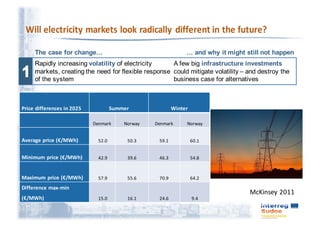
The case for change… … and why it might still not happen
Rapidly increasing volatility of electricity
markets, creating the need for flexible response
of the system
A few big infrastructure investments
could mitigate volatility – and destroy the
business case for alternatives
Price differences	in	2025 Summer Winter
Denmark Norway Denmark Norway
Average	price	(€/MWh) 52.0	 50.3	 59.1	 60.1	
Minimum	price	(€/MWh) 42.9	 39.6	 46.3	 54.8	
Maximum	price	(€/MWh) 57.9	 55.6	 70.9	 64.2	
Difference	max-min	
(€/MWh) 15.0	 16.1	 24.6	 9.4	
McKinsey 2011
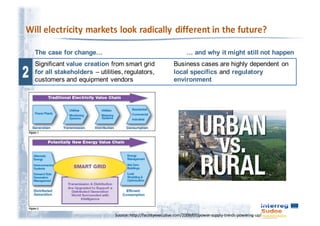
The case for change… … and why it might still not happen
Significant value creation from smart grid
for all stakeholders – utilities, regulators,
customers and equipment vendors
Business cases are highly dependent on
local specifics and regulatory
environment
Source:	http://facilityexecutive.com/2009/07/power-supply-trends-powering-up/
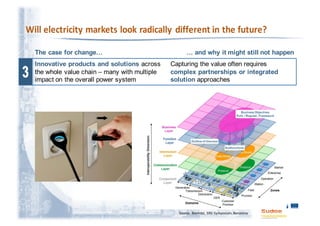
The case for change… … and why it might still not happen
Innovative products and solutions across
the whole value chain – many with multiple
impact on the overall power system
Capturing the value often requires
complex partnerships or integrated
solution approaches
Source:	Bremdal,	 SRG	Symposium,	Barcelona
The case for change… … and why it might still not happen
Attractive business models in the making –
opening opportunities for „unorthodox“
coalitions and new players‘ entries
Both established and new players might
lack sufficient clout and speed to really
change the market
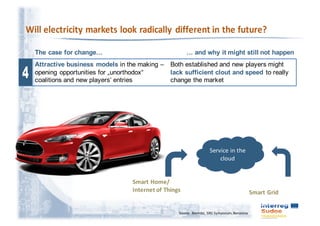
Smart	Grid
Smart	Home/
Internet of	Things
Service	in	the	
cloud
Source:	Bremdal,	 SRG	Symposium,	Barcelona
The case for change… … and why it might still not happen
Disruptive technologies under development
such as electric vehicles – attracting talent,
capital and attention
Breakeven points to reach economically
attractivebusiness cases might be too far
out to be reached
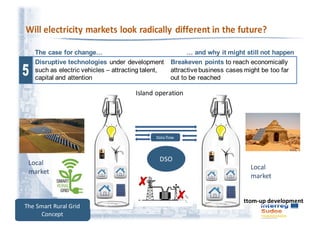
The	Smart	Rural	Grid	
Concept
Bottom-up	development
Local
market
Local
market
Normal	operation
DSO
Island operation
Data	flow
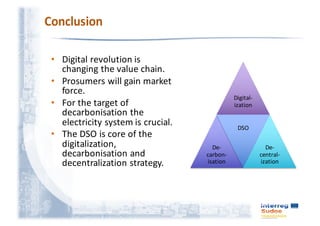
• Digital	revolution	is	
changing	the	value	chain.	
• Prosumers	will	gain	market	
force.
• For	the	target	of	
decarbonisation	the	
electricity	system	is	crucial.
• The	DSO	is	core	of	the	
digitalization,	
decarbonisation	and	
decentralization	strategy.
Digital-
ization
De-
carbon-
isation
DSO
De-
central-
ization

Smart Grid Challenges

  • 1.
    European cooperation Networkon Energy Transition in Electricity Andreas Sumper CITCEA-UPC SESSION 2: SMART GRIDS CHALLENGES: THE VISION OF TECHNOLOGICAL CENTRES WORKSHOP “DEFINING SMART GRIDS: CONDITIONS FOR SUCCESSFUL IMPLEMENTATION” Barcelona, 9th February 2017
  • 2.
  • 3.
    3 Smart, connected productsare changing how value is created for customers, how companies compete, and the boundaries of competition itself. These shifts will affect virtually every industry,directly or indirectly. Michael E. Porter and James E. Heppelmann, Harvard Busines Reviews: Is every “thing” now going SMART? • Electricity is a connected product • Smartness is creating a non-commodity • The value is shifting to the customers (Prosumers) • Competition is changing in the electricity sector • The electricity sector is heavily impacted
  • 4.
    • The prosumer is inevitably an energy market participant • The prosumer is an economically motivated entity •A potential co-player or an adversary to the establishment • A collection of prosumers can execute significant market power Prosumers
  • 5.
    The case forchange… … and why it might still not happen Rapidly increasing volatility of electricity markets, creating the need for flexible response of the system A few big infrastructure investments could mitigate volatility – and destroy the business case for alternatives Price differences in 2025 Summer Winter Denmark Norway Denmark Norway Average price (€/MWh) 52.0 50.3 59.1 60.1 Minimum price (€/MWh) 42.9 39.6 46.3 54.8 Maximum price (€/MWh) 57.9 55.6 70.9 64.2 Difference max-min (€/MWh) 15.0 16.1 24.6 9.4 McKinsey 2011
  • 6.
    The case forchange… … and why it might still not happen Significant value creation from smart grid for all stakeholders – utilities, regulators, customers and equipment vendors Business cases are highly dependent on local specifics and regulatory environment Source: http://facilityexecutive.com/2009/07/power-supply-trends-powering-up/
  • 7.
    The case forchange… … and why it might still not happen Innovative products and solutions across the whole value chain – many with multiple impact on the overall power system Capturing the value often requires complex partnerships or integrated solution approaches Source: Bremdal, SRG Symposium, Barcelona
  • 8.
    The case forchange… … and why it might still not happen Attractive business models in the making – opening opportunities for „unorthodox“ coalitions and new players‘ entries Both established and new players might lack sufficient clout and speed to really change the market Smart Grid Smart Home/ Internet of Things Service in the cloud Source: Bremdal, SRG Symposium, Barcelona
  • 9.
    The case forchange… … and why it might still not happen Disruptive technologies under development such as electric vehicles – attracting talent, capital and attention Breakeven points to reach economically attractivebusiness cases might be too far out to be reached The Smart Rural Grid Concept Bottom-up development Local market Local market Normal operation DSO Island operation Data flow
  • 10.
    • Digital revolution is changing the value chain. • Prosumers will gain market force. •For the target of decarbonisation the electricity system is crucial. • The DSO is core of the digitalization, decarbonisation and decentralization strategy. Digital- ization De- carbon- isation DSO De- central- ization