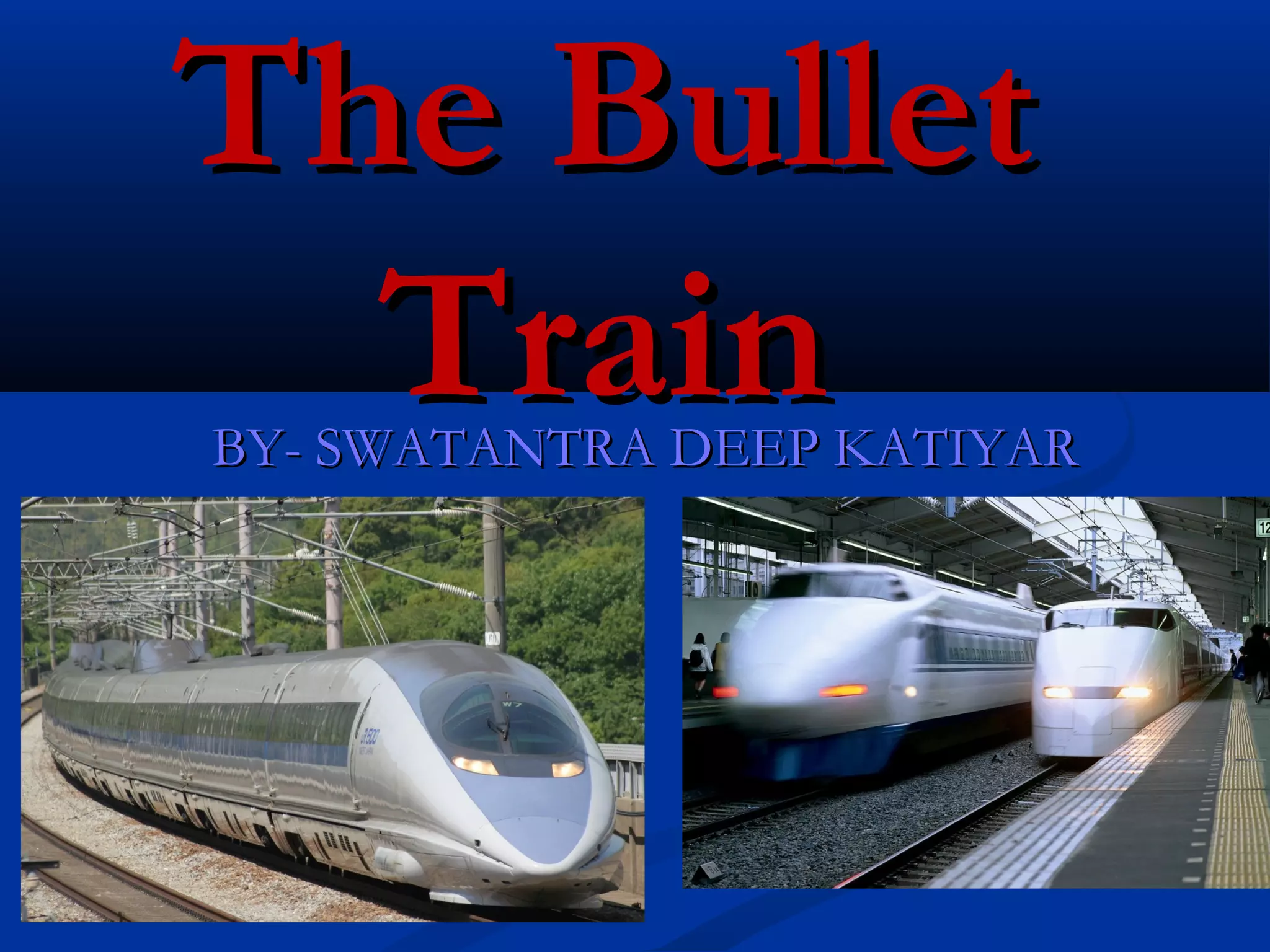
The BulletThe Bullet
TrainTrainBY- SWATANTRA DEEP KATIYARBY- SWATANTRA DEEP KATIYAR
 IntroductionIntroduction
 Bullet train trackBullet train track
 Support systemSupport system
 Types of technologyTypes of technology
 Propulsion systemPropulsion system
 Bullet vs conventonal trainBullet vs conventonal train
 How it is better for the environmentHow it is better for the environment
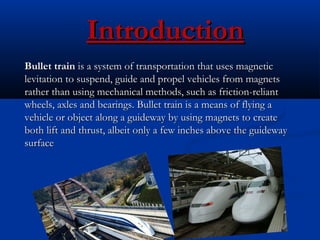
IntroductionIntroduction
  
Bullet trainBullet train is a system of transportation that uses magnetic is a system of transportation that uses magnetic
levitation to suspend, guide and propel vehicles from magnetslevitation to suspend, guide and propel vehicles from magnets
rather than using mechanical methods, such as friction-reliantrather than using mechanical methods, such as friction-reliant
wheels, axles and bearings. Bullet train is a means of flying awheels, axles and bearings. Bullet train is a means of flying a
vehicle or object along a guideway by using magnets to createvehicle or object along a guideway by using magnets to create
both lift and thrust, albeit only a few inches above the guidewayboth lift and thrust, albeit only a few inches above the guideway
surfacesurface
The Bullet TrainThe Bullet Train
TrackTrackType of Magnet UsesType of Magnet Uses
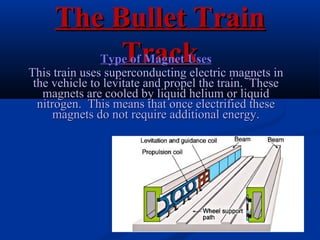
This train uses superconducting electric magnets inThis train uses superconducting electric magnets in
the vehicle to levitate and propel the train. Thesethe vehicle to levitate and propel the train. These
magnets are cooled by liquid helium or liquidmagnets are cooled by liquid helium or liquid
nitrogen. This means that once electrified thesenitrogen. This means that once electrified these
magnets do not require additional energy.magnets do not require additional energy.
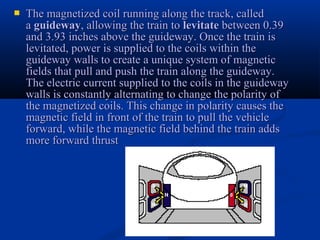
 The magnetized coil running along the track, calledThe magnetized coil running along the track, called
aa guidewayguideway, allowing the train to, allowing the train to levitatelevitate between 0.39between 0.39
and 3.93 inches above the guideway. Once the train isand 3.93 inches above the guideway. Once the train is
levitated, power is supplied to the coils within thelevitated, power is supplied to the coils within the
guideway walls to create a unique system of magneticguideway walls to create a unique system of magnetic
fields that pull and push the train along the guideway.fields that pull and push the train along the guideway.
The electric current supplied to the coils in the guidewayThe electric current supplied to the coils in the guideway
walls is constantly alternating to change the polarity ofwalls is constantly alternating to change the polarity of
the magnetized coils. This change in polarity causes thethe magnetized coils. This change in polarity causes the
magnetic field in front of the train to pull the vehiclemagnetic field in front of the train to pull the vehicle
forward, while the magnetic field behind the train addsforward, while the magnetic field behind the train adds
more forward thrustmore forward thrust
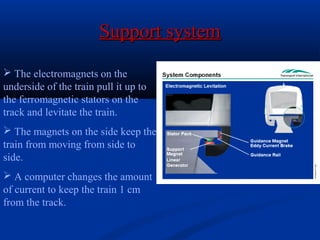
 The electromagnets on the
underside of the train pull it up to
the ferromagnetic stators on the
track and levitate the train.
 The magnets on the side keep the
train from moving from side to
side.
 A computer changes the amount
of current to keep the train 1 cm
from the track.
Support systemSupport system
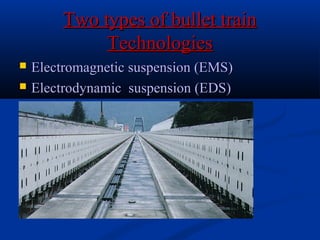
Two types of bullet trainTwo types of bullet train
TechnologiesTechnologies
 Electromagnetic suspension (EMS)Electromagnetic suspension (EMS)
 Electrodynamic suspension (EDS)Electrodynamic suspension (EDS)
Electromagnetic suspension (EMS)Electromagnetic suspension (EMS)
In current electromagnetic suspension (EMS)In current electromagnetic suspension (EMS)
systems, the train levitates above a steel railsystems, the train levitates above a steel rail
whilewhile electromagnetselectromagnets, attached to the train, are, attached to the train, are
oriented toward the rail from below. Theoriented toward the rail from below. The
system is typically arranged on a series of C-system is typically arranged on a series of C-
shaped arms, with the upper portion of the armshaped arms, with the upper portion of the arm
attached to the vehicle, and the lower insideattached to the vehicle, and the lower inside
edge containing the magnets. The rail isedge containing the magnets. The rail is
situated between the upper and lower edges.situated between the upper and lower edges.
Electrodynamic suspension (EDS)Electrodynamic suspension (EDS)
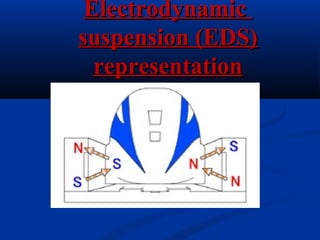
In electrodynamic suspension (EDS), both theIn electrodynamic suspension (EDS), both the
rail and the train exert a magnetic field, andrail and the train exert a magnetic field, and
the train is levitated by the repulsive forcethe train is levitated by the repulsive force
between these magnetic fields. The magneticbetween these magnetic fields. The magnetic
field in the train is produced by eitherfield in the train is produced by either
superconducting magnets or by an array ofsuperconducting magnets or by an array of
permanent magnets . The repulsive force in thepermanent magnets . The repulsive force in the
track is created by antrack is created by an induced magneticinduced magnetic
fieldfield in wires or other conducting strips in thein wires or other conducting strips in the
track.track.
ElectrodynamicElectrodynamic
suspension (EDS)suspension (EDS)
representationrepresentation
Propulsion System
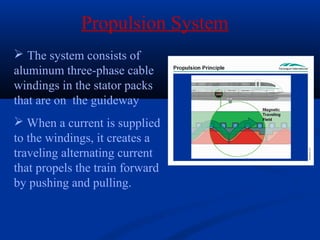
 The system consists of
aluminum three-phase cable
windings in the stator packs
that are on the guideway
 When a current is supplied
to the windings, it creates a
traveling alternating current
that propels the train forward
by pushing and pulling.
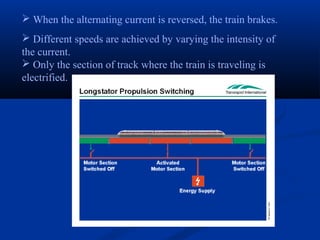
 When the alternating current is reversed, the train brakes.
 Different speeds are achieved by varying the intensity of
the current.
 Only the section of track where the train is traveling is
electrified.
PropulsionPropulsion
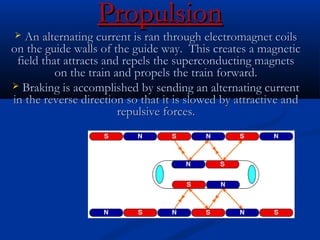
 An alternating current is ran through electromagnet coilsAn alternating current is ran through electromagnet coils
on the guide walls of the guide way. This creates a magneticon the guide walls of the guide way. This creates a magnetic
field that attracts and repels the superconducting magnetsfield that attracts and repels the superconducting magnets
on the train and propels the train forward.on the train and propels the train forward.
 Braking is accomplished by sending an alternating currentBraking is accomplished by sending an alternating current
in the reverse direction so that it is slowed by attractive andin the reverse direction so that it is slowed by attractive and
repulsive forces.repulsive forces.  
Seating Capacity & classesSeating Capacity & classes
 The train has three seprate classes namelyThe train has three seprate classes namely
buisness class, green class, ordinary class.buisness class, green class, ordinary class.
 E 5 Series shinkansen train configured with tenE 5 Series shinkansen train configured with ten
cars and has a capacity to carry 731 passenger.cars and has a capacity to carry 731 passenger.
 658 seats of ordinary class, 55 seats are of green658 seats of ordinary class, 55 seats are of green
class and 18 seats are in buisness class.class and 18 seats are in buisness class.
BulletBullet vs.vs. ConventionalConventional TrainsTrains
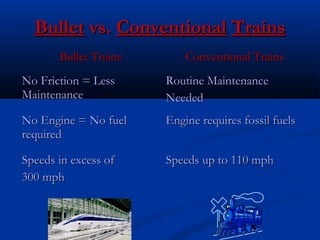
Bullet TrainsBullet Trains Conventional TrainsConventional Trains
No Friction = LessNo Friction = Less
MaintenanceMaintenance
Routine MaintenanceRoutine Maintenance
NeededNeeded
No Engine = No fuelNo Engine = No fuel
requiredrequired
Engine requires fossil fuelsEngine requires fossil fuels
Speeds in excess ofSpeeds in excess of
300 mph300 mph
Speeds up to 110 mphSpeeds up to 110 mph
ApplicationApplication
InformationInformation
SafetySafety
 The trains are virtually impossible to derailThe trains are virtually impossible to derail
because the train is wrapped around the track.because the train is wrapped around the track.
 Collisions between trains are unlikely becauseCollisions between trains are unlikely because
computers are controlling the trains movements.computers are controlling the trains movements.
MaintenanceMaintenance
 There is very little maintenance because there isThere is very little maintenance because there is
no contact between the parts.no contact between the parts.
ComfortComfort
 The ride is smooth while not accelerating..The ride is smooth while not accelerating..
Economic EfficencyEconomic Efficency
 The initial investment is similar to other highThe initial investment is similar to other high
speed rail roads. (Maglift is $20-$40 millionspeed rail roads. (Maglift is $20-$40 million
per mile and I-279 in Pittsburg cost $37 millionper mile and I-279 in Pittsburg cost $37 million
per mile 17 years ago.)per mile 17 years ago.)
 Operating expenses are half of that of otherOperating expenses are half of that of other
railroads.railroads.
 A train is composed of sections that eachA train is composed of sections that each
contain 100 seats, and a train can have betweencontain 100 seats, and a train can have between
2 and 10 sections.2 and 10 sections.
Better for the EnvironmentBetter for the Environment
 Less energy consumption because no rail-track frictionLess energy consumption because no rail-track friction
 Requires no fossil fuel which can harm the environment.Requires no fossil fuel which can harm the environment.
 Less noise pollution since the train never hits the trackLess noise pollution since the train never hits the track
 MagLev guideways and trains take up less space thanMagLev guideways and trains take up less space than
conventional trainsconventional trains
SummarySummary
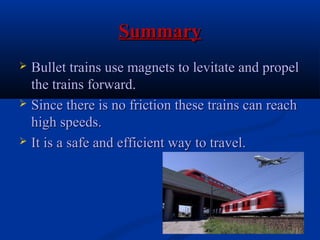
 Bullet trains use magnets to levitate and propelBullet trains use magnets to levitate and propel
the trains forward.the trains forward.
 Since there is no friction these trains can reachSince there is no friction these trains can reach
high speeds.high speeds.
 It is a safe and efficient way to travel.It is a safe and efficient way to travel.
ReferencesReferences
 www.wikipedia.comwww.wikipedia.com
 www.google.comwww.google.com
QUERIESQUERIES

Bullet train

  • 1.
    The BulletThe Bullet TrainTrainBY-SWATANTRA DEEP KATIYARBY- SWATANTRA DEEP KATIYAR
  • 2.
     IntroductionIntroduction  Bullettrain trackBullet train track  Support systemSupport system  Types of technologyTypes of technology  Propulsion systemPropulsion system  Bullet vs conventonal trainBullet vs conventonal train  How it is better for the environmentHow it is better for the environment
  • 3.
    IntroductionIntroduction    Bullet trainBullet train isa system of transportation that uses magnetic is a system of transportation that uses magnetic levitation to suspend, guide and propel vehicles from magnetslevitation to suspend, guide and propel vehicles from magnets rather than using mechanical methods, such as friction-reliantrather than using mechanical methods, such as friction-reliant wheels, axles and bearings. Bullet train is a means of flying awheels, axles and bearings. Bullet train is a means of flying a vehicle or object along a guideway by using magnets to createvehicle or object along a guideway by using magnets to create both lift and thrust, albeit only a few inches above the guidewayboth lift and thrust, albeit only a few inches above the guideway surfacesurface
  • 4.
    The Bullet TrainTheBullet Train TrackTrackType of Magnet UsesType of Magnet Uses This train uses superconducting electric magnets inThis train uses superconducting electric magnets in the vehicle to levitate and propel the train. Thesethe vehicle to levitate and propel the train. These magnets are cooled by liquid helium or liquidmagnets are cooled by liquid helium or liquid nitrogen. This means that once electrified thesenitrogen. This means that once electrified these magnets do not require additional energy.magnets do not require additional energy.
  • 5.
     The magnetizedcoil running along the track, calledThe magnetized coil running along the track, called aa guidewayguideway, allowing the train to, allowing the train to levitatelevitate between 0.39between 0.39 and 3.93 inches above the guideway. Once the train isand 3.93 inches above the guideway. Once the train is levitated, power is supplied to the coils within thelevitated, power is supplied to the coils within the guideway walls to create a unique system of magneticguideway walls to create a unique system of magnetic fields that pull and push the train along the guideway.fields that pull and push the train along the guideway. The electric current supplied to the coils in the guidewayThe electric current supplied to the coils in the guideway walls is constantly alternating to change the polarity ofwalls is constantly alternating to change the polarity of the magnetized coils. This change in polarity causes thethe magnetized coils. This change in polarity causes the magnetic field in front of the train to pull the vehiclemagnetic field in front of the train to pull the vehicle forward, while the magnetic field behind the train addsforward, while the magnetic field behind the train adds more forward thrustmore forward thrust
  • 6.
     The electromagnetson the underside of the train pull it up to the ferromagnetic stators on the track and levitate the train.  The magnets on the side keep the train from moving from side to side.  A computer changes the amount of current to keep the train 1 cm from the track. Support systemSupport system
  • 7.
    Two types ofbullet trainTwo types of bullet train TechnologiesTechnologies  Electromagnetic suspension (EMS)Electromagnetic suspension (EMS)  Electrodynamic suspension (EDS)Electrodynamic suspension (EDS)
  • 8.
    Electromagnetic suspension (EMS)Electromagneticsuspension (EMS) In current electromagnetic suspension (EMS)In current electromagnetic suspension (EMS) systems, the train levitates above a steel railsystems, the train levitates above a steel rail whilewhile electromagnetselectromagnets, attached to the train, are, attached to the train, are oriented toward the rail from below. Theoriented toward the rail from below. The system is typically arranged on a series of C-system is typically arranged on a series of C- shaped arms, with the upper portion of the armshaped arms, with the upper portion of the arm attached to the vehicle, and the lower insideattached to the vehicle, and the lower inside edge containing the magnets. The rail isedge containing the magnets. The rail is situated between the upper and lower edges.situated between the upper and lower edges.
  • 9.
    Electrodynamic suspension (EDS)Electrodynamicsuspension (EDS) In electrodynamic suspension (EDS), both theIn electrodynamic suspension (EDS), both the rail and the train exert a magnetic field, andrail and the train exert a magnetic field, and the train is levitated by the repulsive forcethe train is levitated by the repulsive force between these magnetic fields. The magneticbetween these magnetic fields. The magnetic field in the train is produced by eitherfield in the train is produced by either superconducting magnets or by an array ofsuperconducting magnets or by an array of permanent magnets . The repulsive force in thepermanent magnets . The repulsive force in the track is created by antrack is created by an induced magneticinduced magnetic fieldfield in wires or other conducting strips in thein wires or other conducting strips in the track.track.
  • 10.
  • 11.
    Propulsion System  Thesystem consists of aluminum three-phase cable windings in the stator packs that are on the guideway  When a current is supplied to the windings, it creates a traveling alternating current that propels the train forward by pushing and pulling.
  • 12.
     When thealternating current is reversed, the train brakes.  Different speeds are achieved by varying the intensity of the current.  Only the section of track where the train is traveling is electrified.
  • 13.
    PropulsionPropulsion  An alternatingcurrent is ran through electromagnet coilsAn alternating current is ran through electromagnet coils on the guide walls of the guide way. This creates a magneticon the guide walls of the guide way. This creates a magnetic field that attracts and repels the superconducting magnetsfield that attracts and repels the superconducting magnets on the train and propels the train forward.on the train and propels the train forward.  Braking is accomplished by sending an alternating currentBraking is accomplished by sending an alternating current in the reverse direction so that it is slowed by attractive andin the reverse direction so that it is slowed by attractive and repulsive forces.repulsive forces.  
  • 14.
    Seating Capacity &classesSeating Capacity & classes  The train has three seprate classes namelyThe train has three seprate classes namely buisness class, green class, ordinary class.buisness class, green class, ordinary class.  E 5 Series shinkansen train configured with tenE 5 Series shinkansen train configured with ten cars and has a capacity to carry 731 passenger.cars and has a capacity to carry 731 passenger.  658 seats of ordinary class, 55 seats are of green658 seats of ordinary class, 55 seats are of green class and 18 seats are in buisness class.class and 18 seats are in buisness class.
  • 15.
    BulletBullet vs.vs. ConventionalConventionalTrainsTrains Bullet TrainsBullet Trains Conventional TrainsConventional Trains No Friction = LessNo Friction = Less MaintenanceMaintenance Routine MaintenanceRoutine Maintenance NeededNeeded No Engine = No fuelNo Engine = No fuel requiredrequired Engine requires fossil fuelsEngine requires fossil fuels Speeds in excess ofSpeeds in excess of 300 mph300 mph Speeds up to 110 mphSpeeds up to 110 mph
  • 16.
    ApplicationApplication InformationInformation SafetySafety  The trainsare virtually impossible to derailThe trains are virtually impossible to derail because the train is wrapped around the track.because the train is wrapped around the track.  Collisions between trains are unlikely becauseCollisions between trains are unlikely because computers are controlling the trains movements.computers are controlling the trains movements. MaintenanceMaintenance  There is very little maintenance because there isThere is very little maintenance because there is no contact between the parts.no contact between the parts.
  • 17.
    ComfortComfort  The rideis smooth while not accelerating..The ride is smooth while not accelerating.. Economic EfficencyEconomic Efficency  The initial investment is similar to other highThe initial investment is similar to other high speed rail roads. (Maglift is $20-$40 millionspeed rail roads. (Maglift is $20-$40 million per mile and I-279 in Pittsburg cost $37 millionper mile and I-279 in Pittsburg cost $37 million per mile 17 years ago.)per mile 17 years ago.)  Operating expenses are half of that of otherOperating expenses are half of that of other railroads.railroads.  A train is composed of sections that eachA train is composed of sections that each contain 100 seats, and a train can have betweencontain 100 seats, and a train can have between 2 and 10 sections.2 and 10 sections.
  • 18.
    Better for theEnvironmentBetter for the Environment  Less energy consumption because no rail-track frictionLess energy consumption because no rail-track friction  Requires no fossil fuel which can harm the environment.Requires no fossil fuel which can harm the environment.  Less noise pollution since the train never hits the trackLess noise pollution since the train never hits the track  MagLev guideways and trains take up less space thanMagLev guideways and trains take up less space than conventional trainsconventional trains
  • 19.
    SummarySummary  Bullet trainsuse magnets to levitate and propelBullet trains use magnets to levitate and propel the trains forward.the trains forward.  Since there is no friction these trains can reachSince there is no friction these trains can reach high speeds.high speeds.  It is a safe and efficient way to travel.It is a safe and efficient way to travel.
  • 20.
  • 21.