DSM - 5 
An overview. 
Dr.Cijo Alex 
PG Trainee, 
SMVMCH , Puducherry
Conte nt s 
• Background 
• Changes in DSM-5 
• Critical analysis of DSM-5
N o s o l o g y 
Nosology or taxonomy is a branch of medical science 
that deals with classification of diseases. 
Most disciplines of medicine follow etiological 
classification. 
Since etiology is still obscure in most of the psychiatric 
illnesses , our classifications are primarily based on 
symptomatology rather than on etiology.
What is the need for classification systems? 
To distinguish one psychiatric diagnosis from 
another, so that clinicians can offer the most 
effective treatment; 
To provide a common language among health care 
professionals; 
And to explore the still unknown causes of many 
mental disorders.
Systems of classifications in Psychiatry. 
- ICD by WHO 
- DSM by APA 
- Chinese Classification of Mental Disorders [CCMD] 
- Latin American Guide for Psychiatric Diagnosis. 
- The Research Domain Criteria [RDoC] by NIMH
Acceptance of various classification systems. 
ICD-10 is the official classification system used in Europe and most parts of the 
world. 
All categories used in DSM-IV-TR are found in ICD-10, but not all ICD-10 
categories are in DSM-IV-TR. 
DSM-IV-TR is the official US nomenclature. 
All terminology used standard textbooks conforms to DSM nomenclature. 
As per international agreements ,the deadline for the United States to begin 
using ICD-10-Clinical Modification (CM) is currently October 1, 2014.
The DSM classification. 
In 1952, the APA published the DSM. 
DSM-II (1968); DSM-III (1980); DSM-III-R (1987); DSM-IV 
(1994); and DSM-IV-TR (2000).
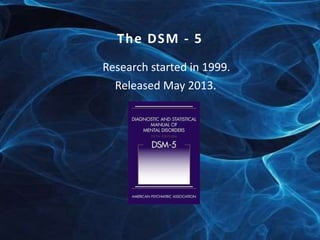
The DSM - 5 
Research started in 1999. 
Released May 2013.
I n s i d e D SM- 5 
Divided into three sections. 
Section I - DSM 5 basics 
Section II - Diagnostic criterion and codes 
Section III - Emerging measures and models 
and an 
Appendix.
Section I – DSM -5 basics. 
Harmonization with ICD system. 
Non axial documentation of diagnosis. 
Dimensional assessment. 
Changes in diagnostic criterions.
Harmonization with the ICD system has been done to 
avoid unwanted hindrances in both scientific 
research and patient care. 
Most importantly the salient differences between ICD 
and DSM does not have any scientific basis rather 
they reflect historical byproducts of various 
committee meetings.
DSM-5 have moved towards non-axial system of 
diagnosis [formerly Axis I,II and III] with separate 
notations for important psychosocial and contextual 
factors [formerly Axis IV] and disability 
[formerly Axis V]
Sect ion I I - Diagnost ic cr i ter ion and codes
Section III - Emerging measures and models 
Alternative DSM-5 model of Personality disorders. 
A typical patient meeting a criterion for a DSM-IV 
personality disorder often qualifies for another 
personality disorder too. So an alternative model have 
been introduced. 
Antisocial, Avoidant, Borderline ,Narcissistic ,Obsessive – 
Compulsive and Schizotypal PD can be diagnosed and 
Personality Disorder –Trait Specific can be diagnosed if 
the criterion is not met , but if PD is suspected.
Conditions for further study 
Proposed criterion sets have been described for following 
conditions in which further research is encouraged. 
Attenuated Psychosis Syndrome 
Depressive episodes with short duration hypomania 
Persistent complex bereavement disorder 
Caffeine use disorder 
Internet gaming disorder 
Neurobehavioral disorder associated with prenatal alcohol 
exposure 
Suicidal behavior disorder 
Nonsuicidal self injury
Psychosis like condition but in which symptoms are below the 
threshold to be clinically diagnosed as Psychosis. 
Symptoms are usually transient and insight is good.
A p p e n d i x 
Highlights of changes from DSM-IV to DSM-5.
Neurodevelopmental disorders 
Intellectual disability 
New term introduced for Mental Retardation. 
Diagnostic criterion emphazise the need for assessment of both 
cognitive capacity [IQ] & adaptive functioning. 
Severity is determined by adaptive functioning rather than IQ 
score.
Communication disorders 
New term for phonological disorders & stuttering. 
Speech sound disorder – previously phonological disorder. 
Childhood onset fluency disorder – new term for 
stuttering. 
Social communication disorder – new condition for for 
persistent difficulties in the social uses of verbal and 
nonverbal communication.
Autism spectrum disorder 
New disorder encompassing previously called 
Autism + Aspergers disorder + Retts disorder + Childhood 
disintegrative disorder + pervasive developmental disorder 
NOS. 
The new criteria describe two principal symptoms: “deficits 
in social communication and social interaction” and 
“restrictive and repetitive behavior patterns”.
ADHD 
Several changes to diagnostic criterion. 
The onset criterion has been changed from 
“symptoms that caused impairment were present 
before age 7 years” to “several inattentive or 
hyperactive-impulsive symptoms were present prior 
to age 12”; 
Co morbid diagnosis with Autism spectrum 
disorders allowed.
Specific learning disorde 
Combines DSM –IV diagnoses of reading disorder , 
mathematics disorder , disorders of written expression and 
learning disorders NOS.
Schizophrenia spectrum and other Psychotic disorders. 
Schizophrenia 
Elimination of the special attribution of bizarre 
delusions and Schneiderian first-rank auditory 
hallucinations (e.g., two or more voices conversing). 
The second change is the addition of a requirement in 
Criterion A that the individual must have at least one of 
these three symptoms: delusions, hallucinations, and 
disorganized speech. At least one of these core 
“positive symptoms” is necessary for a reliable 
diagnosis of schizophrenia
The DSM-IV subtypes of schizophrenia (i.e., 
paranoid, disorganized, catatonic, undifferentiated, 
and residual types) are eliminated due to their 
limited diagnostic stability, low reliability, and poor 
validity. 
Instead, a dimensional approach to rating severity 
for the core symptoms of schizophrenia.
schizoaffective disorder 
The primary change to schizoaffective disorder is the 
requirement that a major mood episode be present for 
a majority of the disorder’s total duration 
[after Criterion A has been met]. 
It makes schizoaffective disorder a longitudinal instead 
of a cross-sectional diagnosis—more comparable to 
schizophrenia, bipolar disorder, and major depressive 
disorder, which are bridged by this condition.
Delusional disorder 
Criterion A for delusional disorder no longer has the 
requirement that the delusions must be nonbizarre.
Catatonia 
In DSM-5, catatonia may be diagnosed as a specifier 
for depressive, bipolar, and psychotic disorders
B i p o l a r a n d r e l a t e d d i s o r d e r s 
Criterion A for manic and hypomanic episodes now includes 
an emphasis on changes in activity and energy as well as 
mood. 
The DSM-IV diagnosis of bipolar I disorder, mixed episode, 
requiring that the individual simultaneously meet full criteria 
for both mania and major depressive episode, has been 
removed. Instead, a new specifier, “with mixed features,” has 
been added that can be applied to episodes of mania or 
hypomania when depressive features are present, and to 
episodes of depression in the context of major depressive 
disorder or bipolar disorder when features of 
mania/hypomania are present.
Other Specified Bipolar and Related Disorder 
A category for individuals with a past history of a major 
depressive disorder who meet all criteria for 
hypomania except the duration criterion (i.e., at least 4 
consecutive days). 
A second condition constituting an other specified 
bipolar and related disorder is that too few symptoms 
of hypomania are present to meet criteria for the full 
bipolar II syndrome, although the duration is sufficient 
at 4 or more days.
D e p r e s s i v e d i s o r d e r s 
Disruptive Mood Dysregulation Disorder – New diagnosis to 
include children upto 18 years of age with persistent irritability 
and extreme dyscontrol. 
Premenstrual Dysphoric Disorder – promoted from appendix to 
main body. 
Persistent depressive disorder – New term for dysthymia and 
chronic MDD 
No more berevement exclusion for diagnosing MDD. Bereavement 
is now recognized as a severe psychosocial stressor that can 
precipitate a major depressive episode in a vulnerable individual
A n x i e t y d i s o r d e r s 
OCD and PTSD have been omitted and made into 
separate categories. 
Separation anxiety and selective mutism are 
included in anxiety disorders. 
Anxiety disorders no longer need age >18 for 
diagnosis. 
Panic disorder and Agoraphobia are unlinked 
Panic attacks can be listed as a specifier to ALL 
DSM-5 diagnoses.
Obsessive Compulsive and related disorders 
New chapter. 
New disorders include 
hoarding disorder, excoriation(skin picking)disorder , 
Substance/Medication induced obsessive – 
compulsive and related disorders And obsessive-compulsive 
disorders due to another medical 
condition. 
Detailed specifiers introduced for insight viz fair , 
poor and absent.
Trauma and Stressor related disorders 
Qualifying traumatic events are now explicit as to 
whether they were experienced directly , witnessed or 
experienced indirectly. 
Four symptom clusters instead of three 
-Re-experiencing 
-Arousal 
-Avoidance 
-Persistent negative alterations in cognition and mood.
Dissociative disorders 
Dissociative fugue is now a specifier of dissociative 
amnesia rather than a specific diagnosis.
Somatic symptom and related disorders 
New name for somatoform disorders. 
To avoid problematic overlap , many subcategories have been 
omitted including . 
-Somatization disorder 
-Hypochondriasis 
-Pain disorder 
-Undifferentiated somatoform disorder 
Criterion for conversion disorder have been revised to 
emphasize importance of neurological examination and the 
fact that psychosocial stressor may not be demonstrable at 
the time of diagnosis.
Feeding and eating disorders 
Includes many conditions found in DSM-IV chapter 
“disorders usually first diagnosed during 
Infancy,Childhood or Adolescence” like pica. 
Anorexia nervosa diagnosis does not need amenorrhea as 
a criterion. 
Slight changes to Bulimia nervosa criterion too
Sexual dysfunctions 
Female sexual desire and arousal disorders combined 
into one disorder “female sexual interest/arousal 
disorder” 
Vaginismus and Dyspareunia combined to form 
Genito pelvic pain/Penetration disorder .
Substance related and addictive disorders 
Gambling disorder , Cannabis withdrawal and Caffeine 
withdrawal are new conditions introduced 
No more substance abuse and dependence , only 
substance use disorders
Neurocognitive Disorders 
Mild NCD , newly introduced condition to cover 
milder forms of memory impairment (?MCI)
Personality Disorders 
No change in criterion as such but new approach to 
diagnosis.
C r i t i c a l An a l y s i s of DSM- 5
1) Disruptive Mood Dysregulation Disorder may turn temper tantrums 
into a mental disorder. 
2) Normal grief may become Major Depressive Disorder. 
3) The everyday forgetting characteristic of old age will now be 
misdiagnosed as Minor Neurocognitive Disorder. 
4) DSM 5 will likely trigger a fad of Adult Attention Deficit Disorder 
leading to widespread misuse of stimulant drugs for performance 
enhancement and recreation. 
5) Excessive eating 12 times in 3 months is no longer just a 
manifestation of gluttony but it is a psychiatric illness called Binge 
Eating Disorder.
6) The changes in the DSM 5 definition of Autism will result in lowered 
rates- perhaps by 50% according to outside research groups. 
7) First time substance abusers will be lumped in definitionaly in with 
hard core addicts despite their very different treatment needs and 
prognosis and the stigma this will cause. 
8) Behavioral Addictions that eventually can spread to make a mental 
disorder of everything we like to do a lot. Eg; New proposed internet 
addiction 
9) DSM 5 obscures the already fuzzy boundary been Generalized 
Anxiety Disorder and the worries of everyday life. 
10) DSM 5 has opened the gate even further to the already existing 
problem of misdiagnosis of PTSD in forensic settings.
Thank you

Dsm 5 - An overview

  • 1.
    DSM - 5 An overview. Dr.Cijo Alex PG Trainee, SMVMCH , Puducherry
  • 2.
    Conte nt s • Background • Changes in DSM-5 • Critical analysis of DSM-5
  • 3.
    N o so l o g y Nosology or taxonomy is a branch of medical science that deals with classification of diseases. Most disciplines of medicine follow etiological classification. Since etiology is still obscure in most of the psychiatric illnesses , our classifications are primarily based on symptomatology rather than on etiology.
  • 4.
    What is theneed for classification systems? To distinguish one psychiatric diagnosis from another, so that clinicians can offer the most effective treatment; To provide a common language among health care professionals; And to explore the still unknown causes of many mental disorders.
  • 6.
    Systems of classificationsin Psychiatry. - ICD by WHO - DSM by APA - Chinese Classification of Mental Disorders [CCMD] - Latin American Guide for Psychiatric Diagnosis. - The Research Domain Criteria [RDoC] by NIMH
  • 7.
    Acceptance of variousclassification systems. ICD-10 is the official classification system used in Europe and most parts of the world. All categories used in DSM-IV-TR are found in ICD-10, but not all ICD-10 categories are in DSM-IV-TR. DSM-IV-TR is the official US nomenclature. All terminology used standard textbooks conforms to DSM nomenclature. As per international agreements ,the deadline for the United States to begin using ICD-10-Clinical Modification (CM) is currently October 1, 2014.
  • 8.
    The DSM classification. In 1952, the APA published the DSM. DSM-II (1968); DSM-III (1980); DSM-III-R (1987); DSM-IV (1994); and DSM-IV-TR (2000).
  • 9.
    The DSM -5 Research started in 1999. Released May 2013.
  • 10.
    I n si d e D SM- 5 Divided into three sections. Section I - DSM 5 basics Section II - Diagnostic criterion and codes Section III - Emerging measures and models and an Appendix.
  • 11.
    Section I –DSM -5 basics. Harmonization with ICD system. Non axial documentation of diagnosis. Dimensional assessment. Changes in diagnostic criterions.
  • 12.
    Harmonization with theICD system has been done to avoid unwanted hindrances in both scientific research and patient care. Most importantly the salient differences between ICD and DSM does not have any scientific basis rather they reflect historical byproducts of various committee meetings.
  • 13.
    DSM-5 have movedtowards non-axial system of diagnosis [formerly Axis I,II and III] with separate notations for important psychosocial and contextual factors [formerly Axis IV] and disability [formerly Axis V]
  • 14.
    Sect ion II - Diagnost ic cr i ter ion and codes
  • 15.
    Section III -Emerging measures and models Alternative DSM-5 model of Personality disorders. A typical patient meeting a criterion for a DSM-IV personality disorder often qualifies for another personality disorder too. So an alternative model have been introduced. Antisocial, Avoidant, Borderline ,Narcissistic ,Obsessive – Compulsive and Schizotypal PD can be diagnosed and Personality Disorder –Trait Specific can be diagnosed if the criterion is not met , but if PD is suspected.
  • 16.
    Conditions for furtherstudy Proposed criterion sets have been described for following conditions in which further research is encouraged. Attenuated Psychosis Syndrome Depressive episodes with short duration hypomania Persistent complex bereavement disorder Caffeine use disorder Internet gaming disorder Neurobehavioral disorder associated with prenatal alcohol exposure Suicidal behavior disorder Nonsuicidal self injury
  • 17.
    Psychosis like conditionbut in which symptoms are below the threshold to be clinically diagnosed as Psychosis. Symptoms are usually transient and insight is good.
  • 18.
    A p pe n d i x Highlights of changes from DSM-IV to DSM-5.
  • 19.
    Neurodevelopmental disorders Intellectualdisability New term introduced for Mental Retardation. Diagnostic criterion emphazise the need for assessment of both cognitive capacity [IQ] & adaptive functioning. Severity is determined by adaptive functioning rather than IQ score.
  • 20.
    Communication disorders Newterm for phonological disorders & stuttering. Speech sound disorder – previously phonological disorder. Childhood onset fluency disorder – new term for stuttering. Social communication disorder – new condition for for persistent difficulties in the social uses of verbal and nonverbal communication.
  • 21.
    Autism spectrum disorder New disorder encompassing previously called Autism + Aspergers disorder + Retts disorder + Childhood disintegrative disorder + pervasive developmental disorder NOS. The new criteria describe two principal symptoms: “deficits in social communication and social interaction” and “restrictive and repetitive behavior patterns”.
  • 22.
    ADHD Several changesto diagnostic criterion. The onset criterion has been changed from “symptoms that caused impairment were present before age 7 years” to “several inattentive or hyperactive-impulsive symptoms were present prior to age 12”; Co morbid diagnosis with Autism spectrum disorders allowed.
  • 23.
    Specific learning disorde Combines DSM –IV diagnoses of reading disorder , mathematics disorder , disorders of written expression and learning disorders NOS.
  • 24.
    Schizophrenia spectrum andother Psychotic disorders. Schizophrenia Elimination of the special attribution of bizarre delusions and Schneiderian first-rank auditory hallucinations (e.g., two or more voices conversing). The second change is the addition of a requirement in Criterion A that the individual must have at least one of these three symptoms: delusions, hallucinations, and disorganized speech. At least one of these core “positive symptoms” is necessary for a reliable diagnosis of schizophrenia
  • 25.
    The DSM-IV subtypesof schizophrenia (i.e., paranoid, disorganized, catatonic, undifferentiated, and residual types) are eliminated due to their limited diagnostic stability, low reliability, and poor validity. Instead, a dimensional approach to rating severity for the core symptoms of schizophrenia.
  • 26.
    schizoaffective disorder Theprimary change to schizoaffective disorder is the requirement that a major mood episode be present for a majority of the disorder’s total duration [after Criterion A has been met]. It makes schizoaffective disorder a longitudinal instead of a cross-sectional diagnosis—more comparable to schizophrenia, bipolar disorder, and major depressive disorder, which are bridged by this condition.
  • 27.
    Delusional disorder CriterionA for delusional disorder no longer has the requirement that the delusions must be nonbizarre.
  • 28.
    Catatonia In DSM-5,catatonia may be diagnosed as a specifier for depressive, bipolar, and psychotic disorders
  • 29.
    B i po l a r a n d r e l a t e d d i s o r d e r s Criterion A for manic and hypomanic episodes now includes an emphasis on changes in activity and energy as well as mood. The DSM-IV diagnosis of bipolar I disorder, mixed episode, requiring that the individual simultaneously meet full criteria for both mania and major depressive episode, has been removed. Instead, a new specifier, “with mixed features,” has been added that can be applied to episodes of mania or hypomania when depressive features are present, and to episodes of depression in the context of major depressive disorder or bipolar disorder when features of mania/hypomania are present.
  • 30.
    Other Specified Bipolarand Related Disorder A category for individuals with a past history of a major depressive disorder who meet all criteria for hypomania except the duration criterion (i.e., at least 4 consecutive days). A second condition constituting an other specified bipolar and related disorder is that too few symptoms of hypomania are present to meet criteria for the full bipolar II syndrome, although the duration is sufficient at 4 or more days.
  • 31.
    D e pr e s s i v e d i s o r d e r s Disruptive Mood Dysregulation Disorder – New diagnosis to include children upto 18 years of age with persistent irritability and extreme dyscontrol. Premenstrual Dysphoric Disorder – promoted from appendix to main body. Persistent depressive disorder – New term for dysthymia and chronic MDD No more berevement exclusion for diagnosing MDD. Bereavement is now recognized as a severe psychosocial stressor that can precipitate a major depressive episode in a vulnerable individual
  • 32.
    A n xi e t y d i s o r d e r s OCD and PTSD have been omitted and made into separate categories. Separation anxiety and selective mutism are included in anxiety disorders. Anxiety disorders no longer need age >18 for diagnosis. Panic disorder and Agoraphobia are unlinked Panic attacks can be listed as a specifier to ALL DSM-5 diagnoses.
  • 33.
    Obsessive Compulsive andrelated disorders New chapter. New disorders include hoarding disorder, excoriation(skin picking)disorder , Substance/Medication induced obsessive – compulsive and related disorders And obsessive-compulsive disorders due to another medical condition. Detailed specifiers introduced for insight viz fair , poor and absent.
  • 34.
    Trauma and Stressorrelated disorders Qualifying traumatic events are now explicit as to whether they were experienced directly , witnessed or experienced indirectly. Four symptom clusters instead of three -Re-experiencing -Arousal -Avoidance -Persistent negative alterations in cognition and mood.
  • 35.
    Dissociative disorders Dissociativefugue is now a specifier of dissociative amnesia rather than a specific diagnosis.
  • 36.
    Somatic symptom andrelated disorders New name for somatoform disorders. To avoid problematic overlap , many subcategories have been omitted including . -Somatization disorder -Hypochondriasis -Pain disorder -Undifferentiated somatoform disorder Criterion for conversion disorder have been revised to emphasize importance of neurological examination and the fact that psychosocial stressor may not be demonstrable at the time of diagnosis.
  • 37.
    Feeding and eatingdisorders Includes many conditions found in DSM-IV chapter “disorders usually first diagnosed during Infancy,Childhood or Adolescence” like pica. Anorexia nervosa diagnosis does not need amenorrhea as a criterion. Slight changes to Bulimia nervosa criterion too
  • 38.
    Sexual dysfunctions Femalesexual desire and arousal disorders combined into one disorder “female sexual interest/arousal disorder” Vaginismus and Dyspareunia combined to form Genito pelvic pain/Penetration disorder .
  • 39.
    Substance related andaddictive disorders Gambling disorder , Cannabis withdrawal and Caffeine withdrawal are new conditions introduced No more substance abuse and dependence , only substance use disorders
  • 40.
    Neurocognitive Disorders MildNCD , newly introduced condition to cover milder forms of memory impairment (?MCI)
  • 41.
    Personality Disorders Nochange in criterion as such but new approach to diagnosis.
  • 42.
    C r it i c a l An a l y s i s of DSM- 5
  • 43.
    1) Disruptive MoodDysregulation Disorder may turn temper tantrums into a mental disorder. 2) Normal grief may become Major Depressive Disorder. 3) The everyday forgetting characteristic of old age will now be misdiagnosed as Minor Neurocognitive Disorder. 4) DSM 5 will likely trigger a fad of Adult Attention Deficit Disorder leading to widespread misuse of stimulant drugs for performance enhancement and recreation. 5) Excessive eating 12 times in 3 months is no longer just a manifestation of gluttony but it is a psychiatric illness called Binge Eating Disorder.
  • 44.
    6) The changesin the DSM 5 definition of Autism will result in lowered rates- perhaps by 50% according to outside research groups. 7) First time substance abusers will be lumped in definitionaly in with hard core addicts despite their very different treatment needs and prognosis and the stigma this will cause. 8) Behavioral Addictions that eventually can spread to make a mental disorder of everything we like to do a lot. Eg; New proposed internet addiction 9) DSM 5 obscures the already fuzzy boundary been Generalized Anxiety Disorder and the worries of everyday life. 10) DSM 5 has opened the gate even further to the already existing problem of misdiagnosis of PTSD in forensic settings.
  • 45.