
Premnath R
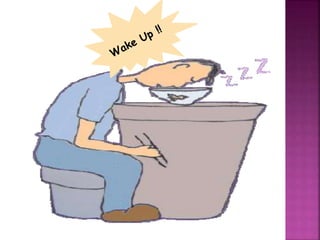
THE WORST THINGS;
TO BE IN BED AND SLEEP NOT,
TO WANT FOR ONE WHO COMES
NOT,
TO TRY TO PLEASE AND PLEASE
NOT
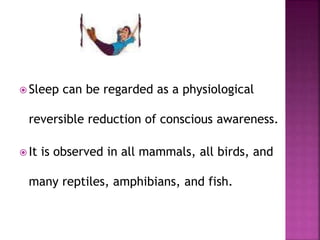
 Sleep can be regarded as a physiological
reversible reduction of conscious awareness.
 It is observed in all mammals, all birds, and
many reptiles, amphibians, and fish.
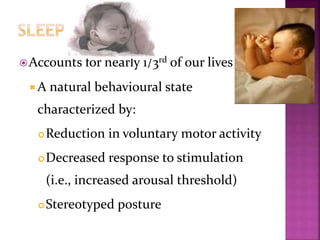
Accounts for nearly 1/3rd of our lives
 A natural behavioural state
characterized by:
Reduction in voluntary motor activity
Decreased response to stimulation
(i.e., increased arousal threshold)
Stereotyped posture
 There are two types of sleep, non-rapid eye-
movement (NREM) sleep and rapid eye-
movement (REM) sleep.
 NREM sleep is divided into stages 1, 2, 3, and
4, representing a continuum of relative depth.
 Entered through NREM
 REM sleep dominates last third of night
 REM sleep: 20-25% total sleep time
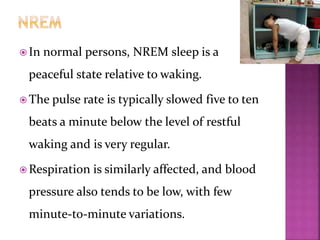
 In normal persons, NREM sleep is a
peaceful state relative to waking.
 The pulse rate is typically slowed five to ten
beats a minute below the level of restful
waking and is very regular.
 Respiration is similarly affected, and blood
pressure also tends to be low, with few
minute-to-minute variations.
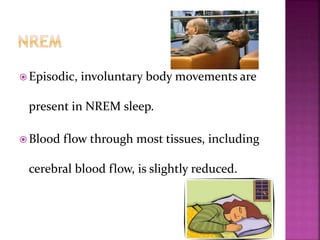
 Episodic, involuntary body movements are
present in NREM sleep.
 Blood flow through most tissues, including
cerebral blood flow, is slightly reduced.
Pulse, respiration, and blood pressure in
humans are all high during REM sleep, much
higher than during NREM sleep and often
higher than during waking.
 Brain oxygen use increases during REM sleep.
Thermoregulation is altered during REM sleep.
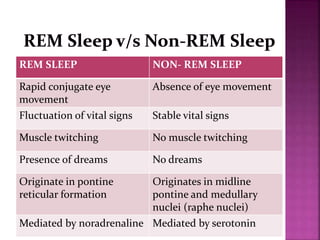
REM SLEEP NON- REM SLEEP
Rapid conjugate eye
movement
Absence of eye movement
Fluctuation of vital signs Stable vital signs
Muscle twitching No muscle twitching
Presence of dreams No dreams
Originate in pontine
reticular formation
Originates in midline
pontine and medullary
nuclei (raphe nuclei)
Mediated by noradrenaline Mediated by serotonin
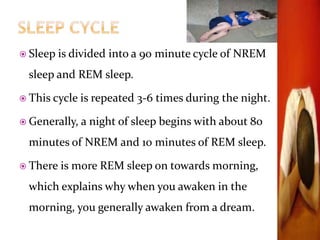
 Sleep is divided into a 90 minute cycle of NREM
sleep and REM sleep.
 This cycle is repeated 3-6 times during the night.
 Generally, a night of sleep begins with about 80
minutes of NREM and 10 minutes of REM sleep.
 There is more REM sleep on towards morning,
which explains why when you awaken in the
morning, you generally awaken from a dream.
NON-ORGANIC SLEEP
DISORDERS
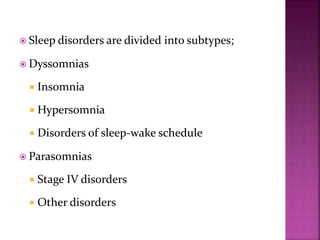
 Sleep disorders are divided into subtypes;
 Dyssomnias
 Insomnia
 Hypersomnia
 Disorders of sleep-wake schedule
 Parasomnias
 Stage IV disorders
 Other disorders
Dyssomnias
They are primarily psychogenic conditions
in which the predominant disturbance is in the
amount, quality or timing of sleep is due to
emotional causes.
Parasomnias
They are abnormal episodic events
occurring during sleep; in childhood, these are
related mainly to the child’s development,
while in adulthood, they are primarily
psychogenic.
It refer to the disorder of initiation and
maintenance of sleep. This includes frequent
awakening during night and early morning
awakening.
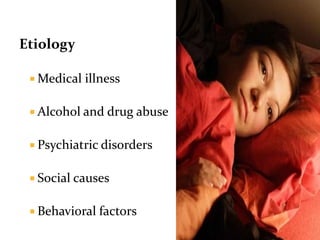
Etiology
 Medical illness
 Alcohol and drug abuse
 Psychiatric disorders
 Social causes
 Behavioral factors
 Individuals describe themselves as feeling tense,
anxious, worried, or depressed at bedtime and as
though their thoughts are racing
 They frequently ruminate over getting enough
sleep, personal problems, health status and even
death.
 Use of alcohol and other substances.
 In the morning, they frequently report feeling
physically and mentally tired; during the day,
they characteristically feel depressed, worried,
tense and preoccupied with themselves.
 Difficulty in falling asleep at night or getting back
to sleep after waking during night.
 Sleep is light, fragmented or unrefreshing
 Need to take something in order to get sleep
 Sleepiness and low energy during the day.
TREATMENT
 Thorough medical and psychiatric assessment
 Polysomnography
 Treatment of underlying physical/psychiatric disorder
 Withdrawal of current medications
 Benzodiazepines for short periods
 Non-benzodiazepine hypnotic
 Opioids
 Melatonin
 Low doses of atypical antipsychotics
Non-pharmacologic management
 Progressive relaxation
 Autosuggestion
 Meditation, yoga
 Stimulus control therapy
 Do not use bed for reading or chatting-go to bed
for sleep only
 Sleep hygiene
 Sleep as much as needed to feel rested; do not
oversleep
 Exercise regularly
 Avoid forcing to sleep
 Keep a regular sleep and awakening schedule
 Avoid caffeinated drink at bedtime
 Avoid ‘night caps’
 Do not go to bed hungry
 Adjust room environment
 Do not go to bed with worries
 Back rub, warm milk and relaxation exercises.
 It is also known as Disorder Of Excessive
Somnolence (DOES)
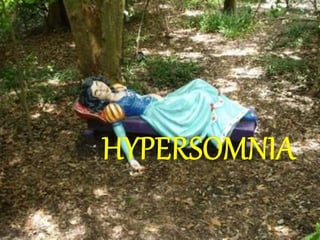
Hypersomnia is characterised by
recurrent episodes of excessive daytime
sleepiness or prolonged night-time sleep. It
includes sleep attacks during daytime, sleep
drunkenness (person needs much more time to
awaken, and during this period he is confused or
disoriented).
Etiology
 Narcolepsy(Excessive daytime sleepiness
characterized by sleep attacks, cataplexy, sleep
paralysis and hypnagogic hallucinations)
 Sleep apnoea
 Kleine –Levin syndrome (Periodic episodes of
hypersomnia)
 Dysfunctions in autonomic nervous system
 Drug or alcohol abuse
 Certain medications
 Medical conditions like multiple sclerosis,
depression, encephalitis, epilepsy, obesity etc.
Clinical features
 Persons are compelled to take nap during day at
inappropriate times
 Disoriented sometimes
 Anxiety, increased irritation, decreased energy,
restlessness, slow thinking, slow speech, anorexia,
hallucinations and memory difficulty
 Poor social, occupational and family functioning
TREATMENT
 Symptomatic treatment
 Changes in behavior and diet
 Avoiding alcohol
 Stimulants like amphetamine, methylphenidate and
modafinil
 Clonidine, levodopa, bromocriptine
 Antidepressants, MAO inhibitors
It is characterized by a disturbance in
the timing of sleep. The person with this
disorder is not able to sleep when he
wishes to, although at other times he is
able to sleep adequately.
 It is a form of dyssomnia caused by a
conflict between a person’s circadian
rhythm and the socio-economic demands of
society, such as work and travel schedules.
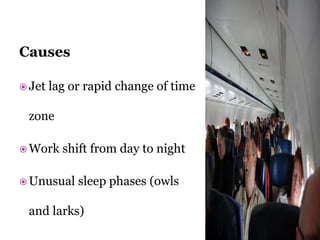
Causes
 Jet lag or rapid change of time
zone
 Work shift from day to night
 Unusual sleep phases (owls
and larks)
STAGE IV SLEEP DISORDERS
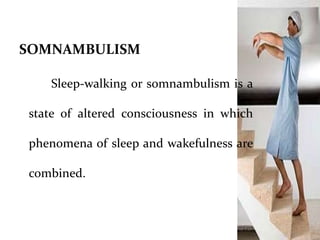
SOMNAMBULISM
Sleep-walking or somnambulism is a
state of altered consciousness in which
phenomena of sleep and wakefulness are
combined.
 During sleepwalking episode, the individual
arises from bed, usually during first third of
nocturnal sleep, and walks about, exhibiting
low levels of awareness, reactivity, and motor
skill.
 Most often he will return quietly to bed, either
unaided or with a gentle assistance.
 Upon awakening, there will be no recall of
event.
NIGHT TERRORS
Night terror or sleep terror or pavor
nocturnus, is a parasomnia disorder that
predominantly affects children, causing
feelings of dread or terror.
 Children usually described the experience as
“bolting upright” with their eyes wide open,
with a look of fear and panic, and will often
scream.
SLEEP-RELATED ENURESIS
Sleep related enuresis or bedwetting,
involves urinating during sleep and occurs
most often during deep sleep.
 It is frequently the result of a failure of brain
to engage in appropriate “alarming” of
bathroom needs during sleep before
urination occurs.
BRUXISM
It is characterized by the grinding of the
teeth and typically includes the clenching of
the jaw.
 While bruxism may be a diurnal or nocturnal
activity, it is bruxism during sleep that causes
majority of health issues and can even occur
during short naps.
SLEEP-TALKING (SOMNILOQUY)
It refers to talking aloud in one’s sleep. It
can be quite loud, ranging from simple sounds
to long speeches, and can occur many times
during sleep.
 Listeners may or may not be able to
understand what the person is saying.
OTHER SLEEP DISORDERS
 NOCTURNAL ANGINA
 NOCTURNAL ASTHMA
 NOCTURNAL SEIZURES
 SLEEP PARALYSIS
 OBSTRUCTIVE SLEEP APNEA SYNDROME (OSAS)
 PERIODIC LIMB MOVEMENT DISORDER
 RESTLESS LEG SYNDROME
NURSING MANAGEMENT
Assessment
 Usual activities in the hour before sleep
 Sleep latency
 Number and perceived cause of awakenings
 Regularity of sleep pattern
 Consistency of rising time
 Frequency and duration of naps
 Ease of falling asleep in places other than the
usual bedroom
 Daily caffeine intake
 Use of alcohol, sleeping pills and other
medications
 Objective data may include visible signs of
fatigue and lack of sleep, such as circles
under the eyes, lack of coordination,
drowsiness and irritability.
Diagnosis:- Disturbed sleep pattern related to
(specific medical condition),use of or withdrawal
from substances, anxiety or depression, circadian
rhythm disruptions, familial patterns
 Interventions:-
 To promote sleep:
 Encourage activities that prepare one for sleep:
soft music, relaxation exercise or warm bath
 Discourage strenuous exercise within one hour of
bed time
 Control intake of caffeine containing substances within 4
hours of bed time
 Provide a high carbohydrate snack before bed time
 Keep the temperature of the room between 68-72 degree F
 Instruct the client not to use alcoholic beverages to relax
 Discourage smoking and other tobacco products near sleep
time
 Discourage day time napping
 Individuals with chronic insomnia should use sleeping
medication judiciously
Diagnosis:- Risk of injury related to excessive
sleeping, sleep terrors, or sleep walking
Interventions:-
 Keep the side rails of the bed up
 Keep the bed in a low position
 Equip the bed with a bell that is activated when the
bed is excited
 Keep a night light on and arrange the furniture in
the bedroom in a manner that promote safety
 Administer drug therapy as ordered.
Diagnosis:- Disturbed sleep pattern related to
enuresis as evidenced by frequent arousal of the
child from bed.
Interventions:-
 Assess for anatomical or urinary problems, if any.
 lnsist the parents to make the child void before
bedtime
 ЕхрІаіn about the availability of bedwetting alarms
 Teach bladder stretching exercises
 Administer medications as per physician's order.
Thank you….

Sleep disorders premnath cnt

  • 1.
  • 2.
    THE WORST THINGS; TOBE IN BED AND SLEEP NOT, TO WANT FOR ONE WHO COMES NOT, TO TRY TO PLEASE AND PLEASE NOT
  • 4.
     Sleep canbe regarded as a physiological reversible reduction of conscious awareness.  It is observed in all mammals, all birds, and many reptiles, amphibians, and fish.
  • 5.
    Accounts for nearly1/3rd of our lives  A natural behavioural state characterized by: Reduction in voluntary motor activity Decreased response to stimulation (i.e., increased arousal threshold) Stereotyped posture
  • 6.
     There aretwo types of sleep, non-rapid eye- movement (NREM) sleep and rapid eye- movement (REM) sleep.  NREM sleep is divided into stages 1, 2, 3, and 4, representing a continuum of relative depth.
  • 7.
     Entered throughNREM  REM sleep dominates last third of night  REM sleep: 20-25% total sleep time
  • 8.
     In normalpersons, NREM sleep is a peaceful state relative to waking.  The pulse rate is typically slowed five to ten beats a minute below the level of restful waking and is very regular.  Respiration is similarly affected, and blood pressure also tends to be low, with few minute-to-minute variations.
  • 9.
     Episodic, involuntarybody movements are present in NREM sleep.  Blood flow through most tissues, including cerebral blood flow, is slightly reduced.
  • 10.
    Pulse, respiration, andblood pressure in humans are all high during REM sleep, much higher than during NREM sleep and often higher than during waking.  Brain oxygen use increases during REM sleep. Thermoregulation is altered during REM sleep.
  • 11.
    REM SLEEP NON-REM SLEEP Rapid conjugate eye movement Absence of eye movement Fluctuation of vital signs Stable vital signs Muscle twitching No muscle twitching Presence of dreams No dreams Originate in pontine reticular formation Originates in midline pontine and medullary nuclei (raphe nuclei) Mediated by noradrenaline Mediated by serotonin
  • 12.
     Sleep isdivided into a 90 minute cycle of NREM sleep and REM sleep.  This cycle is repeated 3-6 times during the night.  Generally, a night of sleep begins with about 80 minutes of NREM and 10 minutes of REM sleep.  There is more REM sleep on towards morning, which explains why when you awaken in the morning, you generally awaken from a dream.
  • 14.
  • 15.
     Sleep disordersare divided into subtypes;  Dyssomnias  Insomnia  Hypersomnia  Disorders of sleep-wake schedule  Parasomnias  Stage IV disorders  Other disorders
  • 16.
    Dyssomnias They are primarilypsychogenic conditions in which the predominant disturbance is in the amount, quality or timing of sleep is due to emotional causes.
  • 17.
    Parasomnias They are abnormalepisodic events occurring during sleep; in childhood, these are related mainly to the child’s development, while in adulthood, they are primarily psychogenic.
  • 19.
    It refer tothe disorder of initiation and maintenance of sleep. This includes frequent awakening during night and early morning awakening.
  • 20.
    Etiology  Medical illness Alcohol and drug abuse  Psychiatric disorders  Social causes  Behavioral factors
  • 21.
     Individuals describethemselves as feeling tense, anxious, worried, or depressed at bedtime and as though their thoughts are racing  They frequently ruminate over getting enough sleep, personal problems, health status and even death.  Use of alcohol and other substances.
  • 22.
     In themorning, they frequently report feeling physically and mentally tired; during the day, they characteristically feel depressed, worried, tense and preoccupied with themselves.  Difficulty in falling asleep at night or getting back to sleep after waking during night.
  • 23.
     Sleep islight, fragmented or unrefreshing  Need to take something in order to get sleep  Sleepiness and low energy during the day.
  • 24.
    TREATMENT  Thorough medicaland psychiatric assessment  Polysomnography  Treatment of underlying physical/psychiatric disorder  Withdrawal of current medications  Benzodiazepines for short periods  Non-benzodiazepine hypnotic  Opioids  Melatonin  Low doses of atypical antipsychotics
  • 25.
    Non-pharmacologic management  Progressiverelaxation  Autosuggestion  Meditation, yoga  Stimulus control therapy  Do not use bed for reading or chatting-go to bed for sleep only
  • 26.
     Sleep hygiene Sleep as much as needed to feel rested; do not oversleep  Exercise regularly  Avoid forcing to sleep  Keep a regular sleep and awakening schedule  Avoid caffeinated drink at bedtime  Avoid ‘night caps’  Do not go to bed hungry  Adjust room environment  Do not go to bed with worries  Back rub, warm milk and relaxation exercises.
  • 28.
     It isalso known as Disorder Of Excessive Somnolence (DOES)
  • 29.
    Hypersomnia is characterisedby recurrent episodes of excessive daytime sleepiness or prolonged night-time sleep. It includes sleep attacks during daytime, sleep drunkenness (person needs much more time to awaken, and during this period he is confused or disoriented).
  • 30.
    Etiology  Narcolepsy(Excessive daytimesleepiness characterized by sleep attacks, cataplexy, sleep paralysis and hypnagogic hallucinations)  Sleep apnoea  Kleine –Levin syndrome (Periodic episodes of hypersomnia)
  • 31.
     Dysfunctions inautonomic nervous system  Drug or alcohol abuse  Certain medications  Medical conditions like multiple sclerosis, depression, encephalitis, epilepsy, obesity etc.
  • 32.
    Clinical features  Personsare compelled to take nap during day at inappropriate times  Disoriented sometimes  Anxiety, increased irritation, decreased energy, restlessness, slow thinking, slow speech, anorexia, hallucinations and memory difficulty  Poor social, occupational and family functioning
  • 33.
    TREATMENT  Symptomatic treatment Changes in behavior and diet  Avoiding alcohol  Stimulants like amphetamine, methylphenidate and modafinil  Clonidine, levodopa, bromocriptine  Antidepressants, MAO inhibitors
  • 35.
    It is characterizedby a disturbance in the timing of sleep. The person with this disorder is not able to sleep when he wishes to, although at other times he is able to sleep adequately.
  • 36.
     It isa form of dyssomnia caused by a conflict between a person’s circadian rhythm and the socio-economic demands of society, such as work and travel schedules.
  • 37.
    Causes  Jet lagor rapid change of time zone  Work shift from day to night  Unusual sleep phases (owls and larks)
  • 39.
    STAGE IV SLEEPDISORDERS
  • 40.
    SOMNAMBULISM Sleep-walking or somnambulismis a state of altered consciousness in which phenomena of sleep and wakefulness are combined.
  • 41.
     During sleepwalkingepisode, the individual arises from bed, usually during first third of nocturnal sleep, and walks about, exhibiting low levels of awareness, reactivity, and motor skill.  Most often he will return quietly to bed, either unaided or with a gentle assistance.  Upon awakening, there will be no recall of event.
  • 42.
    NIGHT TERRORS Night terroror sleep terror or pavor nocturnus, is a parasomnia disorder that predominantly affects children, causing feelings of dread or terror.  Children usually described the experience as “bolting upright” with their eyes wide open, with a look of fear and panic, and will often scream.
  • 43.
    SLEEP-RELATED ENURESIS Sleep relatedenuresis or bedwetting, involves urinating during sleep and occurs most often during deep sleep.  It is frequently the result of a failure of brain to engage in appropriate “alarming” of bathroom needs during sleep before urination occurs.
  • 44.
    BRUXISM It is characterizedby the grinding of the teeth and typically includes the clenching of the jaw.  While bruxism may be a diurnal or nocturnal activity, it is bruxism during sleep that causes majority of health issues and can even occur during short naps.
  • 45.
    SLEEP-TALKING (SOMNILOQUY) It refersto talking aloud in one’s sleep. It can be quite loud, ranging from simple sounds to long speeches, and can occur many times during sleep.  Listeners may or may not be able to understand what the person is saying.
  • 46.
  • 47.
     NOCTURNAL ANGINA NOCTURNAL ASTHMA  NOCTURNAL SEIZURES  SLEEP PARALYSIS  OBSTRUCTIVE SLEEP APNEA SYNDROME (OSAS)  PERIODIC LIMB MOVEMENT DISORDER  RESTLESS LEG SYNDROME
  • 48.
    NURSING MANAGEMENT Assessment  Usualactivities in the hour before sleep  Sleep latency  Number and perceived cause of awakenings  Regularity of sleep pattern  Consistency of rising time  Frequency and duration of naps  Ease of falling asleep in places other than the usual bedroom  Daily caffeine intake  Use of alcohol, sleeping pills and other medications
  • 49.
     Objective datamay include visible signs of fatigue and lack of sleep, such as circles under the eyes, lack of coordination, drowsiness and irritability.
  • 50.
    Diagnosis:- Disturbed sleeppattern related to (specific medical condition),use of or withdrawal from substances, anxiety or depression, circadian rhythm disruptions, familial patterns  Interventions:-  To promote sleep:  Encourage activities that prepare one for sleep: soft music, relaxation exercise or warm bath  Discourage strenuous exercise within one hour of bed time
  • 51.
     Control intakeof caffeine containing substances within 4 hours of bed time  Provide a high carbohydrate snack before bed time  Keep the temperature of the room between 68-72 degree F  Instruct the client not to use alcoholic beverages to relax  Discourage smoking and other tobacco products near sleep time  Discourage day time napping  Individuals with chronic insomnia should use sleeping medication judiciously
  • 52.
    Diagnosis:- Risk ofinjury related to excessive sleeping, sleep terrors, or sleep walking Interventions:-  Keep the side rails of the bed up  Keep the bed in a low position  Equip the bed with a bell that is activated when the bed is excited  Keep a night light on and arrange the furniture in the bedroom in a manner that promote safety  Administer drug therapy as ordered.
  • 53.
    Diagnosis:- Disturbed sleeppattern related to enuresis as evidenced by frequent arousal of the child from bed. Interventions:-  Assess for anatomical or urinary problems, if any.  lnsist the parents to make the child void before bedtime  ЕхрІаіn about the availability of bedwetting alarms  Teach bladder stretching exercises  Administer medications as per physician's order.
  • 54.