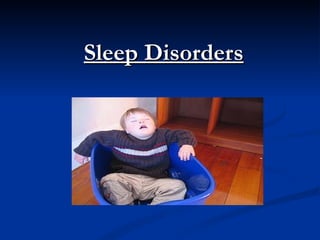
Sleep Disorders
Sleep - Sleep   is  unconsciousness  from which the person can be  aroused  by sensory or other stimuli  - Coma   is unconsciousness from which the person cannot be aroused
Sleep 1. Slow-wave sleep  (non REM sleep) 2. Rapid eye movement sleep  (REM sleep)
Slow-wave deep (non-REM) -Most sleep during night (75%). -Exceedingly restful. -Dec. peripheral vascular tone. -10-30% dec. in blood pressure, resp. rate and basal metabolic rate. -dreams are usually not remembered.
Rapid Eye Movement (REM) -Occurs in normal night sleeps. -Last for 5-30 min. and occur every 90 min. -Rapid movement of the eyes. -Usually ass. With active dreaming and active bodily muscle movement. -The heart rate and resp. rate become irregular (dream). -The brain is highly active.
Theories of sleep passive theory of sle ep:  excitatory areas of (RAS) in the upper brain stem fatigued and became inactive. active inhibitory process: Stimulation of  center located below the  midpontile level  of the brain stem inhibiting excitatory areas of (RAS) in the upper brain stem leading to sleep.
Sleep Disorders -1/3 of U.S. people suffer from sleep disorders. -It is classified into: 1. Primary  ( Dyssomnias  and  Parasomnias ) 2. Secondary
Causes of 2ry sleep disorders -Medical conditions (pain, met dis, endo dis) -Physical conditions (obesity) -Sedative withdrawal -Use of stimulants -Major depression -Mania or anxiety -Neurotransmitter abnormalities (  dopamine or norepinephrine,  ACH,  serotonin).
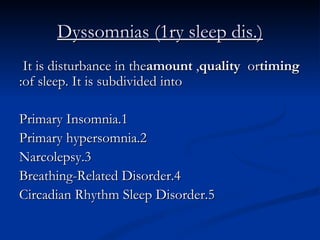
Dyssomnias (1ry sleep dis.) It is disturbance in the  amount ,  quality  or  timing  of sleep. It is subdivided into: 1.Primary Insomnia 2.Primary hypersomnia 3.Narcolepsy 4.Breathing-Related Disorder 5.Circadian Rhythm Sleep Disorder
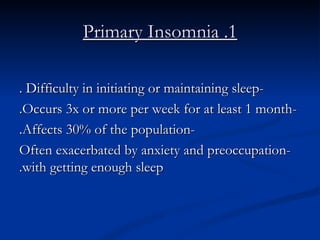
1. Primary Insomnia -Difficulty in initiating or maintaining sleep . -Occurs 3x or more per week for at least 1 month. -Affects 30% of the population. -Often exacerbated by anxiety and preoccupation with getting enough sleep.
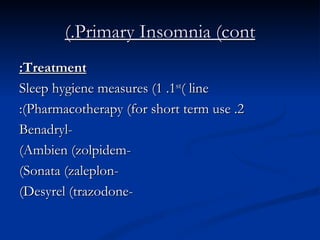
Primary Insomnia (cont.) Treatment: 1. Sleep hygiene measures (1 st  line) 2. Pharmacotherapy (for short term use): -Benadryl -Ambien (zolpidem) -Sonata (zaleplon) -Desyrel (trazodone)
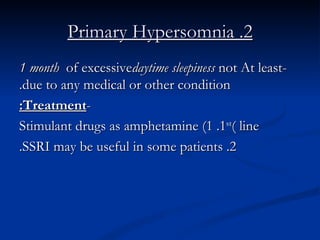
2. Primary Hypersomnia -At least  1 month  of excessive  daytime sleepiness  not due to any medical or other condition. - Treatment: 1. Stimulant drugs as amphetamine (1 st  line) 2. SSRI may be useful in some patients.
3. Narcolepsy -Repeated, sudden attacks of sleep during the day for at least  3 months , ass. With: 1. Cataplexy (collapse due to sudden loss of muscle tone). 2. Short REM latency. 3. Sleep paralysis ( brief paralysis upon awakening). 4. Hypnagogic, hypnopompic  hallucinations.
Narcolepsy (cont.) -Occur in  0.02-0.16%  of population. - Equal  incidence in males and females. -Onset most commonly in  childhood  and  adolescence. -May have genetic component. -Patients usually have poor nighttime sleep.
Narcolepsy (cont.) - Treatment: 1. Timed daily naps. 2. Stimulant drugs (amphetamines and methylphenidate). 3. SSRI or oxalate for patients with  cataplexy.
4. Breathing-Related dis. -Sleep disruption and excessive daytime sleepiness caused by abnormal sleep ventilation from either: 1. Obstructive Sleep Apnea  [OSA] which is correlated to  snoring  or  2. Central Sleep Apnea  [SPA] which is correlated to  heart failure .
OSA risk factors: -Male gender. -Obesity -male shirt collar size >17 -Previous upper airway surgeries. -Deviated nasal septum. - retrognathia Large uvula
Breathing-Related dis. (cont.) - Treatment: 1. OSA: Nasal continuous positive airway pressure (nCPAP), weight loss, nasal surgery or uvulopalatoplasty. 2. CSA : Mechanical ventillation with a backup rate.
Parasomnias -Abnormal events in  behavior  or  physiology  during sleep. It is subdivided into: 1. Nightmare disorder. 2. Night Terror disorder. 3. Sleep Walking disorder (somnambulism).
1. Nightmare dis. -Repeated  awakenings  with recall of extremely frightening dreams. -Occurs during  REM  sleep. -Onset most often starts at  childhood . -Occur more frequently during time of stress. - NO  SPECIFIC  TREATMENT  but  tricyclics  could be used.
2. Night Terror disorder -Repeated episodes of fearfulness during sleep. -Episodes usually occur during the  slow-wave deep stage of sleep. -Patients usually don ’ t remember the episodes. -It usually begins with a scream and ass. With intense anxiety.
Night Terror dis. (cont.) -Usually occur in  children . -More common in  boys . -Tend to run in families. -High ass. With  comorbid sleepwalking dis. - No  specific  treatment  but giving  diazepam  before bedtime might be effective.
3. Sleepwalking dis. (Somnambulism) -Repeated episodes of getting out of bed and walking. -Ass. With  blank stare  and  difficulty in being awakened . -Onset bet. Age 4-8 yrs. run in family  to   tends   boy   - More common in -The best treatment is to prevent injury in surrounding environment.
Thank you

I disordini del sonno

  • 1.
  • 2.
    Sleep - Sleep is unconsciousness from which the person can be aroused by sensory or other stimuli - Coma is unconsciousness from which the person cannot be aroused
  • 3.
    Sleep 1. Slow-wavesleep (non REM sleep) 2. Rapid eye movement sleep (REM sleep)
  • 4.
    Slow-wave deep (non-REM)-Most sleep during night (75%). -Exceedingly restful. -Dec. peripheral vascular tone. -10-30% dec. in blood pressure, resp. rate and basal metabolic rate. -dreams are usually not remembered.
  • 5.
    Rapid Eye Movement(REM) -Occurs in normal night sleeps. -Last for 5-30 min. and occur every 90 min. -Rapid movement of the eyes. -Usually ass. With active dreaming and active bodily muscle movement. -The heart rate and resp. rate become irregular (dream). -The brain is highly active.
  • 6.
    Theories of sleeppassive theory of sle ep: excitatory areas of (RAS) in the upper brain stem fatigued and became inactive. active inhibitory process: Stimulation of center located below the midpontile level of the brain stem inhibiting excitatory areas of (RAS) in the upper brain stem leading to sleep.
  • 7.
    Sleep Disorders -1/3of U.S. people suffer from sleep disorders. -It is classified into: 1. Primary ( Dyssomnias and Parasomnias ) 2. Secondary
  • 8.
    Causes of 2rysleep disorders -Medical conditions (pain, met dis, endo dis) -Physical conditions (obesity) -Sedative withdrawal -Use of stimulants -Major depression -Mania or anxiety -Neurotransmitter abnormalities ( dopamine or norepinephrine, ACH, serotonin).
  • 9.
    Dyssomnias (1ry sleepdis.) It is disturbance in the amount , quality or timing of sleep. It is subdivided into: 1.Primary Insomnia 2.Primary hypersomnia 3.Narcolepsy 4.Breathing-Related Disorder 5.Circadian Rhythm Sleep Disorder
  • 10.
    1. Primary Insomnia-Difficulty in initiating or maintaining sleep . -Occurs 3x or more per week for at least 1 month. -Affects 30% of the population. -Often exacerbated by anxiety and preoccupation with getting enough sleep.
  • 11.
    Primary Insomnia (cont.)Treatment: 1. Sleep hygiene measures (1 st line) 2. Pharmacotherapy (for short term use): -Benadryl -Ambien (zolpidem) -Sonata (zaleplon) -Desyrel (trazodone)
  • 12.
    2. Primary Hypersomnia-At least 1 month of excessive daytime sleepiness not due to any medical or other condition. - Treatment: 1. Stimulant drugs as amphetamine (1 st line) 2. SSRI may be useful in some patients.
  • 13.
    3. Narcolepsy -Repeated,sudden attacks of sleep during the day for at least 3 months , ass. With: 1. Cataplexy (collapse due to sudden loss of muscle tone). 2. Short REM latency. 3. Sleep paralysis ( brief paralysis upon awakening). 4. Hypnagogic, hypnopompic hallucinations.
  • 14.
    Narcolepsy (cont.) -Occurin 0.02-0.16% of population. - Equal incidence in males and females. -Onset most commonly in childhood and adolescence. -May have genetic component. -Patients usually have poor nighttime sleep.
  • 15.
    Narcolepsy (cont.) -Treatment: 1. Timed daily naps. 2. Stimulant drugs (amphetamines and methylphenidate). 3. SSRI or oxalate for patients with cataplexy.
  • 16.
    4. Breathing-Related dis.-Sleep disruption and excessive daytime sleepiness caused by abnormal sleep ventilation from either: 1. Obstructive Sleep Apnea [OSA] which is correlated to snoring or 2. Central Sleep Apnea [SPA] which is correlated to heart failure .
  • 17.
    OSA risk factors:-Male gender. -Obesity -male shirt collar size >17 -Previous upper airway surgeries. -Deviated nasal septum. - retrognathia Large uvula
  • 18.
    Breathing-Related dis. (cont.)- Treatment: 1. OSA: Nasal continuous positive airway pressure (nCPAP), weight loss, nasal surgery or uvulopalatoplasty. 2. CSA : Mechanical ventillation with a backup rate.
  • 19.
    Parasomnias -Abnormal eventsin behavior or physiology during sleep. It is subdivided into: 1. Nightmare disorder. 2. Night Terror disorder. 3. Sleep Walking disorder (somnambulism).
  • 20.
    1. Nightmare dis.-Repeated awakenings with recall of extremely frightening dreams. -Occurs during REM sleep. -Onset most often starts at childhood . -Occur more frequently during time of stress. - NO SPECIFIC TREATMENT but tricyclics could be used.
  • 21.
    2. Night Terrordisorder -Repeated episodes of fearfulness during sleep. -Episodes usually occur during the slow-wave deep stage of sleep. -Patients usually don ’ t remember the episodes. -It usually begins with a scream and ass. With intense anxiety.
  • 22.
    Night Terror dis.(cont.) -Usually occur in children . -More common in boys . -Tend to run in families. -High ass. With comorbid sleepwalking dis. - No specific treatment but giving diazepam before bedtime might be effective.
  • 23.
    3. Sleepwalking dis.(Somnambulism) -Repeated episodes of getting out of bed and walking. -Ass. With blank stare and difficulty in being awakened . -Onset bet. Age 4-8 yrs. run in family to tends boy - More common in -The best treatment is to prevent injury in surrounding environment.
  • 24.