By
Dr. Asma A Rehman
Consultant Psychiatrist
MCPS psychiatry
 Sleep
 Definition
 Function
 Stages
 Regulation
 Requirement
 Sleep disorders
 Classification
 Specific sleep disorders
Sleep.
 Definition.
 Sleep is a state of unconsciousness in which the brain is
relatively more responsive to internal than external stimuli.
 Functions
 Restorative
 Homeostatic function
Sleep stages
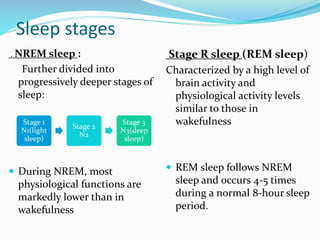
. NREM sleep :
Further divided into
progressively deeper stages of
sleep:
 During NREM, most
physiological functions are
markedly lower than in
wakefulness
Stage R sleep (REM sleep)
Characterized by a high level of
brain activity and
physiological activity levels
similar to those in
wakefulness
 REM sleep follows NREM
sleep and occurs 4-5 times
during a normal 8-hour sleep
period.
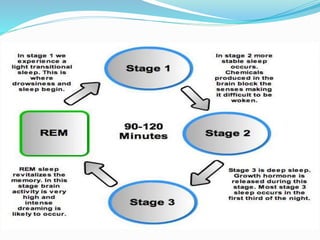
Stage 1
N1(light
sleep)
Stage 2
N2
Stage 3
N3(deep
sleep)
 About 90 minutes after sleep onset NREM - to 1st REM
episode of night.
 The order normally being N1 → N2 → N3 → N2 → REM.
 REM latency of 90 min is normal
 Shortening of REM latency frequently occurs with orders :
depressive disorders and narcolepsy
 REM period occurs every 90-100min during night.
 1st REM shortest of 10min later 15-40min.
 Typically, N3 sleep ----- first third of the night,
 Whereas REM sleep ------- last third of the night.
 This can be helpful clinically as NREM parasomnias such
as sleep walking typically occur in the first third of the
night with the presence of N3 sleep.
 This contrasts with REM sleep behavior disorder (RBD),
which typically occurs in the last half of the night.
Sleep Cycle.
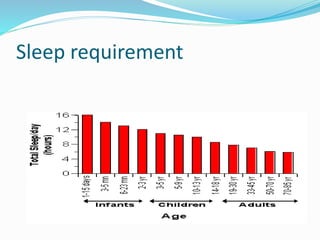
Sleep requirement
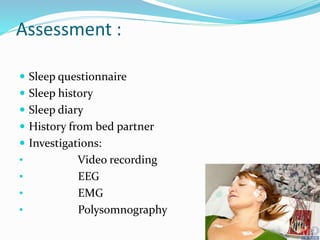
Assessment :
 Sleep questionnaire
 Sleep history
 Sleep diary
 History from bed partner
 Investigations:
• Video recording
• EEG
• EMG
• Polysomnography
Sleep disorders
 Definition
 Epidemiology
10.2% insomnia
3.2% hypersomnia
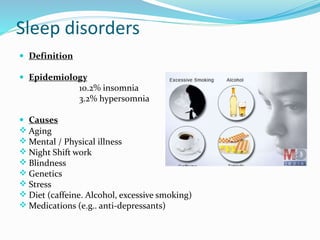
 Causes
 Aging
 Mental / Physical illness
 Night Shift work
 Blindness
 Genetics
 Stress
 Diet (caffeine. Alcohol, excessive smoking)
 Medications (e.g.. anti-depressants)
Sleep disorders
 Classification
o 1) Dyssomnia:
disorders of Quantity and timing of sleep
o 2) Parasomnias:
abnormal behaviors during sleep or the transition
between sleep and wakefulness.
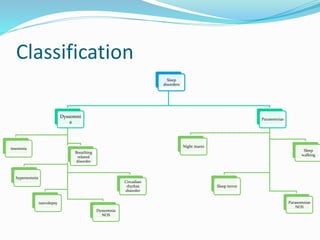
Classification
Sleep
disorders
Dyssomni
a
insomnia
hypersomnia
narcolepsy
Breathing
related
disorder
Dyssomnia
NOS
Circadian
rhythm
disorder
Parasomnias
Night mares
Sleep terror
Parasomnias
NOS
Sleep
walking
Dyssomnia
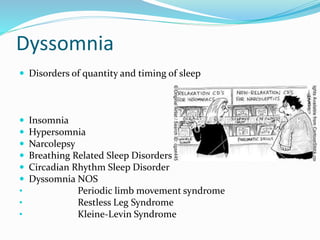
 Disorders of quantity and timing of sleep
 Insomnia
 Hypersomnia
 Narcolepsy
 Breathing Related Sleep Disorders
 Circadian Rhythm Sleep Disorder
 Dyssomnia NOS
• Periodic limb movement syndrome
• Restless Leg Syndrome
• Kleine-Levin Syndrome
Insomnia
Difficulty in initiating or maintaining sleep.
Persistent problems (at least 3days/week or 1 month)
F>M
Transient insomnia: occurs at time of stress or jet lag
Short term insomnia: with personnel problems as illness,
bereavement, relationship difficulties
Secondary to : excessive use of caffeine or alcohol or stimulants.
Only 15% ------- primary insomnia.
 Primary insomnia:
 when chief complain of non-restorable sleep or
difficulties in initiating or maintaining sleep for at
least 1 month.
 Independent of physical and mental disorder
Treatment
Non-pharmacological Pharmacological.
 1) sleep hygiene
 2) cognitive therapy
 3) stimulus control therapy
 4) sleep restriction
 5) progressive muscle
relaxation.
 Dietary supplements
 melatonin
 L-tryptophan
 Short acting benzodiazepines
 Z- drugs
 zolpedium

 Low dose sedative
antidepressants
 mitrazepine
 Long acting medicines
 flurazepam
 quazepam
 Other medicines
 nefazadone
 qutiepine.
hypersomnia
 Excessive amounts of sleep, excessive day time sleepiness, or sometimes
both.
 3-5%
 Mostly secondary to loss of night time sleep
 causes
 Insufficient night sleep Pathological sleep
Unsatisfactory sleep routine Narcolepsy
Circadian Rhythm sleep disorder Obstructive sleep apnea
Frequent parasomnias CNS diseases
Chronic physical illness Drug effects
Psychiatric disorders Kleine-Levin Syndrome.
 Primary hypersomnia:
 when no other cause can be found for
excessive somnolence occurring for at least 1 month
 Treatment.
 Stimulant drugs
 Non sedating SSRIs.
Narcolepsy
 Epidemiology
 age of onset: 10-20years
 prevalence : 0.02-0.16%
 Sleep attack of narcolepsy represents episodes of
irresistible sleepiness leading to 10-20 minutes of sleep
after which person is fresh
 Occurs in inappropriate times (talking, eating or during
sex)
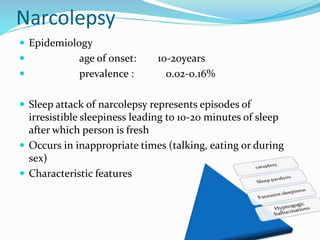
 Characteristic features
Treatment
 Follow regular routine
 Planned naps
 Avoid fatigue as it provokes catalepsy
 Medicines
• Dexamphetamine
• Modafinil
• Methylphenidate (Ritalin)
 For Cataplexy—
• TCAs or SSRIs.
Breathing related sleep disorders/ obstructive
sleep apnea syndrome
 Characterized by sleep disruptions leading to excessive
sleepiness or insomnia caused by sleep-related breathing
disturbances such as apnea, hypopnea, and oxygen
desaturation.
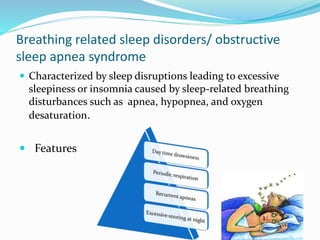
 Features
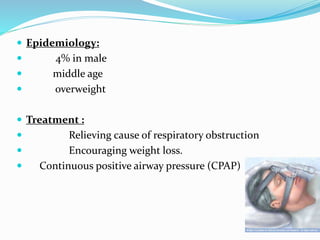
 Epidemiology:
 4% in male
 middle age
 overweight
 Treatment :
 Relieving cause of respiratory obstruction
 Encouraging weight loss.
 Continuous positive airway pressure (CPAP)
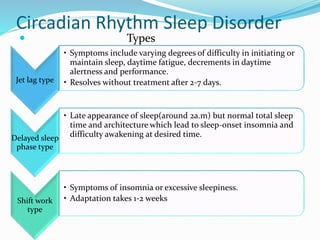
Circadian Rhythm Sleep Disorder
 Types
Jet lag type
• Symptoms include varying degrees of difficulty in initiating or
maintain sleep, daytime fatigue, decrements in daytime
alertness and performance.
• Resolves without treatment after 2-7 days.
Delayed sleep
phase type
• Late appearance of sleep(around 2a.m) but normal total sleep
time and architecture which lead to sleep-onset insomnia and
difficulty awakening at desired time.
Shift work
type
• Symptoms of insomnia or excessive sleepiness.
• Adaptation takes 1-2 weeks
Circadian Rhythm Sleep Disorder
 Management .
 1) General measures.
education about sleep nature
establishing good sleep habits
regular sleep and meal times
 2) Chronotherapy
establish regular waking time.
 3) Medication.
short-acting BdZs(lormetazepam)
melatonin.
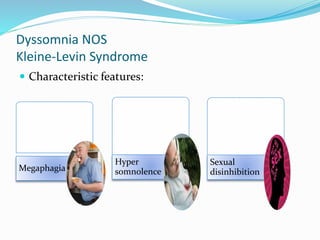
Dyssomnia NOS
Kleine-Levin Syndrome
 Characteristic features:
Megaphagia
Hyper
somnolence
Sexual
disinhibition
Periodic Limb Movement Syndrome (PLMS)
 PLMS also called Nocturnal Myoclonus
 Consist of highly stereotyped abrupt contractions of certain leg
muscle during sleep.
 These include extension of toes, as well as flexion of ankle and
knee.
 Patient unaware .
 Associated with renal disease, iron and Vit B12 anemia,
exacerbated by TCAs.
 Treatment :
 Benzodiazepines
 Levodopa
 Quinine
 rarely Opioids
Restless leg syndrome (RLS)
 Distressing & painful condition which can result in severe
insomnia and periodic limb movement during sleep.
 More common
 Prevalence 10%
 M=F
 Exacerbated by caffeine, fatigue or stress
 Also called Ekbom’s Syndrome (Creepy Crawling)
 Causes
 Anemia
 Vit B12 deficiency
 Treatment .
 Look for anemia & Vit B12 and treat if
 Clonazepam.
 L-Dopa
 Carbidopa
 Bromocriptine
 Pergolide
 Ropinirole
Parasomnias.
 Abnormal behavior or physiological events occurring in
association with sleep, specific sleep stage or sleep wake
transition.
 1) Night mares
 2) Night terror
 3) Sleep walking
 4) Parasomnias NOS
• Sleep-related bruxism
• REM sleep behavior disorder
• Sleep talking
• Sleep-related head banging
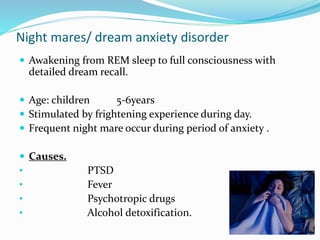
Night mares/ dream anxiety disorder
 Awakening from REM sleep to full consciousness with
detailed dream recall.
 Age: children 5-6years
 Stimulated by frightening experience during day.
 Frequent night mare occur during period of anxiety .
 Causes.
• PTSD
• Fever
• Psychotropic drugs
• Alcohol detoxification.
Night terror.
 Less common then night mare.
 More familial
 Begins and usually ends in childhood
 Few hours after going to sleep.
 Within stage 3-4 NREM
• Sits up and appears terrified
• Screams and appears confused
• Marked increased in heart rate & resp rate
• Slowly settles and returns to normal calm
• Little or no dream recall.
 Prevalence :
• children 3%
• adults 1%
• more in boys
Sleep-walking disorder/somnambulism
 Automatism that occurs during deep NREM sleep usually in early part of night.
 Age: 5-12 years.
 17% in childhood
 4-10% in adults.
 Familial
 Features
 sits up & makes repetitive movements
or
 walk with eyes open
 do not responds to questions
 very difficulty in walking
 led back to bed.
 Lasts for few seconds to minutes.
Sleep-walking disorder/somnambulism
 Polysomnography.
non epileptic high-voltage delta waves.
 Management .
Reassurance
Protect patient from coming harm
Relaxation techniques and minimization of stressors
Sleep hygiene measures
Medications
small night dose of BDZ
Diazepam 2-10mg
Clonazepam 1-4mg
or Anti-depressants
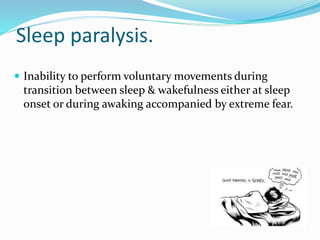
Sleep paralysis.
 Inability to perform voluntary movements during
transition between sleep & wakefulness either at sleep
onset or during awaking accompanied by extreme fear.
Parasomnias not otherwise specific
1)Sleep-related BRUXISM (tooth grinding):
 Grinding occurs throughout night
 Treatment: Dental bite plate and corrective
orthodontic procedure.
 2)REM SLEEP BEHAVIOR DISORDER:
 Characterized by episodes of complex often
violent behavior and thought to represent a patient acting
out his/her dream.
 3)SLEEP TALKING:
 Talking involves few words that are difficulty to
distinguish
 4)SLEEP RELATED HEAD BANGING.
Thank you for not sleeping

sleepandsleepdisorders-160401170019 (1).pdf

  • 1.
    By Dr. Asma ARehman Consultant Psychiatrist MCPS psychiatry
  • 2.
     Sleep  Definition Function  Stages  Regulation  Requirement  Sleep disorders  Classification  Specific sleep disorders
  • 3.
    Sleep.  Definition.  Sleepis a state of unconsciousness in which the brain is relatively more responsive to internal than external stimuli.  Functions  Restorative  Homeostatic function
  • 4.
    Sleep stages . NREMsleep : Further divided into progressively deeper stages of sleep:  During NREM, most physiological functions are markedly lower than in wakefulness Stage R sleep (REM sleep) Characterized by a high level of brain activity and physiological activity levels similar to those in wakefulness  REM sleep follows NREM sleep and occurs 4-5 times during a normal 8-hour sleep period. Stage 1 N1(light sleep) Stage 2 N2 Stage 3 N3(deep sleep)
  • 5.
     About 90minutes after sleep onset NREM - to 1st REM episode of night.  The order normally being N1 → N2 → N3 → N2 → REM.  REM latency of 90 min is normal  Shortening of REM latency frequently occurs with orders : depressive disorders and narcolepsy  REM period occurs every 90-100min during night.  1st REM shortest of 10min later 15-40min.
  • 6.
     Typically, N3sleep ----- first third of the night,  Whereas REM sleep ------- last third of the night.  This can be helpful clinically as NREM parasomnias such as sleep walking typically occur in the first third of the night with the presence of N3 sleep.  This contrasts with REM sleep behavior disorder (RBD), which typically occurs in the last half of the night.
  • 7.
  • 8.
  • 9.
    Assessment :  Sleepquestionnaire  Sleep history  Sleep diary  History from bed partner  Investigations: • Video recording • EEG • EMG • Polysomnography
  • 10.
    Sleep disorders  Definition Epidemiology 10.2% insomnia 3.2% hypersomnia  Causes  Aging  Mental / Physical illness  Night Shift work  Blindness  Genetics  Stress  Diet (caffeine. Alcohol, excessive smoking)  Medications (e.g.. anti-depressants)
  • 11.
    Sleep disorders  Classification o1) Dyssomnia: disorders of Quantity and timing of sleep o 2) Parasomnias: abnormal behaviors during sleep or the transition between sleep and wakefulness.
  • 12.
  • 13.
    Dyssomnia  Disorders ofquantity and timing of sleep  Insomnia  Hypersomnia  Narcolepsy  Breathing Related Sleep Disorders  Circadian Rhythm Sleep Disorder  Dyssomnia NOS • Periodic limb movement syndrome • Restless Leg Syndrome • Kleine-Levin Syndrome
  • 14.
    Insomnia Difficulty in initiatingor maintaining sleep. Persistent problems (at least 3days/week or 1 month) F>M Transient insomnia: occurs at time of stress or jet lag Short term insomnia: with personnel problems as illness, bereavement, relationship difficulties Secondary to : excessive use of caffeine or alcohol or stimulants. Only 15% ------- primary insomnia.
  • 15.
     Primary insomnia: when chief complain of non-restorable sleep or difficulties in initiating or maintaining sleep for at least 1 month.  Independent of physical and mental disorder
  • 16.
    Treatment Non-pharmacological Pharmacological.  1)sleep hygiene  2) cognitive therapy  3) stimulus control therapy  4) sleep restriction  5) progressive muscle relaxation.  Dietary supplements  melatonin  L-tryptophan  Short acting benzodiazepines  Z- drugs  zolpedium   Low dose sedative antidepressants  mitrazepine  Long acting medicines  flurazepam  quazepam  Other medicines  nefazadone  qutiepine.
  • 17.
    hypersomnia  Excessive amountsof sleep, excessive day time sleepiness, or sometimes both.  3-5%  Mostly secondary to loss of night time sleep  causes  Insufficient night sleep Pathological sleep Unsatisfactory sleep routine Narcolepsy Circadian Rhythm sleep disorder Obstructive sleep apnea Frequent parasomnias CNS diseases Chronic physical illness Drug effects Psychiatric disorders Kleine-Levin Syndrome.
  • 18.
     Primary hypersomnia: when no other cause can be found for excessive somnolence occurring for at least 1 month  Treatment.  Stimulant drugs  Non sedating SSRIs.
  • 19.
    Narcolepsy  Epidemiology  ageof onset: 10-20years  prevalence : 0.02-0.16%  Sleep attack of narcolepsy represents episodes of irresistible sleepiness leading to 10-20 minutes of sleep after which person is fresh  Occurs in inappropriate times (talking, eating or during sex)  Characteristic features
  • 20.
    Treatment  Follow regularroutine  Planned naps  Avoid fatigue as it provokes catalepsy  Medicines • Dexamphetamine • Modafinil • Methylphenidate (Ritalin)  For Cataplexy— • TCAs or SSRIs.
  • 21.
    Breathing related sleepdisorders/ obstructive sleep apnea syndrome  Characterized by sleep disruptions leading to excessive sleepiness or insomnia caused by sleep-related breathing disturbances such as apnea, hypopnea, and oxygen desaturation.  Features
  • 22.
     Epidemiology:  4%in male  middle age  overweight  Treatment :  Relieving cause of respiratory obstruction  Encouraging weight loss.  Continuous positive airway pressure (CPAP)
  • 23.
    Circadian Rhythm SleepDisorder  Types Jet lag type • Symptoms include varying degrees of difficulty in initiating or maintain sleep, daytime fatigue, decrements in daytime alertness and performance. • Resolves without treatment after 2-7 days. Delayed sleep phase type • Late appearance of sleep(around 2a.m) but normal total sleep time and architecture which lead to sleep-onset insomnia and difficulty awakening at desired time. Shift work type • Symptoms of insomnia or excessive sleepiness. • Adaptation takes 1-2 weeks
  • 24.
    Circadian Rhythm SleepDisorder  Management .  1) General measures. education about sleep nature establishing good sleep habits regular sleep and meal times  2) Chronotherapy establish regular waking time.  3) Medication. short-acting BdZs(lormetazepam) melatonin.
  • 25.
    Dyssomnia NOS Kleine-Levin Syndrome Characteristic features: Megaphagia Hyper somnolence Sexual disinhibition
  • 26.
    Periodic Limb MovementSyndrome (PLMS)  PLMS also called Nocturnal Myoclonus  Consist of highly stereotyped abrupt contractions of certain leg muscle during sleep.  These include extension of toes, as well as flexion of ankle and knee.  Patient unaware .  Associated with renal disease, iron and Vit B12 anemia, exacerbated by TCAs.  Treatment :  Benzodiazepines  Levodopa  Quinine  rarely Opioids
  • 27.
    Restless leg syndrome(RLS)  Distressing & painful condition which can result in severe insomnia and periodic limb movement during sleep.  More common  Prevalence 10%  M=F  Exacerbated by caffeine, fatigue or stress  Also called Ekbom’s Syndrome (Creepy Crawling)  Causes  Anemia  Vit B12 deficiency
  • 28.
     Treatment . Look for anemia & Vit B12 and treat if  Clonazepam.  L-Dopa  Carbidopa  Bromocriptine  Pergolide  Ropinirole
  • 29.
    Parasomnias.  Abnormal behavioror physiological events occurring in association with sleep, specific sleep stage or sleep wake transition.  1) Night mares  2) Night terror  3) Sleep walking  4) Parasomnias NOS • Sleep-related bruxism • REM sleep behavior disorder • Sleep talking • Sleep-related head banging
  • 30.
    Night mares/ dreamanxiety disorder  Awakening from REM sleep to full consciousness with detailed dream recall.  Age: children 5-6years  Stimulated by frightening experience during day.  Frequent night mare occur during period of anxiety .  Causes. • PTSD • Fever • Psychotropic drugs • Alcohol detoxification.
  • 31.
    Night terror.  Lesscommon then night mare.  More familial  Begins and usually ends in childhood  Few hours after going to sleep.  Within stage 3-4 NREM • Sits up and appears terrified • Screams and appears confused • Marked increased in heart rate & resp rate • Slowly settles and returns to normal calm • Little or no dream recall.  Prevalence : • children 3% • adults 1% • more in boys
  • 32.
    Sleep-walking disorder/somnambulism  Automatismthat occurs during deep NREM sleep usually in early part of night.  Age: 5-12 years.  17% in childhood  4-10% in adults.  Familial  Features  sits up & makes repetitive movements or  walk with eyes open  do not responds to questions  very difficulty in walking  led back to bed.  Lasts for few seconds to minutes.
  • 33.
    Sleep-walking disorder/somnambulism  Polysomnography. nonepileptic high-voltage delta waves.  Management . Reassurance Protect patient from coming harm Relaxation techniques and minimization of stressors Sleep hygiene measures Medications small night dose of BDZ Diazepam 2-10mg Clonazepam 1-4mg or Anti-depressants
  • 34.
    Sleep paralysis.  Inabilityto perform voluntary movements during transition between sleep & wakefulness either at sleep onset or during awaking accompanied by extreme fear.
  • 35.
    Parasomnias not otherwisespecific 1)Sleep-related BRUXISM (tooth grinding):  Grinding occurs throughout night  Treatment: Dental bite plate and corrective orthodontic procedure.  2)REM SLEEP BEHAVIOR DISORDER:  Characterized by episodes of complex often violent behavior and thought to represent a patient acting out his/her dream.  3)SLEEP TALKING:  Talking involves few words that are difficulty to distinguish  4)SLEEP RELATED HEAD BANGING.
  • 36.
    Thank you fornot sleeping