Made by
Psychologist
Stella
Affect:
 Visible external, objective manifestation of
emotional state.
 Dynamic changes in the expression of emotional
responses.
 Both internal stimuli (eg. Memories, ideas,
preoccupation) and external events (eg. Changes in
the environment) can after affect.
 ‘Emotional foreground’
Mood
 Subjective (described by patient) internal
feeling state or emotional tone over an
extended period of time.
 Less connected to internal stimuli or external
events.
 ‘Emotional background’
DescribingAffect
Affect can be evaluated along the following parameters:
 Type/Quality
 Range/Variability
 Degree/Intensity
 Stability/Mobility
 Appropriateness
 Congruence
1. Type/ Quality
Type or quality is the predominant emotion expressed.
There are nine principal types of affect:
 Happiness
 Sadness
 Fear/anxiety
 Surprise  Shame
 Anger
 Interest
 Disgust
 Contentment
2. Range/Variability
 The degree to which visible emotions vary.
 The patient would be expected to display various types of
affect (eg. Smile, frown, appear interested, sad, or
anxious.
 No standard degree of affect
 Terms used is ‘the patient showed an adequate range of
affect.?
 ‘Narrow/Restricted Range: Expression of only one or
two emotional states (eg. Mania, schiz paranoid disorders,
OCD).
 Wide Range or Expanded range: Several emotions are
displayed, eg. Cluster B PDs, dementia, delerium and
intoxication or withdrawal.
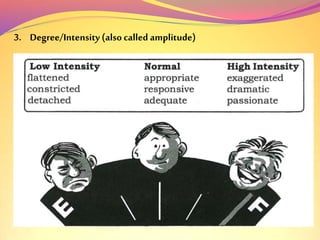
3. Degree/Intensity (also called amplitude)
3. Degree/Intensity (also called amplitude) contd……. .
 The ‘force of the expression’ eg. the good actor...
 Measure of the energy expended in Conveying the
feeling.
 Emotional expression is on continuum.
 Intense affect may go with narrow range eg. mania or
depn.
 Low intensity may go with wide range. eg. histrionic
personalities, delirium.
3. Degree/Intensity (also called amplitude) contd……. .
 Blunting: lack of emotional sensitivity to other.
 Flattening: Limitation of useful intensity of emotion (as
in Schiz, conversion– la belle indifferénce, and OC and
schiz personalities.
 Heightened: seen in mania, narcisstic and borderline
personalities.
 Depressives conveny
 Either intense distress.
 Or are muted and apathetic
4. Stability/Reactivity
 Duration of an affective response. eg. As brief as a
facial expression, or a tear shed; other may be more
pervasive.
 During an interview, for eg. There may be shifts
anxiety at the beginning, sadness when discussing a
loss, anger at the husband’s infidelity, happiness at
the son’s academic achievement.
 These periods (shifts) may be for some moments and
are appropriate to the context.
4. Stability/Reactivity contd...
 If shifts in affect are small or non-existent, are
considered fixed or immobile and are more referable
to mood.
 Labile : rapid and frequent changes in affect.
 Changes could be either in intensity or range. eg.
Happy  tearful, low irritations  high irritation
(mania)
Inappropriate affect is seen in:
 Malingering- the emotional component of a
patient’s presentation doesn’t “add up” to the
verbalized problems.
 Substance use – introxication or withdrawal
can cause patients to be inappropriately jovial
or unconcerned with medical problems,
criminal charges, etc.
 Conversion disorder – la belle indiference
describes a distinct lack of concern for
reported neurologic deficits
Inappropriate affect is seen in contd…
 Depression- when patients have decided to
attempt suicide, they can become
unconcerned or untroubled by their pre-
existing problems
 Delirious or demented patients can seem to
be unusually concerned about trivial matters
(or the converse)
 Antipsychotic use – affective flattening can
occur through the parkinsonian side-effects
of these medications.
6. Congruence
 Mood : Affect may not be congruent to mood state described by the Incongruity
may mean
 Malingering
 Two or more condition (mood & personality disorder)
 Substance use
 Schizoaffective disorder
 Schizophrenia
 Psychotic mood disorder.
 Appearance:
 Patient have little time or interest
 Grooming & Attire – Depressed patients neglect self care  disheveled.
 Manic patients dress flamboyantly (often in red) and use poor judgement
in picking new looks or styles.
 Schizophrenic patients may make bizarre alterations and become
unkempt.
 Facial expression –
 Unvarying movements are seen in depression and schizophrenia
 In mania and personality disorders: dramatic and exaggerated.
 Behaviour
 Posture
 Body movement/gesticulation
 Speech
 Inflection provides Modulation and emphasis in speech
 Makes speech interesting
 Reduced in depression, schizopohrenia or OC personalities.
 Enhanced in mania and cluster B personality disorders.
Affect has 3 functions
 Self perception – providing an emotional value
judgement.
 Communication – expression of feelings is made known
to others.
 Motivation –affect is one of the key elements leading to
the initiation of action.
Describing Mood
 Reactivity
 Intensity same as in affect
 Stability/Duration
 Pattern
 Type/Quality
Type/Quality
 Quality of mood is the patient’s self report on
emotional state.
 DSM includes
 Depressed Mood
 Euphoric Mood
 Angry / Irritable Mood
 Anxious Mood
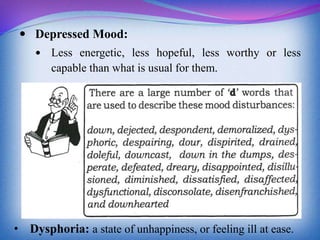
 Depressed Mood:
 Less energetic, less hopeful, less worthy or less
capable than what is usual for them.
• Dysphoria: a state of unhappiness, or feeling ill at ease.
• Double Depression: Depressive episode on dysthymia
Euphoric Mood
 Patient feel energized, elated or ecstatic.
 Of a greater degree than what is experienced when patients are ‘up’
or in a ‘good mood.”
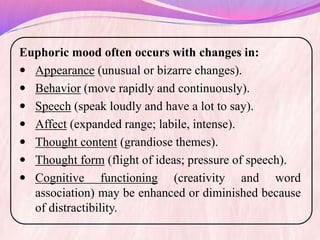
Euphoric mood often occurs with changes in:
 Appearance (unusual or bizarre changes).
 Behavior (move rapidly and continuously).
 Speech (speak loudly and have a lot to say).
 Affect (expanded range; labile, intense).
 Thought content (grandiose themes).
 Thought form (flight of ideas; pressure of speech).
 Cognitive functioning (creativity and word
association) may be enhanced or diminished because
of distractibility.
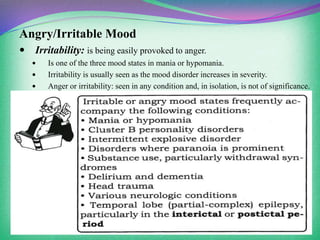
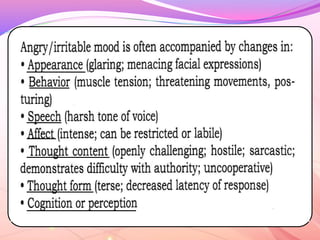
Angry/Irritable Mood
 Irritability: is being easily provoked to anger.
 Is one of the three mood states in mania or hypomania.
 Irritability is usually seen as the mood disorder increases in severity.
 Anger or irritability: seen in any condition and, in isolation, is not of significance.
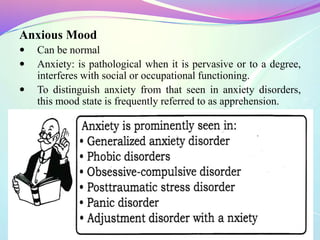
Anxious Mood
 Can be normal
 Anxiety: is pathological when it is pervasive or to a degree,
interferes with social or occupational functioning.
 To distinguish anxiety from that seen in anxiety disorders,
this mood state is frequently referred to as apprehension.
Stability
 Describes the length of time a mood disturbance exists
without significant variation.
 Rapid Cycling Subtype: Four or more cycles
 Mixed State: Mania and depression coexist.
 Mood-incogruent psychotic features (MIPF)
 Four possibilities:
 Do not denote a specific subtype of illness.
 MIPF indicate a distinct subtype of mood disorder.
 MIPF denote a form of schizoaffective disorder.
 MIPF are a type of schizophrenia.
 The strongest evidence was for the second possibility,
with some support for the third.
Affect and Mood

Affect and Mood

  • 1.
  • 2.
    Affect:  Visible external,objective manifestation of emotional state.  Dynamic changes in the expression of emotional responses.  Both internal stimuli (eg. Memories, ideas, preoccupation) and external events (eg. Changes in the environment) can after affect.  ‘Emotional foreground’
  • 3.
    Mood  Subjective (describedby patient) internal feeling state or emotional tone over an extended period of time.  Less connected to internal stimuli or external events.  ‘Emotional background’
  • 4.
    DescribingAffect Affect can beevaluated along the following parameters:  Type/Quality  Range/Variability  Degree/Intensity  Stability/Mobility  Appropriateness  Congruence
  • 5.
    1. Type/ Quality Typeor quality is the predominant emotion expressed. There are nine principal types of affect:  Happiness  Sadness  Fear/anxiety  Surprise  Shame  Anger  Interest  Disgust  Contentment
  • 6.
    2. Range/Variability  Thedegree to which visible emotions vary.  The patient would be expected to display various types of affect (eg. Smile, frown, appear interested, sad, or anxious.  No standard degree of affect  Terms used is ‘the patient showed an adequate range of affect.?  ‘Narrow/Restricted Range: Expression of only one or two emotional states (eg. Mania, schiz paranoid disorders, OCD).  Wide Range or Expanded range: Several emotions are displayed, eg. Cluster B PDs, dementia, delerium and intoxication or withdrawal.
  • 7.
    3. Degree/Intensity (alsocalled amplitude)
  • 8.
    3. Degree/Intensity (alsocalled amplitude) contd……. .  The ‘force of the expression’ eg. the good actor...  Measure of the energy expended in Conveying the feeling.  Emotional expression is on continuum.  Intense affect may go with narrow range eg. mania or depn.  Low intensity may go with wide range. eg. histrionic personalities, delirium.
  • 9.
    3. Degree/Intensity (alsocalled amplitude) contd……. .  Blunting: lack of emotional sensitivity to other.  Flattening: Limitation of useful intensity of emotion (as in Schiz, conversion– la belle indifferénce, and OC and schiz personalities.  Heightened: seen in mania, narcisstic and borderline personalities.  Depressives conveny  Either intense distress.  Or are muted and apathetic
  • 10.
    4. Stability/Reactivity  Durationof an affective response. eg. As brief as a facial expression, or a tear shed; other may be more pervasive.  During an interview, for eg. There may be shifts anxiety at the beginning, sadness when discussing a loss, anger at the husband’s infidelity, happiness at the son’s academic achievement.  These periods (shifts) may be for some moments and are appropriate to the context.
  • 11.
    4. Stability/Reactivity contd... If shifts in affect are small or non-existent, are considered fixed or immobile and are more referable to mood.  Labile : rapid and frequent changes in affect.  Changes could be either in intensity or range. eg. Happy  tearful, low irritations  high irritation (mania)
  • 13.
    Inappropriate affect isseen in:  Malingering- the emotional component of a patient’s presentation doesn’t “add up” to the verbalized problems.  Substance use – introxication or withdrawal can cause patients to be inappropriately jovial or unconcerned with medical problems, criminal charges, etc.  Conversion disorder – la belle indiference describes a distinct lack of concern for reported neurologic deficits
  • 14.
    Inappropriate affect isseen in contd…  Depression- when patients have decided to attempt suicide, they can become unconcerned or untroubled by their pre- existing problems  Delirious or demented patients can seem to be unusually concerned about trivial matters (or the converse)  Antipsychotic use – affective flattening can occur through the parkinsonian side-effects of these medications.
  • 15.
    6. Congruence  Mood: Affect may not be congruent to mood state described by the Incongruity may mean  Malingering  Two or more condition (mood & personality disorder)  Substance use  Schizoaffective disorder  Schizophrenia  Psychotic mood disorder.
  • 16.
     Appearance:  Patienthave little time or interest  Grooming & Attire – Depressed patients neglect self care  disheveled.  Manic patients dress flamboyantly (often in red) and use poor judgement in picking new looks or styles.  Schizophrenic patients may make bizarre alterations and become unkempt.  Facial expression –  Unvarying movements are seen in depression and schizophrenia  In mania and personality disorders: dramatic and exaggerated.  Behaviour  Posture  Body movement/gesticulation  Speech  Inflection provides Modulation and emphasis in speech  Makes speech interesting  Reduced in depression, schizopohrenia or OC personalities.  Enhanced in mania and cluster B personality disorders.
  • 17.
    Affect has 3functions  Self perception – providing an emotional value judgement.  Communication – expression of feelings is made known to others.  Motivation –affect is one of the key elements leading to the initiation of action.
  • 18.
    Describing Mood  Reactivity Intensity same as in affect  Stability/Duration  Pattern  Type/Quality
  • 19.
    Type/Quality  Quality ofmood is the patient’s self report on emotional state.  DSM includes  Depressed Mood  Euphoric Mood  Angry / Irritable Mood  Anxious Mood
  • 20.
     Depressed Mood: Less energetic, less hopeful, less worthy or less capable than what is usual for them. • Dysphoria: a state of unhappiness, or feeling ill at ease.
  • 21.
    • Double Depression:Depressive episode on dysthymia
  • 23.
    Euphoric Mood  Patientfeel energized, elated or ecstatic.  Of a greater degree than what is experienced when patients are ‘up’ or in a ‘good mood.”
  • 24.
    Euphoric mood oftenoccurs with changes in:  Appearance (unusual or bizarre changes).  Behavior (move rapidly and continuously).  Speech (speak loudly and have a lot to say).  Affect (expanded range; labile, intense).  Thought content (grandiose themes).  Thought form (flight of ideas; pressure of speech).  Cognitive functioning (creativity and word association) may be enhanced or diminished because of distractibility.
  • 25.
    Angry/Irritable Mood  Irritability:is being easily provoked to anger.  Is one of the three mood states in mania or hypomania.  Irritability is usually seen as the mood disorder increases in severity.  Anger or irritability: seen in any condition and, in isolation, is not of significance.
  • 27.
    Anxious Mood  Canbe normal  Anxiety: is pathological when it is pervasive or to a degree, interferes with social or occupational functioning.  To distinguish anxiety from that seen in anxiety disorders, this mood state is frequently referred to as apprehension.
  • 29.
    Stability  Describes thelength of time a mood disturbance exists without significant variation.  Rapid Cycling Subtype: Four or more cycles  Mixed State: Mania and depression coexist.
  • 32.
     Mood-incogruent psychoticfeatures (MIPF)  Four possibilities:  Do not denote a specific subtype of illness.  MIPF indicate a distinct subtype of mood disorder.  MIPF denote a form of schizoaffective disorder.  MIPF are a type of schizophrenia.  The strongest evidence was for the second possibility, with some support for the third.