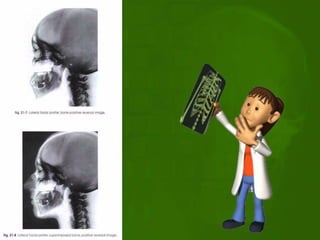
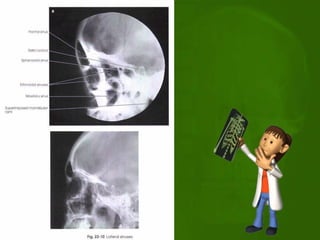
> Hello everyone, I'm Dr. Matindi.
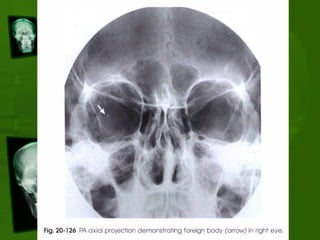
> Welcome to Skull Radiography - V.4.0
> We are going to play a game,
and you will be receiving exciting
prizes.> You will be divided into four
groups of four members each.
> The group with the highest
number of scores at the end of this
game would receive a great
reward.
> Everytime that I would appear
and ask a question is the time
where your scores would be
recorded.
Dr. Matindi,
We're ready.
OK, Let's
begin.
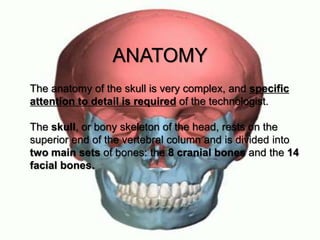
The anatomy of the skull is very complex, and specific
attention to detail is required of the technologist.
The skull, or bony skeleton of the head, rests on the
superior end of the vertebral column and is divided into
two main sets of bones: the 8 cranial bones and the 14
facial bones.
ANATOMY
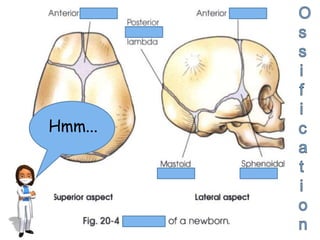
Hmm...
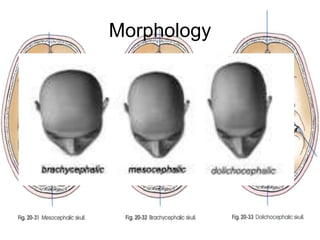
Morphology
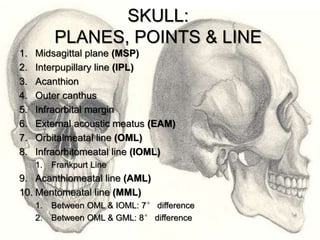
SKULL:
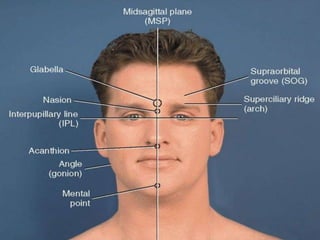
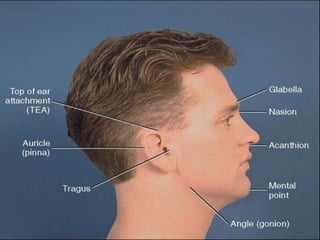
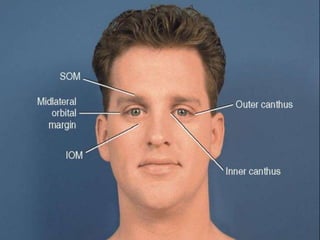
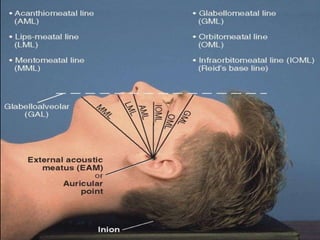
PLANES, POINTS & LINE
1. Midsagittal plane (MSP)
2. Interpupillary line (IPL)
3. Acanthion
4. Outer canthus
5. Infraorbital margin
6. External acoustic meatus (EAM)
7. Orbitalmeatal line (OML)
8. Infraorbitomeatal line (IOML)
1. Frankpurt Line
9. Acanthiomeatal line (AML)
10. Mentomeatal line (MML)
1. Between OML & IOML: 7° difference
2. Between OML & GML: 8° difference
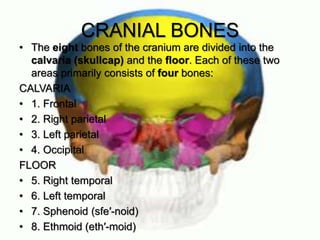
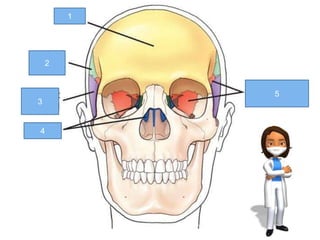
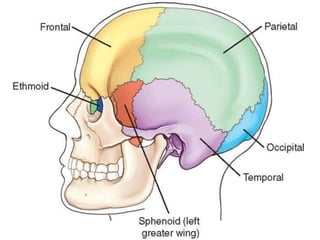
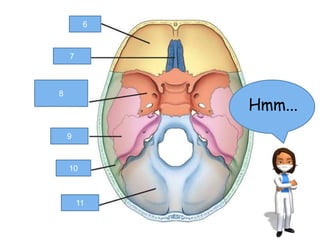
CRANIAL BONES
• The eight bones of the cranium are divided into the
calvaria (skullcap) and the floor. Each of these two
areas primarily consists of four bones:
CALVARIA
• 1. Frontal
• 2. Right parietal
• 3. Left parietal
• 4. Occipital
FLOOR
• 5. Right temporal
• 6. Left temporal
• 7. Sphenoid (sfe′-noid)
• 8. Ethmoid (eth′-moid)
1
4
3
5
2
6
11
10
9
8
7
Hmm...
SKULL SERIES
Clinical Projections
• BASIC:
– PA 0°
– Lateral
– Towne Method: AP Axial
– Caldwell Method: PA Axial 15°or PA Axial
25° to 30°
• SPECIAL:
ub ento ertex (SMV)
– Haas Method: PA Axial
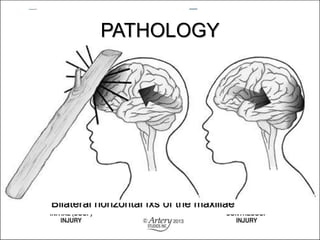
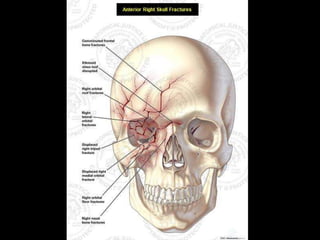
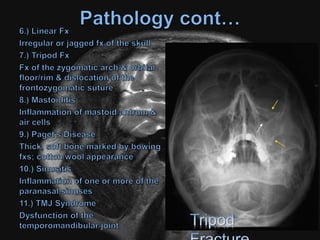
PATHOLOGY
1. ) Basal Fx
Fx located at the base of the skull
2) Blowout Fx
Fx of the floor of the orbit
3.) Contre-Coup Fx
Fx to one side of a structure caused by
trauma to the other side
4.) Depressed Fx
Fx causing a portion of the skull to be depressed
into the cranial cavity
5.) Le Fort Fx
Bilateral horizontal fxs of the maxillae
Hmm...
Hmm...
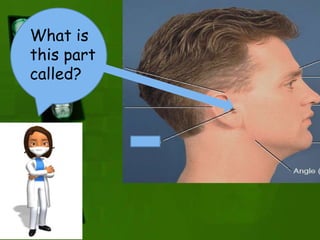
What is
this part
called?
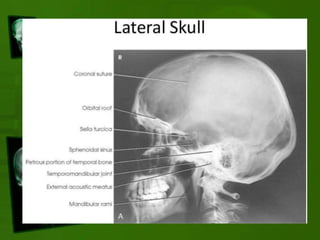
Lateral Projection
• Px Position : seated erect or semiprone
• Part Position:
– MSP // to IR.
– IOML is ┴ to front edge of IR.
– IPL is ┴ to IR.
• CR: ┴
• RP:
– 2 inches superior to EAM- general survey
– ¾ inch superior and ¾ inch anterior to the EAM
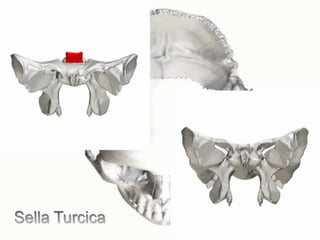
– sella turcica
• SS:
– sella turcica
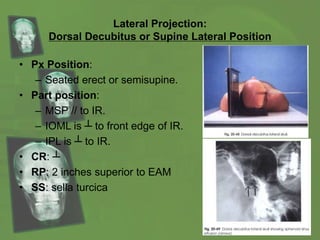
Lateral Projection:
Dorsal Decubitus or Supine Lateral Position
• Px Position:
– Seated erect or semisupine.
• Part position:
– MSP // to IR.
– IOML is ┴ to front edge of IR.
– IPL is ┴ to IR.
• CR: ┴
• RP: 2 inches superior to EAM
• SS: sella turcica
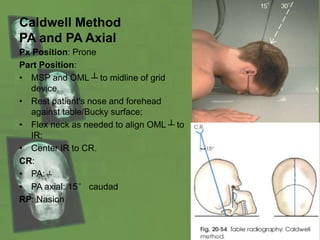
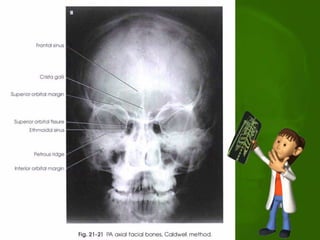
Caldwell Method
PA and PA Axial
Px Position: Prone
Part Position:
• MSP and OML ┴ to midline of grid
device
• Rest patient's nose and forehead
against table/Bucky surface;
• Flex neck as needed to align OML ┴ to
IR;
• Center IR to CR.
CR:
• PA: ┴
• PA axial: 15° caudad
RP: Nasion
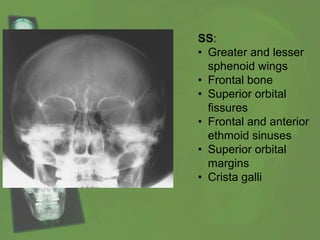
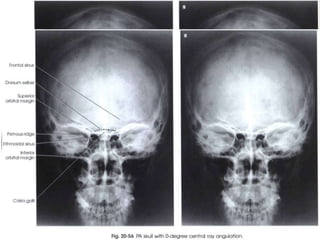
SS:
• Greater and lesser
sphenoid wings
• Frontal bone
• Superior orbital
fissures
• Frontal and anterior
ethmoid sinuses
• Superior orbital
margins
• Crista galli
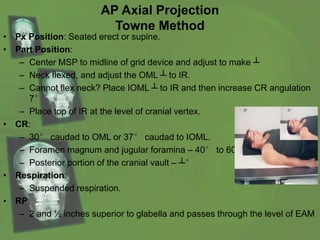
AP Axial Projection
Towne Method
• Px Position: Seated erect or supine.
• Part Position:
– Center MSP to midline of grid device and adjust to make ┴
– Neck flexed, and adjust the OML ┴ to IR.
– Cannot flex neck? Place IOML ┴ to IR and then increase CR angulation
7°
– Place top of IR at the level of cranial vertex.
• CR:
– 30° caudad to OML or 37° caudad to IOML.
– Foramen magnum and jugular foramina – 40° to 60°
– Posterior portion of the cranial vault – ┴°
• Respiration:
– Suspended respiration.
• RP:
– 2 and ½ inches superior to glabella and passes through the level of EAM
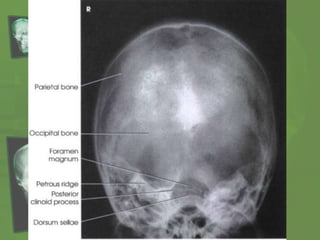
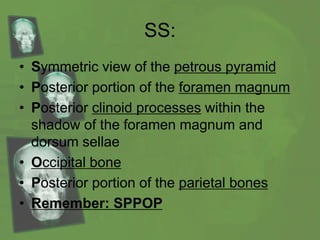
SS:
• Symmetric view of the petrous pyramid
• Posterior portion of the foramen magnum
• Posterior clinoid processes within the
shadow of the foramen magnum and
dorsum sellae
• Occipital bone
• Posterior portion of the parietal bones
• Remember: SPPOP
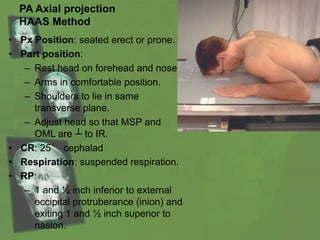
PA Axial projection
HAAS Method
• Px Position: seated erect or prone.
• Part position:
– Rest head on forehead and nose.
– Arms in comfortable position.
– Shoulders to lie in same
transverse plane.
– Adjust head so that MSP and
OML are ┴ to IR.
• CR: 25° cephalad
• Respiration: suspended respiration.
• RP:
– 1 and ½ inch inferior to external
occipital protruberance (inion) and
exiting 1 and ½ inch superior to
nasion.
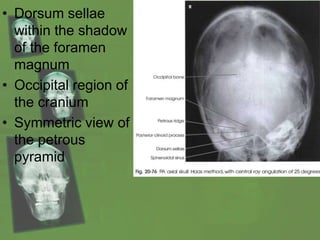
• Dorsum sellae
within the shadow
of the foramen
magnum
• Occipital region of
the cranium
• Symmetric view of
the petrous
pyramid
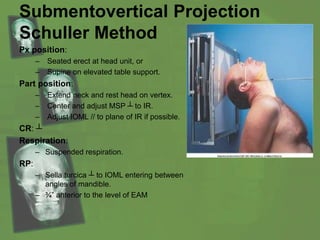
Submentovertical Projection
Schuller Method
Px position:
– Seated erect at head unit, or
– Supine on elevated table support.
Part position:
– Extend neck and rest head on vertex.
– Center and adjust MSP ┴ to IR.
– Adjust IOML // to plane of IR if possible.
CR: ┴
Respiration:
– Suspended respiration.
RP:
– Sella turcica ┴ to IOML entering between
angles of mandible.
– ¾” anterior to the level of EAM
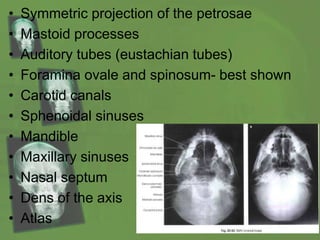
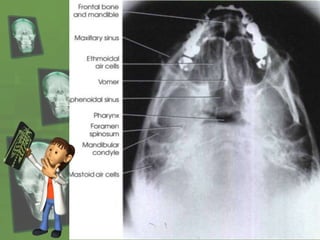
• Symmetric projection of the petrosae
• Mastoid processes
• Auditory tubes (eustachian tubes)
• Foramina ovale and spinosum- best shown
• Carotid canals
• Sphenoidal sinuses
• Mandible
• Maxillary sinuses
• Nasal septum
• Dens of the axis
• Atlas
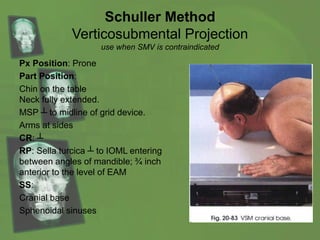
Schuller Method
Verticosubmental Projection
use when SMV is contraindicated
Px Position: Prone
Part Position:
Chin on the table
Neck fully extended.
MSP ┴ to midline of grid device.
Arms at sides
CR: ┴
RP: Sella turcica ┴ to IOML entering
between angles of mandible; ¾ inch
anterior to the level of EAM
SS:
Cranial base
Sphenoidal sinuses
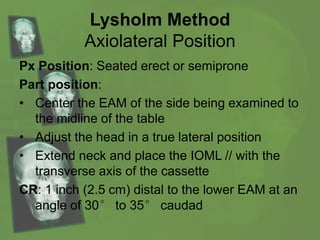
Lysholm Method
Axiolateral Position
Px Position: Seated erect or semiprone
Part position:
• Center the EAM of the side being examined to
the midline of the table
• Adjust the head in a true lateral position
• Extend neck and place the IOML // with the
transverse axis of the cassette
CR: 1 inch (2.5 cm) distal to the lower EAM at an
angle of 30° to 35° caudad
SS:
• Oblique position of the lateral aspect of the
base of the cranium closest to film
NOTE:
• Lysholm is recommended for patients who
cannot extend their head enough for a
satisfactory submentovertical projection
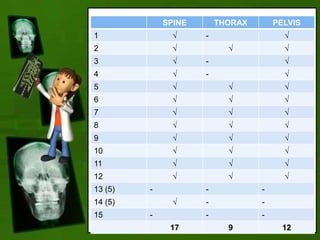
SPINE THORAX PELVIS
1 √ - √
2 √ √ √
3 √ - √
4 √ - √
5 √ √ √
6 √ √ √
7 √ √ √
8 √ √ √
9 √ √ √
10 √ √ √
11 √ √ √
12 √ √ √
13 (5) - - -
14 (5) √ - -
15 - - -
17 9 12
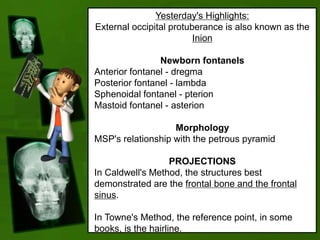
Yesterday's Highlights:
External occipital protuberance is also known as the
Inion
Newborn fontanels
Anterior fontanel - dregma
Posterior fontanel - lambda
Sphenoidal fontanel - pterion
Mastoid fontanel - asterion
Morphology
MSP's relationship with the petrous pyramid
PROJECTIONS
In Caldwell's Method, the structures best
demonstrated are the frontal bone and the frontal
sinus.
In Towne's Method, the reference point, in some
books, is the hairline.
In Towne's method, the structure best
demonstrated is the occipital bone. What
are the other structures that are being
demonstrated if the central ray angulation is
37°?
A. sella turcica and dorsum sellae
B. anterior clinoid process and dorsum
sellae
C. dorsum sellae and posterior clinoid
process
D. anterior clinoid process and sellae
turcica
Enumerate the Skull:
Planes, Points, and
Lines.
Each will be given two
points.
!!!
TEA stands for
?
Top of Ear Attachment
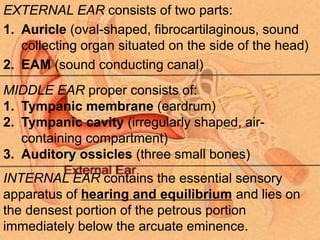
EXTERNAL EAR consists of two parts:
1. Auricle (oval-shaped, fibrocartilaginous, sound
collecting organ situated on the side of the head)
2. EAM (sound conducting canal)
MIDDLE EAR proper consists of:
1. Tympanic membrane (eardrum)
2. Tympanic cavity (irregularly shaped, air-
containing compartment)
3. Auditory ossicles (three small bones)
INTERNAL EAR contains the essential sensory
apparatus of hearing and equilibrium and lies on
the densest portion of the petrous portion
immediately below the arcuate eminence.
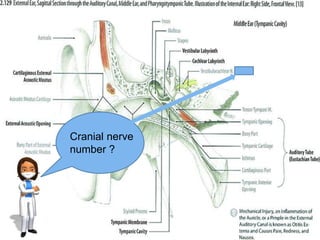
Cranial nerve
number ?
Valdini Method
PA Axial
Px Position: Seating position
Part position:
• Rest the patient’s upper frontal region of the skull on the table and
adjust it so that the MSP is ┴ to the midline of the grid
• IOML 50° with IR for demonstration of dorsum sellae, internal
auditory canals and labyrinths of the ear
• OML 50° with the IR for demonstration of the external auditory
canals, tympanic cavities and eustachian tubes
CR: ┴ to inion
RP:
• For dorsum sellae - Center to a point 0.5 cm distal to the nasion
• For petrosae - Center to the foramen magnum at or slightly above
the level of the EAM
SS:
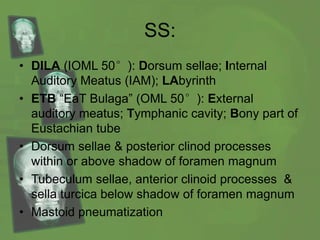
• DILA (IOML 50°): Dorsum sellae; Internal
Auditory Meatus (IAM); LAbyrinth
• ETB “EaT Bulaga” (OML 50°): External
auditory meatus; Tymphanic cavity; Bony part of
Eustachian tube
• Dorsum sellae & posterior clinod processes
within or above shadow of foramen magnum
• Tubeculum sellae, anterior clinoid processes &
sella turcica below shadow of foramen magnum
• Mastoid pneumatization
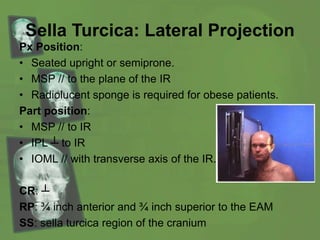
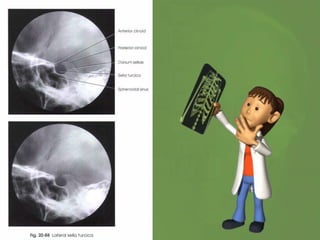
Sella Turcica: Lateral Projection
Px Position:
• Seated upright or semiprone.
• MSP // to the plane of the IR
• Radiolucent sponge is required for obese patients.
Part position:
• MSP // to IR
• IPL ┴ to IR
• IOML // with transverse axis of the IR.
CR: ┴
RP: ¾ inch anterior and ¾ inch superior to the EAM
SS: sella turcica region of the cranium
Enumerate
the structures
of “D.I.LA.”
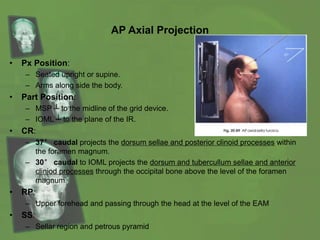
AP Axial Projection
• Px Position:
– Seated upright or supine.
– Arms along side the body.
• Part Position:
– MSP ┴ to the midline of the grid device.
– IOML ┴ to the plane of the IR.
• CR:
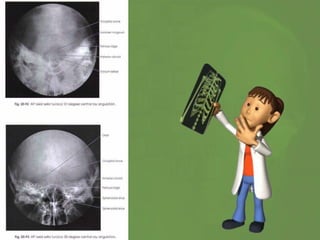
– 37° caudal projects the dorsum sellae and posterior clinoid processes within
the foramen magnum.
– 30° caudal to IOML projects the dorsum and tubercullum sellae and anterior
cliniod processes through the occipital bone above the level of the foramen
magnum.
• RP:
– Upper forehead and passing through the head at the level of the EAM
• SS:
– Sellar region and petrous pyramid
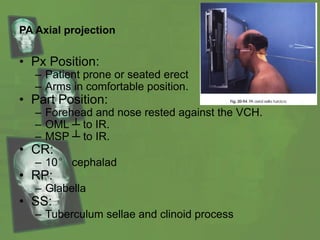
PA Axial projection
• Px Position:
– Patient prone or seated erect
– Arms in comfortable position.
• Part Position:
– Forehead and nose rested against the VCH.
– OML ┴ to IR.
– MSP ┴ to IR.
• CR:
– 10° cephalad
• RP:
– Glabella
• SS:
– Tuberculum sellae and clinoid process
SOG stands for ?
Supraorbital Groove
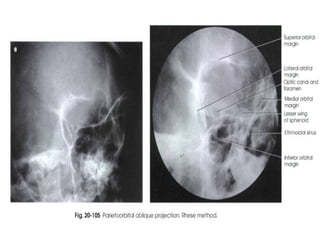
Rhese Method
Parietoorbital Oblique Projection
Optic Canal and Foramen
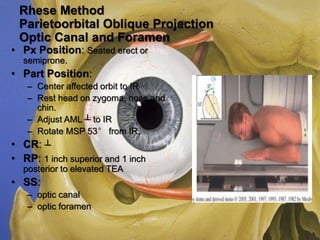
• Px Position: Seated erect or
semiprone.
• Part Position:
– Center affected orbit to IR
– Rest head on zygoma, nose and
chin.
– Adjust AML ┴ to IR
– Rotate MSP 53° from IR.
• CR: ┴
• RP: 1 inch superior and 1 inch
posterior to elevated TEA
• SS:
– optic canal
– optic foramen
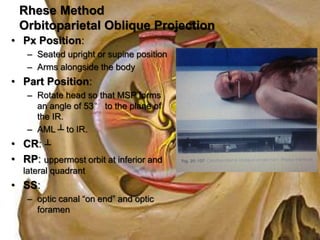
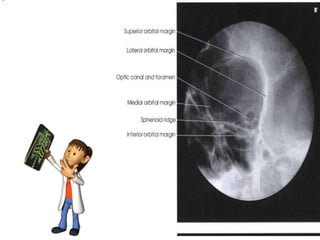
Rhese Method
Orbitoparietal Oblique Projection
• Px Position:
– Seated upright or supine position
– Arms alongside the body
• Part Position:
– Rotate head so that MSP forms
an angle of 53° to the plane of
the IR.
– AML ┴ to IR.
• CR: ┴
• RP: uppermost orbit at inferior and
lateral quadrant
• SS:
– optic canal “on end” and optic
foramen
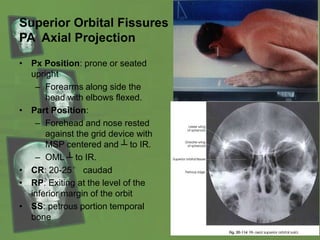
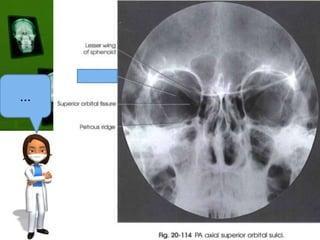
Superior Orbital Fissures
PA Axial Projection
• Px Position: prone or seated
upright
– Forearms along side the
head with elbows flexed.
• Part Position:
– Forehead and nose rested
against the grid device with
MSP centered and ┴ to IR.
– OML ┴ to IR.
• CR: 20-25° caudad
• RP: Exiting at the level of the
inferior margin of the orbit
• SS: petrous portion temporal
bone
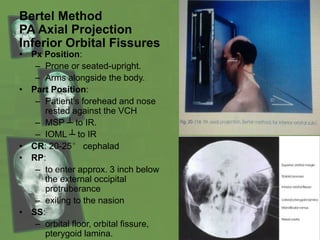
Bertel Method
PA Axial Projection
Inferior Orbital Fissures
• Px Position:
– Prone or seated-upright.
– Arms alongside the body.
• Part Position:
– Patient’s forehead and nose
rested against the VCH
– MSP ┴ to IR.
– IOML ┴ to IR
• CR: 20-25° cephalad
• RP:
– to enter approx. 3 inch below
the external occipital
protruberance
– exiting to the nasion
• SS:
– orbital floor, orbital fissure,
pterygoid lamina.
In Rhese method, the MSP is
angulated:
A. 57°
B. 51°
C. 55°
D. 53°
...
In Reese Method, the central ray is
directed perpendicularly, however in
Bertel Method, the central ray is:
A. 10 - 25° cephalad
B. 20 - 25° caudad
C. 10 - 15° cephalad
D. 20 - 25° cephalad
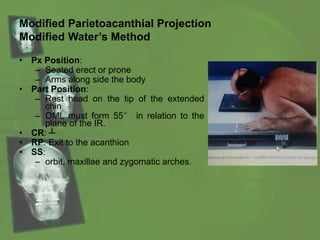
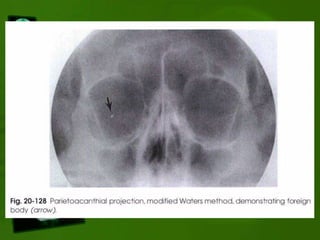
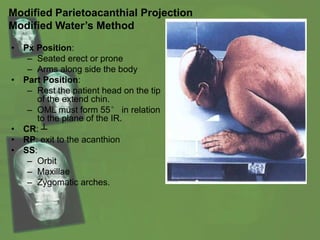
Modified Parietoacanthial Projection
Modified Water’s Method
• Px Position:
– Seated erect or prone
– Arms along side the body
• Part Position:
– Rest head on the tip of the extended
chin
– OML must form 55° in relation to the
plane of the IR.
• CR: ┴
• RP: Exit to the acanthion
• SS:
– orbit, maxillae and zygomatic arches.
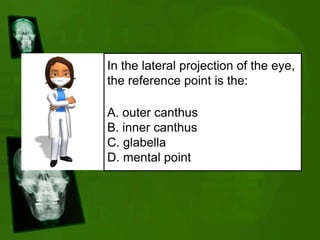
In the lateral projection of the eye,
the reference point is the:
A. outer canthus
B. inner canthus
C. glabella
D. mental point
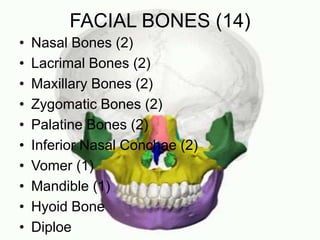
FACIAL BONES (14)
• Nasal Bones (2)
• Lacrimal Bones (2)
• Maxillary Bones (2)
• Zygomatic Bones (2)
• Palatine Bones (2)
• Inferior Nasal Conchae (2)
• Vomer (1)
• Mandible (1)
• Hyoid Bone
• Diploe
!!!
Enumerate
the 14 Facial
Bones.
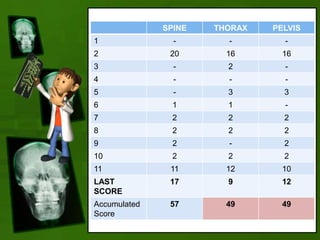
SPINE THORAX PELVIS
1 - - -
2 20 16 16
3 - 2 -
4 - - -
5 - 3 3
6 1 1 -
7 2 2 2
8 2 2 2
9 2 - 2
10 2 2 2
11 11 12 10
LAST
SCORE
17 9 12
Accumulated
Score
57 49 49
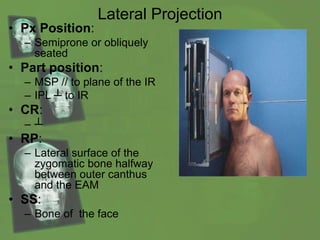
Lateral Projection
• Px Position:
– Semiprone or obliquely
seated
• Part position:
– MSP // to plane of the IR
– IPL ┴ to IR
• CR:
– ┴
• RP:
– Lateral surface of the
zygomatic bone halfway
between outer canthus
and the EAM
• SS:
– Bone of the face
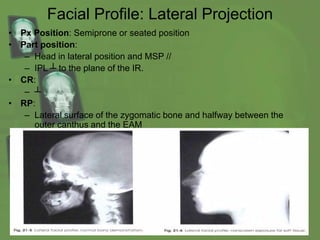
Facial Profile: Lateral Projection
• Px Position: Semiprone or seated position
• Part position:
– Head in lateral position and MSP //
– IPL ┴ to the plane of the IR.
• CR:
– ┴
• RP:
– Lateral surface of the zygomatic bone and halfway between the
outer canthus and the EAM
• SS:
– Bony and Tissue structure
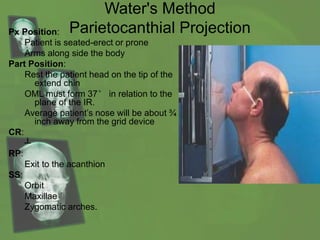
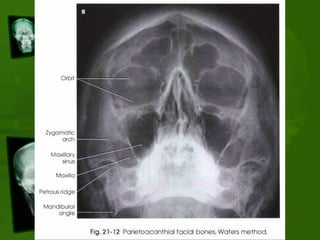
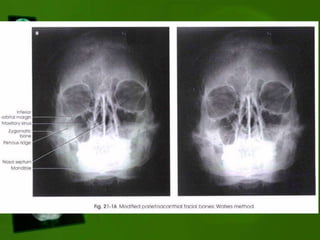
Water's Method
Parietocanthial ProjectionPx Position:
Patient is seated-erect or prone
Arms along side the body
Part Position:
Rest the patient head on the tip of the
extend chin
OML must form 37° in relation to the
plane of the IR.
Average patient’s nose will be about ¾
inch away from the grid device
CR:
┴
RP:
Exit to the acanthion
SS:
Orbit
Maxillae
Zygomatic arches.
Modified Parietoacanthial Projection
Modified Water’s Method
• Px Position:
– Seated erect or prone
– Arms along side the body
• Part Position:
– Rest the patient head on the tip
of the extend chin.
– OML must form 55° in relation
to the plane of the IR.
• CR: ┴
• RP: exit to the acanthion
• SS:
– Orbit
– Maxillae
– Zygomatic arches.
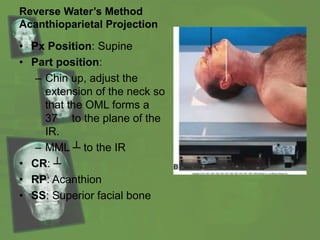
Reverse Water’s Method
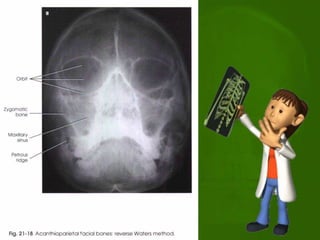
Acanthioparietal Projection
• Px Position: Supine
• Part position:
– Chin up, adjust the
extension of the neck so
that the OML forms a
37° to the plane of the
IR.
– MML ┴ to the IR
• CR: ┴
• RP: Acanthion
• SS: Superior facial bone
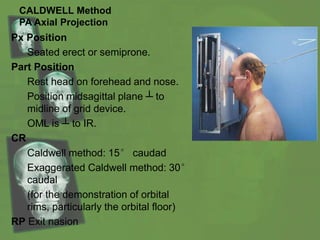
CALDWELL Method
PA Axial Projection
Px Position
Seated erect or semiprone.
Part Position
Rest head on forehead and nose.
Position midsagittal plane ┴ to
midline of grid device.
OML is ┴ to IR.
CR
Caldwell method: 15° caudad
Exaggerated Caldwell method: 30°
caudal
(for the demonstration of orbital
rims, particularly the orbital floor)
RP Exit nasion
In the lateral projection, the IPL is
in what relationship with the IR?
A. Perpendicular
B. Parallel
C. All of the above
D. None of the above
Nasal bone
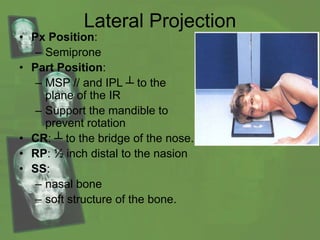
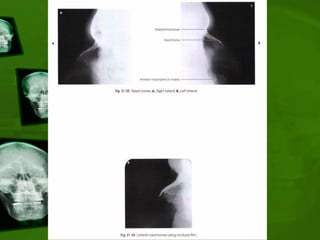
Lateral Projection
• Px Position:
– Semiprone
• Part Position:
– MSP // and IPL ┴ to the
plane of the IR
– Support the mandible to
prevent rotation
• CR: ┴ to the bridge of the nose.
• RP: ½ inch distal to the nasion
• SS:
– nasal bone
– soft structure of the bone.
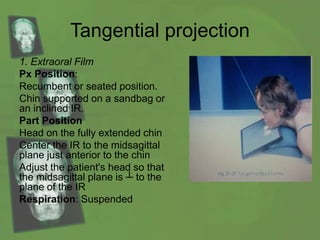
Tangential projection
1. Extraoral Film
Px Position:
Recumbent or seated position.
Chin supported on a sandbag or
an inclined IR.
Part Position
Head on the fully extended chin
Center the IR to the midsagittal
plane just anterior to the chin
Adjust the patient's head so that
the midsagittal plane is ┴ to the
plane of the IR
Respiration: Suspended
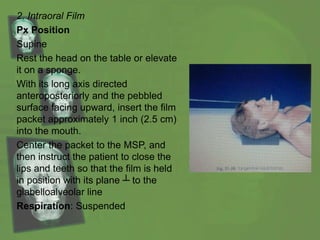
2. Intraoral Film
Px Position
Supine
Rest the head on the table or elevate
it on a sponge.
With its long axis directed
anteroposteriorly and the pebbled
surface facing upward, insert the film
packet approximately 1 inch (2.5 cm)
into the mouth.
Center the packet to the MSP, and
then instruct the patient to close the
lips and teeth so that the film is held
in position with its plane ┴ to the
glabelloalveolar line
Respiration: Suspended
• CR
– // to glabelloalveolar line
– ┴ to the plane of the image receptor
• SS
– A tangential projection of only a portion of the nasal
bones that extend beyond the glabelloalveolar line
CLUE: Two words.
The second word
ends with letter “e”.
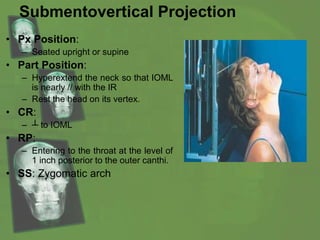
Submentovertical Projection
• Px Position:
– Seated upright or supine
• Part Position:
– Hyperextend the neck so that IOML
is nearly // with the IR
– Rest the head on its vertex.
• CR:
– ┴ to IOML
• RP:
– Entering to the throat at the level of
1 inch posterior to the outer canthi.
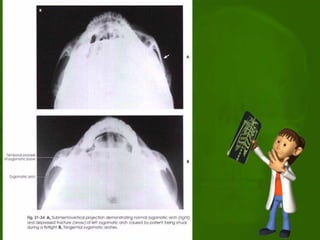
• SS: Zygomatic arch
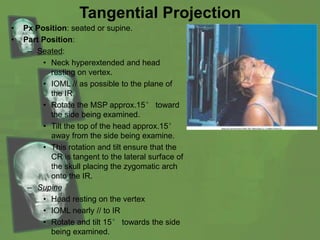
Tangential Projection
• Px Position: seated or supine.
• Part Position:
– Seated:
• Neck hyperextended and head
resting on vertex.
• IOML // as possible to the plane of
the IR.
• Rotate the MSP approx.15° toward
the side being examined.
• Tilt the top of the head approx.15°
away from the side being examine.
• This rotation and tilt ensure that the
CR is tangent to the lateral surface of
the skull placing the zygomatic arch
onto the IR.
– Supine
• Head resting on the vertex
• IOML nearly // to IR
• Rotate and tilt 15° towards the side
being examined.
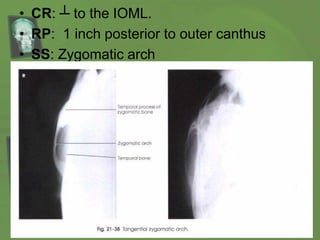
• CR: ┴ to the IOML.
• RP: 1 inch posterior to outer canthus
• SS: Zygomatic arch
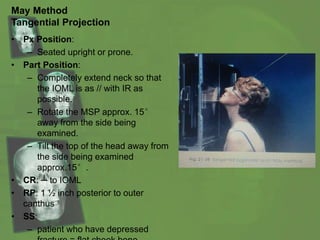
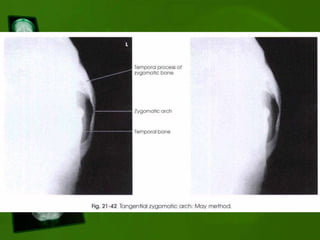
May Method
Tangential Projection
• Px Position:
– Seated upright or prone.
• Part Position:
– Completely extend neck so that
the IOML is as // with IR as
possible.
– Rotate the MSP approx. 15°
away from the side being
examined.
– Tilt the top of the head away from
the side being examined
approx.15°.
• CR: ┴ to IOML
• RP: 1 ½ inch posterior to outer
canthus
• SS:
– patient who have depressed
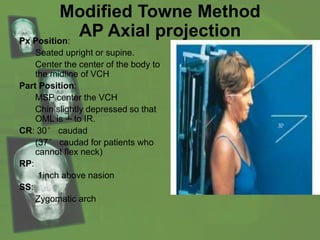
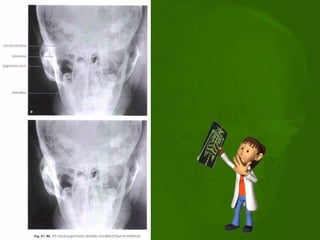
Modified Towne Method
AP Axial projectionPx Position:
Seated upright or supine.
Center the center of the body to
the midline of VCH
Part Position:
MSP center the VCH
Chin slightly depressed so that
OML is ┴ to IR.
CR: 30° caudad
(37° caudad for patients who
cannot flex neck)
RP:
1inch above nasion
SS:
Zygomatic arch
What is the CR in the May Method:
Tangential Projection, the
Submentovertal Projection, and the
Tangential Projection of the Zygomatic
Arch?
A. Parallel to IOML
B. Perpendicular to IOML
C. Parallel to MML
D. Perpendicular to MML
MML stands for ?
Mentomeatal Line
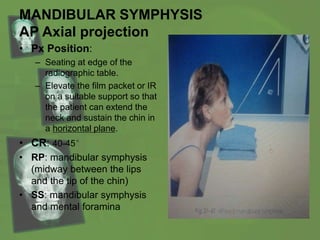
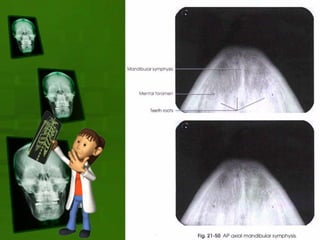
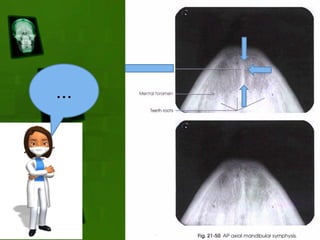
MANDIBULAR SYMPHYSIS
AP Axial projection
• Px Position:
– Seating at edge of the
radiographic table.
– Elevate the film packet or IR
on a suitable support so that
the patient can extend the
neck and sustain the chin in
a horizontal plane.
• CR: 40-45°
• RP: mandibular symphysis
(midway between the lips
and the tip of the chin)
• SS: mandibular symphysis
and mental foramina
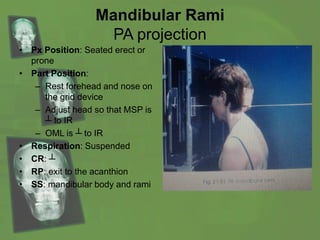
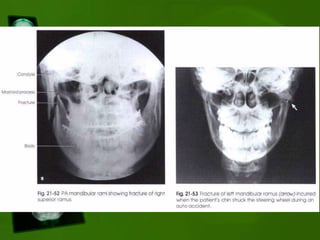
Mandibular Rami
PA projection
• Px Position: Seated erect or
prone
• Part Position:
– Rest forehead and nose on
the grid device
– Adjust head so that MSP is
┴ to IR
– OML is ┴ to IR
• Respiration: Suspended
• CR: ┴
• RP: exit to the acanthion
• SS: mandibular body and rami
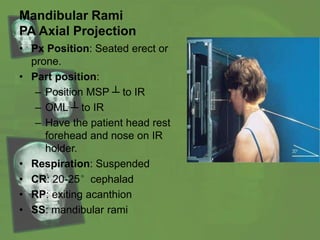
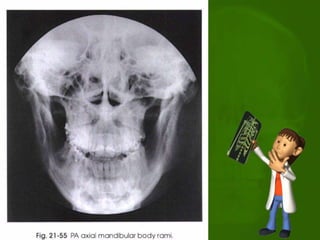
Mandibular Rami
PA Axial Projection
• Px Position: Seated erect or
prone.
• Part position:
– Position MSP ┴ to IR
– OML ┴ to IR
– Have the patient head rest
forehead and nose on IR
holder.
• Respiration: Suspended
• CR: 20-25°cephalad
• RP: exiting acanthion
• SS: mandibular rami
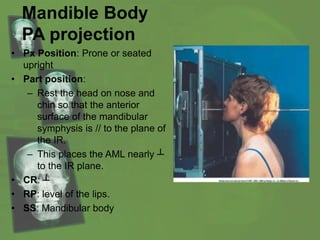
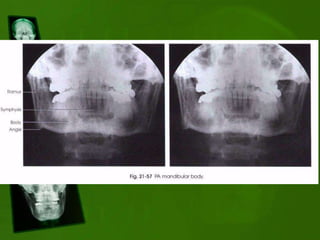
Mandible Body
PA projection
• Px Position: Prone or seated
upright
• Part position:
– Rest the head on nose and
chin so that the anterior
surface of the mandibular
symphysis is // to the plane of
the IR.
– This places the AML nearly ┴
to the IR plane.
• CR: ┴
• RP: level of the lips.
• SS: Mandibular body
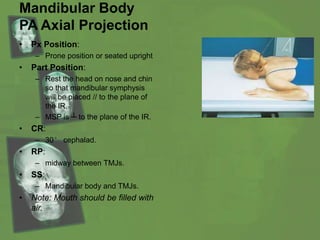
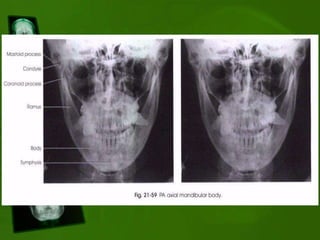
Mandibular Body
PA Axial Projection
• Px Position:
– Prone position or seated upright
• Part Position:
– Rest the head on nose and chin
so that mandibular symphysis
will be placed // to the plane of
the IR.
– MSP is ┴ to the plane of the IR.
• CR:
– 30° cephalad.
• RP:
– midway between TMJs.
• SS:
– Mandibular body and TMJs.
• Note: Mouth should be filled with
air.
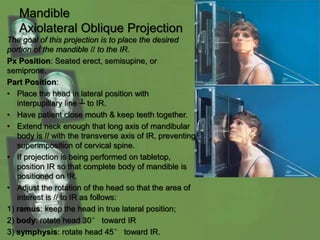
Mandible
Axiolateral Oblique Projection
The goal of this projection is to place the desired
portion of the mandible // to the IR.
Px Position: Seated erect, semisupine, or
semiprone.
Part Position:
• Place the head in lateral position with
interpupillary line ┴ to IR.
• Have patient close mouth & keep teeth together.
• Extend neck enough that long axis of mandibular
body is // with the transverse axis of IR, preventing
superimposition of cervical spine.
• If projection is being performed on tabletop,
position IR so that complete body of mandible is
positioned on IR.
• Adjust the rotation of the head so that the area of
interest is // to IR as follows:
1) ramus: keep the head in true lateral position;
2) body: rotate head 30° toward IR
3) symphysis: rotate head 45° toward IR.
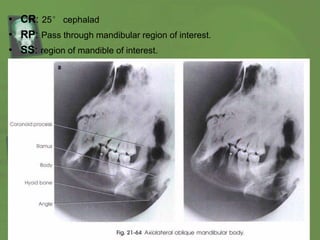
• CR: 25° cephalad
• RP: Pass through mandibular region of interest.
• SS: region of mandible of interest.
Mandible
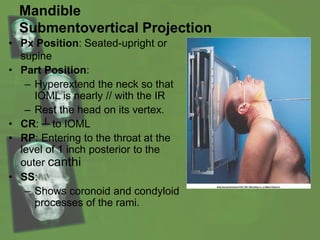
Submentovertical Projection
• Px Position: Seated-upright or
supine
• Part Position:
– Hyperextend the neck so that
IOML is nearly // with the IR
– Rest the head on its vertex.
• CR: ┴ to IOML
• RP: Entering to the throat at the
level of 1 inch posterior to the
outer canthi
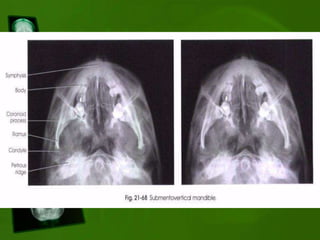
• SS:
– Shows coronoid and condyloid
processes of the rami.
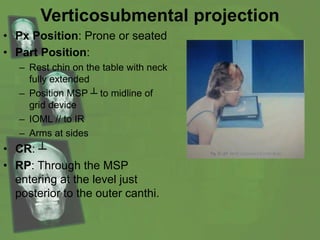
Verticosubmental projection
• Px Position: Prone or seated
• Part Position:
– Rest chin on the table with neck
fully extended
– Position MSP ┴ to midline of
grid device
– IOML // to IR
– Arms at sides
• CR: ┴
• RP: Through the MSP
entering at the level just
posterior to the outer canthi.
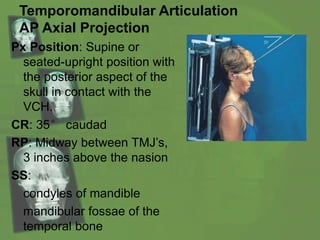
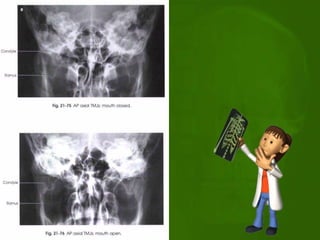
Temporomandibular Articulation
AP Axial Projection
Px Position: Supine or
seated-upright position with
the posterior aspect of the
skull in contact with the
VCH.
CR: 35° caudad
RP: Midway between TMJ’s,
3 inches above the nasion
SS:
condyles of mandible
mandibular fossae of the
temporal bone
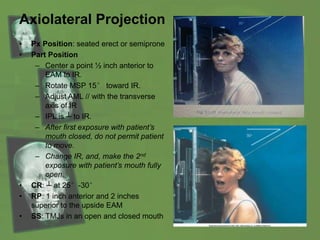
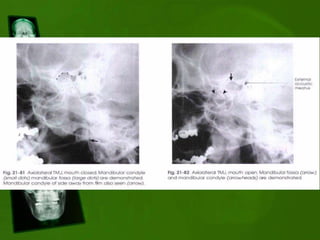
Axiolateral Projection
• Px Position: seated erect or semiprone
• Part Position
– Center a point ½ inch anterior to
EAM to IR.
– Rotate MSP 15° toward IR.
– Adjust AML // with the transverse
axis of IR
– IPL is ┴ to IR.
– After first exposure with patient’s
mouth closed, do not permit patient
to move.
– Change IR, and, make the 2nd
exposure with patient’s mouth fully
open.
• CR: ┴ at 25°-30°
• RP: 1 inch anterior and 2 inches
superior to the upside EAM
• SS: TMJs in an open and closed mouth
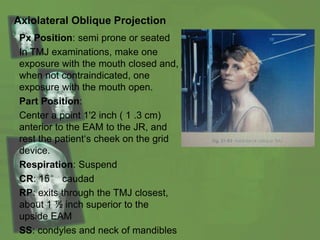
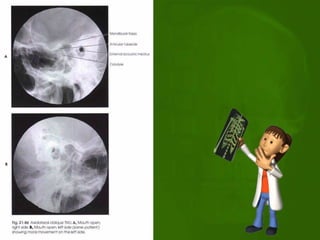
Axiolateral Oblique Projection
Px Position: semi prone or seated
In TMJ examinations, make one
exposure with the mouth closed and,
when not contraindicated, one
exposure with the mouth open.
Part Position:
Center a point 1'2 inch ( 1 .3 cm)
anterior to the EAM to the JR, and
rest the patient‘s cheek on the grid
device.
Respiration: Suspend
CR: 15° caudad
RP: exits through the TMJ closest,
about 1 ½ inch superior to the
upside EAM
SS: condyles and neck of mandibles
What is the
reference point in
Mandibular
Symphysis: AP
Axial Projection?
...
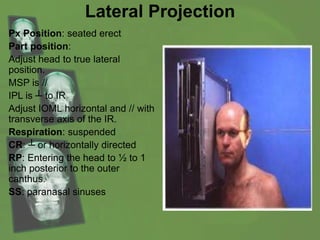
Lateral Projection
Px Position: seated erect
Part position:
Adjust head to true lateral
position.
MSP is //
IPL is ┴ to IR
Adjust IOML horizontal and // with
transverse axis of the IR.
Respiration: suspended
CR: ┴ or horizontally directed
RP: Entering the head to ½ to 1
inch posterior to the outer
canthus.
SS: paranasal sinuses
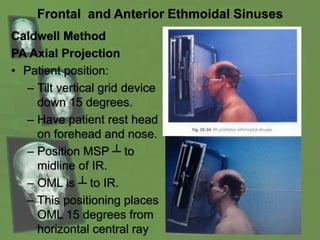
Frontal and Anterior Ethmoidal Sinuses
Caldwell Method
PA Axial Projection
• Patient position:
– Tilt vertical grid device
down 15 degrees.
– Have patient rest head
on forehead and nose.
– Position MSP ┴ to
midline of IR.
– OML is ┴ to IR.
– This positioning places
OML 15 degrees from
horizontal central ray
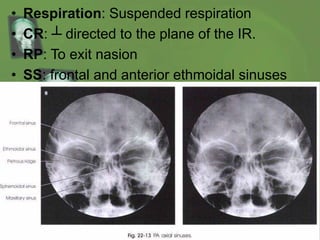
• Respiration: Suspended respiration
• CR: ┴ directed to the plane of the IR.
• RP: To exit nasion
• SS: frontal and anterior ethmoidal sinuses
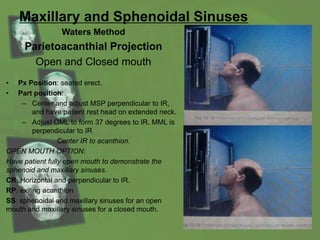
Maxillary and Sphenoidal Sinuses
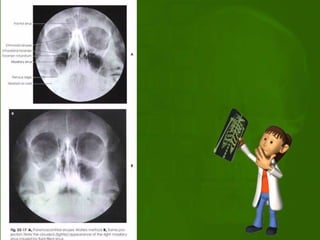
Waters Method
Parietoacanthial Projection
Open and Closed mouth
• Px Position: seated erect.
• Part position:
– Center and adjust MSP perpendicular to IR,
and have patient rest head on extended neck.
– Adjust OML to form 37 degrees to IR. MML is
perpendicular to IR
Center IR to acanthion.
OPEN MOUTH OPTION:
Have patient fully open mouth to demonstrate the
sphenoid and maxillary sinuses.
CR: Horizontal and perpendicular to IR.
RP: exiting acanthion
SS: sphenoidal and maxillary sinuses for an open
mouth and maxillary sinuses for a closed mouth.
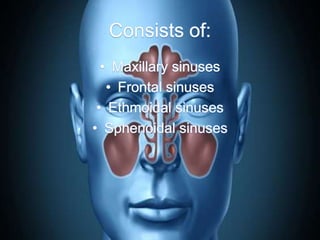
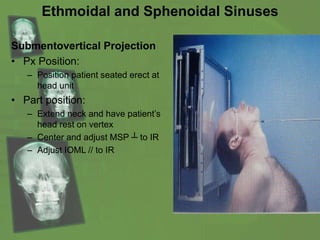
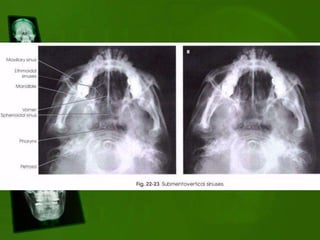
Ethmoidal and Sphenoidal Sinuses
Submentovertical Projection
• Px Position:
– Position patient seated erect at
head unit
• Part position:
– Extend neck and have patient’s
head rest on vertex
– Center and adjust MSP ┴ to IR
– Adjust IOML // to IR
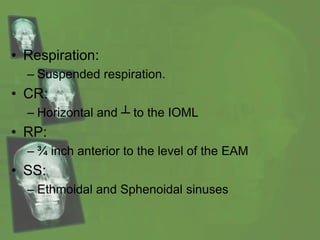
• Respiration:
– Suspended respiration.
• CR:
– Horizontal and ┴ to the IOML
• RP:
– ¾ inch anterior to the level of the EAM
• SS:
– Ethmoidal and Sphenoidal sinuses
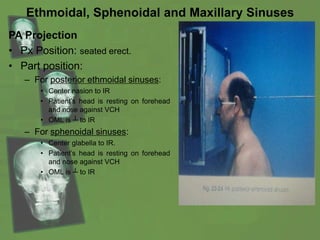
Ethmoidal, Sphenoidal and Maxillary Sinuses
PA Projection
• Px Position: seated erect.
• Part position:
– For posterior ethmoidal sinuses:
• Center nasion to IR
• Patient’s head is resting on forehead
and nose against VCH
• OML is ┴ to IR
– For sphenoidal sinuses:
• Center glabella to IR.
• Patient’s head is resting on forehead
and nose against VCH
• OML is ┴ to IR
– For maxillary sinuses:
• Center IR midway between the infraorbital margins and the acanthion.
• Patient’s head is resting on forehead and nose against VCH
• OML is perpendicular to IR
• Central Ray:
– For posterior ethmoidal sinuses:
• Horizontal and perpendicular to IR
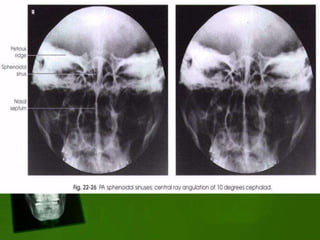
– For sphenoidal sinuses:
• 10 degrees cephalad passing through the sphenoidal sinuses.
– For maxillary sinuses:
• Horizontal and perpendicular to IR.
• Reference point:
– For posterior ethmoidal sinuses:
• To exit to the nasion
– For sphenoidal sinuses:
• To exit glabella
– For maxillary sinuses:
• Midway between infraorbital margins
and acanthion
• Structure shown:
– Ethmoidal, sphenoidal and
maxillary sinuses.
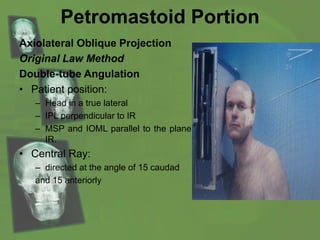
Petromastoid Portion
Axiolateral Oblique Projection
Original Law Method
Double-tube Angulation
• Patient position:
– Head in a true lateral
– IPL perpendicular to IR
– MSP and IOML parallel to the plane of
IR.
• Central Ray:
– directed at the angle of 15 caudad
and 15 anteriorly
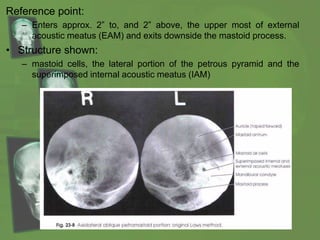
Reference point:
– Enters approx. 2” to, and 2” above, the upper most of external
acoustic meatus (EAM) and exits downside the mastoid process.
• Structure shown:
– mastoid cells, the lateral portion of the petrous pyramid and the
superimposed internal acoustic meatus (IAM)
Axiolateral Oblique Projection
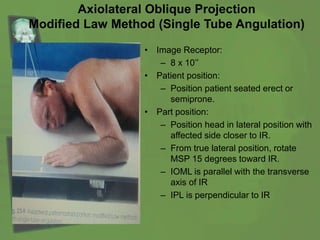
Modified Law Method (Single Tube Angulation)
• Image Receptor:
– 8 x 10’’
• Patient position:
– Position patient seated erect or
semiprone.
• Part position:
– Position head in lateral position with
affected side closer to IR.
– From true lateral position, rotate
MSP 15 degrees toward IR.
– IOML is parallel with the transverse
axis of IR
– IPL is perpendicular to IR
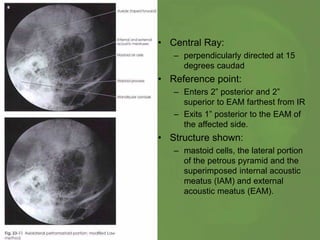
• Central Ray:
– perpendicularly directed at 15
degrees caudad
• Reference point:
– Enters 2” posterior and 2”
superior to EAM farthest from IR
– Exits 1” posterior to the EAM of
the affected side.
• Structure shown:
– mastoid cells, the lateral portion
of the petrous pyramid and the
superimposed internal acoustic
meatus (IAM) and external
acoustic meatus (EAM).
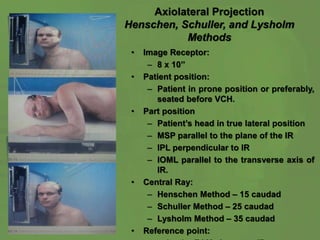
Axiolateral Projection
Henschen, Schuller, and Lysholm
Methods
• Image Receptor:
– 8 x 10’’
• Patient position:
– Patient in prone position or preferably,
seated before VCH.
• Part position
– Patient’s head in true lateral position
– MSP parallel to the plane of the IR
– IPL perpendicular to IR
– IOML parallel to the transverse axis of
IR.
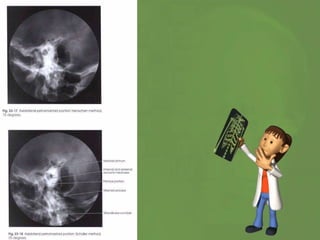
• Central Ray:
– Henschen Method – 15 caudad
– Schuller Method – 25 caudad
– Lysholm Method – 35 caudad
• Reference point:
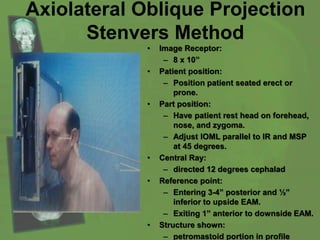
Axiolateral Oblique Projection
Stenvers Method
• Image Receptor:
– 8 x 10’’
• Patient position:
– Position patient seated erect or
prone.
• Part position:
– Have patient rest head on forehead,
nose, and zygoma.
– Adjust IOML parallel to IR and MSP
at 45 degrees.
• Central Ray:
– directed 12 degrees cephalad
• Reference point:
– Entering 3-4” posterior and ½”
inferior to upside EAM.
– Exiting 1” anterior to downside EAM.
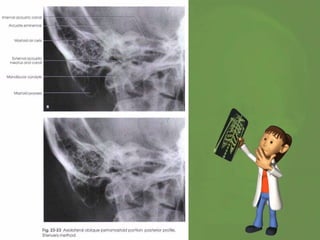
• Structure shown:
– petromastoid portion in profile
Axiolateral Oblique Projection
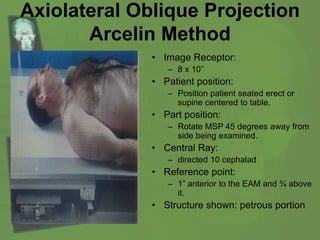
Arcelin Method
• Image Receptor:
– 8 x 10’’
• Patient position:
– Position patient seated erect or
supine centered to table.
• Part position:
– Rotate MSP 45 degrees away from
side being examined.
• Central Ray:
– directed 10 cephalad
• Reference point:
– 1” anterior to the EAM and ¾ above
it.
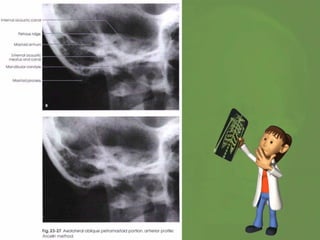
• Structure shown: petrous portion
Axiolateral Oblique Projection
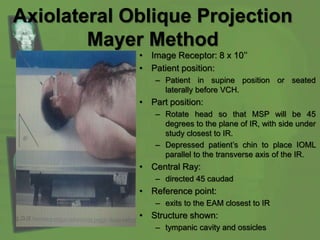
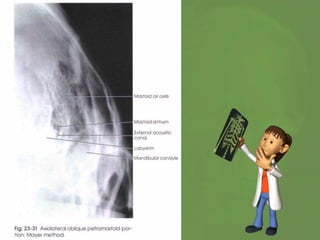
Mayer Method
• Image Receptor: 8 x 10’’
• Patient position:
– Patient in supine position or seated
laterally before VCH.
• Part position:
– Rotate head so that MSP will be 45
degrees to the plane of IR, with side under
study closest to IR.
– Depressed patient’s chin to place IOML
parallel to the transverse axis of the IR.
• Central Ray:
– directed 45 caudad
• Reference point:
– exits to the EAM closest to IR
• Structure shown:
– tympanic cavity and ossicles
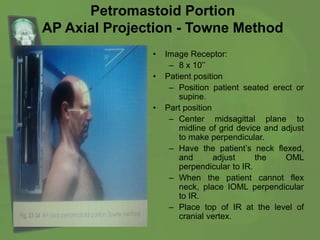
Petromastoid Portion
AP Axial Projection - Towne Method
• Image Receptor:
– 8 x 10’’
• Patient position
– Position patient seated erect or
supine.
• Part position
– Center midsagittal plane to
midline of grid device and adjust
to make perpendicular.
– Have the patient’s neck flexed,
and adjust the OML
perpendicular to IR.
– When the patient cannot flex
neck, place IOML perpendicular
to IR.
– Place top of IR at the level of
cranial vertex.
• Central Ray:
– 30 degrees caudad to OML or
37 caudad degrees to IOML.
• Respiration:
– Obtain radiograph during
suspended respiration.
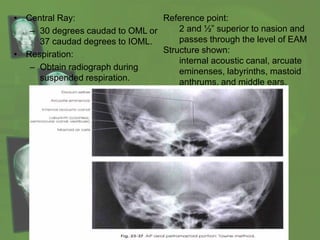
Reference point:
2 and ½” superior to nasion and
passes through the level of EAM
Structure shown:
internal acoustic canal, arcuate
eminenses, labyrinths, mastoid
anthrums, and middle ears.
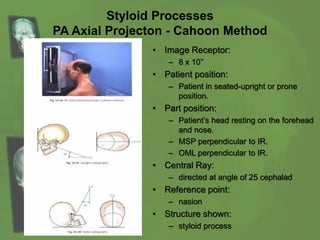
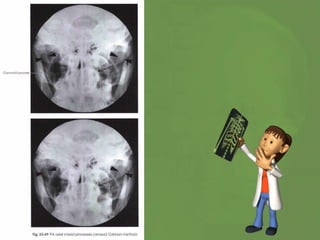
Styloid Processes
PA Axial Projecton - Cahoon Method
• Image Receptor:
– 8 x 10’’
• Patient position:
– Patient in seated-upright or prone
position.
• Part position:
– Patient’s head resting on the forehead
and nose.
– MSP perpendicular to IR.
– OML perpendicular to IR.
• Central Ray:
– directed at angle of 25 cephalad
• Reference point:
– nasion
• Structure shown:
– styloid process
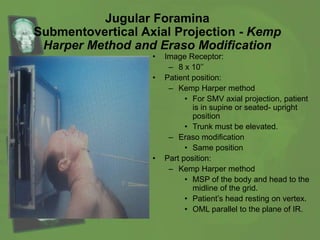
Jugular Foramina
Submentovertical Axial Projection - Kemp
Harper Method and Eraso Modification
• Image Receptor:
– 8 x 10’’
• Patient position:
– Kemp Harper method
• For SMV axial projection, patient
is in supine or seated- upright
position
• Trunk must be elevated.
– Eraso modification
• Same position
• Part position:
– Kemp Harper method
• MSP of the body and head to the
midline of the grid.
• Patient’s head resting on vertex.
• OML parallel to the plane of IR.
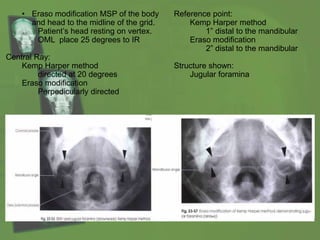
• Eraso modification MSP of the body
and head to the midline of the grid.
Patient’s head resting on vertex.
OML place 25 degrees to IR
Central Ray:
Kemp Harper method
directed at 20 degrees
Eraso modification
Perpedicularly directed
Reference point:
Kemp Harper method
1” distal to the mandibular
Eraso modification
2” distal to the mandibular
Structure shown:
Jugular foramina
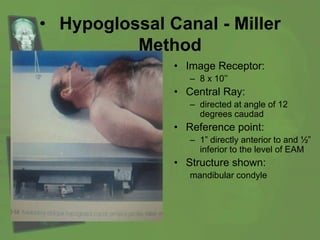
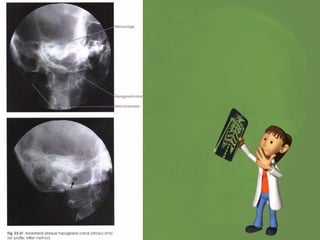
• Hypoglossal Canal - Miller
Method
• Image Receptor:
– 8 x 10’’
• Central Ray:
– directed at angle of 12
degrees caudad
• Reference point:
– 1” directly anterior to and ½”
inferior to the level of EAM
• Structure shown:
mandibular condyle
That's the end of
our projections,
Dr. Matindi...
LAST...
Enumerate the
22 bones of the
Skull (8 cranial
bones and 14
facial bones)
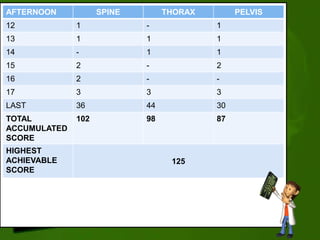
AFTERNOON SPINE THORAX PELVIS
12 1 - 1
13 1 1 1
14 - 1 1
15 2 - 2
16 2 - -
17 3 3 3
LAST 36 44 30
TOTAL
ACCUMULATED
SCORE
102 98 87
HIGHEST
ACHIEVABLE
SCORE
125
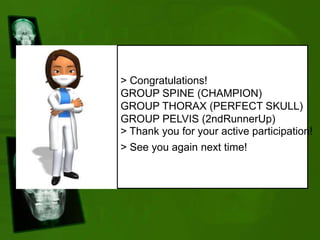
> Congratulations!
GROUP SPINE (CHAMPION)
GROUP THORAX (PERFECT SKULL)
GROUP PELVIS (2ndRunnerUp)
> Thank you for your active participation!
> See you again next time!
END...

SKULL: Radiologic Positioning (Non-contrast)

  • 3.
    > Hello everyone,I'm Dr. Matindi. > Welcome to Skull Radiography - V.4.0 > We are going to play a game, and you will be receiving exciting prizes.> You will be divided into four groups of four members each. > The group with the highest number of scores at the end of this game would receive a great reward. > Everytime that I would appear and ask a question is the time where your scores would be recorded. Dr. Matindi, We're ready. OK, Let's begin.
  • 4.
    The anatomy ofthe skull is very complex, and specific attention to detail is required of the technologist. The skull, or bony skeleton of the head, rests on the superior end of the vertebral column and is divided into two main sets of bones: the 8 cranial bones and the 14 facial bones. ANATOMY
  • 5.
  • 6.
  • 7.
    SKULL: PLANES, POINTS &LINE 1. Midsagittal plane (MSP) 2. Interpupillary line (IPL) 3. Acanthion 4. Outer canthus 5. Infraorbital margin 6. External acoustic meatus (EAM) 7. Orbitalmeatal line (OML) 8. Infraorbitomeatal line (IOML) 1. Frankpurt Line 9. Acanthiomeatal line (AML) 10. Mentomeatal line (MML) 1. Between OML & IOML: 7° difference 2. Between OML & GML: 8° difference
  • 12.
    CRANIAL BONES • Theeight bones of the cranium are divided into the calvaria (skullcap) and the floor. Each of these two areas primarily consists of four bones: CALVARIA • 1. Frontal • 2. Right parietal • 3. Left parietal • 4. Occipital FLOOR • 5. Right temporal • 6. Left temporal • 7. Sphenoid (sfe′-noid) • 8. Ethmoid (eth′-moid)
  • 13.
  • 15.
  • 16.
    SKULL SERIES Clinical Projections •BASIC: – PA 0° – Lateral – Towne Method: AP Axial – Caldwell Method: PA Axial 15°or PA Axial 25° to 30° • SPECIAL: ub ento ertex (SMV) – Haas Method: PA Axial
  • 17.
    PATHOLOGY 1. ) BasalFx Fx located at the base of the skull 2) Blowout Fx Fx of the floor of the orbit 3.) Contre-Coup Fx Fx to one side of a structure caused by trauma to the other side 4.) Depressed Fx Fx causing a portion of the skull to be depressed into the cranial cavity 5.) Le Fort Fx Bilateral horizontal fxs of the maxillae
  • 20.
  • 21.
  • 25.
  • 26.
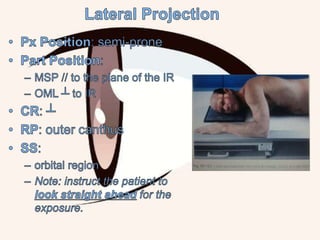
    Lateral Projection • PxPosition : seated erect or semiprone • Part Position: – MSP // to IR. – IOML is ┴ to front edge of IR. – IPL is ┴ to IR. • CR: ┴ • RP: – 2 inches superior to EAM- general survey – ¾ inch superior and ¾ inch anterior to the EAM – sella turcica • SS: – sella turcica
  • 28.
    Lateral Projection: Dorsal Decubitusor Supine Lateral Position • Px Position: – Seated erect or semisupine. • Part position: – MSP // to IR. – IOML is ┴ to front edge of IR. – IPL is ┴ to IR. • CR: ┴ • RP: 2 inches superior to EAM • SS: sella turcica
  • 30.
    Caldwell Method PA andPA Axial Px Position: Prone Part Position: • MSP and OML ┴ to midline of grid device • Rest patient's nose and forehead against table/Bucky surface; • Flex neck as needed to align OML ┴ to IR; • Center IR to CR. CR: • PA: ┴ • PA axial: 15° caudad RP: Nasion
  • 31.
    SS: • Greater andlesser sphenoid wings • Frontal bone • Superior orbital fissures • Frontal and anterior ethmoid sinuses • Superior orbital margins • Crista galli
  • 33.
    AP Axial Projection TowneMethod • Px Position: Seated erect or supine. • Part Position: – Center MSP to midline of grid device and adjust to make ┴ – Neck flexed, and adjust the OML ┴ to IR. – Cannot flex neck? Place IOML ┴ to IR and then increase CR angulation 7° – Place top of IR at the level of cranial vertex. • CR: – 30° caudad to OML or 37° caudad to IOML. – Foramen magnum and jugular foramina – 40° to 60° – Posterior portion of the cranial vault – ┴° • Respiration: – Suspended respiration. • RP: – 2 and ½ inches superior to glabella and passes through the level of EAM
  • 35.
    SS: • Symmetric viewof the petrous pyramid • Posterior portion of the foramen magnum • Posterior clinoid processes within the shadow of the foramen magnum and dorsum sellae • Occipital bone • Posterior portion of the parietal bones • Remember: SPPOP
  • 36.
    PA Axial projection HAASMethod • Px Position: seated erect or prone. • Part position: – Rest head on forehead and nose. – Arms in comfortable position. – Shoulders to lie in same transverse plane. – Adjust head so that MSP and OML are ┴ to IR. • CR: 25° cephalad • Respiration: suspended respiration. • RP: – 1 and ½ inch inferior to external occipital protruberance (inion) and exiting 1 and ½ inch superior to nasion.
  • 37.
    • Dorsum sellae withinthe shadow of the foramen magnum • Occipital region of the cranium • Symmetric view of the petrous pyramid
  • 40.
    Submentovertical Projection Schuller Method Pxposition: – Seated erect at head unit, or – Supine on elevated table support. Part position: – Extend neck and rest head on vertex. – Center and adjust MSP ┴ to IR. – Adjust IOML // to plane of IR if possible. CR: ┴ Respiration: – Suspended respiration. RP: – Sella turcica ┴ to IOML entering between angles of mandible. – ¾” anterior to the level of EAM
  • 41.
    • Symmetric projectionof the petrosae • Mastoid processes • Auditory tubes (eustachian tubes) • Foramina ovale and spinosum- best shown • Carotid canals • Sphenoidal sinuses • Mandible • Maxillary sinuses • Nasal septum • Dens of the axis • Atlas
  • 42.
    Schuller Method Verticosubmental Projection usewhen SMV is contraindicated Px Position: Prone Part Position: Chin on the table Neck fully extended. MSP ┴ to midline of grid device. Arms at sides CR: ┴ RP: Sella turcica ┴ to IOML entering between angles of mandible; ¾ inch anterior to the level of EAM SS: Cranial base Sphenoidal sinuses
  • 44.
    Lysholm Method Axiolateral Position PxPosition: Seated erect or semiprone Part position: • Center the EAM of the side being examined to the midline of the table • Adjust the head in a true lateral position • Extend neck and place the IOML // with the transverse axis of the cassette CR: 1 inch (2.5 cm) distal to the lower EAM at an angle of 30° to 35° caudad
  • 45.
    SS: • Oblique positionof the lateral aspect of the base of the cranium closest to film NOTE: • Lysholm is recommended for patients who cannot extend their head enough for a satisfactory submentovertical projection
  • 47.
    SPINE THORAX PELVIS 1√ - √ 2 √ √ √ 3 √ - √ 4 √ - √ 5 √ √ √ 6 √ √ √ 7 √ √ √ 8 √ √ √ 9 √ √ √ 10 √ √ √ 11 √ √ √ 12 √ √ √ 13 (5) - - - 14 (5) √ - - 15 - - - 17 9 12
  • 48.
    Yesterday's Highlights: External occipitalprotuberance is also known as the Inion Newborn fontanels Anterior fontanel - dregma Posterior fontanel - lambda Sphenoidal fontanel - pterion Mastoid fontanel - asterion Morphology MSP's relationship with the petrous pyramid PROJECTIONS In Caldwell's Method, the structures best demonstrated are the frontal bone and the frontal sinus. In Towne's Method, the reference point, in some books, is the hairline.
  • 49.
    In Towne's method,the structure best demonstrated is the occipital bone. What are the other structures that are being demonstrated if the central ray angulation is 37°? A. sella turcica and dorsum sellae B. anterior clinoid process and dorsum sellae C. dorsum sellae and posterior clinoid process D. anterior clinoid process and sellae turcica
  • 50.
    Enumerate the Skull: Planes,Points, and Lines. Each will be given two points. !!!
  • 52.
    TEA stands for ? Topof Ear Attachment
  • 54.
    EXTERNAL EAR consistsof two parts: 1. Auricle (oval-shaped, fibrocartilaginous, sound collecting organ situated on the side of the head) 2. EAM (sound conducting canal) MIDDLE EAR proper consists of: 1. Tympanic membrane (eardrum) 2. Tympanic cavity (irregularly shaped, air- containing compartment) 3. Auditory ossicles (three small bones) INTERNAL EAR contains the essential sensory apparatus of hearing and equilibrium and lies on the densest portion of the petrous portion immediately below the arcuate eminence.
  • 55.
  • 56.
    Valdini Method PA Axial PxPosition: Seating position Part position: • Rest the patient’s upper frontal region of the skull on the table and adjust it so that the MSP is ┴ to the midline of the grid • IOML 50° with IR for demonstration of dorsum sellae, internal auditory canals and labyrinths of the ear • OML 50° with the IR for demonstration of the external auditory canals, tympanic cavities and eustachian tubes CR: ┴ to inion RP: • For dorsum sellae - Center to a point 0.5 cm distal to the nasion • For petrosae - Center to the foramen magnum at or slightly above the level of the EAM
  • 57.
    SS: • DILA (IOML50°): Dorsum sellae; Internal Auditory Meatus (IAM); LAbyrinth • ETB “EaT Bulaga” (OML 50°): External auditory meatus; Tymphanic cavity; Bony part of Eustachian tube • Dorsum sellae & posterior clinod processes within or above shadow of foramen magnum • Tubeculum sellae, anterior clinoid processes & sella turcica below shadow of foramen magnum • Mastoid pneumatization
  • 58.
    Sella Turcica: LateralProjection Px Position: • Seated upright or semiprone. • MSP // to the plane of the IR • Radiolucent sponge is required for obese patients. Part position: • MSP // to IR • IPL ┴ to IR • IOML // with transverse axis of the IR. CR: ┴ RP: ¾ inch anterior and ¾ inch superior to the EAM SS: sella turcica region of the cranium
  • 60.
  • 62.
    AP Axial Projection •Px Position: – Seated upright or supine. – Arms along side the body. • Part Position: – MSP ┴ to the midline of the grid device. – IOML ┴ to the plane of the IR. • CR: – 37° caudal projects the dorsum sellae and posterior clinoid processes within the foramen magnum. – 30° caudal to IOML projects the dorsum and tubercullum sellae and anterior cliniod processes through the occipital bone above the level of the foramen magnum. • RP: – Upper forehead and passing through the head at the level of the EAM • SS: – Sellar region and petrous pyramid
  • 64.
    PA Axial projection •Px Position: – Patient prone or seated erect – Arms in comfortable position. • Part Position: – Forehead and nose rested against the VCH. – OML ┴ to IR. – MSP ┴ to IR. • CR: – 10° cephalad • RP: – Glabella • SS: – Tuberculum sellae and clinoid process
  • 67.
    SOG stands for? Supraorbital Groove
  • 69.
    Rhese Method Parietoorbital ObliqueProjection Optic Canal and Foramen • Px Position: Seated erect or semiprone. • Part Position: – Center affected orbit to IR – Rest head on zygoma, nose and chin. – Adjust AML ┴ to IR – Rotate MSP 53° from IR. • CR: ┴ • RP: 1 inch superior and 1 inch posterior to elevated TEA • SS: – optic canal – optic foramen
  • 71.
    Rhese Method Orbitoparietal ObliqueProjection • Px Position: – Seated upright or supine position – Arms alongside the body • Part Position: – Rotate head so that MSP forms an angle of 53° to the plane of the IR. – AML ┴ to IR. • CR: ┴ • RP: uppermost orbit at inferior and lateral quadrant • SS: – optic canal “on end” and optic foramen
  • 73.
    Superior Orbital Fissures PAAxial Projection • Px Position: prone or seated upright – Forearms along side the head with elbows flexed. • Part Position: – Forehead and nose rested against the grid device with MSP centered and ┴ to IR. – OML ┴ to IR. • CR: 20-25° caudad • RP: Exiting at the level of the inferior margin of the orbit • SS: petrous portion temporal bone
  • 74.
    Bertel Method PA AxialProjection Inferior Orbital Fissures • Px Position: – Prone or seated-upright. – Arms alongside the body. • Part Position: – Patient’s forehead and nose rested against the VCH – MSP ┴ to IR. – IOML ┴ to IR • CR: 20-25° cephalad • RP: – to enter approx. 3 inch below the external occipital protruberance – exiting to the nasion • SS: – orbital floor, orbital fissure, pterygoid lamina.
  • 75.
    In Rhese method,the MSP is angulated: A. 57° B. 51° C. 55° D. 53°
  • 76.
  • 77.
    In Reese Method,the central ray is directed perpendicularly, however in Bertel Method, the central ray is: A. 10 - 25° cephalad B. 20 - 25° caudad C. 10 - 15° cephalad D. 20 - 25° cephalad
  • 83.
    Modified Parietoacanthial Projection ModifiedWater’s Method • Px Position: – Seated erect or prone – Arms along side the body • Part Position: – Rest head on the tip of the extended chin – OML must form 55° in relation to the plane of the IR. • CR: ┴ • RP: Exit to the acanthion • SS: – orbit, maxillae and zygomatic arches.
  • 85.
    In the lateralprojection of the eye, the reference point is the: A. outer canthus B. inner canthus C. glabella D. mental point
  • 86.
    FACIAL BONES (14) •Nasal Bones (2) • Lacrimal Bones (2) • Maxillary Bones (2) • Zygomatic Bones (2) • Palatine Bones (2) • Inferior Nasal Conchae (2) • Vomer (1) • Mandible (1) • Hyoid Bone • Diploe
  • 87.
  • 89.
    SPINE THORAX PELVIS 1- - - 2 20 16 16 3 - 2 - 4 - - - 5 - 3 3 6 1 1 - 7 2 2 2 8 2 2 2 9 2 - 2 10 2 2 2 11 11 12 10 LAST SCORE 17 9 12 Accumulated Score 57 49 49
  • 91.
    Lateral Projection • PxPosition: – Semiprone or obliquely seated • Part position: – MSP // to plane of the IR – IPL ┴ to IR • CR: – ┴ • RP: – Lateral surface of the zygomatic bone halfway between outer canthus and the EAM • SS: – Bone of the face
  • 93.
    Facial Profile: LateralProjection • Px Position: Semiprone or seated position • Part position: – Head in lateral position and MSP // – IPL ┴ to the plane of the IR. • CR: – ┴ • RP: – Lateral surface of the zygomatic bone and halfway between the outer canthus and the EAM • SS: – Bony and Tissue structure
  • 95.
    Water's Method Parietocanthial ProjectionPxPosition: Patient is seated-erect or prone Arms along side the body Part Position: Rest the patient head on the tip of the extend chin OML must form 37° in relation to the plane of the IR. Average patient’s nose will be about ¾ inch away from the grid device CR: ┴ RP: Exit to the acanthion SS: Orbit Maxillae Zygomatic arches.
  • 97.
    Modified Parietoacanthial Projection ModifiedWater’s Method • Px Position: – Seated erect or prone – Arms along side the body • Part Position: – Rest the patient head on the tip of the extend chin. – OML must form 55° in relation to the plane of the IR. • CR: ┴ • RP: exit to the acanthion • SS: – Orbit – Maxillae – Zygomatic arches.
  • 99.
    Reverse Water’s Method AcanthioparietalProjection • Px Position: Supine • Part position: – Chin up, adjust the extension of the neck so that the OML forms a 37° to the plane of the IR. – MML ┴ to the IR • CR: ┴ • RP: Acanthion • SS: Superior facial bone
  • 101.
    CALDWELL Method PA AxialProjection Px Position Seated erect or semiprone. Part Position Rest head on forehead and nose. Position midsagittal plane ┴ to midline of grid device. OML is ┴ to IR. CR Caldwell method: 15° caudad Exaggerated Caldwell method: 30° caudal (for the demonstration of orbital rims, particularly the orbital floor) RP Exit nasion
  • 103.
    In the lateralprojection, the IPL is in what relationship with the IR? A. Perpendicular B. Parallel C. All of the above D. None of the above
  • 104.
  • 106.
    Lateral Projection • PxPosition: – Semiprone • Part Position: – MSP // and IPL ┴ to the plane of the IR – Support the mandible to prevent rotation • CR: ┴ to the bridge of the nose. • RP: ½ inch distal to the nasion • SS: – nasal bone – soft structure of the bone.
  • 108.
    Tangential projection 1. ExtraoralFilm Px Position: Recumbent or seated position. Chin supported on a sandbag or an inclined IR. Part Position Head on the fully extended chin Center the IR to the midsagittal plane just anterior to the chin Adjust the patient's head so that the midsagittal plane is ┴ to the plane of the IR Respiration: Suspended
  • 109.
    2. Intraoral Film PxPosition Supine Rest the head on the table or elevate it on a sponge. With its long axis directed anteroposteriorly and the pebbled surface facing upward, insert the film packet approximately 1 inch (2.5 cm) into the mouth. Center the packet to the MSP, and then instruct the patient to close the lips and teeth so that the film is held in position with its plane ┴ to the glabelloalveolar line Respiration: Suspended
  • 110.
    • CR – //to glabelloalveolar line – ┴ to the plane of the image receptor • SS – A tangential projection of only a portion of the nasal bones that extend beyond the glabelloalveolar line CLUE: Two words. The second word ends with letter “e”.
  • 113.
    Submentovertical Projection • PxPosition: – Seated upright or supine • Part Position: – Hyperextend the neck so that IOML is nearly // with the IR – Rest the head on its vertex. • CR: – ┴ to IOML • RP: – Entering to the throat at the level of 1 inch posterior to the outer canthi. • SS: Zygomatic arch
  • 115.
    Tangential Projection • PxPosition: seated or supine. • Part Position: – Seated: • Neck hyperextended and head resting on vertex. • IOML // as possible to the plane of the IR. • Rotate the MSP approx.15° toward the side being examined. • Tilt the top of the head approx.15° away from the side being examine. • This rotation and tilt ensure that the CR is tangent to the lateral surface of the skull placing the zygomatic arch onto the IR. – Supine • Head resting on the vertex • IOML nearly // to IR • Rotate and tilt 15° towards the side being examined.
  • 116.
    • CR: ┴to the IOML. • RP: 1 inch posterior to outer canthus • SS: Zygomatic arch
  • 117.
    May Method Tangential Projection •Px Position: – Seated upright or prone. • Part Position: – Completely extend neck so that the IOML is as // with IR as possible. – Rotate the MSP approx. 15° away from the side being examined. – Tilt the top of the head away from the side being examined approx.15°. • CR: ┴ to IOML • RP: 1 ½ inch posterior to outer canthus • SS: – patient who have depressed
  • 119.
    Modified Towne Method APAxial projectionPx Position: Seated upright or supine. Center the center of the body to the midline of VCH Part Position: MSP center the VCH Chin slightly depressed so that OML is ┴ to IR. CR: 30° caudad (37° caudad for patients who cannot flex neck) RP: 1inch above nasion SS: Zygomatic arch
  • 121.
    What is theCR in the May Method: Tangential Projection, the Submentovertal Projection, and the Tangential Projection of the Zygomatic Arch? A. Parallel to IOML B. Perpendicular to IOML C. Parallel to MML D. Perpendicular to MML
  • 124.
    MML stands for? Mentomeatal Line
  • 126.
    MANDIBULAR SYMPHYSIS AP Axialprojection • Px Position: – Seating at edge of the radiographic table. – Elevate the film packet or IR on a suitable support so that the patient can extend the neck and sustain the chin in a horizontal plane. • CR: 40-45° • RP: mandibular symphysis (midway between the lips and the tip of the chin) • SS: mandibular symphysis and mental foramina
  • 128.
    Mandibular Rami PA projection •Px Position: Seated erect or prone • Part Position: – Rest forehead and nose on the grid device – Adjust head so that MSP is ┴ to IR – OML is ┴ to IR • Respiration: Suspended • CR: ┴ • RP: exit to the acanthion • SS: mandibular body and rami
  • 130.
    Mandibular Rami PA AxialProjection • Px Position: Seated erect or prone. • Part position: – Position MSP ┴ to IR – OML ┴ to IR – Have the patient head rest forehead and nose on IR holder. • Respiration: Suspended • CR: 20-25°cephalad • RP: exiting acanthion • SS: mandibular rami
  • 132.
    Mandible Body PA projection •Px Position: Prone or seated upright • Part position: – Rest the head on nose and chin so that the anterior surface of the mandibular symphysis is // to the plane of the IR. – This places the AML nearly ┴ to the IR plane. • CR: ┴ • RP: level of the lips. • SS: Mandibular body
  • 134.
    Mandibular Body PA AxialProjection • Px Position: – Prone position or seated upright • Part Position: – Rest the head on nose and chin so that mandibular symphysis will be placed // to the plane of the IR. – MSP is ┴ to the plane of the IR. • CR: – 30° cephalad. • RP: – midway between TMJs. • SS: – Mandibular body and TMJs. • Note: Mouth should be filled with air.
  • 136.
    Mandible Axiolateral Oblique Projection Thegoal of this projection is to place the desired portion of the mandible // to the IR. Px Position: Seated erect, semisupine, or semiprone. Part Position: • Place the head in lateral position with interpupillary line ┴ to IR. • Have patient close mouth & keep teeth together. • Extend neck enough that long axis of mandibular body is // with the transverse axis of IR, preventing superimposition of cervical spine. • If projection is being performed on tabletop, position IR so that complete body of mandible is positioned on IR. • Adjust the rotation of the head so that the area of interest is // to IR as follows: 1) ramus: keep the head in true lateral position; 2) body: rotate head 30° toward IR 3) symphysis: rotate head 45° toward IR.
  • 137.
    • CR: 25°cephalad • RP: Pass through mandibular region of interest. • SS: region of mandible of interest.
  • 138.
    Mandible Submentovertical Projection • PxPosition: Seated-upright or supine • Part Position: – Hyperextend the neck so that IOML is nearly // with the IR – Rest the head on its vertex. • CR: ┴ to IOML • RP: Entering to the throat at the level of 1 inch posterior to the outer canthi • SS: – Shows coronoid and condyloid processes of the rami.
  • 140.
    Verticosubmental projection • PxPosition: Prone or seated • Part Position: – Rest chin on the table with neck fully extended – Position MSP ┴ to midline of grid device – IOML // to IR – Arms at sides • CR: ┴ • RP: Through the MSP entering at the level just posterior to the outer canthi.
  • 142.
    Temporomandibular Articulation AP AxialProjection Px Position: Supine or seated-upright position with the posterior aspect of the skull in contact with the VCH. CR: 35° caudad RP: Midway between TMJ’s, 3 inches above the nasion SS: condyles of mandible mandibular fossae of the temporal bone
  • 144.
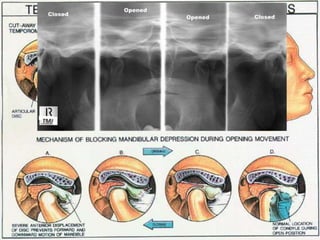
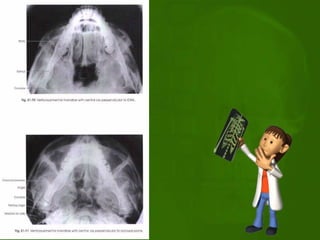
    Axiolateral Projection • PxPosition: seated erect or semiprone • Part Position – Center a point ½ inch anterior to EAM to IR. – Rotate MSP 15° toward IR. – Adjust AML // with the transverse axis of IR – IPL is ┴ to IR. – After first exposure with patient’s mouth closed, do not permit patient to move. – Change IR, and, make the 2nd exposure with patient’s mouth fully open. • CR: ┴ at 25°-30° • RP: 1 inch anterior and 2 inches superior to the upside EAM • SS: TMJs in an open and closed mouth
  • 146.
    Axiolateral Oblique Projection PxPosition: semi prone or seated In TMJ examinations, make one exposure with the mouth closed and, when not contraindicated, one exposure with the mouth open. Part Position: Center a point 1'2 inch ( 1 .3 cm) anterior to the EAM to the JR, and rest the patient‘s cheek on the grid device. Respiration: Suspend CR: 15° caudad RP: exits through the TMJ closest, about 1 ½ inch superior to the upside EAM SS: condyles and neck of mandibles
  • 148.
    What is the referencepoint in Mandibular Symphysis: AP Axial Projection?
  • 149.
  • 152.
    Lateral Projection Px Position:seated erect Part position: Adjust head to true lateral position. MSP is // IPL is ┴ to IR Adjust IOML horizontal and // with transverse axis of the IR. Respiration: suspended CR: ┴ or horizontally directed RP: Entering the head to ½ to 1 inch posterior to the outer canthus. SS: paranasal sinuses
  • 154.
    Frontal and AnteriorEthmoidal Sinuses Caldwell Method PA Axial Projection • Patient position: – Tilt vertical grid device down 15 degrees. – Have patient rest head on forehead and nose. – Position MSP ┴ to midline of IR. – OML is ┴ to IR. – This positioning places OML 15 degrees from horizontal central ray
  • 155.
    • Respiration: Suspendedrespiration • CR: ┴ directed to the plane of the IR. • RP: To exit nasion • SS: frontal and anterior ethmoidal sinuses
  • 156.
    Maxillary and SphenoidalSinuses Waters Method Parietoacanthial Projection Open and Closed mouth • Px Position: seated erect. • Part position: – Center and adjust MSP perpendicular to IR, and have patient rest head on extended neck. – Adjust OML to form 37 degrees to IR. MML is perpendicular to IR Center IR to acanthion. OPEN MOUTH OPTION: Have patient fully open mouth to demonstrate the sphenoid and maxillary sinuses. CR: Horizontal and perpendicular to IR. RP: exiting acanthion SS: sphenoidal and maxillary sinuses for an open mouth and maxillary sinuses for a closed mouth.
  • 158.
    Ethmoidal and SphenoidalSinuses Submentovertical Projection • Px Position: – Position patient seated erect at head unit • Part position: – Extend neck and have patient’s head rest on vertex – Center and adjust MSP ┴ to IR – Adjust IOML // to IR
  • 159.
    • Respiration: – Suspendedrespiration. • CR: – Horizontal and ┴ to the IOML • RP: – ¾ inch anterior to the level of the EAM • SS: – Ethmoidal and Sphenoidal sinuses
  • 161.
    Ethmoidal, Sphenoidal andMaxillary Sinuses PA Projection • Px Position: seated erect. • Part position: – For posterior ethmoidal sinuses: • Center nasion to IR • Patient’s head is resting on forehead and nose against VCH • OML is ┴ to IR – For sphenoidal sinuses: • Center glabella to IR. • Patient’s head is resting on forehead and nose against VCH • OML is ┴ to IR
  • 162.
    – For maxillarysinuses: • Center IR midway between the infraorbital margins and the acanthion. • Patient’s head is resting on forehead and nose against VCH • OML is perpendicular to IR • Central Ray: – For posterior ethmoidal sinuses: • Horizontal and perpendicular to IR – For sphenoidal sinuses: • 10 degrees cephalad passing through the sphenoidal sinuses. – For maxillary sinuses: • Horizontal and perpendicular to IR.
  • 163.
    • Reference point: –For posterior ethmoidal sinuses: • To exit to the nasion – For sphenoidal sinuses: • To exit glabella – For maxillary sinuses: • Midway between infraorbital margins and acanthion • Structure shown: – Ethmoidal, sphenoidal and maxillary sinuses.
  • 167.
    Petromastoid Portion Axiolateral ObliqueProjection Original Law Method Double-tube Angulation • Patient position: – Head in a true lateral – IPL perpendicular to IR – MSP and IOML parallel to the plane of IR. • Central Ray: – directed at the angle of 15 caudad and 15 anteriorly
  • 168.
    Reference point: – Entersapprox. 2” to, and 2” above, the upper most of external acoustic meatus (EAM) and exits downside the mastoid process. • Structure shown: – mastoid cells, the lateral portion of the petrous pyramid and the superimposed internal acoustic meatus (IAM)
  • 169.
    Axiolateral Oblique Projection ModifiedLaw Method (Single Tube Angulation) • Image Receptor: – 8 x 10’’ • Patient position: – Position patient seated erect or semiprone. • Part position: – Position head in lateral position with affected side closer to IR. – From true lateral position, rotate MSP 15 degrees toward IR. – IOML is parallel with the transverse axis of IR – IPL is perpendicular to IR
  • 170.
    • Central Ray: –perpendicularly directed at 15 degrees caudad • Reference point: – Enters 2” posterior and 2” superior to EAM farthest from IR – Exits 1” posterior to the EAM of the affected side. • Structure shown: – mastoid cells, the lateral portion of the petrous pyramid and the superimposed internal acoustic meatus (IAM) and external acoustic meatus (EAM).
  • 171.
    Axiolateral Projection Henschen, Schuller,and Lysholm Methods • Image Receptor: – 8 x 10’’ • Patient position: – Patient in prone position or preferably, seated before VCH. • Part position – Patient’s head in true lateral position – MSP parallel to the plane of the IR – IPL perpendicular to IR – IOML parallel to the transverse axis of IR. • Central Ray: – Henschen Method – 15 caudad – Schuller Method – 25 caudad – Lysholm Method – 35 caudad • Reference point:
  • 173.
    Axiolateral Oblique Projection StenversMethod • Image Receptor: – 8 x 10’’ • Patient position: – Position patient seated erect or prone. • Part position: – Have patient rest head on forehead, nose, and zygoma. – Adjust IOML parallel to IR and MSP at 45 degrees. • Central Ray: – directed 12 degrees cephalad • Reference point: – Entering 3-4” posterior and ½” inferior to upside EAM. – Exiting 1” anterior to downside EAM. • Structure shown: – petromastoid portion in profile
  • 175.
    Axiolateral Oblique Projection ArcelinMethod • Image Receptor: – 8 x 10’’ • Patient position: – Position patient seated erect or supine centered to table. • Part position: – Rotate MSP 45 degrees away from side being examined. • Central Ray: – directed 10 cephalad • Reference point: – 1” anterior to the EAM and ¾ above it. • Structure shown: petrous portion
  • 177.
    Axiolateral Oblique Projection MayerMethod • Image Receptor: 8 x 10’’ • Patient position: – Patient in supine position or seated laterally before VCH. • Part position: – Rotate head so that MSP will be 45 degrees to the plane of IR, with side under study closest to IR. – Depressed patient’s chin to place IOML parallel to the transverse axis of the IR. • Central Ray: – directed 45 caudad • Reference point: – exits to the EAM closest to IR • Structure shown: – tympanic cavity and ossicles
  • 179.
    Petromastoid Portion AP AxialProjection - Towne Method • Image Receptor: – 8 x 10’’ • Patient position – Position patient seated erect or supine. • Part position – Center midsagittal plane to midline of grid device and adjust to make perpendicular. – Have the patient’s neck flexed, and adjust the OML perpendicular to IR. – When the patient cannot flex neck, place IOML perpendicular to IR. – Place top of IR at the level of cranial vertex.
  • 180.
    • Central Ray: –30 degrees caudad to OML or 37 caudad degrees to IOML. • Respiration: – Obtain radiograph during suspended respiration. Reference point: 2 and ½” superior to nasion and passes through the level of EAM Structure shown: internal acoustic canal, arcuate eminenses, labyrinths, mastoid anthrums, and middle ears.
  • 181.
    Styloid Processes PA AxialProjecton - Cahoon Method • Image Receptor: – 8 x 10’’ • Patient position: – Patient in seated-upright or prone position. • Part position: – Patient’s head resting on the forehead and nose. – MSP perpendicular to IR. – OML perpendicular to IR. • Central Ray: – directed at angle of 25 cephalad • Reference point: – nasion • Structure shown: – styloid process
  • 183.
    Jugular Foramina Submentovertical AxialProjection - Kemp Harper Method and Eraso Modification • Image Receptor: – 8 x 10’’ • Patient position: – Kemp Harper method • For SMV axial projection, patient is in supine or seated- upright position • Trunk must be elevated. – Eraso modification • Same position • Part position: – Kemp Harper method • MSP of the body and head to the midline of the grid. • Patient’s head resting on vertex. • OML parallel to the plane of IR.
  • 184.
    • Eraso modificationMSP of the body and head to the midline of the grid. Patient’s head resting on vertex. OML place 25 degrees to IR Central Ray: Kemp Harper method directed at 20 degrees Eraso modification Perpedicularly directed Reference point: Kemp Harper method 1” distal to the mandibular Eraso modification 2” distal to the mandibular Structure shown: Jugular foramina
  • 185.
    • Hypoglossal Canal- Miller Method • Image Receptor: – 8 x 10’’ • Central Ray: – directed at angle of 12 degrees caudad • Reference point: – 1” directly anterior to and ½” inferior to the level of EAM • Structure shown: mandibular condyle
  • 187.
    That's the endof our projections, Dr. Matindi...
  • 188.
    LAST... Enumerate the 22 bonesof the Skull (8 cranial bones and 14 facial bones)
  • 189.
    AFTERNOON SPINE THORAXPELVIS 12 1 - 1 13 1 1 1 14 - 1 1 15 2 - 2 16 2 - - 17 3 3 3 LAST 36 44 30 TOTAL ACCUMULATED SCORE 102 98 87 HIGHEST ACHIEVABLE SCORE 125
  • 190.
    > Congratulations! GROUP SPINE(CHAMPION) GROUP THORAX (PERFECT SKULL) GROUP PELVIS (2ndRunnerUp) > Thank you for your active participation! > See you again next time!
  • 191.

Editor's Notes

  • #50 C. dorsum sellae and posterior clinoid process
  • #61 DILA (IOML 50°): Dorsum sellae; Internal Auditory Meatus (IAM); LAbyrinth
  • #76 D. 53° 37 + 53 = 90 :)
  • #78 D. 20-25° cephalad
  • #86 A. outer canthus
  • #104 A. Perpendicular
  • #122 B. Perpendicular to IOML
  • #149 Mandibular symphysis