Anatomy and X-ray of the
PNS and Orbit
Paranasal Sinus Anatomy
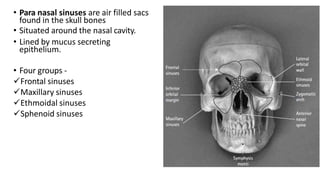
• Para nasal sinuses are air filled sacs
found in the skull bones
• Situated around the nasal cavity.
• Lined by mucus secreting
epithelium.
• Four groups -
Frontal sinuses
Maxillary sinuses
Ethmoidal sinuses
Sphenoid sinuses
Function of Paranasal Sinuses
• The presence of these sinuses lightens the skull
• They add resonance to speech
• They play a vital role in conditioning the inspired air (Warm &
moisten air)
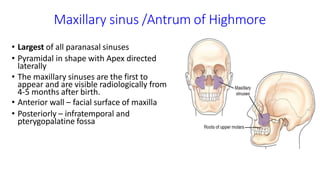
Maxillary sinus /Antrum of Highmore
• Largest of all paranasal sinuses
• Pyramidal in shape with Apex directed
laterally
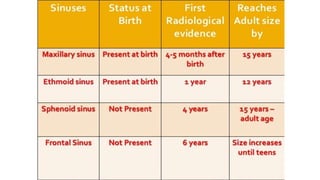
• The maxillary sinuses are the first to
appear and are visible radiologically from
4-5 months after birth.
• Anterior wall – facial surface of maxilla
• Posteriorly – infratemporal and
pterygopalatine fossa
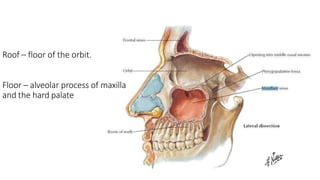
Roof – floor of the orbit.
Floor – alveolar process of maxilla
and the hard palate
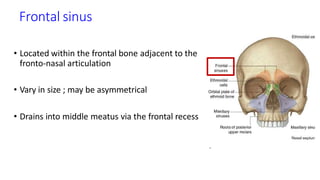
Frontal sinus
• Located within the frontal bone adjacent to the
fronto-nasal articulation
• Vary in size ; may be asymmetrical
• Drains into middle meatus via the frontal recess
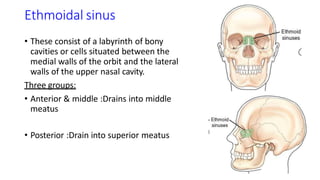
Ethmoidal sinus
• These consist of a labyrinth of bony
cavities or cells situated between the
medial walls of the orbit and the lateral
walls of the upper nasal cavity.
Three groups:
• Anterior & middle :Drains into middle
meatus
• Posterior :Drain into superior meatus
• Lateral wall – Is formed by the orbital plate of ethmoid. It is paper
thin and is known as lamina papyracea. Infections involving the
Ethmoidal air cells may spread to the orbit via this thin plate of bone.
• Roof – lies the frontal bone anteriorly, by the sphenoid posteriorly.
• Common sinus infections in children involve Ethmoidal sinuses
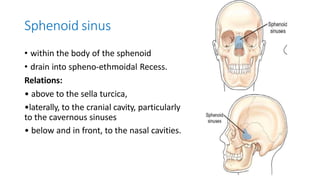
Sphenoid sinus
• within the body of the sphenoid
• drain into spheno-ethmoidal Recess.
Relations:
• above to the sella turcica,
•laterally, to the cranial cavity, particularly
to the cavernous sinuses
• below and in front, to the nasal cavities.
X ray Paranasal sinuses
• The indication and the need for plain X-rays in diagnosis and further
management sinus pathology has declined over the last decade.
• CT is the imaging modality of choice.
• There is still a role for plain films of the paranasal sinuses in acute
infection.
• Advantages of x-ray imaging for PNS include:
1. Cost effectiveness
2. Easy availability
Views:
• 1. Occipito mental view (Water's view)
• 2. Occipital frontal view (Caldwell view)
• 3. Lateral view
Waters View
• Also known as occipito mental view
• is the commonest view taken for paranasal sinuses
• developed by Waters and Waldron in 1915
• This was actually a modification of occipito frontal projection
(Caldwell view)
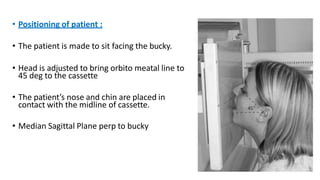
• Positioning of patient :
• The patient is made to sit facing the bucky.
• Head is adjusted to bring orbito meatal line to
45 deg to the cassette
• The patient’s nose and chin are placed in
contact with the midline of cassette.
• Median Sagittal Plane perp to bucky
• Horizontal central line of cassette should be at the
level of the lower orbital margins
Centering –
• Central ray perpendicular to the cassette
• Centred 1 inch above the external occipital
protuberance.
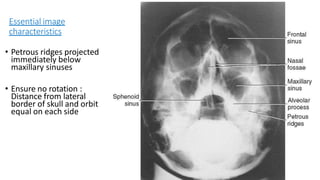
Essential image
characteristics
• Petrous ridges projected
immediately below
maxillary sinuses
• Ensure no rotation :
Distance from lateral
border of skull and orbit
equal on each side
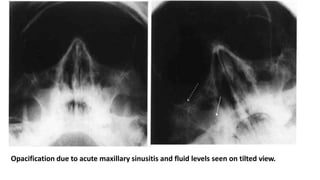
Opacification due to acute maxillary sinusitis and fluid levels seen on tilted view.
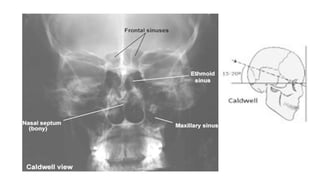
Caldwell view [occipito frontal with 15 deg caudad]
• This projection is used to demonstrate the frontal
and ethmoid sinuses.
• Positioning of patient :
• Patient is seated facing the erect bucky
• Neck is flexed to bring nose and forehead in contact
with the bucky.
• orbito meatal line perpendicular to the bucky,
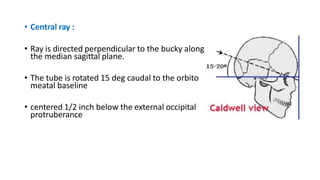
• Central ray :
• Ray is directed perpendicular to the bucky along
the median sagittal plane.
• The tube is rotated 15 deg caudal to the orbito
meatal baseline
• centered 1/2 inch below the external occipital
protruberance
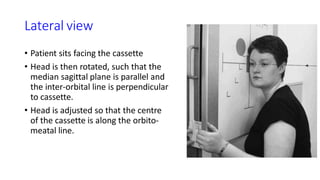
Lateral view
• Patient sits facing the cassette
• Head is then rotated, such that the
median sagittal plane is parallel and
the inter-orbital line is perpendicular
to cassette.
• Head is adjusted so that the centre
of the cassette is along the orbito-
meatal line.
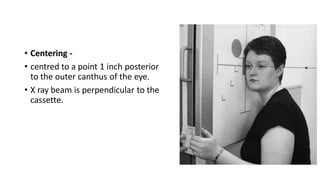
• Centering -
• centred to a point 1 inch posterior
to the outer canthus of the eye.
• X ray beam is perpendicular to the
cassette.
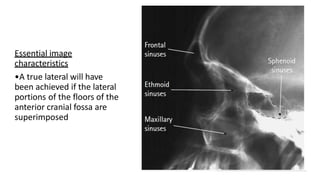
Essential image
characteristics
•A true lateral will have
been achieved if the lateral
portions of the floors of the
anterior cranial fossa are
superimposed
Orbit bony Anatomy
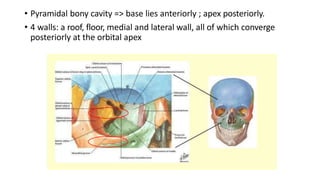
• Pyramidal bony cavity => base lies anteriorly ; apex posteriorly.
• 4 walls: a roof, floor, medial and lateral wall, all of which converge
posteriorly at the orbital apex
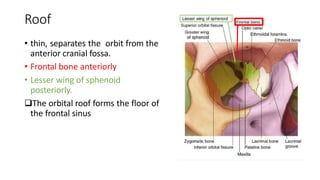
Roof
• thin, separates the orbit from the
anterior cranial fossa.
• Frontal bone anteriorly
• Lesser wing of sphenoid
posteriorly.
The orbital roof forms the floor of
the frontal sinus
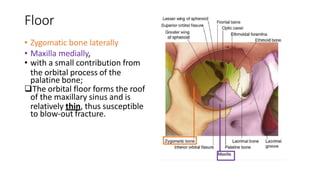
Floor
• Zygomatic bone laterally
• Maxilla medially,
• with a small contribution from
the orbital process of the
palatine bone;
The orbital floor forms the roof
of the maxillary sinus and is
relatively thin, thus susceptible
to blow-out fracture.
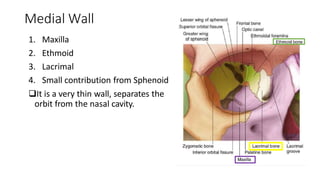
Medial Wall
1. Maxilla
2. Ethmoid
3. Lacrimal
4. Small contribution from Sphenoid
It is a very thin wall, separates the
orbit from the nasal cavity.
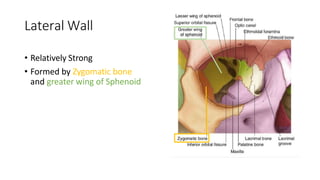
Lateral Wall
• Relatively Strong
• Formed by Zygomatic bone
and greater wing of Sphenoid
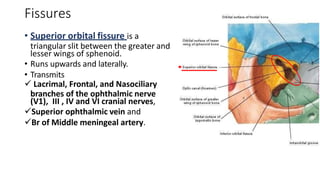
Fissures
• Superior orbital fissure is a
triangular slit between the greater and
lesser wings of sphenoid.
• Runs upwards and laterally.
• Transmits
 Lacrimal, Frontal, and Nasociliary
branches of the ophthalmic nerve
(V1), III , IV and VI cranial nerves,
Superior ophthalmic vein and
Br of Middle meningeal artery.
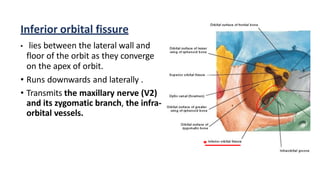
Inferior orbital fissure
• lies between the lateral wall and
floor of the orbit as they converge
on the apex of orbit.
• Runs downwards and laterally .
• Transmits the maxillary nerve (V2)
and its zygomatic branch, the infra-
orbital vessels.
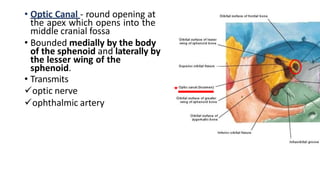
• Optic Canal - round opening at
the apex which opens into the
middle cranial fossa
• Bounded medially by the body
of the sphenoid and laterally by
the lesser wing of the
sphenoid.
• Transmits
optic nerve
ophthalmic artery
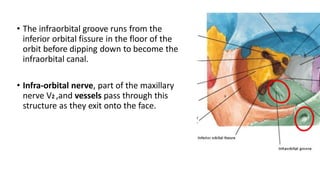
• The infraorbital groove runs from the
inferior orbital fissure in the floor of the
orbit before dipping down to become the
infraorbital canal.
• Infra-orbital nerve, part of the maxillary
nerve V2 ,and vessels pass through this
structure as they exit onto the face.
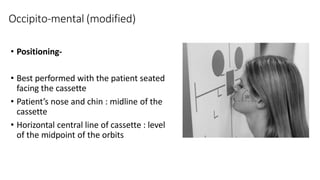
Occipito-mental (modified)
• Positioning-
• Best performed with the patient seated
facing the cassette
• Patient’s nose and chin : midline of the
cassette
• Horizontal central line of cassette : level
of the midpoint of the orbits
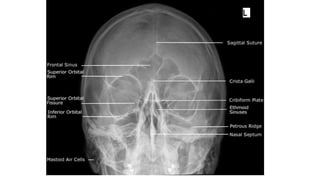
• Centering :
• Central ray of the skull unit should be perpendicular to the cassette
• Centred 1 inch above the external occipital protuberance
• There should be no rotation. This can be checked by ensuring that
the distance from the lateral orbital wall to the outer skull margins
is equidistant on both sides.
X-RAY PNS.pptx

X-RAY PNS.pptx

  • 1.
    Anatomy and X-rayof the PNS and Orbit
  • 2.
  • 3.
    • Para nasalsinuses are air filled sacs found in the skull bones • Situated around the nasal cavity. • Lined by mucus secreting epithelium. • Four groups - Frontal sinuses Maxillary sinuses Ethmoidal sinuses Sphenoid sinuses
  • 4.
    Function of ParanasalSinuses • The presence of these sinuses lightens the skull • They add resonance to speech • They play a vital role in conditioning the inspired air (Warm & moisten air)
  • 5.
    Maxillary sinus /Antrumof Highmore • Largest of all paranasal sinuses • Pyramidal in shape with Apex directed laterally • The maxillary sinuses are the first to appear and are visible radiologically from 4-5 months after birth. • Anterior wall – facial surface of maxilla • Posteriorly – infratemporal and pterygopalatine fossa
  • 6.
    Roof – floorof the orbit. Floor – alveolar process of maxilla and the hard palate
  • 7.
    Frontal sinus • Locatedwithin the frontal bone adjacent to the fronto-nasal articulation • Vary in size ; may be asymmetrical • Drains into middle meatus via the frontal recess
  • 8.
    Ethmoidal sinus • Theseconsist of a labyrinth of bony cavities or cells situated between the medial walls of the orbit and the lateral walls of the upper nasal cavity. Three groups: • Anterior & middle :Drains into middle meatus • Posterior :Drain into superior meatus
  • 9.
    • Lateral wall– Is formed by the orbital plate of ethmoid. It is paper thin and is known as lamina papyracea. Infections involving the Ethmoidal air cells may spread to the orbit via this thin plate of bone. • Roof – lies the frontal bone anteriorly, by the sphenoid posteriorly. • Common sinus infections in children involve Ethmoidal sinuses
  • 10.
    Sphenoid sinus • withinthe body of the sphenoid • drain into spheno-ethmoidal Recess. Relations: • above to the sella turcica, •laterally, to the cranial cavity, particularly to the cavernous sinuses • below and in front, to the nasal cavities.
  • 12.
    X ray Paranasalsinuses • The indication and the need for plain X-rays in diagnosis and further management sinus pathology has declined over the last decade. • CT is the imaging modality of choice. • There is still a role for plain films of the paranasal sinuses in acute infection. • Advantages of x-ray imaging for PNS include: 1. Cost effectiveness 2. Easy availability
  • 13.
    Views: • 1. Occipitomental view (Water's view) • 2. Occipital frontal view (Caldwell view) • 3. Lateral view
  • 14.
    Waters View • Alsoknown as occipito mental view • is the commonest view taken for paranasal sinuses • developed by Waters and Waldron in 1915 • This was actually a modification of occipito frontal projection (Caldwell view)
  • 15.
    • Positioning ofpatient : • The patient is made to sit facing the bucky. • Head is adjusted to bring orbito meatal line to 45 deg to the cassette • The patient’s nose and chin are placed in contact with the midline of cassette. • Median Sagittal Plane perp to bucky
  • 16.
    • Horizontal centralline of cassette should be at the level of the lower orbital margins Centering – • Central ray perpendicular to the cassette • Centred 1 inch above the external occipital protuberance.
  • 17.
    Essential image characteristics • Petrousridges projected immediately below maxillary sinuses • Ensure no rotation : Distance from lateral border of skull and orbit equal on each side
  • 18.
    Opacification due toacute maxillary sinusitis and fluid levels seen on tilted view.
  • 19.
    Caldwell view [occipitofrontal with 15 deg caudad] • This projection is used to demonstrate the frontal and ethmoid sinuses. • Positioning of patient : • Patient is seated facing the erect bucky • Neck is flexed to bring nose and forehead in contact with the bucky. • orbito meatal line perpendicular to the bucky,
  • 20.
    • Central ray: • Ray is directed perpendicular to the bucky along the median sagittal plane. • The tube is rotated 15 deg caudal to the orbito meatal baseline • centered 1/2 inch below the external occipital protruberance
  • 22.
    Lateral view • Patientsits facing the cassette • Head is then rotated, such that the median sagittal plane is parallel and the inter-orbital line is perpendicular to cassette. • Head is adjusted so that the centre of the cassette is along the orbito- meatal line.
  • 23.
    • Centering - •centred to a point 1 inch posterior to the outer canthus of the eye. • X ray beam is perpendicular to the cassette.
  • 24.
    Essential image characteristics •A truelateral will have been achieved if the lateral portions of the floors of the anterior cranial fossa are superimposed
  • 25.
  • 26.
    • Pyramidal bonycavity => base lies anteriorly ; apex posteriorly. • 4 walls: a roof, floor, medial and lateral wall, all of which converge posteriorly at the orbital apex
  • 27.
    Roof • thin, separatesthe orbit from the anterior cranial fossa. • Frontal bone anteriorly • Lesser wing of sphenoid posteriorly. The orbital roof forms the floor of the frontal sinus
  • 28.
    Floor • Zygomatic bonelaterally • Maxilla medially, • with a small contribution from the orbital process of the palatine bone; The orbital floor forms the roof of the maxillary sinus and is relatively thin, thus susceptible to blow-out fracture.
  • 29.
    Medial Wall 1. Maxilla 2.Ethmoid 3. Lacrimal 4. Small contribution from Sphenoid It is a very thin wall, separates the orbit from the nasal cavity.
  • 30.
    Lateral Wall • RelativelyStrong • Formed by Zygomatic bone and greater wing of Sphenoid
  • 31.
    Fissures • Superior orbitalfissure is a triangular slit between the greater and lesser wings of sphenoid. • Runs upwards and laterally. • Transmits  Lacrimal, Frontal, and Nasociliary branches of the ophthalmic nerve (V1), III , IV and VI cranial nerves, Superior ophthalmic vein and Br of Middle meningeal artery.
  • 32.
    Inferior orbital fissure •lies between the lateral wall and floor of the orbit as they converge on the apex of orbit. • Runs downwards and laterally . • Transmits the maxillary nerve (V2) and its zygomatic branch, the infra- orbital vessels.
  • 33.
    • Optic Canal- round opening at the apex which opens into the middle cranial fossa • Bounded medially by the body of the sphenoid and laterally by the lesser wing of the sphenoid. • Transmits optic nerve ophthalmic artery
  • 34.
    • The infraorbitalgroove runs from the inferior orbital fissure in the floor of the orbit before dipping down to become the infraorbital canal. • Infra-orbital nerve, part of the maxillary nerve V2 ,and vessels pass through this structure as they exit onto the face.
  • 35.
    Occipito-mental (modified) • Positioning- •Best performed with the patient seated facing the cassette • Patient’s nose and chin : midline of the cassette • Horizontal central line of cassette : level of the midpoint of the orbits
  • 36.
    • Centering : •Central ray of the skull unit should be perpendicular to the cassette • Centred 1 inch above the external occipital protuberance • There should be no rotation. This can be checked by ensuring that the distance from the lateral orbital wall to the outer skull margins is equidistant on both sides.