INTENSIFYING SCREEN
Dr.Tarique Ajij
Junior Resident,
Department of Radio-
Diagnosis,
Medical College,
Kolkata
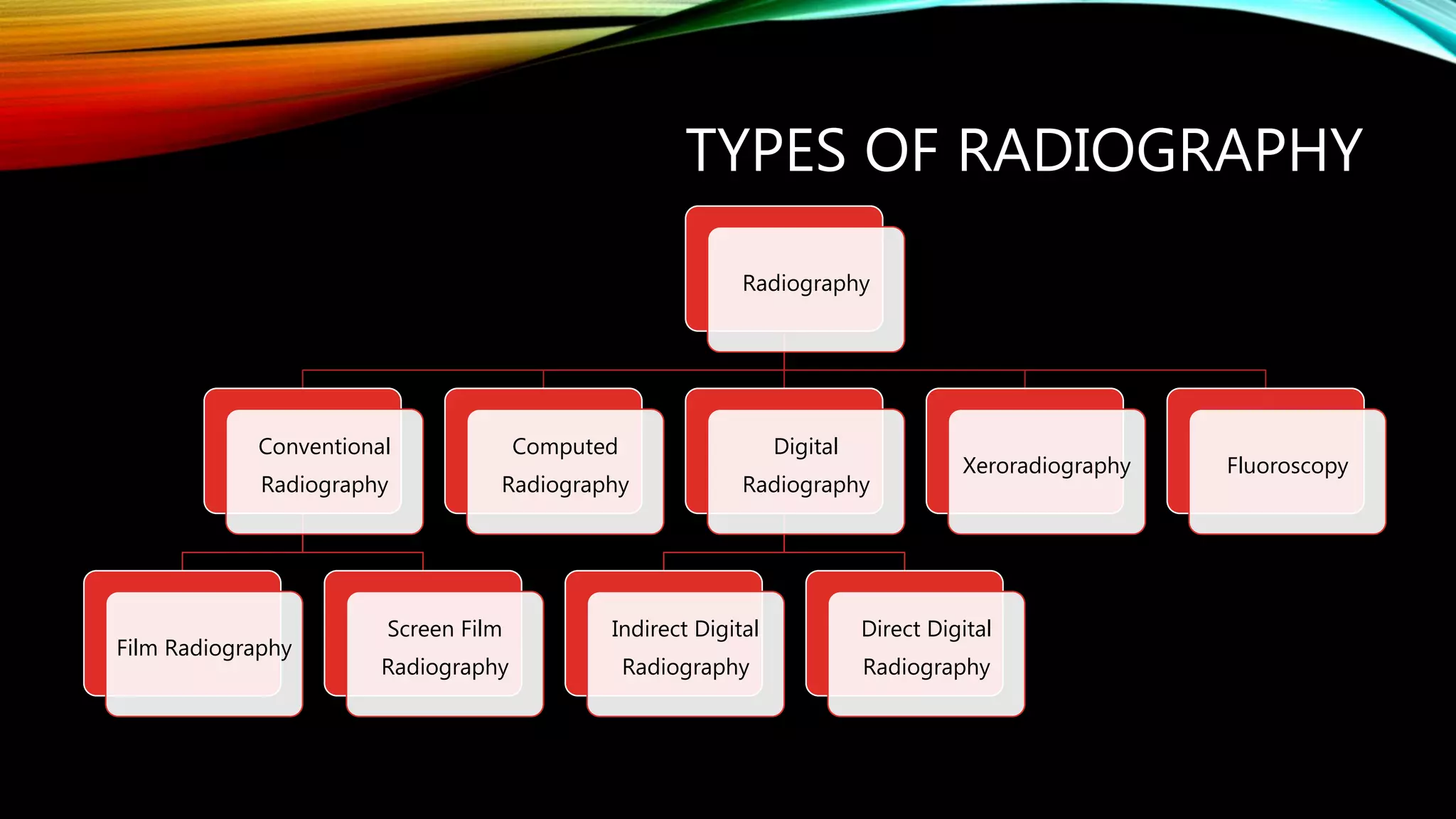
TYPES OF RADIOGRAPHY
Radiography
Conventional
Radiography
Film Radiography
Screen Film
Radiography
Computed
Radiography
Digital
Radiography
Indirect Digital
Radiography
Direct Digital
Radiography
Xeroradiography Fluoroscopy
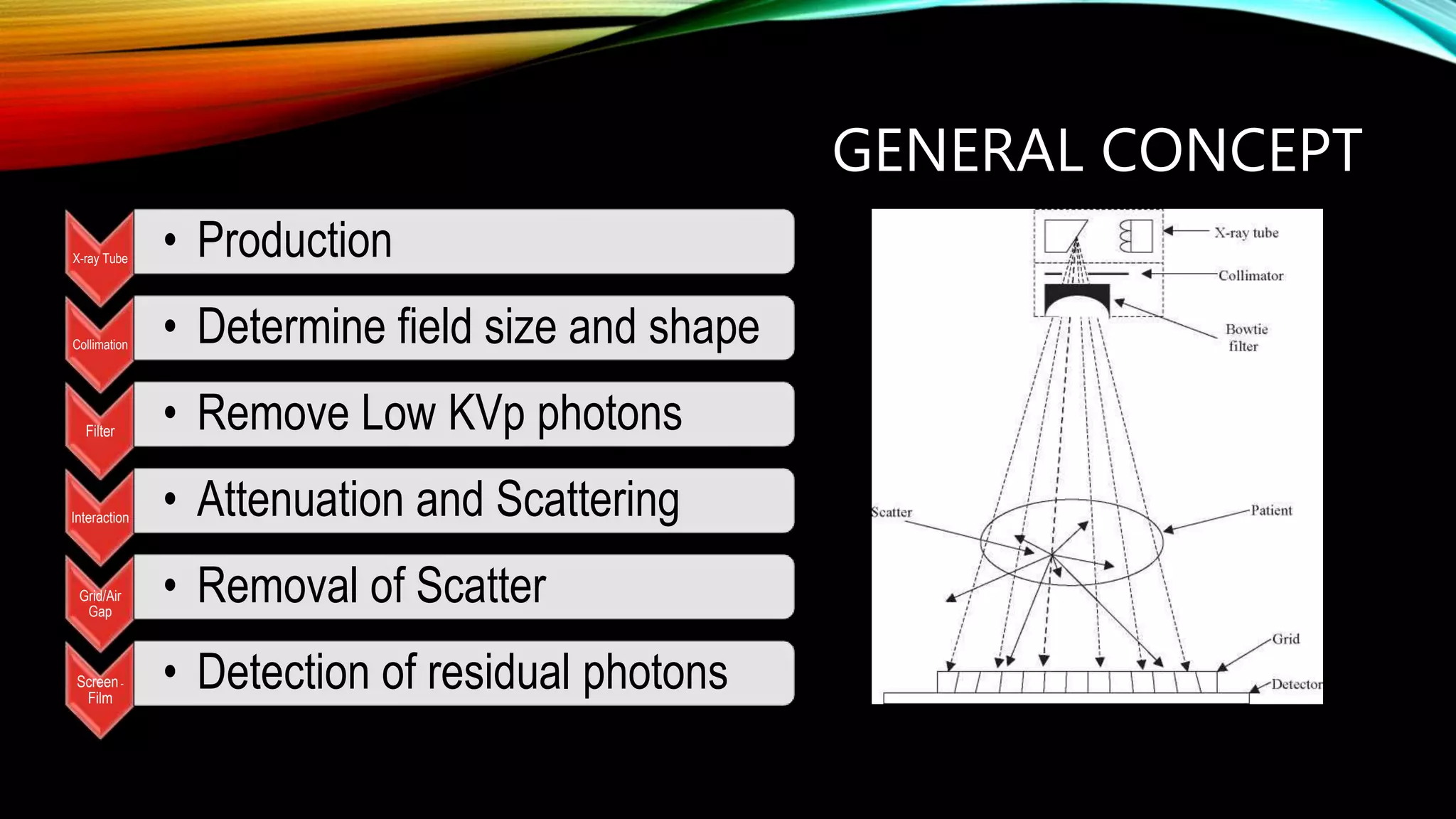
GENERAL CONCEPT
X-ray Tube • Production
Collimation • Determine field size and shape
Filter • Remove Low KVp photons
Interaction • Attenuation and Scattering
Grid/Air
Gap
• Removal of Scatter
Screen-
Film
• Detection of residual photons
WHY INTENSIFICATION
• Low Sensitivity:
• Less than 5% of the incident x-rays interact with
the film to contribute to the latent image.
• Large X-ray Dose avoided
• Duration of exposure reduced: motion blur is
prevented
• The intensifying screens converts the remnant
radiation to light that produces the latent image.
They act as an amplifier of the remnant radiation
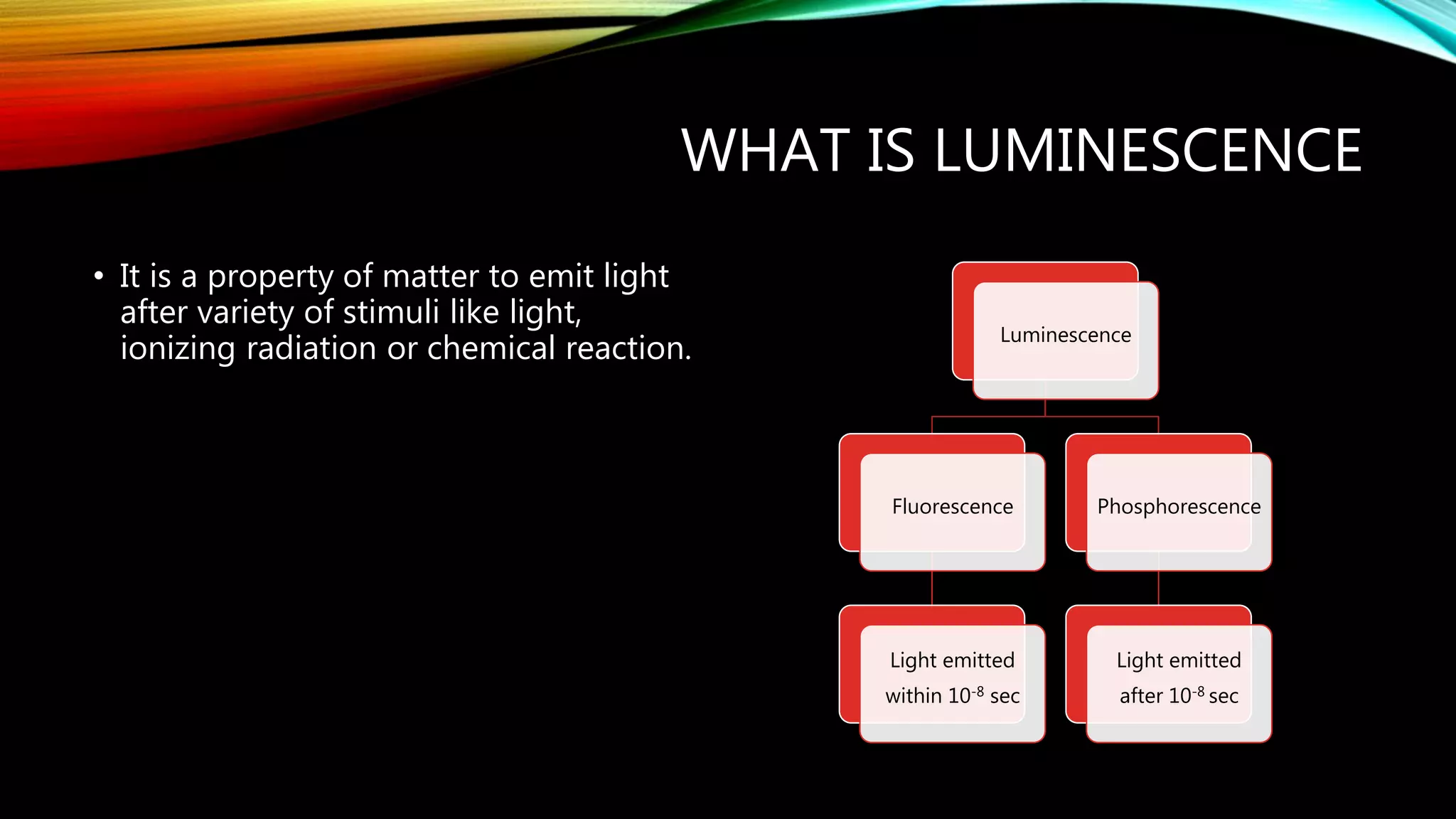
WHAT IS LUMINESCENCE
• It is a property of matter to emit light
after variety of stimuli like light,
ionizing radiation or chemical reaction.
Luminescence
Fluorescence
Light emitted
within 10-8 sec
Phosphorescence
Light emitted
after 10-8 sec
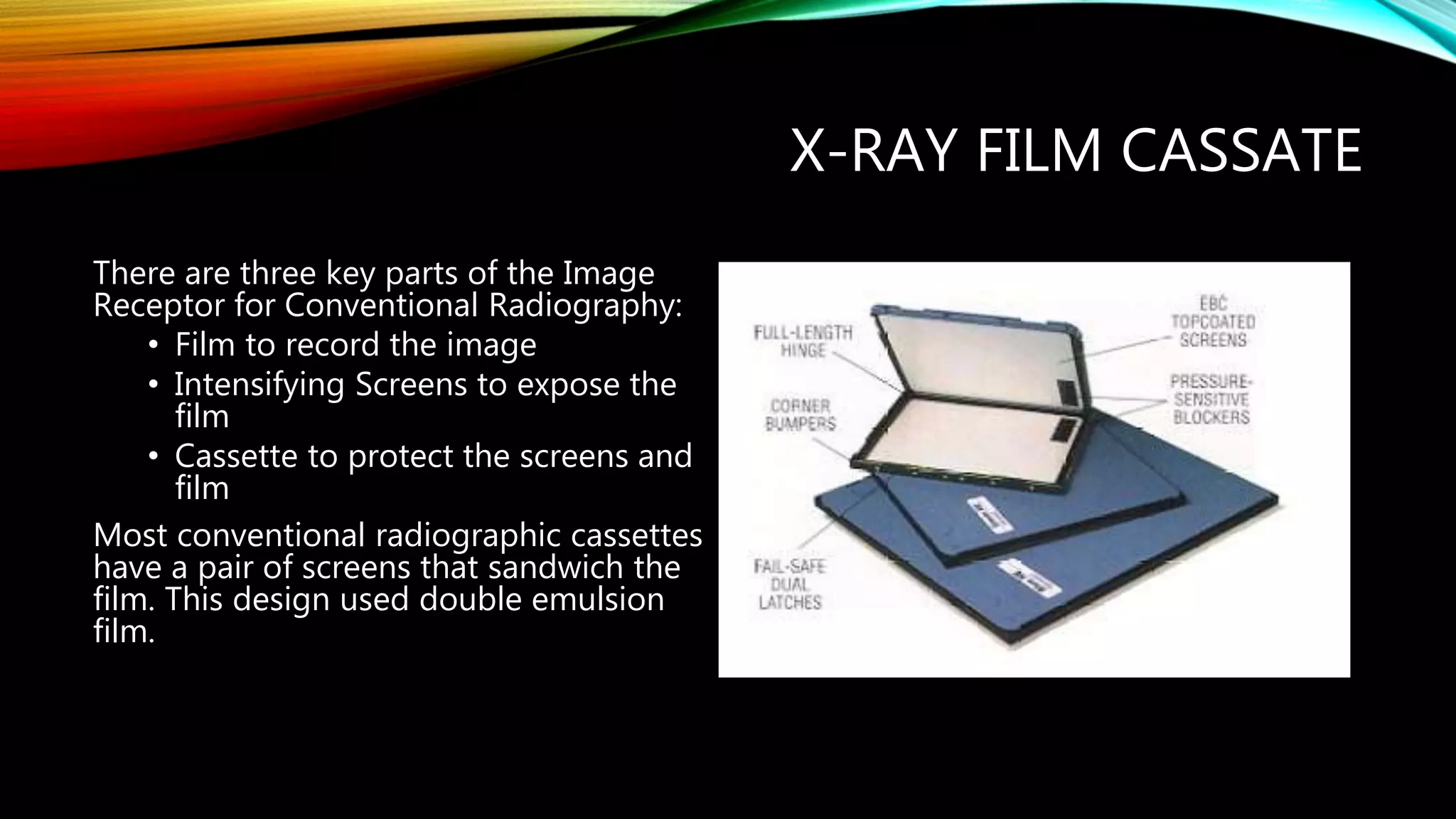
X-RAY FILM CASSATE
There are three key parts of the Image
Receptor for Conventional Radiography:
• Film to record the image
• Intensifying Screens to expose the
film
• Cassette to protect the screens and
film
Most conventional radiographic cassettes
have a pair of screens that sandwich the
film. This design used double emulsion
film.
INTENSIFYING SCREENS
Four Distinct Layers
• Base
• Reflective layer
• Phosphor
• Protective Coating
INTENSIFYING SCREENS
BASE
 The base is the layer farthest from the
film.
 It is usually made of polyester or
cardboard (10mm). The base should
be:
◦ Rugged and moisture resistant
◦ Can not be damaged by radiation or
discoloration
◦ Chemically inert, flexible and free of
impurities.
INTENSIFYING SCREENS
REFLECTIVE LAYER
• Made up of TiO2 (1mm)
• The light from the phosphors is
emitted isotopically.
• Without a reflective layer, only half of
the light would interact with the film.
• The reflective layer redirects the light to
the film.
INTENSIFYING SCREENS
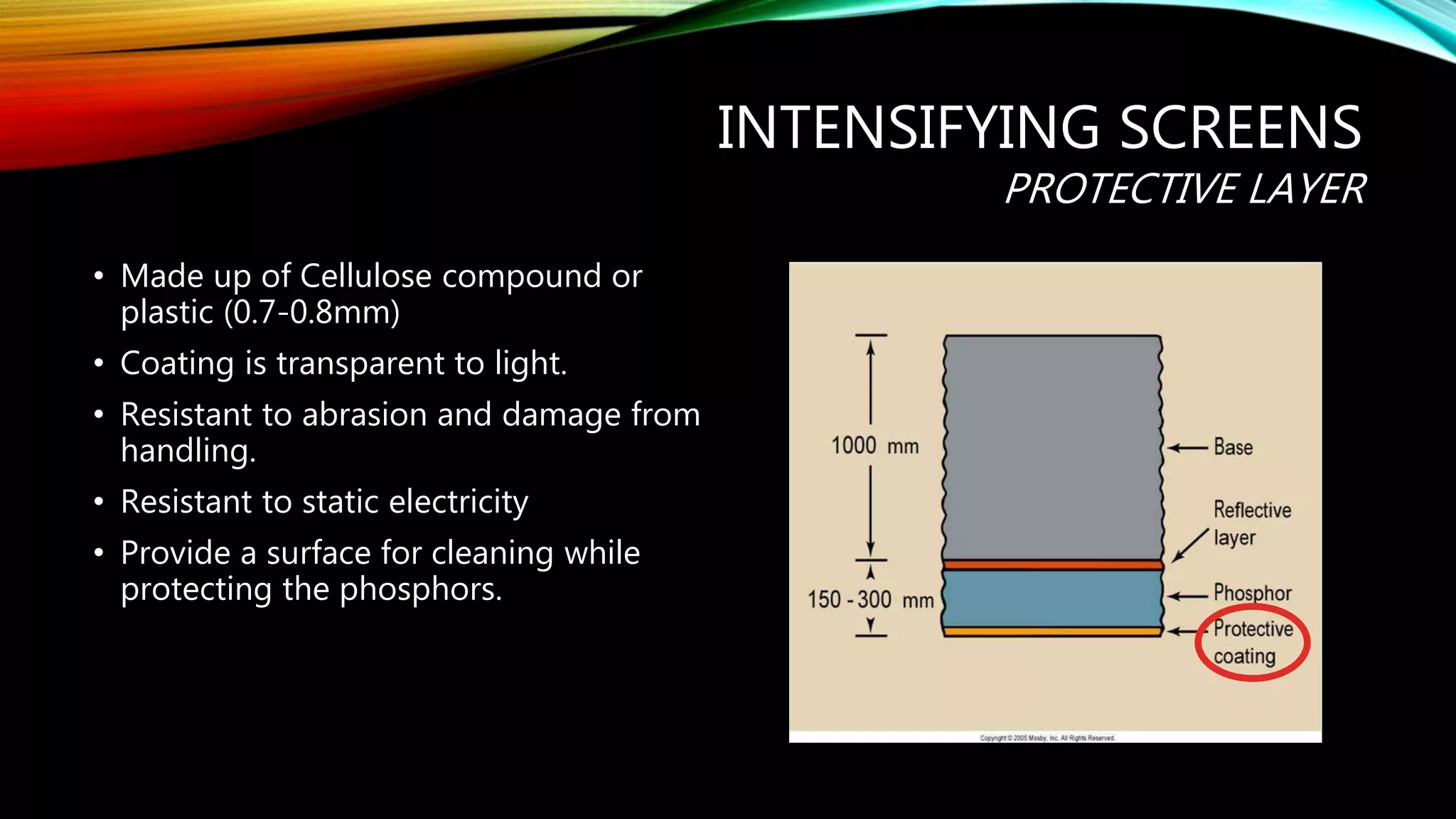
PROTECTIVE LAYER
• Made up of Cellulose compound or
plastic (0.7-0.8mm)
• Coating is transparent to light.
• Resistant to abrasion and damage from
handling.
• Resistant to static electricity
• Provide a surface for cleaning while
protecting the phosphors.
INTENSIFYING SCREENS
PHOSPHOR LAYER
• The active layer of the screen is the
phosphors.
• The phosphors emit light when
stimulated by x-rays.
• Prior to 1970 the most common
phosphor was a crystalline form of
Calcium Tungstate.
• These are crystalline and suspended in
polymer to make it flexible
PHOSPHOR
• Natural Calcium Tungstate (Sheelite)
• Synthetic Calcium Tungstate
• It produce blue light (3500-5800Å)
• Emitted light is sensitive to most of the
radiographic film, but less to eye.
PROPERTIES OF PHOSPHORS
• Quantum Detective Efficiency (QDE) =
(amount of x-ray absorbed /amount of
x-ray exposed)*100%
20-40% for CaWO4
• Intrinsic Conversion efficiency =
(amount of light liberated / amount of
x-ray absorbed)*100%
5% for CaWO4
• Screen efficiency = (amount of light
exposed to film / amount of light
emitted by screen)*100%
50% for CaWO4
PROPERTIES OF PHOSPHORS
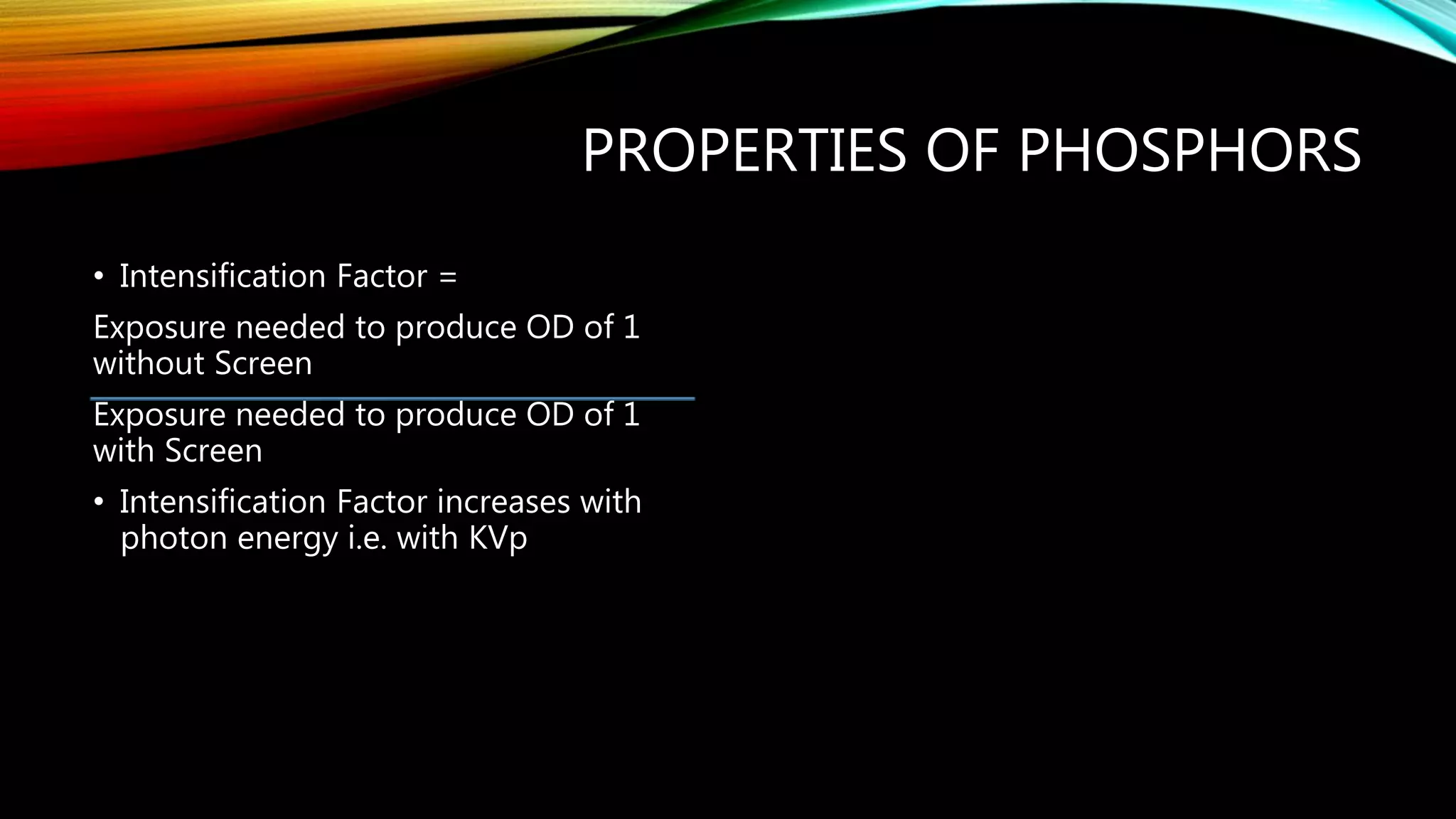
• Intensification Factor =
Exposure needed to produce OD of 1
without Screen
Exposure needed to produce OD of 1
with Screen
• Intensification Factor increases with
photon energy i.e. with KVp
PROPERTIES OF PHOSPHORS
• Phosphor Afterglow should be minimal.
• Phosphor should not be affected by
heat humidity or other environmental
conditions
LETS DO SOME MATHS!
• A 50 KeV (50,000 eV) photon interact with
phosphor, resulting emission of blue light
(wave length, λ = 4300 Å). What would be the
number of emitted photons?
We know, λ = 12.4 / KeV
Or, 4300 = 12.4 / KeV
Or, KeV = 0.003, eV = 3
So each emitted photon have energy of 3 eV
Now the from rule of conservation of energy,
these photons come from original x-ray photon
that interact with phosphor having 100%
intrinsic conversion efficiency
So no. of blue photons emitted is = 50000/3 ≈
17000
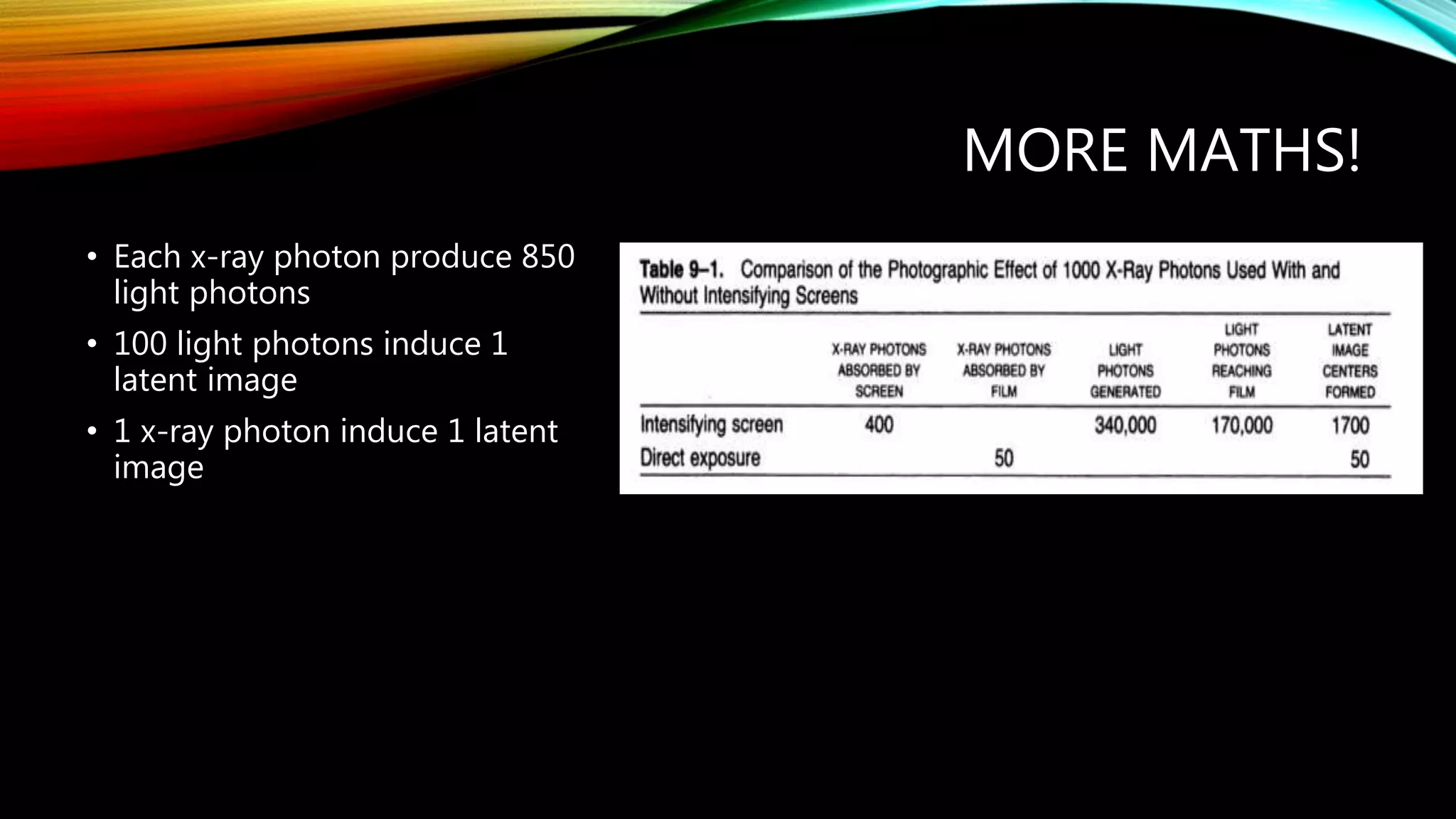
• For CaWO4 intrinsic conversion efficiency is
5%, so 5% of 17000 i.e. 850 photon will be
produced
• And half of 850 photons are able to expose
the film (for CaWO4, screen efficiency is 50%)
MORE MATHS!
• Each x-ray photon produce 850
light photons
• 100 light photons induce 1
latent image
• 1 x-ray photon induce 1 latent
image
SPEED!
Depends upon:
• Thickness of the phosphor Layer
• Concentration of the crystals
• Size of the crystals.
• Intrinsic conversion Efficiency of
phosphor
• QDE
• Presence of absorbing dyes (yellow)
DYE IN INTENSIFYING SCREEN
• Some screens have special dyes that
absorb the light photons coming at a
large angles (scattered light)
• These photons would increase the
image blur.
• Only the photons perpendicular to
the film are emitted. The dye
increases spatial resolution but
reduce speed.
Phosphor
TiO2
Protective Layer
Base
Film
SCREEN FILM CONTACT
• Tight enough in all aspect to reduce
blur
CLEANING
• By detergent and anti-static compound
• Don’t rub vigorously
• Rub with lint free cloth
• Dry after cleaning
NEWER PHOSPHOR
High SPEED due to
• Thick Layer
• Higher Intrinsic conversion Efficiency
• Higher Absorption i.e. high QDE
NEWER PHOSPHOR
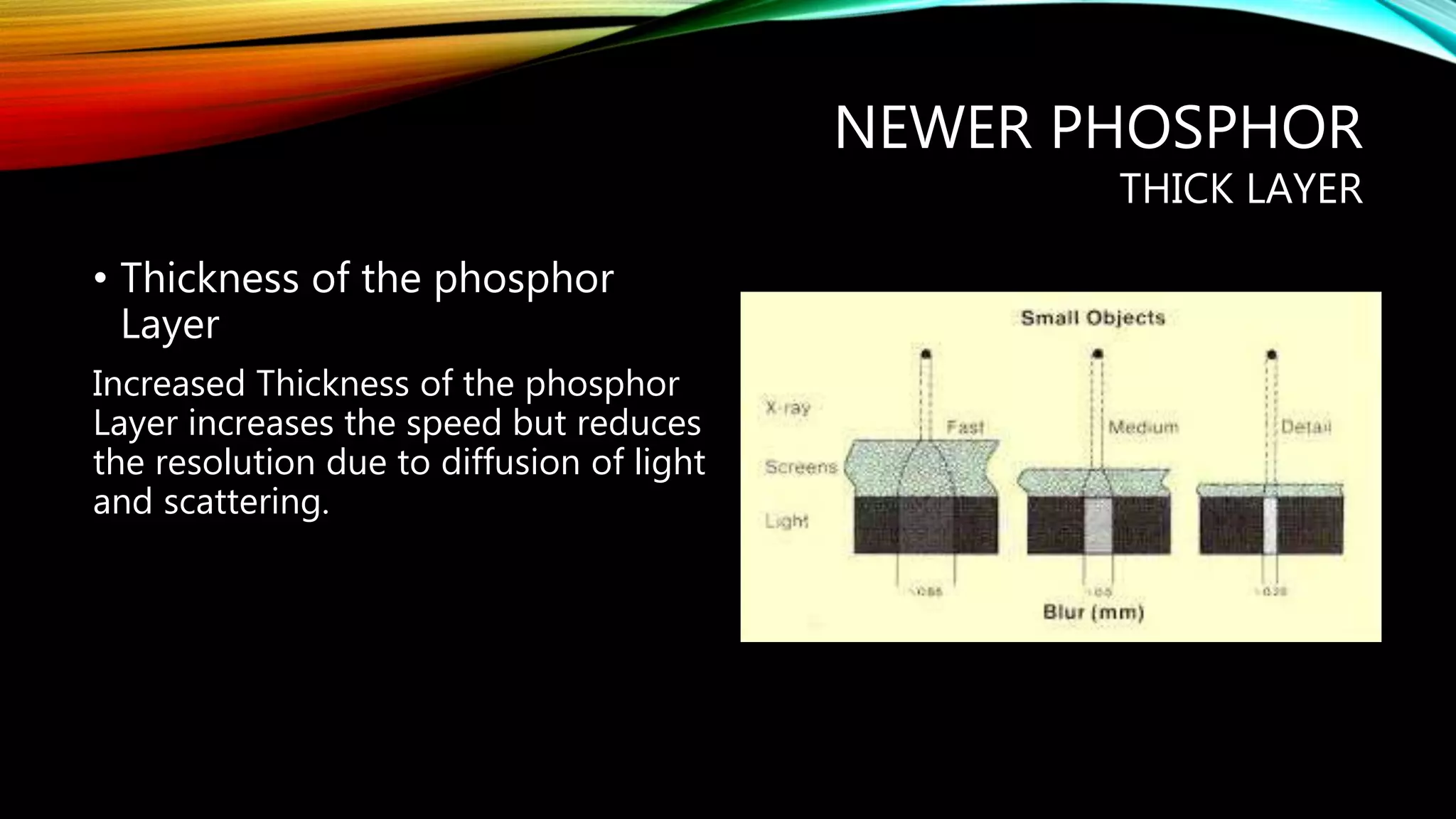
THICK LAYER
• Thickness of the phosphor
Layer
Increased Thickness of the phosphor
Layer increases the speed but reduces
the resolution due to diffusion of light
and scattering.
NEWER PHOSPHOR
HIGHER INTRINSIC CONVERSION EFFICIENCY
• Rare Earth Groups
• Don’t fluoresce in pure state, doping
needed
• Intrinsic conversion Efficiency is 20%
compared to 5% in CaWO4
• 60% in newer phosphor
• High Z = high photo electric effect (in
W)
• Lower K-shell electron binding energy
(in Gd, La, Y)
NEWER PHOSPHOR
HIGHER QDE
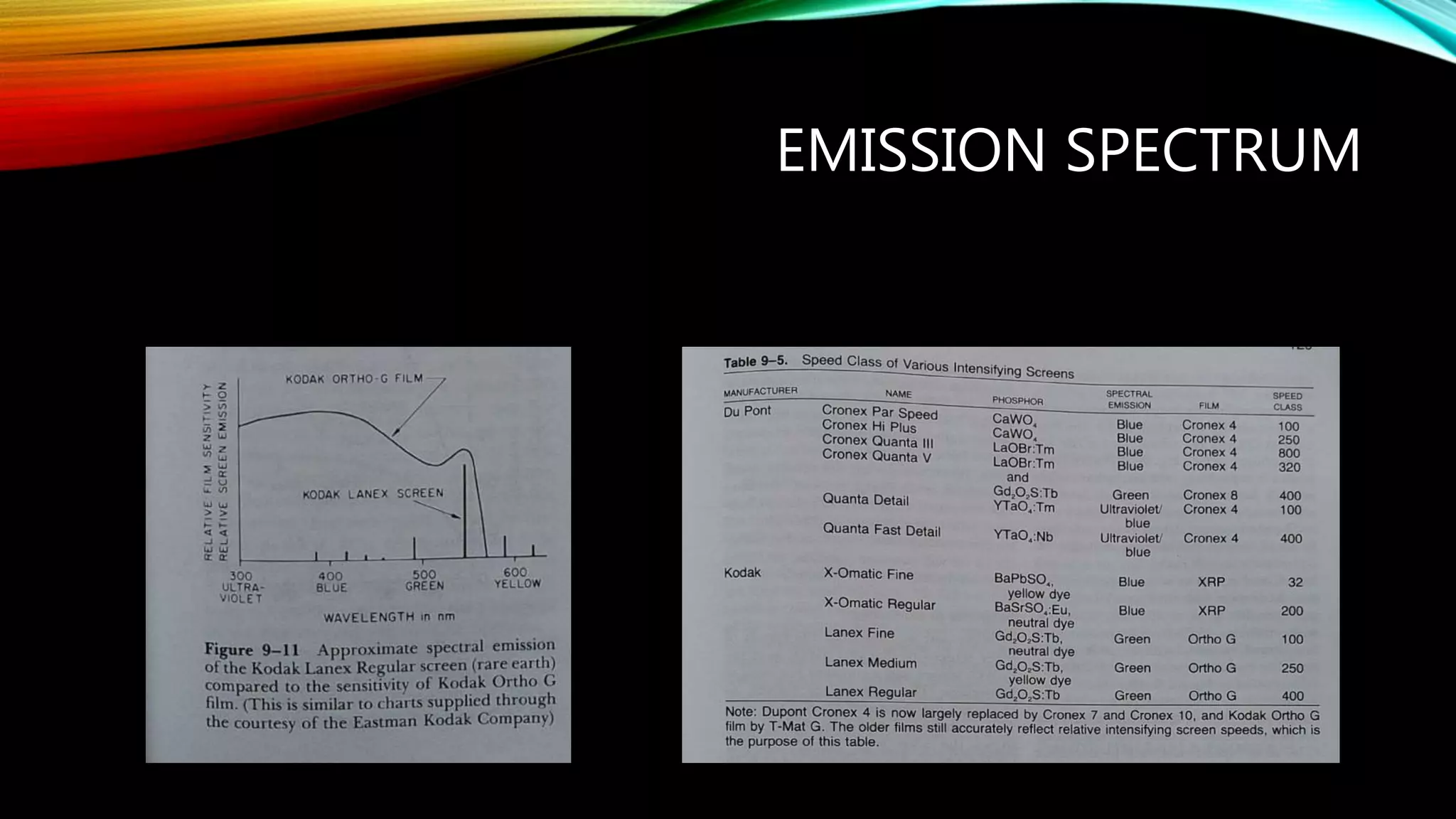
EMISSION SPECTRUM
• Light emitted from screen and
maximum sensitivity must be matched.
EMISSION SPECTRUM
EMISSION SPECTRUM
SPEED AND KVP
Radiographic Intensifying Screen

Radiographic Intensifying Screen

  • 1.
    INTENSIFYING SCREEN Dr.Tarique Ajij JuniorResident, Department of Radio- Diagnosis, Medical College, Kolkata
  • 2.
    TYPES OF RADIOGRAPHY Radiography Conventional Radiography FilmRadiography Screen Film Radiography Computed Radiography Digital Radiography Indirect Digital Radiography Direct Digital Radiography Xeroradiography Fluoroscopy
  • 3.
    GENERAL CONCEPT X-ray Tube• Production Collimation • Determine field size and shape Filter • Remove Low KVp photons Interaction • Attenuation and Scattering Grid/Air Gap • Removal of Scatter Screen- Film • Detection of residual photons
  • 4.
    WHY INTENSIFICATION • LowSensitivity: • Less than 5% of the incident x-rays interact with the film to contribute to the latent image. • Large X-ray Dose avoided • Duration of exposure reduced: motion blur is prevented • The intensifying screens converts the remnant radiation to light that produces the latent image. They act as an amplifier of the remnant radiation
  • 5.
    WHAT IS LUMINESCENCE •It is a property of matter to emit light after variety of stimuli like light, ionizing radiation or chemical reaction. Luminescence Fluorescence Light emitted within 10-8 sec Phosphorescence Light emitted after 10-8 sec
  • 6.
    X-RAY FILM CASSATE Thereare three key parts of the Image Receptor for Conventional Radiography: • Film to record the image • Intensifying Screens to expose the film • Cassette to protect the screens and film Most conventional radiographic cassettes have a pair of screens that sandwich the film. This design used double emulsion film.
  • 7.
    INTENSIFYING SCREENS Four DistinctLayers • Base • Reflective layer • Phosphor • Protective Coating
  • 8.
    INTENSIFYING SCREENS BASE  Thebase is the layer farthest from the film.  It is usually made of polyester or cardboard (10mm). The base should be: ◦ Rugged and moisture resistant ◦ Can not be damaged by radiation or discoloration ◦ Chemically inert, flexible and free of impurities.
  • 9.
    INTENSIFYING SCREENS REFLECTIVE LAYER •Made up of TiO2 (1mm) • The light from the phosphors is emitted isotopically. • Without a reflective layer, only half of the light would interact with the film. • The reflective layer redirects the light to the film.
  • 10.
    INTENSIFYING SCREENS PROTECTIVE LAYER •Made up of Cellulose compound or plastic (0.7-0.8mm) • Coating is transparent to light. • Resistant to abrasion and damage from handling. • Resistant to static electricity • Provide a surface for cleaning while protecting the phosphors.
  • 11.
    INTENSIFYING SCREENS PHOSPHOR LAYER •The active layer of the screen is the phosphors. • The phosphors emit light when stimulated by x-rays. • Prior to 1970 the most common phosphor was a crystalline form of Calcium Tungstate. • These are crystalline and suspended in polymer to make it flexible
  • 12.
    PHOSPHOR • Natural CalciumTungstate (Sheelite) • Synthetic Calcium Tungstate • It produce blue light (3500-5800Å) • Emitted light is sensitive to most of the radiographic film, but less to eye.
  • 13.
    PROPERTIES OF PHOSPHORS •Quantum Detective Efficiency (QDE) = (amount of x-ray absorbed /amount of x-ray exposed)*100% 20-40% for CaWO4 • Intrinsic Conversion efficiency = (amount of light liberated / amount of x-ray absorbed)*100% 5% for CaWO4 • Screen efficiency = (amount of light exposed to film / amount of light emitted by screen)*100% 50% for CaWO4
  • 14.
    PROPERTIES OF PHOSPHORS •Intensification Factor = Exposure needed to produce OD of 1 without Screen Exposure needed to produce OD of 1 with Screen • Intensification Factor increases with photon energy i.e. with KVp
  • 15.
    PROPERTIES OF PHOSPHORS •Phosphor Afterglow should be minimal. • Phosphor should not be affected by heat humidity or other environmental conditions
  • 16.
    LETS DO SOMEMATHS! • A 50 KeV (50,000 eV) photon interact with phosphor, resulting emission of blue light (wave length, λ = 4300 Å). What would be the number of emitted photons? We know, λ = 12.4 / KeV Or, 4300 = 12.4 / KeV Or, KeV = 0.003, eV = 3 So each emitted photon have energy of 3 eV Now the from rule of conservation of energy, these photons come from original x-ray photon that interact with phosphor having 100% intrinsic conversion efficiency So no. of blue photons emitted is = 50000/3 ≈ 17000 • For CaWO4 intrinsic conversion efficiency is 5%, so 5% of 17000 i.e. 850 photon will be produced • And half of 850 photons are able to expose the film (for CaWO4, screen efficiency is 50%)
  • 17.
    MORE MATHS! • Eachx-ray photon produce 850 light photons • 100 light photons induce 1 latent image • 1 x-ray photon induce 1 latent image
  • 18.
    SPEED! Depends upon: • Thicknessof the phosphor Layer • Concentration of the crystals • Size of the crystals. • Intrinsic conversion Efficiency of phosphor • QDE • Presence of absorbing dyes (yellow)
  • 19.
    DYE IN INTENSIFYINGSCREEN • Some screens have special dyes that absorb the light photons coming at a large angles (scattered light) • These photons would increase the image blur. • Only the photons perpendicular to the film are emitted. The dye increases spatial resolution but reduce speed. Phosphor TiO2 Protective Layer Base Film
  • 20.
    SCREEN FILM CONTACT •Tight enough in all aspect to reduce blur
  • 21.
    CLEANING • By detergentand anti-static compound • Don’t rub vigorously • Rub with lint free cloth • Dry after cleaning
  • 22.
    NEWER PHOSPHOR High SPEEDdue to • Thick Layer • Higher Intrinsic conversion Efficiency • Higher Absorption i.e. high QDE
  • 23.
    NEWER PHOSPHOR THICK LAYER •Thickness of the phosphor Layer Increased Thickness of the phosphor Layer increases the speed but reduces the resolution due to diffusion of light and scattering.
  • 24.
    NEWER PHOSPHOR HIGHER INTRINSICCONVERSION EFFICIENCY • Rare Earth Groups • Don’t fluoresce in pure state, doping needed • Intrinsic conversion Efficiency is 20% compared to 5% in CaWO4
  • 25.
    • 60% innewer phosphor • High Z = high photo electric effect (in W) • Lower K-shell electron binding energy (in Gd, La, Y) NEWER PHOSPHOR HIGHER QDE
  • 26.
    EMISSION SPECTRUM • Lightemitted from screen and maximum sensitivity must be matched.
  • 27.
  • 28.
  • 29.

Editor's Notes

  • #15 In case of high KVp photoelectric effect would be high using screen (with high Z). So intensification factor will be more with high KVp. That is utilized in thick body part x-ray such as lumber spine where low energy photons cannot reach, only high energy photons strike screen producing larger intensification.