REJECT FILM 
ANALYSIS 
SUNIL KUMAR SEKSANA, Lecturer 
sunilkrseksana@gmail.com
In Radiology many groups of professionals 
are involved who share their responsibility 
which are clearly defined. Each group has an 
important part in the output of the entire 
process, and their overall roles, as well as 
their specific quality assurance roles, are 
interdependent, requiring close cooperation 
specially in large healthcare delivering 
system where Each staff member must have 
qualifications (education, training and 
experience) appropriate to his or her role 
and responsibility.
Film Analysis????????? 
Film/Image analysis’ is the regulatory 
process through which the actual 
quality performance is measured, 
compared with existing standards, 
and the actions necessary to keep or 
regain conformance with the 
standards.
Reject Film Analysis???????? 
Reject Film analysis is all those 
planned and systematic actions 
necessary to provide adequate 
confidence that a product or service 
will satisfy the given requirements 
for quality of Image or Radiograph. 
It is a well-established indicator of 
quality control in radiology 
department.
World Health Organization (WHO) has 
recommended a permissible reject rate 
of 5%. 
Conference of Radiographic Control 
Programme Directorate (CRCPD’S) 
committee on Quality Assurance (QA) 
recommend a higher reject rate of 10%.
X-rays, one of the important diagnostic 
modalities being used worldwide in the 
healthcare services despite being 
associated with some radiation exposure 
to the patients. So the analysis of results 
become important for the safe, fast and 
error free delivering of services to the 
patients.
The practice of radiographic imaging has 
undergone several changes with 
evolution of Digital Technology but 
traditional conventional film-screen 
radiography systems provide good image 
quality, high spatial resolution, generally 
low costs and off course living style 
which is particularly an important factor 
in health care delivery services in 
developing countries like India.
A number of films are discarded for 
one reason or another???????
OBJECTIVE OF REJECT FILM ANALYSIS 
Minimize Patient exposure. 
 Cost Reduction. 
High throughput. 
Better image quality. 
Identify the main errors and put measures 
to reduce them. 
Support claims for more funding to replace, 
modify or repair faulty equipment. 
Rejected film may be informative for 
teaching purposes.
Minimize Patient exposure 
Medical x-ray exposures are the largest man-made 
source of ionizing radiation. Recent 
developments in medical imaging have led to 
rapid increases in a number of high dose x-ray 
examinations performed with significant 
consequences in individual patient doses and 
the collective dose of the population as a 
whole.
• The International Commission on 
Radiological Protection (ICRP) 
recommends that such medical exposure 
should be kept as low as reasonably 
achievable (ALARA principle). 
• One way of achieving this is through a 
quality assurance program, which 
includes reject film analysis. 
• As it reduces the number of repeat x-ray.
COST REDUCTION 
Control on repeat X-ray will reduce 
the cost of X-ray film, Chemicals, 
electricity and other cost.
High throughput 
Control on repeat X-ray will reduce 
the waiting of patient.
Better image quality 
Reject film analysis helps to identify the 
reason of reject film and helps in to 
enhance the image quality of the 
patients.
Support claims for more funding to replace, 
modify or repair faulty equipment. 
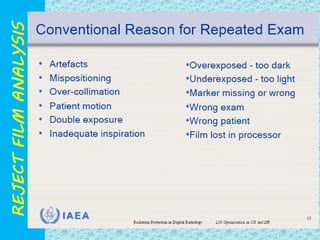
In conventional radiography 
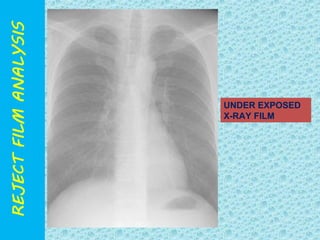
underexposure was the most frequent 
factor responsible for the retake X-rays as 
compared to the other factors. 
The differ image quality in conventional 
radiographs due to the process of 
developing the X-ray films is eliminated 
with the use of digital radiography.
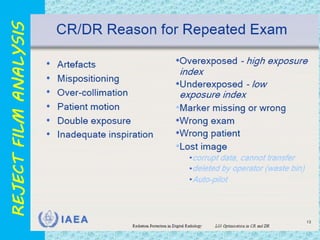
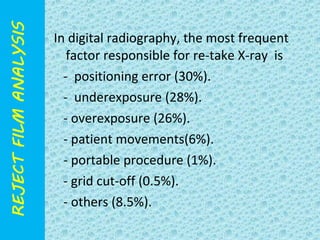
In digital radiography, the most frequent 
factor responsible for re-take X-ray is 
- positioning error (30%). 
- underexposure (28%). 
- overexposure (26%). 
- patient movements(6%). 
- portable procedure (1%). 
- grid cut-off (0.5%). 
- others (8.5%).
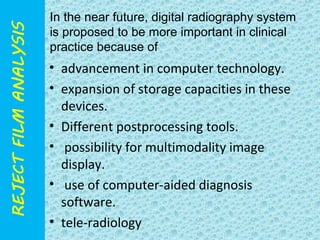
In the near future, digital radiography system 
is proposed to be more important in clinical 
practice because of 
• advancement in computer technology. 
• expansion of storage capacities in these 
devices. 
• Different postprocessing tools. 
• possibility for multimodality image 
display. 
• use of computer-aided diagnosis 
software. 
• tele-radiology
Rejected film may be informative for 
teaching purposes. 
Eyes See what the 
mind knows
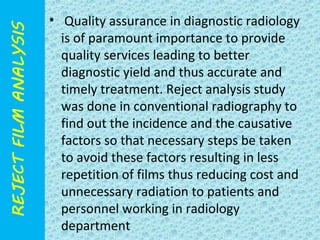
• Quality assurance in diagnostic radiology 
is of paramount importance to provide 
quality services leading to better 
diagnostic yield and thus accurate and 
timely treatment. Reject analysis study 
was done in conventional radiography to 
find out the incidence and the causative 
factors so that necessary steps be taken 
to avoid these factors resulting in less 
repetition of films thus reducing cost and 
unnecessary radiation to patients and 
personnel working in radiology 
department
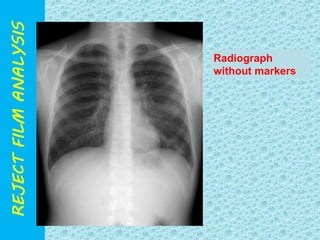
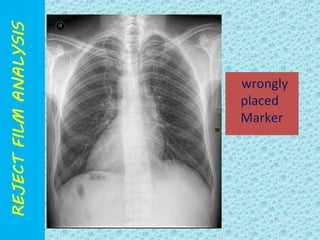
Its Radiographer’s responsibility to use proper 
Markers which ensure the viewer about 
1. The side(Left or Right) of the patient has 
examined. 
2. Identity of the patient. 
3. Time interval (For contrast Study like BMFT, IVP) 
4. Identifying the operators. 
Note:- The first two must be present on the 
radiograph when we are taking radiograph on 
conventional x-ray film or with the help of 
computed Radiography System.
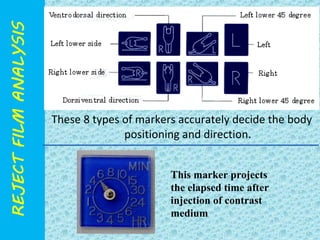
These 8 types of markers accurately decide the body 
positioning and direction. 
This marker projects 
the elapsed time after 
injection of contrast 
medium
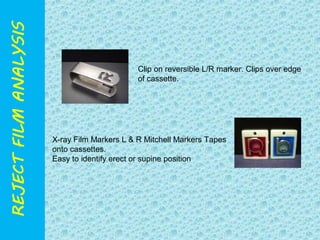
Clip on reversible L/R marker. Clips over edge 
of cassette. 
X-ray Film Markers L & R Mitchell Markers Tapes 
onto cassettes. 
Easy to identify erect or supine position
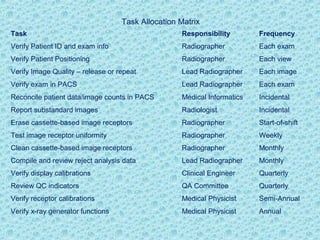
Task Allocation Matrix 
Task Responsibility Frequency 
Verify Patient ID and exam info Radiographer Each exam 
Verify Patient Positioning Radiographer Each view 
Verify Image Quality – release or repeat Lead Radiographer Each image 
Verify exam in PACS Lead Radiographer Each exam 
Reconcile patient data/image counts in PACS Medical Informatics Incidental 
Report substandard images Radiologist Incidental 
Erase cassette-based image receptors Radiographer Start-of-shift 
Test image receptor uniformity Radiographer Weekly 
Clean cassette-based image receptors Radiographer Monthly 
Compile and review reject analysis data Lead Radiographer Monthly 
Verify display calibrations Clinical Engineer Quarterly 
Review QC indicators QA Committee Quarterly 
Verify receptor calibrations Medical Physicist Semi-Annual 
Verify x-ray generator functions Medical Physicist Annual
Artifacts in Digital Radiography 
28 
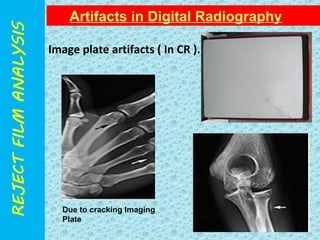
Image plate artifacts ( In CR ). 
Due to cracking Imaging 
Plate
Radiograph 
without markers
wrongly 
placed 
Marker
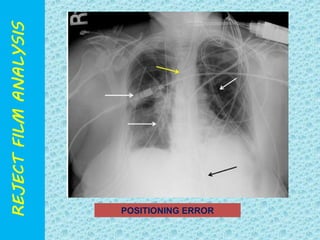
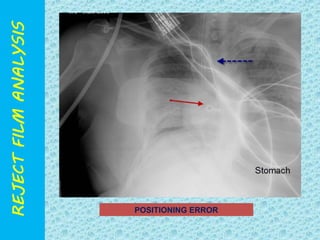
POSITIONING ERROR
POSITIONING ERROR
UNDER EXPOSED 
X-RAY FILM
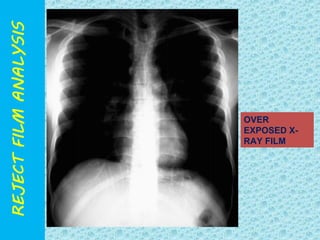
OVER 
EXPOSED X-RAY 
FILM
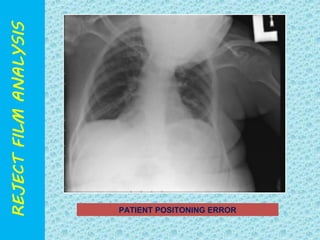
PATIENT POSITONING ERROR
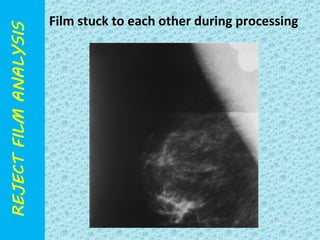
Film stuck to each other during processing
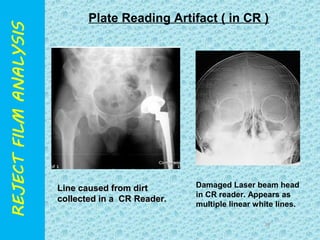
Plate Reading Artifact ( in CR ) 
38 
LLiinnee ccaauusseedd ffrroomm ddiirrtt 
ccoolllleecctteedd iinn aa CCRR RReeaaddeerr. 
Damaged Laser beam head 
in CR reader. Appears as 
multiple linear white lines.
39 
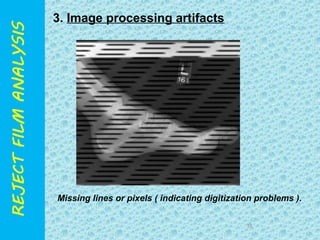
3. Image processing artifacts 
Missing lines or pixels ( indicating digitization problems ).
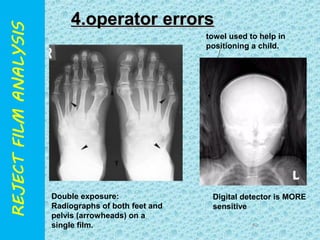
towel used to help in 
positioning a child. 
40 
44..oo pp ee rr aa tt o orr eerrrroorrss 
Digital detector is MORE 
sensitive 
Double exposure: 
Radiographs of both feet and 
pelvis (arrowheads) on a 
single film.
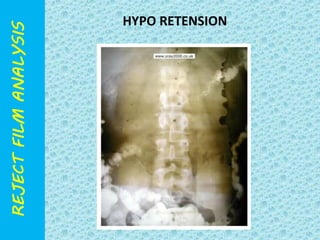
HYPO RETENSION
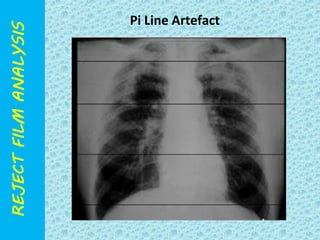
Pi Line Artefact
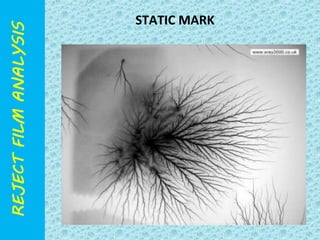
STATIC MARK
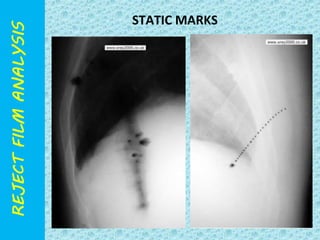
STATIC MARKS
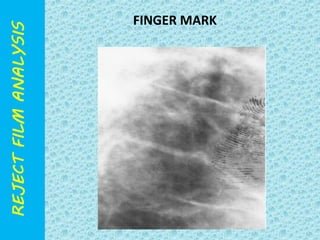
FINGER MARK
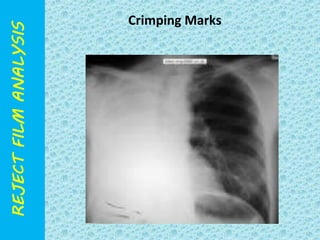
Crimping Marks
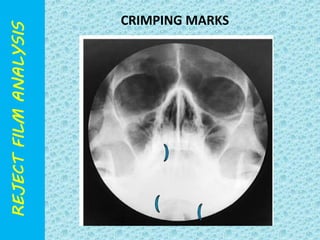
CRIMPING MARKS
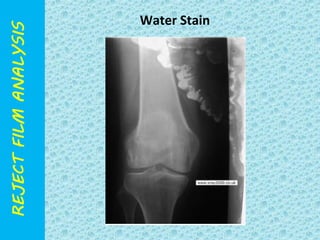
Water Stain
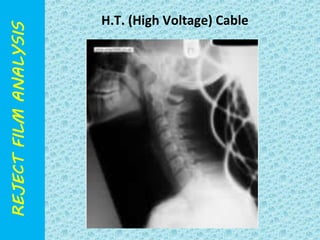
H.T. (High Voltage) Cable
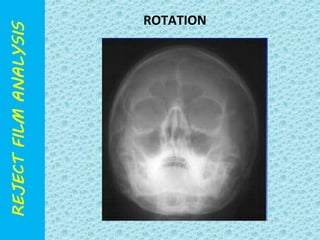
ROTATION
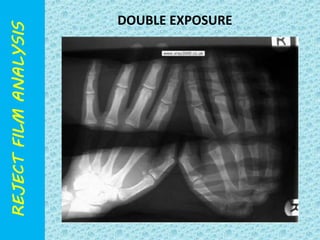
DOUBLE EXPOSURE
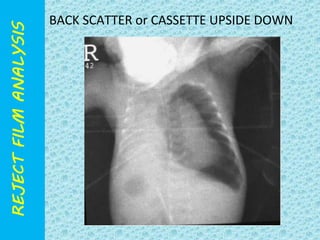
BACK SCATTER or CASSETTE UPSIDE DOWN
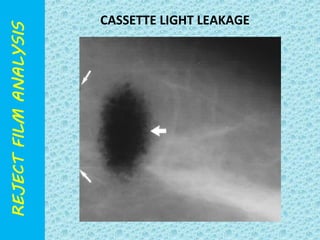
CASSETTE LIGHT LEAKAGE
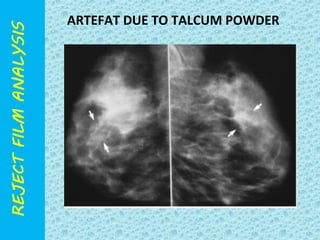
ARTEFAT DUE TO TALCUM POWDER
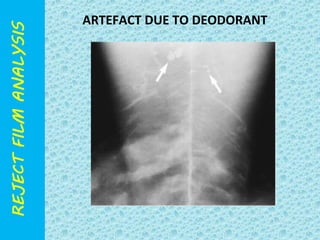
ARTEFACT DUE TO DEODORANT
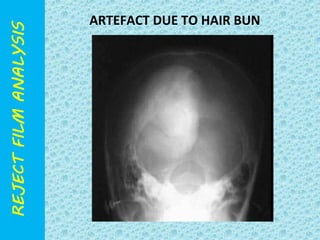
ARTEFACT DUE TO HAIR BUN
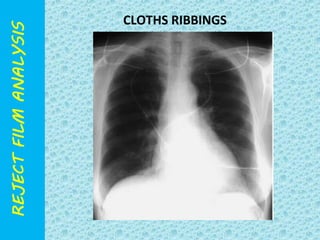
CLOTHS RIBBINGS
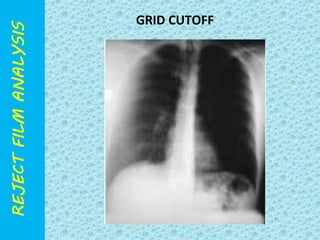
GRID CUTOFF
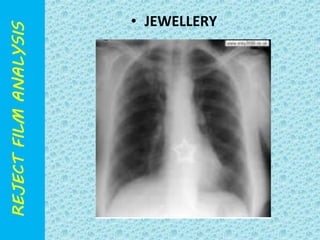
• JEWELLERY
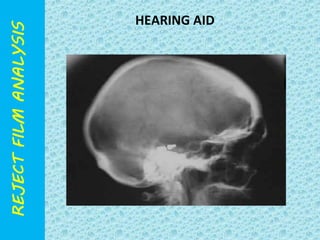
HEARING AID
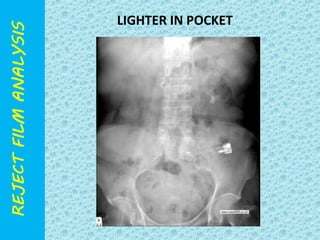
LIGHTER IN POCKET
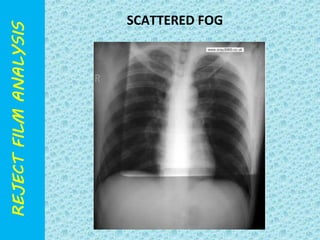
SCATTERED FOG
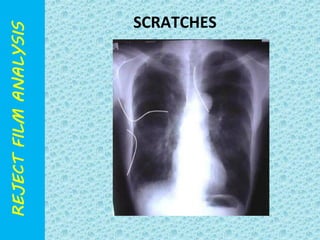
SCRATCHES
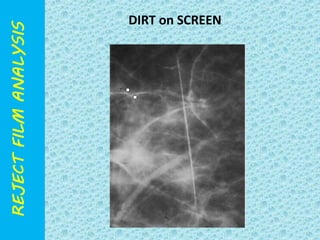
DIRT on SCREEN
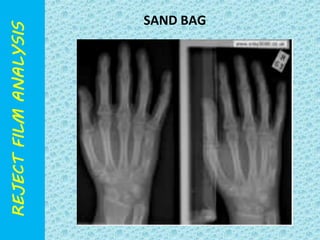
SAND BAG
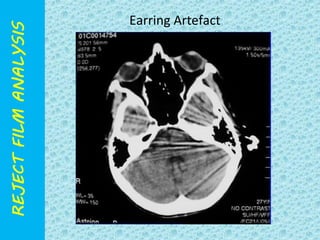
Earring Artefact
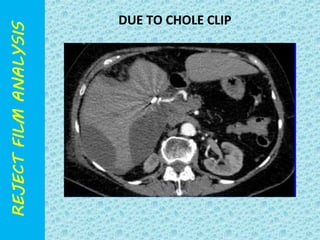
DUE TO CHOLE CLIP
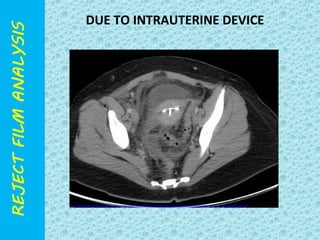
DUE TO INTRAUTERINE DEVICE
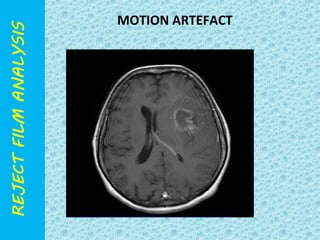
MOTION ARTEFACT
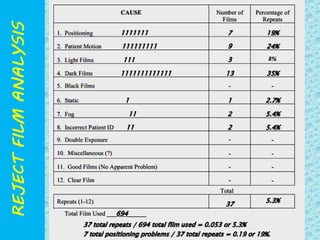
Corrective Action 
The percentage of repeats should guide the 
facility to focus their efforts to those areas 
needing the most attention. For example, 
films that are too light or too dark may be 
due to processing problems, equipment 
problems that require repair or calibration, 
or technique charts may need updating.
Reject film Analysis

Reject film Analysis

  • 1.
    REJECT FILM ANALYSIS SUNIL KUMAR SEKSANA, Lecturer sunilkrseksana@gmail.com
  • 2.
    In Radiology manygroups of professionals are involved who share their responsibility which are clearly defined. Each group has an important part in the output of the entire process, and their overall roles, as well as their specific quality assurance roles, are interdependent, requiring close cooperation specially in large healthcare delivering system where Each staff member must have qualifications (education, training and experience) appropriate to his or her role and responsibility.
  • 3.
    Film Analysis????????? Film/Imageanalysis’ is the regulatory process through which the actual quality performance is measured, compared with existing standards, and the actions necessary to keep or regain conformance with the standards.
  • 4.
    Reject Film Analysis???????? Reject Film analysis is all those planned and systematic actions necessary to provide adequate confidence that a product or service will satisfy the given requirements for quality of Image or Radiograph. It is a well-established indicator of quality control in radiology department.
  • 5.
    World Health Organization(WHO) has recommended a permissible reject rate of 5%. Conference of Radiographic Control Programme Directorate (CRCPD’S) committee on Quality Assurance (QA) recommend a higher reject rate of 10%.
  • 6.
    X-rays, one ofthe important diagnostic modalities being used worldwide in the healthcare services despite being associated with some radiation exposure to the patients. So the analysis of results become important for the safe, fast and error free delivering of services to the patients.
  • 7.
    The practice ofradiographic imaging has undergone several changes with evolution of Digital Technology but traditional conventional film-screen radiography systems provide good image quality, high spatial resolution, generally low costs and off course living style which is particularly an important factor in health care delivery services in developing countries like India.
  • 8.
    A number offilms are discarded for one reason or another???????
  • 9.
    OBJECTIVE OF REJECTFILM ANALYSIS Minimize Patient exposure.  Cost Reduction. High throughput. Better image quality. Identify the main errors and put measures to reduce them. Support claims for more funding to replace, modify or repair faulty equipment. Rejected film may be informative for teaching purposes.
  • 10.
    Minimize Patient exposure Medical x-ray exposures are the largest man-made source of ionizing radiation. Recent developments in medical imaging have led to rapid increases in a number of high dose x-ray examinations performed with significant consequences in individual patient doses and the collective dose of the population as a whole.
  • 12.
    • The InternationalCommission on Radiological Protection (ICRP) recommends that such medical exposure should be kept as low as reasonably achievable (ALARA principle). • One way of achieving this is through a quality assurance program, which includes reject film analysis. • As it reduces the number of repeat x-ray.
  • 13.
    COST REDUCTION Controlon repeat X-ray will reduce the cost of X-ray film, Chemicals, electricity and other cost.
  • 14.
    High throughput Controlon repeat X-ray will reduce the waiting of patient.
  • 15.
    Better image quality Reject film analysis helps to identify the reason of reject film and helps in to enhance the image quality of the patients.
  • 16.
    Support claims formore funding to replace, modify or repair faulty equipment. In conventional radiography underexposure was the most frequent factor responsible for the retake X-rays as compared to the other factors. The differ image quality in conventional radiographs due to the process of developing the X-ray films is eliminated with the use of digital radiography.
  • 19.
    In digital radiography,the most frequent factor responsible for re-take X-ray is - positioning error (30%). - underexposure (28%). - overexposure (26%). - patient movements(6%). - portable procedure (1%). - grid cut-off (0.5%). - others (8.5%).
  • 20.
    In the nearfuture, digital radiography system is proposed to be more important in clinical practice because of • advancement in computer technology. • expansion of storage capacities in these devices. • Different postprocessing tools. • possibility for multimodality image display. • use of computer-aided diagnosis software. • tele-radiology
  • 21.
    Rejected film maybe informative for teaching purposes. Eyes See what the mind knows
  • 22.
    • Quality assurancein diagnostic radiology is of paramount importance to provide quality services leading to better diagnostic yield and thus accurate and timely treatment. Reject analysis study was done in conventional radiography to find out the incidence and the causative factors so that necessary steps be taken to avoid these factors resulting in less repetition of films thus reducing cost and unnecessary radiation to patients and personnel working in radiology department
  • 24.
    Its Radiographer’s responsibilityto use proper Markers which ensure the viewer about 1. The side(Left or Right) of the patient has examined. 2. Identity of the patient. 3. Time interval (For contrast Study like BMFT, IVP) 4. Identifying the operators. Note:- The first two must be present on the radiograph when we are taking radiograph on conventional x-ray film or with the help of computed Radiography System.
  • 25.
    These 8 typesof markers accurately decide the body positioning and direction. This marker projects the elapsed time after injection of contrast medium
  • 26.
    Clip on reversibleL/R marker. Clips over edge of cassette. X-ray Film Markers L & R Mitchell Markers Tapes onto cassettes. Easy to identify erect or supine position
  • 27.
    Task Allocation Matrix Task Responsibility Frequency Verify Patient ID and exam info Radiographer Each exam Verify Patient Positioning Radiographer Each view Verify Image Quality – release or repeat Lead Radiographer Each image Verify exam in PACS Lead Radiographer Each exam Reconcile patient data/image counts in PACS Medical Informatics Incidental Report substandard images Radiologist Incidental Erase cassette-based image receptors Radiographer Start-of-shift Test image receptor uniformity Radiographer Weekly Clean cassette-based image receptors Radiographer Monthly Compile and review reject analysis data Lead Radiographer Monthly Verify display calibrations Clinical Engineer Quarterly Review QC indicators QA Committee Quarterly Verify receptor calibrations Medical Physicist Semi-Annual Verify x-ray generator functions Medical Physicist Annual
  • 28.
    Artifacts in DigitalRadiography 28 Image plate artifacts ( In CR ). Due to cracking Imaging Plate
  • 29.
  • 30.
  • 32.
  • 33.
  • 34.
  • 35.
  • 36.
  • 37.
    Film stuck toeach other during processing
  • 38.
    Plate Reading Artifact( in CR ) 38 LLiinnee ccaauusseedd ffrroomm ddiirrtt ccoolllleecctteedd iinn aa CCRR RReeaaddeerr. Damaged Laser beam head in CR reader. Appears as multiple linear white lines.
  • 39.
    39 3. Imageprocessing artifacts Missing lines or pixels ( indicating digitization problems ).
  • 40.
    towel used tohelp in positioning a child. 40 44..oo pp ee rr aa tt o orr eerrrroorrss Digital detector is MORE sensitive Double exposure: Radiographs of both feet and pelvis (arrowheads) on a single film.
  • 41.
  • 42.
  • 44.
  • 45.
  • 46.
  • 47.
  • 48.
  • 49.
  • 51.
  • 52.
  • 53.
  • 54.
    BACK SCATTER orCASSETTE UPSIDE DOWN
  • 55.
  • 56.
    ARTEFAT DUE TOTALCUM POWDER
  • 57.
    ARTEFACT DUE TODEODORANT
  • 58.
  • 59.
  • 60.
  • 61.
  • 62.
  • 63.
  • 64.
  • 65.
  • 66.
  • 67.
  • 68.
  • 69.
  • 70.
  • 71.
  • 72.
    Corrective Action Thepercentage of repeats should guide the facility to focus their efforts to those areas needing the most attention. For example, films that are too light or too dark may be due to processing problems, equipment problems that require repair or calibration, or technique charts may need updating.