

Is noticeable differences
exhibited when items are
compared or set side by
side.

An example of the radiographic
property of contrast
Radiographic contrast
The difference in densities between light and dark
regions on the radiograph

The radiographic contrast of an image is the result of the
interplay of subject contrast, film contrast, and scattered
radiation








Radiographic contrast : the differences in
densities .
Such densities variations are called
radiographic contrast.
A radiograph that has marked differences in
densities is a high contrast radiograph.
A radiograph that has less differences in
densities is the a low contrast radiograph.





Is product of two separate factors:
(1) Film contrast, is inherent in the film and is
influenced somewhat by processing of the film.
(2) Subject contrast, is determined by the
size ,shape, and x-ray attenuating
characteristics of the subject being examined
and the energy (kvp) of the x-ray.
Patient factors
1. Tissue thickness (age, sex, pathologic change).
2. Tissue opacity (cellular composition, tissue
structure status of organ empty or filled.
3. Tissue densities (gas, fat, muscle, bone)

I.
II.
III.

The difference between two adjacent densities
Film displays high or low contrast characteristics
Contrast controls slope of characteristic curve
Optical
Density

Lower
Contrast

log relative exposure

Higher
Contrast

Optical
Density

log relative exposure


Film latitude refers to
the range of exposure
values that will produce
density in accepted
diagnostic range (0.4 2.75).
Film Contrast
Film processing: incomplete
or excessive development;
improper storage; light leaks
Film fog: contrast is reduced.
Improper film processing and
storage.
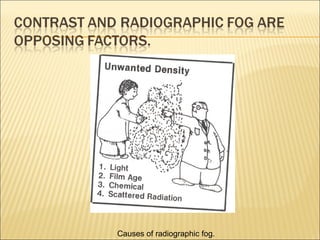
Scattered radiation
Photons that travel in directions other
than that of the primary beam – fogging
of the radiograph




Film with short latitude (high contrast) .Used in
examination of an area of the body with poor
subject contrast, in order to demonstrate
higher radiographic contrast within the
structures being examined.
Film with wide latitude (low contrast). Used in
examination of an area of the body with high
subject contrast, in order to demonstrate
adequate numbers of densities within recorded
image.
The useful densities recorded on the film are visible for
comparison as ratio of densities.
 The number of useful densities visible on film and the
percentage of difference between them .
 Low contrast : (long scale)
the ratio of differences from one adjacent density to an
other is slight (the total number of useful densities would
be maximal).
 High contrast : (short scale)
the ratio of differences between densities are considerable
(minimal number of densities ).



(1) Kvp/ mAs relationship.

High contrast: high mAs +low kvp
Low contrast: low mAs +high kvp


(2) Fog levels.



(3) Intensifying screen.


CONTROLLING FACTORS?



INFLUENCING FACTORS?
Contrast sources
Subject
Signal
Exposure energy (kvp)
Receptor (Film)
Processing (development)
Causes of radiographic fog.





Type and constitution of developer.
Temperature of developer.
Freshness of developer.
Agitation of the film in the developer.



1- Kvp :to penetrate
2-mAs :to maintain
density.
Kvp :to penetrate

75 kvp

79 kvp

79 kvp
mAs :to maintain density.
1.
2.
3.
4.
5.
6.
7.
8.
9.
10.

Small extremities
Large extremities
Skull
Sinuses
Abdomen, pelvis and posterior spine
Lateral vertebrae
GI tract
Chest
Chest lateral
Chest oblique

60
80
85
70
75
85
90
80
90
85
High and low mAs effect..

Density is determined principally by mAs
As shown by these radiographs of
abdomen taken at 70 kvp. A,10mAs.
B, plus 25 %, 12.5 mAs C, plus 50 %,
15 mAs.








Scatter radiation negatively affect contrast.
Scatter radiation fog the film(making it Gary)
and reduces the contrast.
The more scatter there is the lower the contrast
You can reduce the amount of scatter radiation
by lowing kvp.
Kvp has to be high enough to penetrate. the
part .
Reduce formation of scatter;
1. Used of compression.
2. Beam Restriction devices.
3. Used of low kvp.
 Prevent scatter to reach the film;
1. Air gab technique.
2. Used of lead blocker
3. used of x-ray grids.

A. Tissue
1. Volume.
2. Thickness.
3. Opacity.
 B. object-film distance

When tissue compressed, scatter radiation
is reduced resulting in lower dose and
improve image contrast (reduced fog)
Beam Restriction devices
1. Diaphragms
2. Cones
3. Collimators
4. Lead blockers



A device used to reduce
intensity of scatter
radiation in remnant xray beam.
• Grid ratios : are the maximum degree of angling before cutoff.

• Grid ratios compares the height of lead strips to the distance between each strip
Number of lead strips per inch.
When to use a grid ?




Over 10 cm thickness.
Above 60 kvp
Contrast
Contrast

Contrast

  • 2.
     Is noticeable differences exhibitedwhen items are compared or set side by side. An example of the radiographic property of contrast
  • 3.
    Radiographic contrast The differencein densities between light and dark The difference in densities between light and dark regions on the radiograph regions on the radiograph The radiographic contrast of an image is the result of the interplay of subject contrast, film contrast, and scattered radiation
  • 4.
        Radiographic contrast :the differences in densities . Such densities variations are called radiographic contrast. A radiograph that has marked differences in densities is a high contrast radiograph. A radiograph that has less differences in densities is the a low contrast radiograph.
  • 6.
       Is product oftwo separate factors: (1) Film contrast, is inherent in the film and is influenced somewhat by processing of the film. (2) Subject contrast, is determined by the size ,shape, and x-ray attenuating characteristics of the subject being examined and the energy (kvp) of the x-ray.
  • 7.
    Patient factors 1. Tissuethickness (age, sex, pathologic change). 2. Tissue opacity (cellular composition, tissue structure status of organ empty or filled. 3. Tissue densities (gas, fat, muscle, bone) 
  • 8.
    I. II. III. The difference betweentwo adjacent densities Film displays high or low contrast characteristics Contrast controls slope of characteristic curve Optical Density Lower Contrast log relative exposure Higher Contrast Optical Density log relative exposure
  • 9.
     Film latitude refersto the range of exposure values that will produce density in accepted diagnostic range (0.4 2.75).
  • 10.
    Film Contrast Film processing:incomplete or excessive development; improper storage; light leaks Film fog: contrast is reduced. Improper film processing and storage. Scattered radiation Photons that travel in directions other than that of the primary beam – fogging of the radiograph
  • 12.
      Film with shortlatitude (high contrast) .Used in examination of an area of the body with poor subject contrast, in order to demonstrate higher radiographic contrast within the structures being examined. Film with wide latitude (low contrast). Used in examination of an area of the body with high subject contrast, in order to demonstrate adequate numbers of densities within recorded image.
  • 13.
    The useful densitiesrecorded on the film are visible for comparison as ratio of densities.  The number of useful densities visible on film and the percentage of difference between them .  Low contrast : (long scale) the ratio of differences from one adjacent density to an other is slight (the total number of useful densities would be maximal).  High contrast : (short scale) the ratio of differences between densities are considerable (minimal number of densities ). 
  • 15.
     (1) Kvp/ mAsrelationship. High contrast: high mAs +low kvp Low contrast: low mAs +high kvp  (2) Fog levels.  (3) Intensifying screen.
  • 16.
  • 17.
    Contrast sources Subject Signal Exposure energy(kvp) Receptor (Film) Processing (development)
  • 18.
  • 19.
        Type and constitutionof developer. Temperature of developer. Freshness of developer. Agitation of the film in the developer.
  • 22.
      1- Kvp :topenetrate 2-mAs :to maintain density.
  • 23.
    Kvp :to penetrate 75kvp 79 kvp 79 kvp
  • 25.
  • 29.
    1. 2. 3. 4. 5. 6. 7. 8. 9. 10. Small extremities Large extremities Skull Sinuses Abdomen,pelvis and posterior spine Lateral vertebrae GI tract Chest Chest lateral Chest oblique 60 80 85 70 75 85 90 80 90 85
  • 30.
    High and lowmAs effect.. Density is determined principally by mAs As shown by these radiographs of abdomen taken at 70 kvp. A,10mAs. B, plus 25 %, 12.5 mAs C, plus 50 %, 15 mAs.
  • 31.
         Scatter radiation negativelyaffect contrast. Scatter radiation fog the film(making it Gary) and reduces the contrast. The more scatter there is the lower the contrast You can reduce the amount of scatter radiation by lowing kvp. Kvp has to be high enough to penetrate. the part .
  • 32.
    Reduce formation ofscatter; 1. Used of compression. 2. Beam Restriction devices. 3. Used of low kvp.  Prevent scatter to reach the film; 1. Air gab technique. 2. Used of lead blocker 3. used of x-ray grids. 
  • 33.
    A. Tissue 1. Volume. 2.Thickness. 3. Opacity.  B. object-film distance 
  • 35.
    When tissue compressed,scatter radiation is reduced resulting in lower dose and improve image contrast (reduced fog)
  • 36.
    Beam Restriction devices 1.Diaphragms 2. Cones 3. Collimators 4. Lead blockers 
  • 43.
     A device usedto reduce intensity of scatter radiation in remnant xray beam.
  • 47.
    • Grid ratios: are the maximum degree of angling before cutoff. • Grid ratios compares the height of lead strips to the distance between each strip
  • 48.
    Number of leadstrips per inch.
  • 49.
    When to usea grid ?   Over 10 cm thickness. Above 60 kvp

Editor's Notes

  • #4 ריבוי גווני ביניים – פחות ניגוד
  • #11 סיבות נפוצות לערפל: חדירת אור לחדר חושך, אחסון לא תקין של הפילם, עודף חשיפה / פיתוח. מניעת פזור קרינה: מתח נמוך יחסית, collimation, grids בצילום אקסטרא- אורלי.