• Everyone yearns for that feeling of belonging and being
loved.
• We are able to meet those needs through relationships.
• Relationships: A bond or connection you have with other
people.
• All our relationships can have positive and negative
effects on your health triangle.
• A healthy relationship supports, encourages and helps
both individuals in the relationship.
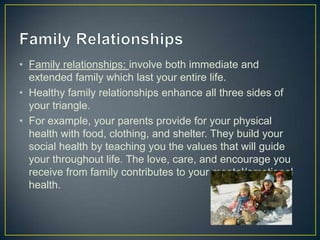
• Family relationships: involve both immediate and
extended family which last your entire life.
• Healthy family relationships enhance all three sides of
your triangle.
• For example, your parents provide for your physical
health with food, clothing, and shelter. They build your
social health by teaching you the values that will guide
your throughout life. The love, care, and encourage you
receive from family contributes to your mental/emotional
health.
• Friendships: Significant relationship between two people
that is based on caring, trust, and consideration.
• Friends can be of any age and you get to choose them
for different reasons.
• Friends are those that have similar values and more
importantly have a positive influence.
• Maintaining a good friendship can sometimes be hard
work, but it is well worth the effort.
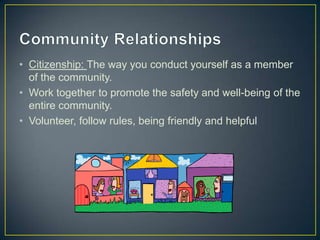
• Citizenship: The way you conduct yourself as a member
of the community.
• Work together to promote the safety and well-being of the
entire community.
• Volunteer, follow rules, being friendly and helpful
• Role: A part you play in a relationship.
• You play various roles depending on the relationship and
situation.
• Examples: Son/Daughter, student, athlete, employee,
girlfriend/boyfriend, and etc.
• It is important we are able to acknowledge the roles we
play and understand the influences of each role.
• In order for relationships to succeed, people need certain
skills. Three of these skills are communication,
cooperation, and compromise—the three Cs of healthy
relationships.
• Communication: Your ways of sending and receiving
messages.
• Examples: Exchanged through words, gestures, facial
expressions and behaviors
• Cooperation: Working together for the good of all.
• Examples: Sports teams working together for a common
goal.
• Compromise: Problem-solving method that involves each
participant’s giving up something to reach a solution that
• All good relationships have certain recognizable
characteristics.
• Mutual Respect and Consideration: People show
mutual respect even when they disagree. This involves
accepting one another’s tastes and opinions.
• Honesty: Because of their mutual respect and
consideration people in a healthy relationship have the
confidence to be open and honest about their actions,
thoughts, and feelings.
• Dependability: Dependable, trustworthy and reliable.
Each person is there for the other when needed.
• Commitment: People are willing to work together and
make sacrifices that benefit everyone involved.
• Your character-the way you think, feel, and act has the
greatest influence on your relationships with others. You
can establish healthy relationships by demonstrating the
six characteristics of a good character.
• Trustworthiness
• Respect
• Responsibility
• Fairness
• Caring
• Citizenship
• There are three basic skills in order to achieve effective
communication.
• Speaking, listening, and body language
• There are three types of communication styles.
• Passive: inability or unwillingness to express thoughts
and feelings
• Aggressive: get their way through bullying and
intimidation
• Assertive: expressing thoughts and feeling clearly and
directly but without hurting other.
• Having good communication skills means that you do not
assume that others can read your mind or know your
needs and expectations.
• When you interact with others, you are responsible for
making your thoughts and feelings know.
• Demonstrating good speaking skills means you clearly
say what you mean.
• Changes in the tone, pitch, or loudness of your voice can
affect communication.
• Listening is an important aspect to effective communication
• Active listening: paying close attention to what someone is
saying and communicating.
• Techniques for Active Listening
• Reflective listening: you rephrase or summarize what the other
person has said
• Clarifying: ask the speaker what he or she thinks or how he or
she feels about the situation
• Encouraging: you signal that you are interested and involved.
“I understand,” and “I see”.
• Empathizing: you are able to imagine and understand how
someone else feels
• Body language: nonverbal communication through gestures,
facial expressions, behaviors, and posture.
• Being able to identify and eliminate communication
barriers is important for everyone in the relationship. The
following are examples of obstacles that could affect
clear communication between two people
• Image and identity issues:
• Unrealistic expectations:
• Lack of trust
• Prejudice
• Gender stereotyping
• No one is perfect and we all make mistakes throughout life.
How we acknowledge and accept our mistakes will only help
us with our relationships.
• Constructive Criticism: nonhostile comments that point out
problems and encourage improvement
• CC is intended to bring about positive changes. It is important
to start the conversation with “I” messages to explain how you
feel. For example, I feel frustrated you keep canceling our
plans to hang out because I really want to hang out with you.
Could we please make plans that work be broken?
• Expressing and receiving respect, admiration, and
appreciation with grace and sincerity can help you build and
maintain healthy relationships. Acknowledgements and
compliments can help improve one’s mental and social health.

Skills for a healthy relationship

  • 2.
    • Everyone yearnsfor that feeling of belonging and being loved. • We are able to meet those needs through relationships. • Relationships: A bond or connection you have with other people. • All our relationships can have positive and negative effects on your health triangle. • A healthy relationship supports, encourages and helps both individuals in the relationship.
  • 3.
    • Family relationships:involve both immediate and extended family which last your entire life. • Healthy family relationships enhance all three sides of your triangle. • For example, your parents provide for your physical health with food, clothing, and shelter. They build your social health by teaching you the values that will guide your throughout life. The love, care, and encourage you receive from family contributes to your mental/emotional health.
  • 4.
    • Friendships: Significantrelationship between two people that is based on caring, trust, and consideration. • Friends can be of any age and you get to choose them for different reasons. • Friends are those that have similar values and more importantly have a positive influence. • Maintaining a good friendship can sometimes be hard work, but it is well worth the effort.
  • 5.
    • Citizenship: Theway you conduct yourself as a member of the community. • Work together to promote the safety and well-being of the entire community. • Volunteer, follow rules, being friendly and helpful
  • 6.
    • Role: Apart you play in a relationship. • You play various roles depending on the relationship and situation. • Examples: Son/Daughter, student, athlete, employee, girlfriend/boyfriend, and etc. • It is important we are able to acknowledge the roles we play and understand the influences of each role.
  • 7.
    • In orderfor relationships to succeed, people need certain skills. Three of these skills are communication, cooperation, and compromise—the three Cs of healthy relationships. • Communication: Your ways of sending and receiving messages. • Examples: Exchanged through words, gestures, facial expressions and behaviors • Cooperation: Working together for the good of all. • Examples: Sports teams working together for a common goal. • Compromise: Problem-solving method that involves each participant’s giving up something to reach a solution that
  • 8.
    • All goodrelationships have certain recognizable characteristics. • Mutual Respect and Consideration: People show mutual respect even when they disagree. This involves accepting one another’s tastes and opinions. • Honesty: Because of their mutual respect and consideration people in a healthy relationship have the confidence to be open and honest about their actions, thoughts, and feelings. • Dependability: Dependable, trustworthy and reliable. Each person is there for the other when needed. • Commitment: People are willing to work together and make sacrifices that benefit everyone involved.
  • 9.
    • Your character-theway you think, feel, and act has the greatest influence on your relationships with others. You can establish healthy relationships by demonstrating the six characteristics of a good character. • Trustworthiness • Respect • Responsibility • Fairness • Caring • Citizenship
  • 10.
    • There arethree basic skills in order to achieve effective communication. • Speaking, listening, and body language • There are three types of communication styles. • Passive: inability or unwillingness to express thoughts and feelings • Aggressive: get their way through bullying and intimidation • Assertive: expressing thoughts and feeling clearly and directly but without hurting other.
  • 11.
    • Having goodcommunication skills means that you do not assume that others can read your mind or know your needs and expectations. • When you interact with others, you are responsible for making your thoughts and feelings know. • Demonstrating good speaking skills means you clearly say what you mean. • Changes in the tone, pitch, or loudness of your voice can affect communication.
  • 12.
    • Listening isan important aspect to effective communication • Active listening: paying close attention to what someone is saying and communicating. • Techniques for Active Listening • Reflective listening: you rephrase or summarize what the other person has said • Clarifying: ask the speaker what he or she thinks or how he or she feels about the situation • Encouraging: you signal that you are interested and involved. “I understand,” and “I see”. • Empathizing: you are able to imagine and understand how someone else feels • Body language: nonverbal communication through gestures, facial expressions, behaviors, and posture.
  • 13.
    • Being ableto identify and eliminate communication barriers is important for everyone in the relationship. The following are examples of obstacles that could affect clear communication between two people • Image and identity issues: • Unrealistic expectations: • Lack of trust • Prejudice • Gender stereotyping
  • 14.
    • No oneis perfect and we all make mistakes throughout life. How we acknowledge and accept our mistakes will only help us with our relationships. • Constructive Criticism: nonhostile comments that point out problems and encourage improvement • CC is intended to bring about positive changes. It is important to start the conversation with “I” messages to explain how you feel. For example, I feel frustrated you keep canceling our plans to hang out because I really want to hang out with you. Could we please make plans that work be broken? • Expressing and receiving respect, admiration, and appreciation with grace and sincerity can help you build and maintain healthy relationships. Acknowledgements and compliments can help improve one’s mental and social health.