Goal SettingMotivationThe information is taken from Slocum and Helriegel (2007)
The expectancy theory demonstrates the importance of rewards in relation to the effort-performance ratio. This lesson extends the knowledge of goal setting as a means of motivation employees to reach high levels of performance and satisfaction. At the end of the lesson students should be able to:Explain how performance is affected by goal setting.State the effects of goal setting on job satisfaction and performance. Describe reward systems for fostering high performance. Overview
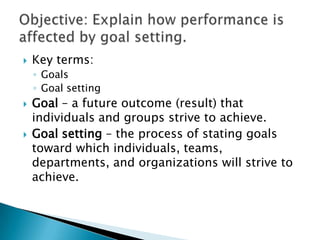
Key terms:GoalsGoal settingGoal – a future outcome (result) that individuals and groups strive to achieve.Goal setting – the process of stating goals toward which individuals, teams, departments, and organizations will strive to achieve.Objective: Explain how performance is affected by goal setting.
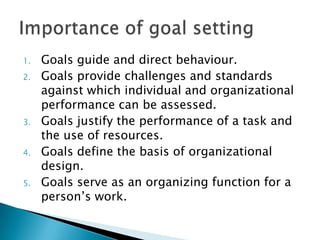
Goals guide and direct behaviour.Goals provide challenges and standards against which individual and organizational performance can be assessed.Goals justify the performance of a task and the use of resources.Goals define the basis of organizational design.Goals serve as an organizing function for a person’s work.Importance of goal setting
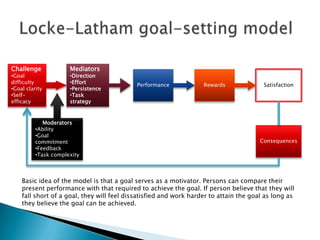
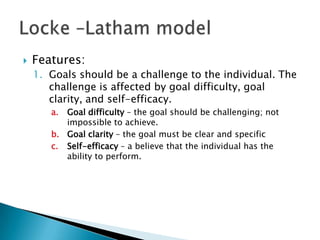
Locke-Latham goal-setting modelChallengeGoal difficulty
Goal clarity
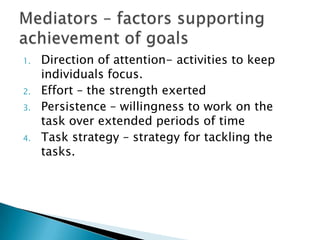
Self-efficacyMediatorsDirection
Effort
Persistence
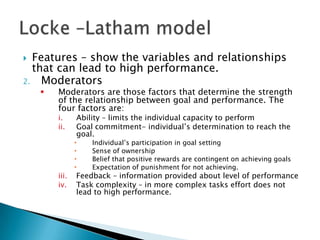
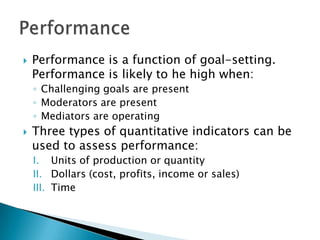
Task strategyPerformanceRewardsSatisfactionModeratorsAbility
Goal commitment
Feedback
Task complexityConsequencesBasic idea of the model is that a goal serves as a motivator. Persons can compare their present performance with that required to achieve the goal. If person believe that they will fall short of a goal, they will feel dissatisfied and work harder to attain the goal as long as they believe the goal can be achieved.

Goal setting

  • 1.
    Goal SettingMotivationThe informationis taken from Slocum and Helriegel (2007)
  • 2.
    The expectancy theorydemonstrates the importance of rewards in relation to the effort-performance ratio. This lesson extends the knowledge of goal setting as a means of motivation employees to reach high levels of performance and satisfaction. At the end of the lesson students should be able to:Explain how performance is affected by goal setting.State the effects of goal setting on job satisfaction and performance. Describe reward systems for fostering high performance. Overview
  • 3.
    Key terms:GoalsGoal settingGoal– a future outcome (result) that individuals and groups strive to achieve.Goal setting – the process of stating goals toward which individuals, teams, departments, and organizations will strive to achieve.Objective: Explain how performance is affected by goal setting.
  • 4.
    Goals guide anddirect behaviour.Goals provide challenges and standards against which individual and organizational performance can be assessed.Goals justify the performance of a task and the use of resources.Goals define the basis of organizational design.Goals serve as an organizing function for a person’s work.Importance of goal setting
  • 5.
  • 6.
  • 7.
  • 8.
  • 9.
  • 10.
  • 11.
  • 12.
  • 13.
    Task complexityConsequencesBasic ideaof the model is that a goal serves as a motivator. Persons can compare their present performance with that required to achieve the goal. If person believe that they will fall short of a goal, they will feel dissatisfied and work harder to attain the goal as long as they believe the goal can be achieved.