TEEN DATING ABUSE
101
love is respect org
The best way to Avoid is to Know
What is Dating Abuse?
Dating abuse (or Relationship
Abuse): A pattern of controlling
behavior that someone uses against
a girlfriend or a boyfriend. The
core of dating abuse is Power and
Control
2
Game of
Stats1. A comparison of Intimate Partner Violence rates between
teens and adults reveals that ________are at higher risk of
intimate partner abuse.
2.“_______of female and _________of male high school students
endorse some form of sexual coercion, including unwanted
kissing, hugging, genital contact, and sexual intercourse.
3. Teen dating abuse most often takes place in the _________of
one of the partners.
4. About ___________teens report verbal, physical, emotional or
sexual abuse each year
5. Only ___________ of teens who have been in or known about an
abusive dating relationship report having told anyone about
it.
3Teen1 in 4 33% 67%77%Home
Answer Choices
• Race
• Gender
• Age
• Sexual Orientation
• Social economic status
• Level of education
• Religion
4
IT CAN HAPPEN TO
ANYONE…
Patterns of dating
violence behavior
often start early
and carry through
into adult
relationships.
In a study of gay, lesbian,
and bisexual adolescents,
youths involved in same-sex
dating are just
as likely to experience dating
violence as youths involved in
opposite sex dating.
15.8% of Rural
teens report ever
being hit, pushed,
or threatened by a
dating partner
Among students
experiencing
physical dating
violence, 14.0%
were black
females,7.5% of
whites and 9.2%
for Hispanics.
These rates are
similar for males
Studies found
higher rates
of dating
violence in
low SES
groups
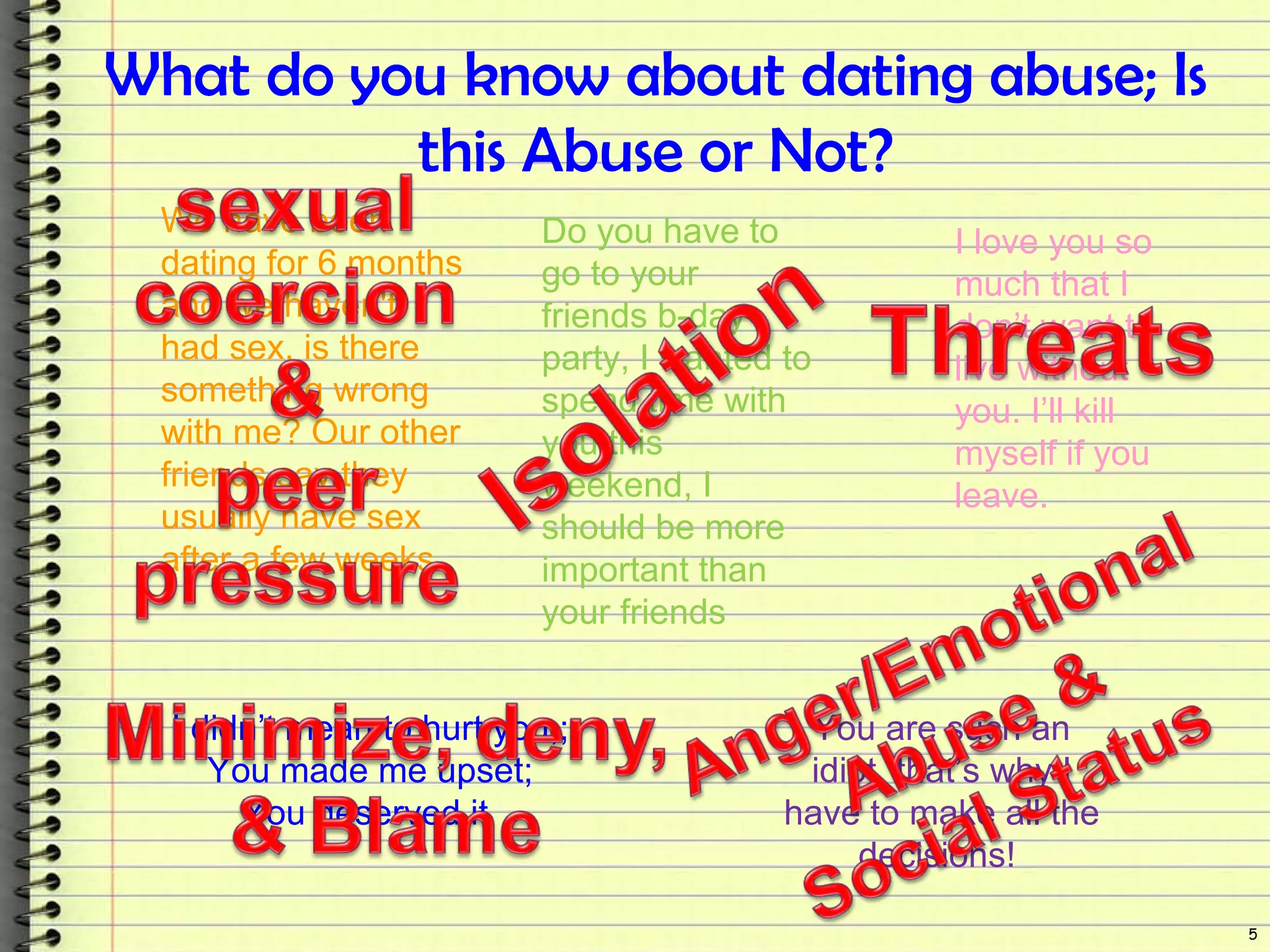
What do you know about dating abuse; Is
this Abuse or Not?
5
We have been
dating for 6 months
and we haven't
had sex, is there
something wrong
with me? Our other
friends say they
usually have sex
after a few weeks.
Do you have to
go to your
friends b-day
party, I wanted to
spend time with
you this
weekend, I
should be more
important than
your friends
I love you so
much that I
don’t want to
live without
you. I’ll kill
myself if you
leave.
I didn’t mean to hurt you,;
You made me upset;
You deserved it
You are such an
idiot, that’s why I
have to make all the
decisions!
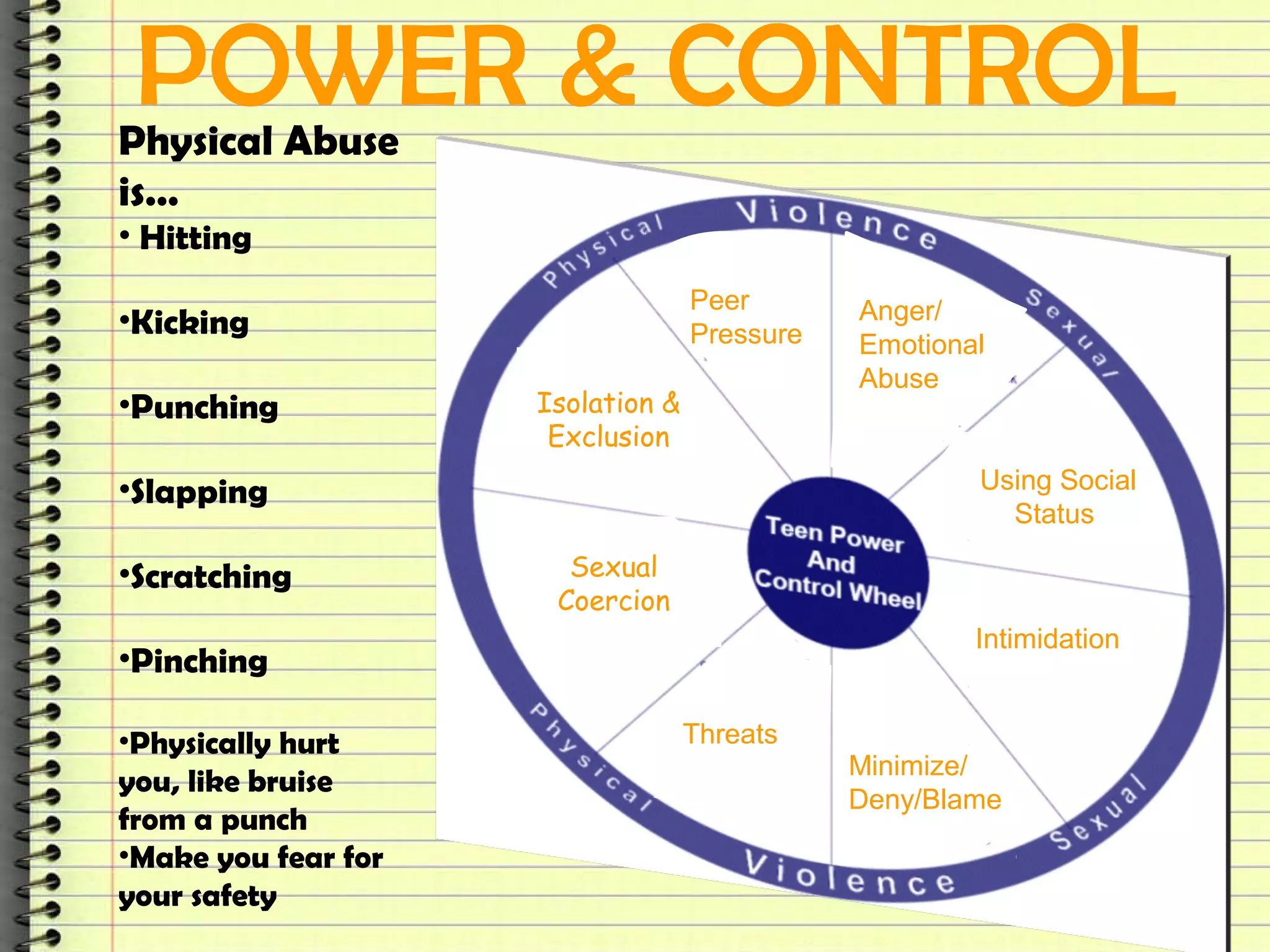
POWER & CONTROLPhysical Abuse
is…
• Hitting
•Kicking
•Punching
•Slapping
•Scratching
•Pinching
•Physically hurt
you, like bruise
from a punch
•Make you fear for
your safety
Isolation &
Exclusion
Sexual
Coercion
Peer
Pressure
Anger/
Emotional
Abuse
In
Using Social
Status
Intimidation
Minimize/
Deny/Blame
Threats
Facts About Technology Abuse
Technology is a
means of
constant control
1 in 3 teens
say they are
texted 10, 20,
30 times an hour
by a partner
keeping tabs on
them
68% of teens say
boyfriends/girlfriends
sharing private or
embarrassing
pictures/videos on cell
phones and computers
is a serious problem.
1 in 4 teens in a
relationship say
they have been
called names,
harassed, or put
down by their
partner through cell
phones & texting.
19% of teens in
relationships say their
partner has used a
cellular device or the
internet to spread rumors
about
Nearly 1 in 4 teens
in a relationship
communicated with
their partner via
cell phone or texting
HOURLY between
12 am & 5 am
71% of teens regard
boyfriends/girlfriends
spreading rumors about
them on cell phones and
social networking sites as
a serious problem.
8
5 FORMS OF
TECHNOLOGY
ABUSE…
Why is Dating Abuse
Prevalent?
• Gender hierarchies
• Views of “romantic” relationships
• Inexperience
• Independence
• Peer pressure
9
Myth vs. Fact
• Drugs/Alcohol cause someone to be violent?
MYTH: These chemicals just aggravate the situation but they don’t cause it
• Women are victims of violence more often than men
FACT: The U.S. Bureau of Justice Statistics reports that 95% of the
reported incidents of assaults in relationships are committed by males.
• Most of the time abusers will never get better because it is a learned
behavior and cannot be unlearned.
MYTH: Although it is uncommon for an abusive person to change and
unlearn their behavior, if they acknowledge their behavior and want to
change for themselves it can happen. However, no one can make them change,
they have to make the decision for themselves.
• Jealousy and possessiveness are a sign of true love.
MYTH: Jealousy and possessiveness are a sign that the person sees you as a
possession. It is the most common early warning sign of abuse.
• If a person stays in an abusive relationship, it must not really be that bad.
MYTH: People stay in abusive relationships for a number of reasons: fear,
economic dependence, confusion, loss of self-confidence, not recognizing that
what’s happening is abusive, belief that the abuser needs their help or will
change.
10
11
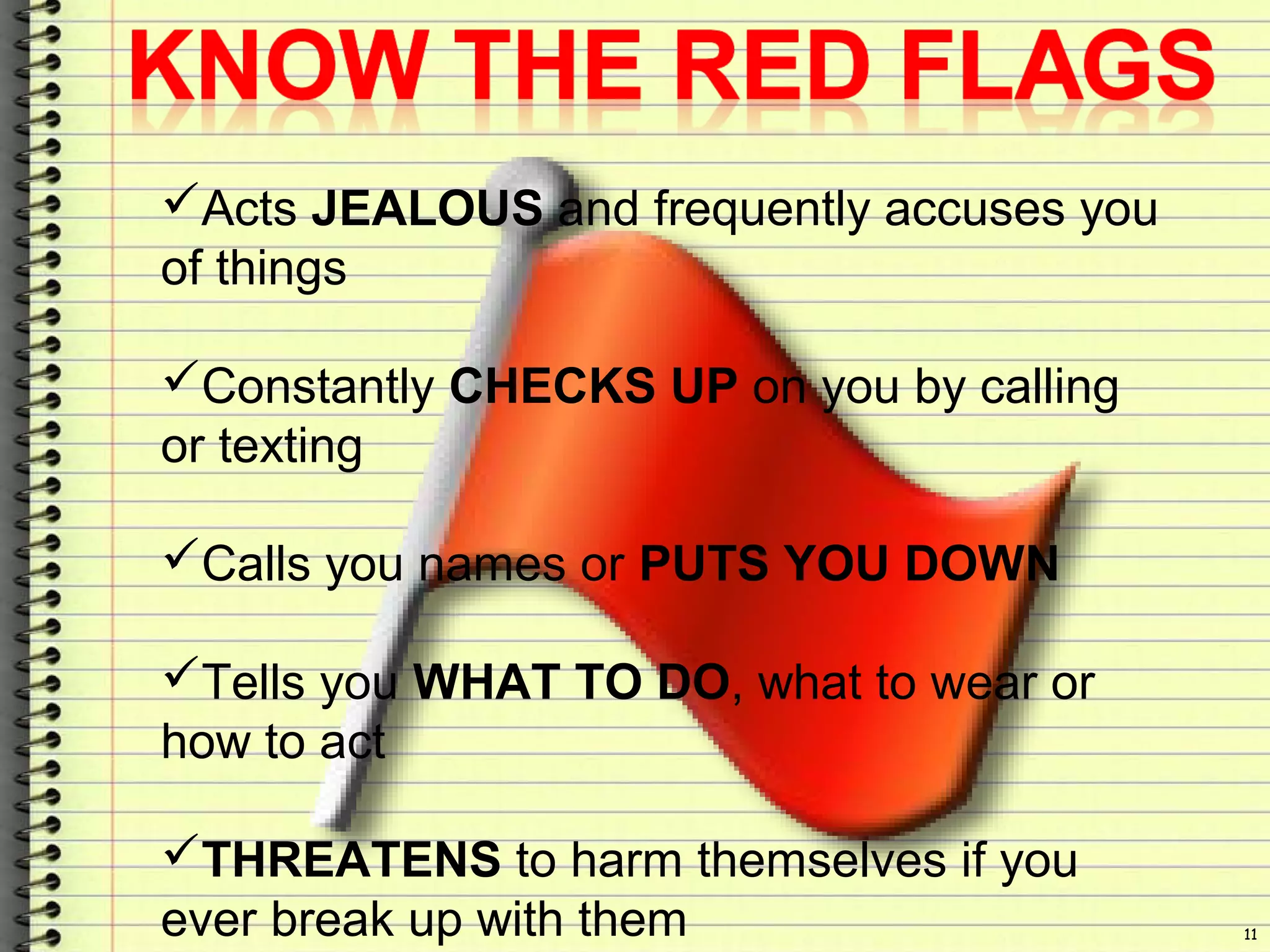
Acts JEALOUS and frequently accuses you
of things
Constantly CHECKS UP on you by calling
or texting
Calls you names or PUTS YOU DOWN
Tells you WHAT TO DO, what to wear or
how to act
THREATENS to harm themselves if you
ever break up with them
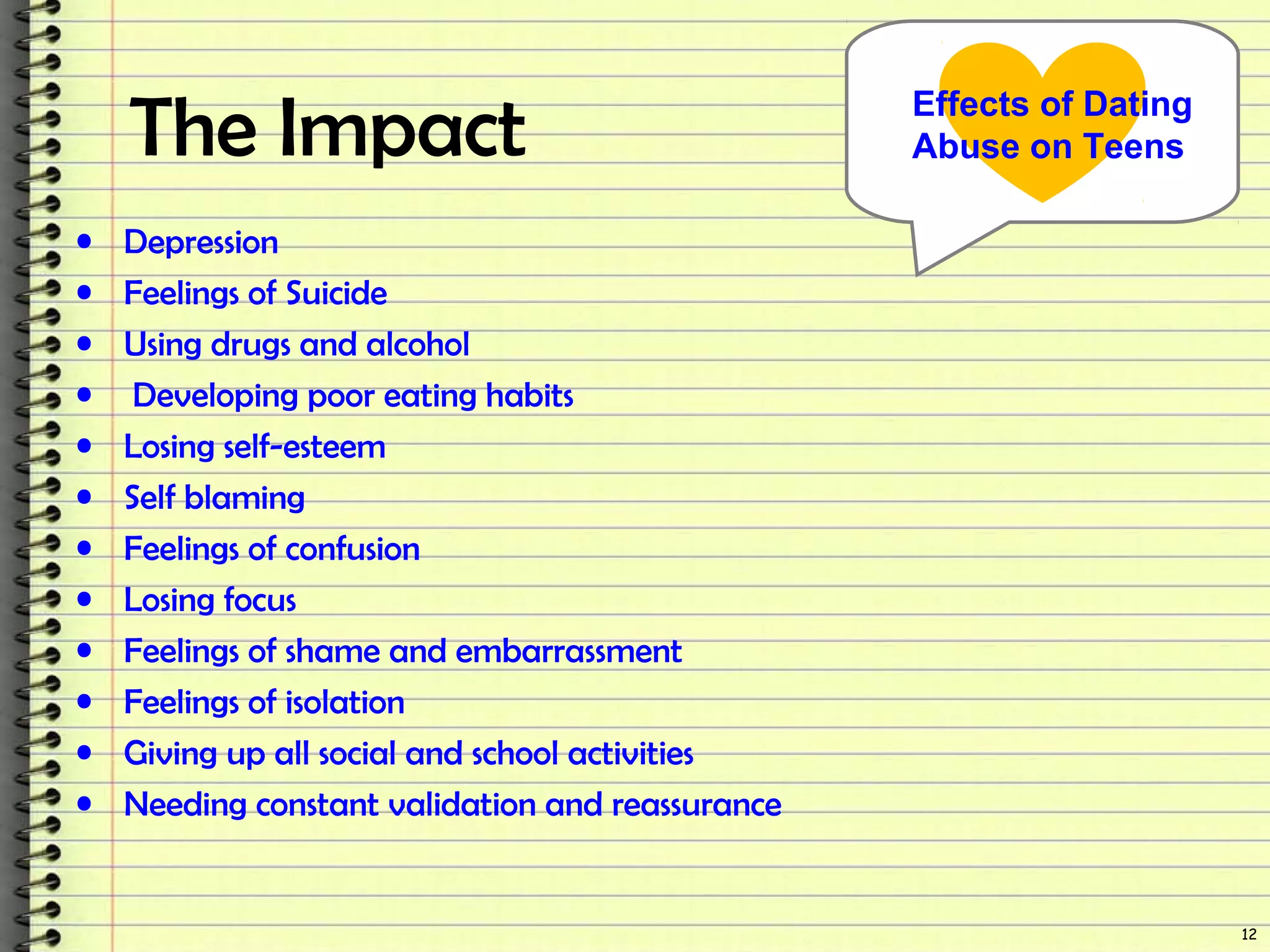
The Impact
• Depression
• Feelings of Suicide
• Using drugs and alcohol
• Developing poor eating habits
• Losing self-esteem
• Self blaming
• Feelings of confusion
• Losing focus
• Feelings of shame and embarrassment
• Feelings of isolation
• Giving up all social and school activities
• Needing constant validation and reassurance
12
Effects of Dating
Abuse on Teens
13
14
15
To always
be treated
with respect
To not be hurt
Physically or
emotionally
To have friends and
activities apart from my
girlfriend or boyfriend
To be in a healthy
relationship
To refuse sex or
affection anytime
To end a relationship
Resources
• www.loveisrespect.org
• www.thesafespace.org
• www.athinline.org
16

Teen Dating Violence 101

  • 1.
    TEEN DATING ABUSE 101 loveis respect org The best way to Avoid is to Know
  • 2.
    What is DatingAbuse? Dating abuse (or Relationship Abuse): A pattern of controlling behavior that someone uses against a girlfriend or a boyfriend. The core of dating abuse is Power and Control 2
  • 3.
    Game of Stats1. Acomparison of Intimate Partner Violence rates between teens and adults reveals that ________are at higher risk of intimate partner abuse. 2.“_______of female and _________of male high school students endorse some form of sexual coercion, including unwanted kissing, hugging, genital contact, and sexual intercourse. 3. Teen dating abuse most often takes place in the _________of one of the partners. 4. About ___________teens report verbal, physical, emotional or sexual abuse each year 5. Only ___________ of teens who have been in or known about an abusive dating relationship report having told anyone about it. 3Teen1 in 4 33% 67%77%Home Answer Choices
  • 4.
    • Race • Gender •Age • Sexual Orientation • Social economic status • Level of education • Religion 4 IT CAN HAPPEN TO ANYONE… Patterns of dating violence behavior often start early and carry through into adult relationships. In a study of gay, lesbian, and bisexual adolescents, youths involved in same-sex dating are just as likely to experience dating violence as youths involved in opposite sex dating. 15.8% of Rural teens report ever being hit, pushed, or threatened by a dating partner Among students experiencing physical dating violence, 14.0% were black females,7.5% of whites and 9.2% for Hispanics. These rates are similar for males Studies found higher rates of dating violence in low SES groups
  • 5.
    What do youknow about dating abuse; Is this Abuse or Not? 5 We have been dating for 6 months and we haven't had sex, is there something wrong with me? Our other friends say they usually have sex after a few weeks. Do you have to go to your friends b-day party, I wanted to spend time with you this weekend, I should be more important than your friends I love you so much that I don’t want to live without you. I’ll kill myself if you leave. I didn’t mean to hurt you,; You made me upset; You deserved it You are such an idiot, that’s why I have to make all the decisions!
  • 6.
    POWER & CONTROLPhysicalAbuse is… • Hitting •Kicking •Punching •Slapping •Scratching •Pinching •Physically hurt you, like bruise from a punch •Make you fear for your safety Isolation & Exclusion Sexual Coercion Peer Pressure Anger/ Emotional Abuse In Using Social Status Intimidation Minimize/ Deny/Blame Threats
  • 7.
    Facts About TechnologyAbuse Technology is a means of constant control 1 in 3 teens say they are texted 10, 20, 30 times an hour by a partner keeping tabs on them 68% of teens say boyfriends/girlfriends sharing private or embarrassing pictures/videos on cell phones and computers is a serious problem. 1 in 4 teens in a relationship say they have been called names, harassed, or put down by their partner through cell phones & texting. 19% of teens in relationships say their partner has used a cellular device or the internet to spread rumors about Nearly 1 in 4 teens in a relationship communicated with their partner via cell phone or texting HOURLY between 12 am & 5 am 71% of teens regard boyfriends/girlfriends spreading rumors about them on cell phones and social networking sites as a serious problem.
  • 8.
  • 9.
    Why is DatingAbuse Prevalent? • Gender hierarchies • Views of “romantic” relationships • Inexperience • Independence • Peer pressure 9
  • 10.
    Myth vs. Fact •Drugs/Alcohol cause someone to be violent? MYTH: These chemicals just aggravate the situation but they don’t cause it • Women are victims of violence more often than men FACT: The U.S. Bureau of Justice Statistics reports that 95% of the reported incidents of assaults in relationships are committed by males. • Most of the time abusers will never get better because it is a learned behavior and cannot be unlearned. MYTH: Although it is uncommon for an abusive person to change and unlearn their behavior, if they acknowledge their behavior and want to change for themselves it can happen. However, no one can make them change, they have to make the decision for themselves. • Jealousy and possessiveness are a sign of true love. MYTH: Jealousy and possessiveness are a sign that the person sees you as a possession. It is the most common early warning sign of abuse. • If a person stays in an abusive relationship, it must not really be that bad. MYTH: People stay in abusive relationships for a number of reasons: fear, economic dependence, confusion, loss of self-confidence, not recognizing that what’s happening is abusive, belief that the abuser needs their help or will change. 10
  • 11.
    11 Acts JEALOUS andfrequently accuses you of things Constantly CHECKS UP on you by calling or texting Calls you names or PUTS YOU DOWN Tells you WHAT TO DO, what to wear or how to act THREATENS to harm themselves if you ever break up with them
  • 12.
    The Impact • Depression •Feelings of Suicide • Using drugs and alcohol • Developing poor eating habits • Losing self-esteem • Self blaming • Feelings of confusion • Losing focus • Feelings of shame and embarrassment • Feelings of isolation • Giving up all social and school activities • Needing constant validation and reassurance 12 Effects of Dating Abuse on Teens
  • 13.
  • 14.
  • 15.
    15 To always be treated withrespect To not be hurt Physically or emotionally To have friends and activities apart from my girlfriend or boyfriend To be in a healthy relationship To refuse sex or affection anytime To end a relationship
  • 16.

Editor's Notes

  • #2 Love is respect is a national teen dating abuse helpline dedicated to ensuring not only the safety of teens in dating relationships but also making sure that teens are educated on the issue surrounding dating abuse/violence. This presentation intends to give a brief summarization on the epidemic of teen dating abuse. Often times because teens are unaware of what constitute being abused it is hidden or ignored, but there is power in knowing; the best way to avoid is to know.
  • #3 Although once narrowly conceptualized as involving only physical force, dating violence is now more broadly recognized; Abuse can be physical and can result in death or a severe injury however; dating abuse also comes in different forms, such as verbal ,sexual, and emotional abuse. Dating abuse isn’t an argument every once in a while, or a bad mood after a bad day, it is a cycle of control; a continuum of behaviors that a person elicits to gain power over another.
  • #4 In attempts to form an understating of the severity of teen dating abuse, numerous studies and research efforts have been conducted; this game of stats pulls from those efforts providing statistics on teen dating violence. The object of the game is to fill in the blanks by guessing which answer (provide in the answer key) goes with which stat. There are 6 answer choices for the 5 questions; all of the answer choices must be used. Proceed with the game/ Student questions and reflections about the game and the stats (this can also be discussed after each stat is revealed)
  • #5 Studies show that certain populations may be more at risk of being affected by dating abuse, for example (read stats from slide bubbles) however, it is important to understand that although specific populations maintain a higher likelihood, no one it exempt, Dating abuse can happen to anyone of any (read slide bullets)
  • #6 Ample times some of the “normal” things expected for a boyfriend or girlfriend to say can be abusive in nature. This in terms makes it more difficult to detect an abusive situation. With this in mind, this activity will attempt to provide some common scenarios and statements that may be elicited in teen dating relationships, these statements can be addressed by a male or female in a heterosexual or same-sex dating relationship. The goal is to be able to detect whether the statement is Abusive or not abusive. Once the statement is read, don’t think too much just say if you think the scenario is abusive or not. If the majority identifies the statement as abusive, identify what type of abuse it could be considered. Proceed with game / Questions and game reflection; this can also be done after each type of abuse is revealed
  • #7 In many instances Physical abuse is the most easily detectable, which makes it easier to discern if abuse is occurring but, there are other forms of abuse that may not involve any physical contact. Emotional, verbal and sexual are other forms of abuse that can occur in dating relationships. These three forms of abuse are most common in teen dating relationships however, because there is not direct evident that can define these acts as abuse, they are commonly ignored, which is one of the reasons why teen dating abuse is hidden. As currently addressed in the game, sexual coercion, isolation/exclusion, threats, etc.. are all forms of abuse.
  • #8 With an increased usage of technology, it has become an easy gateway for control. Here are some of the statistics on technology abuse. Read stats.
  • #9 Digital Disrespect Bad mouthing through social networking sites, text messages, IMs, or other forms of technology 2. Constant messaging / threatening text messages Obsessively texting to keep track of whereabouts, asking things like “what are you doing?”, “Who are you with?”, “When are you going home?” etc. Holding you on the phone when you are ready to stop talking. Requesting calls/texts when leaving or going places. Threatening is used as a way to manipulate and control situations.   3. Online Stalking Spying and keeping track through social networking pages 4. Threatening to share pictures Sexting (sending sexually suggestive or nude photos through technology) may seem harmless but it can be used as a form of control when someone threatens to share or expose the images. 5. Impersonating through social networking Using someone’s username and password to get into their account, Creating a fake pages, etc.
  • #10 Adolescents are often pressured to conform to masculine or feminine gender roles that reinforce unequal power and control between dating partners. This is one of the primary factors that enforce the prevalence of dating abuse. Along with the views of gender roles that are instilled in our heads from birth (hence, pink is for girls and blue is for boys), ideals of romance and love is also depicted. At a young age it is idealized that the girl is the damsel in distress (i.e. Cinderella, snow white, sleeping beauty) and the boy is the prince/hero that must save her. These images not only promote the gender hierarchy but establish the notion that the boy/man possesses the control in the (heterosexual) relationship. Many times teens are just beginning to date (have their first boyfriend/girlfriend) therefore, besides the issues of gender that avidly affect dating, there is the lack of experience / familiarity teens have with dating and the peer pressure that acts as a mold for the ways in which teens maintain relationships. Above all the need for independence tends to influence teens decision not to express abusive situation with anyone (friends, family, etc).
  • #11 Unfortunately there are quite a few myths surrounding the issue of teen dating abuse, this in terms makes it hard for teens to tell the differences between a healthy relationship and an abusive/unhealthy relationship. Through this game we will try to dispel some of those rumors. The object of the game is to identify if the statement is a myth or fact. Try to answer within a few seconds of reading the statement. Proceed with game / questions and game reflection
  • #12 Recognizing the early warning signs of an abusive personality gives you the key to avoiding the whole problem. THE RED FLAGS are there, you just have to KNOW them.  These are some of the red flags of an abusive personality but there are many, many more.
  • #13 Evidence suggests that dating violence among adolescents is even more widespread than previously believed, and may have serious developmental consequences on victims/survivors. Some common outcomes of dating abuse include depression , suicide, use of abuses substances such as alcohol, tobacco or illegal drugs, etc. ,eating disorders & low self-esteem; it is also common for an abused person to take responsibility ,accept blame for abuse and feel like a failure for not being able to keep the relationship happy. Victims may also seem generally numb or without affect. In many instances the victims begin to identify as being confused, crazy, shamed, or embarrassed. Also they have the tendency not to focus on or even recognize their own needs; feelings of failure for not being able to keep the relationship happy and feelings of disconnection from others is common; May teen who have been victims of unhealthy/ abusive relationship give up all social and school activities that did not involve the abuser; they need constant validation and reassurance. All in all, Teen victims of physical dating violence are more likely than their non-abused peers to engage in risky behaviors and attempt or consider suicide.
  • #14 Relationships are never perfect; maintaining a strong one takes some work—by both people. It’s not always easy, but it shouldn’t feel like a chore or a job. This wheel displays some of the relationship basics that act as the basis for a healthy, safe and happy relationship. ****Read from healthy relationship wheel – leave open for questions or if definitions are needed (Remember that a relationship consists of two people; both should always feel like an equal in the relationship and feel free to speak their mind. And it’s not just about making sure you get your say; it’s also about letting your partner know you’re listening. It’s likely that arguments will happen from time to time and that you will disagree – this is normal. But how you choose to deal with your disagreements is what really counts. At the end of the day, you should feel happy not only in your relationship, but also with what you’re getting out of and putting into it. Being aware of your own feelings and those of your partner’s is a big part of making any relationship work.) http://www.expect-respect.org.nz/excuses.htm
  • #15 Link to PSA (dating B.O.R /Pledge) Everyone has a right to a safe and healthy relationship and everyone plays a role in ensuring dating abuse is limited, take the pledge to end relationship abuse…. Play the video Note: This slide requires internet. Slide 15 is the supplement slide which doesn’t require internet