MANAGING  NEGATIVE FEELINGS Emotional regulation A Key to Self Care for You and Your Clients MHA Clinical Seminar: December 11, 2006 Presenter: Katherine Gordy Levine, LCSW    MHA Clinical Consultant   Emotional Fitness Trainer
Without exception, men and women of all ages, of all cultures, of all levels of education, and of all walks of economic life have emotions, are mindful of the emotions of others, cultivate pastimes that manipulate their emotions, and govern their lives in no small part by the pursuit of one emotion, happiness, and the avoidance of unpleasant emotions. Antonio Damasio
By the end of today’s session you will: Know the importance of emotional regulation Be able to define: emotion, feelings, emotional regulation.  Know eight  feeling facts Practice twelve exercises designed to improve self care Identify three tools for coaxing self and clients to improve emotional regulation OBJECTIVES
AGENDA 2:30 Introductory Lecture 2:45 Self Care Test 3:00 Self Soothing Exercises 3:15 Daily Emotional Fitness Program 4:00 Coaxing and Coaching Others  4:15 Questions and wrap up " You, yourself, as much as anybody in the entire universe, deserve your love and affection."    Buddha
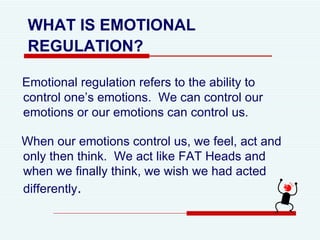
WHAT IS EMOTIONAL REGULATION?   Emotional regulation refers to the ability to control one’s emotions.  We can control our emotions or our emotions can control us.  When our emotions control us, we feel, act and only then think.  We act like FAT Heads and when we finally think, we wish we had acted differently .
HOW IMPORTANT IS  EMOTIONAL REGULATION? The Stanford Encyclopedia of Philosophy notes:  “No aspect of our mental life is  more important  to the quality and meaning of our existence than emotions. They are what make life worth living, or sometimes ending.”  Our training as clinicians stresses the need to be in touch with our emotions, with the emotions of those we work with and with good reason.  Emotional regulation is important.
HOW IMPORTANT IS  EMOTIONAL REGULATION ? Emotional regulation abilities are four times more important than IQ in determining who becomes successful and who does not (Sternberg, 1996).  One study of 450 boys found that those who succeeded were able to handle frustration, control emotions, and get along with other people (Goleman, 1986). Two-thirds of these boys grew up in welfare families, and one-third had IQ’s below 90.
WHAT IS MEANT BY EMOTION?   Emotion is complex, and the term has no single universally accepted definition.  The word derives from the Old French word esmovoir meaning to excite and from   the Latin  ex  meaning out and  movēre  meaning move. Theorist Antonio Damasio sees emotions as complicated collections of chemical and neural responses designed to assist each person’s ability to stay alive.  Another theorist Jerome Kagan sees emotion as the relations among external events, thoughts, and changes in internal feelings.
AN EMOTION OR A FEELING?   Emotions are both what is felt by the body (not necessarily by the mind) and what is displayed to others. Feelings are the subjective aspect of emotion—how the mind responds or does not respond to the arousals.  The word feeling derives from the Middle English felen—and was used to refer to   sensory and tactile experiences as well as a range of emotional and affective responses, both pleasurable and painful.
EMOTION OR FEELING? SO WHAT? Think of waking in the middle of the night. You hear someone walking around.  If you didn’t wake, you might be in danger.  However, unless you remember a cousin is visiting, your arousal will be named fear.  You might get a gun and kill the “intruder”. If you remember the cousin is visiting you might name the feeling annoyance at being disturbed.  If you care deeply for the cousin, you might name the feeling pleasure that the cousin is visiting.  How arousals are named is important.
EMOTION OR FEELING? SO WHAT? Kagan believes until the arousal is noticed and named, a feeling does not exist. Until the person notices the arousal, no thought occurs about what is happening, or what should happen. Even when the arousal is not noticed the emotion often continues to drive the behavior.  Freud’s interest in what we don’t know is important.  So are those who emphasize feelings in talk therapy.  Important but not everything.
YES/AND THINKING For the most part theorists take an “either/or” approach.  The behaviorists had, and for the most part continue to have, no interest in feelings or emotions. Rogerian theorists were invested in being with the client’s feelings.  Analytic theorists focused on the unconscious.  “ Yes/and”  thinking is coming into favor. Such thinking believes who we are is  determined by biology, our environment, our beliefs, as well as how our behavior is rewarded.  Emotions are intermingled with biology, environment, beliefs and behavior.
FEELING FACTS The following facts help you better understand emotion and how emotions and feelings influence behavior. FACT ONE:   Feelings begin with a physical arousal.  FACT TWO : Think of feelings as signals.  The physical arousal that alerts you to a feeling’s presence says “Pay attention, something is happening.”
FEELING FACTS FACT THREE  : Arousals are not always noticed.  The arousal might be detected by another person, but it only becomes a feeling when it is noticed and named by the person being aroused.  Affect is the name for arousal a clinician notices.
FEELING FACTS FACT FOUR:   Controlling an emotion or arousal that does not reach your consciousness is difficult.  Some people are more attuned to feelings than others.  Some are attuned to only one feeling.  Someone may be attuned to anger, but not to the hurt or fear or other emotions that  underlie the anger.
FEELING FACTS FACT FIVE : Feelings motivate.  Feelings want us to do something.  Afraid?  Your fear says run away and hide. Guilty? Your guilt says stop doing wrong.  Angry?  Your anger tells you to fight.  FACT SIX:   What feelings tell you to do is not always the wisest way to act. Even in emergencies, taking a few minutes to think works best. Emotional regulation is about managing feelings.
FEELING FACTS FACT SEVEN:  Some feelings shut you down instead of energizing you.  Depression is a way a feeling shut you down.  Shutting down can keep you alive in some situations, but isn’t helpful in other situations. The stronger the feeling, the greater the danger the feeling will take over.  When a feeling takes over the brain is hijacked, and taken over .
FEELING FACTS FACT EIGHT  Knowing when a feeling is visiting you, knowing how to keep it from taking over your brain, properly naming arousals, and thinking before acting are key to emotional regulation.  You are emotionally fit when you stay in control of your actions no matter what your feelings suggest doing.
You cannot make yourself feel something you do not feel, but you can make yourself do right in spite of your feelings. Pearl Buck
HOW TO REGULATE EMOTIONS Strengthen feeling awareness skills Learn and use self-soothing skills Practice a Daily Emotional Fitness Exercise Program Develop a support system Develop a philosophy of acceptance. Control what you can and let go of what you cannot control  Live a meaningful life
TIME TO TAKE A SELF CARE TEST
TIME TO LEARN SOME  SELF SOOTHING SKILLS
SELF SOOTHING SKILLS  CALMING BREATH Breathe in slowly Hold your breath. Slowly count to four Breathe out slowly  Say “Ahhhhh” Smile
SELF SOOTHING SKILLS   HOW TO CENTER Take a calming breath. Breathe normally for four breaths.  Notice what it feels like just to breathe in and out. Take another Calming Breath.  Repeat. Go on.
THINK OF A SAFE PLACE WHILE CENTERING Review your good memory file for places that you experienced as calming and safe.  Pick the best of these and recreate it in as much detail as possible.  Try combining several safe place People your safe place with those who care or cared for you Add anything that comforts and calms. Use all the senses including taste, movement and massage.  ENHANCING CENTERING
A man described his safe place as lying on a large soft cloud floating gently in an otherwise clear sky.  His dog is with him.  It is sunset and the sky is an ever-changing palate of gold and purple and pink.  The only sound is the soft tinkling of some wind chimes.  The air smells of fresh cut grass.   EXAMPLE OF A SAFE PLACE
A small boy said his safe place was the pitcher’s mound at Yankee Stadium.  It was before a night game, no players were on the field, there was the smell of peanuts in the air, the song “Take me out to ball game” was playing. He was lying with his head on a base pad, he could see the stars.  EXAMPLE OF A SAFE PLACE
USE CALMING SELF TALK   When you breathe out while centering, say or sing something calming.  Some people pray.  Some sing. Others find repeating a short slogan helps.  Sample slogans? Now is not forever. Life goes on. Doing our best. I have been given what I need. It is all all right. I forgive and am forgiven.
For every pass I caught in a game, I caught a thousand in practice.    Don Hutson, Football star
A DAILY  EMOTIONAL FITNESS PROGRAM Be grateful for all you have been given Remember another’s caring acts Remember your mission Move your body Practice kindness Be with beauty
A DAILY  EMOTIONAL FITNESS PROGRAM   Laugh  Indulge in a healthy pleasure Create something Forgive another Forgive yourself Be grateful yet again
OTHER WAYS TO REGULATE NEGATIVE EMOTIONS Plan Ahead as Much as Possible   A few minutes spent organizing and planning often eliminates stress completely.  Exercise as Much Choice as Possible   Not every thing is in our control, but a great deal is, the more we choose our behavior, the stronger we grow.
OTHER WAYS TO REGULATE NEGATIVE EMOTIONS Find A Complaint Partner  Sharing fears and doubts and hurts helps keep negative emotions under control.  Try to find one friend who will listen when you need to complain.  Make that person someone who will not over-react, who will not criticize or tell you what to do, and who will affirm your strength,  That person has the right to complain to you when he or she needs to vent.
OTHER WAYS TO REGULATE NEGATIVE EMOTIONS Find a Support Group  The right  support group strengthens all its members.  Look for a group that does  more than just get together to complain.  A good support group affirms strengths, help members stay in touch with all that is good and allows time to deal with releasing frustration.  The emphasis should be on sharing solutions to common problems as well as finding support for what cannot be changed.
COAXING   OTHERS Model:  Take care of you.  Use Calming Breath, take time to center when dealing with difficult moments.  Say:  “I need to think, to get calm for a minute.”  Educate:   Post an Emotional Fitness Poster where you and others will see it.  Post quotes, cartoons.  Normalize to de-stigmatize:  Everyone needs coaching and coaxing to stay on track when it comes to self care skills.
COAXING   OTHERS Set SMART goals :  Use the Self Care Test or the Twelve Exercises to pick a goal.  Then use the SMART goal formula to check .  S for specific, M for measurable, A for acceptable to you (A can also stand for agreed upon, attainable, achievable, or action-oriented achievable);  R for realistic and finally, T for timed—which means you know when the goal will be reached.  It is best to break long range goals into smaller time segments:  six weeks seems to work well for many.
If a goal is not met, the wrong goal was set.
Life is difficult.  Frustration, worry, anger and stress  frequent visitors.  Managing negative feelings is an everyday process.  Practice these exercises, follow the other suggestions, and the quality of your life will improve.  If not, it is probably a sign more is needed.  Think seriously about therapy.  FINAL WORDS
A man can do only what he can do. But if he does that each day he can sleep at night and do it again the next day. Albert Schweitzer FINAL WORDS

Emotional Regulation Lecture

  • 1.
    MANAGING NEGATIVEFEELINGS Emotional regulation A Key to Self Care for You and Your Clients MHA Clinical Seminar: December 11, 2006 Presenter: Katherine Gordy Levine, LCSW MHA Clinical Consultant Emotional Fitness Trainer
  • 2.
    Without exception, menand women of all ages, of all cultures, of all levels of education, and of all walks of economic life have emotions, are mindful of the emotions of others, cultivate pastimes that manipulate their emotions, and govern their lives in no small part by the pursuit of one emotion, happiness, and the avoidance of unpleasant emotions. Antonio Damasio
  • 3.
    By the endof today’s session you will: Know the importance of emotional regulation Be able to define: emotion, feelings, emotional regulation. Know eight feeling facts Practice twelve exercises designed to improve self care Identify three tools for coaxing self and clients to improve emotional regulation OBJECTIVES
  • 4.
    AGENDA 2:30 IntroductoryLecture 2:45 Self Care Test 3:00 Self Soothing Exercises 3:15 Daily Emotional Fitness Program 4:00 Coaxing and Coaching Others 4:15 Questions and wrap up " You, yourself, as much as anybody in the entire universe, deserve your love and affection." Buddha
  • 5.
    WHAT IS EMOTIONALREGULATION? Emotional regulation refers to the ability to control one’s emotions. We can control our emotions or our emotions can control us. When our emotions control us, we feel, act and only then think. We act like FAT Heads and when we finally think, we wish we had acted differently .
  • 6.
    HOW IMPORTANT IS EMOTIONAL REGULATION? The Stanford Encyclopedia of Philosophy notes: “No aspect of our mental life is more important to the quality and meaning of our existence than emotions. They are what make life worth living, or sometimes ending.” Our training as clinicians stresses the need to be in touch with our emotions, with the emotions of those we work with and with good reason. Emotional regulation is important.
  • 7.
    HOW IMPORTANT IS EMOTIONAL REGULATION ? Emotional regulation abilities are four times more important than IQ in determining who becomes successful and who does not (Sternberg, 1996). One study of 450 boys found that those who succeeded were able to handle frustration, control emotions, and get along with other people (Goleman, 1986). Two-thirds of these boys grew up in welfare families, and one-third had IQ’s below 90.
  • 8.
    WHAT IS MEANTBY EMOTION? Emotion is complex, and the term has no single universally accepted definition. The word derives from the Old French word esmovoir meaning to excite and from the Latin ex meaning out and movēre meaning move. Theorist Antonio Damasio sees emotions as complicated collections of chemical and neural responses designed to assist each person’s ability to stay alive. Another theorist Jerome Kagan sees emotion as the relations among external events, thoughts, and changes in internal feelings.
  • 9.
    AN EMOTION ORA FEELING? Emotions are both what is felt by the body (not necessarily by the mind) and what is displayed to others. Feelings are the subjective aspect of emotion—how the mind responds or does not respond to the arousals. The word feeling derives from the Middle English felen—and was used to refer to sensory and tactile experiences as well as a range of emotional and affective responses, both pleasurable and painful.
  • 10.
    EMOTION OR FEELING?SO WHAT? Think of waking in the middle of the night. You hear someone walking around. If you didn’t wake, you might be in danger. However, unless you remember a cousin is visiting, your arousal will be named fear. You might get a gun and kill the “intruder”. If you remember the cousin is visiting you might name the feeling annoyance at being disturbed. If you care deeply for the cousin, you might name the feeling pleasure that the cousin is visiting. How arousals are named is important.
  • 11.
    EMOTION OR FEELING?SO WHAT? Kagan believes until the arousal is noticed and named, a feeling does not exist. Until the person notices the arousal, no thought occurs about what is happening, or what should happen. Even when the arousal is not noticed the emotion often continues to drive the behavior. Freud’s interest in what we don’t know is important. So are those who emphasize feelings in talk therapy. Important but not everything.
  • 12.
    YES/AND THINKING Forthe most part theorists take an “either/or” approach. The behaviorists had, and for the most part continue to have, no interest in feelings or emotions. Rogerian theorists were invested in being with the client’s feelings. Analytic theorists focused on the unconscious. “ Yes/and” thinking is coming into favor. Such thinking believes who we are is determined by biology, our environment, our beliefs, as well as how our behavior is rewarded. Emotions are intermingled with biology, environment, beliefs and behavior.
  • 13.
    FEELING FACTS Thefollowing facts help you better understand emotion and how emotions and feelings influence behavior. FACT ONE: Feelings begin with a physical arousal. FACT TWO : Think of feelings as signals. The physical arousal that alerts you to a feeling’s presence says “Pay attention, something is happening.”
  • 14.
    FEELING FACTS FACTTHREE : Arousals are not always noticed. The arousal might be detected by another person, but it only becomes a feeling when it is noticed and named by the person being aroused. Affect is the name for arousal a clinician notices.
  • 15.
    FEELING FACTS FACTFOUR: Controlling an emotion or arousal that does not reach your consciousness is difficult. Some people are more attuned to feelings than others. Some are attuned to only one feeling. Someone may be attuned to anger, but not to the hurt or fear or other emotions that underlie the anger.
  • 16.
    FEELING FACTS FACTFIVE : Feelings motivate. Feelings want us to do something. Afraid? Your fear says run away and hide. Guilty? Your guilt says stop doing wrong. Angry? Your anger tells you to fight. FACT SIX: What feelings tell you to do is not always the wisest way to act. Even in emergencies, taking a few minutes to think works best. Emotional regulation is about managing feelings.
  • 17.
    FEELING FACTS FACTSEVEN: Some feelings shut you down instead of energizing you. Depression is a way a feeling shut you down. Shutting down can keep you alive in some situations, but isn’t helpful in other situations. The stronger the feeling, the greater the danger the feeling will take over. When a feeling takes over the brain is hijacked, and taken over .
  • 18.
    FEELING FACTS FACTEIGHT Knowing when a feeling is visiting you, knowing how to keep it from taking over your brain, properly naming arousals, and thinking before acting are key to emotional regulation. You are emotionally fit when you stay in control of your actions no matter what your feelings suggest doing.
  • 19.
    You cannot makeyourself feel something you do not feel, but you can make yourself do right in spite of your feelings. Pearl Buck
  • 20.
    HOW TO REGULATEEMOTIONS Strengthen feeling awareness skills Learn and use self-soothing skills Practice a Daily Emotional Fitness Exercise Program Develop a support system Develop a philosophy of acceptance. Control what you can and let go of what you cannot control Live a meaningful life
  • 21.
    TIME TO TAKEA SELF CARE TEST
  • 22.
    TIME TO LEARNSOME SELF SOOTHING SKILLS
  • 23.
    SELF SOOTHING SKILLS CALMING BREATH Breathe in slowly Hold your breath. Slowly count to four Breathe out slowly Say “Ahhhhh” Smile
  • 24.
    SELF SOOTHING SKILLS HOW TO CENTER Take a calming breath. Breathe normally for four breaths. Notice what it feels like just to breathe in and out. Take another Calming Breath. Repeat. Go on.
  • 25.
    THINK OF ASAFE PLACE WHILE CENTERING Review your good memory file for places that you experienced as calming and safe. Pick the best of these and recreate it in as much detail as possible. Try combining several safe place People your safe place with those who care or cared for you Add anything that comforts and calms. Use all the senses including taste, movement and massage. ENHANCING CENTERING
  • 26.
    A man describedhis safe place as lying on a large soft cloud floating gently in an otherwise clear sky. His dog is with him. It is sunset and the sky is an ever-changing palate of gold and purple and pink. The only sound is the soft tinkling of some wind chimes. The air smells of fresh cut grass. EXAMPLE OF A SAFE PLACE
  • 27.
    A small boysaid his safe place was the pitcher’s mound at Yankee Stadium. It was before a night game, no players were on the field, there was the smell of peanuts in the air, the song “Take me out to ball game” was playing. He was lying with his head on a base pad, he could see the stars. EXAMPLE OF A SAFE PLACE
  • 28.
    USE CALMING SELFTALK When you breathe out while centering, say or sing something calming. Some people pray. Some sing. Others find repeating a short slogan helps. Sample slogans? Now is not forever. Life goes on. Doing our best. I have been given what I need. It is all all right. I forgive and am forgiven.
  • 29.
    For every passI caught in a game, I caught a thousand in practice.   Don Hutson, Football star
  • 30.
    A DAILY EMOTIONAL FITNESS PROGRAM Be grateful for all you have been given Remember another’s caring acts Remember your mission Move your body Practice kindness Be with beauty
  • 31.
    A DAILY EMOTIONAL FITNESS PROGRAM Laugh Indulge in a healthy pleasure Create something Forgive another Forgive yourself Be grateful yet again
  • 32.
    OTHER WAYS TOREGULATE NEGATIVE EMOTIONS Plan Ahead as Much as Possible A few minutes spent organizing and planning often eliminates stress completely. Exercise as Much Choice as Possible Not every thing is in our control, but a great deal is, the more we choose our behavior, the stronger we grow.
  • 33.
    OTHER WAYS TOREGULATE NEGATIVE EMOTIONS Find A Complaint Partner Sharing fears and doubts and hurts helps keep negative emotions under control. Try to find one friend who will listen when you need to complain. Make that person someone who will not over-react, who will not criticize or tell you what to do, and who will affirm your strength, That person has the right to complain to you when he or she needs to vent.
  • 34.
    OTHER WAYS TOREGULATE NEGATIVE EMOTIONS Find a Support Group The right support group strengthens all its members. Look for a group that does more than just get together to complain. A good support group affirms strengths, help members stay in touch with all that is good and allows time to deal with releasing frustration. The emphasis should be on sharing solutions to common problems as well as finding support for what cannot be changed.
  • 35.
    COAXING OTHERS Model: Take care of you. Use Calming Breath, take time to center when dealing with difficult moments. Say: “I need to think, to get calm for a minute.” Educate: Post an Emotional Fitness Poster where you and others will see it. Post quotes, cartoons. Normalize to de-stigmatize: Everyone needs coaching and coaxing to stay on track when it comes to self care skills.
  • 36.
    COAXING OTHERS Set SMART goals : Use the Self Care Test or the Twelve Exercises to pick a goal. Then use the SMART goal formula to check . S for specific, M for measurable, A for acceptable to you (A can also stand for agreed upon, attainable, achievable, or action-oriented achievable); R for realistic and finally, T for timed—which means you know when the goal will be reached. It is best to break long range goals into smaller time segments: six weeks seems to work well for many.
  • 37.
    If a goalis not met, the wrong goal was set.
  • 38.
    Life is difficult. Frustration, worry, anger and stress frequent visitors. Managing negative feelings is an everyday process. Practice these exercises, follow the other suggestions, and the quality of your life will improve. If not, it is probably a sign more is needed. Think seriously about therapy. FINAL WORDS
  • 39.
    A man cando only what he can do. But if he does that each day he can sleep at night and do it again the next day. Albert Schweitzer FINAL WORDS

Editor's Notes

  • #6 Use the thesaurus in seeking out meanings of these three words and you will find that feeling and emotion are often used interchangeably. Affect shares the idea of moving or changing.
  • #10 Use the thesaurus in seeking out meanings of these three words and you will find that feeling and emotion are often used interchangeably. Affect shares the idea of moving or changing.