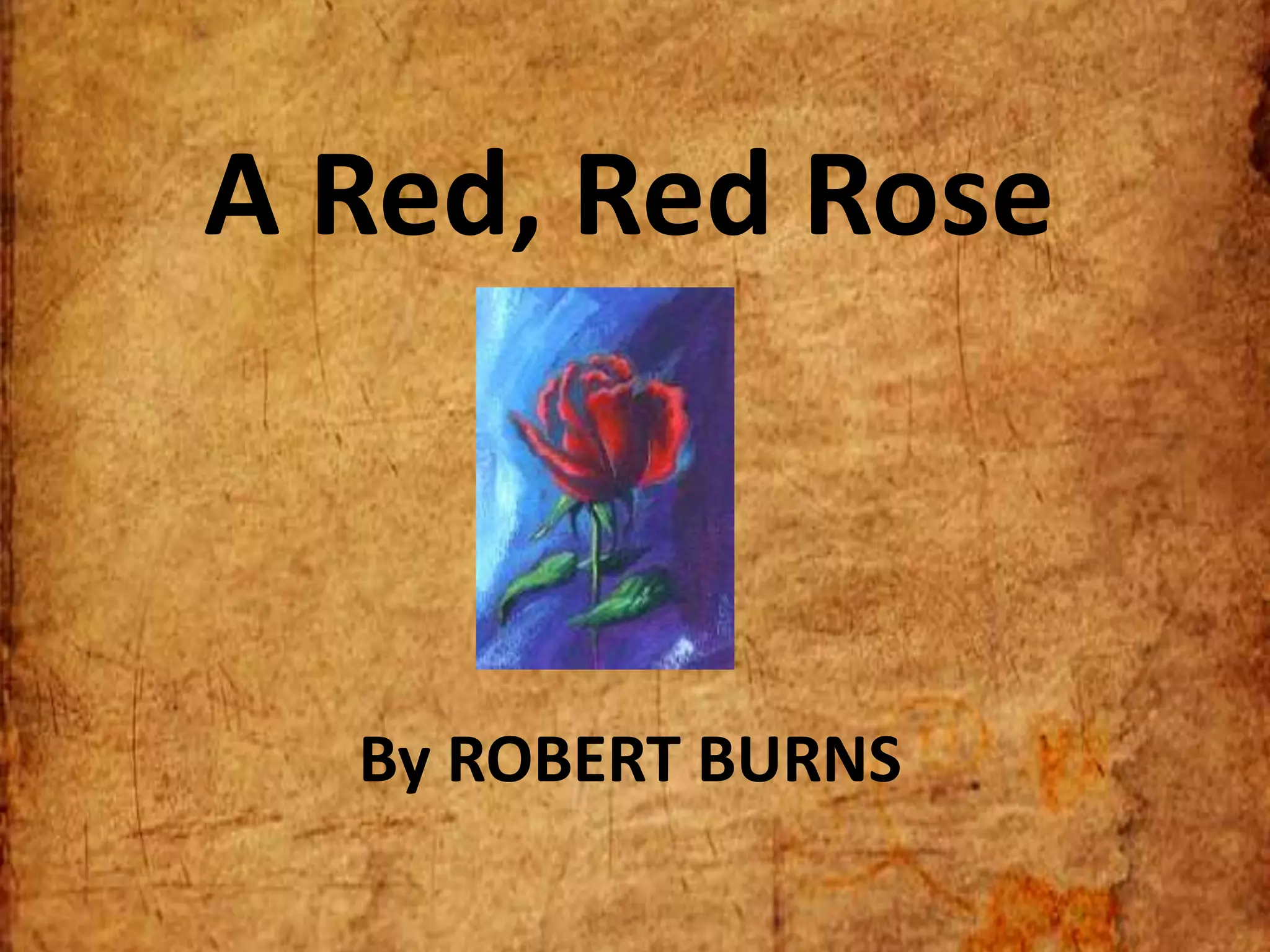
A Red, Red Rose

By ROBERT BURNS
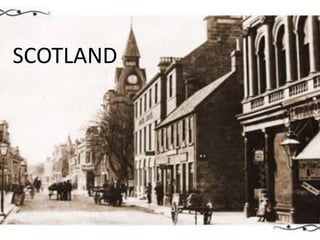
SCOTLAND
LANGUAGE
• 1. Gaelic:
A Celtic language closely related to Irish
Gaelic, from which it developed.

• 2. Scots
A development of a northern form of Old
English which by the fifteenth century had
become a distinct language, used by the
court and throughout the Lowlands and
southern Scotland.
• 3. English
Actively adopted by the Scots for formal
speaking and writing, first by their choice
of an English translation of the Bible after
the Reformation, and then by their efforts
to exploit the Union with England in the
eighteenth century. Until the middle of this
century Scots and Gaelic were forbidden in
schools.
LITERARY BACKGROUND
• The early struggles of the Scottish
kingdom meant a slow development
of the arts. Gaelic culture was
primarily oral, and at first
dominated by the Irish, and not
much that is specifically Scottish
survives.
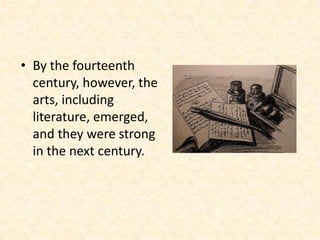
• By the fourteenth
century, however, the
arts, including
literature, emerged,
and they were strong
in the next century.
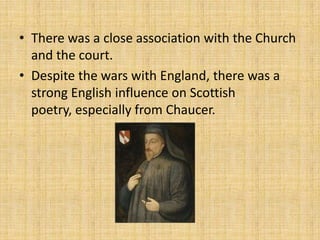
• There was a close association with the Church
and the court.
• Despite the wars with England, there was a
strong English influence on Scottish
poetry, especially from Chaucer.
• Much literary activity was
suppressed by the
Reformation, with its hostility to
the frivolity of the arts. For over a
century the energy of the Scots
went into theological and political
dispute, not only on paper. Much
poetry was lost and what survives
is found in only a few manuscript
collections.
• Scott set up a tradition of
historical fiction which influenced
many writers in other countries.
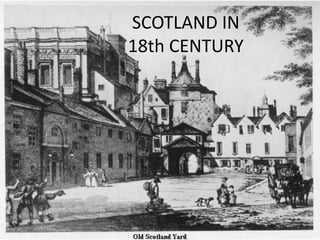
SCOTLAND IN
18th CENTURY
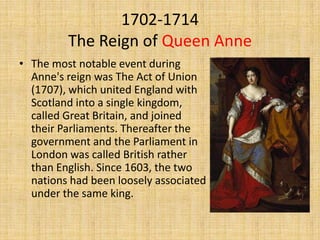
1702-1714
The Reign of Queen Anne
• The most notable event during
Anne's reign was The Act of Union
(1707), which united England with
Scotland into a single kingdom,
called Great Britain, and joined
their Parliaments. Thereafter the
government and the Parliament in
London was called British rather
than English. Since 1603, the two
nations had been loosely associated
under the same king.
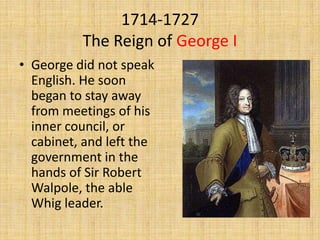
1714-1727
The Reign of George I
• George did not speak
English. He soon
began to stay away
from meetings of his
inner council, or
cabinet, and left the
government in the
hands of Sir Robert
Walpole, the able
Whig leader.
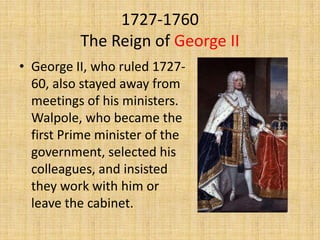
1727-1760
The Reign of George II
• George II, who ruled 172760, also stayed away from
meetings of his ministers.
Walpole, who became the
first Prime minister of the
government, selected his
colleagues, and insisted
they work with him or
leave the cabinet.
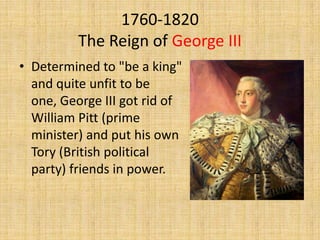
1760-1820
The Reign of George III
• Determined to "be a king"
and quite unfit to be
one, George III got rid of
William Pitt (prime
minister) and put his own
Tory (British political
party) friends in power.
Jacobitism
• On the death of Charles II, his
brother, James VII of Scotland and II of
England, succeeded to the throne. (The
word Jacobite comes from the Latin for
James - Jacobus.) He was a Roman
Catholic and a firm believer in the divine
right of Kings. Both stances made him so
unpopular that in 1688 Parliament invited
William of Orange and Mary to rule. In
1689 James VII & II was deposed. In the
sixty years that followed there were five
attempts to restore James and his
descendents to the throne. The
supporters of James VII & II were called as
“jacobites”.
Scottish Enlightenment
• The 18th-century Scottish Enlightenment,
embodied by such world-class influential
thinkers as Francis Hutcheson, Adam Smith
and David Hume, paved the way for the
modernization of Scotland. Hutcheson, the
father of the Scottish Enlightenment,
championed political liberty and the right
of popular rebellion against tyranny. Smith,
in his monumental Wealth of Nations
(1776), advocated liberty in the sphere of
commerce and the global economy. Hume
developed philosophical concepts that
directly influenced James Madison and thus
the U.S. Constitution.
Industrialisation
• In 1765, James Watt invented the separate
condenser steam engine and The Industrial
Revolution began in Britain, then spread out the
world. It was made up of four sets of changes:
first, the introduction of new technology;
second, the use of new mineral sources of
energy; third, a concentration of workers in
factories; and fourth, new methods of
transportation.
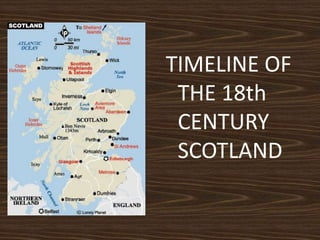
TIMELINE OF
THE 18th
CENTURY
SCOTLAND
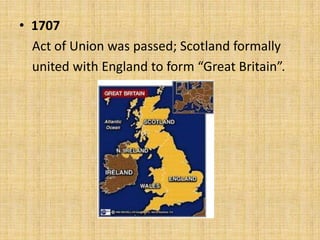
• 1707
Act of Union was passed; Scotland formally
united with England to form “Great Britain”.
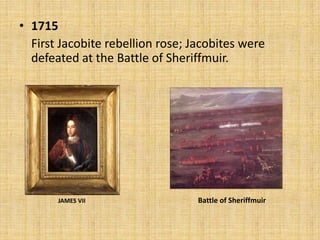
• 1715
First Jacobite rebellion rose; Jacobites were
defeated at the Battle of Sheriffmuir.

JAMES VII

Battle of Sheriffmuir
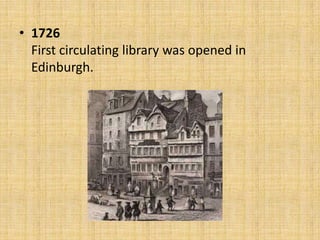
• 1726
First circulating library was opened in
Edinburgh.
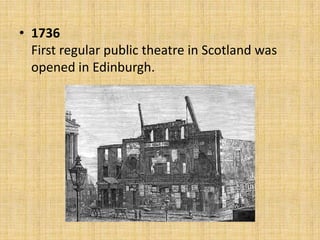
• 1736
First regular public theatre in Scotland was
opened in Edinburgh.
• 1744
The world's first Golf Club was founded.

• 1755
First Scottish census was completed.
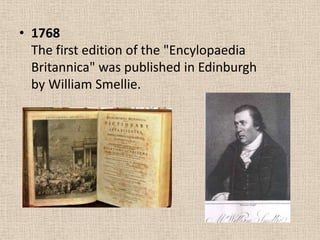
• 1768
The first edition of the "Encylopaedia
Britannica" was published in Edinburgh
by William Smellie.
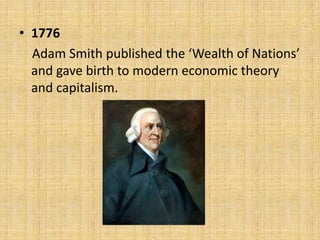
• 1776
Adam Smith published the ‘Wealth of Nations’
and gave birth to modern economic theory
and capitalism.
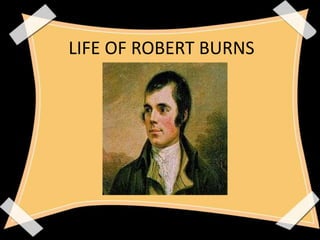
LIFE OF ROBERT BURNS
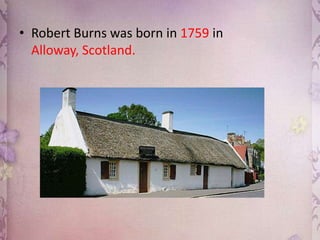
• Robert Burns was born in 1759 in
Alloway, Scotland.
• He had little regular schooling and got
much of his education from his
father, who taught his children
reading, writing, arithmetic, geograph
y, and history and also wrote for them
A Manual Of Christian Belief.
• He was also taught Latin, French, and
mathematics by John Murdoch who
opened an 'adventure school' in Alloway
in 1763.
• By the age of 15, Burns was the principal
labourer at Mount Oliphant. During the
harvest of 1774, he was assisted by Nelly
Kilpatrick, who inspired his first attempt
at poetry, O, Once I Lov'd A Bonnie Lass.
• He is widely regarded as the
national poet of Scotland.
• He is regarded as a pioneer of
the Romantic movement, and
after his death he became a
great source of inspiration to
the founders of both liberalism
and socialism.
• As well as making original
compositions, Burns also
collected folk songs from across
Scotland, often revising or
adapting them.
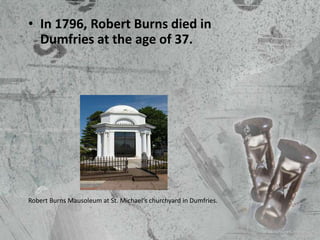
• In 1796, Robert Burns died in
Dumfries at the age of 37.

Robert Burns Mausoleum at St. Michael‘s churchyard in Dumfries.
His notable works
•
•
•
•
•
•
•
•
•

Auld Lang Syne
To a Mouse
A Man's A Man for A' That
Ae Fond Kiss
Scots Wha Hae
Tam O'Shanter
Halloween
The Battle of Sherramuir
A Red, Red Rose
The Analysis of “A Red, Red Rose”
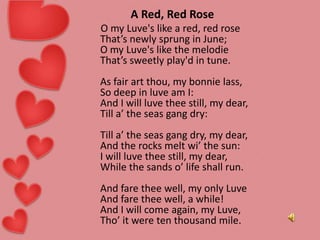
A Red, Red Rose
O my Luve's like a red, red rose
That’s newly sprung in June;
O my Luve's like the melodie
That’s sweetly play'd in tune.
As fair art thou, my bonnie lass,
So deep in luve am I:
And I will luve thee still, my dear,
Till a’ the seas gang dry:
Till a’ the seas gang dry, my dear,
And the rocks melt wi’ the sun:
I will luve thee still, my dear,
While the sands o’ life shall run.
And fare thee well, my only Luve
And fare thee well, a while!
And I will come again, my Luve,
Tho’ it were ten thousand mile.
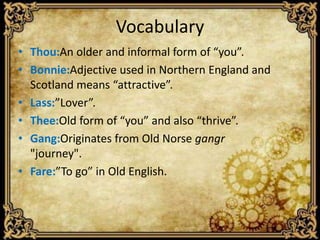
Vocabulary
• Thou:An older and informal form of “you”.
• Bonnie:Adjective used in Northern England and
Scotland means “attractive”.
• Lass:”Lover”.
• Thee:Old form of “you” and also “thrive”.
• Gang:Originates from Old Norse gangr
"journey".
• Fare:”To go” in Old English.
O my Luve's like a red, red rose
That's newly sprung in June;
O my Luve's like the melodie
That's sweetly played in tune.

• The poet composes his sweet
words of love in the following
verses. He loves the young
lady beyond measure.
Through vivid similes and
hyperbolic comparisons he
has drawn his love to the
spring time rosy hues or to
the sweet melodious
tunes. His ladylove is as
fresh as the newly sprung
rose or as sweetly as those of
melodious tune.
• Next the poet addresses
directly his lady as bonnie
or pretty and asserts his
As fair art thou, my bonnie lass,
love in hyperbolic terms
So deep in luve am I;
that he would continue his
And I will luve thee still, my dear, love still all the seas go dry.
Till a' the seas gang dry:
The infinite urge of love
and its permanency can be
copied from these
statements.
Till a' the seas gang dry, my dear,
And the rocks melt wi' the sun;
I will luve thee still, my dear,
While the sands o' life shall run.

• The speaker continues his
exaggerating mood linked to
the previous stanza and
states that he will continue
to love his lady till the rocks
melts way or life leads to
desert of death. “Sands o’
life” probably means the
passage of time which is
compared to the vast desert
land.
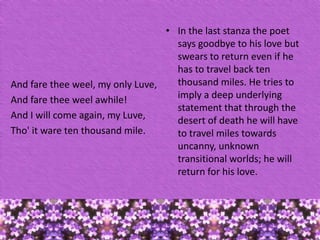
• In the last stanza the poet
says goodbye to his love but
swears to return even if he
has to travel back ten
thousand miles. He tries to
And fare thee weel, my only Luve,
imply a deep underlying
And fare thee weel awhile!
statement that through the
And I will come again, my Luve,
desert of death he will have
Tho' it ware ten thousand mile.
to travel miles towards
uncanny, unknown
transitional worlds; he will
return for his love.
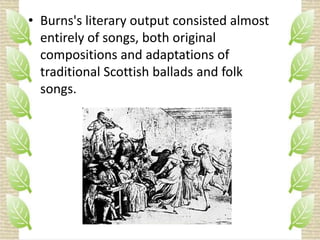
• Burns's literary output consisted almost
entirely of songs, both original
compositions and adaptations of
traditional Scottish ballads and folk
songs.
• He had used the Scottish lowland
vernacular to rhyme in about then
neighbors and their scandals, their
loves and their church.
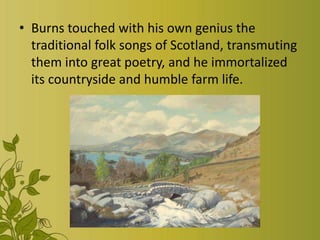
• Burns touched with his own genius the
traditional folk songs of Scotland, transmuting
them into great poetry, and he immortalized
its countryside and humble farm life.
• It is easy to see that though
Burns admired unaffectedly the
"classic" writers, his native
realism and his melody made
him a potent agent in the cause
of naturalism and romance.
GÜLÇİN MOZAKOĞLU
&
DERYA BAYSAL
2-A

A red, red rose by Robert Burns

  • 1.
    A Red, RedRose By ROBERT BURNS
  • 2.
  • 3.
    LANGUAGE • 1. Gaelic: ACeltic language closely related to Irish Gaelic, from which it developed. • 2. Scots A development of a northern form of Old English which by the fifteenth century had become a distinct language, used by the court and throughout the Lowlands and southern Scotland.
  • 4.
    • 3. English Activelyadopted by the Scots for formal speaking and writing, first by their choice of an English translation of the Bible after the Reformation, and then by their efforts to exploit the Union with England in the eighteenth century. Until the middle of this century Scots and Gaelic were forbidden in schools.
  • 5.
    LITERARY BACKGROUND • Theearly struggles of the Scottish kingdom meant a slow development of the arts. Gaelic culture was primarily oral, and at first dominated by the Irish, and not much that is specifically Scottish survives.
  • 6.
    • By thefourteenth century, however, the arts, including literature, emerged, and they were strong in the next century.
  • 7.
    • There wasa close association with the Church and the court. • Despite the wars with England, there was a strong English influence on Scottish poetry, especially from Chaucer.
  • 8.
    • Much literaryactivity was suppressed by the Reformation, with its hostility to the frivolity of the arts. For over a century the energy of the Scots went into theological and political dispute, not only on paper. Much poetry was lost and what survives is found in only a few manuscript collections. • Scott set up a tradition of historical fiction which influenced many writers in other countries.
  • 9.
  • 10.
    1702-1714 The Reign ofQueen Anne • The most notable event during Anne's reign was The Act of Union (1707), which united England with Scotland into a single kingdom, called Great Britain, and joined their Parliaments. Thereafter the government and the Parliament in London was called British rather than English. Since 1603, the two nations had been loosely associated under the same king.
  • 11.
    1714-1727 The Reign ofGeorge I • George did not speak English. He soon began to stay away from meetings of his inner council, or cabinet, and left the government in the hands of Sir Robert Walpole, the able Whig leader.
  • 12.
    1727-1760 The Reign ofGeorge II • George II, who ruled 172760, also stayed away from meetings of his ministers. Walpole, who became the first Prime minister of the government, selected his colleagues, and insisted they work with him or leave the cabinet.
  • 13.
    1760-1820 The Reign ofGeorge III • Determined to "be a king" and quite unfit to be one, George III got rid of William Pitt (prime minister) and put his own Tory (British political party) friends in power.
  • 14.
    Jacobitism • On thedeath of Charles II, his brother, James VII of Scotland and II of England, succeeded to the throne. (The word Jacobite comes from the Latin for James - Jacobus.) He was a Roman Catholic and a firm believer in the divine right of Kings. Both stances made him so unpopular that in 1688 Parliament invited William of Orange and Mary to rule. In 1689 James VII & II was deposed. In the sixty years that followed there were five attempts to restore James and his descendents to the throne. The supporters of James VII & II were called as “jacobites”.
  • 15.
    Scottish Enlightenment • The18th-century Scottish Enlightenment, embodied by such world-class influential thinkers as Francis Hutcheson, Adam Smith and David Hume, paved the way for the modernization of Scotland. Hutcheson, the father of the Scottish Enlightenment, championed political liberty and the right of popular rebellion against tyranny. Smith, in his monumental Wealth of Nations (1776), advocated liberty in the sphere of commerce and the global economy. Hume developed philosophical concepts that directly influenced James Madison and thus the U.S. Constitution.
  • 16.
    Industrialisation • In 1765,James Watt invented the separate condenser steam engine and The Industrial Revolution began in Britain, then spread out the world. It was made up of four sets of changes: first, the introduction of new technology; second, the use of new mineral sources of energy; third, a concentration of workers in factories; and fourth, new methods of transportation.
  • 17.
  • 18.
    • 1707 Act ofUnion was passed; Scotland formally united with England to form “Great Britain”.
  • 19.
    • 1715 First Jacobiterebellion rose; Jacobites were defeated at the Battle of Sheriffmuir. JAMES VII Battle of Sheriffmuir
  • 20.
    • 1726 First circulatinglibrary was opened in Edinburgh.
  • 21.
    • 1736 First regularpublic theatre in Scotland was opened in Edinburgh.
  • 22.
    • 1744 The world'sfirst Golf Club was founded. • 1755 First Scottish census was completed.
  • 23.
    • 1768 The firstedition of the "Encylopaedia Britannica" was published in Edinburgh by William Smellie.
  • 24.
    • 1776 Adam Smithpublished the ‘Wealth of Nations’ and gave birth to modern economic theory and capitalism.
  • 25.
  • 26.
    • Robert Burnswas born in 1759 in Alloway, Scotland.
  • 27.
    • He hadlittle regular schooling and got much of his education from his father, who taught his children reading, writing, arithmetic, geograph y, and history and also wrote for them A Manual Of Christian Belief.
  • 28.
    • He wasalso taught Latin, French, and mathematics by John Murdoch who opened an 'adventure school' in Alloway in 1763. • By the age of 15, Burns was the principal labourer at Mount Oliphant. During the harvest of 1774, he was assisted by Nelly Kilpatrick, who inspired his first attempt at poetry, O, Once I Lov'd A Bonnie Lass.
  • 29.
    • He iswidely regarded as the national poet of Scotland. • He is regarded as a pioneer of the Romantic movement, and after his death he became a great source of inspiration to the founders of both liberalism and socialism.
  • 30.
    • As wellas making original compositions, Burns also collected folk songs from across Scotland, often revising or adapting them.
  • 31.
    • In 1796,Robert Burns died in Dumfries at the age of 37. Robert Burns Mausoleum at St. Michael‘s churchyard in Dumfries.
  • 32.
    His notable works • • • • • • • • • AuldLang Syne To a Mouse A Man's A Man for A' That Ae Fond Kiss Scots Wha Hae Tam O'Shanter Halloween The Battle of Sherramuir A Red, Red Rose
  • 33.
    The Analysis of“A Red, Red Rose”
  • 34.
    A Red, RedRose O my Luve's like a red, red rose That’s newly sprung in June; O my Luve's like the melodie That’s sweetly play'd in tune. As fair art thou, my bonnie lass, So deep in luve am I: And I will luve thee still, my dear, Till a’ the seas gang dry: Till a’ the seas gang dry, my dear, And the rocks melt wi’ the sun: I will luve thee still, my dear, While the sands o’ life shall run. And fare thee well, my only Luve And fare thee well, a while! And I will come again, my Luve, Tho’ it were ten thousand mile.
  • 35.
    Vocabulary • Thou:An olderand informal form of “you”. • Bonnie:Adjective used in Northern England and Scotland means “attractive”. • Lass:”Lover”. • Thee:Old form of “you” and also “thrive”. • Gang:Originates from Old Norse gangr "journey". • Fare:”To go” in Old English.
  • 36.
    O my Luve'slike a red, red rose That's newly sprung in June; O my Luve's like the melodie That's sweetly played in tune. • The poet composes his sweet words of love in the following verses. He loves the young lady beyond measure. Through vivid similes and hyperbolic comparisons he has drawn his love to the spring time rosy hues or to the sweet melodious tunes. His ladylove is as fresh as the newly sprung rose or as sweetly as those of melodious tune.
  • 37.
    • Next thepoet addresses directly his lady as bonnie or pretty and asserts his As fair art thou, my bonnie lass, love in hyperbolic terms So deep in luve am I; that he would continue his And I will luve thee still, my dear, love still all the seas go dry. Till a' the seas gang dry: The infinite urge of love and its permanency can be copied from these statements.
  • 38.
    Till a' theseas gang dry, my dear, And the rocks melt wi' the sun; I will luve thee still, my dear, While the sands o' life shall run. • The speaker continues his exaggerating mood linked to the previous stanza and states that he will continue to love his lady till the rocks melts way or life leads to desert of death. “Sands o’ life” probably means the passage of time which is compared to the vast desert land.
  • 39.
    • In thelast stanza the poet says goodbye to his love but swears to return even if he has to travel back ten thousand miles. He tries to And fare thee weel, my only Luve, imply a deep underlying And fare thee weel awhile! statement that through the And I will come again, my Luve, desert of death he will have Tho' it ware ten thousand mile. to travel miles towards uncanny, unknown transitional worlds; he will return for his love.
  • 40.
    • Burns's literaryoutput consisted almost entirely of songs, both original compositions and adaptations of traditional Scottish ballads and folk songs.
  • 41.
    • He hadused the Scottish lowland vernacular to rhyme in about then neighbors and their scandals, their loves and their church.
  • 42.
    • Burns touchedwith his own genius the traditional folk songs of Scotland, transmuting them into great poetry, and he immortalized its countryside and humble farm life.
  • 43.
    • It iseasy to see that though Burns admired unaffectedly the "classic" writers, his native realism and his melody made him a potent agent in the cause of naturalism and romance.
  • 44.