Resilience
Dr. Suresh Kumar Murugesan PhD
Disclaimer
● This presentation is prepared
for learning purpose only and
all the images and pictures
used in this presentation are
taken from google image
search.
● Due recognition was given to
all the material collected from
the various sources.
● Any name or reference is
missed kindly bring it to the
notice of the presenter for
inclusion.
● Email -
sureshkumar800@yahoo.com
Thank you
Yellow
Pond
Understanding Resilience
Yellow
Pond
“It’s not the
strongest of the
species that
survive, nor the
most intelligent,
but the most
responsive to
change.
- Charles Darwin
The greatest glory of
living, lies not in never
falling, but in rising
every time you fall -
Nelson Mandela
Resilience is the
capacity for
healthy
development
and successful
learning in spite
of challenges.” -
B Benard
Yellow
Pond
Resilience Resilience is the capacity to spring back, rebound, successfully
adapt in the face of adversity and develop social, academic, and
vocational competence despite being exposed to extreme stress or
simply to the stress that is inherent in today’s world. - Henderson
and Milstein, 1996
Yellow
Pond
Resilience is a
pattern of
positive
adaptation in
the context of
past or present
adversity -
Wright &
Master, 2005
Yellow
Pond
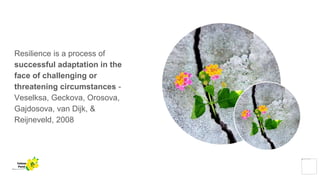
Resilience is a process of
successful adaptation in the
face of challenging or
threatening circumstances -
Veselksa, Geckova, Orosova,
Gajdosova, van Dijk, &
Reijneveld, 2008
Yellow
Pond
Yellow
Pond
“A diamond is just a
piece of charcoal
that handles stress
exceptionally well.”
— Anonymous
Yellow
Pond
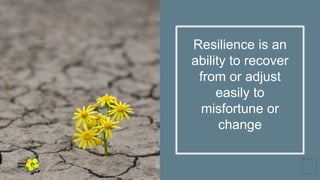
Resilience is an
ability to recover
from or adjust
easily to
misfortune or
change
Yellow
Pond
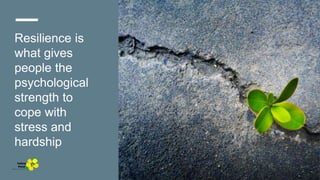
Resilience is
what gives
people the
psychological
strength to
cope with
stress and
hardship
Yellow
Pond
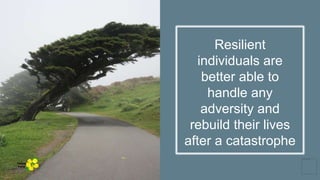
Resilient
individuals are
better able to
handle any
adversity and
rebuild their lives
after a catastrophe
Yellow
Pond
Traits of Resilience
Yellow
Pond
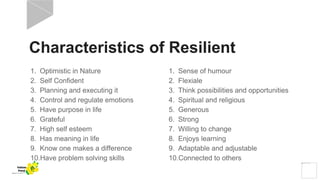
Characteristics of Resilient
1. Sense of humour
2. Flexiale
3. Think possibilities and opportunities
4. Spiritual and religious
5. Generous
6. Strong
7. Willing to change
8. Enjoys learning
9. Adaptable and adjustable
10.Connected to others
1. Optimistic in Nature
2. Self Confident
3. Planning and executing it
4. Control and regulate emotions
5. Have purpose in life
6. Grateful
7. High self esteem
8. Has meaning in life
9. Know one makes a difference
10.Have problem solving skills
Yellow
Pond
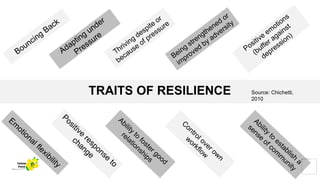
TRAITS OF RESILIENCE Source: Chichetti,
2010
Yellow
Pond
Benefits of Resilience
15 Elements of Resilience
Yellow
Pond
15 ELEMENTS OF RESILIENCE
✔I HAVE
✔I AM
✔I CAN
✔ (from “Reaching Today’s Youth”, vol.2, Issue 3, p. 37, Spring 1998)
Yellow
Pond
I HAVE
1. People around me I trust + who love me, no matter
what. [TRUSTING/LOVING]
2. People who set limits for me so I know when to stop
before there is danger or trouble. [LIMIT SETTING]
3. People who show me how to do things right by the
way they do things. [POSITIVE ROLE MODELING]
4. People who want me to learn to do things on my
own.[PERSONAL INITIATIVE]
5. People who help me when I am sick, in danger,
or need to learn. [CARING, INVOLVED
FRIENDS]
Yellow
Pond
I AM
6. A person people can like and love.
[LIKEABLE/LOVABLE]
7. Glad to do nice things for others + show my
concern. [EMPATHETIC]
8. Respectful of myself + others. [RESPECTFUL]
9. Willing to be responsible for what I do.
[RESPONSIBLE]
10. Sure things will be alright. [CONFIDENT]
Yellow
Pond
I CAN
11. Talk to others about things that frighten me or
bother me. [CONSULT OTHERS]
12. Find ways to solve problems that I face.
[SOLVE PROBLEMS]
13. Control myself when I feel like doing
something not right or dangerous. [CONTROL
MYSELF POSITIVELY]
14. Figure out when it is a good time to talk to
someone or take action. [MAKE GOOD
DECISIONS]
15. Find someone to help me when I need it.
[SEEK HELP]
Yellow
Pond
5 C’s of Resilience
Yellow
Pond
I. Connection ● Good relationships with friends and family members
● Involve in community and social activities
● Internalise a sense of belonging and connectedness
● Connect with self and others
● Give priority and value to the connection rather than gadgets
Yellow
Pond
II.
Communication
● have an ability to share, explain, explore and understand
● ability to reframe what has happened
● develop on insight and understanding
● make right judgement
Yellow
Pond
III. Confidence ● Positive yet realistic view of themselves
● Accurate sense of their abilities
● Lean from the mistakes
● Able to visualize their goals
● Recognise their potentials
● Believe themselves to be
Yellow
Pond
IV. Competence
and Commitment
● Able to look the big picture
● Able to solve the problems
● Follow through but not giving up
● Working towards the goals in every day
Yellow
Pond
V. Control ● Manage their strong feelings
● Enhance their relationship and productivity
● Develop coping skills and strategies
● Keep the things in perspective
● Understand the roles and responsibilities
● have control on thought, emotion and behaviour
Yellow
Pond
8 Resilience Strategies for
Children
Yellow
Pond
Strategy - 1 1. Encourage the Development of a positive attitude,
self belief and Communication
• Provide positive feedback, encouragement and
reassurance
• Help children learn to understand and express their
feelings
• Communicate openly with children
Yellow
Pond
Strategy - 2 2. Increase support network for Children
• Someone to talk to
• One to one support at home, school and community
level
• Peer support/ buddying/ befriending
• Foster a culture of listening
Yellow
Pond
Strategy - 3 3. Encourage the building of trusting and
cooperative relationship
• Foster mutual respect between everyone in the family,
community and at school
• Recognize outside pressures/ influences on children
• Activity days / residential trips
Yellow
Pond
Strategy - 4 4. Increase children engagement with learning
• Flexible use of teaching methods and styles
• Opportunities for performance
• Provide additional support for learning
• Assessments to plan learning experiences
Yellow
Pond
Strategy - 5 5. Foster a positive and inclusive ethos
• Build a sense of belongingness
• Involve children in decision making
• Celebrate diversity within the community and school
Yellow
Pond
Strategy - 6 6. Activity
• Development of safe social areas in community and
school play areas
• Participation in health promoting community activities
• Helping the elderly in the community
• Activities of mental, emotional and behaviour should
be given
Yellow
Pond
Strategy - 7 7. Encourage a sense of fun
• Make time to have fun in a day
• Opportunity for games, laughter, jokes and relaxation
• Enrol children in dance classes
• Participation in festivals and meets in community and
schools
Yellow
Pond
Strategy - 8 8. Develop life skills
• Practical work should be given
• Children are motivated to involve and take
responsibility
• Motivate them to gain work experience / Voluntary
work
• Opportunity to think and act in positive ways
• Build literacy and numeracy skills
Yellow
Pond
Strategies to Promote
Resilience
Yellow
Pond
Yellow
Pond
Factors of Resilience
Yellow
Pond
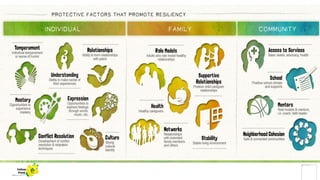
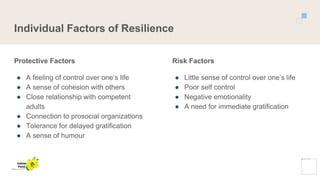
Individual Factors of Resilience
Protective Factors
● A feeling of control over one’s life
● A sense of cohesion with others
● Close relationship with competent
adults
● Connection to prosocial organizations
● Tolerance for delayed gratification
● A sense of humour
Risk Factors
● Little sense of control over one’s life
● Poor self control
● Negative emotionality
● A need for immediate gratification
Yellow
Pond
Family Factors of Resilience
Risk Factors
● Limited resources
● Low socioeconomic status
● Communities that lack the ability or
resources to reach out to those in need
of assistance
Protective Factors
● Participation in school, work and
community with a sense of belonging
and contribution
● A social network peers
● An opportunity to learn to handle
challenges
Yellow
Pond
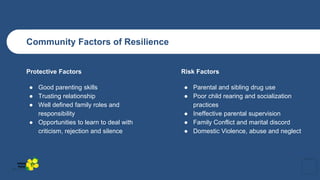
Community Factors of Resilience
Protective Factors
● Good parenting skills
● Trusting relationship
● Well defined family roles and
responsibility
● Opportunities to learn to deal with
criticism, rejection and silence
Risk Factors
● Parental and sibling drug use
● Poor child rearing and socialization
practices
● Ineffective parental supervision
● Family Conflict and marital discord
● Domestic Violence, abuse and neglect
Yellow
Pond
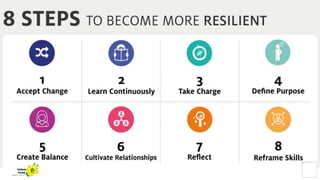
8 steps to become more
Resilient
Yellow
Pond
Yellow
Pond
Personal Resilience
Strategies for Teachers
Yellow
Pond
Yellow
Pond
More Resilience Strategies
Yellow
Pond
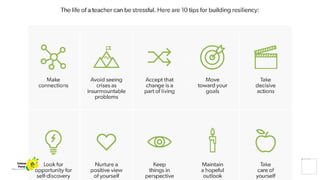
More Resilience Strategies
1. Develop supportive and caring relationships at
home, among friends and colleagues.
2. Accept help and support and help others when
they need it.
3. Receiving & appreciating kindness from others
may be just as important as offering it up.
4. This is because gratitude is an important part of
resiliency.
5. Remember that some crises are beyond your
control.
6. You cannot change events however you can
change the way you interpret and react to them.
7. It’s important that you try to accept this and look
ahead.
8. Accept that change is part of life and that you
will have to adapt to changing circumstances.
9. Set some realistic goals and take regular small
steps towards achieving them.
10. Do scary or adventure things
11. Practice positive emotion Exercise
1. Ask yourself, “What’s the one thing I can
accomplish today?” rather than focusing on the
overarching goal.
2. Be decisive – do as much as you can rather
than avoiding problems and hoping they will go
away.
3. Try to understand your own experiences of
dealing with loss, hardship or emotional
problems.
4. Appreciate what you have learned from these
difficult issues.
5. Develop a positive view about yourself and be
confident in your strengths and abilities.
6. Try to take a longer-term perspective and don’t
blow the significance of the event out of
proportion.
7. Stay hopeful and optimistic.
8. Visualise what you want, rather than worrying
about what you fear.
9. Look after yourself – your health, fitness and
need for relaxation and peace.
10. Looking after yourself will give you the strength
and balance to deal with difficult situations.
11. Hand on Heart serenity exercise
12. Gratitude practices
Yellow
Pond
Resilience in Children, Teen
and Adult
Yellow
Pond
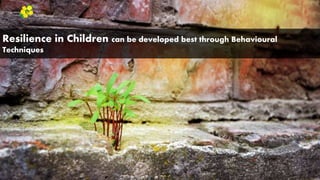
Resilience in Children can be developed best through Behavioural
Techniques
Yellow
Pond
Resilience in Adolescence can be developed best through emotional Techniques
Yellow
Pond
Resilience in Adult can be developed best through Cognitive Techniques
Yellow
Pond
Yellow
Pond
About the
Presenters
● Dr.Suresh Kumar Murugesan PhD
and Dr. Veenavani are Founders of
Yellow Pond Counselling and
Wellness Centre
● Both are passionate
Psychotherapists striving towards
Excellence

Resilience 1.0

  • 1.
  • 2.
    Disclaimer ● This presentationis prepared for learning purpose only and all the images and pictures used in this presentation are taken from google image search. ● Due recognition was given to all the material collected from the various sources. ● Any name or reference is missed kindly bring it to the notice of the presenter for inclusion. ● Email - sureshkumar800@yahoo.com Thank you Yellow Pond
  • 3.
  • 4.
    “It’s not the strongestof the species that survive, nor the most intelligent, but the most responsive to change. - Charles Darwin
  • 5.
    The greatest gloryof living, lies not in never falling, but in rising every time you fall - Nelson Mandela
  • 6.
    Resilience is the capacityfor healthy development and successful learning in spite of challenges.” - B Benard Yellow Pond
  • 7.
    Resilience Resilience isthe capacity to spring back, rebound, successfully adapt in the face of adversity and develop social, academic, and vocational competence despite being exposed to extreme stress or simply to the stress that is inherent in today’s world. - Henderson and Milstein, 1996 Yellow Pond
  • 8.
    Resilience is a patternof positive adaptation in the context of past or present adversity - Wright & Master, 2005 Yellow Pond
  • 9.
    Resilience is aprocess of successful adaptation in the face of challenging or threatening circumstances - Veselksa, Geckova, Orosova, Gajdosova, van Dijk, & Reijneveld, 2008 Yellow Pond
  • 10.
  • 11.
    “A diamond isjust a piece of charcoal that handles stress exceptionally well.” — Anonymous Yellow Pond
  • 12.
    Resilience is an abilityto recover from or adjust easily to misfortune or change Yellow Pond
  • 13.
    Resilience is what gives peoplethe psychological strength to cope with stress and hardship Yellow Pond
  • 14.
    Resilient individuals are better ableto handle any adversity and rebuild their lives after a catastrophe Yellow Pond
  • 15.
  • 16.
    Characteristics of Resilient 1.Sense of humour 2. Flexiale 3. Think possibilities and opportunities 4. Spiritual and religious 5. Generous 6. Strong 7. Willing to change 8. Enjoys learning 9. Adaptable and adjustable 10.Connected to others 1. Optimistic in Nature 2. Self Confident 3. Planning and executing it 4. Control and regulate emotions 5. Have purpose in life 6. Grateful 7. High self esteem 8. Has meaning in life 9. Know one makes a difference 10.Have problem solving skills Yellow Pond
  • 17.
    TRAITS OF RESILIENCESource: Chichetti, 2010 Yellow Pond
  • 18.
  • 20.
    15 Elements ofResilience Yellow Pond
  • 21.
    15 ELEMENTS OFRESILIENCE ✔I HAVE ✔I AM ✔I CAN ✔ (from “Reaching Today’s Youth”, vol.2, Issue 3, p. 37, Spring 1998) Yellow Pond
  • 22.
    I HAVE 1. Peoplearound me I trust + who love me, no matter what. [TRUSTING/LOVING] 2. People who set limits for me so I know when to stop before there is danger or trouble. [LIMIT SETTING] 3. People who show me how to do things right by the way they do things. [POSITIVE ROLE MODELING] 4. People who want me to learn to do things on my own.[PERSONAL INITIATIVE] 5. People who help me when I am sick, in danger, or need to learn. [CARING, INVOLVED FRIENDS] Yellow Pond
  • 23.
    I AM 6. Aperson people can like and love. [LIKEABLE/LOVABLE] 7. Glad to do nice things for others + show my concern. [EMPATHETIC] 8. Respectful of myself + others. [RESPECTFUL] 9. Willing to be responsible for what I do. [RESPONSIBLE] 10. Sure things will be alright. [CONFIDENT] Yellow Pond
  • 24.
    I CAN 11. Talkto others about things that frighten me or bother me. [CONSULT OTHERS] 12. Find ways to solve problems that I face. [SOLVE PROBLEMS] 13. Control myself when I feel like doing something not right or dangerous. [CONTROL MYSELF POSITIVELY] 14. Figure out when it is a good time to talk to someone or take action. [MAKE GOOD DECISIONS] 15. Find someone to help me when I need it. [SEEK HELP] Yellow Pond
  • 25.
    5 C’s ofResilience Yellow Pond
  • 26.
    I. Connection ●Good relationships with friends and family members ● Involve in community and social activities ● Internalise a sense of belonging and connectedness ● Connect with self and others ● Give priority and value to the connection rather than gadgets Yellow Pond
  • 27.
    II. Communication ● have anability to share, explain, explore and understand ● ability to reframe what has happened ● develop on insight and understanding ● make right judgement Yellow Pond
  • 28.
    III. Confidence ●Positive yet realistic view of themselves ● Accurate sense of their abilities ● Lean from the mistakes ● Able to visualize their goals ● Recognise their potentials ● Believe themselves to be Yellow Pond
  • 29.
    IV. Competence and Commitment ●Able to look the big picture ● Able to solve the problems ● Follow through but not giving up ● Working towards the goals in every day Yellow Pond
  • 30.
    V. Control ●Manage their strong feelings ● Enhance their relationship and productivity ● Develop coping skills and strategies ● Keep the things in perspective ● Understand the roles and responsibilities ● have control on thought, emotion and behaviour Yellow Pond
  • 31.
    8 Resilience Strategiesfor Children Yellow Pond
  • 32.
    Strategy - 11. Encourage the Development of a positive attitude, self belief and Communication • Provide positive feedback, encouragement and reassurance • Help children learn to understand and express their feelings • Communicate openly with children Yellow Pond
  • 33.
    Strategy - 22. Increase support network for Children • Someone to talk to • One to one support at home, school and community level • Peer support/ buddying/ befriending • Foster a culture of listening Yellow Pond
  • 34.
    Strategy - 33. Encourage the building of trusting and cooperative relationship • Foster mutual respect between everyone in the family, community and at school • Recognize outside pressures/ influences on children • Activity days / residential trips Yellow Pond
  • 35.
    Strategy - 44. Increase children engagement with learning • Flexible use of teaching methods and styles • Opportunities for performance • Provide additional support for learning • Assessments to plan learning experiences Yellow Pond
  • 36.
    Strategy - 55. Foster a positive and inclusive ethos • Build a sense of belongingness • Involve children in decision making • Celebrate diversity within the community and school Yellow Pond
  • 37.
    Strategy - 66. Activity • Development of safe social areas in community and school play areas • Participation in health promoting community activities • Helping the elderly in the community • Activities of mental, emotional and behaviour should be given Yellow Pond
  • 38.
    Strategy - 77. Encourage a sense of fun • Make time to have fun in a day • Opportunity for games, laughter, jokes and relaxation • Enrol children in dance classes • Participation in festivals and meets in community and schools Yellow Pond
  • 39.
    Strategy - 88. Develop life skills • Practical work should be given • Children are motivated to involve and take responsibility • Motivate them to gain work experience / Voluntary work • Opportunity to think and act in positive ways • Build literacy and numeracy skills Yellow Pond
  • 40.
  • 41.
  • 42.
  • 43.
    Individual Factors ofResilience Protective Factors ● A feeling of control over one’s life ● A sense of cohesion with others ● Close relationship with competent adults ● Connection to prosocial organizations ● Tolerance for delayed gratification ● A sense of humour Risk Factors ● Little sense of control over one’s life ● Poor self control ● Negative emotionality ● A need for immediate gratification Yellow Pond
  • 44.
    Family Factors ofResilience Risk Factors ● Limited resources ● Low socioeconomic status ● Communities that lack the ability or resources to reach out to those in need of assistance Protective Factors ● Participation in school, work and community with a sense of belonging and contribution ● A social network peers ● An opportunity to learn to handle challenges Yellow Pond
  • 45.
    Community Factors ofResilience Protective Factors ● Good parenting skills ● Trusting relationship ● Well defined family roles and responsibility ● Opportunities to learn to deal with criticism, rejection and silence Risk Factors ● Parental and sibling drug use ● Poor child rearing and socialization practices ● Ineffective parental supervision ● Family Conflict and marital discord ● Domestic Violence, abuse and neglect Yellow Pond
  • 46.
    8 steps tobecome more Resilient Yellow Pond
  • 47.
  • 48.
  • 49.
  • 50.
  • 51.
    More Resilience Strategies 1.Develop supportive and caring relationships at home, among friends and colleagues. 2. Accept help and support and help others when they need it. 3. Receiving & appreciating kindness from others may be just as important as offering it up. 4. This is because gratitude is an important part of resiliency. 5. Remember that some crises are beyond your control. 6. You cannot change events however you can change the way you interpret and react to them. 7. It’s important that you try to accept this and look ahead. 8. Accept that change is part of life and that you will have to adapt to changing circumstances. 9. Set some realistic goals and take regular small steps towards achieving them. 10. Do scary or adventure things 11. Practice positive emotion Exercise 1. Ask yourself, “What’s the one thing I can accomplish today?” rather than focusing on the overarching goal. 2. Be decisive – do as much as you can rather than avoiding problems and hoping they will go away. 3. Try to understand your own experiences of dealing with loss, hardship or emotional problems. 4. Appreciate what you have learned from these difficult issues. 5. Develop a positive view about yourself and be confident in your strengths and abilities. 6. Try to take a longer-term perspective and don’t blow the significance of the event out of proportion. 7. Stay hopeful and optimistic. 8. Visualise what you want, rather than worrying about what you fear. 9. Look after yourself – your health, fitness and need for relaxation and peace. 10. Looking after yourself will give you the strength and balance to deal with difficult situations. 11. Hand on Heart serenity exercise 12. Gratitude practices Yellow Pond
  • 52.
    Resilience in Children,Teen and Adult Yellow Pond
  • 53.
    Resilience in Childrencan be developed best through Behavioural Techniques Yellow Pond
  • 54.
    Resilience in Adolescencecan be developed best through emotional Techniques Yellow Pond
  • 55.
    Resilience in Adultcan be developed best through Cognitive Techniques Yellow Pond
  • 56.
  • 57.
    About the Presenters ● Dr.SureshKumar Murugesan PhD and Dr. Veenavani are Founders of Yellow Pond Counselling and Wellness Centre ● Both are passionate Psychotherapists striving towards Excellence