PEER PRESSURE
SCHOOL GUIDANCE AND SUPPORT
PRESENTED
BY
TSHIDISO THLAKA
WHAT IS PEER PRESSURE?
PEER PRESSURE
• Refers to a strong influence of a group, especially of children, on the
members of that group to behave as everyone else does.
• The influence can be positive to the children’s development, for example,
Peer pressure may convince adolescents to engage in prosocial behaviour
such as doing community service or exercising.
Prosocial relates to behaviours that
are positive, helpful, and intended to
promote social acceptance and
friendship.
FURTHER….
• Peer pressure may also work to prevent behaviours usually connected
with succumbing to peer pressure; for example, peer pressure may
encourage an adolescent not to drink or smoke because his or her friends
disapprove.
• However, peer pressure’s impact is usually negative. The problem with
peer pressure comes when adolescents “adopt the attitudes or behaviour
of others because of real or imagined pressure from them”; this process
is known as conformity (Santrock 314-315). When adolescents begin to
conform to antisocial peer pressure they can be thrown into situations
that end poorly.
WHO IS AT RISK?
• The simple answer is everyone. Every adolescent is going to encounter peer
pressure in some form in their lives.
• These groups will be shown on the next slide:
Adolescence in this situations might be at risk:
• …from single-parent homes
• …with overly permissive parents
• …with authoritarian parents
• …with low self-esteem
• …from dysfunctional homes
• …exposed to antisocial behaviour through their peers or family
Where’s is the threat?
• One location is usually at the centre of the threat for peer pressure: which is
school.
• Because adolescents spend a large portion of their time in school and is
place in which they meet with friends and socialize.
• Since more time is spent on the school setting, one can easily agree that peer
pressure originates in schools.
What causes adolescence to succumb to
peer pressure?
• Adolescence is a time when kids are trying to figure out who they are, at the
same time they are adjusting to numerous physical changes.
• It’s a time when they’re trying to balance the hormonal changes of puberty
with the weekly changes of homework and extracurricular schedules.
• During all this, adolescents search for an identity and find themselves with
increased autonomy as they become less reliant on their parents.
Identifying conformity to Peer Pressure?
• Because so many adolescents will encounter peer pressure, it is important to
recognize if they have begun to conform to it so that intervention – if
necessary– can take place.
• Teachers can also communicate with parents and other teachers to gather
other perspectives and input on the adolescent.
• Teacher, parents, and counsellors should look for the following warning
signs when attempting to identify conformity to peer pressure:
Warning signs of conformity
• It is important to realize none of these indicators are sure-fire signs an adolescent
has succumbed to peer pressure; there is no definitive way to predict this.
• The following are reliable signs that an adolescence has begun to conform to peer
pressure :
behaviour
 language
 clothing
 attitudes
 preferences (music, etc.)
 values, morals, or beliefs
“
”
PARENTS AND TEACHERS IT IS OUR
RESPONISIBILITY TO ENSURE THAT PEER
PRESSURE IS FOREVER POSITIVE.
THANK YOU
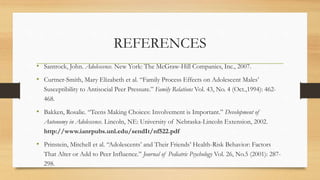
REFERENCES
• Santrock, John. Adolescence. New York: The McGraw-Hill Companies, Inc., 2007.
• Curtner-Smith, Mary Elizabeth et al. “Family Process Effects on Adolescent Males’
Susceptibility to Antisocial Peer Pressure.” Family Relations Vol. 43, No. 4 (Oct.,1994): 462-
468.
• Bakken, Rosalie. “Teens Making Choices: Involvement is Important.” Development of
Autonomy in Adolescence. Lincoln, NE: University of Nebraska-Lincoln Extension, 2002.
http://www.ianrpubs.unl.edu/sendIt/nf522.pdf
• Prinstein, Mitchell et al. “Adolescents’ and Their Friends’ Health-Risk Behavior: Factors
That Alter or Add to Peer Influence.” Journal of Pediatric Psychology Vol. 26, No.5 (2001): 287-
298.

Peer pressure

  • 1.
    PEER PRESSURE SCHOOL GUIDANCEAND SUPPORT PRESENTED BY TSHIDISO THLAKA
  • 2.
    WHAT IS PEERPRESSURE?
  • 3.
    PEER PRESSURE • Refersto a strong influence of a group, especially of children, on the members of that group to behave as everyone else does. • The influence can be positive to the children’s development, for example, Peer pressure may convince adolescents to engage in prosocial behaviour such as doing community service or exercising. Prosocial relates to behaviours that are positive, helpful, and intended to promote social acceptance and friendship.
  • 4.
    FURTHER…. • Peer pressuremay also work to prevent behaviours usually connected with succumbing to peer pressure; for example, peer pressure may encourage an adolescent not to drink or smoke because his or her friends disapprove. • However, peer pressure’s impact is usually negative. The problem with peer pressure comes when adolescents “adopt the attitudes or behaviour of others because of real or imagined pressure from them”; this process is known as conformity (Santrock 314-315). When adolescents begin to conform to antisocial peer pressure they can be thrown into situations that end poorly.
  • 5.
    WHO IS ATRISK? • The simple answer is everyone. Every adolescent is going to encounter peer pressure in some form in their lives. • These groups will be shown on the next slide:
  • 6.
    Adolescence in thissituations might be at risk: • …from single-parent homes • …with overly permissive parents • …with authoritarian parents • …with low self-esteem • …from dysfunctional homes • …exposed to antisocial behaviour through their peers or family
  • 7.
    Where’s is thethreat? • One location is usually at the centre of the threat for peer pressure: which is school. • Because adolescents spend a large portion of their time in school and is place in which they meet with friends and socialize. • Since more time is spent on the school setting, one can easily agree that peer pressure originates in schools.
  • 8.
    What causes adolescenceto succumb to peer pressure? • Adolescence is a time when kids are trying to figure out who they are, at the same time they are adjusting to numerous physical changes. • It’s a time when they’re trying to balance the hormonal changes of puberty with the weekly changes of homework and extracurricular schedules. • During all this, adolescents search for an identity and find themselves with increased autonomy as they become less reliant on their parents.
  • 9.
    Identifying conformity toPeer Pressure? • Because so many adolescents will encounter peer pressure, it is important to recognize if they have begun to conform to it so that intervention – if necessary– can take place. • Teachers can also communicate with parents and other teachers to gather other perspectives and input on the adolescent. • Teacher, parents, and counsellors should look for the following warning signs when attempting to identify conformity to peer pressure:
  • 10.
    Warning signs ofconformity • It is important to realize none of these indicators are sure-fire signs an adolescent has succumbed to peer pressure; there is no definitive way to predict this. • The following are reliable signs that an adolescence has begun to conform to peer pressure : behaviour  language  clothing  attitudes  preferences (music, etc.)  values, morals, or beliefs
  • 11.
    “ ” PARENTS AND TEACHERSIT IS OUR RESPONISIBILITY TO ENSURE THAT PEER PRESSURE IS FOREVER POSITIVE. THANK YOU
  • 12.
    REFERENCES • Santrock, John.Adolescence. New York: The McGraw-Hill Companies, Inc., 2007. • Curtner-Smith, Mary Elizabeth et al. “Family Process Effects on Adolescent Males’ Susceptibility to Antisocial Peer Pressure.” Family Relations Vol. 43, No. 4 (Oct.,1994): 462- 468. • Bakken, Rosalie. “Teens Making Choices: Involvement is Important.” Development of Autonomy in Adolescence. Lincoln, NE: University of Nebraska-Lincoln Extension, 2002. http://www.ianrpubs.unl.edu/sendIt/nf522.pdf • Prinstein, Mitchell et al. “Adolescents’ and Their Friends’ Health-Risk Behavior: Factors That Alter or Add to Peer Influence.” Journal of Pediatric Psychology Vol. 26, No.5 (2001): 287- 298.