Chapter  4: Managing Stress and Coping with Loss Lesson 1—Understanding Stress
Your Body’s Response to Stressors The Stress Response—The Three Stages Alarm—Your mind and body go on high alert. This reaction is sometimes referred to as the “fight-or-flight” response because it prepares your body to either defend itself or to flee from a threat Resistance—If exposure to a stressor continues, your body adapts and reacts to the stressor. You may perform at a higher level and with more endurance for a brief period of time. Fatigue—If exposure to stress is prolonged, your body loses its ability to adapt. You begin to tire and lose the ability to manage other stressors effectively.
Physical Symptoms of The Alarm Response Dilated pupils Increase in perspiration Faster heart rate and pulse Rise in blood pressure Faster respiration rate Narrowing of arteries to internal organs and skin Increased blood flow to muscles and brain Increase in muscle tension Release of blood sugar, fats, and cholesterol
How Does Stress Affect Your Physical Health? The physical changes that take place in your body during the stress response can take a toll on your body.  Prolonged stress can lead to a  psychomatic response , a physical reaction that results from stress rather than from injury or illness: Headache A weakened immune system High blood pressure Bruxism, clenching the jaw or grinding the teeth Digestive disorders
Chapter  4: Managing Stress and Coping with Loss Lesson 2—Managing Stress
Stress-Management Techniques Use refusal skills Plan ahead Think positively Practice relaxation techniques Redirect your energy
Staying Healthy and Building Resiliency Get Adequate Rest Use time management skills Get regular physical activity 30-60 minutes of physical activity daily Eat nutritious foods Poor eating habits can contribute to stress, causing weakness
Chapter  4: Managing Stress and Coping with Loss Lesson 3—Coping with Loss and Grief
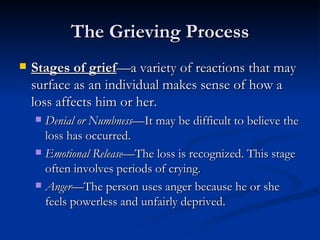
The Grieving Process Stages of grief —a variety of reactions that may surface as an individual makes sense of how a loss affects him or her.  Denial or Numbness —It may be difficult to believe the loss has occurred. Emotional Release —The loss is recognized. This stage often involves periods of crying. Anger —The person uses anger because he or she feels powerless and unfairly deprived.
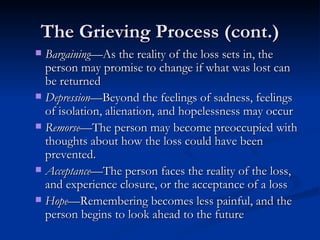
The Grieving Process (cont.) Bargaining —As the reality of the loss sets in, the person may promise to change if what was lost can be returned Depression —Beyond the feelings of sadness, feelings of isolation, alienation, and hopelessness may occur Remorse —The person may become preoccupied with thoughts about how the loss could have been prevented. Acceptance —The person faces the reality of the loss, and experience closure, or the acceptance of a loss Hope— Remembering becomes less painful, and the person begins to look ahead to the future
Empathy The action of understanding, being aware of, being sensitive to, and vicariously experiencing the feelings, thoughts, and experience of another, of either the past or present, without having the feelings, thoughts, and experience fully communicated in an objectively explicit manner.
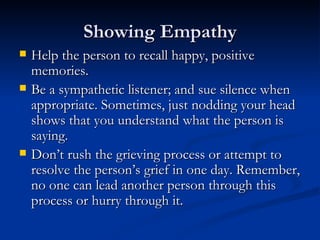
Showing Empathy Help the person to recall happy, positive memories. Be a sympathetic listener; and sue silence when appropriate. Sometimes, just nodding your head shows that you understand what the person is saying. Don’t rush the grieving process or attempt to resolve the person’s grief in one day. Remember, no one can lead another person through this process or hurry through it.

Chapter 4: Managing Stress and Coping with Loss

  • 1.
    Chapter 4:Managing Stress and Coping with Loss Lesson 1—Understanding Stress
  • 2.
    Your Body’s Responseto Stressors The Stress Response—The Three Stages Alarm—Your mind and body go on high alert. This reaction is sometimes referred to as the “fight-or-flight” response because it prepares your body to either defend itself or to flee from a threat Resistance—If exposure to a stressor continues, your body adapts and reacts to the stressor. You may perform at a higher level and with more endurance for a brief period of time. Fatigue—If exposure to stress is prolonged, your body loses its ability to adapt. You begin to tire and lose the ability to manage other stressors effectively.
  • 3.
    Physical Symptoms ofThe Alarm Response Dilated pupils Increase in perspiration Faster heart rate and pulse Rise in blood pressure Faster respiration rate Narrowing of arteries to internal organs and skin Increased blood flow to muscles and brain Increase in muscle tension Release of blood sugar, fats, and cholesterol
  • 4.
    How Does StressAffect Your Physical Health? The physical changes that take place in your body during the stress response can take a toll on your body. Prolonged stress can lead to a psychomatic response , a physical reaction that results from stress rather than from injury or illness: Headache A weakened immune system High blood pressure Bruxism, clenching the jaw or grinding the teeth Digestive disorders
  • 5.
    Chapter 4:Managing Stress and Coping with Loss Lesson 2—Managing Stress
  • 6.
    Stress-Management Techniques Userefusal skills Plan ahead Think positively Practice relaxation techniques Redirect your energy
  • 7.
    Staying Healthy andBuilding Resiliency Get Adequate Rest Use time management skills Get regular physical activity 30-60 minutes of physical activity daily Eat nutritious foods Poor eating habits can contribute to stress, causing weakness
  • 8.
    Chapter 4:Managing Stress and Coping with Loss Lesson 3—Coping with Loss and Grief
  • 9.
    The Grieving ProcessStages of grief —a variety of reactions that may surface as an individual makes sense of how a loss affects him or her. Denial or Numbness —It may be difficult to believe the loss has occurred. Emotional Release —The loss is recognized. This stage often involves periods of crying. Anger —The person uses anger because he or she feels powerless and unfairly deprived.
  • 10.
    The Grieving Process(cont.) Bargaining —As the reality of the loss sets in, the person may promise to change if what was lost can be returned Depression —Beyond the feelings of sadness, feelings of isolation, alienation, and hopelessness may occur Remorse —The person may become preoccupied with thoughts about how the loss could have been prevented. Acceptance —The person faces the reality of the loss, and experience closure, or the acceptance of a loss Hope— Remembering becomes less painful, and the person begins to look ahead to the future
  • 11.
    Empathy The actionof understanding, being aware of, being sensitive to, and vicariously experiencing the feelings, thoughts, and experience of another, of either the past or present, without having the feelings, thoughts, and experience fully communicated in an objectively explicit manner.
  • 12.
    Showing Empathy Helpthe person to recall happy, positive memories. Be a sympathetic listener; and sue silence when appropriate. Sometimes, just nodding your head shows that you understand what the person is saying. Don’t rush the grieving process or attempt to resolve the person’s grief in one day. Remember, no one can lead another person through this process or hurry through it.