Lesson 1   Understanding Healthy Relationships
Introduction  In this lesson students examine the characteristics and benefits of healthy relationships and the characteristics of unhealthy relationships. Students also learn about the importance of effective communication to the development and maintenance of a healthy relationship. They examine elements and styles of communication, including the potential impact of technology on effective communication.
Specific Learning Outcomes Demonstrate understanding of the characteristics of healthy and unhealthy relationships, and discuss factors that might influence their development.  Demonstrate understanding of effective communication within a relationship and the potential impact of technology on communication within a relationship.
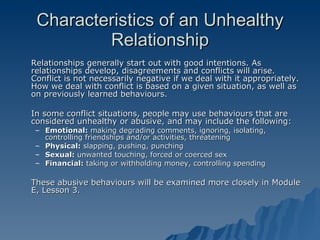
Characteristics of an Unhealthy Relationship Relationships generally start out with good intentions. As relationships develop, disagreements and conflicts will arise. Conflict is not necessarily negative if we deal with it appropriately. How we deal with conflict is based on a given situation, as well as on previously learned behaviours. In some conflict situations, people may use behaviours that are considered unhealthy or abusive, and may include the following: Emotional:  making degrading comments, ignoring, isolating, controlling friendships and/or activities, threatening Physical:  slapping, pushing, punching Sexual:  unwanted touching, forced or coerced sex Financial:  taking or withholding money, controlling spending These abusive behaviours will be examined more closely in Module E, Lesson 3.
Assignment Have each student complete RM 1–HR .  Encourage students to elaborate on their answers, using more paper as needed.
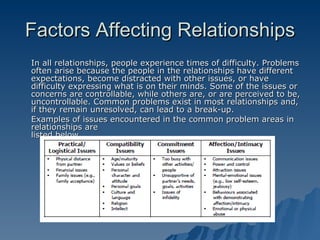
Factors Affecting Relationships In all relationships, people experience times of difficulty. Problems often arise because the people in the relationships have different expectations, become distracted with other issues, or have difficulty expressing what is on their minds. Some of the issues or concerns are controllable, while others are, or are perceived to be, uncontrollable. Common problems exist in most relationships and, if they remain unresolved, can lead to a break-up.  Examples of issues encountered in the common problem areas in relationships are  listed below.
Assignment Have students reflect on relationships by completing RM 2–HR.
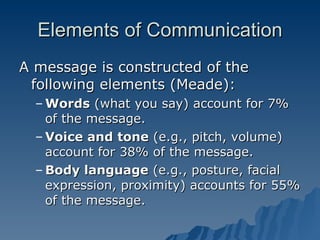
Elements of Communication A message is constructed of the following elements (Meade): Words  (what you say) account for 7% of the message. Voice and tone  (e.g., pitch, volume) account for 38% of the message. Body language  (e.g., posture, facial expression, proximity) accounts for 55% of the message.

Module e lesson 1

  • 1.
    Lesson 1 Understanding Healthy Relationships
  • 2.
    Introduction Inthis lesson students examine the characteristics and benefits of healthy relationships and the characteristics of unhealthy relationships. Students also learn about the importance of effective communication to the development and maintenance of a healthy relationship. They examine elements and styles of communication, including the potential impact of technology on effective communication.
  • 3.
    Specific Learning OutcomesDemonstrate understanding of the characteristics of healthy and unhealthy relationships, and discuss factors that might influence their development. Demonstrate understanding of effective communication within a relationship and the potential impact of technology on communication within a relationship.
  • 4.
    Characteristics of anUnhealthy Relationship Relationships generally start out with good intentions. As relationships develop, disagreements and conflicts will arise. Conflict is not necessarily negative if we deal with it appropriately. How we deal with conflict is based on a given situation, as well as on previously learned behaviours. In some conflict situations, people may use behaviours that are considered unhealthy or abusive, and may include the following: Emotional: making degrading comments, ignoring, isolating, controlling friendships and/or activities, threatening Physical: slapping, pushing, punching Sexual: unwanted touching, forced or coerced sex Financial: taking or withholding money, controlling spending These abusive behaviours will be examined more closely in Module E, Lesson 3.
  • 5.
    Assignment Have eachstudent complete RM 1–HR . Encourage students to elaborate on their answers, using more paper as needed.
  • 6.
    Factors Affecting RelationshipsIn all relationships, people experience times of difficulty. Problems often arise because the people in the relationships have different expectations, become distracted with other issues, or have difficulty expressing what is on their minds. Some of the issues or concerns are controllable, while others are, or are perceived to be, uncontrollable. Common problems exist in most relationships and, if they remain unresolved, can lead to a break-up. Examples of issues encountered in the common problem areas in relationships are listed below.
  • 7.
    Assignment Have studentsreflect on relationships by completing RM 2–HR.
  • 8.
    Elements of CommunicationA message is constructed of the following elements (Meade): Words (what you say) account for 7% of the message. Voice and tone (e.g., pitch, volume) account for 38% of the message. Body language (e.g., posture, facial expression, proximity) accounts for 55% of the message.