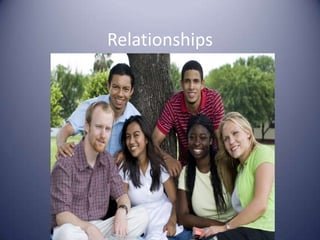
Relationships
9/19 Do NowWhat are a few ways you interact and support your family?
Different Types of Relationships-leave space under each relationship type for additional infoFamily RelationshipsLast your entire life. Enhance all sides of your health triangle.Peer FriendshipsBased on caring, trust, and consideration. Share similar values/interest. Positively influence self-concept and help resist negative influences.Community RelationshipsManner you conduct and represent yourself in your community. Involvement in programs and community groups
	Family relationships last your entire life and enhance or hinder all sides of your health triangle.  Healthy family relationships nurture your overall health by:Physical HealthProvide food, clothing, and shelterMental/Emotional Health-   Provide love, care, encouragementSocial HealthTeach morals and values that guide your life
Friendship“A significant relationship between two people”Friendships are based onCaringTrustConsideration for one another The strongest friendships are those between people who share similar values
Community Relationships“The way you conduct yourself as a member of the community”Promote the safety and well-being of the entire communitySchoolWorkNeighborhoodCityCommunity membersObey the given rules and lawsConduct themselves as friendly and helpful neighborsContribute to the efforts to improve school and community
Round RobinWhat do you feel like are important traits or characteristics to healthy family, peer, and community relationships. Be sure to discuss each typeBe sure to listen to teammates
3 “C’s” of Building Healthy RelationshipsCommunication“How you send and receive messages”Through wordsGesturesFacial expressionsBehaviorsBody languageCooperation“Working together for the good of all”Helps build strong relationshipsCompromise“a problem-solving method that involves each person’s giving up of something to reach a solution that satisfies everyone involved”Helps strengthen relationships
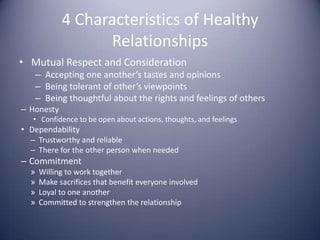
4 Characteristics of Healthy RelationshipsMutual Respect and ConsiderationAccepting one another’s tastes and opinionsBeing tolerant of other’s viewpointsBeing thoughtful about the rights and feelings of othersHonestyConfidence to be open about actions, thoughts, and feelingsDependabilityTrustworthy and reliableThere for the other person when neededCommitmentWilling to work togetherMake sacrifices that benefit everyone involvedLoyal to one anotherCommitted to strengthen the relationship
9/20 Do Now	What are a few ways you resolve conflict with family/friends?
Character“the way you think, feel, and act”Your character has the greatest influence on your relationships with others.Six main traits of good character:TrustworthinessRespectResponsibilityFairnessCaringCitizenship
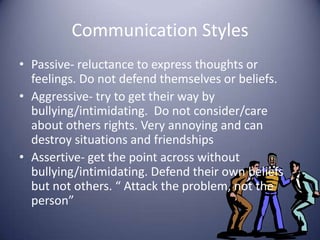
Communication StylesPassive- reluctance to express thoughts or feelings. Do not defend themselves or beliefs.Aggressive- try to get their way by bullying/intimidating.  Do not consider/care about others rights. Very annoying and can destroy situations and friendshipsAssertive- get the point across without bullying/intimidating. Defend their own beliefs but not others. “ Attack the problem, not the person”
9/21 Do NowWhat type of communicator are you? Is this the type of communicator you want to be? Record your thoughts.
Communication ActivityA is working on a project with classmate B.  A & B disagree with their ideas for the project.A & B are going to the movies and trying to decide on which movie to watch. Both have really been wanting to see a certain movie.A wants you to skip class with them. B has never skipped a class before and doesn’t want to start now.B is spending the night with A, B wants to sneak out of the house. A is reluctant, knowing their parents will be upset.
Standard 6:Relationships Book Work*Keep in notes section*Ch 10 Review 1Questions 1,3,4,5Ch 11 Review 1Questions 1,3,4,5
Active ListeningReflective Listening-rephrase what others have said.Clarifying- asking questions to help you fully understand what is being saidEncouraging- positive gestures, expressionsEmpathizing- feeling how the person your listening to is feeling. But not when against beliefs .
Tips for Active ListeningMake eye contact!Use positive body language and gesturesDo not interrupt You cannot listen if your talking!!Avoid communication barriersLack of trustPrejudicestereotyping
Active Listening Game
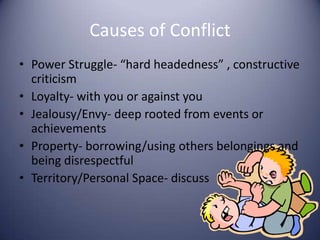
Causes of ConflictPower Struggle- “hard headedness” , constructive criticism Loyalty- with you or against youJealousy/Envy- deep rooted from events or achievements Property- borrowing/using others belongings and being disrespectfulTerritory/Personal Space- discuss
Resolving ConflictGive yourself time to calm down(10 sec.)Cooperation with communication over the conflict. NegotiateClarifyDiscuss ways to resolve the conflict “ Give and Take”Come up with a compromising solution
AbuseEmotional Abuse- yelling, bullying, threats, degrading comments meant to harm. Impairing sense of worth of an individual. Peers, Superiors, Parents/GuardiansPhysical Abuse-intentional harm or injury of another person. Patterns, CyclesSexual Abuse- sexual contact forced upon a person against his/her will.Child Abuse- domestic abuse of a child. Neglect- failure to meet/provide child with physical and/or emotional needs.
How to break the cycle of violence?Tell a trusted adult(parent, other family member, teacher, counselor) Somebody you feel comfortable with. Contact an abuse hotline or crisis centerContact police, Child welfare, or youth services
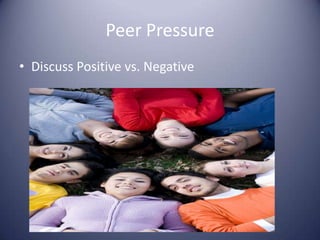
Peer PressureDiscuss Positive vs. Negative
ManipulationDishonest way to control/influence others	-Mocking/Teasing other with malicious intent	-” Guilt Trips”	-Bargaining- offering to make a deal to get what you want	-Flattery or Praise, False Praise	-Bribing	-Making Threats	-Blackmail
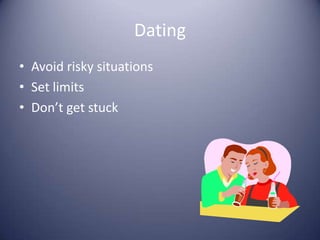
DatingAvoid risky situationsSet limitsDon’t get stuck
9/26 Do Now-Finish B.C. AssignmentThe Breakfast ClubObserve 5 different relationshipsFor each relationship do the followingWhat is the relationship?What are 3 positive aspects of the relationship?What are 3 negative aspects of the relationship?Is this a healthy or unhealthy relationship? Why?
Peer Pressure ArticleRead & record 10 comments/facts in your notes.

Relationships

  • 1.
  • 2.
    9/19 Do NowWhatare a few ways you interact and support your family?
  • 3.
    Different Types ofRelationships-leave space under each relationship type for additional infoFamily RelationshipsLast your entire life. Enhance all sides of your health triangle.Peer FriendshipsBased on caring, trust, and consideration. Share similar values/interest. Positively influence self-concept and help resist negative influences.Community RelationshipsManner you conduct and represent yourself in your community. Involvement in programs and community groups
  • 4.
    Family relationships lastyour entire life and enhance or hinder all sides of your health triangle. Healthy family relationships nurture your overall health by:Physical HealthProvide food, clothing, and shelterMental/Emotional Health- Provide love, care, encouragementSocial HealthTeach morals and values that guide your life
  • 5.
    Friendship“A significant relationshipbetween two people”Friendships are based onCaringTrustConsideration for one another The strongest friendships are those between people who share similar values
  • 6.
    Community Relationships“The wayyou conduct yourself as a member of the community”Promote the safety and well-being of the entire communitySchoolWorkNeighborhoodCityCommunity membersObey the given rules and lawsConduct themselves as friendly and helpful neighborsContribute to the efforts to improve school and community
  • 7.
    Round RobinWhat doyou feel like are important traits or characteristics to healthy family, peer, and community relationships. Be sure to discuss each typeBe sure to listen to teammates
  • 8.
    3 “C’s” ofBuilding Healthy RelationshipsCommunication“How you send and receive messages”Through wordsGesturesFacial expressionsBehaviorsBody languageCooperation“Working together for the good of all”Helps build strong relationshipsCompromise“a problem-solving method that involves each person’s giving up of something to reach a solution that satisfies everyone involved”Helps strengthen relationships
  • 9.
    4 Characteristics ofHealthy RelationshipsMutual Respect and ConsiderationAccepting one another’s tastes and opinionsBeing tolerant of other’s viewpointsBeing thoughtful about the rights and feelings of othersHonestyConfidence to be open about actions, thoughts, and feelingsDependabilityTrustworthy and reliableThere for the other person when neededCommitmentWilling to work togetherMake sacrifices that benefit everyone involvedLoyal to one anotherCommitted to strengthen the relationship
  • 10.
    9/20 Do Now Whatare a few ways you resolve conflict with family/friends?
  • 11.
    Character“the way youthink, feel, and act”Your character has the greatest influence on your relationships with others.Six main traits of good character:TrustworthinessRespectResponsibilityFairnessCaringCitizenship
  • 12.
    Communication StylesPassive- reluctanceto express thoughts or feelings. Do not defend themselves or beliefs.Aggressive- try to get their way by bullying/intimidating. Do not consider/care about others rights. Very annoying and can destroy situations and friendshipsAssertive- get the point across without bullying/intimidating. Defend their own beliefs but not others. “ Attack the problem, not the person”
  • 13.
    9/21 Do NowWhattype of communicator are you? Is this the type of communicator you want to be? Record your thoughts.
  • 14.
    Communication ActivityA isworking on a project with classmate B. A & B disagree with their ideas for the project.A & B are going to the movies and trying to decide on which movie to watch. Both have really been wanting to see a certain movie.A wants you to skip class with them. B has never skipped a class before and doesn’t want to start now.B is spending the night with A, B wants to sneak out of the house. A is reluctant, knowing their parents will be upset.
  • 15.
    Standard 6:Relationships BookWork*Keep in notes section*Ch 10 Review 1Questions 1,3,4,5Ch 11 Review 1Questions 1,3,4,5
  • 16.
    Active ListeningReflective Listening-rephrasewhat others have said.Clarifying- asking questions to help you fully understand what is being saidEncouraging- positive gestures, expressionsEmpathizing- feeling how the person your listening to is feeling. But not when against beliefs .
  • 17.
    Tips for ActiveListeningMake eye contact!Use positive body language and gesturesDo not interrupt You cannot listen if your talking!!Avoid communication barriersLack of trustPrejudicestereotyping
  • 18.
  • 19.
    Causes of ConflictPowerStruggle- “hard headedness” , constructive criticism Loyalty- with you or against youJealousy/Envy- deep rooted from events or achievements Property- borrowing/using others belongings and being disrespectfulTerritory/Personal Space- discuss
  • 20.
    Resolving ConflictGive yourselftime to calm down(10 sec.)Cooperation with communication over the conflict. NegotiateClarifyDiscuss ways to resolve the conflict “ Give and Take”Come up with a compromising solution
  • 21.
    AbuseEmotional Abuse- yelling,bullying, threats, degrading comments meant to harm. Impairing sense of worth of an individual. Peers, Superiors, Parents/GuardiansPhysical Abuse-intentional harm or injury of another person. Patterns, CyclesSexual Abuse- sexual contact forced upon a person against his/her will.Child Abuse- domestic abuse of a child. Neglect- failure to meet/provide child with physical and/or emotional needs.
  • 22.
    How to breakthe cycle of violence?Tell a trusted adult(parent, other family member, teacher, counselor) Somebody you feel comfortable with. Contact an abuse hotline or crisis centerContact police, Child welfare, or youth services
  • 23.
  • 24.
    ManipulationDishonest way tocontrol/influence others -Mocking/Teasing other with malicious intent -” Guilt Trips” -Bargaining- offering to make a deal to get what you want -Flattery or Praise, False Praise -Bribing -Making Threats -Blackmail
  • 25.
    DatingAvoid risky situationsSetlimitsDon’t get stuck
  • 26.
    9/26 Do Now-FinishB.C. AssignmentThe Breakfast ClubObserve 5 different relationshipsFor each relationship do the followingWhat is the relationship?What are 3 positive aspects of the relationship?What are 3 negative aspects of the relationship?Is this a healthy or unhealthy relationship? Why?
  • 27.
    Peer Pressure ArticleRead& record 10 comments/facts in your notes.