Yes,
No,
Maybe.
Hannah Kelliher
What are Boundaries?
 What

is your understanding of
boundaries?

 Why

are they important to you?
Definition of Boundaries
 “Personal

boundaries are guidelines, rules
or limits that a person creates to identify
for him- or herself what are reasonable,
safe and permissible ways for other
people to behave around him or her and
how he or she will respond when
someone steps outside those limits.”

http://en.wikipedia.org/wiki/Personal_boundaries
Definition of Boundaries (cont.)
 “Boundaries

are an important issue for all
peer support programs. Participants need
to understand that our interactions and
levels of responsibility differ according to
the nature of relationships.”

http://student-learning.tcd.ie/assets/docs/old/Peer%20Support%20Training%20Manual.pdf
Why?


“Setting boundaries helps both people know what
to expect.



Clear boundaries keep our relationships healthy.



As a peer educator, both you and your student
will have boundaries



Setting boundaries is an important way for peer
educators and peers to be clear about what to
expect.”

http://peer.hdwg.org/sites/default/files/2d%20SettingBoundaries-PeerRole-Peer_Training.pdf
Why? (cont.)


“The process of you setting limits and honoring your
boundaries is the most healing behavior you can
present to self and others.”1



Knowing when to refer students to pro staff and
counseling.”



“The behavior you express is an important aspect of
setting boundaries.”2

Any more reasons?
1. http://www.melanietoniaevans.com/articles/setting-boundaries.htm
2. http://web.ccsu.edu/fye/PeerGuide/role2.htm
Rules.


“Know the limits of the peer support relationship.



Be clear about your role.



Encourage peers to be responsible for their
problems, decisions and actions.



Accept that others may not be ready to face
problems or make changes.



Do not take on too much or try to „save‟ peers by
solving their problems.
http://student-learning.tcd.ie/assets/docs/old/Peer%20Support%20Training%20Manual.pdf
Rules. (cont.)
 “Seek

personal support if impacted or
stressed by helping a peer.

 Leave

peers‟ problems with them, rather
than „taking the problems home‟ with
you.”

More?
http://student-learning.tcd.ie/assets/docs/old/Peer%20Support%20Training%20Manual.pdf
Activity.


Stand up.



Choose a partner.



Make two parallel lines and stand across from
your partner.



I will explain the rest.



When we go back to seats we will discuss.
How?
 Self

asses your personal beliefs, morals
and feelings. Without knowing these
things you will not be able to establish
effective boundaries.

 Stop

and think before you take action.
Even if it is for a second. Reflect on your
beliefs, morals, and feelings.
http://web.ccsu.edu/fye/PeerGuide/role2.htm
How? (cont.)


Limit the amount of personal things you share
about your life.



“As a peer leader it is important to set
physical boundaries including the use to
touch, meeting up between or after class as
well as how to handle flirting.”



Establish how you want to communicate
through social media with your students.
http://web.ccsu.edu/fye/PeerGuide/role2.htm
How? (cont.)
 Model

behavior you want your students to
have. If you don‟t do it, they won‟t do it.

 Learn

from every experience you have.
Not one person is perfect and we will
mistakes, but it is important to learn from
them.

http://web.ccsu.edu/fye/PeerGuide/role2.htm
Just say no.


No is not a taboo word.



“By saying „No‟ to more things you have the
time, energy and resources to get really good
at the things you want to say „yes‟ to.



If you find it hard to say „No‟ you won‟t allow
others to step up to the plate and find their
own power.”



If you don‟t learn how to say „No‟, others will
take you for granted and lose respect for
you.”
http://www.melanietoniaevans.com/articles/setting-boundaries.htm
Listening Skills
 Listening

skills is important to establish
boundaries. People give you signals, both
verbal and nonverbal as to what they are
comfortable or uncomfortable with. You
must learn how to listen to pick these up.

 Activity.
Remember!


Boundaries are not easy, even for seasoned
professionals.



Don‟t be afraid to talk to pro-staff about
boundaries if you are in a questionable
situation.



Boundaries are important to have an
effective relationship with the students you
are going to be leading.
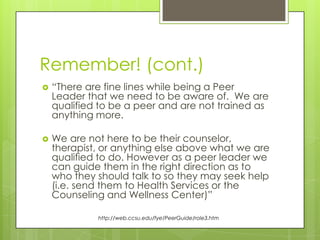
Remember! (cont.)


“There are fine lines while being a Peer
Leader that we need to be aware of. We are
qualified to be a peer and are not trained as
anything more.



We are not here to be their counselor,
therapist, or anything else above what we are
qualified to do. However as a peer leader we
can guide them in the right direction as to
who they should talk to so they may seek help
(i.e. send them to Health Services or the
Counseling and Wellness Center)”
http://web.ccsu.edu/fye/PeerGuide/role3.htm
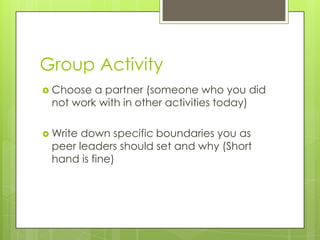
Group Activity
 Choose

a partner (someone who you did
not work with in other activities today)

 Write

down specific boundaries you as
peer leaders should set and why (Short
hand is fine)
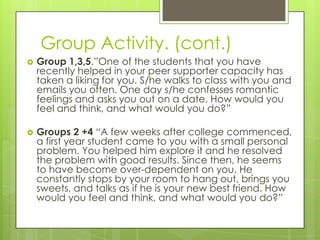
Group Activity. (cont.)


Group 1,3,5.”One of the students that you have
recently helped in your peer supporter capacity has
taken a liking for you. S/he walks to class with you and
emails you often. One day s/he confesses romantic
feelings and asks you out on a date. How would you
feel and think, and what would you do?”



Groups 2 +4 “A few weeks after college commenced,
a first year student came to you with a small personal
problem. You helped him explore it and he resolved
the problem with good results. Since then, he seems
to have become over-dependent on you. He
constantly stops by your room to hang out, brings you
sweets, and talks as if he is your new best friend. How
would you feel and think, and what would you do?”

Boundaries presentation p.l.

  • 1.
  • 2.
    What are Boundaries? What is your understanding of boundaries?  Why are they important to you?
  • 3.
    Definition of Boundaries “Personal boundaries are guidelines, rules or limits that a person creates to identify for him- or herself what are reasonable, safe and permissible ways for other people to behave around him or her and how he or she will respond when someone steps outside those limits.” http://en.wikipedia.org/wiki/Personal_boundaries
  • 4.
    Definition of Boundaries(cont.)  “Boundaries are an important issue for all peer support programs. Participants need to understand that our interactions and levels of responsibility differ according to the nature of relationships.” http://student-learning.tcd.ie/assets/docs/old/Peer%20Support%20Training%20Manual.pdf
  • 5.
    Why?  “Setting boundaries helpsboth people know what to expect.  Clear boundaries keep our relationships healthy.  As a peer educator, both you and your student will have boundaries  Setting boundaries is an important way for peer educators and peers to be clear about what to expect.” http://peer.hdwg.org/sites/default/files/2d%20SettingBoundaries-PeerRole-Peer_Training.pdf
  • 6.
    Why? (cont.)  “The processof you setting limits and honoring your boundaries is the most healing behavior you can present to self and others.”1  Knowing when to refer students to pro staff and counseling.”  “The behavior you express is an important aspect of setting boundaries.”2 Any more reasons? 1. http://www.melanietoniaevans.com/articles/setting-boundaries.htm 2. http://web.ccsu.edu/fye/PeerGuide/role2.htm
  • 7.
    Rules.  “Know the limitsof the peer support relationship.  Be clear about your role.  Encourage peers to be responsible for their problems, decisions and actions.  Accept that others may not be ready to face problems or make changes.  Do not take on too much or try to „save‟ peers by solving their problems. http://student-learning.tcd.ie/assets/docs/old/Peer%20Support%20Training%20Manual.pdf
  • 8.
    Rules. (cont.)  “Seek personalsupport if impacted or stressed by helping a peer.  Leave peers‟ problems with them, rather than „taking the problems home‟ with you.” More? http://student-learning.tcd.ie/assets/docs/old/Peer%20Support%20Training%20Manual.pdf
  • 9.
    Activity.  Stand up.  Choose apartner.  Make two parallel lines and stand across from your partner.  I will explain the rest.  When we go back to seats we will discuss.
  • 10.
    How?  Self asses yourpersonal beliefs, morals and feelings. Without knowing these things you will not be able to establish effective boundaries.  Stop and think before you take action. Even if it is for a second. Reflect on your beliefs, morals, and feelings. http://web.ccsu.edu/fye/PeerGuide/role2.htm
  • 11.
    How? (cont.)  Limit theamount of personal things you share about your life.  “As a peer leader it is important to set physical boundaries including the use to touch, meeting up between or after class as well as how to handle flirting.”  Establish how you want to communicate through social media with your students. http://web.ccsu.edu/fye/PeerGuide/role2.htm
  • 12.
    How? (cont.)  Model behavioryou want your students to have. If you don‟t do it, they won‟t do it.  Learn from every experience you have. Not one person is perfect and we will mistakes, but it is important to learn from them. http://web.ccsu.edu/fye/PeerGuide/role2.htm
  • 13.
    Just say no.  Nois not a taboo word.  “By saying „No‟ to more things you have the time, energy and resources to get really good at the things you want to say „yes‟ to.  If you find it hard to say „No‟ you won‟t allow others to step up to the plate and find their own power.”  If you don‟t learn how to say „No‟, others will take you for granted and lose respect for you.” http://www.melanietoniaevans.com/articles/setting-boundaries.htm
  • 14.
    Listening Skills  Listening skillsis important to establish boundaries. People give you signals, both verbal and nonverbal as to what they are comfortable or uncomfortable with. You must learn how to listen to pick these up.  Activity.
  • 15.
    Remember!  Boundaries are noteasy, even for seasoned professionals.  Don‟t be afraid to talk to pro-staff about boundaries if you are in a questionable situation.  Boundaries are important to have an effective relationship with the students you are going to be leading.
  • 16.
    Remember! (cont.)  “There arefine lines while being a Peer Leader that we need to be aware of. We are qualified to be a peer and are not trained as anything more.  We are not here to be their counselor, therapist, or anything else above what we are qualified to do. However as a peer leader we can guide them in the right direction as to who they should talk to so they may seek help (i.e. send them to Health Services or the Counseling and Wellness Center)” http://web.ccsu.edu/fye/PeerGuide/role3.htm
  • 17.
    Group Activity  Choose apartner (someone who you did not work with in other activities today)  Write down specific boundaries you as peer leaders should set and why (Short hand is fine)
  • 18.
    Group Activity. (cont.)  Group1,3,5.”One of the students that you have recently helped in your peer supporter capacity has taken a liking for you. S/he walks to class with you and emails you often. One day s/he confesses romantic feelings and asks you out on a date. How would you feel and think, and what would you do?”  Groups 2 +4 “A few weeks after college commenced, a first year student came to you with a small personal problem. You helped him explore it and he resolved the problem with good results. Since then, he seems to have become over-dependent on you. He constantly stops by your room to hang out, brings you sweets, and talks as if he is your new best friend. How would you feel and think, and what would you do?”