EMOTIONAL
INTELLIGENCE
when dealing with people, remember you are not dealing
with creatures of logic, but with creatures of emotion. DALE
CARNEGIE
EMOTION
• A mental state that arises spontaneously rather than through
conscious effort and is often accompanied by physiological
changes; a feeling
• A state of mental agitation or disturbance.
INTELLIGENCE
• The ability to learn or understand or to deal with new or
situations: The skilled use of reason.
What is Emotional Intelligence???
 Emotional Intelligence refers to the capacity for recognizing our
own feelings and those of others, for motivating ourselves, and for
managing emotions well within ourselves and in our relationships.
[Daniel Goleman, Mixed Model Theory]
 Emotional Intelligence consists of ones ability to perceive emotions,
to access and generate emotions so as to assist thought, to
understand emotions and emotional knowledge, and to reflectively
regulate emotions so as to promote emotional and intellectual
growth [Mayer and Salovey 1997, Ability Model Theory]
 Bar-On et aI., (2000) view emotional intelligence as a non-cognitive
intelligence and defines the concept as an array of emotional,
personal, and social abilities and skills that influence an individual’s
ability to cope effectively with environmental demands and
pressures.
Emotional Intelligence is a habitual
practice of :
 Using emotional information for ourselves and
other people
 Integrating this with our thinking
 Using these in our decision making to help us
get what we want from the immediate
situation and from life in general.
Evolution of Emotional Intelligence
Thorndike (1920) was the first one to use the term “ Social
Intelligence” and define it as the ability to understand ,men
and women, manage them, boys and girls to act wisely in
human relations.Mc Clelland (1973) A researcher with Harvard offered his view that
conventional concept of Intelligent Quotient ( IQ) simply couldnot predict how
will people perform in the whole workplace.
Howard Gardner (1984) a Harvard Psychologist proposed model of multiple
intelligence where he listed 7 types of Intelligence.
[https://en.wikipedia.org/wiki/Theory_of_multiple_intelligences]
A comprehensive theory was proposed in 1990 by two psychologists Peter
Salovey and John Mayer . These two defined EI in terms of being able to
monitor and requlate one’s own and others feelings and to use feelings to
guide thought and action.
It was Daniel Goleman( 1995) who fine tuned the theory and popularized the
Phineas Gage
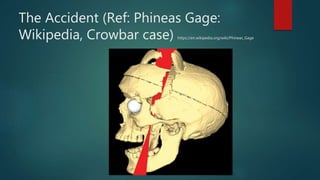
The Accident (Ref: Phineas Gage:
Wikipedia, Crowbar case) https://en.wikipedia.org/wiki/Phineas_Gage
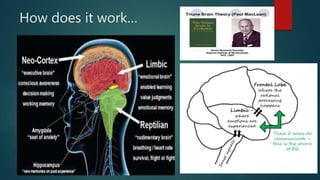
How does it work…
Story of the Lion and Tamer
New Year Resolutions doesn’t work!!!
Thinking Brain is like the lion tamer
Emotional Brain is like the lion
EQ Vs IQ
 Changes little after teen
years
 Academic intelligence
 Coginitive capacities,
strategy, long term
capacity
 Can be largely
learned through
life and
experiences
 EI grows as years,
called as Maturity.
More plasticity
associated
 Tactical(
Immediate
functioning)
Emotional Intelligence is the reflection of one's "common sense" and ability to get along in the world (Bar-On, 1997).
[https://dyuthi.cusat.ac.in/xmlui/bitstream/handle/purl/2681/Dyuthi-T0733.pdf?sequence=1], INTELLIGENT USE OF EMOTIONS IN PERSONAL SELLING: A STUDY INTO THE EFFECT
OF EMOTIONAL INTELLIGENCE ON THE PERFORMANCE OF SALES EXECUTIVES – Study by Dr Zakkariya K A.
Personal
Competency of an
Individual. Qualify
him for a job, but
does not
guarantee
success.
EI relates to
understating of oneself
and others and there by
coping up to diverse
situations and obtaining
success
I Feel there fore I am..
 Education, measured and tested on logical thinking brain challenges and
tasks?
 Senior Managers who have been only promoted based on their subject
specific knowledge?
 Human Engineering is what we need to do.
Two key aspects of emotional intelligence namely Self Management and
Relationship Management.
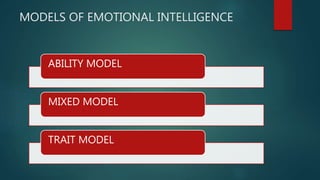
MODELS OF EMOTIONAL INTELLIGENCE
ABILITY MODEL
MIXED MODEL
TRAIT MODEL
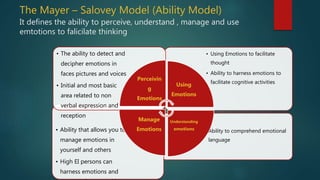
The Mayer – Salovey Model (Ability Model)
It defines the ability to perceive, understand , manage and use
emtotions to falicilate thinking
• Ability to comprehend emotional
language
• Ability that allows you to
manage emotions in
yourself and others
• High EI persons can
harness emotions and
• Using Emotions to facilitate
thought
• Ability to harness emotions to
facilitate cognitive activities
• The ability to detect and
decipher emotions in
faces pictures and voices
• Initial and most basic
area related to non
verbal expression and
reception
Perceivin
g
Emotions
Using
Emotions
Understanding
emotions
Manage
Emotions
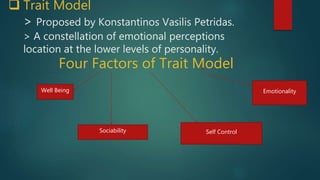
 Trait Model
> Proposed by Konstantinos Vasilis Petridas.
> A constellation of emotional perceptions
location at the lower levels of personality.
Four Factors of Trait Model
Well Being
Sociability Self Control
Emotionality
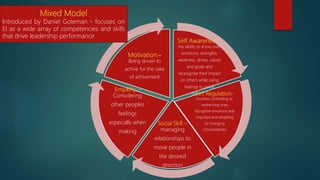
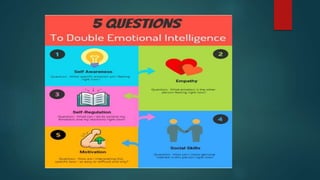
Self Awareness –
the ability to know ones
emotions, strengths,
weakness, drives, values
and goals and
receognise their impact
on others while using
feelings to guide
decisionsSelf Regulation-
involves controlling or
redirecting ones
disruptive emotions and
impulses and adapting
to changing
circumstances
Social Skill –
managing
relationships to
move people in
the desired
direction
Empathy –
Considering
other peoples
feelings
especialls when
making
Motivation –
Being driven to
achive for the sake
of achivement
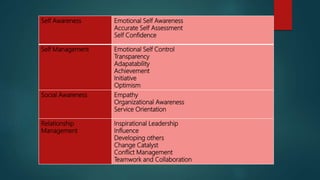
Mixed Model
Introduced by Daniel Goleman - focuses on
EI as a wide array of competencies and skills
that drive leadership performance
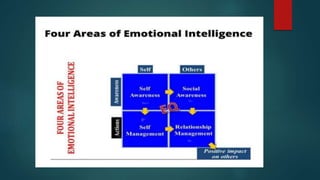
Self Awareness Emotional Self Awareness
Accurate Self Assessment
Self Confidence
Self Management Emotional Self Control
Transparency
Adapatability
Achievement
Initiative
Optimism
Social Awareness Empathy
Organizational Awareness
Service Orientation
Relationship
Management
Inspirational Leadership
Influence
Developing others
Change Catalyst
Conflict Management
Teamwork and Collaboration
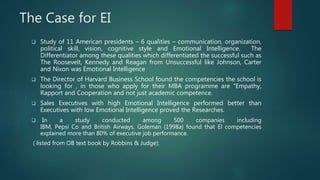
The Case for EI
 Study of 11 American presidents – 6 qualities – communication, organization,
political skill, vision, cognitive style and Emotional Intelligence. The
Differentiator among these qualities which differentiated the successful such as
The Roosevelt, Kennedy and Reagan from Unsuccessful like Johnson, Carter
and Nixon was Emotional Intelligence
 The Director of Harvard Business School found the competencies the school is
looking for , in those who apply for their MBA programme are “Empathy,
Rapport and Cooperation and not just academic competence.
 Sales Executives with high Emotional Intelligence performed better than
Executives with low Emotional Intelligence proved the Researches.
 In a study conducted among 500 companies including
IBM, Pepsi Co and British Airways, Goleman (1998a) found that El competencies
explained more than 80% of executive job performance.
( listed from OB text book by Robbins & Judge):
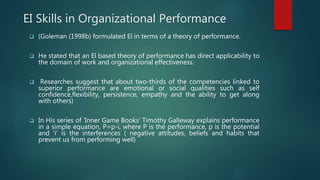
EI Skills in Organizational Performance
 (Goleman (1998b) formulated El in terms of a theory of performance.
 He stated that an El based theory of performance has direct applicability to
the domain of work and organizational effectiveness.
 Researches suggest that about two-thirds of the competencies linked to
superior performance are emotional or social qualities such as self
confidence,flexibility, persistence, empathy and the ability to get along
with others)
 In His series of ‘Inner Game Books’ Timothy Galleway explains performance
in a simple equation, P=p-i, where P is the performance, p is the potential
and ‘i’ is the interferences ( negative attitudes, beliefs and habits that
prevent us from performing well)
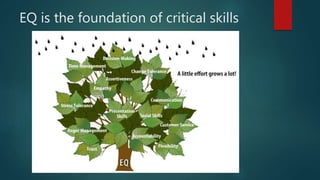
EQ is the foundation of critical skills
Applications of EI in Organizational
Behavior
 Selection ( Recruitment & Hiring)
Employers are currently using EI to hire people, especially in jobs that demand
high degree of Interaction.
Employers find that a person hired wrong is a cost to the company ( Cost of Hire,
Training etc – equal to a years pay)
 Eg: Exxon Mobil uses competency testing involved in numerical reasoning tests
 P & G uses success drivers Assessment and the P&G Reasoning tests
 NDA has their own psychometric tests
 Pilot PABT tests
 Background Reference Checks
[ An Article in the journal by MIT college of Management by Mr Pranav Jyoti 2015,
states that their study has proved that EI has a huge role in the HR processes
specific to Hiring]
Other Areas..
Decision Making
Researches has proved that
Managers with High EI who possess
high level of Self Awareness, Self
Motivation provide Optimal decision
making in turbulent times and
environment
Creativity
 People in good emotions are more flexible and open in
their thinking , they are more creative than others.
 Researches have shown that there is a positive significant
correlation between creativity and Emotional Intelligence
 This affects the cognitive system, changes them. These
changes make individuals to see issues from various
aspects and think deeply and creatively about issues,
Todays work environment is a very volatile one.
Motivation
 Positive Emotions make people think more
creatively and thereby get positive feedback
and inturn this can motivate them to work
better.
 Study of Impact of EI on motivation,
Empowerment and Organization structure has
found very positive and strong correlation.
Leadership
 Effective Leaders rely on emotional appeal to
help convey their messages.
 Examples of Martin Luther King, Dr A P J Abdul
Kalam etc
 By arousing emotions and linking them to the
appealing visions, leaders increase the
likelihood that managers and employees alike
will accept and change
Negotiation
 Another important skill for employees
 Negotiation is an emotional process
 Those who do poorly in negotiations experience negative
emotions and will not be willing to share informations.
EI also has its influence on customer
service, Job attitude, Deviant Work
place behavior etc.
Some misconceptions about EI
 EI does not mean merely “ being nice”. It also depends on the
situation.
 EI does not mean giving free reign to feelings ‘ Let it all hang
out’. Rather it means managing feelings so that they are
expressed appropriately and effectively to work together for
common goals.
 Not gender speficific, Women smarter than men or men
smarter than woman in EI. Each has their own personal profile
of strength and weaknesses.
 Research on men and women have found that women are
more aware of their emotions, show more empathy, and more
adept interpersonally while men are more self confident,
Case Study: Project Aristotle – By
Google Google wanted to know what make a team effective at Google?
 Did a Two year research with 180 teams within the organization
 Dubey, leader of the project, gathered some of the company’s best
statisticians, organizational psychologists, sociologists, engineers, researchers
on people habits and behaviors.
 The Key finds of this research on the effective teams were:
1. Dependability : Team members get things done on time and meet
expectations
2. Structure and Clarity: They had clear goals and had well defined roles in the
group
3. Meaning: The work had a personal significance to each member
4. Impact: The group believed that their work is purposeful and positively
impacts greater good
5. Psychological Safety : This is the ability of group members to connect with
each other on a personal level and to feel comfortable enough to ask
questions and float ideas. Included Open Communication and Empathy
Examples:
How customers feel when they interact with an employee determines
how they feel about the company itself. In a psychological sense, the
‘company’ as experienced by the customer is a sum of these
interactions. Loyalty is lost or strengthened in every interaction
between a company and its customers.”(Daniel Goleman in his book
on Emotional Intelligence)
 Marriott International for their active efforts to put people at the center of
their business, this including both staff and customers. By offering their
employees competitive benefit packages, superior training and empowering
their decision-making capabilities, Marriott hires an all-star team that truly
enjoys coming into work everyday and going out of their way to make guests
feel at home.
 Starbucks/ Coldstone
 When did you lately felt this awesome customer experience???
Arguments against EI
 EI is too vague a concept, to get a clear definition of EI.
Many times researches focus on different skills making it
difficult to get a standard definition of EI
 EI can’t be measured accurately as the measures of EI are
diverse and much more rigorous study is needed to
develop measures on this.
 Validity of EI. Depends on so many variables. Once these
are controlled what is the level of existence of EI??.
Parable of a Hole – A Golden Heart
GRATITUDE -- Giving thanks may help overall well-being
and goal attainment, says UC Davis psychology professor
Robert Emmons, who studies the role of motivation and
spirituality in personality. Emmons is the author of the
1999 book "The Psychology of Ultimate Concerns,"
published by Guilford Publications Inc.
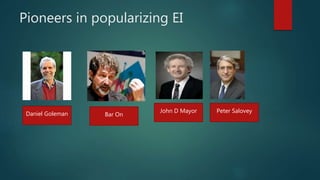
Pioneers in popularizing EI
Daniel Goleman Bar On
John D Mayor Peter Salovey
References
 Working with Emotional Intelligence – Daniel Goleman
 Emotional Intelligence Coachin – Neals, Spence, Liz Wilson
 Organizational Behavior – Robbins and Judge
 Organizational Behavior – Luthans
 Increase Your emotional Intelligence, Geetu Bharwaney
 Ted Talks by Jason Bridge and Tavis Bradberry ( Author of EI 2.0)
 Research papers on Emotional Intelligence.
https://dyuthi.cusat.ac.in/xmlui/bitstream/handle/purl/2681/Dyuthi-
T0733.pdf?sequence=1], INTELLIGENT USE OF EMOTIONS IN PERSONAL
SELLING: A STUDY INTO THE EFFECT OF EMOTIONAL INTELLIGENCE ON
THE PERFORMANCE OF SALES EXECUTIVES – Study by Dr Zakkariya K A.
Thank You…

Emotional intelligence

  • 1.
    EMOTIONAL INTELLIGENCE when dealing withpeople, remember you are not dealing with creatures of logic, but with creatures of emotion. DALE CARNEGIE
  • 2.
    EMOTION • A mentalstate that arises spontaneously rather than through conscious effort and is often accompanied by physiological changes; a feeling • A state of mental agitation or disturbance. INTELLIGENCE • The ability to learn or understand or to deal with new or situations: The skilled use of reason.
  • 3.
    What is EmotionalIntelligence???  Emotional Intelligence refers to the capacity for recognizing our own feelings and those of others, for motivating ourselves, and for managing emotions well within ourselves and in our relationships. [Daniel Goleman, Mixed Model Theory]  Emotional Intelligence consists of ones ability to perceive emotions, to access and generate emotions so as to assist thought, to understand emotions and emotional knowledge, and to reflectively regulate emotions so as to promote emotional and intellectual growth [Mayer and Salovey 1997, Ability Model Theory]  Bar-On et aI., (2000) view emotional intelligence as a non-cognitive intelligence and defines the concept as an array of emotional, personal, and social abilities and skills that influence an individual’s ability to cope effectively with environmental demands and pressures.
  • 4.
    Emotional Intelligence isa habitual practice of :  Using emotional information for ourselves and other people  Integrating this with our thinking  Using these in our decision making to help us get what we want from the immediate situation and from life in general.
  • 5.
    Evolution of EmotionalIntelligence Thorndike (1920) was the first one to use the term “ Social Intelligence” and define it as the ability to understand ,men and women, manage them, boys and girls to act wisely in human relations.Mc Clelland (1973) A researcher with Harvard offered his view that conventional concept of Intelligent Quotient ( IQ) simply couldnot predict how will people perform in the whole workplace. Howard Gardner (1984) a Harvard Psychologist proposed model of multiple intelligence where he listed 7 types of Intelligence. [https://en.wikipedia.org/wiki/Theory_of_multiple_intelligences] A comprehensive theory was proposed in 1990 by two psychologists Peter Salovey and John Mayer . These two defined EI in terms of being able to monitor and requlate one’s own and others feelings and to use feelings to guide thought and action. It was Daniel Goleman( 1995) who fine tuned the theory and popularized the
  • 6.
  • 7.
    The Accident (Ref:Phineas Gage: Wikipedia, Crowbar case) https://en.wikipedia.org/wiki/Phineas_Gage
  • 8.
    How does itwork…
  • 9.
    Story of theLion and Tamer New Year Resolutions doesn’t work!!! Thinking Brain is like the lion tamer Emotional Brain is like the lion
  • 10.
    EQ Vs IQ Changes little after teen years  Academic intelligence  Coginitive capacities, strategy, long term capacity  Can be largely learned through life and experiences  EI grows as years, called as Maturity. More plasticity associated  Tactical( Immediate functioning) Emotional Intelligence is the reflection of one's "common sense" and ability to get along in the world (Bar-On, 1997). [https://dyuthi.cusat.ac.in/xmlui/bitstream/handle/purl/2681/Dyuthi-T0733.pdf?sequence=1], INTELLIGENT USE OF EMOTIONS IN PERSONAL SELLING: A STUDY INTO THE EFFECT OF EMOTIONAL INTELLIGENCE ON THE PERFORMANCE OF SALES EXECUTIVES – Study by Dr Zakkariya K A. Personal Competency of an Individual. Qualify him for a job, but does not guarantee success. EI relates to understating of oneself and others and there by coping up to diverse situations and obtaining success
  • 11.
    I Feel therefore I am..  Education, measured and tested on logical thinking brain challenges and tasks?  Senior Managers who have been only promoted based on their subject specific knowledge?  Human Engineering is what we need to do. Two key aspects of emotional intelligence namely Self Management and Relationship Management.
  • 12.
    MODELS OF EMOTIONALINTELLIGENCE ABILITY MODEL MIXED MODEL TRAIT MODEL
  • 13.
    The Mayer –Salovey Model (Ability Model) It defines the ability to perceive, understand , manage and use emtotions to falicilate thinking • Ability to comprehend emotional language • Ability that allows you to manage emotions in yourself and others • High EI persons can harness emotions and • Using Emotions to facilitate thought • Ability to harness emotions to facilitate cognitive activities • The ability to detect and decipher emotions in faces pictures and voices • Initial and most basic area related to non verbal expression and reception Perceivin g Emotions Using Emotions Understanding emotions Manage Emotions
  • 14.
     Trait Model >Proposed by Konstantinos Vasilis Petridas. > A constellation of emotional perceptions location at the lower levels of personality. Four Factors of Trait Model Well Being Sociability Self Control Emotionality
  • 15.
    Self Awareness – theability to know ones emotions, strengths, weakness, drives, values and goals and receognise their impact on others while using feelings to guide decisionsSelf Regulation- involves controlling or redirecting ones disruptive emotions and impulses and adapting to changing circumstances Social Skill – managing relationships to move people in the desired direction Empathy – Considering other peoples feelings especialls when making Motivation – Being driven to achive for the sake of achivement Mixed Model Introduced by Daniel Goleman - focuses on EI as a wide array of competencies and skills that drive leadership performance
  • 17.
    Self Awareness EmotionalSelf Awareness Accurate Self Assessment Self Confidence Self Management Emotional Self Control Transparency Adapatability Achievement Initiative Optimism Social Awareness Empathy Organizational Awareness Service Orientation Relationship Management Inspirational Leadership Influence Developing others Change Catalyst Conflict Management Teamwork and Collaboration
  • 18.
    The Case forEI  Study of 11 American presidents – 6 qualities – communication, organization, political skill, vision, cognitive style and Emotional Intelligence. The Differentiator among these qualities which differentiated the successful such as The Roosevelt, Kennedy and Reagan from Unsuccessful like Johnson, Carter and Nixon was Emotional Intelligence  The Director of Harvard Business School found the competencies the school is looking for , in those who apply for their MBA programme are “Empathy, Rapport and Cooperation and not just academic competence.  Sales Executives with high Emotional Intelligence performed better than Executives with low Emotional Intelligence proved the Researches.  In a study conducted among 500 companies including IBM, Pepsi Co and British Airways, Goleman (1998a) found that El competencies explained more than 80% of executive job performance. ( listed from OB text book by Robbins & Judge):
  • 19.
    EI Skills inOrganizational Performance  (Goleman (1998b) formulated El in terms of a theory of performance.  He stated that an El based theory of performance has direct applicability to the domain of work and organizational effectiveness.  Researches suggest that about two-thirds of the competencies linked to superior performance are emotional or social qualities such as self confidence,flexibility, persistence, empathy and the ability to get along with others)  In His series of ‘Inner Game Books’ Timothy Galleway explains performance in a simple equation, P=p-i, where P is the performance, p is the potential and ‘i’ is the interferences ( negative attitudes, beliefs and habits that prevent us from performing well)
  • 20.
    EQ is thefoundation of critical skills
  • 21.
    Applications of EIin Organizational Behavior  Selection ( Recruitment & Hiring) Employers are currently using EI to hire people, especially in jobs that demand high degree of Interaction. Employers find that a person hired wrong is a cost to the company ( Cost of Hire, Training etc – equal to a years pay)  Eg: Exxon Mobil uses competency testing involved in numerical reasoning tests  P & G uses success drivers Assessment and the P&G Reasoning tests  NDA has their own psychometric tests  Pilot PABT tests  Background Reference Checks [ An Article in the journal by MIT college of Management by Mr Pranav Jyoti 2015, states that their study has proved that EI has a huge role in the HR processes specific to Hiring]
  • 22.
    Other Areas.. Decision Making Researcheshas proved that Managers with High EI who possess high level of Self Awareness, Self Motivation provide Optimal decision making in turbulent times and environment
  • 23.
    Creativity  People ingood emotions are more flexible and open in their thinking , they are more creative than others.  Researches have shown that there is a positive significant correlation between creativity and Emotional Intelligence  This affects the cognitive system, changes them. These changes make individuals to see issues from various aspects and think deeply and creatively about issues, Todays work environment is a very volatile one.
  • 24.
    Motivation  Positive Emotionsmake people think more creatively and thereby get positive feedback and inturn this can motivate them to work better.  Study of Impact of EI on motivation, Empowerment and Organization structure has found very positive and strong correlation.
  • 25.
    Leadership  Effective Leadersrely on emotional appeal to help convey their messages.  Examples of Martin Luther King, Dr A P J Abdul Kalam etc  By arousing emotions and linking them to the appealing visions, leaders increase the likelihood that managers and employees alike will accept and change
  • 26.
    Negotiation  Another importantskill for employees  Negotiation is an emotional process  Those who do poorly in negotiations experience negative emotions and will not be willing to share informations. EI also has its influence on customer service, Job attitude, Deviant Work place behavior etc.
  • 27.
    Some misconceptions aboutEI  EI does not mean merely “ being nice”. It also depends on the situation.  EI does not mean giving free reign to feelings ‘ Let it all hang out’. Rather it means managing feelings so that they are expressed appropriately and effectively to work together for common goals.  Not gender speficific, Women smarter than men or men smarter than woman in EI. Each has their own personal profile of strength and weaknesses.  Research on men and women have found that women are more aware of their emotions, show more empathy, and more adept interpersonally while men are more self confident,
  • 28.
    Case Study: ProjectAristotle – By Google Google wanted to know what make a team effective at Google?  Did a Two year research with 180 teams within the organization  Dubey, leader of the project, gathered some of the company’s best statisticians, organizational psychologists, sociologists, engineers, researchers on people habits and behaviors.  The Key finds of this research on the effective teams were: 1. Dependability : Team members get things done on time and meet expectations 2. Structure and Clarity: They had clear goals and had well defined roles in the group 3. Meaning: The work had a personal significance to each member 4. Impact: The group believed that their work is purposeful and positively impacts greater good 5. Psychological Safety : This is the ability of group members to connect with each other on a personal level and to feel comfortable enough to ask questions and float ideas. Included Open Communication and Empathy
  • 29.
    Examples: How customers feelwhen they interact with an employee determines how they feel about the company itself. In a psychological sense, the ‘company’ as experienced by the customer is a sum of these interactions. Loyalty is lost or strengthened in every interaction between a company and its customers.”(Daniel Goleman in his book on Emotional Intelligence)  Marriott International for their active efforts to put people at the center of their business, this including both staff and customers. By offering their employees competitive benefit packages, superior training and empowering their decision-making capabilities, Marriott hires an all-star team that truly enjoys coming into work everyday and going out of their way to make guests feel at home.  Starbucks/ Coldstone  When did you lately felt this awesome customer experience???
  • 30.
    Arguments against EI EI is too vague a concept, to get a clear definition of EI. Many times researches focus on different skills making it difficult to get a standard definition of EI  EI can’t be measured accurately as the measures of EI are diverse and much more rigorous study is needed to develop measures on this.  Validity of EI. Depends on so many variables. Once these are controlled what is the level of existence of EI??.
  • 31.
    Parable of aHole – A Golden Heart GRATITUDE -- Giving thanks may help overall well-being and goal attainment, says UC Davis psychology professor Robert Emmons, who studies the role of motivation and spirituality in personality. Emmons is the author of the 1999 book "The Psychology of Ultimate Concerns," published by Guilford Publications Inc.
  • 32.
    Pioneers in popularizingEI Daniel Goleman Bar On John D Mayor Peter Salovey
  • 34.
    References  Working withEmotional Intelligence – Daniel Goleman  Emotional Intelligence Coachin – Neals, Spence, Liz Wilson  Organizational Behavior – Robbins and Judge  Organizational Behavior – Luthans  Increase Your emotional Intelligence, Geetu Bharwaney  Ted Talks by Jason Bridge and Tavis Bradberry ( Author of EI 2.0)  Research papers on Emotional Intelligence. https://dyuthi.cusat.ac.in/xmlui/bitstream/handle/purl/2681/Dyuthi- T0733.pdf?sequence=1], INTELLIGENT USE OF EMOTIONS IN PERSONAL SELLING: A STUDY INTO THE EFFECT OF EMOTIONAL INTELLIGENCE ON THE PERFORMANCE OF SALES EXECUTIVES – Study by Dr Zakkariya K A.
  • 35.