By-
NIDISH SEBASTIAN - 1021024
 PRAVEEN SIDOLA - 1021026
Labels on Quality Programs/Systems

Statistical Process Control (SPC)
Total Quality Management (TQM)
Customer-focused Quality
Six Sigma –Motorola
http://www.motorola.com/motoro
launiversity.jsp
Certified Quality Engineer (CQE)
American Society for Quality (ASQ)
http://www.asq.org/
Lean Enterprise -Toyota
Just-in-Time (JIT)
Business Process Re-engineering
Supply Chain Management
Labels on Quality Programs/Systems

Statistical Process Control (SPC)
Total Quality Management (TQM)
Customer-focused Quality
Six Sigma –Motorola
http://www.motorola.com/motoro
launiversity.jsp
Certified Quality Engineer (CQE)
American Society for Quality (ASQ)
http://www.asq.org/
Lean Enterprise -Toyota
Just-in-Time (JIT)
Business Process Re-engineering
Supply Chain Management
Old view of “Quality Control”
• time, cost, quality--choose any two
• QA function to independently check up on and
  "control" production
• remove and rework defective product through
  inspection P/F
• cost of quality, optimal inspection and
  rejection
New Concept of Quality
              Management:
Taguchi loss function http://www.mv.com/ipusers/rm/loss.htm
• 99.9% Quality not good enough

•   6-sigma --> less cost of failures
•   Cost of failure underestimated
•   Cost of Quality not understood
•   Increased Quality Eliminates Waste.
•   Quality is free
99.9% is not good enough
• 1 hour of unsafe drinking water every month
• 2 unsafe plane landings per day at O’Hare Airport
  in Chicago
• 16,000 pieces of mail lost by the U.S. Post Office
  every hour.
• 20,000 incorrect prescriptions every year
• 500 incorrect operations each week
• 50 babies dropped at birth every day
• 22,000 checks deducted from the wrong bank
  account each hour
• 32,000 missed heart beats per person each year
Introducing Six Sigma.
• Business improvement concept that focuses
  on meeting the needs of customers and
  bottom line benefit to your organization.
• Customer satisfaction and improvement are
  the driving forces.
• Six Sigma is seen as the ultimate goal in
  achieving near perfect processes through
  continual improvement.
Cont.
• Sigma is standard
  deviation.
• Six Sigma means
  that if there were 1
  million
  opportunities for a
  defect to occur,
  there would only be
  3.4 defects.
Sigma Capabilities.
        Defects per Million     Yield
          Opportunities        (no
Capabil       (DPMO)          defects)
  ity
  2          308,537          69.1%
  3           66,807          93.3%
  4           6,210           99.4%
  5            233           99.97%
  6             3.4         99.99966%
Six Sigma Defined .
• The ultimate goal is
  to eliminate defects
  and errors and the
  costs associated with
  poor quality.
• Six Sigma
  improvement is the
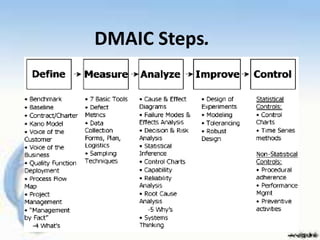
  Define-Measure-
  Analyze-Improve-
  Control (D-M-A-I-C)
  cycle.
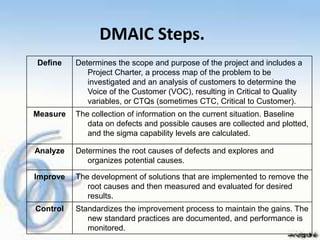
DMAIC Steps.
Define    Determines the scope and purpose of the project and includes a
             Project Charter, a process map of the problem to be
             investigated and an analysis of customers to determine the
             Voice of the Customer (VOC), resulting in Critical to Quality
             variables, or CTQs (sometimes CTC, Critical to Customer).
Measure   The collection of information on the current situation. Baseline
             data on defects and possible causes are collected and plotted,
             and the sigma capability levels are calculated.

Analyze   Determines the root causes of defects and explores and
             organizes potential causes.

Improve   The development of solutions that are implemented to remove the
             root causes and then measured and evaluated for desired
             results.
Control   Standardizes the improvement process to maintain the gains. The
             new standard practices are documented, and performance is
             monitored.
DMAIC Steps.
Six Sigma Training Levels.
• Once committed to Six Sigma methodology,
  learning can be organized by degree of
  employee involvement:
• Yellow Belt
• Green Belt
• Black Belt
• Master Black Belt
• Champion
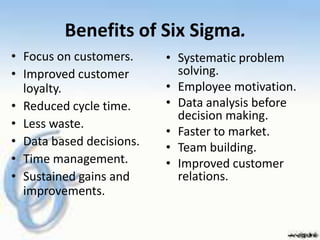
Benefits of Six Sigma.
• Focus on customers.     • Systematic problem
• Improved customer         solving.
  loyalty.                • Employee motivation.
• Reduced cycle time.     • Data analysis before
                            decision making.
• Less waste.
                          • Faster to market.
• Data based decisions.   • Team building.
• Time management.        • Improved customer
• Sustained gains and       relations.
  improvements.
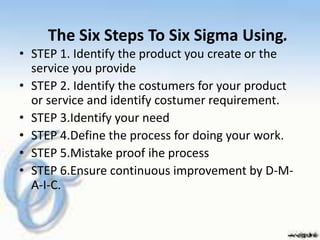
The Six Steps To Six Sigma Using.
• STEP 1. Identify the product you create or the
  service you provide
• STEP 2. Identify the costumers for your product
  or service and identify costumer requirement.
• STEP 3.Identify your need
• STEP 4.Define the process for doing your work.
• STEP 5.Mistake proof ihe process
• STEP 6.Ensure continuous improvement by D-M-
  A-I-C.
Motorola's Six Sigma Program.
• Six Sigma – Beyond Quality Excellence to Total Business
  Excellence.
  By – Keki R. Bhote
  Founding father of the team the Original Six sigma
  process


• In 1988, Motorola Corp. became one of the first
  companies to receive the Malcolm Baldrige National
  Quality Award.
                                   Reference -
                                   “The Ultimate Six Sigma”
                                   Written By - Mr Keki R. Bhote
Motorola Six Sigma Process
• Faith that the 10:1 quality improvement target
  could be achieved.
• Total customer satisfaction
• Powerful new tools
• Cycle time Reduction
• Designs for ease of manufacturing
• Manufacturing Innovation
• True partnership with key supplier
• Training for all employees      Reference -
                                 “The Ultimate Six Sigma”
                                 Written By - Mr Keki R. Bhote
Self- assessment chart & scoring System

•   Customer      -    125
•   Leadership    -    125 (Personal Philosophies & value - 60)
•   Organization -     75 (revolutionizing the organization Culture -65)
•   Employees     -    75
•   Measurement -      75
•   Tools    -         75
•   Design -           75
•   Supply chain Management -         75
•   Manufacturing -    75
                                             Reference -
                                             “The Ultimate Six Sigma”
                                             Written By - Mr Keki R. Bhote
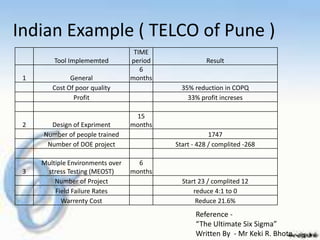
Indian Example ( TELCO of Pune )
                                   TIME
         Tool Implememted         period             Result
                                     6
 1            General             months
        Cost Of poor quality                 35% reduction in COPQ
               Profit                          33% profit increses

                                   15
 2     Design of Expriment        months
     Number of people trained                          1747
      Number of DOE project                Start - 428 / complited -268

     Multiple Environments over     6
 3    stress Testing (MEOST)      months
         Number of Project                   Start 23 / complited 12
         Field Failure Rates                     reduce 4:1 to 0
           Warrenty Cost                          Reduce 21.6%
                                                  Reference -
                                                  “The Ultimate Six Sigma”
                                                  Written By - Mr Keki R. Bhote
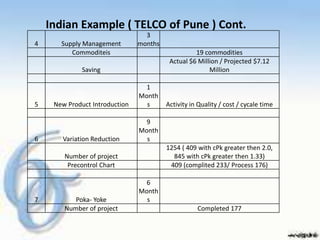
Indian Example ( TELCO of Pune ) Cont.
                                  3
4      Supply Management        months
          Commoditeis                              19 commodities
                                          Actual $6 Million / Projected $7.12
              Saving                                    Million

                                  1
                                Month
5    New Product Introduction     s      Activity in Quality / cost / cycale time

                                  9
                                Month
6      Variation Reduction        s
                                         1254 ( 409 with cPk greater then 2.0,
        Number of project                  845 with cPk greater then 1.33)
         Precontrol Chart                 409 (complited 233/ Process 176)

                                  6
                                Month
7          Poka- Yoke             s
        Number of project                           Completed 177
Costs & Limitations.
• Institutionalizing Six Sigma into the fabric of a
  corporate culture can require significant
  investment in training and infrastructure.
• The infrastructure needed to support the Six
  Sigma environment varies. Some companies
  organize their trained Green/Black Belts into a
  central support organization.
• Others deploy Green/Black Belts into
  organizations based on project needs and rely
  on communities of practice to maintain
  cohesion.
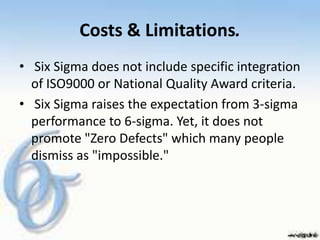
Costs & Limitations.
• Six Sigma does not include specific integration
  of ISO9000 or National Quality Award criteria.
• Six Sigma raises the expectation from 3-sigma
  performance to 6-sigma. Yet, it does not
  promote "Zero Defects" which many people
  dismiss as "impossible."
Reference -
“The Ultimate Six Sigma”
Written By - Mr Keki R. Bhote

Six sigma

  • 1.
    By- NIDISH SEBASTIAN -1021024 PRAVEEN SIDOLA - 1021026
  • 2.
    Labels on QualityPrograms/Systems Statistical Process Control (SPC) Total Quality Management (TQM) Customer-focused Quality Six Sigma –Motorola http://www.motorola.com/motoro launiversity.jsp Certified Quality Engineer (CQE) American Society for Quality (ASQ) http://www.asq.org/ Lean Enterprise -Toyota Just-in-Time (JIT) Business Process Re-engineering Supply Chain Management
  • 3.
    Labels on QualityPrograms/Systems Statistical Process Control (SPC) Total Quality Management (TQM) Customer-focused Quality Six Sigma –Motorola http://www.motorola.com/motoro launiversity.jsp Certified Quality Engineer (CQE) American Society for Quality (ASQ) http://www.asq.org/ Lean Enterprise -Toyota Just-in-Time (JIT) Business Process Re-engineering Supply Chain Management
  • 4.
    Old view of“Quality Control” • time, cost, quality--choose any two • QA function to independently check up on and "control" production • remove and rework defective product through inspection P/F • cost of quality, optimal inspection and rejection
  • 5.
    New Concept ofQuality Management: Taguchi loss function http://www.mv.com/ipusers/rm/loss.htm • 99.9% Quality not good enough • 6-sigma --> less cost of failures • Cost of failure underestimated • Cost of Quality not understood • Increased Quality Eliminates Waste. • Quality is free
  • 6.
    99.9% is notgood enough • 1 hour of unsafe drinking water every month • 2 unsafe plane landings per day at O’Hare Airport in Chicago • 16,000 pieces of mail lost by the U.S. Post Office every hour. • 20,000 incorrect prescriptions every year • 500 incorrect operations each week • 50 babies dropped at birth every day • 22,000 checks deducted from the wrong bank account each hour • 32,000 missed heart beats per person each year
  • 7.
    Introducing Six Sigma. •Business improvement concept that focuses on meeting the needs of customers and bottom line benefit to your organization. • Customer satisfaction and improvement are the driving forces. • Six Sigma is seen as the ultimate goal in achieving near perfect processes through continual improvement.
  • 8.
    Cont. • Sigma isstandard deviation. • Six Sigma means that if there were 1 million opportunities for a defect to occur, there would only be 3.4 defects.
  • 9.
    Sigma Capabilities. Defects per Million Yield  Opportunities (no Capabil (DPMO) defects) ity 2 308,537 69.1% 3 66,807 93.3% 4 6,210 99.4% 5 233 99.97% 6 3.4 99.99966%
  • 10.
    Six Sigma Defined. • The ultimate goal is to eliminate defects and errors and the costs associated with poor quality. • Six Sigma improvement is the Define-Measure- Analyze-Improve- Control (D-M-A-I-C) cycle.
  • 11.
    DMAIC Steps. Define Determines the scope and purpose of the project and includes a Project Charter, a process map of the problem to be investigated and an analysis of customers to determine the Voice of the Customer (VOC), resulting in Critical to Quality variables, or CTQs (sometimes CTC, Critical to Customer). Measure The collection of information on the current situation. Baseline data on defects and possible causes are collected and plotted, and the sigma capability levels are calculated. Analyze Determines the root causes of defects and explores and organizes potential causes. Improve The development of solutions that are implemented to remove the root causes and then measured and evaluated for desired results. Control Standardizes the improvement process to maintain the gains. The new standard practices are documented, and performance is monitored.
  • 12.
  • 13.
    Six Sigma TrainingLevels. • Once committed to Six Sigma methodology, learning can be organized by degree of employee involvement: • Yellow Belt • Green Belt • Black Belt • Master Black Belt • Champion
  • 14.
    Benefits of SixSigma. • Focus on customers. • Systematic problem • Improved customer solving. loyalty. • Employee motivation. • Reduced cycle time. • Data analysis before decision making. • Less waste. • Faster to market. • Data based decisions. • Team building. • Time management. • Improved customer • Sustained gains and relations. improvements.
  • 15.
    The Six StepsTo Six Sigma Using. • STEP 1. Identify the product you create or the service you provide • STEP 2. Identify the costumers for your product or service and identify costumer requirement. • STEP 3.Identify your need • STEP 4.Define the process for doing your work. • STEP 5.Mistake proof ihe process • STEP 6.Ensure continuous improvement by D-M- A-I-C.
  • 16.
    Motorola's Six SigmaProgram. • Six Sigma – Beyond Quality Excellence to Total Business Excellence. By – Keki R. Bhote Founding father of the team the Original Six sigma process • In 1988, Motorola Corp. became one of the first companies to receive the Malcolm Baldrige National Quality Award. Reference - “The Ultimate Six Sigma” Written By - Mr Keki R. Bhote
  • 17.
    Motorola Six SigmaProcess • Faith that the 10:1 quality improvement target could be achieved. • Total customer satisfaction • Powerful new tools • Cycle time Reduction • Designs for ease of manufacturing • Manufacturing Innovation • True partnership with key supplier • Training for all employees Reference - “The Ultimate Six Sigma” Written By - Mr Keki R. Bhote
  • 18.
    Self- assessment chart& scoring System • Customer - 125 • Leadership - 125 (Personal Philosophies & value - 60) • Organization - 75 (revolutionizing the organization Culture -65) • Employees - 75 • Measurement - 75 • Tools - 75 • Design - 75 • Supply chain Management - 75 • Manufacturing - 75 Reference - “The Ultimate Six Sigma” Written By - Mr Keki R. Bhote
  • 19.
    Indian Example (TELCO of Pune ) TIME Tool Implememted period Result 6 1 General months Cost Of poor quality 35% reduction in COPQ Profit 33% profit increses 15 2 Design of Expriment months Number of people trained 1747 Number of DOE project Start - 428 / complited -268 Multiple Environments over 6 3 stress Testing (MEOST) months Number of Project Start 23 / complited 12 Field Failure Rates reduce 4:1 to 0 Warrenty Cost Reduce 21.6% Reference - “The Ultimate Six Sigma” Written By - Mr Keki R. Bhote
  • 20.
    Indian Example (TELCO of Pune ) Cont. 3 4 Supply Management months Commoditeis 19 commodities Actual $6 Million / Projected $7.12 Saving Million 1 Month 5 New Product Introduction s Activity in Quality / cost / cycale time 9 Month 6 Variation Reduction s 1254 ( 409 with cPk greater then 2.0, Number of project 845 with cPk greater then 1.33) Precontrol Chart 409 (complited 233/ Process 176) 6 Month 7 Poka- Yoke s Number of project Completed 177
  • 21.
    Costs & Limitations. •Institutionalizing Six Sigma into the fabric of a corporate culture can require significant investment in training and infrastructure. • The infrastructure needed to support the Six Sigma environment varies. Some companies organize their trained Green/Black Belts into a central support organization. • Others deploy Green/Black Belts into organizations based on project needs and rely on communities of practice to maintain cohesion.
  • 22.
    Costs & Limitations. •Six Sigma does not include specific integration of ISO9000 or National Quality Award criteria. • Six Sigma raises the expectation from 3-sigma performance to 6-sigma. Yet, it does not promote "Zero Defects" which many people dismiss as "impossible."
  • 23.
    Reference - “The UltimateSix Sigma” Written By - Mr Keki R. Bhote