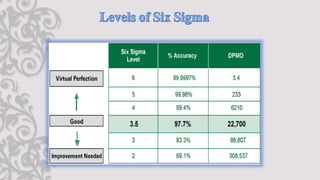
• Six sigma is a business statistical Strategy.
• Is to identifying defects and removing them from the process of
products to improve quality.
• A defect is defined as any process output that does not meet
customer specifications.
• Statistical measure to objectively evaluate processes.
• A comprehensive tool set to increase the speed and effectiveness of
any process.
• Increased revenue, reduced costs, and improved collaboration.
• Implements a fix based on facts, not assumptions.
• The Six sigma was founded by Motorola in the 1970s.
• Out of senior executive Art Sundry's criticism of Motorola’s bad
quality.
• They founded a connection between increases in quality and
decreases in costs of production.
• Bill Smith, “Father of six sigma” introduce this quality improvement
Methodology to Motorola.
Sir Bill Smith
“ the Father of six sigma”
• Six Sigma seeks to improve the quality of process outputs by
identifying and removing the causes of defects.
• Six Sigma approach is a collection of managerial and statistical concept
and techniques that focuses on reducing variation in processes and
preventing deficiencies in product.
• The concept of Variation states “NO two items will be perfectly
identical.”
• Management philosophy focused on business process improvements
to:
✓Eliminate waste, rework, and mistakes
✓Increase customer satisfaction
✓Increase profitability and competitiveness
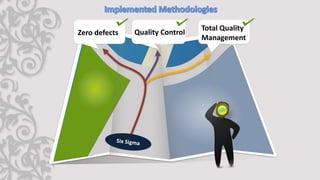
Total Quality
Management
Zero defects Quality Control
Six Sigma projects follow two project methodologies :
1. DMAIC
2. DMADV
These methodologies, composed of five phases.
1. DMAIC
DMAIC is used for projects aimed at improving an existing
business process.
2. DMADV
DMADV is used for projects aimed at creating new product or
process designs.
1. DMAIC
The DMAIC project methodology has Five phases:
1. Define
2. Measure
3. Analyze
4. Improve
5. Control
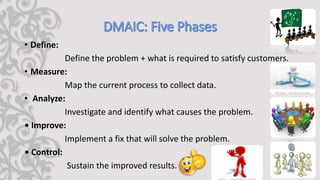
• Define:
Define the problem + what is required to satisfy customers.
• Measure:
Map the current process to collect data.
• Analyze:
Investigate and identify what causes the problem.
• Improve:
Implement a fix that will solve the problem.
• Control:
Sustain the improved results.
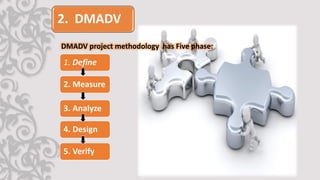
2. DMADV
DMADV project methodology has Five phase:
1. Define
2. Measure
3. Analyze
4. Design
5. Verify
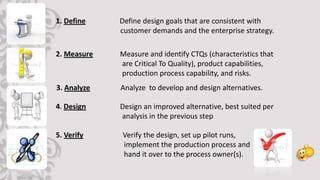
1. Define Define design goals that are consistent with
customer demands and the enterprise strategy.
2. Measure Measure and identify CTQs (characteristics that
are Critical To Quality), product capabilities,
production process capability, and risks.
3. Analyze Analyze to develop and design alternatives.
4. Design Design an improved alternative, best suited per
analysis in the previous step
5. Verify Verify the design, set up pilot runs,
implement the production process and
hand it over to the process owner(s).
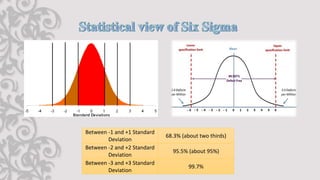
Between -1 and +1 Standard
Deviation
68.3% (about two thirds)
Between -2 and +2 Standard
Deviation
95.5% (about 95%)
Between -3 and +3 Standard
Deviation
99.7%
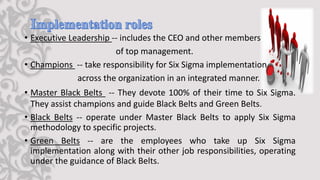
• Executive Leadership -- includes the CEO and other members
of top management.
• Champions -- take responsibility for Six Sigma implementation
across the organization in an integrated manner.
• Master Black Belts -- They devote 100% of their time to Six Sigma.
They assist champions and guide Black Belts and Green Belts.
• Black Belts -- operate under Master Black Belts to apply Six Sigma
methodology to specific projects.
• Green Belts -- are the employees who take up Six Sigma
implementation along with their other job responsibilities, operating
under the guidance of Black Belts.
•Arena
•ARIS Six Sigma
•Bonita Open Solution BPMN2 standard and
KPIs for statistic monitoring
•JMP
•Mathematical
•MATLAB or GNU Octave
•Microsoft Visio
•STATA
•STATISTICA
And Many more…..
✓Overall Business Improvement
Six Sigma methodology focuses on business
improvement. Beyond reducing the number of defects
present in any given number of products.
✓Remedy Defects/Variability
Any business seeking improved numbers must
reduce the number of defective products or services
it produces. Defective products can harm customer
satisfaction levels.
✓Reduce Costs
Reduced costs equal increased profits. A company
implementing Six Sigma principles has to look to
reduce costs wherever it possibly can--without
reducing quality.
✓Improve Cycle Time
Any reduction in the amount of time it takes to
produce a product or perform a service means
money saved, both in maintenance costs and
personnel wages. Additionally, customer
satisfaction improves when both retailers and end
users receive products sooner than expected. The
company that can get a product to its customer
faster may win her business.
✓Increase Customer Satisfaction
Customer satisfaction depends upon successful
resolution of all Six Sigma’s other objectives. But
customer satisfaction is an objective all its own.
Case Study 1
Six Sigma was introduced into Korea in 1997.
The First National Quality Prize of Six Sigma was given to two
companies. One is Samsung and other is LG electronics ; which are
virtually the leader of six sigma in Korea.
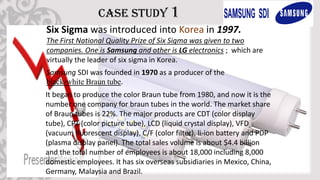
Samsung SDI was founded in 1970 as a producer of the
black/white Braun tube.
It began to produce the color Braun tube from 1980, and now it is the
number one company for braun tubes in the world. The market share
of Braun tubes is 22%. The major products are CDT (color display
tube), CPT (color picture tube), LCD (liquid crystal display), VFD
(vacuum fluorescent display), C/F (color filter), li-ion battery and PDP
(plasma display panel). The total sales volume is about $4.4 billion
and the total number of employees is about 18,000 including 8,000
domestic employees. It has six overseas subsidiaries in Mexico, China,
Germany, Malaysia and Brazil.
STRATEGY FOR TOTAL CHANGEWHY?
Direction
of
problem-
solving
Problems
Scientific &
statistical
approaches are
necessary
Elimination of
waste elements
Continuous
learning
1. Big quality
variation
2. Occurrence of
same defects
1. High quality cost
2. Not enough
provision of unified
information
1. High quality cost
2. Not enough
provision of
unified
information
PRODUCT PROCESS PEOPLE
The necessity of Six Sigma in Samsung
TRUE LEADER IN DIGITAL WORLD
World-best
profit realization
• World no.1 products
• Achievement of 6σ
quality level
Reduction of
quality cost
Cultivation of
global
professionals
PROCESS
• Global standard
• Improvement of
process effectiveness
PEOPLE
• Learning organization
• Good working habit
• 7 values
Well equipped with Six Sigma philosophy, systems and methodologies
• Project team activities • Belt system
• Six Sigma academy (education) • Reward system
PRODUCT
• 4 world #1 products
• Improvement of R&D
power
• Customer-oriented quality
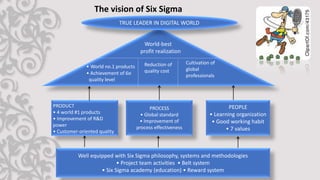
The vision of Six Sigma
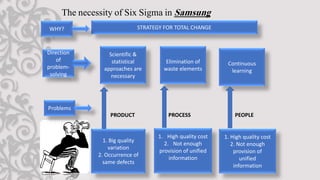
The problems were in the large quality variations in many
products, repeated occurrences of the same defects, high
quality costs(in particular, high failure costs), insufficient
unified information for quality and productivity,
manufacturing-oriented small group activities, and
infrequent use of advanced scientific methods.
The company concluded that the directions for solving these
problems lay in scientific and statistical approaches for
product quality, elimination of waste elements for process
innovation, and continuous learning system for people. These
directions in turn demanded a firm strategy for a complete
overhaul, implying a new paradigm shift to Six Sigma.
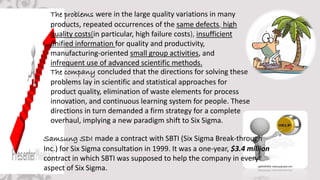
Samsung SDI made a contract with SBTI (Six Sigma Break-through
Inc.) for Six Sigma consultation in 1999. It was a one-year, $3.4 million
contract in which SBTI was supposed to help the company in every
aspect of Six Sigma.
Thank You

6 sigma basic best ppt

  • 2.
    • Six sigmais a business statistical Strategy. • Is to identifying defects and removing them from the process of products to improve quality. • A defect is defined as any process output that does not meet customer specifications. • Statistical measure to objectively evaluate processes. • A comprehensive tool set to increase the speed and effectiveness of any process. • Increased revenue, reduced costs, and improved collaboration. • Implements a fix based on facts, not assumptions.
  • 3.
    • The Sixsigma was founded by Motorola in the 1970s. • Out of senior executive Art Sundry's criticism of Motorola’s bad quality. • They founded a connection between increases in quality and decreases in costs of production. • Bill Smith, “Father of six sigma” introduce this quality improvement Methodology to Motorola.
  • 4.
    Sir Bill Smith “the Father of six sigma”
  • 5.
    • Six Sigmaseeks to improve the quality of process outputs by identifying and removing the causes of defects. • Six Sigma approach is a collection of managerial and statistical concept and techniques that focuses on reducing variation in processes and preventing deficiencies in product. • The concept of Variation states “NO two items will be perfectly identical.” • Management philosophy focused on business process improvements to: ✓Eliminate waste, rework, and mistakes ✓Increase customer satisfaction ✓Increase profitability and competitiveness
  • 6.
  • 7.
    Six Sigma projectsfollow two project methodologies : 1. DMAIC 2. DMADV These methodologies, composed of five phases.
  • 8.
    1. DMAIC DMAIC isused for projects aimed at improving an existing business process. 2. DMADV DMADV is used for projects aimed at creating new product or process designs.
  • 9.
    1. DMAIC The DMAICproject methodology has Five phases: 1. Define 2. Measure 3. Analyze 4. Improve 5. Control
  • 10.
    • Define: Define theproblem + what is required to satisfy customers. • Measure: Map the current process to collect data. • Analyze: Investigate and identify what causes the problem. • Improve: Implement a fix that will solve the problem. • Control: Sustain the improved results.
  • 11.
    2. DMADV DMADV projectmethodology has Five phase: 1. Define 2. Measure 3. Analyze 4. Design 5. Verify
  • 12.
    1. Define Definedesign goals that are consistent with customer demands and the enterprise strategy. 2. Measure Measure and identify CTQs (characteristics that are Critical To Quality), product capabilities, production process capability, and risks. 3. Analyze Analyze to develop and design alternatives. 4. Design Design an improved alternative, best suited per analysis in the previous step 5. Verify Verify the design, set up pilot runs, implement the production process and hand it over to the process owner(s).
  • 14.
    Between -1 and+1 Standard Deviation 68.3% (about two thirds) Between -2 and +2 Standard Deviation 95.5% (about 95%) Between -3 and +3 Standard Deviation 99.7%
  • 15.
    • Executive Leadership-- includes the CEO and other members of top management. • Champions -- take responsibility for Six Sigma implementation across the organization in an integrated manner. • Master Black Belts -- They devote 100% of their time to Six Sigma. They assist champions and guide Black Belts and Green Belts. • Black Belts -- operate under Master Black Belts to apply Six Sigma methodology to specific projects. • Green Belts -- are the employees who take up Six Sigma implementation along with their other job responsibilities, operating under the guidance of Black Belts.
  • 16.
    •Arena •ARIS Six Sigma •BonitaOpen Solution BPMN2 standard and KPIs for statistic monitoring •JMP •Mathematical •MATLAB or GNU Octave •Microsoft Visio •STATA •STATISTICA And Many more…..
  • 17.
    ✓Overall Business Improvement SixSigma methodology focuses on business improvement. Beyond reducing the number of defects present in any given number of products. ✓Remedy Defects/Variability Any business seeking improved numbers must reduce the number of defective products or services it produces. Defective products can harm customer satisfaction levels.
  • 18.
    ✓Reduce Costs Reduced costsequal increased profits. A company implementing Six Sigma principles has to look to reduce costs wherever it possibly can--without reducing quality. ✓Improve Cycle Time Any reduction in the amount of time it takes to produce a product or perform a service means money saved, both in maintenance costs and personnel wages. Additionally, customer satisfaction improves when both retailers and end users receive products sooner than expected. The company that can get a product to its customer faster may win her business.
  • 19.
    ✓Increase Customer Satisfaction Customersatisfaction depends upon successful resolution of all Six Sigma’s other objectives. But customer satisfaction is an objective all its own.
  • 20.
    Case Study 1 SixSigma was introduced into Korea in 1997. The First National Quality Prize of Six Sigma was given to two companies. One is Samsung and other is LG electronics ; which are virtually the leader of six sigma in Korea. Samsung SDI was founded in 1970 as a producer of the black/white Braun tube. It began to produce the color Braun tube from 1980, and now it is the number one company for braun tubes in the world. The market share of Braun tubes is 22%. The major products are CDT (color display tube), CPT (color picture tube), LCD (liquid crystal display), VFD (vacuum fluorescent display), C/F (color filter), li-ion battery and PDP (plasma display panel). The total sales volume is about $4.4 billion and the total number of employees is about 18,000 including 8,000 domestic employees. It has six overseas subsidiaries in Mexico, China, Germany, Malaysia and Brazil.
  • 21.
    STRATEGY FOR TOTALCHANGEWHY? Direction of problem- solving Problems Scientific & statistical approaches are necessary Elimination of waste elements Continuous learning 1. Big quality variation 2. Occurrence of same defects 1. High quality cost 2. Not enough provision of unified information 1. High quality cost 2. Not enough provision of unified information PRODUCT PROCESS PEOPLE The necessity of Six Sigma in Samsung
  • 22.
    TRUE LEADER INDIGITAL WORLD World-best profit realization • World no.1 products • Achievement of 6σ quality level Reduction of quality cost Cultivation of global professionals PROCESS • Global standard • Improvement of process effectiveness PEOPLE • Learning organization • Good working habit • 7 values Well equipped with Six Sigma philosophy, systems and methodologies • Project team activities • Belt system • Six Sigma academy (education) • Reward system PRODUCT • 4 world #1 products • Improvement of R&D power • Customer-oriented quality The vision of Six Sigma
  • 23.
    The problems werein the large quality variations in many products, repeated occurrences of the same defects, high quality costs(in particular, high failure costs), insufficient unified information for quality and productivity, manufacturing-oriented small group activities, and infrequent use of advanced scientific methods. The company concluded that the directions for solving these problems lay in scientific and statistical approaches for product quality, elimination of waste elements for process innovation, and continuous learning system for people. These directions in turn demanded a firm strategy for a complete overhaul, implying a new paradigm shift to Six Sigma. Samsung SDI made a contract with SBTI (Six Sigma Break-through Inc.) for Six Sigma consultation in 1999. It was a one-year, $3.4 million contract in which SBTI was supposed to help the company in every aspect of Six Sigma.
  • 24.