Six Sigma Overview

  Roma Mohanti, 04/2008
Sigma as a Business Strategy
                    Focused on customer requirements
                     o Internal, and external customers
                     o Root cause of defects that impact satisfaction, loyalty,
                       revenue, market share
                    A disciplined, fact-based approach to managing a
                     business and its processes
                    A way to assess performance of a process
                     o Devised at Motorola in 1987
                     o Higher the process sigma, the fewer the defects
                    Comparison of differing processes
                     o Marketing, Finance, Manufacturing, Order Fulfillment, Service
                       Delivery in common terms
                     o Adjust for complexity of the work, product, service


                                                                   2
Six Sigma Overview                                                                     Page 2
Six Sigma


                                 3
Six Sigma Overview                   Page 3
Deployment
           Six Sigma is deployed by individuals
            certified in the methodology including:
              • Master Black Belt - certified to train and certify
                others
              • Black Belt - certified to train and lead Six Sigma
                projects
              • Green Belt - certified to train and participate in
                the process


                                                        4
Six Sigma Overview                                                   Page 4
Six Sigma Methods
               DMAIC
                 •   Define, Measure, Analyze, Improve, Control
                 •   Used to improve existing processes
               DMADV / DFSS
                 • Define, Measure, Analyze, Design, Verify
                 • Used to develop new processes or implement new
                   technologies
                 • May be referred to as DFSS
               Process Management
                 • Reviewing and analyzing E2E of work processes


                                                        5
Six Sigma Overview                                                  Page 5
Methodology Integration


                                        6
Six Sigma Overview                             Page 6
DMAIC Cycle - Define
                Select specific problem/opportunity
                     − An appropriate DMAIC project
                     − Meaningful and Manageable
                Create a Project Charter
                     − Validated by leadership
                     − Identifying key contributors
                Define the process and
                customer(s)


                                                      7
Six Sigma Overview                                        Page 7
Define Stage Activities
               Define Critical Customer Requirements
               Develop Team Charter
               Map “As Is” Business Process
               Complete SIPOC
               Develop the Business Case including high
                level project plan


                                              8
Six Sigma Overview                                         Page 8
SIPOC
                           A document that defines
                        the context, specifics and plans of
                        an improvement or design project
                Define (and narrow) the project’s focus
                Clarify the results being sought
                Confirm value to the business
                Establish boundaries and resources for
                 the team
                Communicate goals and plans

                                                       9
Six Sigma Overview                                            Page 9
Example - SIPOC
                     A SIPOC will allow your project team to put parameters
                     around the process being reviewed and identify the areas
                               impacted both up and down stream

                                                                   SIPOC
                      Suppliers               Input                Process                         Output              Customer
              Clients                Requirements                                         Profile               Client
              Sales People           Resumes                                              Interview Summaries   Sales People
              Candidates             Profiles                                             Offer Letters         Delivery Management
              Web Site               Margin Template                                                            Candidate/Employee
              Recruiting Data Base


                   Get                  Search for      Screen                                      Present
                                                                             Make Offer                              Fill Requirement
                Requirement             Candidate      Candidate                                   Candidate


                                Suppliers – who feeds the process
                                Inputs – what do they feed
                                Process – steps in the process
                                Outputs – outputs of the process
                                Customer – who pulls from the process
                                                                                                     10
Six Sigma Overview                                                                                                                      Page 10
DMAIC Cycle - Measure
              Determine what to measure and why
              Prepare plans to collect output, process
               and/or input data
              Construct forms and test data collection
               procedures
              Refine data collection
              Refine DMAIC Charter


                                                 11
Six Sigma Overview                                        Page 11
Measure Stage Activities
                Identify Key Measurements
                Data Collection Plan
                Data Collection Execution
                Document Process Variations
                Establish Performance Baseline


                                                  12
Six Sigma Overview                                     Page 12
Input – Process – Output Measures
               A DMAIC team must get Output measures to baseline
                the process/problem
                 • Focus on your Goal target or “Project Y”
               Output measures can be taken before or after the
                product or service is delivered to the customer
                 • Defects caught in-house prior to shipment vs. on delivery or
                   inservice
               Use SIPOC diagram and sub-process maps to help
                select measures and ensure “balance”
               Consider possible “X” measures early in the project to
                help get some initial data for the Analyze phase


                                                                  13
Six Sigma Overview                                                                Page 13
Review Y and X Measures


                                        14
Six Sigma Overview                             Page 14
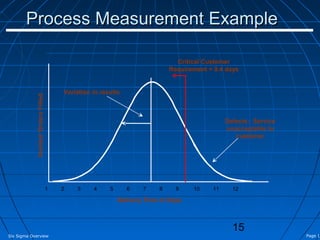
Process Measurement Example

                                                                              Critical Customer
                                                                            Requirement = 9.4 days


                                       Variation in results
            Number Orders Filled


                                                                                              Defects: Service
                                                                                              unacceptable to
                                                                                                 customer


                                   1   2   3     4     5      6    7    8     9    10    11     12

                                                           Delivery Time in Days


                                                                                                15
Six Sigma Overview                                                                                               Page 15
DMAIC Cycle - Analyze
               Current state analysis
               Is the current state as good as the
                process can do?
               Who will help make the changes?
               Resource requirements
               What could cause this change effort to
                fail?
               What major obstacles do I face in
                completing the project?


                                              16
Six Sigma Overview                                       Page 16
Analyze Stage Activities
                Validate “As Is” Process Map
                Complete Root Cause Analysis
                     • Fishbone Diagram
                     • House of Quality
                Develop “To Be” Process Map
                Complete Gap Analysis


                                            17
Six Sigma Overview                                Page 17
Process Analysis
               Look for points in the process that generate
               defects or where work may be disrupted or
                                  delayed


               Disconnects
               Bottlenecks
               Redundancies
               Rework loops
               Decisions/Inspections
               Moves

                                                 18
Six Sigma Overview                                            Page 18
Analyze Current Process
          Use symbols and colors to help you analyze the current state


                                                          19
Six Sigma Overview                                                       Page 19
DMAIC Cycle - Improve
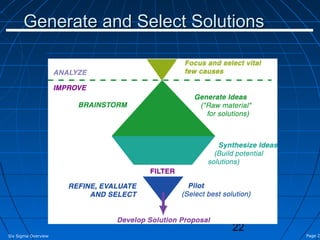
              Create innovative ideas for improvement
              Funnel and select best solution possibilities
              Understand best practices for process
               workflow
              Develop pilot and define implementation
               strategies
                •    Work breakdown structure
                •    Specific activities to meet the project goals
                •    Alignment or re-integration of various subprojects


                                                            20
Six Sigma Overview                                                        Page 20
Improve Stage Activities
               Define Solution
                 • Include IT when defining technical solutions
               Develop Work Breakdown Structure
               Develop Implementation Plan
               Complete FMEA


                                                        21
Six Sigma Overview                                                Page 21
Generate and Select Solutions


                               22
Six Sigma Overview                    Page 22
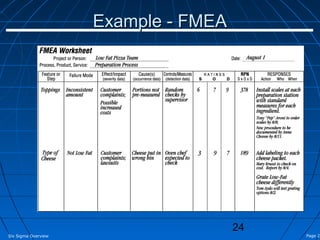
FMEA
                     Failure Modes & Effects Analysis
              Method to assess and plan for problems which
               could impact safety, reliability, customer
               satisfaction, profits, etc.
                • Failure Modes = types of possible error or defect
                • Looks at common or rare events and relative risk
              A tool for process owners to allocate
               measurement and prevention resources
               (Control)


                                                       23
Six Sigma Overview                                                    Page 23
Example - FMEA


                                      24
Six Sigma Overview                         Page 24
DMAIC Cycle - Control
               How will I control risk, quality, cost,
                schedule, scope and changes to the plan?
               What types of progress reports should I
                create?
               How will I assure that the business goals of
                the project were accomplished?
               How will I keep the gains made?


                                                   25
Six Sigma Overview                                             Page 25
Control Stage Activities
               Complete Process Standardization
                 • Validate Process Map
                 • Develop Process Documentation
               Develop Monitoring Plan
               Develop Response Plan
               Complete Transfer of Ownership


                                                   26
Six Sigma Overview                                      Page 26
Control Plan

          Control Plan = FMEA + Monitoring + Response


    From Improve Phase      Dashboard/Control Chart   New!
                                VOC Systems

                                               27
Six Sigma Overview                                           Page 27
Summary

         Six Sigma
            • 3.4 Defects per Million Opportunities
         DMAIC
            •   Define
            •   Measure
            •   Analyze
            •   Improve
            •   Control

                                                28
Six Sigma Overview                                    Page 28

Six sigma-basics

  • 1.
    Six Sigma Overview Roma Mohanti, 04/2008
  • 2.
    Sigma as aBusiness Strategy  Focused on customer requirements o Internal, and external customers o Root cause of defects that impact satisfaction, loyalty, revenue, market share  A disciplined, fact-based approach to managing a business and its processes  A way to assess performance of a process o Devised at Motorola in 1987 o Higher the process sigma, the fewer the defects  Comparison of differing processes o Marketing, Finance, Manufacturing, Order Fulfillment, Service Delivery in common terms o Adjust for complexity of the work, product, service 2 Six Sigma Overview Page 2
  • 3.
    Six Sigma 3 Six Sigma Overview Page 3
  • 4.
    Deployment  Six Sigma is deployed by individuals certified in the methodology including: • Master Black Belt - certified to train and certify others • Black Belt - certified to train and lead Six Sigma projects • Green Belt - certified to train and participate in the process 4 Six Sigma Overview Page 4
  • 5.
    Six Sigma Methods  DMAIC • Define, Measure, Analyze, Improve, Control • Used to improve existing processes  DMADV / DFSS • Define, Measure, Analyze, Design, Verify • Used to develop new processes or implement new technologies • May be referred to as DFSS  Process Management • Reviewing and analyzing E2E of work processes 5 Six Sigma Overview Page 5
  • 6.
    Methodology Integration 6 Six Sigma Overview Page 6
  • 7.
    DMAIC Cycle -Define  Select specific problem/opportunity − An appropriate DMAIC project − Meaningful and Manageable  Create a Project Charter − Validated by leadership − Identifying key contributors  Define the process and customer(s) 7 Six Sigma Overview Page 7
  • 8.
    Define Stage Activities  Define Critical Customer Requirements  Develop Team Charter  Map “As Is” Business Process  Complete SIPOC  Develop the Business Case including high level project plan 8 Six Sigma Overview Page 8
  • 9.
    SIPOC A document that defines the context, specifics and plans of an improvement or design project  Define (and narrow) the project’s focus  Clarify the results being sought  Confirm value to the business  Establish boundaries and resources for the team  Communicate goals and plans 9 Six Sigma Overview Page 9
  • 10.
    Example - SIPOC A SIPOC will allow your project team to put parameters around the process being reviewed and identify the areas impacted both up and down stream SIPOC Suppliers Input Process Output Customer Clients Requirements Profile Client Sales People Resumes Interview Summaries Sales People Candidates Profiles Offer Letters Delivery Management Web Site Margin Template Candidate/Employee Recruiting Data Base Get Search for Screen Present Make Offer Fill Requirement Requirement Candidate Candidate Candidate  Suppliers – who feeds the process  Inputs – what do they feed  Process – steps in the process  Outputs – outputs of the process  Customer – who pulls from the process 10 Six Sigma Overview Page 10
  • 11.
    DMAIC Cycle -Measure  Determine what to measure and why  Prepare plans to collect output, process and/or input data  Construct forms and test data collection procedures  Refine data collection  Refine DMAIC Charter 11 Six Sigma Overview Page 11
  • 12.
    Measure Stage Activities  Identify Key Measurements  Data Collection Plan  Data Collection Execution  Document Process Variations  Establish Performance Baseline 12 Six Sigma Overview Page 12
  • 13.
    Input – Process– Output Measures  A DMAIC team must get Output measures to baseline the process/problem • Focus on your Goal target or “Project Y”  Output measures can be taken before or after the product or service is delivered to the customer • Defects caught in-house prior to shipment vs. on delivery or inservice  Use SIPOC diagram and sub-process maps to help select measures and ensure “balance”  Consider possible “X” measures early in the project to help get some initial data for the Analyze phase 13 Six Sigma Overview Page 13
  • 14.
    Review Y andX Measures 14 Six Sigma Overview Page 14
  • 15.
    Process Measurement Example Critical Customer Requirement = 9.4 days Variation in results Number Orders Filled Defects: Service unacceptable to customer 1 2 3 4 5 6 7 8 9 10 11 12 Delivery Time in Days 15 Six Sigma Overview Page 15
  • 16.
    DMAIC Cycle -Analyze  Current state analysis  Is the current state as good as the process can do?  Who will help make the changes?  Resource requirements  What could cause this change effort to fail?  What major obstacles do I face in completing the project? 16 Six Sigma Overview Page 16
  • 17.
    Analyze Stage Activities  Validate “As Is” Process Map  Complete Root Cause Analysis • Fishbone Diagram • House of Quality  Develop “To Be” Process Map  Complete Gap Analysis 17 Six Sigma Overview Page 17
  • 18.
    Process Analysis Look for points in the process that generate defects or where work may be disrupted or delayed  Disconnects  Bottlenecks  Redundancies  Rework loops  Decisions/Inspections  Moves 18 Six Sigma Overview Page 18
  • 19.
    Analyze Current Process Use symbols and colors to help you analyze the current state 19 Six Sigma Overview Page 19
  • 20.
    DMAIC Cycle -Improve  Create innovative ideas for improvement  Funnel and select best solution possibilities  Understand best practices for process workflow  Develop pilot and define implementation strategies • Work breakdown structure • Specific activities to meet the project goals • Alignment or re-integration of various subprojects 20 Six Sigma Overview Page 20
  • 21.
    Improve Stage Activities  Define Solution • Include IT when defining technical solutions  Develop Work Breakdown Structure  Develop Implementation Plan  Complete FMEA 21 Six Sigma Overview Page 21
  • 22.
    Generate and SelectSolutions 22 Six Sigma Overview Page 22
  • 23.
    FMEA Failure Modes & Effects Analysis  Method to assess and plan for problems which could impact safety, reliability, customer satisfaction, profits, etc. • Failure Modes = types of possible error or defect • Looks at common or rare events and relative risk  A tool for process owners to allocate measurement and prevention resources (Control) 23 Six Sigma Overview Page 23
  • 24.
    Example - FMEA 24 Six Sigma Overview Page 24
  • 25.
    DMAIC Cycle -Control  How will I control risk, quality, cost, schedule, scope and changes to the plan?  What types of progress reports should I create?  How will I assure that the business goals of the project were accomplished?  How will I keep the gains made? 25 Six Sigma Overview Page 25
  • 26.
    Control Stage Activities  Complete Process Standardization • Validate Process Map • Develop Process Documentation  Develop Monitoring Plan  Develop Response Plan  Complete Transfer of Ownership 26 Six Sigma Overview Page 26
  • 27.
    Control Plan Control Plan = FMEA + Monitoring + Response From Improve Phase Dashboard/Control Chart New! VOC Systems 27 Six Sigma Overview Page 27
  • 28.
    Summary  Six Sigma • 3.4 Defects per Million Opportunities  DMAIC • Define • Measure • Analyze • Improve • Control 28 Six Sigma Overview Page 28