

By
Name : Vijayakumar.S
Roll No. : 424
Section : Theeta
Content
 Introduction
 History of Six Sigma
 Areas of Implementation
 Level of Implementation
 Key Elements
 Methodology
 Features of Six Sigma
 Conclusion
12/13/15 2Vijayakumar.S (424)
Introduction
Six Sigma relies heavily on advanced statistical
methods that complement and reduce the process
and product variations.
 It is a new way of doing business that would
eliminate the existing defects efficiently and would
prevent defects from occurring.
12/13/15 3Vijayakumar.S (424)
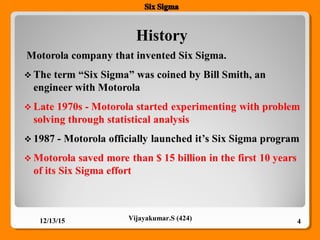
History
12/13/15 4Vijayakumar.S (424)
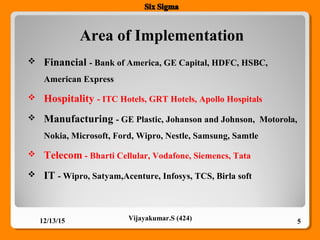
Area of Implementation
 Financial - Bank of America, GE Capital, HDFC, HSBC,
American Express
 Hospitality - ITC Hotels, GRT Hotels, Apollo Hospitals
 Manufacturing - GE Plastic, Johanson and Johnson, Motorola,
Nokia, Microsoft, Ford, Wipro, Nestle, Samsung, Samtle
 Telecom - Bharti Cellular, Vodafone, Siemencs, Tata
 IT - Wipro, Satyam,Acenture, Infosys, TCS, Birla soft
12/13/15 5Vijayakumar.S (424)
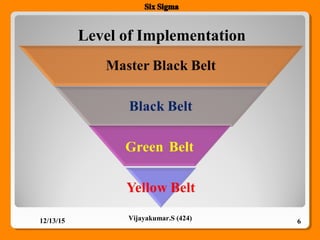
Level of Implementation
12/13/15 6Vijayakumar.S (424)
Cont.…
12/13/15 7Vijayakumar.S (424)
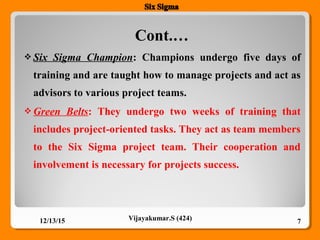
 Six Sigma Champion: Champions undergo five days of
training and are taught how to manage projects and act as
advisors to various project teams.
 Green Belts: They undergo two weeks of training that
includes project-oriented tasks. They act as team members
to the Six Sigma project team. Their cooperation and
involvement is necessary for projects success.
Cont.…
12/13/15 8Vijayakumar.S (424)
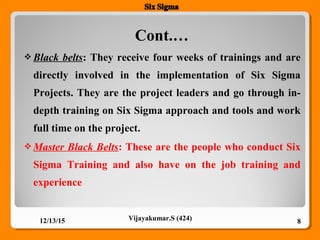
 Black belts: They receive four weeks of trainings and are
directly involved in the implementation of Six Sigma
Projects. They are the project leaders and go through in-
depth training on Six Sigma approach and tools and work
full time on the project.
 Master Black Belts: These are the people who conduct Six
Sigma Training and also have on the job training and
experience
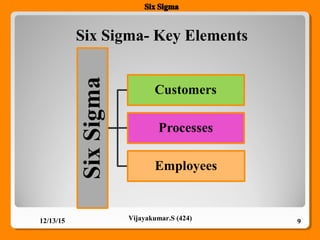
Six Sigma- Key Elements
12/13/15 9Vijayakumar.S (424)
Six Sigma-Methodology
12/13/15 10Vijayakumar.S (424)
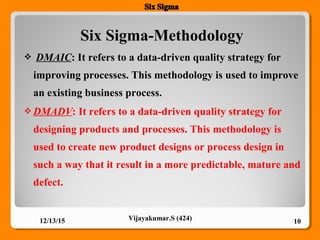
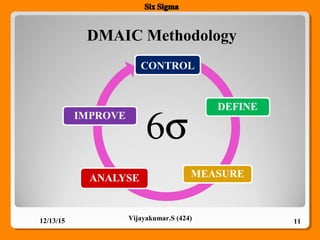
 DMAIC: It refers to a data-driven quality strategy for
improving processes. This methodology is used to improve
an existing business process.
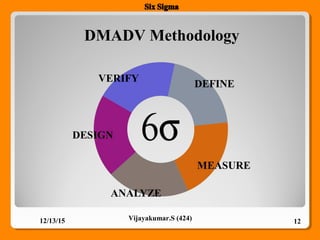
 DMADV: It refers to a data-driven quality strategy for
designing products and processes. This methodology is
used to create new product designs or process design in
such a way that it result in a more predictable, mature and
defect.
DMAIC Methodology
12/13/15 11Vijayakumar.S (424)
DMADV Methodology
12/13/15 12Vijayakumar.S (424)
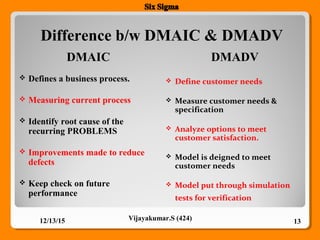
Difference b/w DMAIC & DMADV
12/13/15 13Vijayakumar.S (424)
 Defines a business process.
 Measuring current process
 Identify root cause of the
recurring PROBLEMS
 Improvements made to reduce
defects
 Keep check on future
performance
 Define customer needs
 Measure customer needs &
specification
 Analyze options to meet
customer satisfaction.
 Model is deigned to meet
customer needs
 Model put through simulation
tests for verification
DMAIC DMADV
Features of Six Sigma
12/13/15 14Vijayakumar.S (424)
Improving processes
Reducing defects
Reducing process variability
Reducing costs
Increasing customer satisfaction
Conclusion
12/13/15 15Vijayakumar.S (424)
At the conclusion of the design phase, you should
know who are the customer, their resistance
issues and requirements.
You should also have a clear understanding of
goals and the scope of the project that includes
budget, time constraints and deadlines.
12/13/15 16Vijayakumar.S (424)
QQuueessttiioonn…………????…………????
12/13/15 17Vijayakumar.S (424)

Six sigma overview

  • 1.
    By Name : Vijayakumar.S RollNo. : 424 Section : Theeta
  • 2.
    Content  Introduction  Historyof Six Sigma  Areas of Implementation  Level of Implementation  Key Elements  Methodology  Features of Six Sigma  Conclusion 12/13/15 2Vijayakumar.S (424)
  • 3.
    Introduction Six Sigma reliesheavily on advanced statistical methods that complement and reduce the process and product variations.  It is a new way of doing business that would eliminate the existing defects efficiently and would prevent defects from occurring. 12/13/15 3Vijayakumar.S (424)
  • 4.
  • 5.
    Area of Implementation Financial - Bank of America, GE Capital, HDFC, HSBC, American Express  Hospitality - ITC Hotels, GRT Hotels, Apollo Hospitals  Manufacturing - GE Plastic, Johanson and Johnson, Motorola, Nokia, Microsoft, Ford, Wipro, Nestle, Samsung, Samtle  Telecom - Bharti Cellular, Vodafone, Siemencs, Tata  IT - Wipro, Satyam,Acenture, Infosys, TCS, Birla soft 12/13/15 5Vijayakumar.S (424)
  • 6.
  • 7.
    Cont.… 12/13/15 7Vijayakumar.S (424) Six Sigma Champion: Champions undergo five days of training and are taught how to manage projects and act as advisors to various project teams.  Green Belts: They undergo two weeks of training that includes project-oriented tasks. They act as team members to the Six Sigma project team. Their cooperation and involvement is necessary for projects success.
  • 8.
    Cont.… 12/13/15 8Vijayakumar.S (424) Black belts: They receive four weeks of trainings and are directly involved in the implementation of Six Sigma Projects. They are the project leaders and go through in- depth training on Six Sigma approach and tools and work full time on the project.  Master Black Belts: These are the people who conduct Six Sigma Training and also have on the job training and experience
  • 9.
    Six Sigma- KeyElements 12/13/15 9Vijayakumar.S (424)
  • 10.
    Six Sigma-Methodology 12/13/15 10Vijayakumar.S(424)  DMAIC: It refers to a data-driven quality strategy for improving processes. This methodology is used to improve an existing business process.  DMADV: It refers to a data-driven quality strategy for designing products and processes. This methodology is used to create new product designs or process design in such a way that it result in a more predictable, mature and defect.
  • 11.
  • 12.
  • 13.
    Difference b/w DMAIC& DMADV 12/13/15 13Vijayakumar.S (424)  Defines a business process.  Measuring current process  Identify root cause of the recurring PROBLEMS  Improvements made to reduce defects  Keep check on future performance  Define customer needs  Measure customer needs & specification  Analyze options to meet customer satisfaction.  Model is deigned to meet customer needs  Model put through simulation tests for verification DMAIC DMADV
  • 14.
    Features of SixSigma 12/13/15 14Vijayakumar.S (424) Improving processes Reducing defects Reducing process variability Reducing costs Increasing customer satisfaction
  • 15.
    Conclusion 12/13/15 15Vijayakumar.S (424) Atthe conclusion of the design phase, you should know who are the customer, their resistance issues and requirements. You should also have a clear understanding of goals and the scope of the project that includes budget, time constraints and deadlines.
  • 16.
  • 17.