Introduction to
IATF 16949:2016
By:
Disha Jain
Ashish Mehta
 Introduction of IATF 16949:2016
 What is IATF 16949:2016?
 Why IATF 16949:2016?
 High Level structure and PDCA approach
 Quality Management Principle
 Over view of clauses
- Clause 4 : Context of the Organization
- Clause 5 : Leadership
- Clause 6 : Planning
- Clause 7 : Support
- Clause 8 : Operation
- Clause 9 : Performance Evaluation
- Clause 10 : Improvement
Agenda
Introduction to IATF 16949:2016
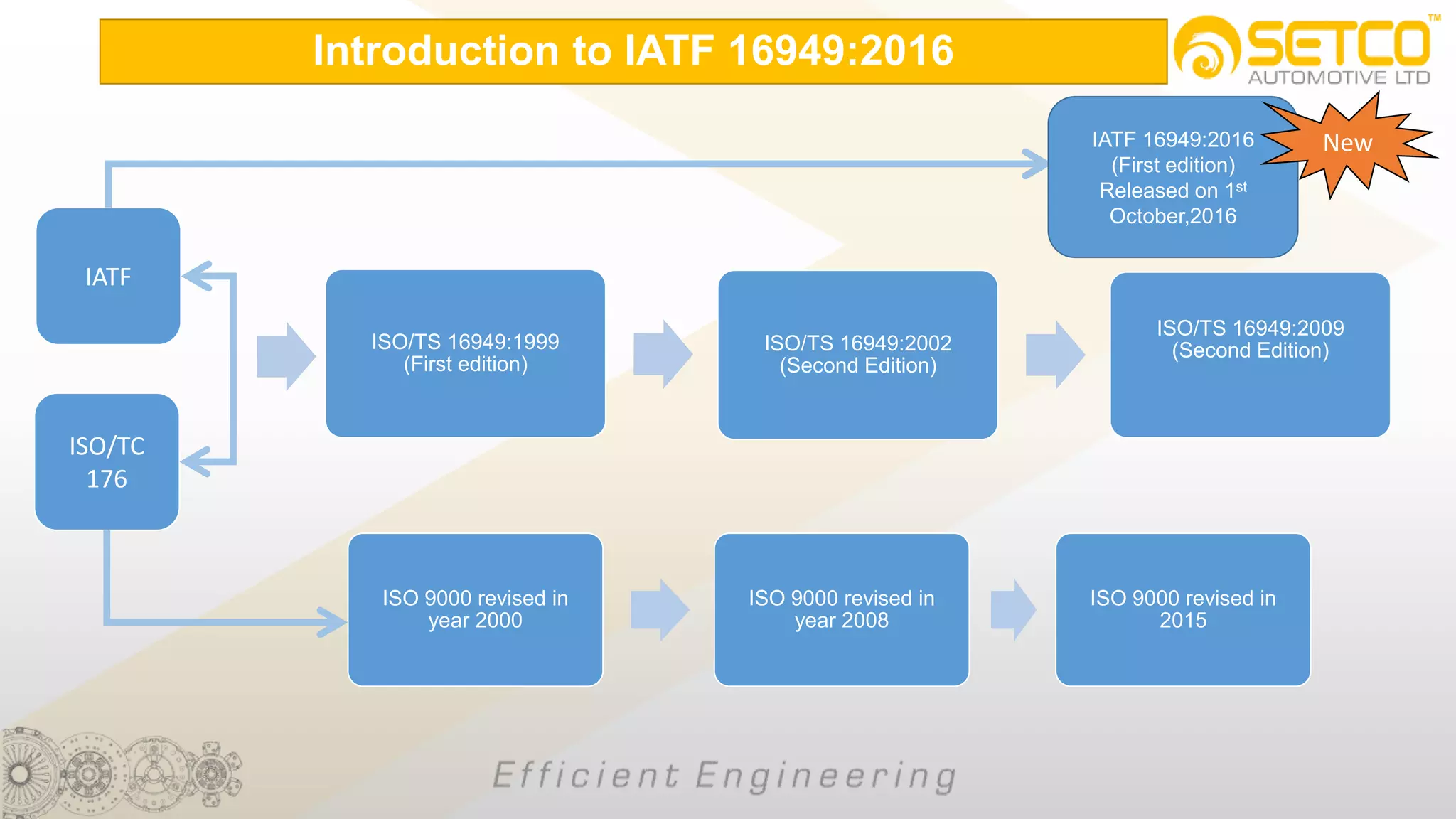
ISO/TS 16949:1999
(First edition)
ISO/TS 16949:2002
(Second Edition)
ISO/TS 16949:2009
(Second Edition)
ISO 9000 revised in
year 2000
ISO 9000 revised in
year 2008
ISO 9000 revised in
2015
IATF
ISO/TC
176
IATF 16949:2016
(First edition)
Released on 1st
October,2016
New
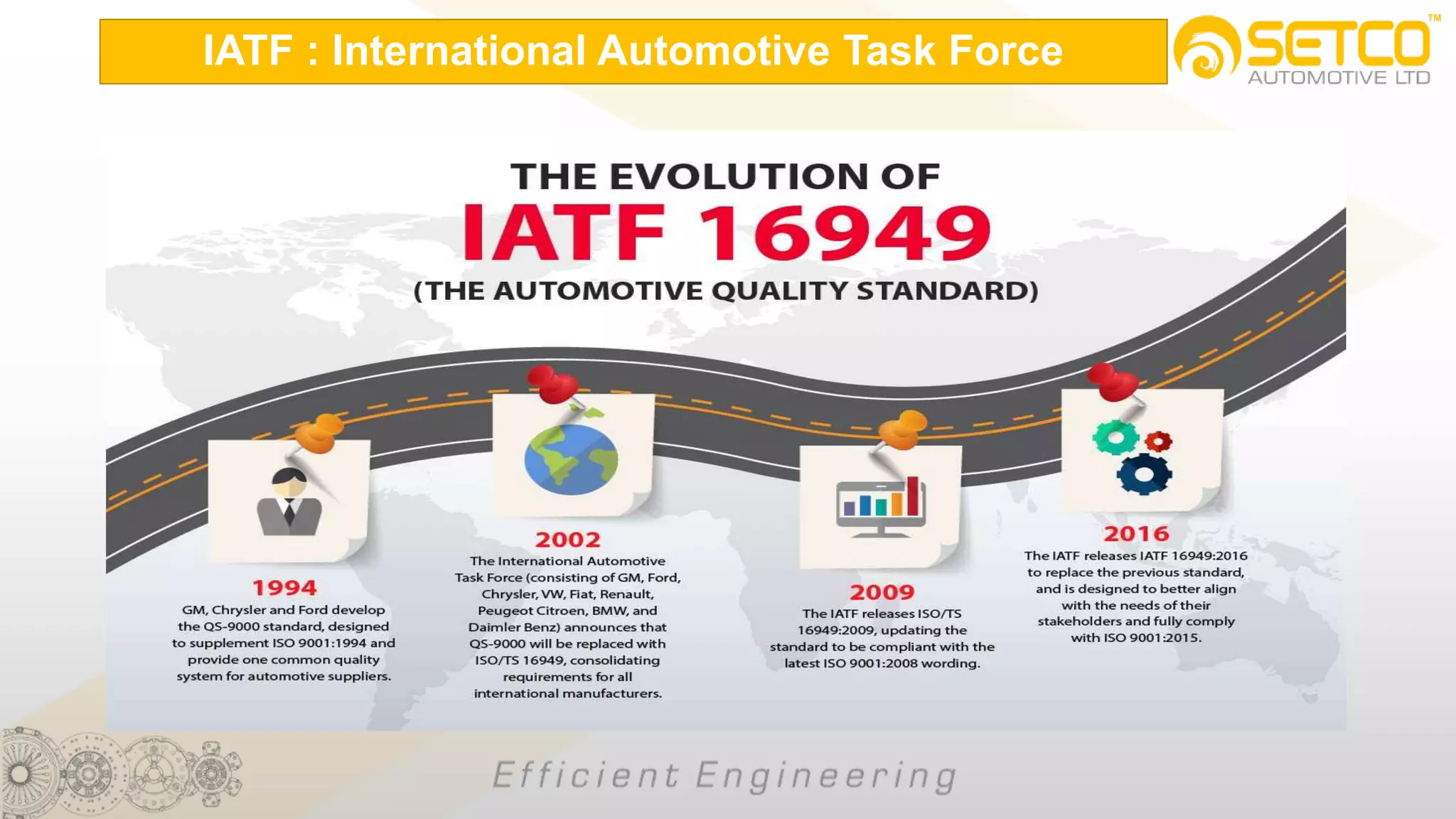
IATF : International Automotive Task Force
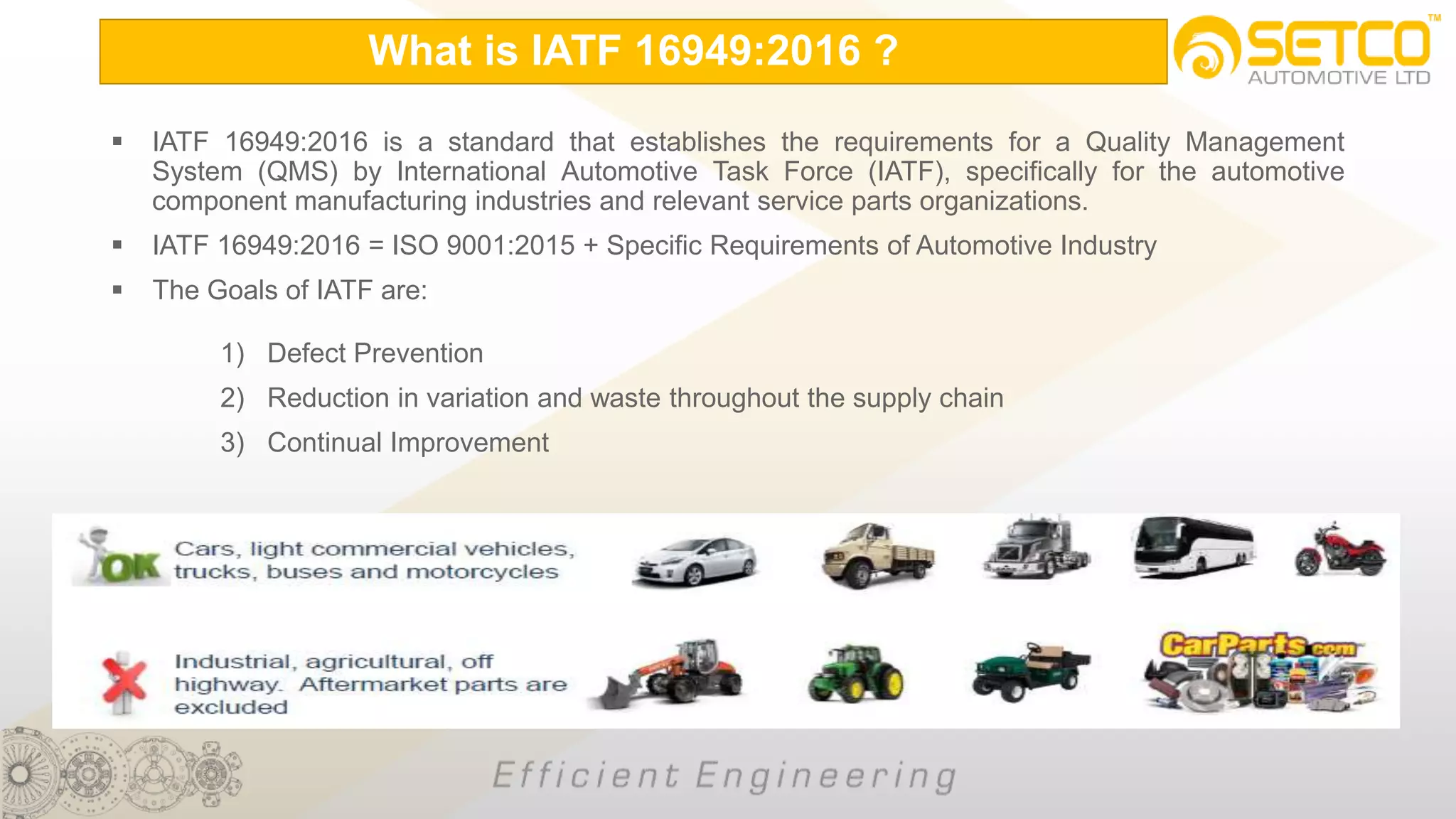
 IATF 16949:2016 is a standard that establishes the requirements for a Quality Management
System (QMS) by International Automotive Task Force (IATF), specifically for the automotive
component manufacturing industries and relevant service parts organizations.
 IATF 16949:2016 = ISO 9001:2015 + Specific Requirements of Automotive Industry
 The Goals of IATF are:
1) Defect Prevention
2) Reduction in variation and waste throughout the supply chain
3) Continual Improvement
What is IATF 16949:2016 ?
Implementing IATF 16949 ensures that our customers receive consistent, good quality products
and services, which in turn may bring many business benefits. IATF 16949 helps to:
Why IATF 16949:2016 ?
 Consistent quality product
 Meets statutory, regulatory and
product safety requirement.
 Customer satisfaction
 Increase in productivity and
efficiency.
 Reduction in internal and external
cost.
 Control on rejection and rework
ppm.
 Standardization of all work
procedures.
 Reduction in product development
lead-time.
 Sustenance of existing business.
 Expansion in new business.
 Increases on- time delivery
High Level Structure and PDCA ApproachHigh Level Structure and PDCA Approach
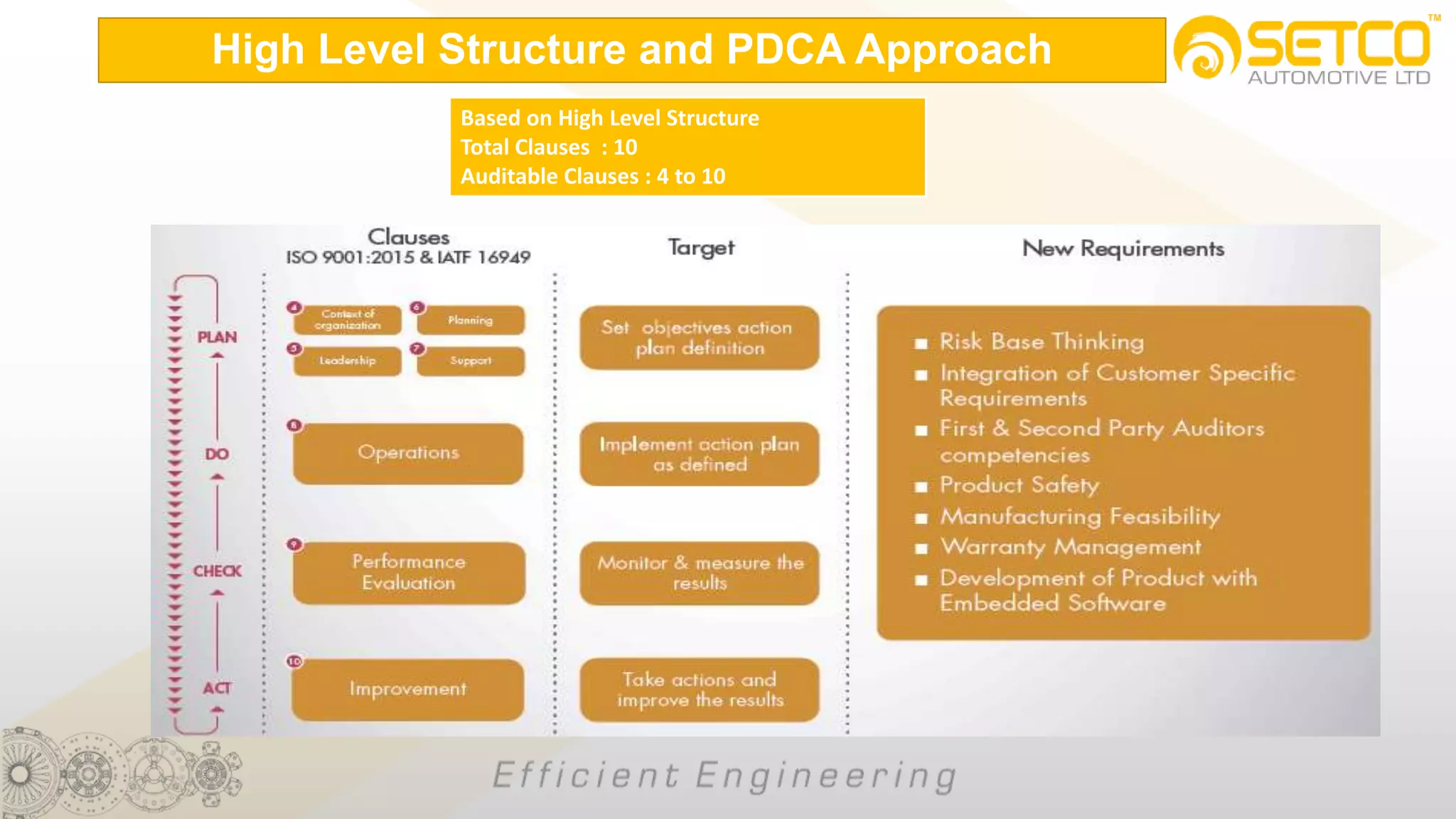
Based on High Level Structure
Total Clauses : 10
Auditable Clauses : 4 to 10
Quality Management Principle
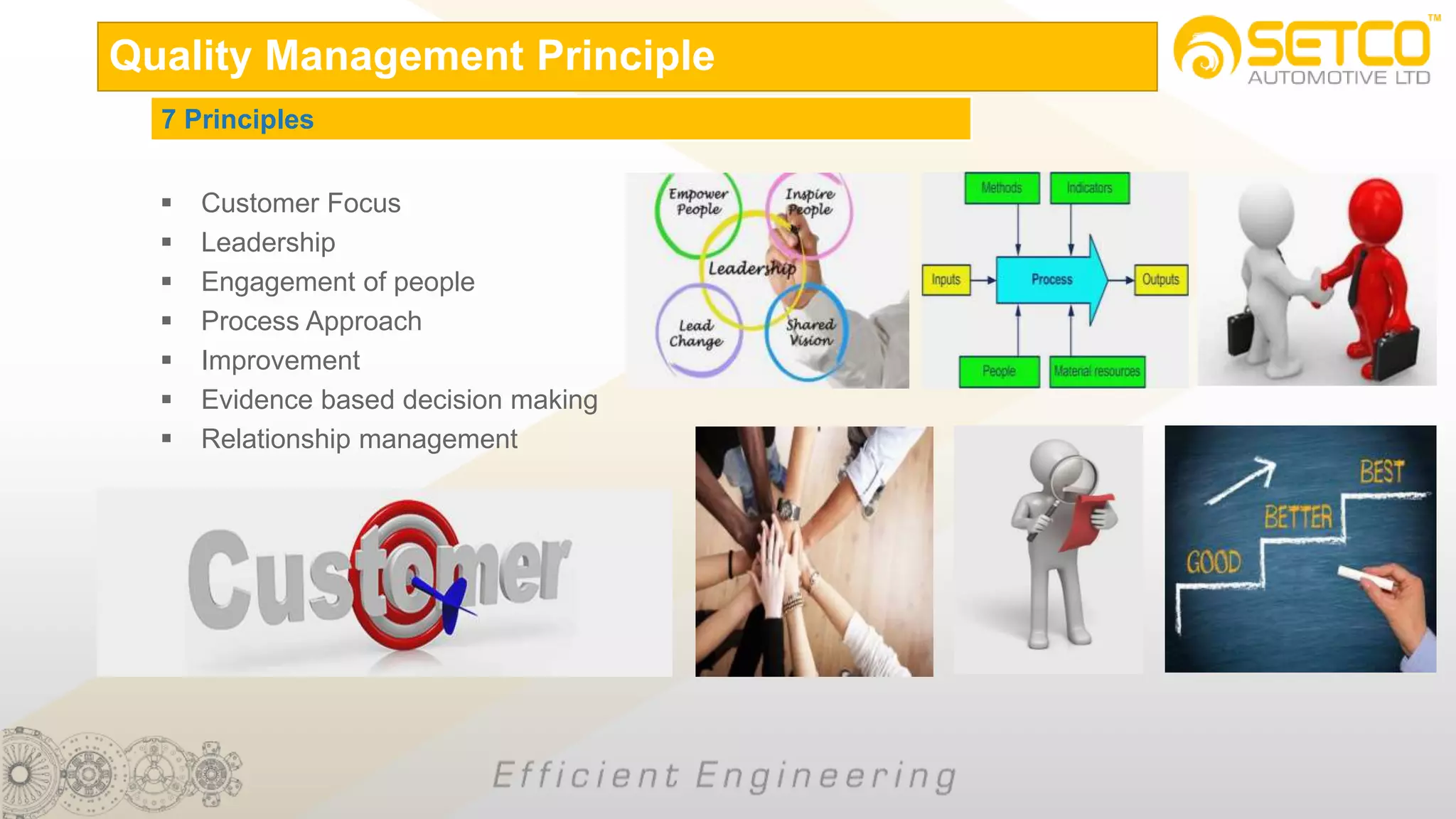
 Customer Focus
 Leadership
 Engagement of people
 Process Approach
 Improvement
 Evidence based decision making
 Relationship management
7 Principles
Overview of clauses
Clause 4 – Context of the Organization
4.1 Understanding the
organization and its
context
4.2 Understanding the
needs and expectations
of interested parties
External Risk:
- Legal: Govt.policies,GST
- Technological: Introduction of EV
- Competitive: Entry of competitor
- Market: Slow down of business
- Cultural: Mass leaves during
festivals
- Social: Riots
- Economic: Inflation, Steel price
hike
Internal Risk:
- Values : Teamwork, Integrity
- Culture : Worker Unions
- Knowledge : Technological
Unawareness
- Performance of organization
- KPI’s not achieved
- Lack of analysis and action plan
 Understand internal and external factors that affects the strategic
direction of organization.
Overview of clauses
Scope of QMS
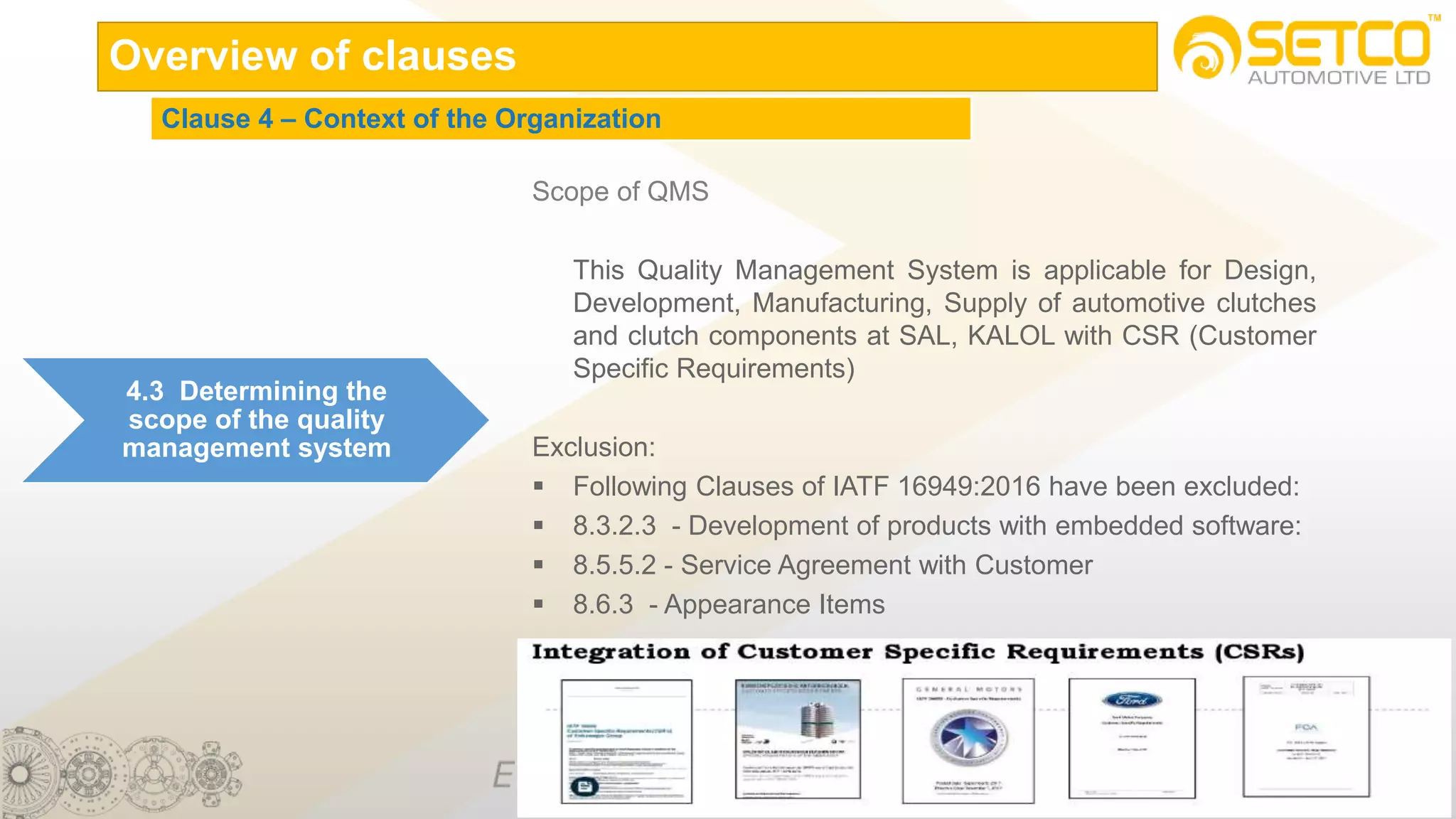
This Quality Management System is applicable for Design,
Development, Manufacturing, Supply of automotive clutches
and clutch components at SAL, KALOL with CSR (Customer
Specific Requirements)
Exclusion:
 Following Clauses of IATF 16949:2016 have been excluded:
 8.3.2.3 - Development of products with embedded software:
 8.5.5.2 - Service Agreement with Customer
 8.6.3 - Appearance Items
Clause 4 – Context of the Organization
4.3 Determining the
scope of the quality
management system
Overview of clauses
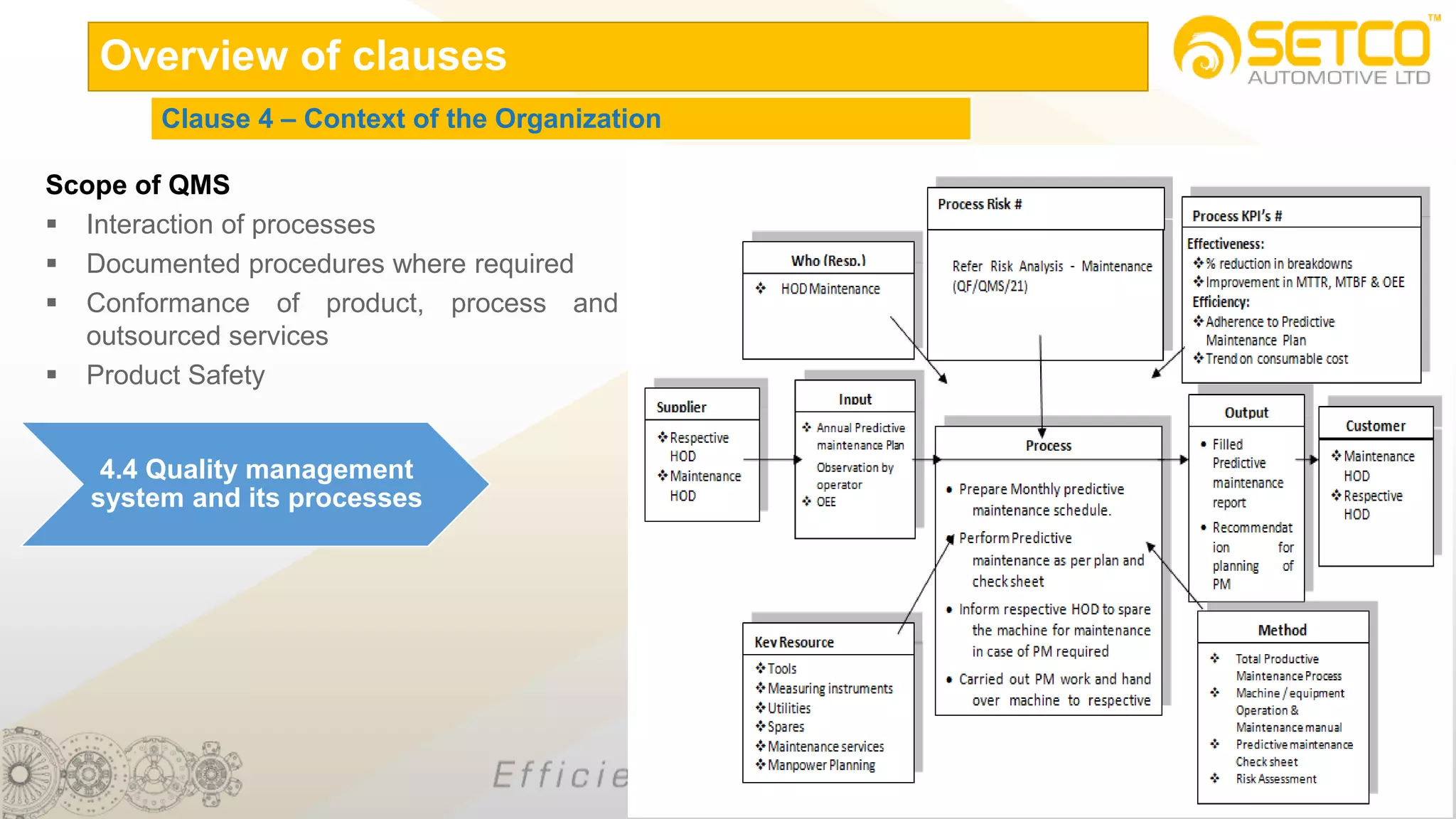
Scope of QMS
 Interaction of processes
 Documented procedures where required
 Conformance of product, process and
outsourced services
 Product Safety
Clause 4 – Context of the Organization
4.4 Quality management
system and its processes
Overview of clauses
Clause 5 – Leadership
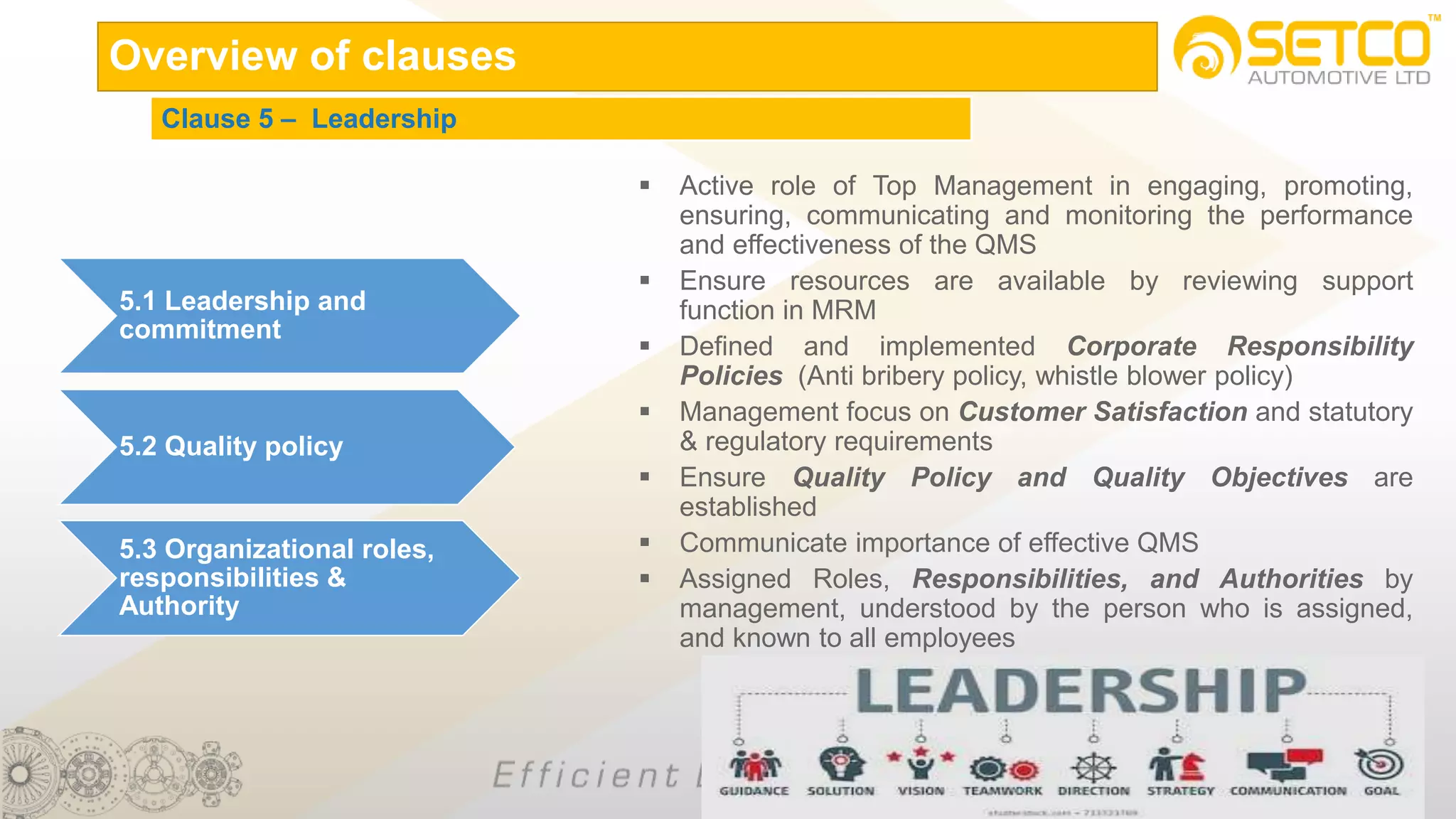
 Active role of Top Management in engaging, promoting,
ensuring, communicating and monitoring the performance
and effectiveness of the QMS
 Ensure resources are available by reviewing support
function in MRM
 Defined and implemented Corporate Responsibility
Policies (Anti bribery policy, whistle blower policy)
 Management focus on Customer Satisfaction and statutory
& regulatory requirements
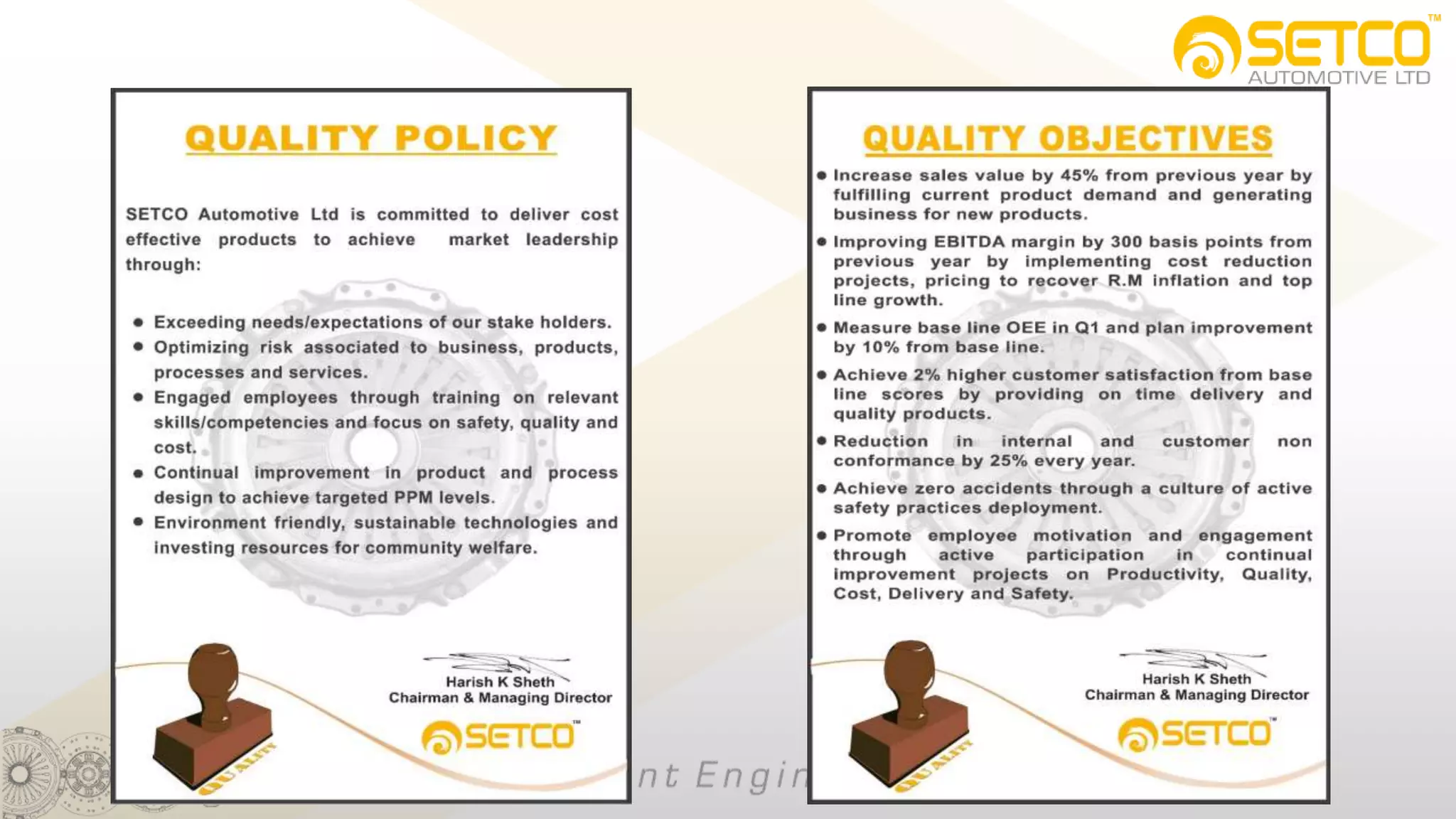
 Ensure Quality Policy and Quality Objectives are
established
 Communicate importance of effective QMS
 Assigned Roles, Responsibilities, and Authorities by
management, understood by the person who is assigned,
and known to all employees
5.1 Leadership and
commitment
5.2 Quality policy
5.3 Organizational roles,
responsibilities &
Authority
Overview of clauses
Clause 6 – Planning
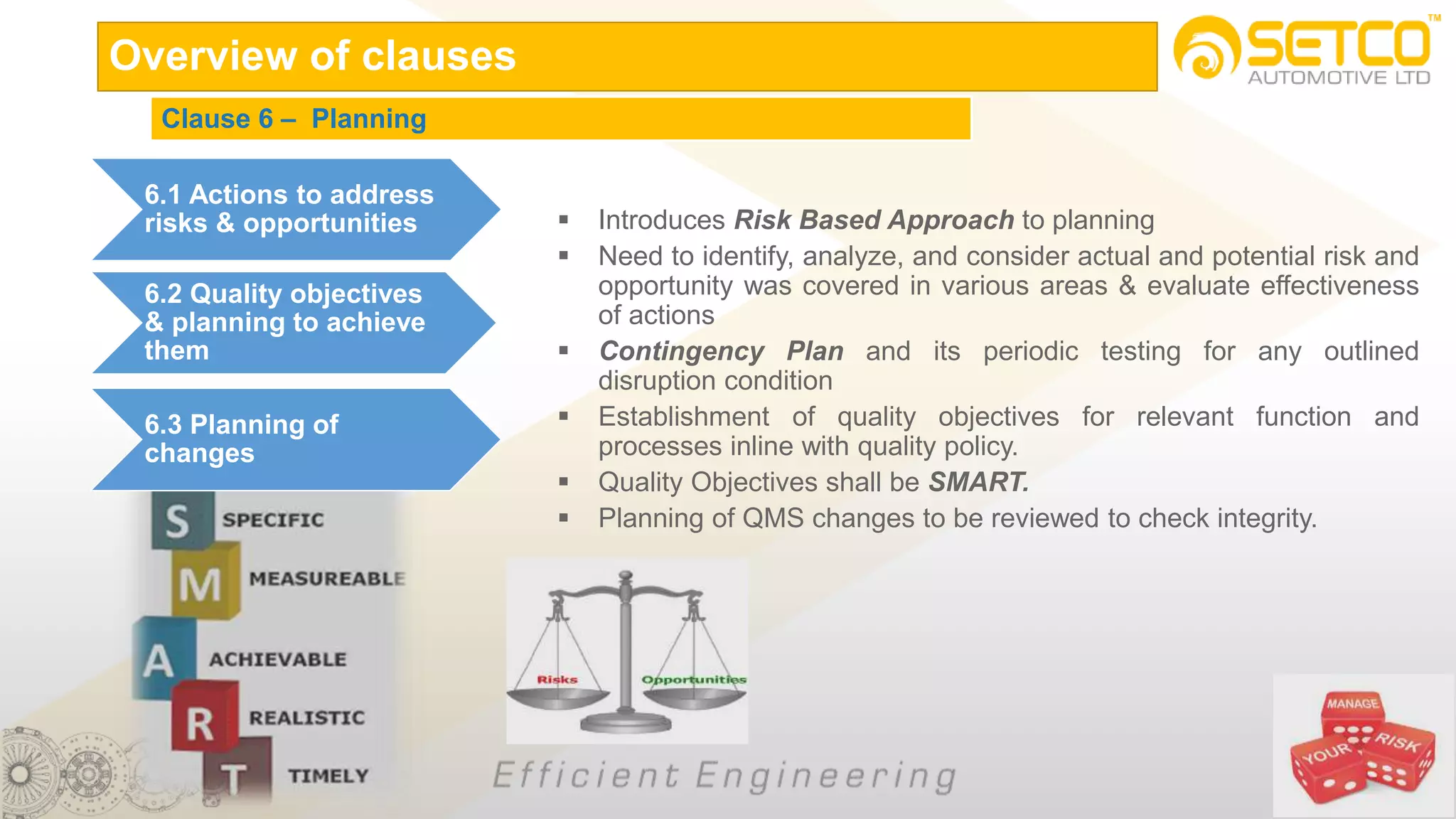
 Introduces Risk Based Approach to planning
 Need to identify, analyze, and consider actual and potential risk and
opportunity was covered in various areas & evaluate effectiveness
of actions
 Contingency Plan and its periodic testing for any outlined
disruption condition
 Establishment of quality objectives for relevant function and
processes inline with quality policy.
 Quality Objectives shall be SMART.
 Planning of QMS changes to be reviewed to check integrity.
.
6.1 Actions to address
risks & opportunities
6.2 Quality objectives
& planning to achieve
them
6.3 Planning of
changes
Overview of clauses
Clause 7 – Support
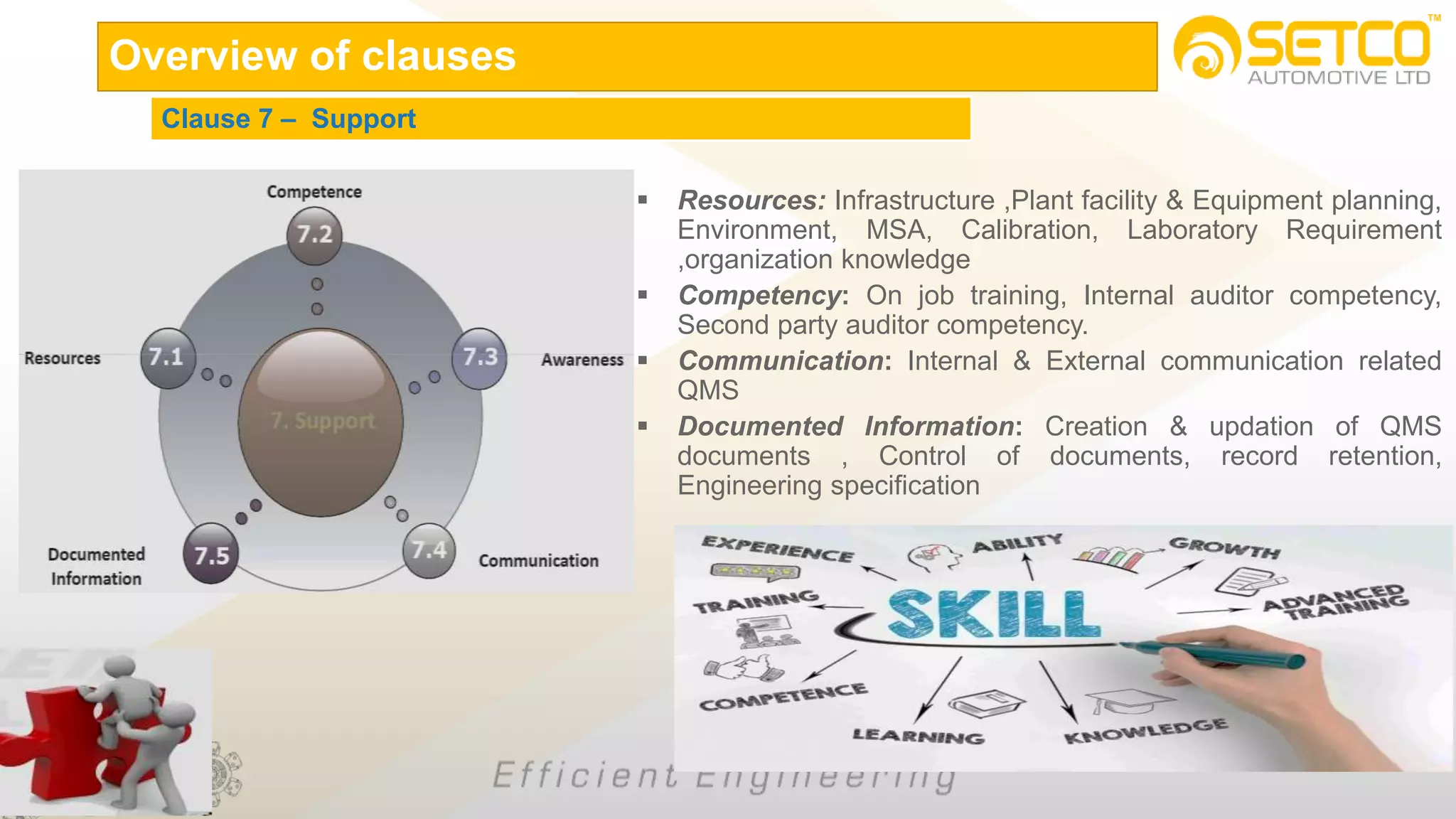
 Resources: Infrastructure ,Plant facility & Equipment planning,
Environment, MSA, Calibration, Laboratory Requirement
,organization knowledge
 Competency: On job training, Internal auditor competency,
Second party auditor competency.
 Communication: Internal & External communication related
QMS
 Documented Information: Creation & updation of QMS
documents , Control of documents, record retention,
Engineering specification
Overview of clauses
Clause 8 – Operation
Operational Planning:
 Production planning, logistics requirement, acceptance criteria,
manufacturing feasibility, validation and verification.
 Confidentiality to be maintained. (NDA signoff)
Requirements:
 Determine requirements of product such as safety, environment
regulations, recycling.
 APQP, FMEAs, ensuring product design skills, embedded
software, validation, PPAP, special characteristics identification.
 Change validation and approval prior to implementation
Design and Development
 Follow Complete APQP cycle
8.1 Operation planning and
control
8.2 Requirements for
products and services
8.3 Design & development of
products & services
Overview of clauses
Clause 8 – Operation
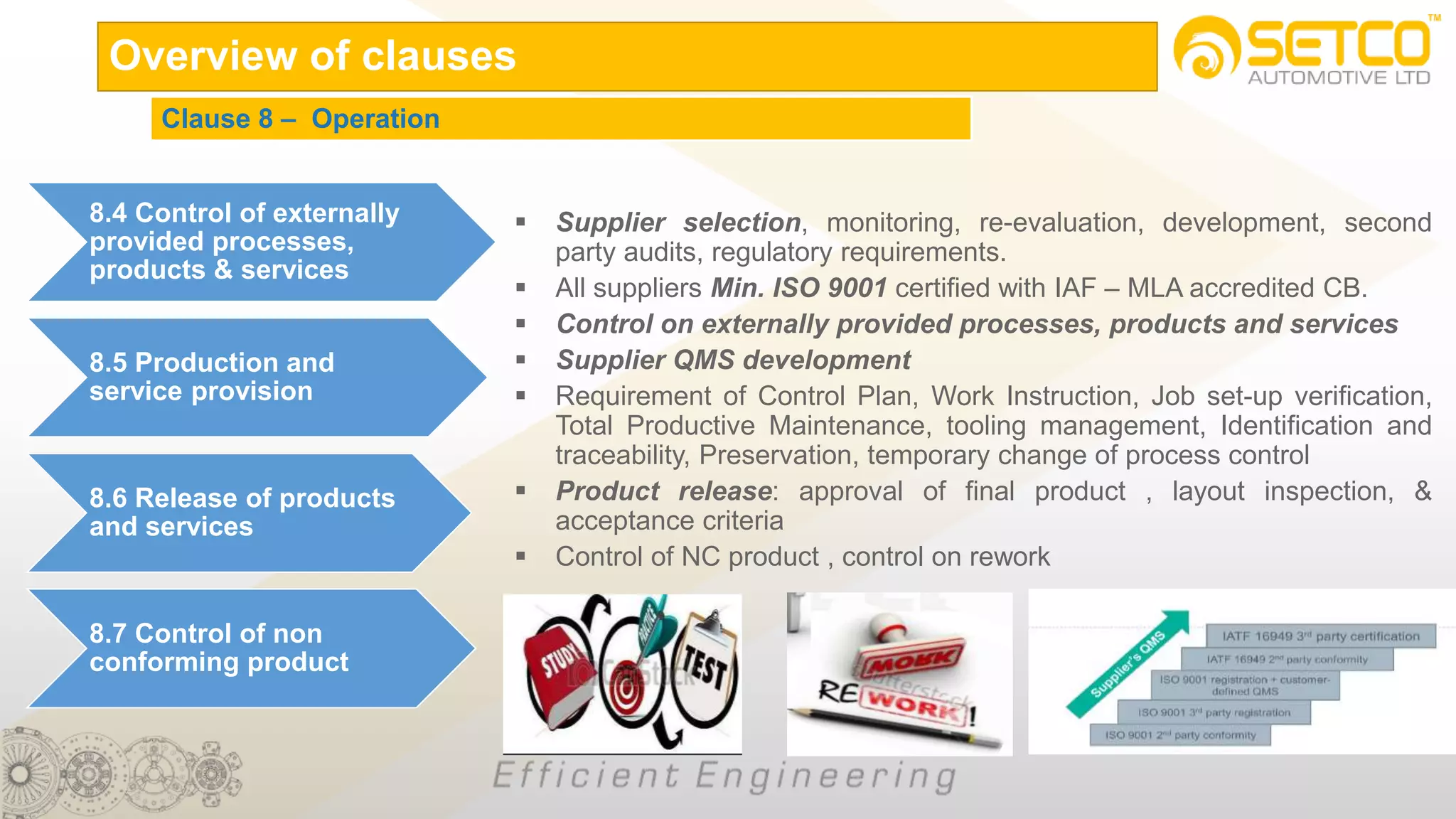
 Supplier selection, monitoring, re-evaluation, development, second
party audits, regulatory requirements.
 All suppliers Min. ISO 9001 certified with IAF – MLA accredited CB.
 Control on externally provided processes, products and services
 Supplier QMS development
 Requirement of Control Plan, Work Instruction, Job set-up verification,
Total Productive Maintenance, tooling management, Identification and
traceability, Preservation, temporary change of process control
 Product release: approval of final product , layout inspection, &
acceptance criteria
 Control of NC product , control on rework
8.4 Control of externally
provided processes,
products & services
8.5 Production and
service provision
8.6 Release of products
and services
8.7 Control of non
conforming product
Overview of clauses
Clause 9 – Performance Evaluation
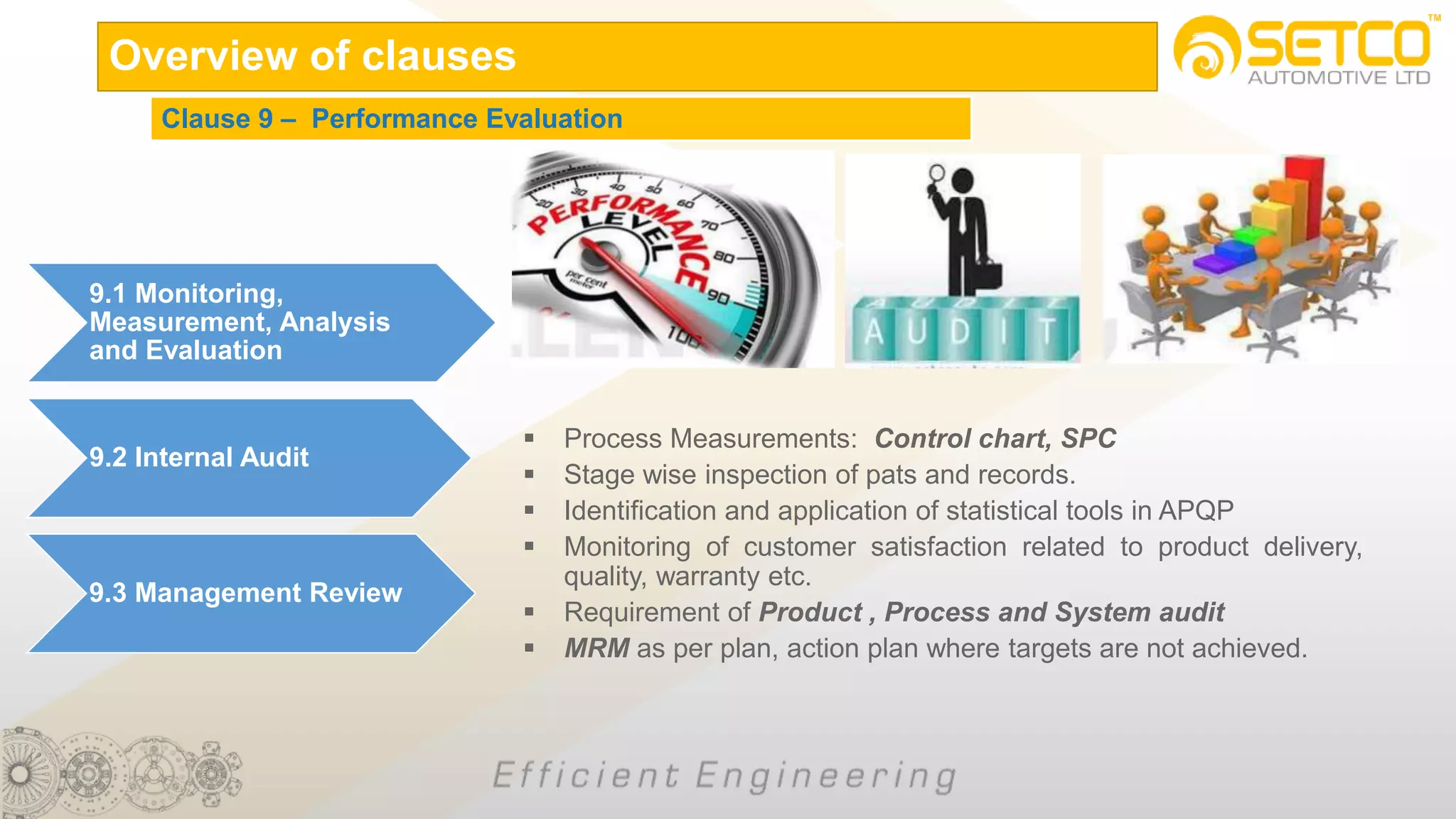
 Process Measurements: Control chart, SPC
 Stage wise inspection of pats and records.
 Identification and application of statistical tools in APQP
 Monitoring of customer satisfaction related to product delivery,
quality, warranty etc.
 Requirement of Product , Process and System audit
 MRM as per plan, action plan where targets are not achieved.
9.1 Monitoring,
Measurement, Analysis
and Evaluation
9.2 Internal Audit
9.3 Management Review
Overview of clauses
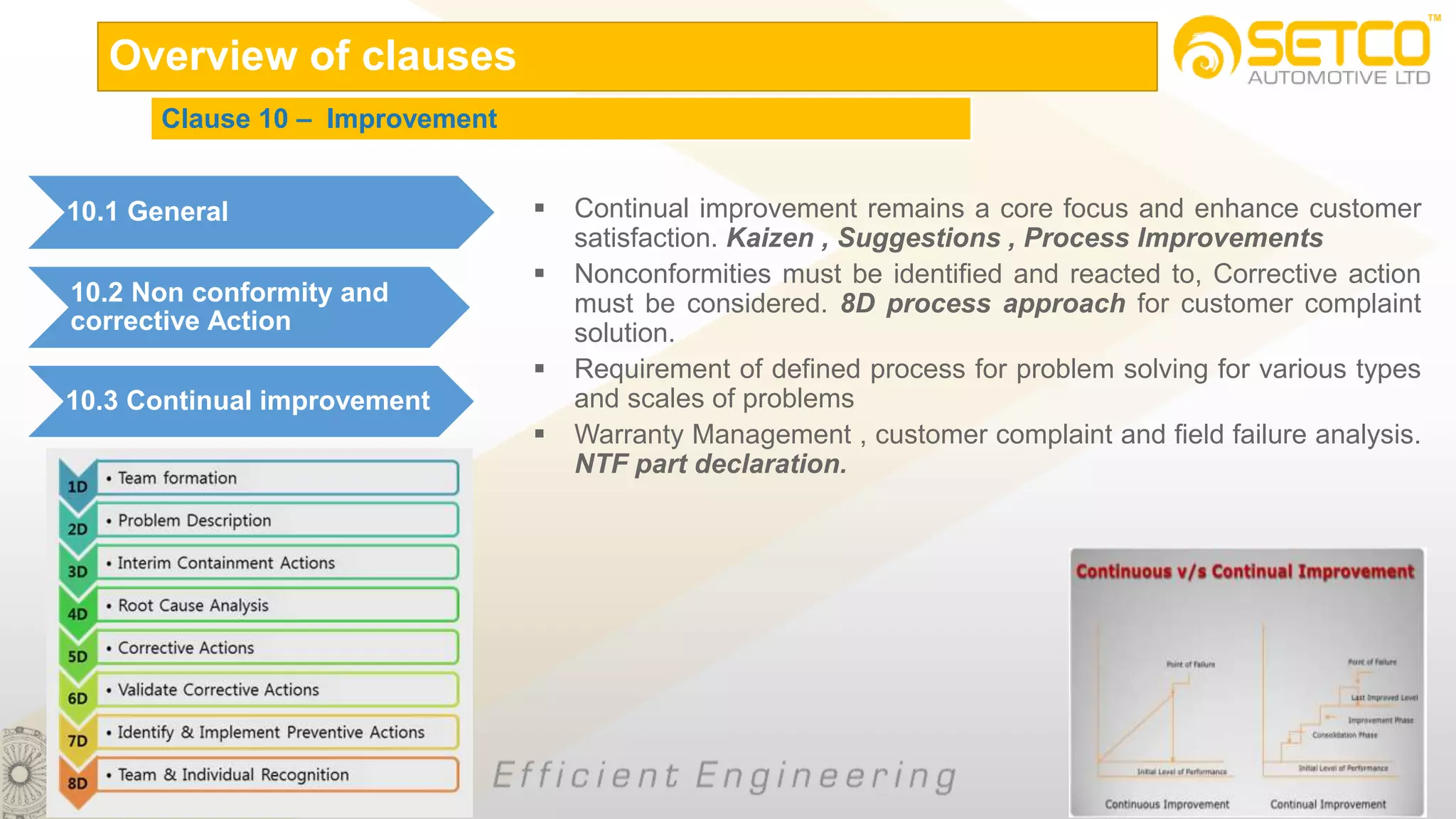
Clause 10 – Improvement
 Continual improvement remains a core focus and enhance customer
satisfaction. Kaizen , Suggestions , Process Improvements
 Nonconformities must be identified and reacted to, Corrective action
must be considered. 8D process approach for customer complaint
solution.
 Requirement of defined process for problem solving for various types
and scales of problems
 Warranty Management , customer complaint and field failure analysis.
NTF part declaration.
10.1 General
10.2 Non conformity and
corrective Action
10.3 Continual improvement
Iatf 16949 training

Iatf 16949 training

  • 1.
  • 2.
     Introduction ofIATF 16949:2016  What is IATF 16949:2016?  Why IATF 16949:2016?  High Level structure and PDCA approach  Quality Management Principle  Over view of clauses - Clause 4 : Context of the Organization - Clause 5 : Leadership - Clause 6 : Planning - Clause 7 : Support - Clause 8 : Operation - Clause 9 : Performance Evaluation - Clause 10 : Improvement Agenda
  • 3.
    Introduction to IATF16949:2016 ISO/TS 16949:1999 (First edition) ISO/TS 16949:2002 (Second Edition) ISO/TS 16949:2009 (Second Edition) ISO 9000 revised in year 2000 ISO 9000 revised in year 2008 ISO 9000 revised in 2015 IATF ISO/TC 176 IATF 16949:2016 (First edition) Released on 1st October,2016 New
  • 4.
    IATF : InternationalAutomotive Task Force
  • 5.
     IATF 16949:2016is a standard that establishes the requirements for a Quality Management System (QMS) by International Automotive Task Force (IATF), specifically for the automotive component manufacturing industries and relevant service parts organizations.  IATF 16949:2016 = ISO 9001:2015 + Specific Requirements of Automotive Industry  The Goals of IATF are: 1) Defect Prevention 2) Reduction in variation and waste throughout the supply chain 3) Continual Improvement What is IATF 16949:2016 ?
  • 6.
    Implementing IATF 16949ensures that our customers receive consistent, good quality products and services, which in turn may bring many business benefits. IATF 16949 helps to: Why IATF 16949:2016 ?  Consistent quality product  Meets statutory, regulatory and product safety requirement.  Customer satisfaction  Increase in productivity and efficiency.  Reduction in internal and external cost.  Control on rejection and rework ppm.  Standardization of all work procedures.  Reduction in product development lead-time.  Sustenance of existing business.  Expansion in new business.  Increases on- time delivery
  • 7.
    High Level Structureand PDCA ApproachHigh Level Structure and PDCA Approach Based on High Level Structure Total Clauses : 10 Auditable Clauses : 4 to 10
  • 8.
    Quality Management Principle Customer Focus  Leadership  Engagement of people  Process Approach  Improvement  Evidence based decision making  Relationship management 7 Principles
  • 9.
    Overview of clauses Clause4 – Context of the Organization 4.1 Understanding the organization and its context 4.2 Understanding the needs and expectations of interested parties External Risk: - Legal: Govt.policies,GST - Technological: Introduction of EV - Competitive: Entry of competitor - Market: Slow down of business - Cultural: Mass leaves during festivals - Social: Riots - Economic: Inflation, Steel price hike Internal Risk: - Values : Teamwork, Integrity - Culture : Worker Unions - Knowledge : Technological Unawareness - Performance of organization - KPI’s not achieved - Lack of analysis and action plan  Understand internal and external factors that affects the strategic direction of organization.
  • 10.
    Overview of clauses Scopeof QMS This Quality Management System is applicable for Design, Development, Manufacturing, Supply of automotive clutches and clutch components at SAL, KALOL with CSR (Customer Specific Requirements) Exclusion:  Following Clauses of IATF 16949:2016 have been excluded:  8.3.2.3 - Development of products with embedded software:  8.5.5.2 - Service Agreement with Customer  8.6.3 - Appearance Items Clause 4 – Context of the Organization 4.3 Determining the scope of the quality management system
  • 11.
    Overview of clauses Scopeof QMS  Interaction of processes  Documented procedures where required  Conformance of product, process and outsourced services  Product Safety Clause 4 – Context of the Organization 4.4 Quality management system and its processes
  • 12.
    Overview of clauses Clause5 – Leadership  Active role of Top Management in engaging, promoting, ensuring, communicating and monitoring the performance and effectiveness of the QMS  Ensure resources are available by reviewing support function in MRM  Defined and implemented Corporate Responsibility Policies (Anti bribery policy, whistle blower policy)  Management focus on Customer Satisfaction and statutory & regulatory requirements  Ensure Quality Policy and Quality Objectives are established  Communicate importance of effective QMS  Assigned Roles, Responsibilities, and Authorities by management, understood by the person who is assigned, and known to all employees 5.1 Leadership and commitment 5.2 Quality policy 5.3 Organizational roles, responsibilities & Authority
  • 14.
    Overview of clauses Clause6 – Planning  Introduces Risk Based Approach to planning  Need to identify, analyze, and consider actual and potential risk and opportunity was covered in various areas & evaluate effectiveness of actions  Contingency Plan and its periodic testing for any outlined disruption condition  Establishment of quality objectives for relevant function and processes inline with quality policy.  Quality Objectives shall be SMART.  Planning of QMS changes to be reviewed to check integrity. . 6.1 Actions to address risks & opportunities 6.2 Quality objectives & planning to achieve them 6.3 Planning of changes
  • 15.
    Overview of clauses Clause7 – Support  Resources: Infrastructure ,Plant facility & Equipment planning, Environment, MSA, Calibration, Laboratory Requirement ,organization knowledge  Competency: On job training, Internal auditor competency, Second party auditor competency.  Communication: Internal & External communication related QMS  Documented Information: Creation & updation of QMS documents , Control of documents, record retention, Engineering specification
  • 16.
    Overview of clauses Clause8 – Operation Operational Planning:  Production planning, logistics requirement, acceptance criteria, manufacturing feasibility, validation and verification.  Confidentiality to be maintained. (NDA signoff) Requirements:  Determine requirements of product such as safety, environment regulations, recycling.  APQP, FMEAs, ensuring product design skills, embedded software, validation, PPAP, special characteristics identification.  Change validation and approval prior to implementation Design and Development  Follow Complete APQP cycle 8.1 Operation planning and control 8.2 Requirements for products and services 8.3 Design & development of products & services
  • 17.
    Overview of clauses Clause8 – Operation  Supplier selection, monitoring, re-evaluation, development, second party audits, regulatory requirements.  All suppliers Min. ISO 9001 certified with IAF – MLA accredited CB.  Control on externally provided processes, products and services  Supplier QMS development  Requirement of Control Plan, Work Instruction, Job set-up verification, Total Productive Maintenance, tooling management, Identification and traceability, Preservation, temporary change of process control  Product release: approval of final product , layout inspection, & acceptance criteria  Control of NC product , control on rework 8.4 Control of externally provided processes, products & services 8.5 Production and service provision 8.6 Release of products and services 8.7 Control of non conforming product
  • 18.
    Overview of clauses Clause9 – Performance Evaluation  Process Measurements: Control chart, SPC  Stage wise inspection of pats and records.  Identification and application of statistical tools in APQP  Monitoring of customer satisfaction related to product delivery, quality, warranty etc.  Requirement of Product , Process and System audit  MRM as per plan, action plan where targets are not achieved. 9.1 Monitoring, Measurement, Analysis and Evaluation 9.2 Internal Audit 9.3 Management Review
  • 19.
    Overview of clauses Clause10 – Improvement  Continual improvement remains a core focus and enhance customer satisfaction. Kaizen , Suggestions , Process Improvements  Nonconformities must be identified and reacted to, Corrective action must be considered. 8D process approach for customer complaint solution.  Requirement of defined process for problem solving for various types and scales of problems  Warranty Management , customer complaint and field failure analysis. NTF part declaration. 10.1 General 10.2 Non conformity and corrective Action 10.3 Continual improvement