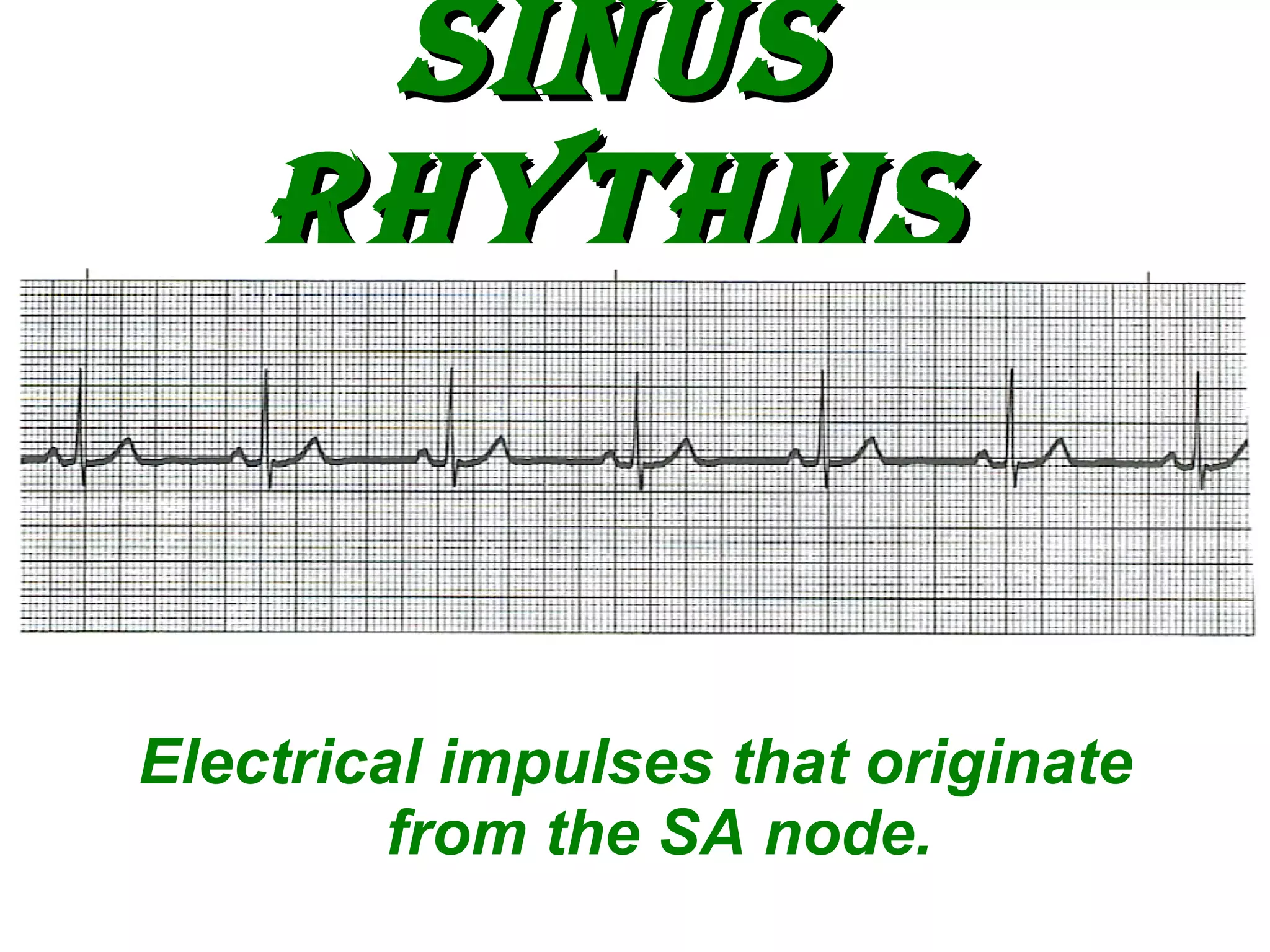
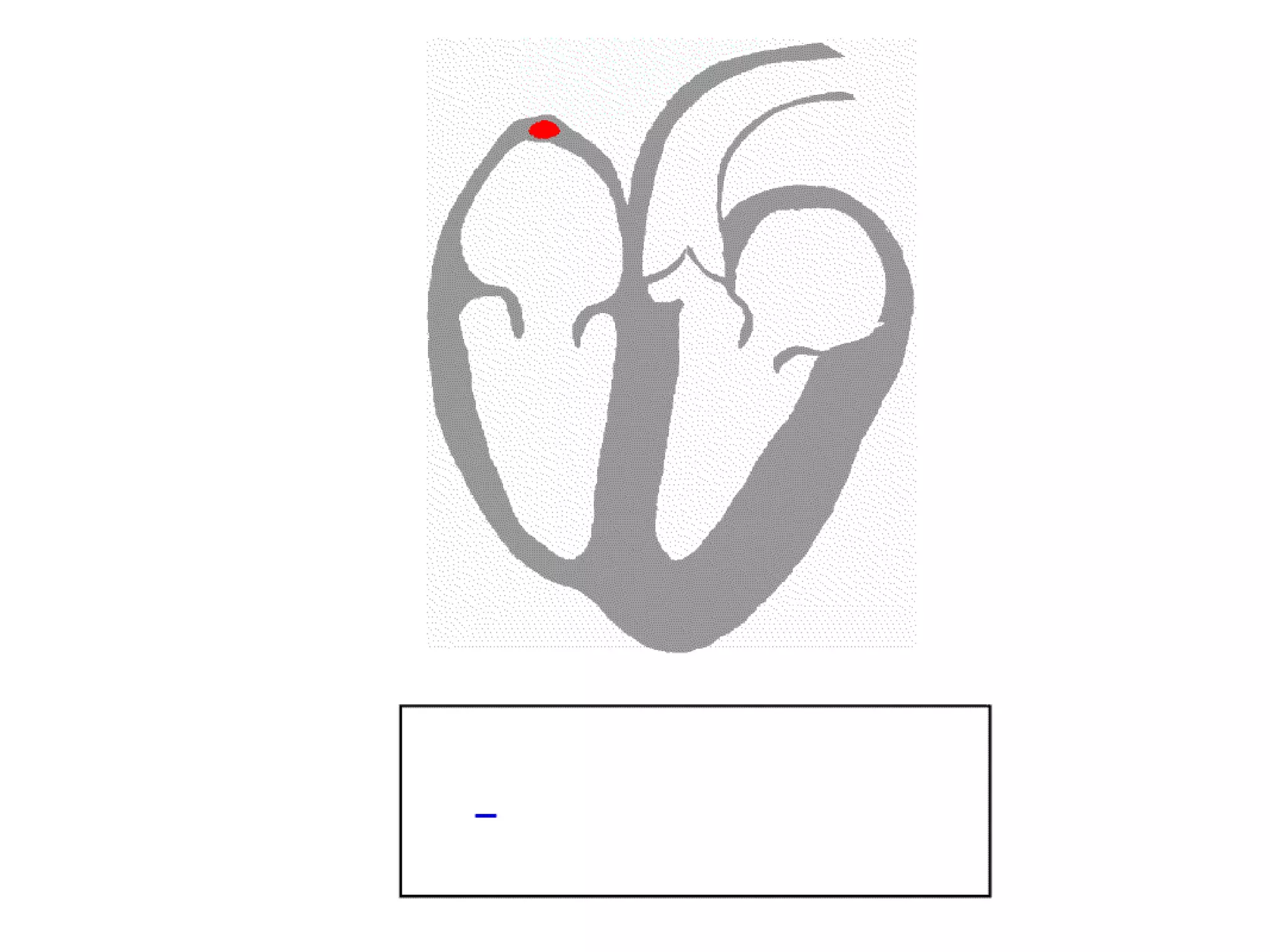
Sinus Rhythms Electrical impulses that originate from the SA node.
 
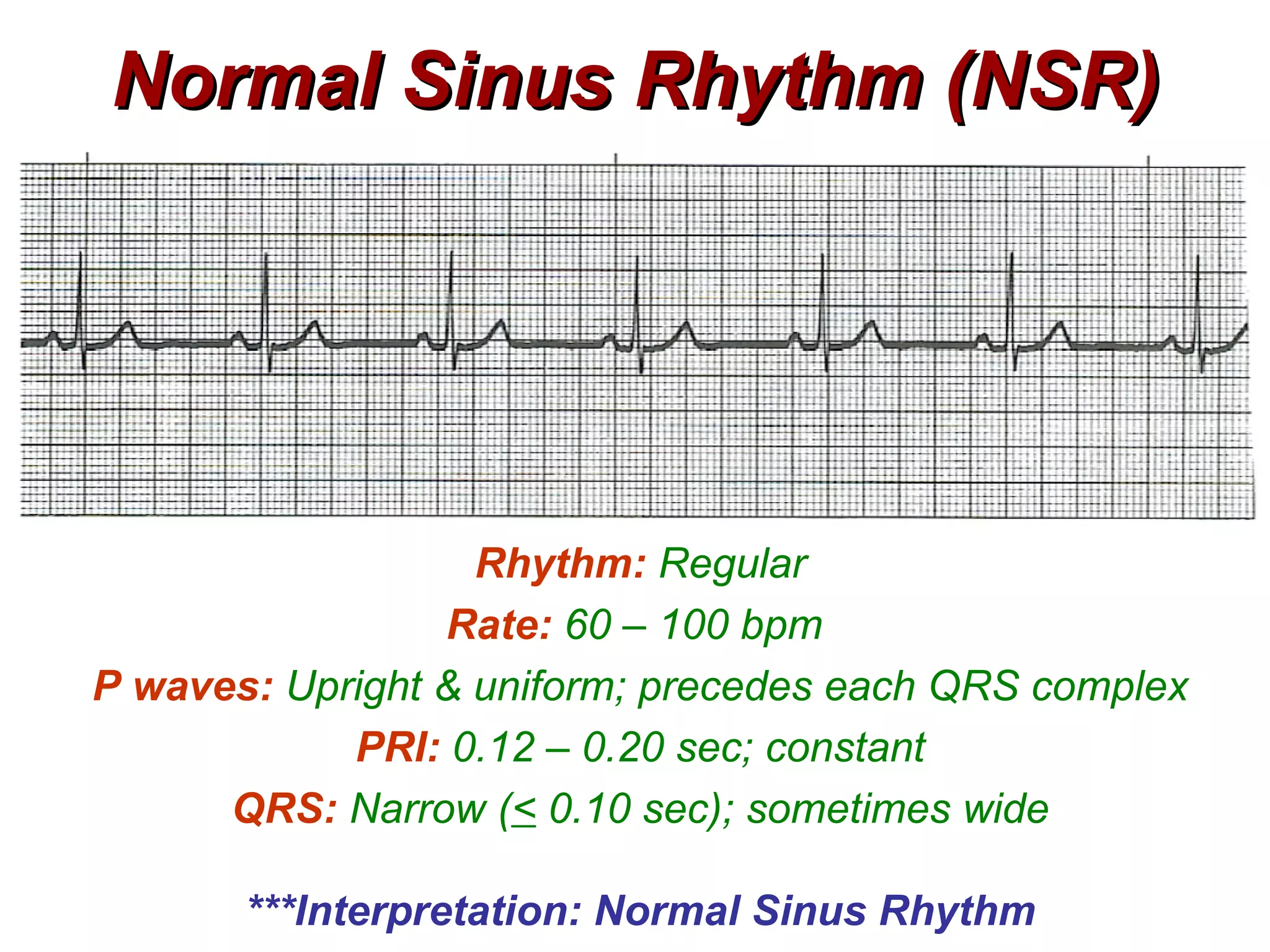
Normal Sinus Rhythm (NSR) Rhythm:   Regular Rate:   60 – 100 bpm  P waves:   Upright & uniform; precedes each QRS complex PRI:   0.12 – 0.20 sec; constant QRS:   Narrow ( <  0.10 sec); sometimes wide ***Interpretation: Normal Sinus Rhythm
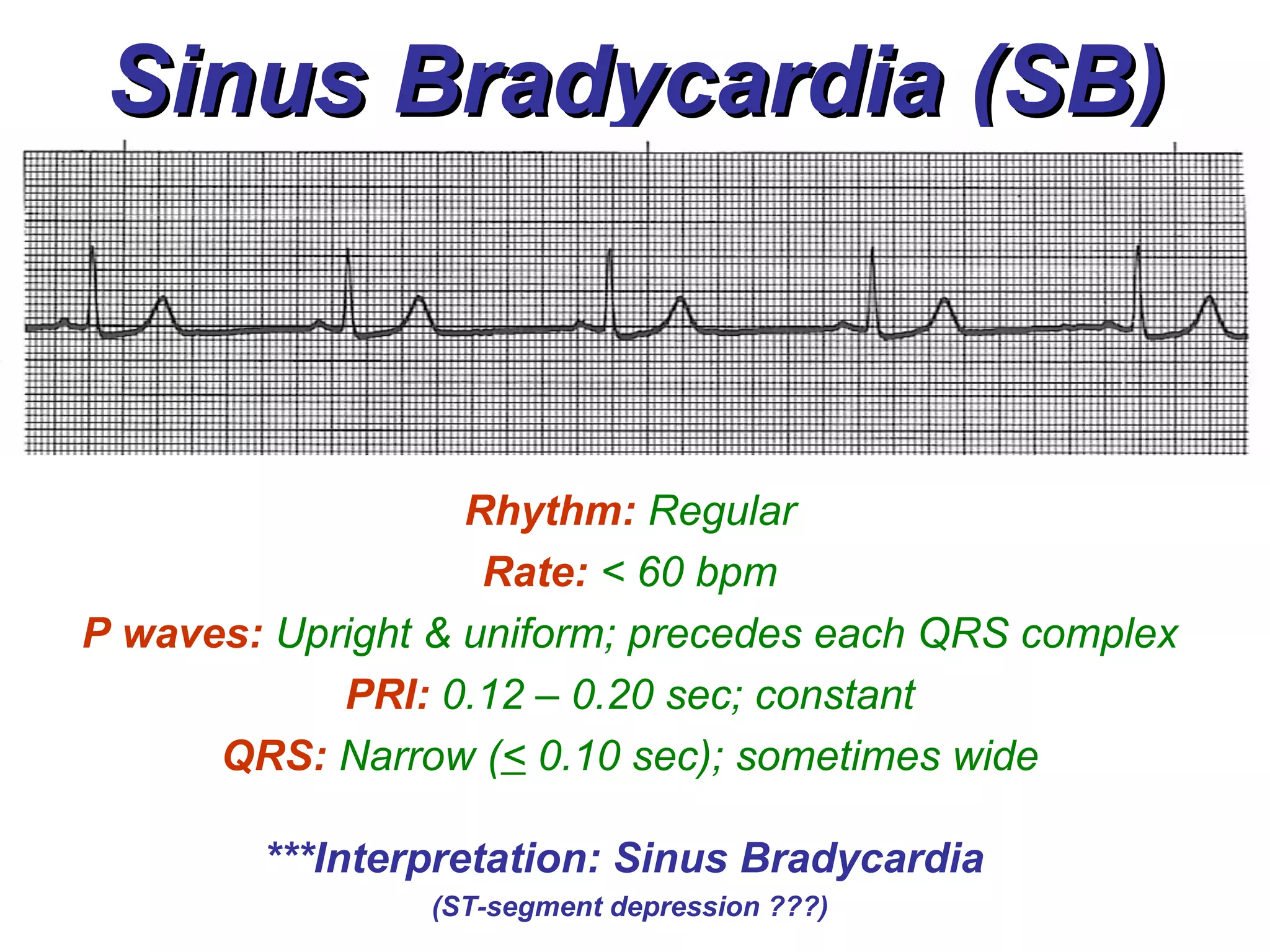
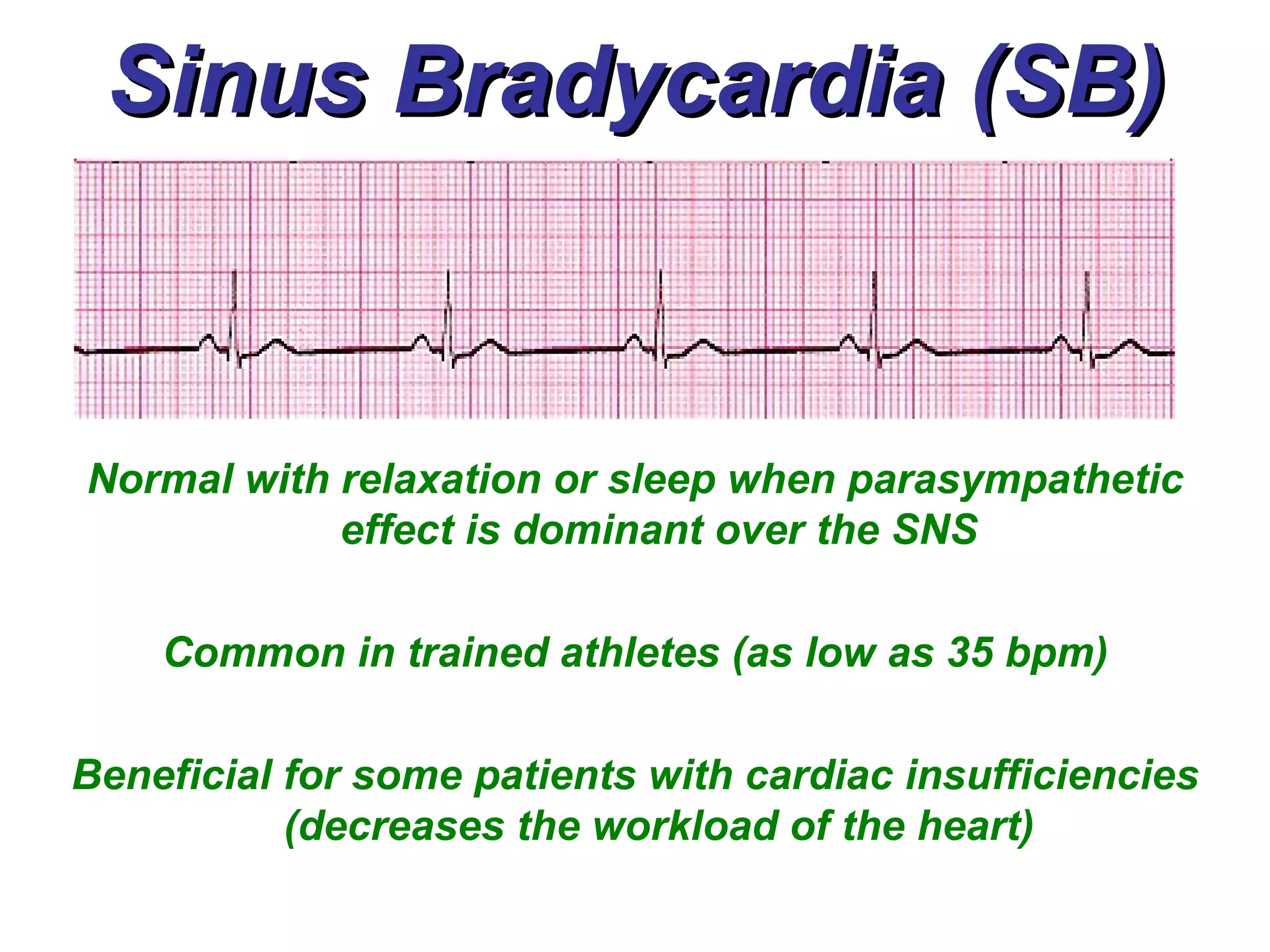
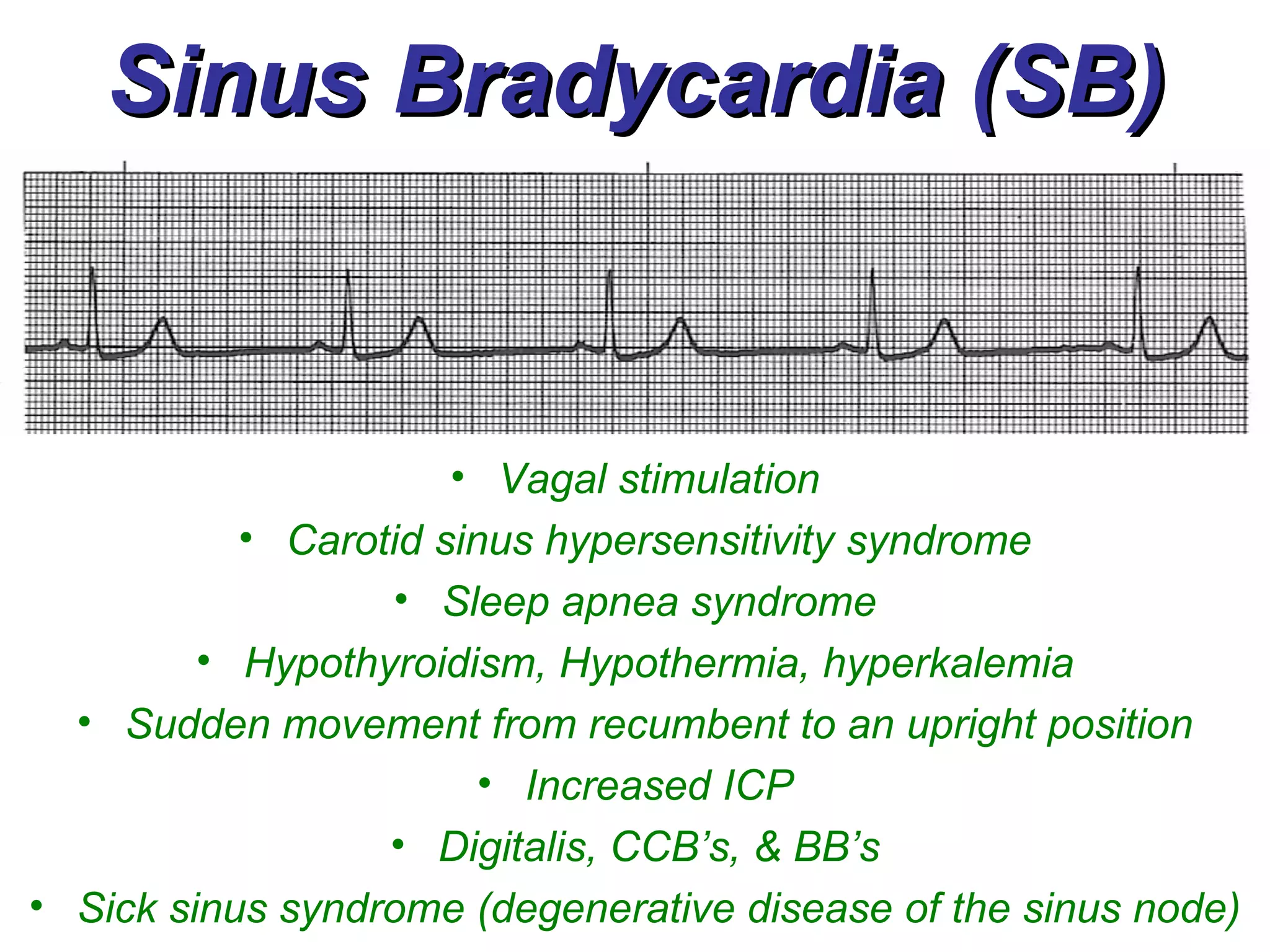
Sinus Bradycardia (SB) Rhythm:   Regular Rate:  < 60 bpm P waves:   Upright & uniform; precedes each QRS complex PRI:   0.12 – 0.20 sec; constant QRS:   Narrow ( <  0.10 sec); sometimes wide ***Interpretation: Sinus Bradycardia  (ST-segment depression ???)
Sinus Bradycardia (SB) Normal with relaxation or sleep when parasympathetic effect is dominant over the SNS Common in trained athletes (as low as 35 bpm) Beneficial for some patients with cardiac insufficiencies (decreases the workload of the heart)
Sinus Bradycardia (SB) Vagal stimulation Carotid sinus hypersensitivity syndrome Sleep apnea syndrome Hypothyroidism, Hypothermia, hyperkalemia Sudden movement from recumbent to an upright position Increased ICP Digitalis, CCB’s, & BB’s Sick sinus syndrome (degenerative disease of the sinus node)
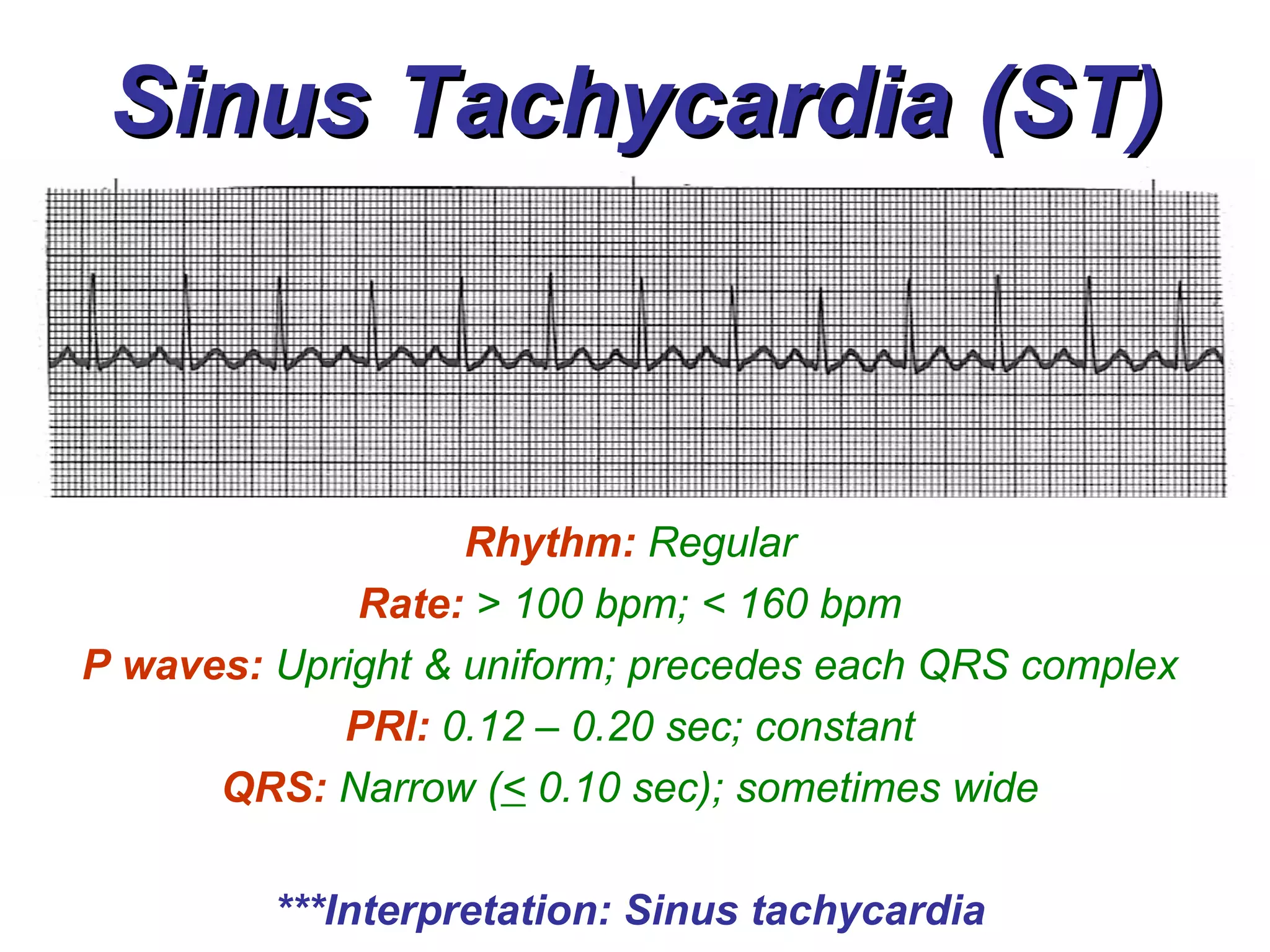
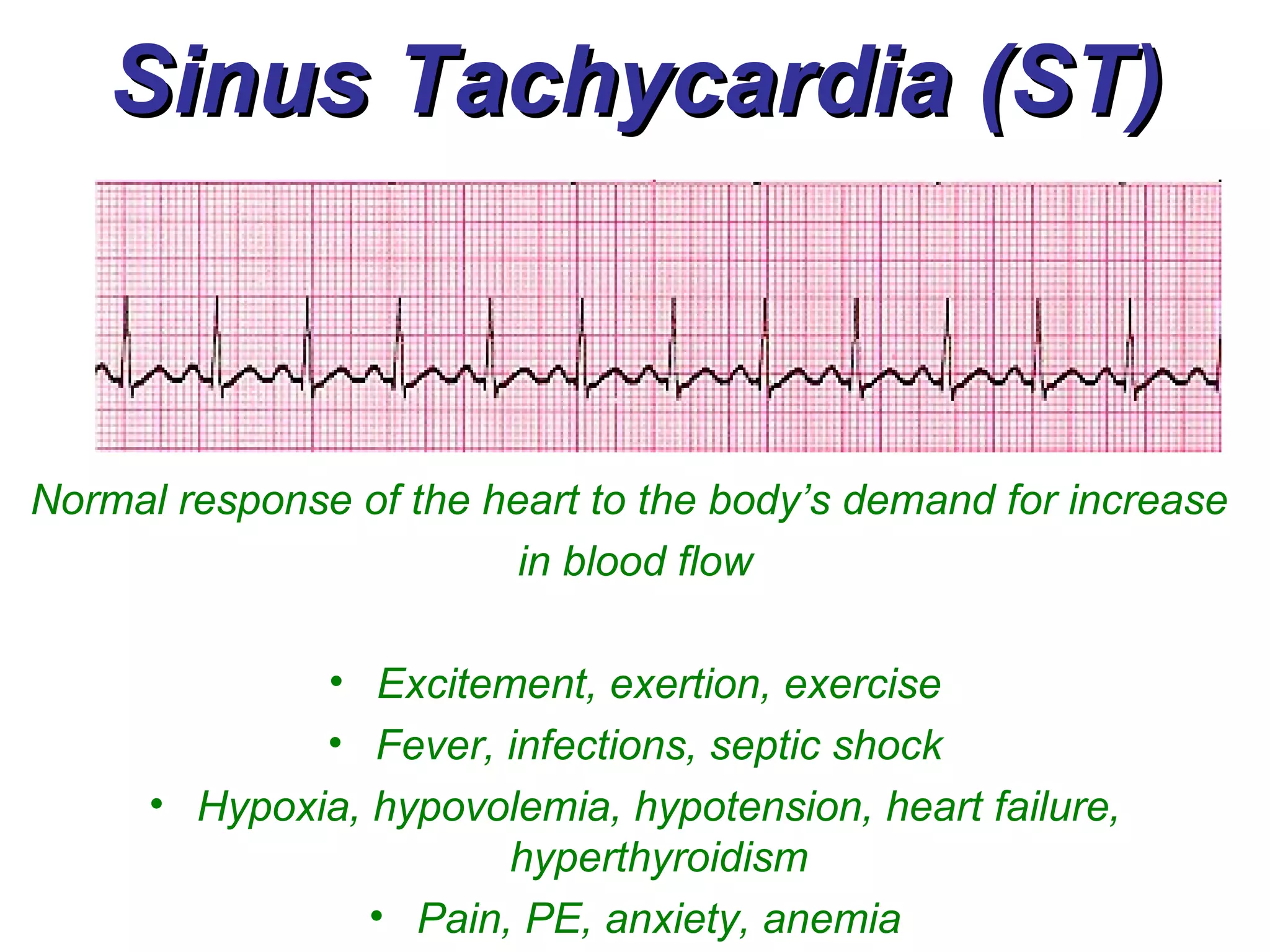
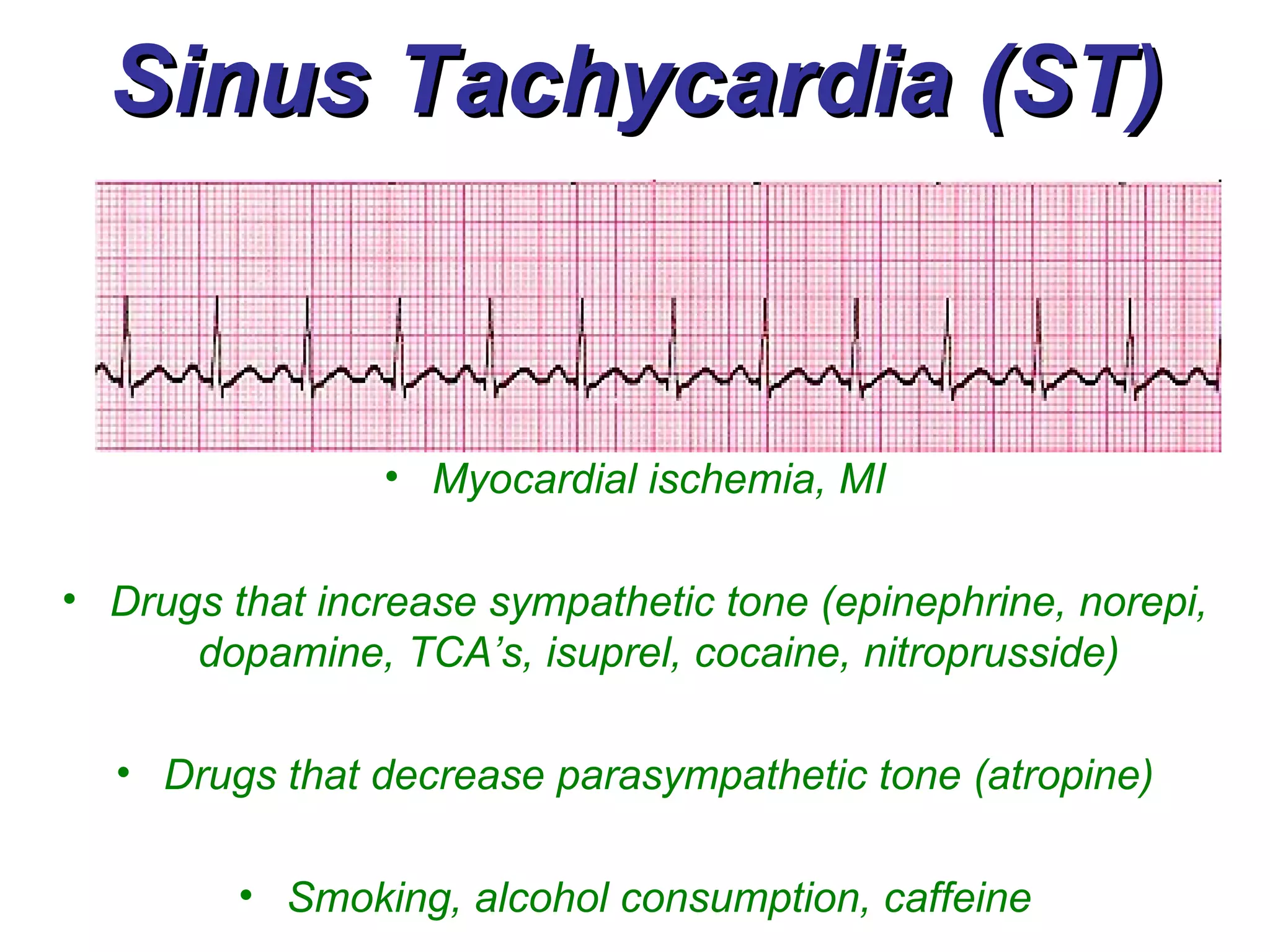
Sinus Tachycardia (ST) Rhythm:   Regular Rate:   > 100 bpm; < 160 bpm P waves:   Upright & uniform; precedes each QRS complex PRI:   0.12 – 0.20 sec; constant QRS:   Narrow ( <  0.10 sec); sometimes wide ***Interpretation: Sinus tachycardia
Sinus Tachycardia (ST) Normal response of the heart to the body’s demand for increase  in blood flow Excitement, exertion, exercise Fever, infections, septic shock Hypoxia, hypovolemia, hypotension, heart failure, hyperthyroidism Pain, PE, anxiety, anemia
Sinus Tachycardia (ST) Myocardial ischemia, MI Drugs that increase sympathetic tone (epinephrine, norepi, dopamine, TCA’s, isuprel, cocaine, nitroprusside) Drugs that decrease parasympathetic tone (atropine) Smoking, alcohol consumption, caffeine
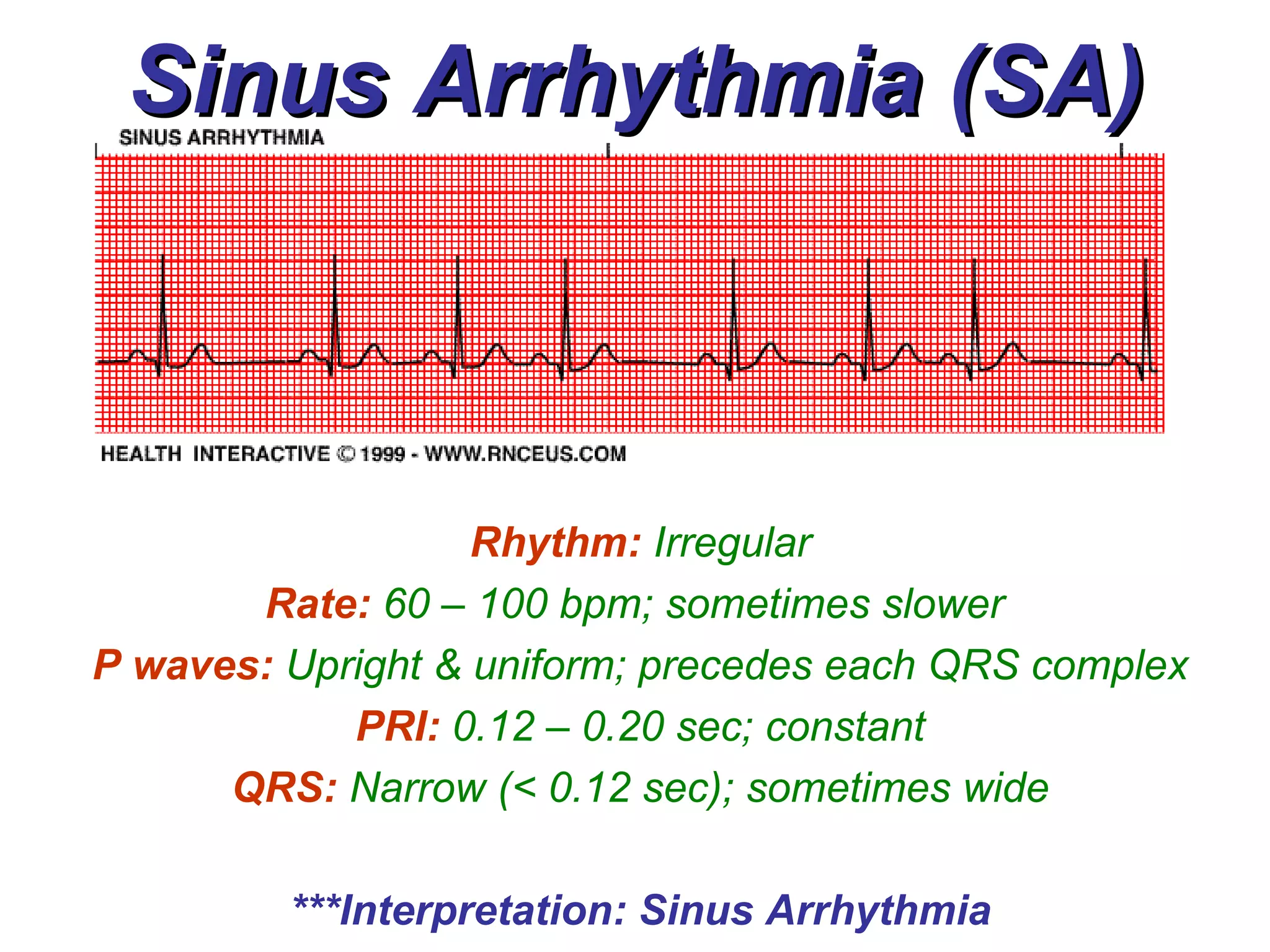
Sinus Arrhythmia (SA) Rhythm:   Irregular Rate:   60 – 100 bpm; sometimes slower   P waves:   Upright & uniform; precedes each QRS complex PRI:   0.12 – 0.20 sec; constant QRS:   Narrow (< 0.12 sec); sometimes wide ***Interpretation: Sinus Arrhythmia
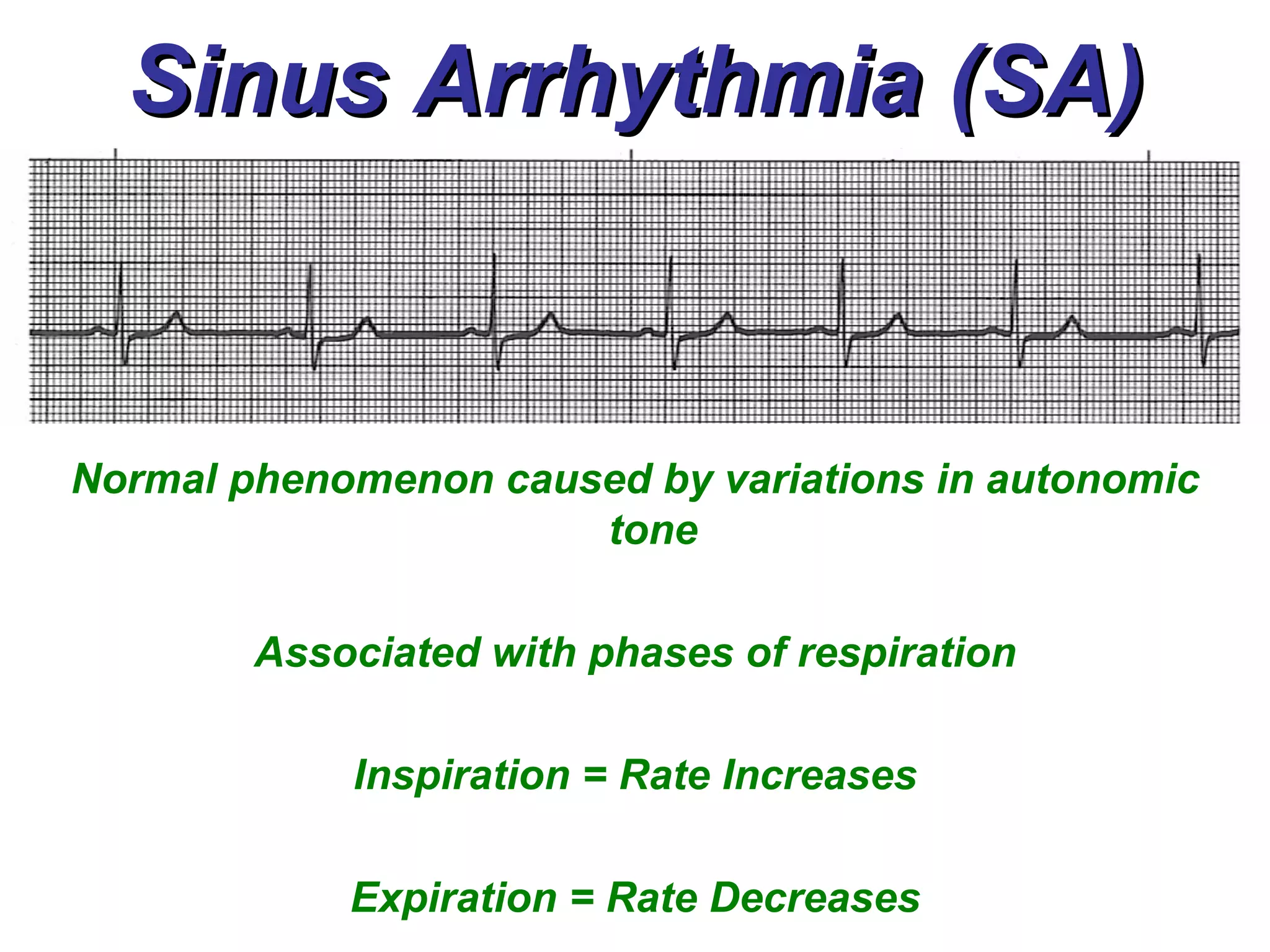
Sinus Arrhythmia (SA) Normal phenomenon caused by variations in autonomic tone  Associated with phases of respiration Inspiration = Rate Increases Expiration = Rate Decreases
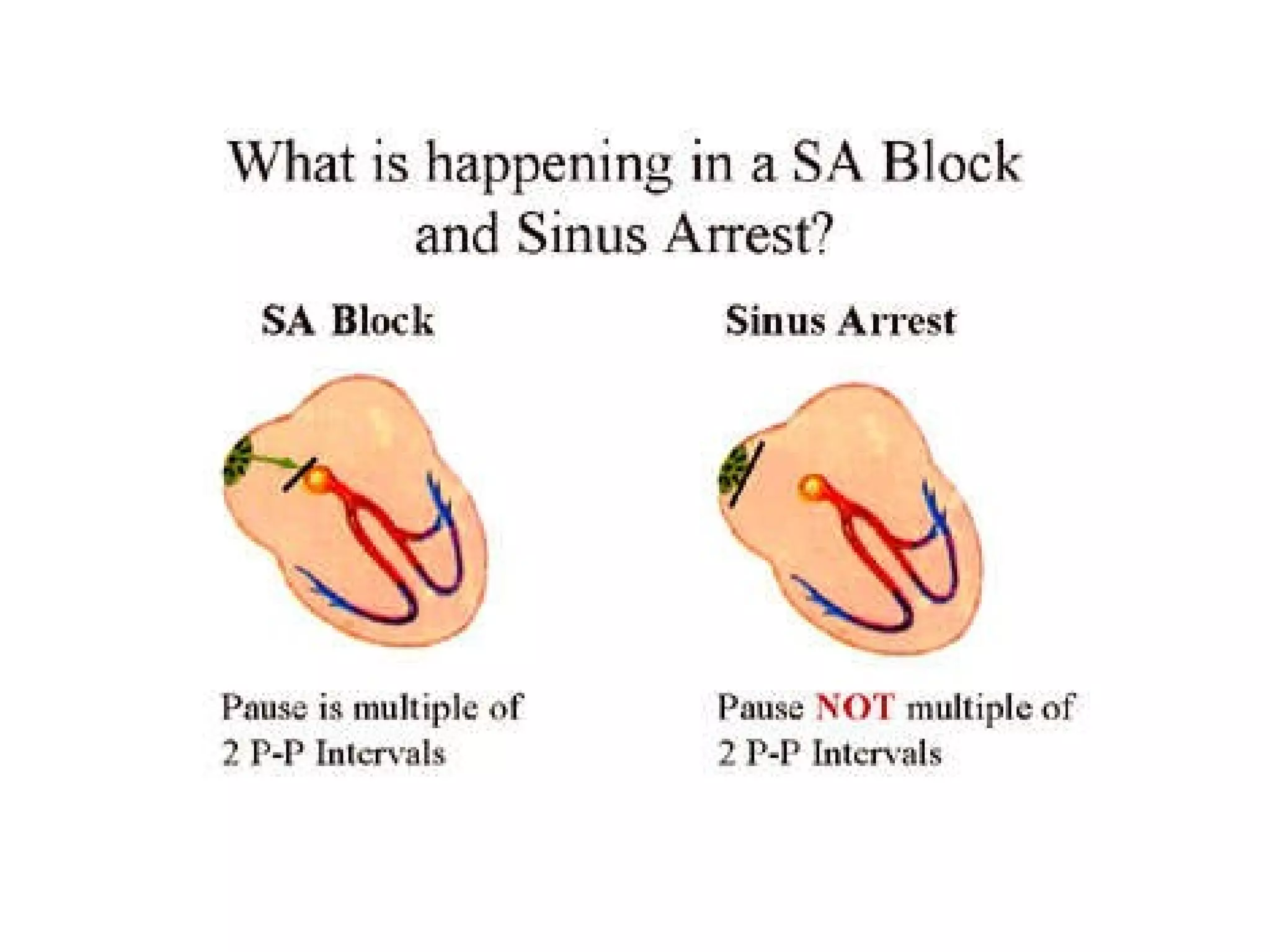
Sinus Pauses Two Kinds: Both originate from the sinus node Sinus (Exit) Block & Sinus Arrest
Sinus Arrest Failure of the SA node to fire; a disorder of automaticity. Failure of the SA node to discharge  causes an irregularity of when the rhythm resumes following the pause
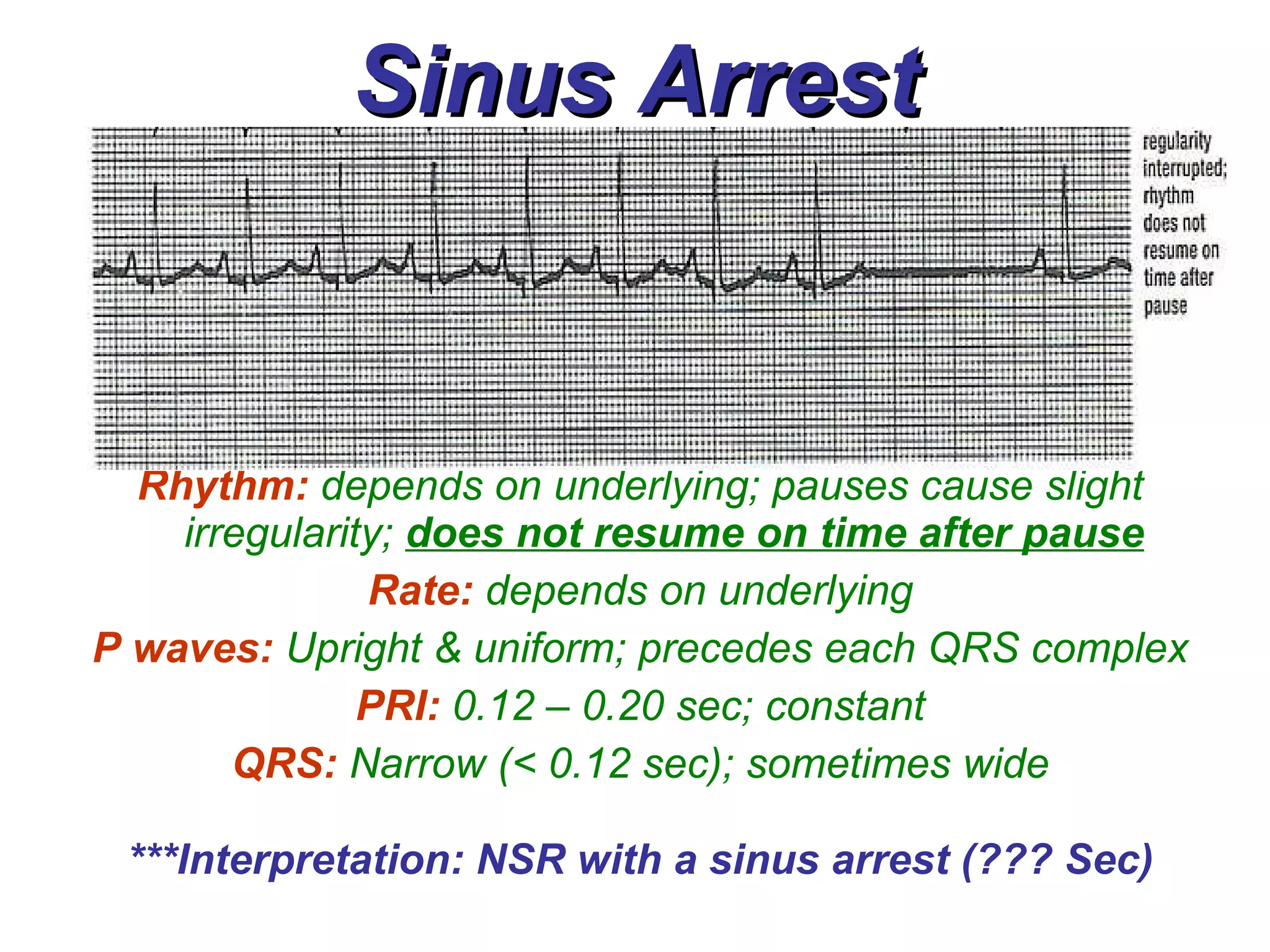
Sinus Arrest Rhythm:   depends on underlying; pauses cause slight irregularity;  does not   resume on time after pause Rate:   depends on underlying P waves:   Upright & uniform; precedes each QRS complex PRI:   0.12 – 0.20 sec; constant QRS:   Narrow (< 0.12 sec); sometimes wide ***Interpretation: NSR with a sinus arrest (??? Sec)
Sinus (Exit) Block Electrical impulse is initiated by the SA node, but is BLOCKED as it exits the sinus node preventing conduction to the atria. SA node discharge not affected; regularity not disturbed after rhythm resumes following the pause                       
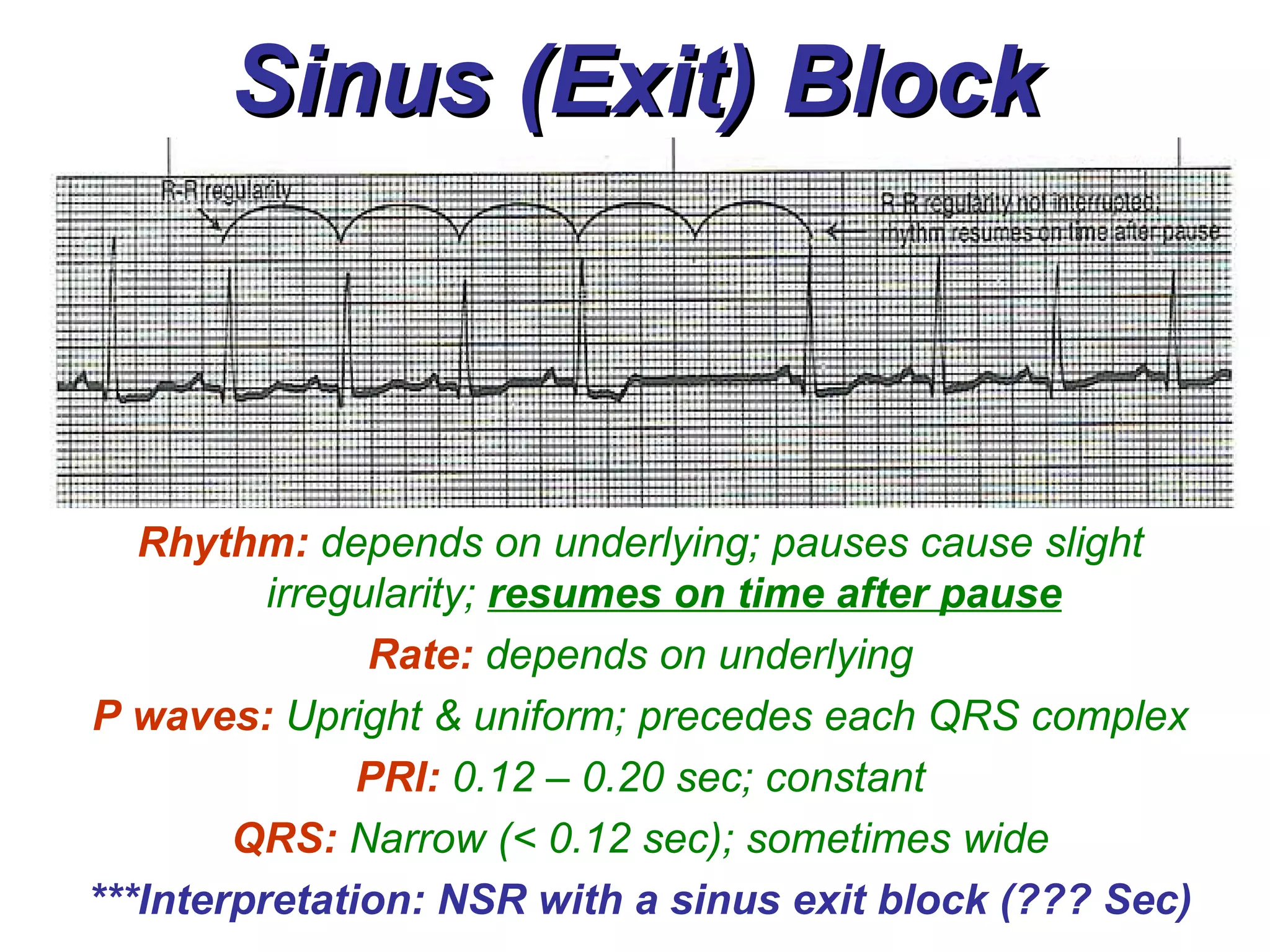
Sinus (Exit) Block Rhythm:   depends on underlying; pauses cause slight irregularity;  resumes on time after pause Rate:   depends on underlying P waves:   Upright & uniform; precedes each QRS complex PRI:   0.12 – 0.20 sec; constant QRS:   Narrow (< 0.12 sec); sometimes wide ***Interpretation: NSR with a sinus exit block (??? Sec)
 
Sinus Pauses Causes: Increase in vagal tone on the SA node Myocardial ischemia or infarction Use of certain drugs (digitalis, BB’s, or CCB’s) May be short and asymptomatic Significant length of a pause is greater than or equal to 3 seconds
Summary All sinus rhythms originate from the SA Node P waves are upright & uniform Sinus rhythms are differentiated by rates All sinus rhythms are regular with the exception of _______________________ Sinus Pauses – Two Types:___________
TIME TO WORKOUT!!!
References Chernecky, C., et al. (2002).  Real world nursing survival guide: ECG’s & the heart.  United States of America: W. B. Saunders Company. Huff, J. (2006).  ECG workout: Exercises in arrhythmia interpretation  (5 th  ed.). United States of America: Lippincott, Williams & Wilkins. Walraven, G. (1999).  Basic arrhythmias  (5 th  ed.). United States of America: Prentice-Hall, Inc. www.madsci.com/manu/ekg_rhy.htm

Sinus Rhythms - BMH/Tele

  • 1.
    Sinus Rhythms Electricalimpulses that originate from the SA node.
  • 2.
  • 3.
    Normal Sinus Rhythm(NSR) Rhythm: Regular Rate: 60 – 100 bpm P waves: Upright & uniform; precedes each QRS complex PRI: 0.12 – 0.20 sec; constant QRS: Narrow ( < 0.10 sec); sometimes wide ***Interpretation: Normal Sinus Rhythm
  • 4.
    Sinus Bradycardia (SB)Rhythm: Regular Rate: < 60 bpm P waves: Upright & uniform; precedes each QRS complex PRI: 0.12 – 0.20 sec; constant QRS: Narrow ( < 0.10 sec); sometimes wide ***Interpretation: Sinus Bradycardia (ST-segment depression ???)
  • 5.
    Sinus Bradycardia (SB)Normal with relaxation or sleep when parasympathetic effect is dominant over the SNS Common in trained athletes (as low as 35 bpm) Beneficial for some patients with cardiac insufficiencies (decreases the workload of the heart)
  • 6.
    Sinus Bradycardia (SB)Vagal stimulation Carotid sinus hypersensitivity syndrome Sleep apnea syndrome Hypothyroidism, Hypothermia, hyperkalemia Sudden movement from recumbent to an upright position Increased ICP Digitalis, CCB’s, & BB’s Sick sinus syndrome (degenerative disease of the sinus node)
  • 7.
    Sinus Tachycardia (ST)Rhythm: Regular Rate: > 100 bpm; < 160 bpm P waves: Upright & uniform; precedes each QRS complex PRI: 0.12 – 0.20 sec; constant QRS: Narrow ( < 0.10 sec); sometimes wide ***Interpretation: Sinus tachycardia
  • 8.
    Sinus Tachycardia (ST)Normal response of the heart to the body’s demand for increase in blood flow Excitement, exertion, exercise Fever, infections, septic shock Hypoxia, hypovolemia, hypotension, heart failure, hyperthyroidism Pain, PE, anxiety, anemia
  • 9.
    Sinus Tachycardia (ST)Myocardial ischemia, MI Drugs that increase sympathetic tone (epinephrine, norepi, dopamine, TCA’s, isuprel, cocaine, nitroprusside) Drugs that decrease parasympathetic tone (atropine) Smoking, alcohol consumption, caffeine
  • 10.
    Sinus Arrhythmia (SA)Rhythm: Irregular Rate: 60 – 100 bpm; sometimes slower P waves: Upright & uniform; precedes each QRS complex PRI: 0.12 – 0.20 sec; constant QRS: Narrow (< 0.12 sec); sometimes wide ***Interpretation: Sinus Arrhythmia
  • 11.
    Sinus Arrhythmia (SA)Normal phenomenon caused by variations in autonomic tone Associated with phases of respiration Inspiration = Rate Increases Expiration = Rate Decreases
  • 12.
    Sinus Pauses TwoKinds: Both originate from the sinus node Sinus (Exit) Block & Sinus Arrest
  • 13.
    Sinus Arrest Failureof the SA node to fire; a disorder of automaticity. Failure of the SA node to discharge causes an irregularity of when the rhythm resumes following the pause
  • 14.
    Sinus Arrest Rhythm: depends on underlying; pauses cause slight irregularity; does not resume on time after pause Rate: depends on underlying P waves: Upright & uniform; precedes each QRS complex PRI: 0.12 – 0.20 sec; constant QRS: Narrow (< 0.12 sec); sometimes wide ***Interpretation: NSR with a sinus arrest (??? Sec)
  • 15.
    Sinus (Exit) BlockElectrical impulse is initiated by the SA node, but is BLOCKED as it exits the sinus node preventing conduction to the atria. SA node discharge not affected; regularity not disturbed after rhythm resumes following the pause                    
  • 16.
    Sinus (Exit) BlockRhythm: depends on underlying; pauses cause slight irregularity; resumes on time after pause Rate: depends on underlying P waves: Upright & uniform; precedes each QRS complex PRI: 0.12 – 0.20 sec; constant QRS: Narrow (< 0.12 sec); sometimes wide ***Interpretation: NSR with a sinus exit block (??? Sec)
  • 17.
  • 18.
    Sinus Pauses Causes:Increase in vagal tone on the SA node Myocardial ischemia or infarction Use of certain drugs (digitalis, BB’s, or CCB’s) May be short and asymptomatic Significant length of a pause is greater than or equal to 3 seconds
  • 19.
    Summary All sinusrhythms originate from the SA Node P waves are upright & uniform Sinus rhythms are differentiated by rates All sinus rhythms are regular with the exception of _______________________ Sinus Pauses – Two Types:___________
  • 20.
  • 21.
    References Chernecky, C.,et al. (2002). Real world nursing survival guide: ECG’s & the heart. United States of America: W. B. Saunders Company. Huff, J. (2006). ECG workout: Exercises in arrhythmia interpretation (5 th ed.). United States of America: Lippincott, Williams & Wilkins. Walraven, G. (1999). Basic arrhythmias (5 th ed.). United States of America: Prentice-Hall, Inc. www.madsci.com/manu/ekg_rhy.htm