Control of Heart Rhythmicity
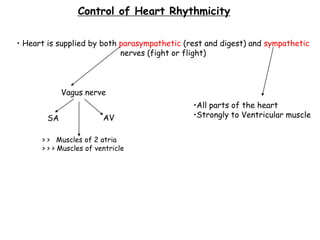
• Heart is supplied by both parasympathetic (rest and digest) and sympathetic
nerves (fight or flight)
Vagus nerve
SA AV
> > Muscles of 2 atria
> > > Muscles of ventricle
•All parts of the heart
•Strongly to Ventricular muscle
Control of Heart Rhythmicity
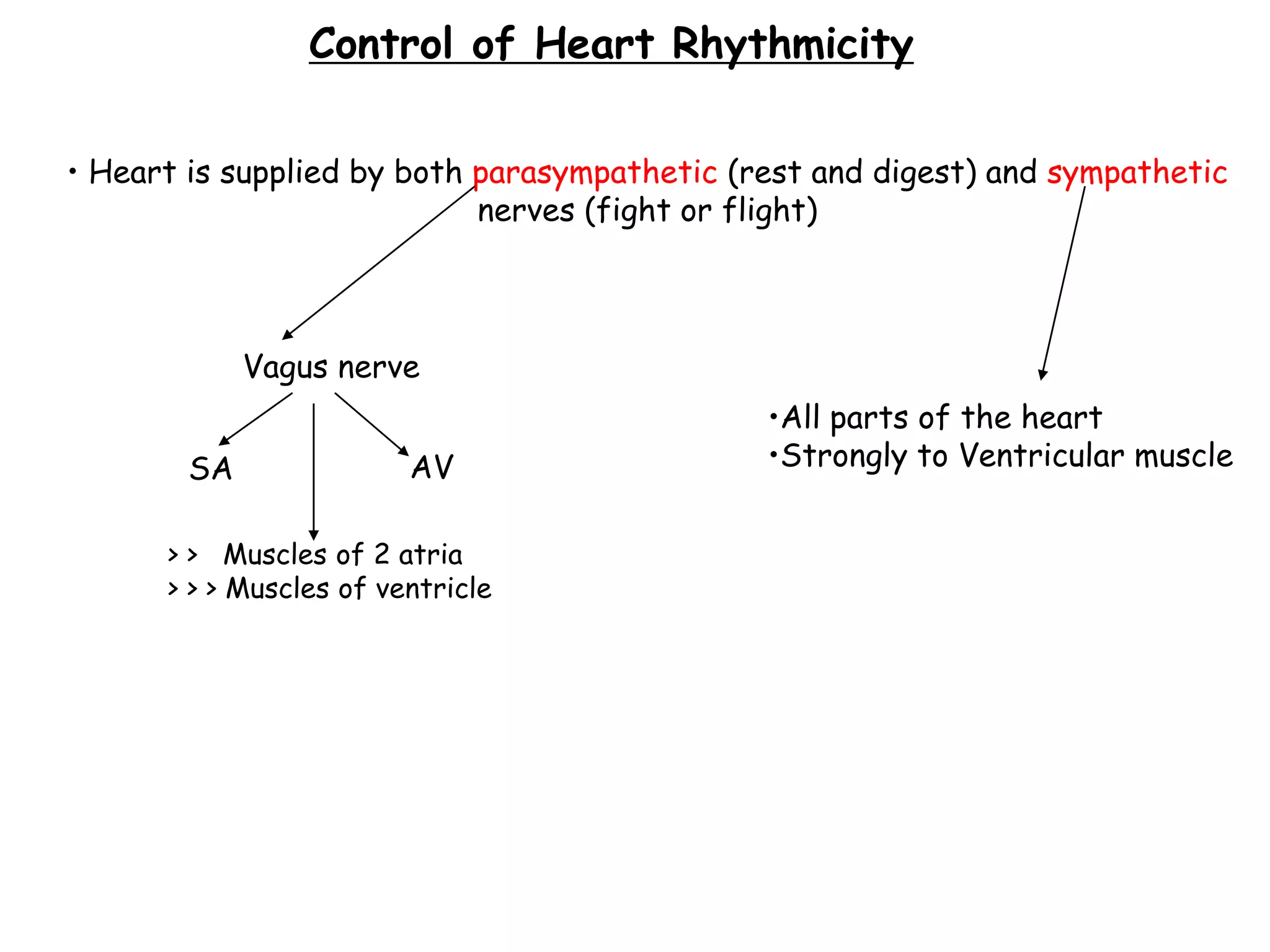
Effect of Parasympathetic stimulation (vagal) on cardiac rhythm and conduction
Vagal stimulation
Release of Acethylcholine at vagal end
Decr rate of rhythm of SA Decr excitability of AV junctional fibers b/w atrial
musculature and AV node (slow transmission of
impulse to ventricles)
Weak vagal stimulation: Slow rate of heart to half than normal
Strong vagal stimulation: stop rhythmic excitation of heart at SA
and block transmission of cardiac impulse from atria to ventricles
by AV bundle
Ventricles stop beating for 15-20secs….portion AV bundle develops a rhythm and cause ventricular
contraction at 15-40 beats per min: this is ventricular escape
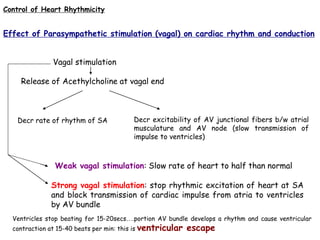
Mech. of Parasympathetic stimulation (vagal) on cardiac rhythm and conduction
Vagal stimulation
Incr permeability of fibre to K+
Rapid leakage of K+ to outside
Incr negativity of fibre: HYPERPOLARIZATION (less excitable)
HYPOLZN decr resting membrane potential of SA to -65 to -75mV (-55 to -60mV
normal)
Initial rise of membrane pot (+) by Na+ and Ca++ inward takes longer to reach
threshold potential for excitation
Slows rate of rhythmicity of nodal fibres
Strong vagal stimulation will stop heart
AV node delay: safety factor thro AVnode
Effect of Sympathetic stimulation on cardiac rhythm and conduction
•Opposite effects on heart to those caused by vagal stimulation
1. Increases the rate of SA node discharge
2. Increases conduction
3. Increases excitability in all portions of heart
4. Increases force of contraction of all cardiac musculature (atrial and ventricular)
In all it increases overall activity of heart
Activity can triple the frequency of heart beat and contraction two fold
Mechanism of Sympathetic stimulation on cardiac rhythm and conduction
Stimulation of sympathetic nerves
Release of norepinephrine at ends
Incrs permeability to Ca and Na
At SA causes more positive resting membrane potential
Incr diastolic membrane pot to threshold level for self excitation
Incr in heart rate
AV node and bundle also the Na and Ca permeability makes easy for AP to
travel and excite conduction fibres and decreases conduction time
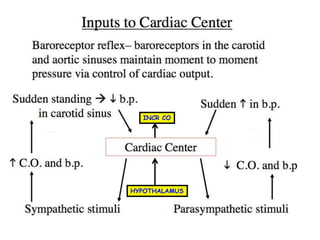
The major control center for cardiac output is the Cardiac Center in the
medulla of the brain.
The medulla sends impulses to the heart through the
parasympathetic (vagus nerve) and
sympathetic (cardiac nerves) divisions.
1. The vagus nerve innervates the SA and AV nodes and, by increasing the
threshold for depolarization, reduces the heart rate. The vagus has no
effect on contractility.
2. Sympathetic stimuli lead not only to the SA and AV nodes, but also to
the myocardium itself. Its effect on the myocardium is to increase
contractility, thus increasing the force and volume of contraction.
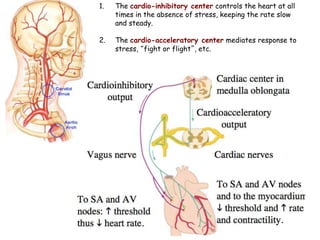
3. The cardio-inhibitory center controls the heart at all times in the
absence of stress, keeping the rate slow and steady.
4. The cardio-acceleratory center mediates response to stress, “fight or
flight”, etc.
1. The cardio-inhibitory center controls the heart at all
times in the absence of stress, keeping the rate slow
and steady.
2. The cardio-acceleratory center mediates response to
stress, “fight or flight”, etc.
The baroreceptor reflex does not respond to abnormally high or low
pressures, at least not effectively.
But rather the reflex keeps pressure within normal limits despite
changes in body position, activity, etc.
An example experienced by almost everyone is the response to decreased
pressure in the carotid sinus when one stands suddenly.
At first light headedness occurs, sometimes even fainting.
But the baroreceptor reflex kicks in and brings the pressure back up
quickly. The opposite happens when pressure suddenly increases, but we
are less aware of this phenomenon.
BARORECEPTOR REFLEX
HYPOTHALAMUS
INCR CO
A major input to the cardiac center is the hypothalamus, which
increases cardiac output when you get excited, go into Fight or Flight
and exercise.
Higher brain center –the hypothalamus
- stimulates the cardiac center in response to exercise, emotions, fight
or flight, etc.
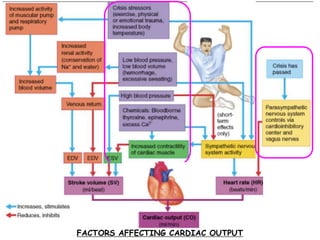
FACTORS AFFECTING CARDIAC OUTPUT
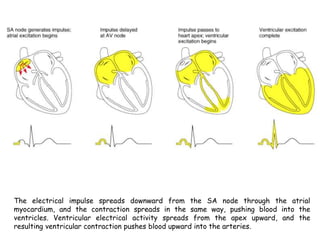
The electrical impulse spreads downward from the SA node through the atrial
myocardium, and the contraction spreads in the same way, pushing blood into the
ventricles. Ventricular electrical activity spreads from the apex upward, and the
resulting ventricular contraction pushes blood upward into the arteries.
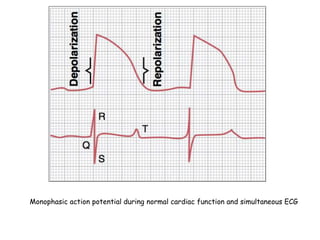
Monophasic action potential during normal cardiac function and simultaneous ECG
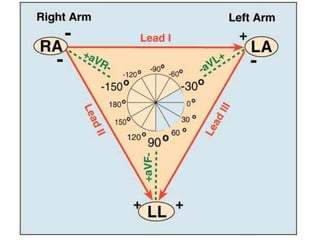
Orientation of the 12 Lead ECG
It is important to remember that the 12-lead ECG provides spatial information
about the heart's electrical activity in 3 approximately orthogonal directions:
Right ⇔ Left
Superior ⇔ Inferior
Anterior ⇔ Posterior
Each of the 12 leads represents a particular orientation in space, as indicated below
(RA = right arm; LA = left arm, LL = left foot):
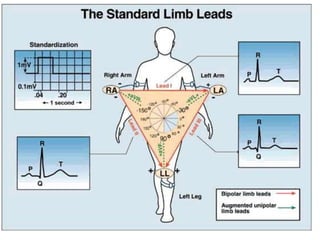
Bipolar limb leads (frontal plane):
Lead I: RA (-) to LA (+) (Right Left, or lateral)
Lead II: RA (-) to LL (+) (Superior Inferior)
Lead III: LA (-) to LL (+) (Superior Inferior)
Augmented unipolar limb leads (frontal plane):
Lead aVR: RA (+) to [LA & LL] (-) (Rightward)
Lead aVL: LA (+) to [RA & LL] (-) (Leftward)
Lead aVF: LL (+) to [RA & LA] (-) (Inferior)
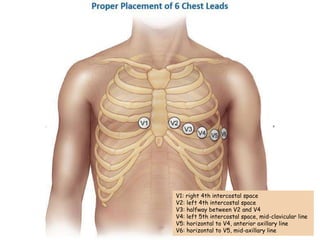
Unipolar (+) chest leads (horizontal plane):
Leads V1, V2, V3: (Posterior Anterior)
Leads V4, V5, V6:(Right Left, or lateral)
V1: right 4th intercostal space
V2: left 4th intercostal space
V3: halfway between V2 and V4
V4: left 5th intercostal space, mid-clavicular line
V5: horizontal to V4, anterior axillary line
V6: horizontal to V5, mid-axillary line
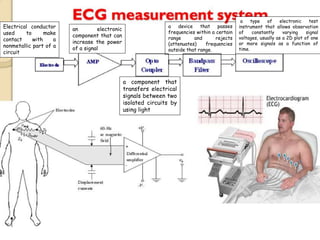
a component that
transfers electrical
signals between two
isolated circuits by
using light
a device that passes
frequencies within a certain
range and rejects
(attenuates) frequencies
outside that range.
an electronic
component that can
increase the power
of a signal
a type of electronic test
instrument that allows observation
of constantly varying signal
voltages, usually as a 2D plot of one
or more signals as a function of
time.
Electrical conductor
used to make
contact with a
nonmetallic part of a
circuit
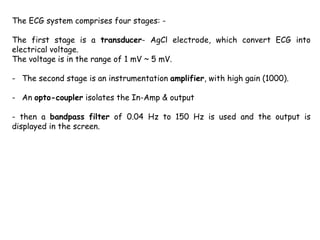
The ECG system comprises four stages: -
The first stage is a transducer- AgCl electrode, which convert ECG into
electrical voltage.
The voltage is in the range of 1 mV ~ 5 mV.
- The second stage is an instrumentation amplifier, with high gain (1000).
- An opto-coupler isolates the In-Amp & output
- then a bandpass filter of 0.04 Hz to 150 Hz is used and the output is
displayed in the screen.
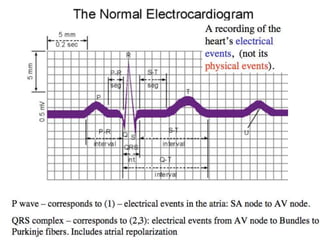
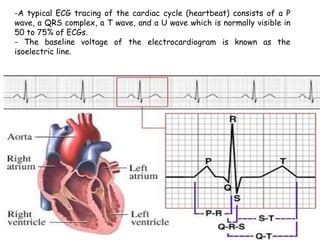
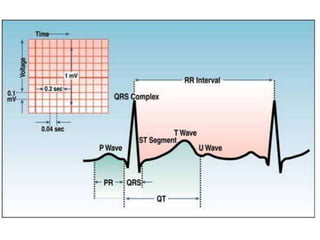
-A typical ECG tracing of the cardiac cycle (heartbeat) consists of a P
wave, a QRS complex, a T wave, and a U wave which is normally visible in
50 to 75% of ECGs.
- The baseline voltage of the electrocardiogram is known as the
isoelectric line.
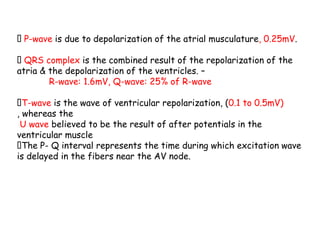
P-wave is due to depolarization of the atrial musculature, 0.25mV.
QRS complex is the combined result of the repolarization of the
atria & the depolarization of the ventricles. –
R-wave: 1.6mV, Q-wave: 25% of R-wave
T-wave is the wave of ventricular repolarization, (0.1 to 0.5mV)
, whereas the
U wave believed to be the result of after potentials in the
ventricular muscle
The P- Q interval represents the time during which excitation wave
is delayed in the fibers near the AV node.
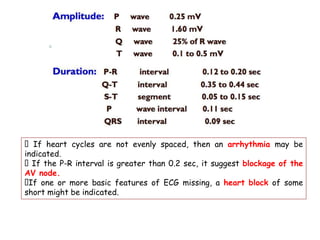
If heart cycles are not evenly spaced, then an arrhythmia may be
indicated.
If the P-R interval is greater than 0.2 sec, it suggest blockage of the
AV node.
If one or more basic features of ECG missing, a heart block of some
short might be indicated.
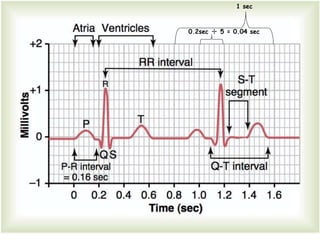
0.2sec ÷ 5 = 0.04 sec
1 sec
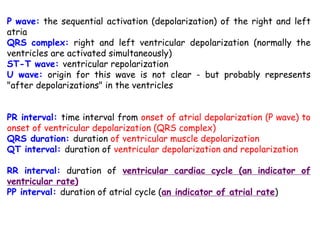
P wave: the sequential activation (depolarization) of the right and left
atria
QRS complex: right and left ventricular depolarization (normally the
ventricles are activated simultaneously)
ST-T wave: ventricular repolarization
U wave: origin for this wave is not clear - but probably represents
"after depolarizations" in the ventricles
PR interval: time interval from onset of atrial depolarization (P wave) to
onset of ventricular depolarization (QRS complex)
QRS duration: duration of ventricular muscle depolarization
QT interval: duration of ventricular depolarization and repolarization
RR interval: duration of ventricular cardiac cycle (an indicator of
ventricular rate)
PP interval: duration of atrial cycle (an indicator of atrial rate)
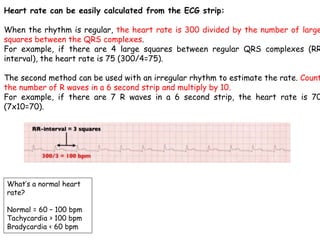
Heart rate can be easily calculated from the ECG strip:
When the rhythm is regular, the heart rate is 300 divided by the number of large
squares between the QRS complexes.
For example, if there are 4 large squares between regular QRS complexes (RR
interval), the heart rate is 75 (300/4=75).
The second method can be used with an irregular rhythm to estimate the rate. Count
the number of R waves in a 6 second strip and multiply by 10.
For example, if there are 7 R waves in a 6 second strip, the heart rate is 70
(7x10=70).
What’s a normal heart
rate?
Normal = 60 – 100 bpm
Tachycardia > 100 bpm
Bradycardia < 60 bpm
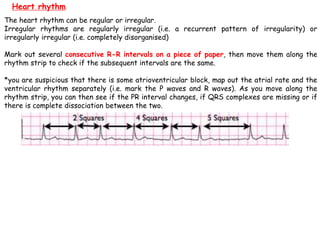
The heart rhythm can be regular or irregular.
Irregular rhythms are regularly irregular (i.e. a recurrent pattern of irregularity) or
irregularly irregular (i.e. completely disorganised)
Mark out several consecutive R-R intervals on a piece of paper, then move them along the
rhythm strip to check if the subsequent intervals are the same.
*you are suspicious that there is some atrioventricular block, map out the atrial rate and the
ventricular rhythm separately (i.e. mark the P waves and R waves). As you move along the
rhythm strip, you can then see if the PR interval changes, if QRS complexes are missing or if
there is complete dissociation between the two.
Heart rhythm
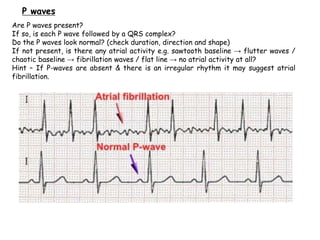
Are P waves present?
If so, is each P wave followed by a QRS complex?
Do the P waves look normal? (check duration, direction and shape)
If not present, is there any atrial activity e.g. sawtooth baseline → flutter waves /
chaotic baseline → fibrillation waves / flat line → no atrial activity at all?
Hint – If P-waves are absent & there is an irregular rhythm it may suggest atrial
fibrillation.
P waves
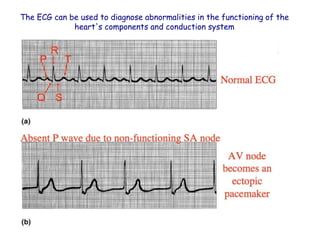
The ECG can be used to diagnose abnormalities in the functioning of the
heart's components and conduction system
In tracing (b) there is no P wave because the SA node is not
functioning. Without the SA node to initiate the beat, the next
fastest area takes over, this being the AV node which has automaticity
about half that of the SA node.
An artificial pacemaker would be used to regulate the heart rate.
Artificial Pacemakers are used to compensate for damage to the SA
node, Bundle branches or other parts of the heart's conducting
system.
Some pacemakers stimulate only the ventricles, but more two
chamber pacemakers are now being used which stimulate both the
atria and ventricles.
These devices have complex sensing capability to sense the heart's
own electrical activity and coordinate the pacemaker's stimulation of
the atria and ventricles. They can even respond to the increased
demand of exercise and compensate by increasing heart rate.
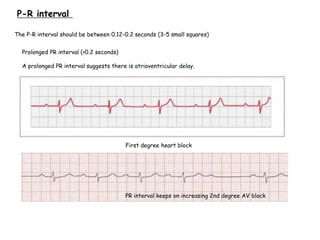
P-R interval
The P-R interval should be between 0.12-0.2 seconds (3-5 small squares)
Prolonged PR interval (>0.2 seconds)
A prolonged PR interval suggests there is atrioventricular delay.
First degree heart block
PR interval keeps on increasing 2nd degree AV block
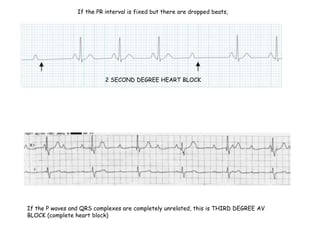
If the PR interval is fixed but there are dropped beats,
2 SECOND DEGREE HEART BLOCK
If the P waves and QRS complexes are completely unrelated, this is THIRD DEGREE AV
BLOCK (complete heart block)
First degree AV block:
Occurs between the SA node and the AV node (i.e. within the
atrium)
Second degree AV block:
Mobitz I (Wenckebach) – occurs IN the AV node. This is the
only piece of conductive tissue in the heart which exhibits
the ability to conduct at different speeds.
Mobitz II – occurs AFTER the AV node in the bundle of His
or Purkinje fibres.
Third degree AV block:
Occurs anywhere from the AV node down causing complete
blockage
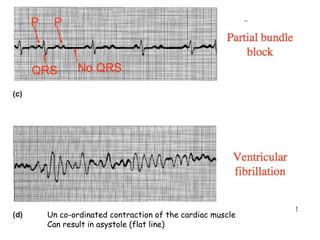
Un co-ordinated contraction of the cardiac muscle
Can result in asystole (flat line)
In a partial bundle block (c) the rate of impulse transmission through
the AV node slows to about half its normal rate. This reduces the
QRS frequency to every other beat. Sometimes partial bundle block
responds to drugs, but others require an artificial pacemaker.
Complete bundle block produces an ectopic pacemaker in the bundle
branches and requires artificial pacing.
(d) Ventricular fibrillation is an electrical spasm in the ventricular
myocardium and is lethal if not corrected quickly. A defibrillator is
used to reset the myocardium by depolarizing it simultaneously. A
regular rhythm can then be established. Implantable pacemaker-
defibrillators can be used in patients who’s hearts repeatedly suffer
electrical spasms.
Tachycardia: increase in heart range, over 100 beats per minute
Bradycardia: decrease in heart range, below 60 beats per minute
Too slow, can cause cardiac arrest, shortness of breath, fatigue
Cardiac arrhythmia: abnormal electrical activity of heart
Other Cardiac Abnormalities
Atrial tachycardia, rapid heartbeat resulting from abnormal rhythm in the atria.
Atrial fibrillation is a short-circuiting electrical spasm in the atria. 100-150 bpm
Ventricular tachycardia (VT or v-tach) is much more serious, resulting from
severe ischemia and damage to the ventricular myocardium and often preceding
ventricular fibrillation. (120-250 beats per minute) leads to myocardial
infarction. Can be exercise induced.
A typical form of atrial tachycardia, involves the AV node and results in an
inverted or obscured P wave. Atrial tachycardia tends to occur in young people
and generally disappears with age without heart damage.
A new surgical technique isolates and destroys the offending cells to restore
normal rhythm. Though more serious than atrial tachycardia, atrial fibrillation is
rarely life-threatening. Since it interferes with the filling action of the atria,
the heart's efficiency is reduced and may cause symptoms of weakness.
In addition the sluggish blood flow in the atria may cause clots which can
subsequently form emboli (clots which move and lodge in another location
downstream).
MYOCARDIAL INFARCTION
Interruption of blood supply to heart (ischemia)
Blockage of arteries
Shortage of oxygen
ISCHEMIC HEART DISEASE
MI, Angina pectoris---- results in failure of heart to pump blood
heart attack
MI can lead to heart failure
Heart Failure: myocardial infarction (heart attack or failure)
cor pulmonale: right side failure
Ischemic heart disease: reduced blood supply to organs
Hypertensive heart disease:
Coranary heart disease
Cardiac arrhythemia: abnormal electrivity of heart
Cardiamyopathy : congenital
Cardiovascular disease: atherosclerosis
Inflamatory heart Disease
Valvular heart disease: murmur

4. control, regulation and disorders heart

  • 1.
    Control of HeartRhythmicity • Heart is supplied by both parasympathetic (rest and digest) and sympathetic nerves (fight or flight) Vagus nerve SA AV > > Muscles of 2 atria > > > Muscles of ventricle •All parts of the heart •Strongly to Ventricular muscle
  • 2.
    Control of HeartRhythmicity Effect of Parasympathetic stimulation (vagal) on cardiac rhythm and conduction Vagal stimulation Release of Acethylcholine at vagal end Decr rate of rhythm of SA Decr excitability of AV junctional fibers b/w atrial musculature and AV node (slow transmission of impulse to ventricles) Weak vagal stimulation: Slow rate of heart to half than normal Strong vagal stimulation: stop rhythmic excitation of heart at SA and block transmission of cardiac impulse from atria to ventricles by AV bundle Ventricles stop beating for 15-20secs….portion AV bundle develops a rhythm and cause ventricular contraction at 15-40 beats per min: this is ventricular escape
  • 3.
    Mech. of Parasympatheticstimulation (vagal) on cardiac rhythm and conduction Vagal stimulation Incr permeability of fibre to K+ Rapid leakage of K+ to outside Incr negativity of fibre: HYPERPOLARIZATION (less excitable) HYPOLZN decr resting membrane potential of SA to -65 to -75mV (-55 to -60mV normal) Initial rise of membrane pot (+) by Na+ and Ca++ inward takes longer to reach threshold potential for excitation Slows rate of rhythmicity of nodal fibres Strong vagal stimulation will stop heart AV node delay: safety factor thro AVnode
  • 4.
    Effect of Sympatheticstimulation on cardiac rhythm and conduction •Opposite effects on heart to those caused by vagal stimulation 1. Increases the rate of SA node discharge 2. Increases conduction 3. Increases excitability in all portions of heart 4. Increases force of contraction of all cardiac musculature (atrial and ventricular) In all it increases overall activity of heart Activity can triple the frequency of heart beat and contraction two fold
  • 5.
    Mechanism of Sympatheticstimulation on cardiac rhythm and conduction Stimulation of sympathetic nerves Release of norepinephrine at ends Incrs permeability to Ca and Na At SA causes more positive resting membrane potential Incr diastolic membrane pot to threshold level for self excitation Incr in heart rate AV node and bundle also the Na and Ca permeability makes easy for AP to travel and excite conduction fibres and decreases conduction time
  • 6.
    The major controlcenter for cardiac output is the Cardiac Center in the medulla of the brain. The medulla sends impulses to the heart through the parasympathetic (vagus nerve) and sympathetic (cardiac nerves) divisions. 1. The vagus nerve innervates the SA and AV nodes and, by increasing the threshold for depolarization, reduces the heart rate. The vagus has no effect on contractility. 2. Sympathetic stimuli lead not only to the SA and AV nodes, but also to the myocardium itself. Its effect on the myocardium is to increase contractility, thus increasing the force and volume of contraction. 3. The cardio-inhibitory center controls the heart at all times in the absence of stress, keeping the rate slow and steady. 4. The cardio-acceleratory center mediates response to stress, “fight or flight”, etc.
  • 7.
    1. The cardio-inhibitorycenter controls the heart at all times in the absence of stress, keeping the rate slow and steady. 2. The cardio-acceleratory center mediates response to stress, “fight or flight”, etc.
  • 8.
    The baroreceptor reflexdoes not respond to abnormally high or low pressures, at least not effectively. But rather the reflex keeps pressure within normal limits despite changes in body position, activity, etc. An example experienced by almost everyone is the response to decreased pressure in the carotid sinus when one stands suddenly. At first light headedness occurs, sometimes even fainting. But the baroreceptor reflex kicks in and brings the pressure back up quickly. The opposite happens when pressure suddenly increases, but we are less aware of this phenomenon. BARORECEPTOR REFLEX
  • 9.
  • 10.
    A major inputto the cardiac center is the hypothalamus, which increases cardiac output when you get excited, go into Fight or Flight and exercise. Higher brain center –the hypothalamus - stimulates the cardiac center in response to exercise, emotions, fight or flight, etc.
  • 11.
  • 12.
    The electrical impulsespreads downward from the SA node through the atrial myocardium, and the contraction spreads in the same way, pushing blood into the ventricles. Ventricular electrical activity spreads from the apex upward, and the resulting ventricular contraction pushes blood upward into the arteries.
  • 13.
    Monophasic action potentialduring normal cardiac function and simultaneous ECG
  • 14.
    Orientation of the12 Lead ECG It is important to remember that the 12-lead ECG provides spatial information about the heart's electrical activity in 3 approximately orthogonal directions: Right ⇔ Left Superior ⇔ Inferior Anterior ⇔ Posterior Each of the 12 leads represents a particular orientation in space, as indicated below (RA = right arm; LA = left arm, LL = left foot): Bipolar limb leads (frontal plane): Lead I: RA (-) to LA (+) (Right Left, or lateral) Lead II: RA (-) to LL (+) (Superior Inferior) Lead III: LA (-) to LL (+) (Superior Inferior) Augmented unipolar limb leads (frontal plane): Lead aVR: RA (+) to [LA & LL] (-) (Rightward) Lead aVL: LA (+) to [RA & LL] (-) (Leftward) Lead aVF: LL (+) to [RA & LA] (-) (Inferior) Unipolar (+) chest leads (horizontal plane): Leads V1, V2, V3: (Posterior Anterior) Leads V4, V5, V6:(Right Left, or lateral)
  • 17.
    V1: right 4thintercostal space V2: left 4th intercostal space V3: halfway between V2 and V4 V4: left 5th intercostal space, mid-clavicular line V5: horizontal to V4, anterior axillary line V6: horizontal to V5, mid-axillary line
  • 18.
    a component that transferselectrical signals between two isolated circuits by using light a device that passes frequencies within a certain range and rejects (attenuates) frequencies outside that range. an electronic component that can increase the power of a signal a type of electronic test instrument that allows observation of constantly varying signal voltages, usually as a 2D plot of one or more signals as a function of time. Electrical conductor used to make contact with a nonmetallic part of a circuit
  • 19.
    The ECG systemcomprises four stages: - The first stage is a transducer- AgCl electrode, which convert ECG into electrical voltage. The voltage is in the range of 1 mV ~ 5 mV. - The second stage is an instrumentation amplifier, with high gain (1000). - An opto-coupler isolates the In-Amp & output - then a bandpass filter of 0.04 Hz to 150 Hz is used and the output is displayed in the screen.
  • 21.
    -A typical ECGtracing of the cardiac cycle (heartbeat) consists of a P wave, a QRS complex, a T wave, and a U wave which is normally visible in 50 to 75% of ECGs. - The baseline voltage of the electrocardiogram is known as the isoelectric line.
  • 22.
    P-wave is dueto depolarization of the atrial musculature, 0.25mV. QRS complex is the combined result of the repolarization of the atria & the depolarization of the ventricles. – R-wave: 1.6mV, Q-wave: 25% of R-wave T-wave is the wave of ventricular repolarization, (0.1 to 0.5mV) , whereas the U wave believed to be the result of after potentials in the ventricular muscle The P- Q interval represents the time during which excitation wave is delayed in the fibers near the AV node.
  • 23.
    If heart cyclesare not evenly spaced, then an arrhythmia may be indicated. If the P-R interval is greater than 0.2 sec, it suggest blockage of the AV node. If one or more basic features of ECG missing, a heart block of some short might be indicated.
  • 24.
    0.2sec ÷ 5= 0.04 sec 1 sec
  • 26.
    P wave: thesequential activation (depolarization) of the right and left atria QRS complex: right and left ventricular depolarization (normally the ventricles are activated simultaneously) ST-T wave: ventricular repolarization U wave: origin for this wave is not clear - but probably represents "after depolarizations" in the ventricles PR interval: time interval from onset of atrial depolarization (P wave) to onset of ventricular depolarization (QRS complex) QRS duration: duration of ventricular muscle depolarization QT interval: duration of ventricular depolarization and repolarization RR interval: duration of ventricular cardiac cycle (an indicator of ventricular rate) PP interval: duration of atrial cycle (an indicator of atrial rate)
  • 27.
    Heart rate canbe easily calculated from the ECG strip: When the rhythm is regular, the heart rate is 300 divided by the number of large squares between the QRS complexes. For example, if there are 4 large squares between regular QRS complexes (RR interval), the heart rate is 75 (300/4=75). The second method can be used with an irregular rhythm to estimate the rate. Count the number of R waves in a 6 second strip and multiply by 10. For example, if there are 7 R waves in a 6 second strip, the heart rate is 70 (7x10=70). What’s a normal heart rate? Normal = 60 – 100 bpm Tachycardia > 100 bpm Bradycardia < 60 bpm
  • 28.
    The heart rhythmcan be regular or irregular. Irregular rhythms are regularly irregular (i.e. a recurrent pattern of irregularity) or irregularly irregular (i.e. completely disorganised) Mark out several consecutive R-R intervals on a piece of paper, then move them along the rhythm strip to check if the subsequent intervals are the same. *you are suspicious that there is some atrioventricular block, map out the atrial rate and the ventricular rhythm separately (i.e. mark the P waves and R waves). As you move along the rhythm strip, you can then see if the PR interval changes, if QRS complexes are missing or if there is complete dissociation between the two. Heart rhythm
  • 29.
    Are P wavespresent? If so, is each P wave followed by a QRS complex? Do the P waves look normal? (check duration, direction and shape) If not present, is there any atrial activity e.g. sawtooth baseline → flutter waves / chaotic baseline → fibrillation waves / flat line → no atrial activity at all? Hint – If P-waves are absent & there is an irregular rhythm it may suggest atrial fibrillation. P waves
  • 30.
    The ECG canbe used to diagnose abnormalities in the functioning of the heart's components and conduction system
  • 31.
    In tracing (b)there is no P wave because the SA node is not functioning. Without the SA node to initiate the beat, the next fastest area takes over, this being the AV node which has automaticity about half that of the SA node. An artificial pacemaker would be used to regulate the heart rate. Artificial Pacemakers are used to compensate for damage to the SA node, Bundle branches or other parts of the heart's conducting system. Some pacemakers stimulate only the ventricles, but more two chamber pacemakers are now being used which stimulate both the atria and ventricles. These devices have complex sensing capability to sense the heart's own electrical activity and coordinate the pacemaker's stimulation of the atria and ventricles. They can even respond to the increased demand of exercise and compensate by increasing heart rate.
  • 32.
    P-R interval The P-Rinterval should be between 0.12-0.2 seconds (3-5 small squares) Prolonged PR interval (>0.2 seconds) A prolonged PR interval suggests there is atrioventricular delay. First degree heart block PR interval keeps on increasing 2nd degree AV block
  • 33.
    If the PRinterval is fixed but there are dropped beats, 2 SECOND DEGREE HEART BLOCK If the P waves and QRS complexes are completely unrelated, this is THIRD DEGREE AV BLOCK (complete heart block)
  • 34.
    First degree AVblock: Occurs between the SA node and the AV node (i.e. within the atrium) Second degree AV block: Mobitz I (Wenckebach) – occurs IN the AV node. This is the only piece of conductive tissue in the heart which exhibits the ability to conduct at different speeds. Mobitz II – occurs AFTER the AV node in the bundle of His or Purkinje fibres. Third degree AV block: Occurs anywhere from the AV node down causing complete blockage
  • 35.
    Un co-ordinated contractionof the cardiac muscle Can result in asystole (flat line)
  • 36.
    In a partialbundle block (c) the rate of impulse transmission through the AV node slows to about half its normal rate. This reduces the QRS frequency to every other beat. Sometimes partial bundle block responds to drugs, but others require an artificial pacemaker. Complete bundle block produces an ectopic pacemaker in the bundle branches and requires artificial pacing. (d) Ventricular fibrillation is an electrical spasm in the ventricular myocardium and is lethal if not corrected quickly. A defibrillator is used to reset the myocardium by depolarizing it simultaneously. A regular rhythm can then be established. Implantable pacemaker- defibrillators can be used in patients who’s hearts repeatedly suffer electrical spasms.
  • 37.
    Tachycardia: increase inheart range, over 100 beats per minute Bradycardia: decrease in heart range, below 60 beats per minute Too slow, can cause cardiac arrest, shortness of breath, fatigue Cardiac arrhythmia: abnormal electrical activity of heart
  • 38.
    Other Cardiac Abnormalities Atrialtachycardia, rapid heartbeat resulting from abnormal rhythm in the atria. Atrial fibrillation is a short-circuiting electrical spasm in the atria. 100-150 bpm Ventricular tachycardia (VT or v-tach) is much more serious, resulting from severe ischemia and damage to the ventricular myocardium and often preceding ventricular fibrillation. (120-250 beats per minute) leads to myocardial infarction. Can be exercise induced. A typical form of atrial tachycardia, involves the AV node and results in an inverted or obscured P wave. Atrial tachycardia tends to occur in young people and generally disappears with age without heart damage. A new surgical technique isolates and destroys the offending cells to restore normal rhythm. Though more serious than atrial tachycardia, atrial fibrillation is rarely life-threatening. Since it interferes with the filling action of the atria, the heart's efficiency is reduced and may cause symptoms of weakness. In addition the sluggish blood flow in the atria may cause clots which can subsequently form emboli (clots which move and lodge in another location downstream).
  • 39.
    MYOCARDIAL INFARCTION Interruption ofblood supply to heart (ischemia) Blockage of arteries Shortage of oxygen ISCHEMIC HEART DISEASE MI, Angina pectoris---- results in failure of heart to pump blood heart attack MI can lead to heart failure
  • 40.
    Heart Failure: myocardialinfarction (heart attack or failure) cor pulmonale: right side failure Ischemic heart disease: reduced blood supply to organs Hypertensive heart disease: Coranary heart disease Cardiac arrhythemia: abnormal electrivity of heart Cardiamyopathy : congenital Cardiovascular disease: atherosclerosis Inflamatory heart Disease Valvular heart disease: murmur