ARHYTHMIA INTERPRETATION REVIEW 2007 Susan Eade RN & Vicki Clavir RN
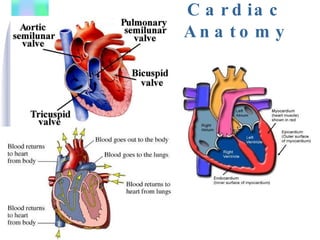
Cardiac Anatomy
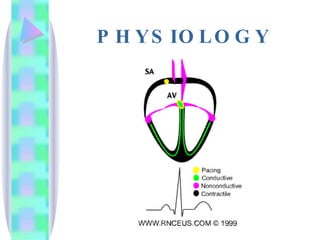
PHYSIOLOGY
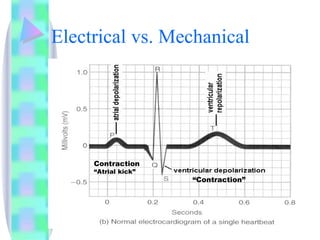
Electrical vs. Mechanical “ Contraction” Contraction “ Atrial kick”
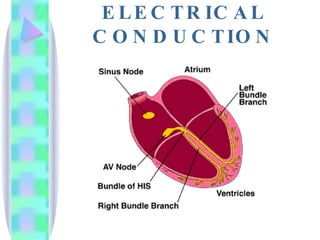
ELECTRICAL CONDUCTION
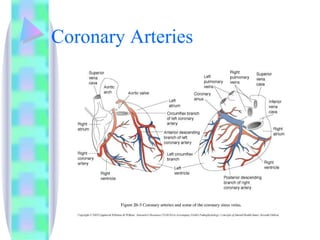
Coronary Arteries
EKG STRIP
Sinus Rhythms P is usually upright lead II Rhythm regular  1 P wave before each QRS – PRI -.12-.20 QRS’s normal width .04-.10 SR rate 60-100 SB rate < 60 ST rate >100
SINUS RHYTHM Rate ____,  R or I____,  PR ____,  QRS_____ Interpretation __________________ 78 R .16 .08
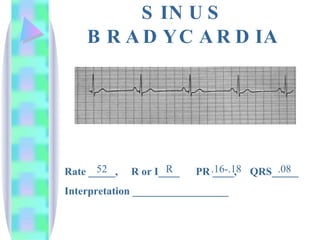
SINUS BRADYCARDIA Rate _____,  R or I____  PR ____,  QRS_____ Interpretation __________________ 52 .16-.18 .08 R
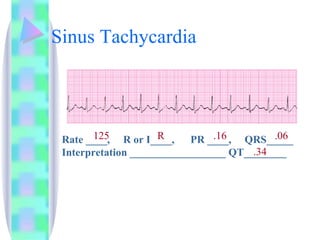
Sinus Tachycardia Rate ____,  R or I____,  PR ____,  QRS_____ Interpretation __________________ QT________ 125 R .16 .06 .34
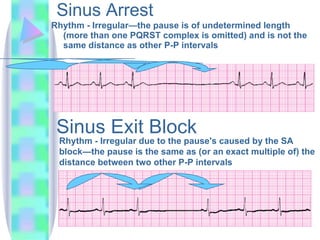
Sinus Arrest Rhythm -  Irregular—the pause is of undetermined length (more than one PQRST complex is omitted) and is not the same distance as other P-P intervals  Sinus Exit Block Rhythm - Irregular due to the pause's caused by the SA block—the pause is the same as (or an exact multiple of) the distance between two other P-P intervals
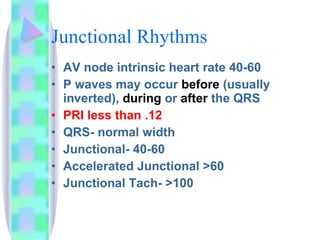
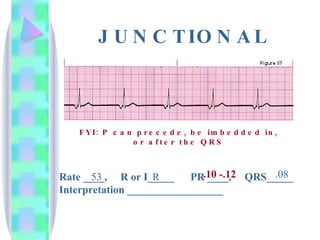
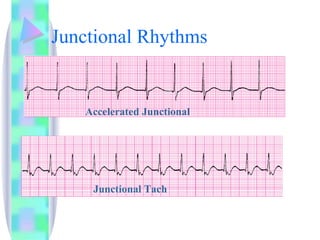
Junctional Rhythms AV node intrinsic heart rate 40-60 P waves may occur  before  (usually inverted),  during  or  after  the QRS PRI less than .12   QRS- normal width Junctional- 40-60 Accelerated Junctional >60 Junctional Tach- >100
JUNCTIONAL Rate ____,  R or I_____  PR ____,  QRS_____ Interpretation __________________ 53 R .10 -.12 .08 FYI: P can precede, be imbedded in, or after the QRS
Junctional Rhythms Accelerated Junctional Junctional Tach
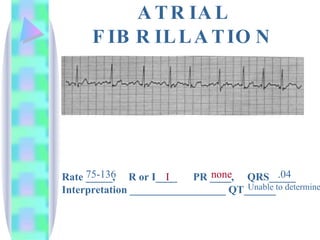
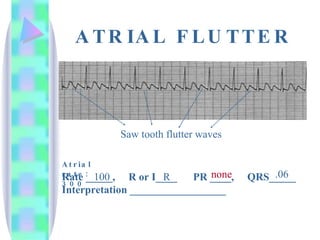
Atrial Rhythms  Atrial Fibrillation  Very Irregular ( Irregularly Irregular) No discernable P waves- fibrillatory waves- wavy baseline (atrial rate >300) No PRI Normal QRS Atrial Flutter Hallmark “Sine Waves&quot; or     pattern May or may not be regular No PRI Atrial rate >200
ATRIAL FIBRILLATION Rate _____,  R or I____  PR ____,  QRS_____ Interpretation __________________ QT______ 75-136 I none .04 Unable to determine
ATRIAL FLUTTER Rate _____,  R or I____  PR ____,  QRS_____ Interpretation __________________ 100 R none .06 Saw tooth flutter waves Atrial rate: 300
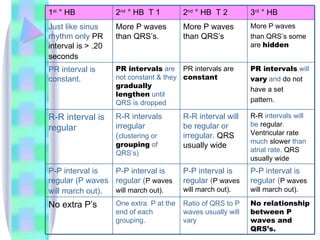
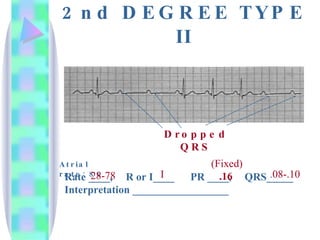
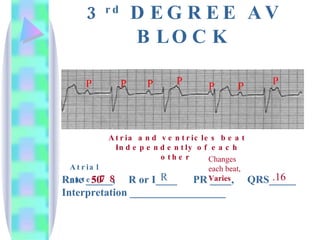
No relationship between P waves and QRS’s.  Ratio of QRS to P waves usually will vary One extra  P at the end of each grouping. No extra P’s P-P interval is regular ( P waves will march out). P-P interval is regular ( P waves will march out). P-P interval is regular ( P waves will march out).   P-P interval is regular (P waves will march out).   R-R  intervals will be  regular .  Ventricular rate  much  slower  than atrial rate.  QRS usually wide R-R interval will be regular or irregular.  QRS usually wide R-R intervals irregular ( clustering or  grouping  of QRS’s)  R-R interval is regular  PR intervals  will vary  and  do not have a set pattern. PR intervals are  constant PR intervals  are not constant & they  gradually   lengthen  until QRS is dropped PR interval is constant.  More P waves than QRS’s some are  hidden More P waves than QRS’s  More P waves than QRS’s.   Just like sinus rhythm only  PR interval is > .20 seconds   3 rd   ° HB 2 nd   ° HB  T 2 2 nd   ° HB  T 1 1 st   ° HB
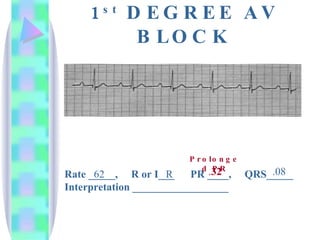
1 st  DEGREE AV BLOCK Rate _____,  R or I___  PR ____,  QRS_____ Interpretation __________________ 62 R . 32 .08 Prolonged PR
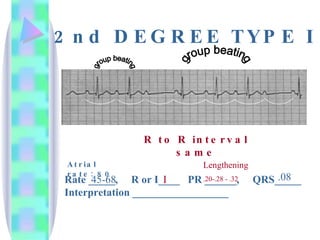
2nd DEGREE TYPE I Rate _____,  R or I____  PR ______,  QRS_____ Interpretation __________________ 45-68 I Lengthening .20-.28 - .32 .08 group beating group beating R to R interval same Atrial rate: 80
2nd DEGREE TYPE II Rate ____,  R or I____  PR ____,  QRS_____ Interpretation __________________ I (Fixed)  .16 . 08-.10 Dropped QRS Atrial rate: 80 28-78
3 rd  DEGREE AV BLOCK Rate _____,  R or I____  PR ____,  QRS_____ Interpretation __________________ 50 R Changes each beat,  Varies .16 Atrial rate:  78 Atria and ventricles beat Independently of each other  P P P P P P P
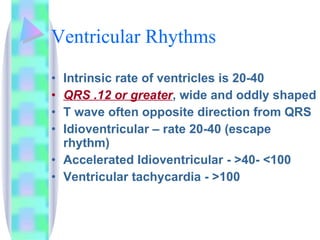
Ventricular Rhythms Intrinsic rate of ventricles is 20-40 QRS .12 or greater , wide and oddly shaped T wave often opposite direction from QRS Idioventricular – rate 20-40 (escape rhythm) Accelerated Idioventricular - >40- <100 Ventricular tachycardia - >100
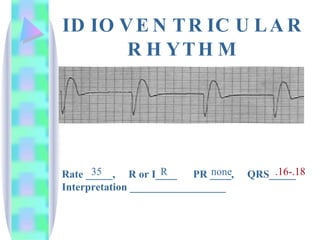
IDIOVENTRICULAR RHYTHM Rate _____,  R or I____  PR ____,  QRS_____ Interpretation __________________ 35 R none .16-.18
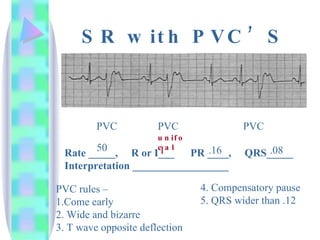
SR with PVC’S Rate _____,  R or I___  PR ____,  QRS_____ Interpretation __________________ 50 I .16 .08 PVC PVC PVC unifocal PVC rules – 1.Come early 2. Wide and bizarre 3. T wave opposite deflection  4. Compensatory pause 5. QRS wider than .12
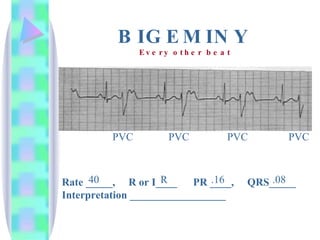
BIGEMINY Rate _____,  R or I____  PR ____,  QRS_____ Interpretation __________________ PVC PVC PVC PVC 40 R .16 .08 Every other beat
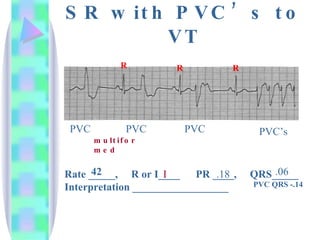
SR with PVC’s to VT Rate _____,  R or I____  PR ____,  QRS_____ Interpretation __________________ 42 .18 I .06 PVC PVC PVC PVC’s multiformed R R R PVC QRS -.14
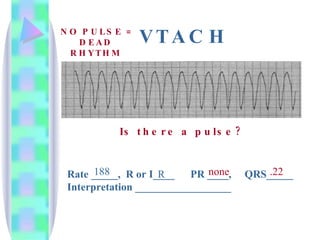
VTACH Rate _____,  R or I____  PR ____,  QRS_____ Interpretation __________________ 188 R none .22 Is there a pulse?   NO PULSE = DEAD RHYTHM
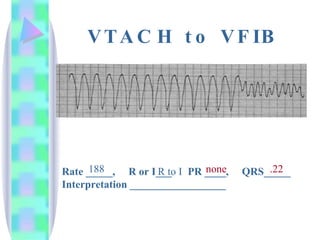
VTACH to VFIB Rate _____,  R or I___  PR ____,  QRS_____ Interpretation __________________ none 188 .22 R to I
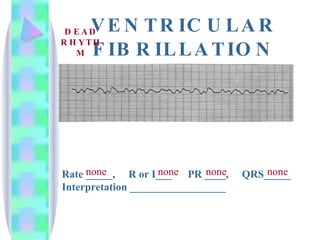
VENTRICULAR FIBRILLATION Rate _____,  R or I___  PR ____,  QRS_____ Interpretation __________________ none none none none DEAD RHYTHM
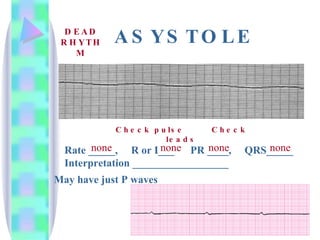
ASYSTOLE Rate _____,  R or I___  PR ____,  QRS_____ Interpretation __________________ none none none none Check pulse Check leads DEAD RHYTHM May have just P waves
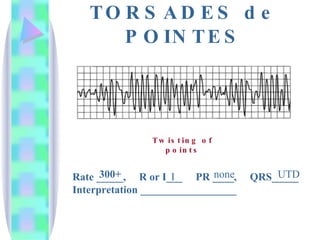
TORSADES de POINTES Rate _____,  R or I___  PR ____,  QRS_____ Interpretation __________________ 300+ I none UTD Twisting of points
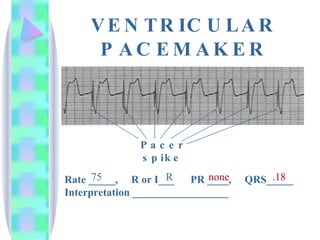
VENTRICULAR PACEMAKER Rate _____,  R or I___  PR ____,  QRS_____ Interpretation __________________ 75 R none .18 Pacer spike
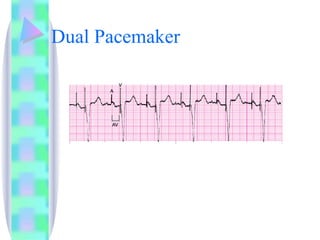
Dual Pacemaker
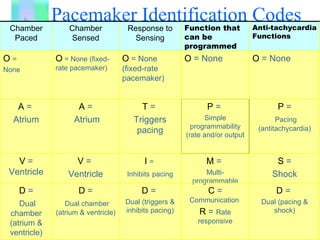
Pacemaker Identification Codes P  = Pacing (antitachycardia) P  =  Simple programmability (rate and/or output T  =  Triggers pacing A  = Atrium A  =  Atrium D  =  Dual (pacing & shock) C  =  Communication  R  =  Rate responsive D  =  Dual (triggers & inhibits pacing) D  = Dual chamber (atrium & ventricle) D  = Dual chamber (atrium & ventricle) S  = Shock M  =  Multi-programmable I  =  Inhibits   pacing V  =  Ventricle V  = Ventricle O  = None O  = None O  = None (fixed-rate pacemaker) O  = None (fixed-rate pacemaker) O  =  None Anti-tachycardia Functions Function that can be programmed Response to Sensing Chamber Sensed Chamber Paced
QUESTIONS

Basic Ekg Reviewr2

  • 1.
    ARHYTHMIA INTERPRETATION REVIEW2007 Susan Eade RN & Vicki Clavir RN
  • 2.
  • 3.
  • 4.
    Electrical vs. Mechanical“ Contraction” Contraction “ Atrial kick”
  • 5.
  • 6.
  • 7.
  • 8.
    Sinus Rhythms Pis usually upright lead II Rhythm regular 1 P wave before each QRS – PRI -.12-.20 QRS’s normal width .04-.10 SR rate 60-100 SB rate < 60 ST rate >100
  • 9.
    SINUS RHYTHM Rate____, R or I____, PR ____, QRS_____ Interpretation __________________ 78 R .16 .08
  • 10.
    SINUS BRADYCARDIA Rate_____, R or I____ PR ____, QRS_____ Interpretation __________________ 52 .16-.18 .08 R
  • 11.
    Sinus Tachycardia Rate____, R or I____, PR ____, QRS_____ Interpretation __________________ QT________ 125 R .16 .06 .34
  • 12.
    Sinus Arrest Rhythm- Irregular—the pause is of undetermined length (more than one PQRST complex is omitted) and is not the same distance as other P-P intervals Sinus Exit Block Rhythm - Irregular due to the pause's caused by the SA block—the pause is the same as (or an exact multiple of) the distance between two other P-P intervals
  • 13.
    Junctional Rhythms AVnode intrinsic heart rate 40-60 P waves may occur before (usually inverted), during or after the QRS PRI less than .12 QRS- normal width Junctional- 40-60 Accelerated Junctional >60 Junctional Tach- >100
  • 14.
    JUNCTIONAL Rate ____, R or I_____ PR ____, QRS_____ Interpretation __________________ 53 R .10 -.12 .08 FYI: P can precede, be imbedded in, or after the QRS
  • 15.
    Junctional Rhythms AcceleratedJunctional Junctional Tach
  • 16.
    Atrial Rhythms Atrial Fibrillation Very Irregular ( Irregularly Irregular) No discernable P waves- fibrillatory waves- wavy baseline (atrial rate >300) No PRI Normal QRS Atrial Flutter Hallmark “Sine Waves&quot; or  pattern May or may not be regular No PRI Atrial rate >200
  • 17.
    ATRIAL FIBRILLATION Rate_____, R or I____ PR ____, QRS_____ Interpretation __________________ QT______ 75-136 I none .04 Unable to determine
  • 18.
    ATRIAL FLUTTER Rate_____, R or I____ PR ____, QRS_____ Interpretation __________________ 100 R none .06 Saw tooth flutter waves Atrial rate: 300
  • 19.
    No relationship betweenP waves and QRS’s. Ratio of QRS to P waves usually will vary One extra P at the end of each grouping. No extra P’s P-P interval is regular ( P waves will march out). P-P interval is regular ( P waves will march out). P-P interval is regular ( P waves will march out). P-P interval is regular (P waves will march out). R-R intervals will be regular . Ventricular rate much slower than atrial rate. QRS usually wide R-R interval will be regular or irregular. QRS usually wide R-R intervals irregular ( clustering or grouping of QRS’s) R-R interval is regular PR intervals will vary and do not have a set pattern. PR intervals are constant PR intervals are not constant & they gradually lengthen until QRS is dropped PR interval is constant. More P waves than QRS’s some are hidden More P waves than QRS’s More P waves than QRS’s. Just like sinus rhythm only PR interval is > .20 seconds 3 rd ° HB 2 nd ° HB T 2 2 nd ° HB T 1 1 st ° HB
  • 20.
    1 st DEGREE AV BLOCK Rate _____, R or I___ PR ____, QRS_____ Interpretation __________________ 62 R . 32 .08 Prolonged PR
  • 21.
    2nd DEGREE TYPEI Rate _____, R or I____ PR ______, QRS_____ Interpretation __________________ 45-68 I Lengthening .20-.28 - .32 .08 group beating group beating R to R interval same Atrial rate: 80
  • 22.
    2nd DEGREE TYPEII Rate ____, R or I____ PR ____, QRS_____ Interpretation __________________ I (Fixed) .16 . 08-.10 Dropped QRS Atrial rate: 80 28-78
  • 23.
    3 rd DEGREE AV BLOCK Rate _____, R or I____ PR ____, QRS_____ Interpretation __________________ 50 R Changes each beat, Varies .16 Atrial rate: 78 Atria and ventricles beat Independently of each other P P P P P P P
  • 24.
    Ventricular Rhythms Intrinsicrate of ventricles is 20-40 QRS .12 or greater , wide and oddly shaped T wave often opposite direction from QRS Idioventricular – rate 20-40 (escape rhythm) Accelerated Idioventricular - >40- <100 Ventricular tachycardia - >100
  • 25.
    IDIOVENTRICULAR RHYTHM Rate_____, R or I____ PR ____, QRS_____ Interpretation __________________ 35 R none .16-.18
  • 26.
    SR with PVC’SRate _____, R or I___ PR ____, QRS_____ Interpretation __________________ 50 I .16 .08 PVC PVC PVC unifocal PVC rules – 1.Come early 2. Wide and bizarre 3. T wave opposite deflection 4. Compensatory pause 5. QRS wider than .12
  • 27.
    BIGEMINY Rate _____, R or I____ PR ____, QRS_____ Interpretation __________________ PVC PVC PVC PVC 40 R .16 .08 Every other beat
  • 28.
    SR with PVC’sto VT Rate _____, R or I____ PR ____, QRS_____ Interpretation __________________ 42 .18 I .06 PVC PVC PVC PVC’s multiformed R R R PVC QRS -.14
  • 29.
    VTACH Rate _____, R or I____ PR ____, QRS_____ Interpretation __________________ 188 R none .22 Is there a pulse? NO PULSE = DEAD RHYTHM
  • 30.
    VTACH to VFIBRate _____, R or I___ PR ____, QRS_____ Interpretation __________________ none 188 .22 R to I
  • 31.
    VENTRICULAR FIBRILLATION Rate_____, R or I___ PR ____, QRS_____ Interpretation __________________ none none none none DEAD RHYTHM
  • 32.
    ASYSTOLE Rate _____, R or I___ PR ____, QRS_____ Interpretation __________________ none none none none Check pulse Check leads DEAD RHYTHM May have just P waves
  • 33.
    TORSADES de POINTESRate _____, R or I___ PR ____, QRS_____ Interpretation __________________ 300+ I none UTD Twisting of points
  • 34.
    VENTRICULAR PACEMAKER Rate_____, R or I___ PR ____, QRS_____ Interpretation __________________ 75 R none .18 Pacer spike
  • 35.
  • 36.
    Pacemaker Identification CodesP = Pacing (antitachycardia) P = Simple programmability (rate and/or output T = Triggers pacing A = Atrium A = Atrium D = Dual (pacing & shock) C = Communication R = Rate responsive D = Dual (triggers & inhibits pacing) D = Dual chamber (atrium & ventricle) D = Dual chamber (atrium & ventricle) S = Shock M = Multi-programmable I = Inhibits pacing V = Ventricle V = Ventricle O = None O = None O = None (fixed-rate pacemaker) O = None (fixed-rate pacemaker) O = None Anti-tachycardia Functions Function that can be programmed Response to Sensing Chamber Sensed Chamber Paced
  • 37.

Editor's Notes

  • #37 The first three letters are used for antibradycardia functions. The first letter of the code identifies the heart chamber (or chambers) paced (stimulated). The options available include: A - atrium, V – ventricle, D – dual (both atrium and ventricle), O – none. A pacemaker used to pace only a single chamber is represented by either the letter A (atrial) or V (ventricular). A pacemaker capable of pacing in both chambers is represented by the letter D (dual). The second letter identifies the chamber of the heart where patient-initiated (intrinsic) electrical activity is sensed by the pacemaker. The letter designations for the second letter are the same as the designations for the first. The third letter indicates how the pacemaker will respond when it senses patient-initiated electrical activity. T - a pacemaker stimulus is triggered in response to a sensed event. I - sensing of intrinsic impulses inhibits the pacemaker from producing a stimulus. D – dual (a combination of triggered pacing and inhibition). O – no sensing. The fourth letter is most often used in permanent pacing and identifies the availability of rate responsiveness and the number of reprogrammable functions available. O – the pacemaker is not programmable or rate responsive. This is most commonly found on devices manufactured before mid-1970. The letter P indicates simple programmability where the pacemaker is limited to one or two programmable parameters (e.g., such as rate or output). M designates multiprogrammability, i.e., more than two variables can be altered. The letter C indicates the device’s capability of transmitting and/or receiving data for informational or programming purposes. Rate responsiveness, designated by the letter R, denotes the pacemaker’s ability to automatically adjust its rate to meet the body’s needs due to increased physical activity. The fifth letter indicates the presence of one or more active antitachycardia functions and indicates how the pacemaker will respond to tachydysrhythmias. O – the device has no antitachycardia functions. P – the device is capable of antitachycardia pacing. S – the device is capable of delivering synchronized and unsynchronized countershocks. D – the device is capable of antitachycardia pacing, synchronized, and unsynchronized countershocks.