Simulation Theory


      ABU BASHAR
EVERYTHING IS
  DIFFICULT
IF YOU CRY,
EVERYTHING IS
    EASY
 IF YOU TRY.
What is Simulation?
 Simulation means imitation of reality.
 The purpose of simulation in the business world
  is to understand the behavior of a system.
 Before making many important decisions, we
  simulate the result to insure that we are doing the
  right thing.
When to use Simulation??
 First, when experimentation is not possible. Note that
  if we can do a real experiment, the results would
  obviously be better than simulation.
• Second condition for using simulation is when the
  analytical solution procedure is not known. If analytical
  formulas are known then we can find the actual
  expected value of the results quickly by using the
  formulas. In simulation we can hope to get the same
  results after simulating thousands of times.
 Simulation is basically a data generation technique.
 Sometimes it is time consuming to conduct real
  study to know about a situation or problem.
 An example is the simulation of the flow of
  customers into and out of a bank, to help determine
  service requirements. The use of simulation frees the
  programmer and user from having to observe a bank
  and keep track of exactly when each customer
  arrives and leaves.
 Thus,     simulation    is    used    when     actual
  experimentation is not feasible.
Example
 We read and hear about Air force pilots being trained
  under simulated conditions.
 Since it would be impossible to train a person when
  an actual war is going on, all the conditions that
  would prevail during a war are reconstructed and
  enacted so that the trainee could develop the skills
  and instincts that would be required of him during
  combat conditions.
 Thus, war conditions are simulated to impart training.
Example Cont’d
 All automobile manufacturing companies have a test-
    track on which the vehicles would be initially driven.
   The test-track would ideally have all the bends, slopes,
    potholes etc., that can be found on the roadways on
    which the vehicles would be subsequently driven.
   The test-track is therefore, a simulated version of the
    actual conditions of the various roadways.
    Simulation, in general, means the creation of
    conditions that prevail in reality, in order to draw certain
    conclusions from the trials that are conducted in the
    artificial conditions.
   A vehicle manufacturer, by driving the vehicle on the
    test-track, is conducting a trial in artificial conditions in
    order to draw conclusions regarding the road-
Types of simulation
 Deterministic and probabilistic Simulation
The deterministic simulation is used when process is very
  complex or consists multiple stages with complicated (but
  known) procedural interactions between them.
In probabilistic simulation, one or more of the independent
  variables is probabilistic i.e. it follows a certain probability
  distribution.
 Time dependent and Time independent simulation
In time independent simulation it is not important to known
  exactly when the event is likely to occur. E.g. we know
  demand of 3 units per day but don’t know when during the
  day the item was demanded.
In time dependent it is important to know the precise time
  when the event is likely to occur. In a queeing situation the
  precise time of arrival of customer must be known (to know
Types of simulation Cont’d….
 Visual Interactive Simulation
It uses computer graphic displays to present the
   consequences of change in the value of input
   variation in the model. The decisions are implemented
   interactively while the simulation is running. The
   decision maker keep track of development of model
   on a graphic interface and can alter the simulation as
   it progress.
 Business Games
It involves several participants who need to play a role
   in a game that simulates a realistic competitive
   situation. Individual or teams compete to achieve their
   goals in competition with the other individual or team.
 Corporate and Financial Simulation
It is used in corporate planning, especially the financial
   aspects. The model integrate production, finance,
   marketing, and possibly other functions, into one
Application of Simulation
Technique
 Simulation is widely used for the following


 Simulation of Inventory Problem


 Simulation of Queuing Problem


 Simulation of investment problem


 Simulation of Maintenance Problem


 Simulation of PERT Problem
Advantages of Simulation
 Solves problems that are difficult or impossible to
  solve mathematically
 Allows experimentation without risk to actual
  system
 Compresses time to
  show long-term effects
 Serves as training tool
  for decision makers
Limitations of Simulation

 Does not produce optimum solution

 Model development may be difficult

 Computer run time may be substantial

 Monte Carlo simulation only applicable to
 random systems
Monte Carlo Method of
 Simulation
 The principle behind this method of simulation is
  representative of the given system under analysis
  by a system described by some known probability
  distribution and then drawing random samples for
  probability distribution by means of random number.
 In case it is not possible to describe a system in
  terms of standard probability distribution such as
  normal, Poisson, exponential, etc., an empirical
  probability distribution can be constructed.
 It can be usefully applied in cases where the system
  to be simulated has a large number of elements that
  exhibit chance (probability) in their behaviour.
 Simulation is normally undertaken only with the help
  of a very high-speed data processing machine such
  as computer.
 The user of simulation technique must always bear
  in mind that the actual frequency or probability would
  approximate the theoretical value of probability only
  when the number of trials are very large i.e. when
  the simulation is repeated a large no. of times.
 This can easily be achieved with the help of a
  computer by generating random numbers.
steps involved in Monte-Carlo simulation
  Step I.
  Obtain      the frequency or probability of all the
     important variables from the historical sources.
    Step II.
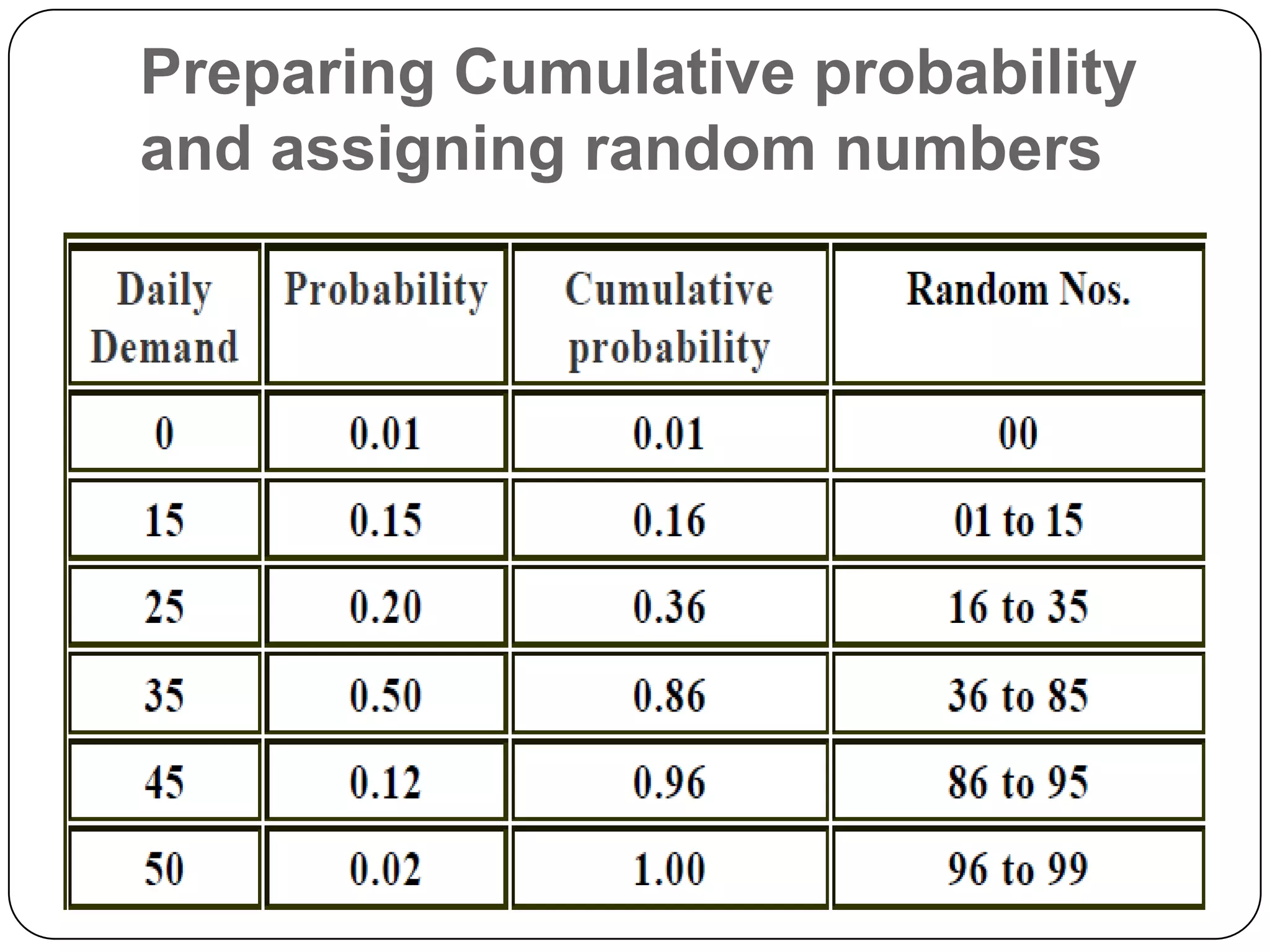
    Convert the respective probabilities of the various
     variables into cumulative probabilities.
    Step III.
    Generate random numbers for each such variable.
    Step IV.
    Based on the cumulative probability distribution table
     obtained in Step II, obtain the interval (i.e.; the
     range) of the assigned random numbers.
    Step V.
    Simulate a series of experiments or trails.
Example
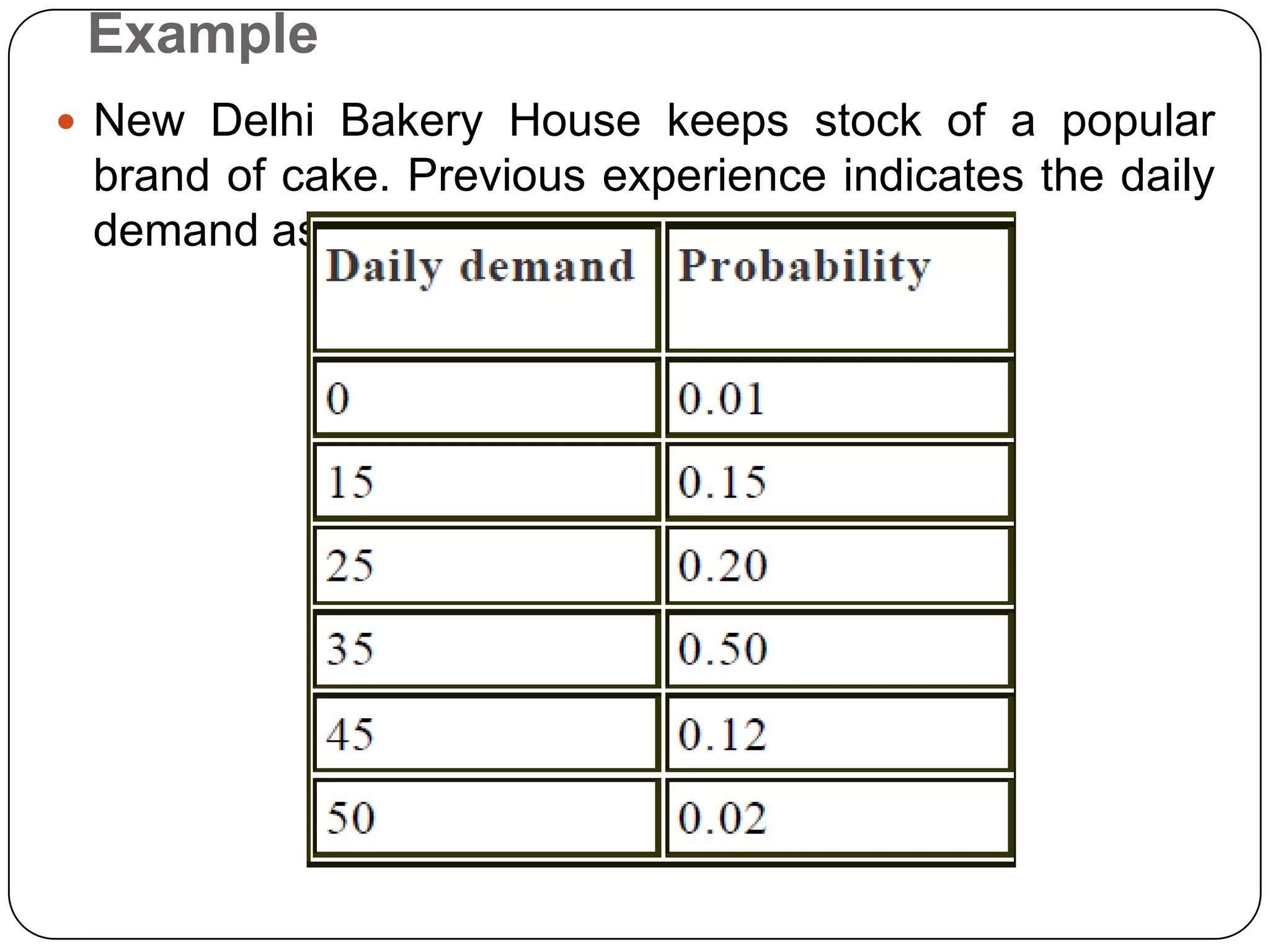
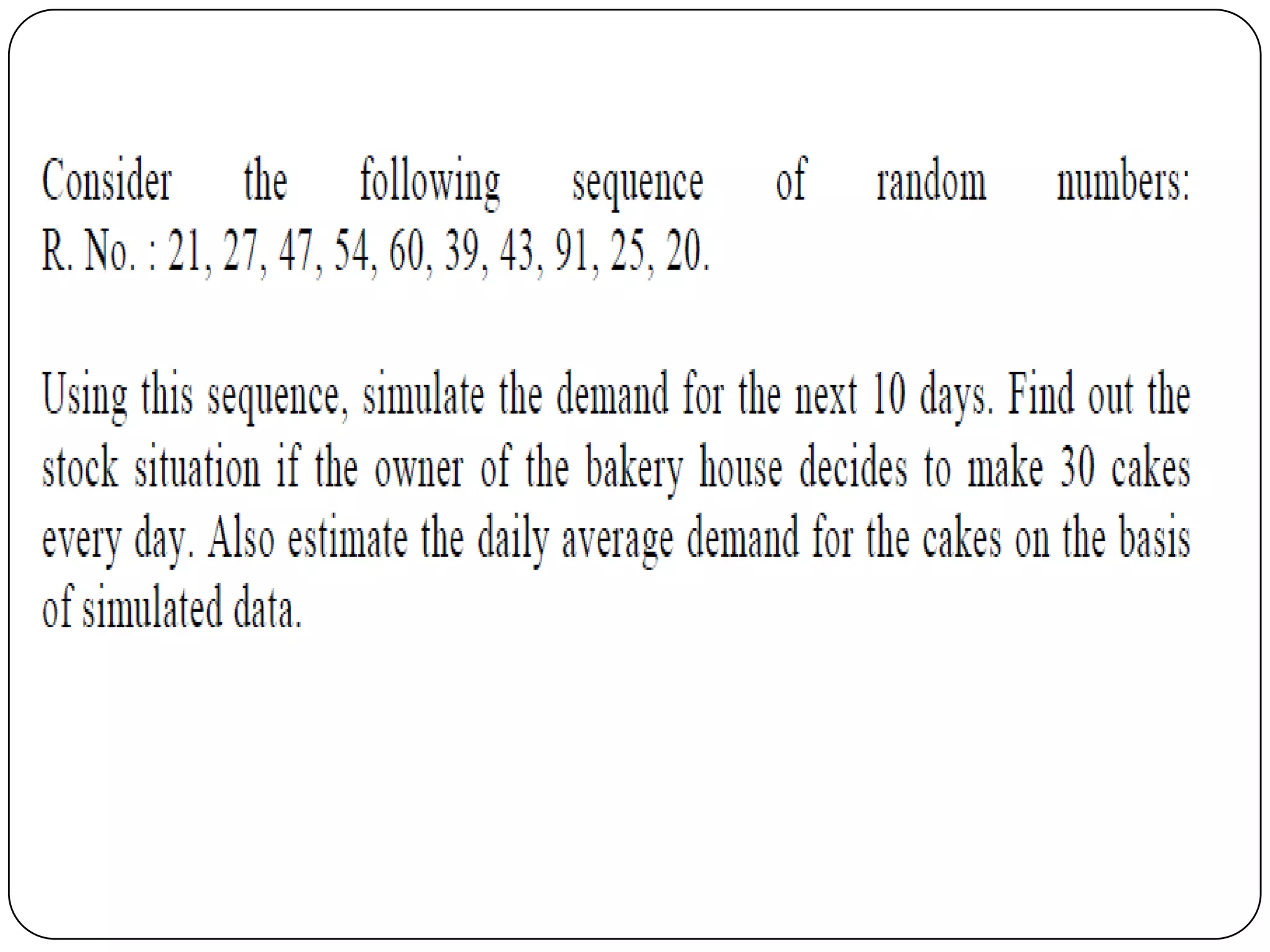
 New Delhi Bakery House keeps stock of a popular
 brand of cake. Previous experience indicates the daily
 demand as given below
Preparing Cumulative probability
and assigning random numbers
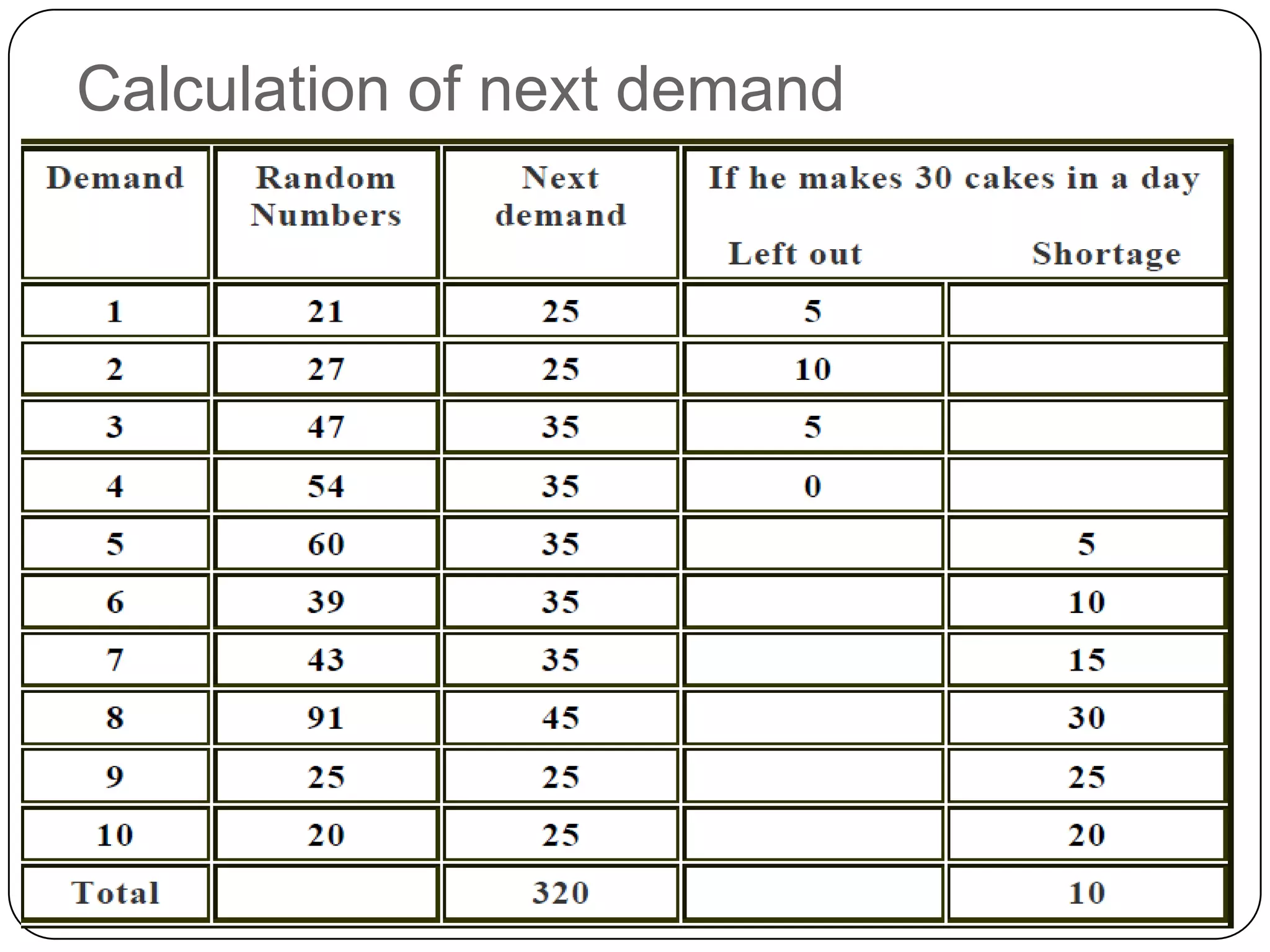
Calculation of next demand
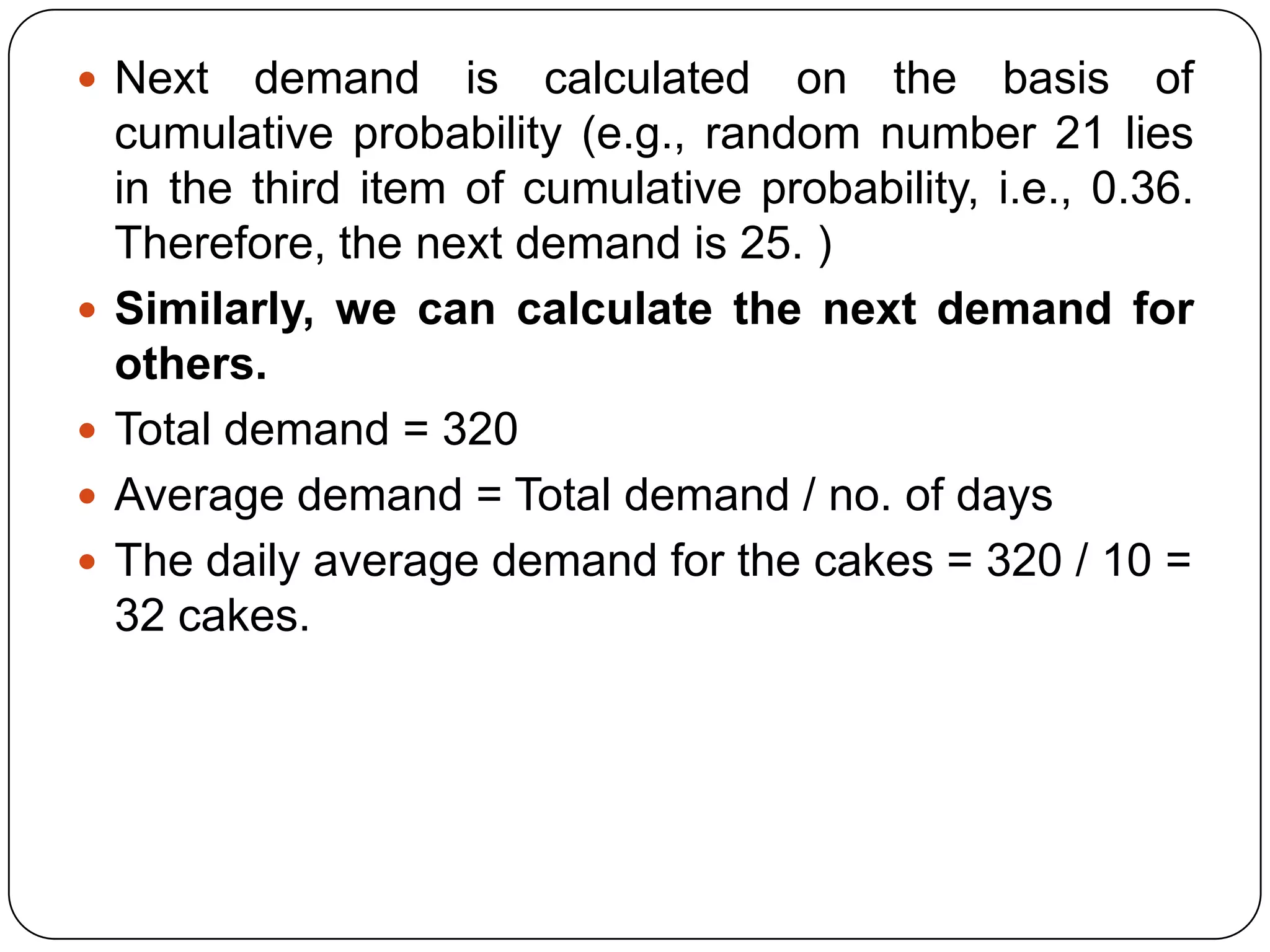
 Next     demand is calculated on the basis of
    cumulative probability (e.g., random number 21 lies
    in the third item of cumulative probability, i.e., 0.36.
    Therefore, the next demand is 25. )
   Similarly, we can calculate the next demand for
    others.
   Total demand = 320
   Average demand = Total demand / no. of days
   The daily average demand for the cakes = 320 / 10 =
    32 cakes.
THANK YOU
VERY MUCH

Simulation theory

  • 1.
  • 2.
    EVERYTHING IS DIFFICULT IF YOU CRY, EVERYTHING IS EASY IF YOU TRY.
  • 3.
    What is Simulation? Simulation means imitation of reality.  The purpose of simulation in the business world is to understand the behavior of a system.  Before making many important decisions, we simulate the result to insure that we are doing the right thing.
  • 4.
    When to useSimulation??  First, when experimentation is not possible. Note that if we can do a real experiment, the results would obviously be better than simulation. • Second condition for using simulation is when the analytical solution procedure is not known. If analytical formulas are known then we can find the actual expected value of the results quickly by using the formulas. In simulation we can hope to get the same results after simulating thousands of times.
  • 5.
     Simulation isbasically a data generation technique.  Sometimes it is time consuming to conduct real study to know about a situation or problem.  An example is the simulation of the flow of customers into and out of a bank, to help determine service requirements. The use of simulation frees the programmer and user from having to observe a bank and keep track of exactly when each customer arrives and leaves.  Thus, simulation is used when actual experimentation is not feasible.
  • 6.
    Example  We readand hear about Air force pilots being trained under simulated conditions.  Since it would be impossible to train a person when an actual war is going on, all the conditions that would prevail during a war are reconstructed and enacted so that the trainee could develop the skills and instincts that would be required of him during combat conditions.  Thus, war conditions are simulated to impart training.
  • 7.
    Example Cont’d  Allautomobile manufacturing companies have a test- track on which the vehicles would be initially driven.  The test-track would ideally have all the bends, slopes, potholes etc., that can be found on the roadways on which the vehicles would be subsequently driven.  The test-track is therefore, a simulated version of the actual conditions of the various roadways.  Simulation, in general, means the creation of conditions that prevail in reality, in order to draw certain conclusions from the trials that are conducted in the artificial conditions.  A vehicle manufacturer, by driving the vehicle on the test-track, is conducting a trial in artificial conditions in order to draw conclusions regarding the road-
  • 9.
    Types of simulation Deterministic and probabilistic Simulation The deterministic simulation is used when process is very complex or consists multiple stages with complicated (but known) procedural interactions between them. In probabilistic simulation, one or more of the independent variables is probabilistic i.e. it follows a certain probability distribution.  Time dependent and Time independent simulation In time independent simulation it is not important to known exactly when the event is likely to occur. E.g. we know demand of 3 units per day but don’t know when during the day the item was demanded. In time dependent it is important to know the precise time when the event is likely to occur. In a queeing situation the precise time of arrival of customer must be known (to know
  • 10.
    Types of simulationCont’d….  Visual Interactive Simulation It uses computer graphic displays to present the consequences of change in the value of input variation in the model. The decisions are implemented interactively while the simulation is running. The decision maker keep track of development of model on a graphic interface and can alter the simulation as it progress.  Business Games It involves several participants who need to play a role in a game that simulates a realistic competitive situation. Individual or teams compete to achieve their goals in competition with the other individual or team.  Corporate and Financial Simulation It is used in corporate planning, especially the financial aspects. The model integrate production, finance, marketing, and possibly other functions, into one
  • 11.
    Application of Simulation Technique Simulation is widely used for the following  Simulation of Inventory Problem  Simulation of Queuing Problem  Simulation of investment problem  Simulation of Maintenance Problem  Simulation of PERT Problem
  • 12.
    Advantages of Simulation Solves problems that are difficult or impossible to solve mathematically  Allows experimentation without risk to actual system  Compresses time to show long-term effects  Serves as training tool for decision makers
  • 13.
    Limitations of Simulation Does not produce optimum solution  Model development may be difficult  Computer run time may be substantial  Monte Carlo simulation only applicable to random systems
  • 14.
    Monte Carlo Methodof Simulation  The principle behind this method of simulation is representative of the given system under analysis by a system described by some known probability distribution and then drawing random samples for probability distribution by means of random number.  In case it is not possible to describe a system in terms of standard probability distribution such as normal, Poisson, exponential, etc., an empirical probability distribution can be constructed.
  • 15.
     It canbe usefully applied in cases where the system to be simulated has a large number of elements that exhibit chance (probability) in their behaviour.  Simulation is normally undertaken only with the help of a very high-speed data processing machine such as computer.  The user of simulation technique must always bear in mind that the actual frequency or probability would approximate the theoretical value of probability only when the number of trials are very large i.e. when the simulation is repeated a large no. of times.  This can easily be achieved with the help of a computer by generating random numbers.
  • 16.
    steps involved inMonte-Carlo simulation  Step I.  Obtain the frequency or probability of all the important variables from the historical sources.  Step II.  Convert the respective probabilities of the various variables into cumulative probabilities.  Step III.  Generate random numbers for each such variable.  Step IV.  Based on the cumulative probability distribution table obtained in Step II, obtain the interval (i.e.; the range) of the assigned random numbers.  Step V.  Simulate a series of experiments or trails.
  • 17.
    Example  New DelhiBakery House keeps stock of a popular brand of cake. Previous experience indicates the daily demand as given below
  • 19.
    Preparing Cumulative probability andassigning random numbers
  • 20.
  • 21.
     Next demand is calculated on the basis of cumulative probability (e.g., random number 21 lies in the third item of cumulative probability, i.e., 0.36. Therefore, the next demand is 25. )  Similarly, we can calculate the next demand for others.  Total demand = 320  Average demand = Total demand / no. of days  The daily average demand for the cakes = 320 / 10 = 32 cakes.
  • 22.