Abu Bashar
    For every LP formulation there exists another
    unique linear programming formulation
    called the 'Dual' (the original formulation is
    called the 'Primal').
   The - Dual formulation can be derived from
    the same data from which the primal was
    formulated.
   The Dual formulated can be solved in the
    same manner in which the Primal is solved
    since the Dual is also a LP formulation.
    The Dual can be considered as the 'inverse' of
    the Primal in every respect.
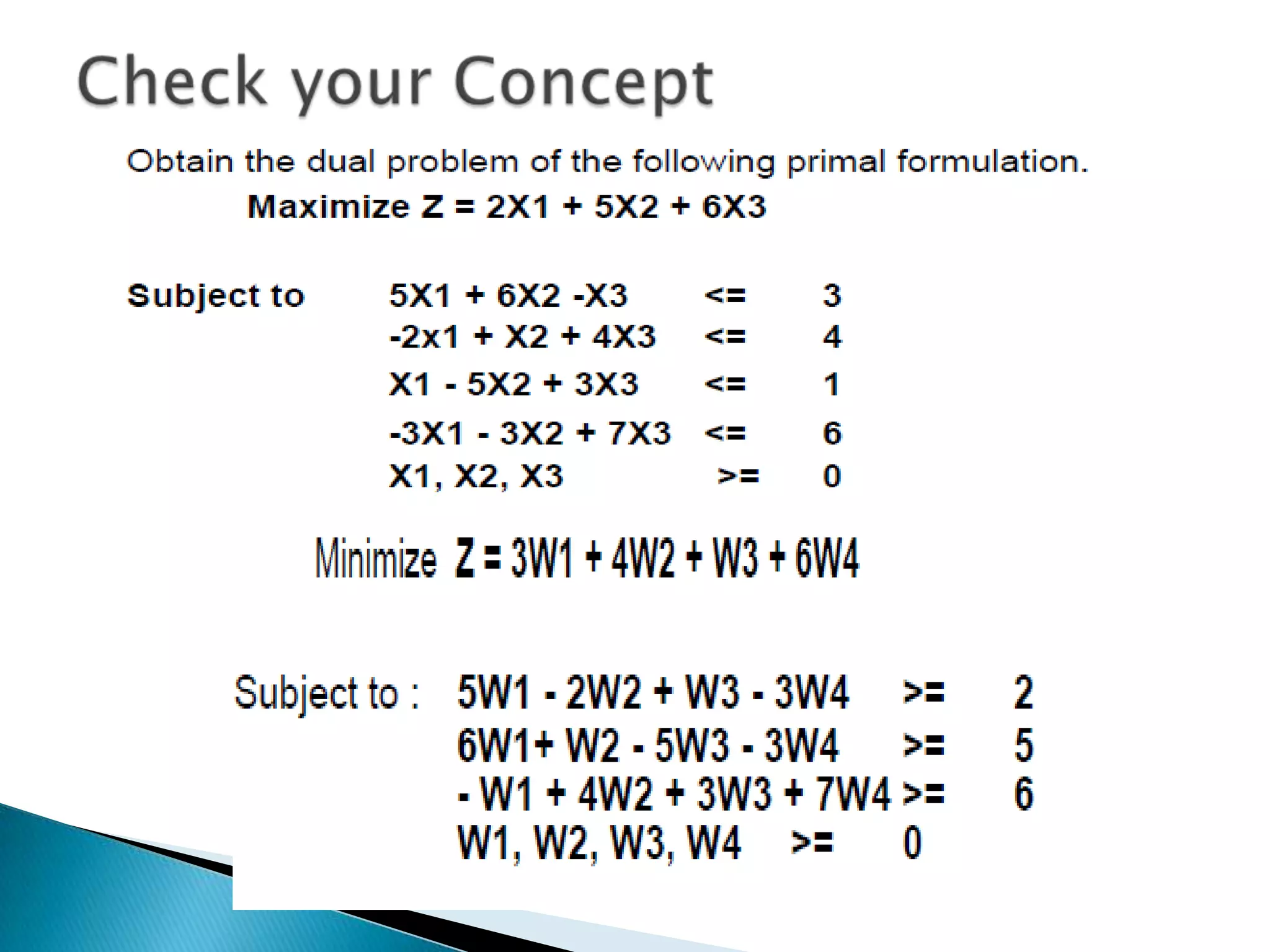
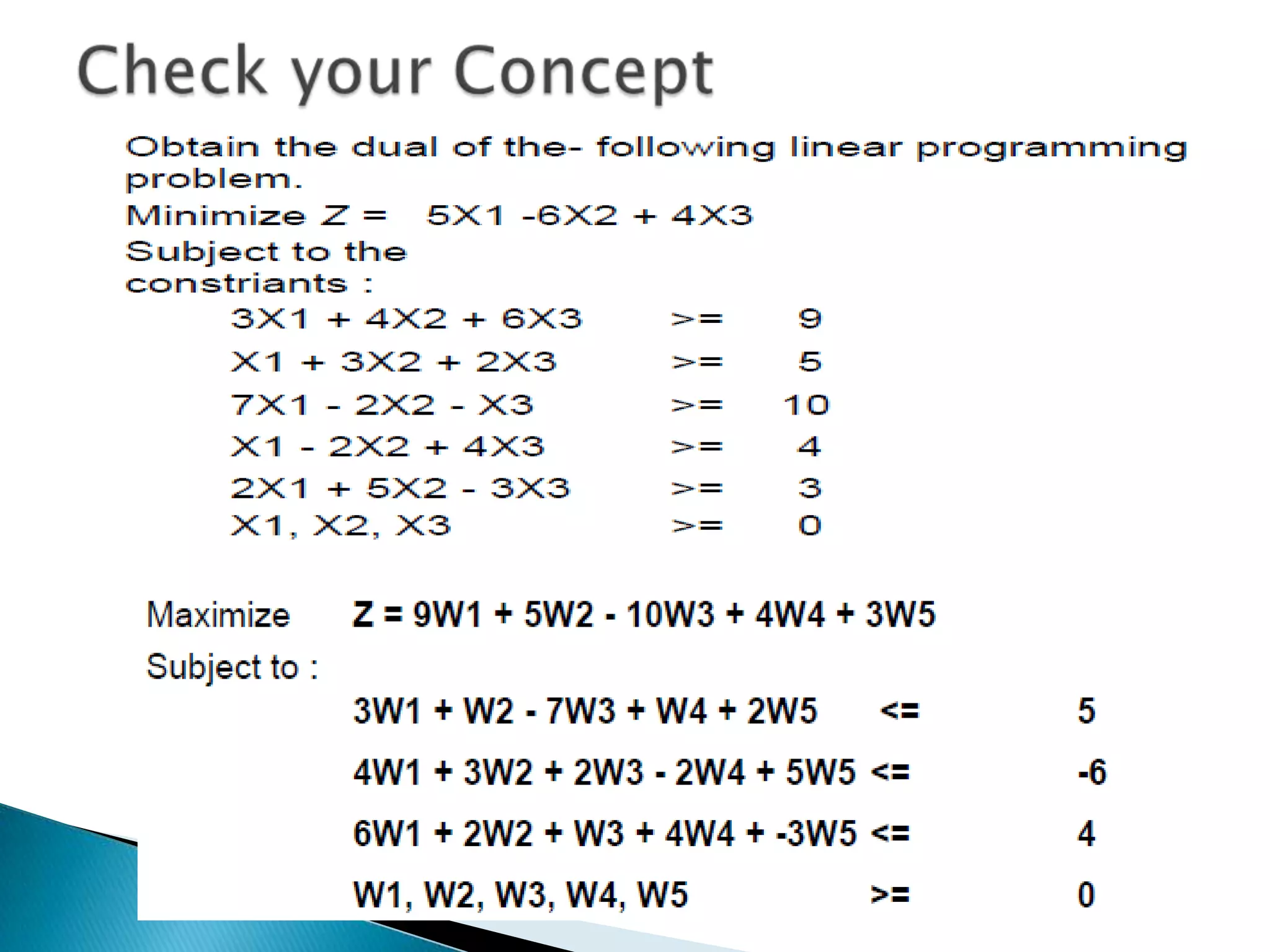
    The column coefficients in the Primal constrains
    become the row coefficients in the Dual
    constraints.
   The coefficients in the Primal objective function
    become the right hand side constraints in the
    Dual constraints.
   The column of constants on the right hand side
    of the Primal constraints becomes the row of
    coefficients of the dual objective function.
   The 'direction of the inequalities are reversed. If
    the primal objective function is a 'Maximization'
    function then the dual objective function is a
    'Minimization' function and vice-versa.
   For each constraint in primal problem there is an
    associated variable in dual problem.
   The elements of right hand side of the constraints
    will be taken as the co-efficient of the objective
    function in the dual problem.
   If the primal problem is maximization, then its dual
    problem will be minimization and vice versa.
   The     inequalities   of   constraints should   be
    interchanged from >= to <= and vice versa and the
    variables in both the problems and non-negative.
   The row of primal problem are changed to columns
    in the dual problem. In other words the matrix A of
    the primal problem will be changed ti its transpose
    (A) for the dual problem.
   The co-efficient of the objective function will be
    taken the right hand side of the constraints of the
    dual problem.
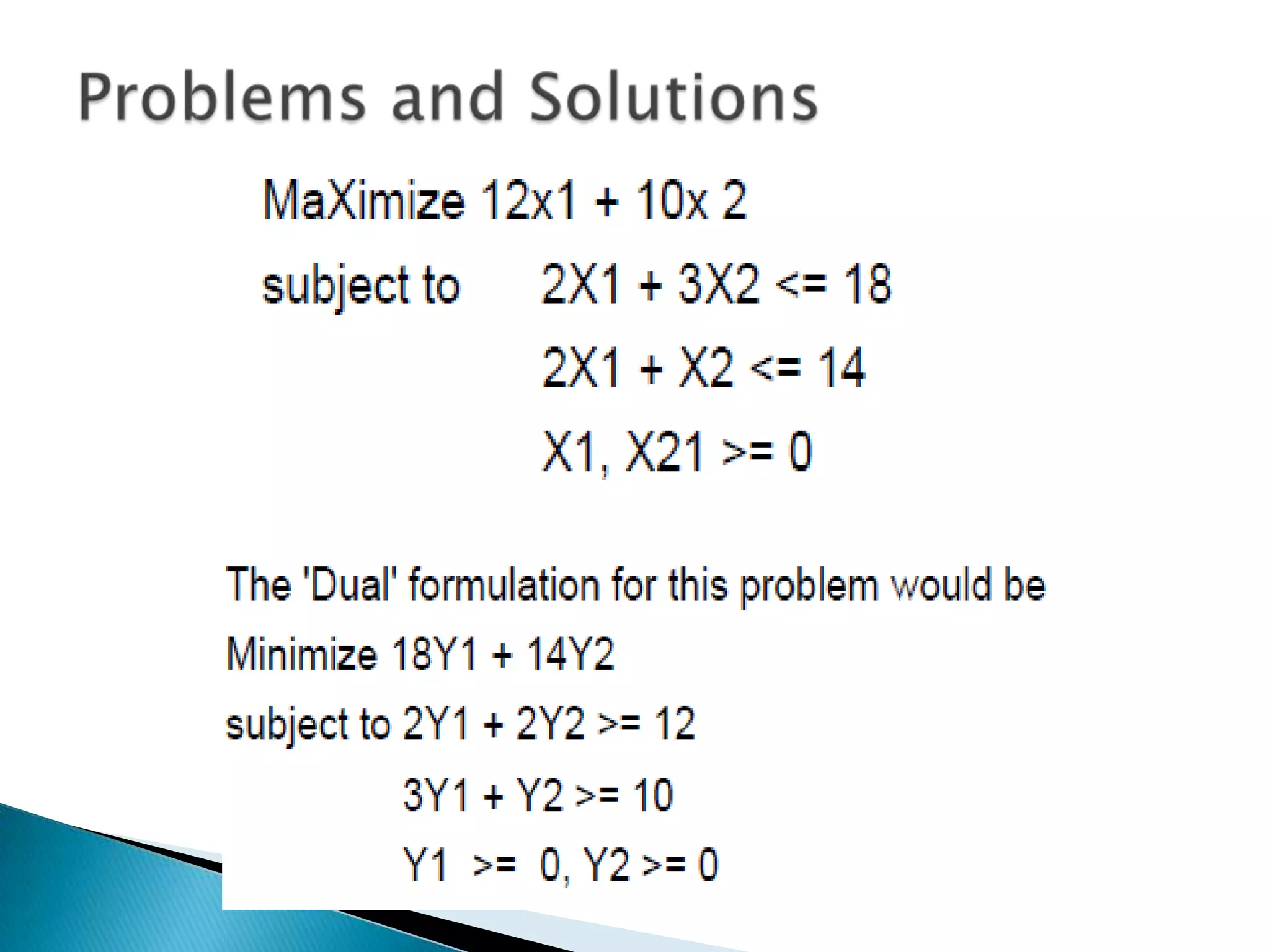
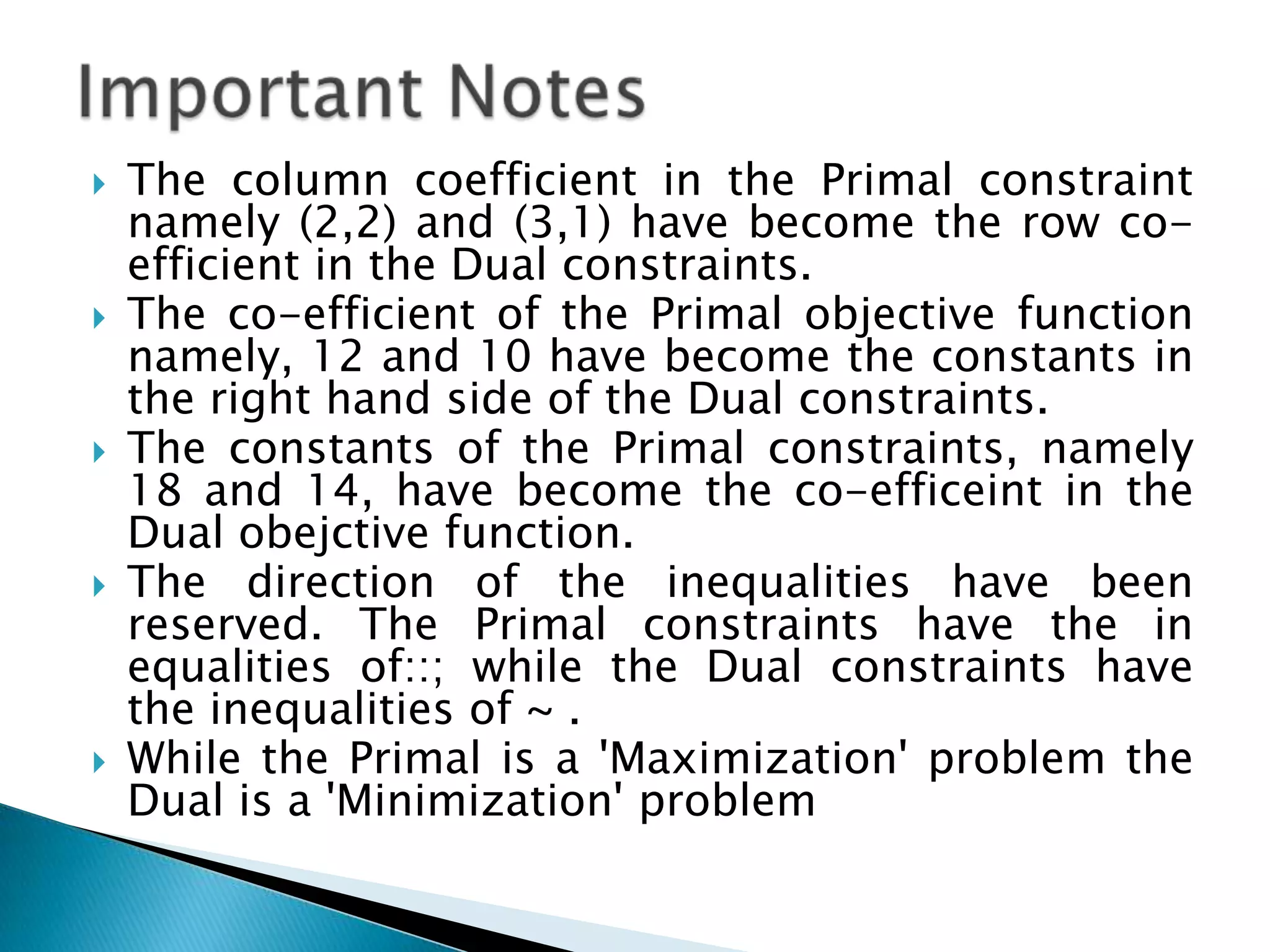
   The column coefficient in the Primal constraint
    namely (2,2) and (3,1) have become the row co-
    efficient in the Dual constraints.
   The co-efficient of the Primal objective function
    namely, 12 and 10 have become the constants in
    the right hand side of the Dual constraints.
   The constants of the Primal constraints, namely
    18 and 14, have become the co-efficeint in the
    Dual obejctive function.
   The direction of the inequalities have been
    reserved. The Primal constraints have the in
    equalities of::; while the Dual constraints have
    the inequalities of ~ .
   While the Primal is a 'Maximization' problem the
    Dual is a 'Minimization' problem
Duality in lpp
Duality in lpp
Duality in lpp

Duality in lpp

  • 1.
  • 2.
    For every LP formulation there exists another unique linear programming formulation called the 'Dual' (the original formulation is called the 'Primal').  The - Dual formulation can be derived from the same data from which the primal was formulated.  The Dual formulated can be solved in the same manner in which the Primal is solved since the Dual is also a LP formulation.
  • 3.
    The Dual can be considered as the 'inverse' of the Primal in every respect.  The column coefficients in the Primal constrains become the row coefficients in the Dual constraints.  The coefficients in the Primal objective function become the right hand side constraints in the Dual constraints.  The column of constants on the right hand side of the Primal constraints becomes the row of coefficients of the dual objective function.  The 'direction of the inequalities are reversed. If the primal objective function is a 'Maximization' function then the dual objective function is a 'Minimization' function and vice-versa.
  • 4.
    For each constraint in primal problem there is an associated variable in dual problem.  The elements of right hand side of the constraints will be taken as the co-efficient of the objective function in the dual problem.  If the primal problem is maximization, then its dual problem will be minimization and vice versa.  The inequalities of constraints should be interchanged from >= to <= and vice versa and the variables in both the problems and non-negative.  The row of primal problem are changed to columns in the dual problem. In other words the matrix A of the primal problem will be changed ti its transpose (A) for the dual problem.  The co-efficient of the objective function will be taken the right hand side of the constraints of the dual problem.
  • 6.
    The column coefficient in the Primal constraint namely (2,2) and (3,1) have become the row co- efficient in the Dual constraints.  The co-efficient of the Primal objective function namely, 12 and 10 have become the constants in the right hand side of the Dual constraints.  The constants of the Primal constraints, namely 18 and 14, have become the co-efficeint in the Dual obejctive function.  The direction of the inequalities have been reserved. The Primal constraints have the in equalities of::; while the Dual constraints have the inequalities of ~ .  While the Primal is a 'Maximization' problem the Dual is a 'Minimization' problem