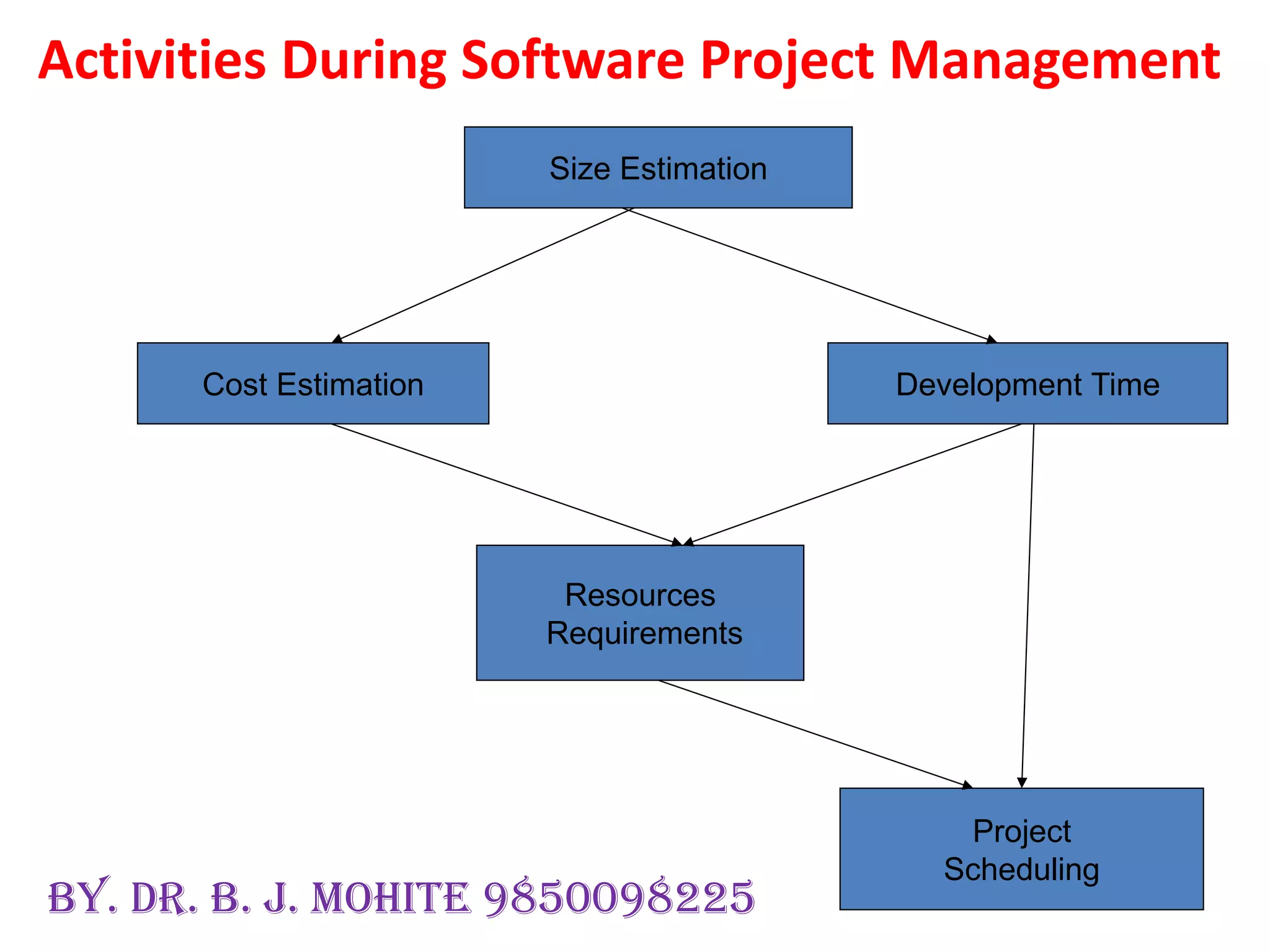
Activities During Software Project Management
Size Estimation
Cost Estimation Development Time
Resources
Requirements
Project
Scheduling
By. Dr. B. J. Mohite 9850098225
Process For Successful Projects
• Scope of work to be done
• The risk to be incurred
• The resources required
• The task to be achieved
• The cost to be expended
• The schedule to be followed.
Size Estimation
• IT is beginning step of estimation.
• Critical and difficult area of project planning.
• Difficult to establish units of size measuring.
• It is divided into two types like
1. LOC (Lines of Code)
2. Function Count
Lines Of Code
A line of code is any line of program text that
is not a comment or blank line, regardless of
the number of statements or fragments of
statements on the line. This specifically
includes all lines containing program header,
declarations, and executable and non-
executable statements.
Function Count
• Developed by Alan Albrecht in 1970 in IBM.
• Develop this technique is called as Function
Point Analysis.
• Used for problem size measurements.
• Function point measures functionality from
users point of view , that is , on the basis of
what the user requests and receives in return
from the system.
FUNCTION POINT ANALYSIS
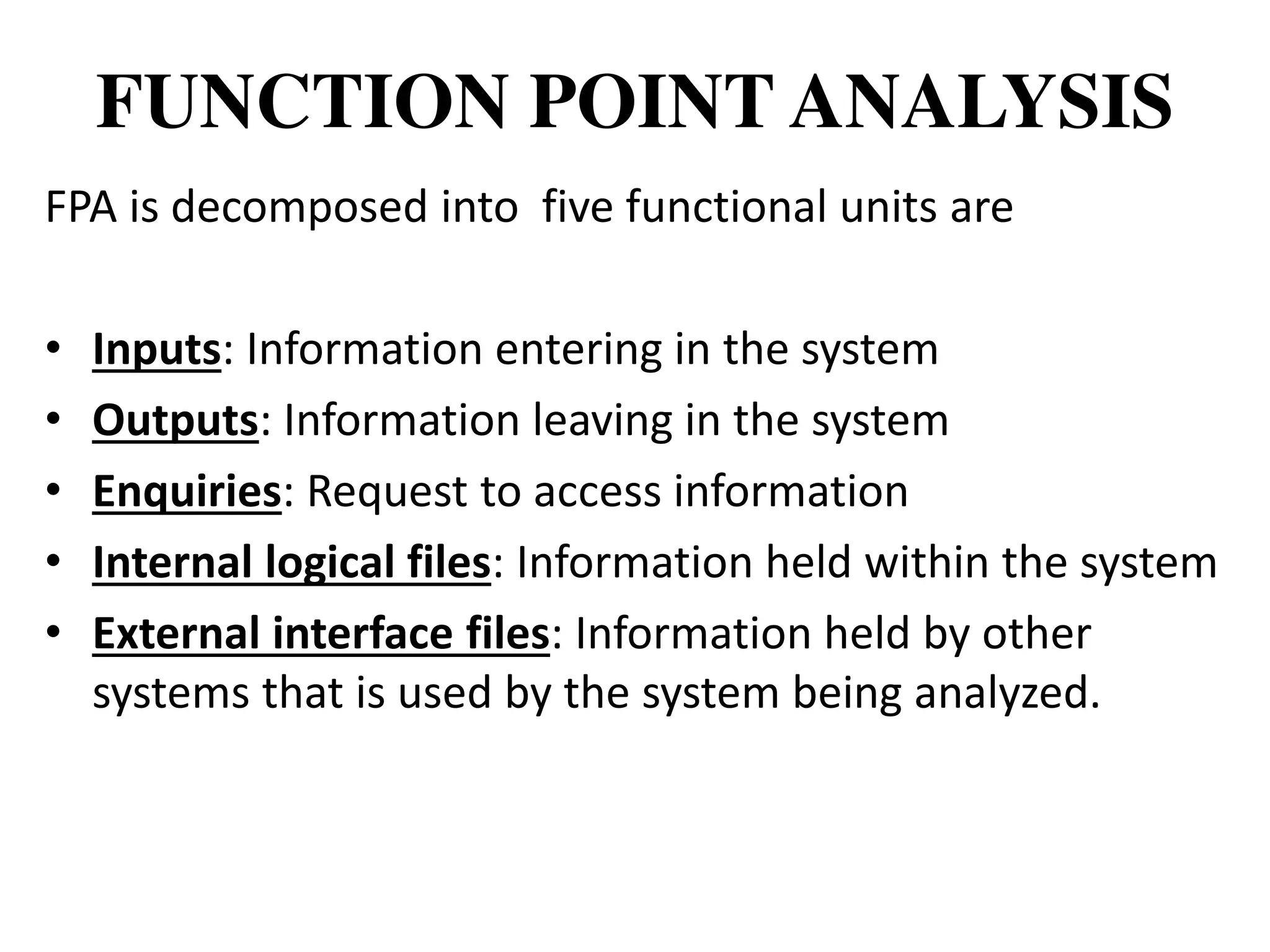
FPA is decomposed into five functional units are
• Inputs: Information entering in the system
• Outputs: Information leaving in the system
• Enquiries: Request to access information
• Internal logical files: Information held within the system
• External interface files: Information held by other
systems that is used by the system being analyzed.
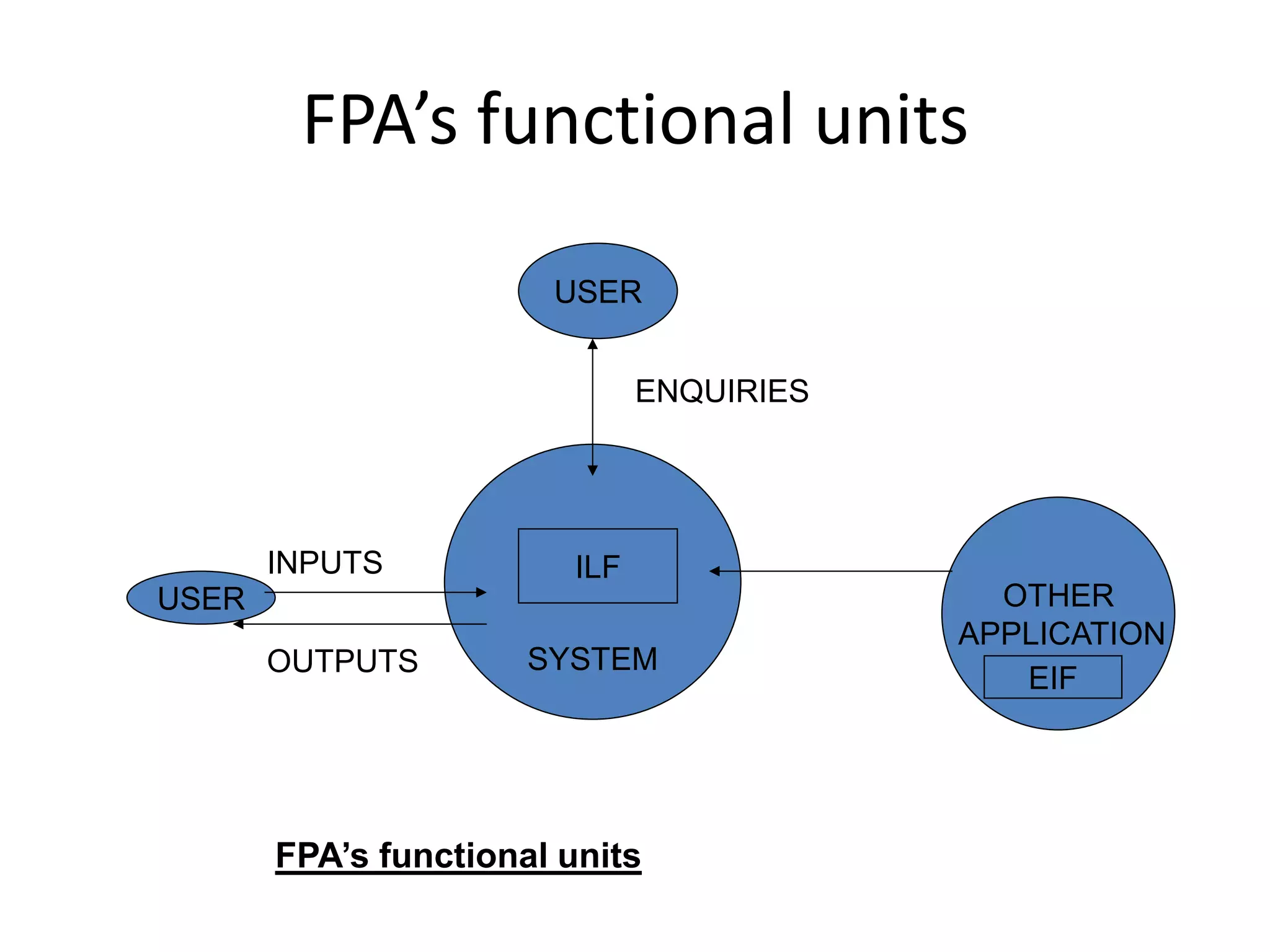
FPA’s fu ctio al u its
SYSTEM
OTHER
APPLICATION
USER
EIF
USER
ILFINPUTS
OUTPUTS
ENQUIRIES
FPA’s functional units
Two categories of functional units
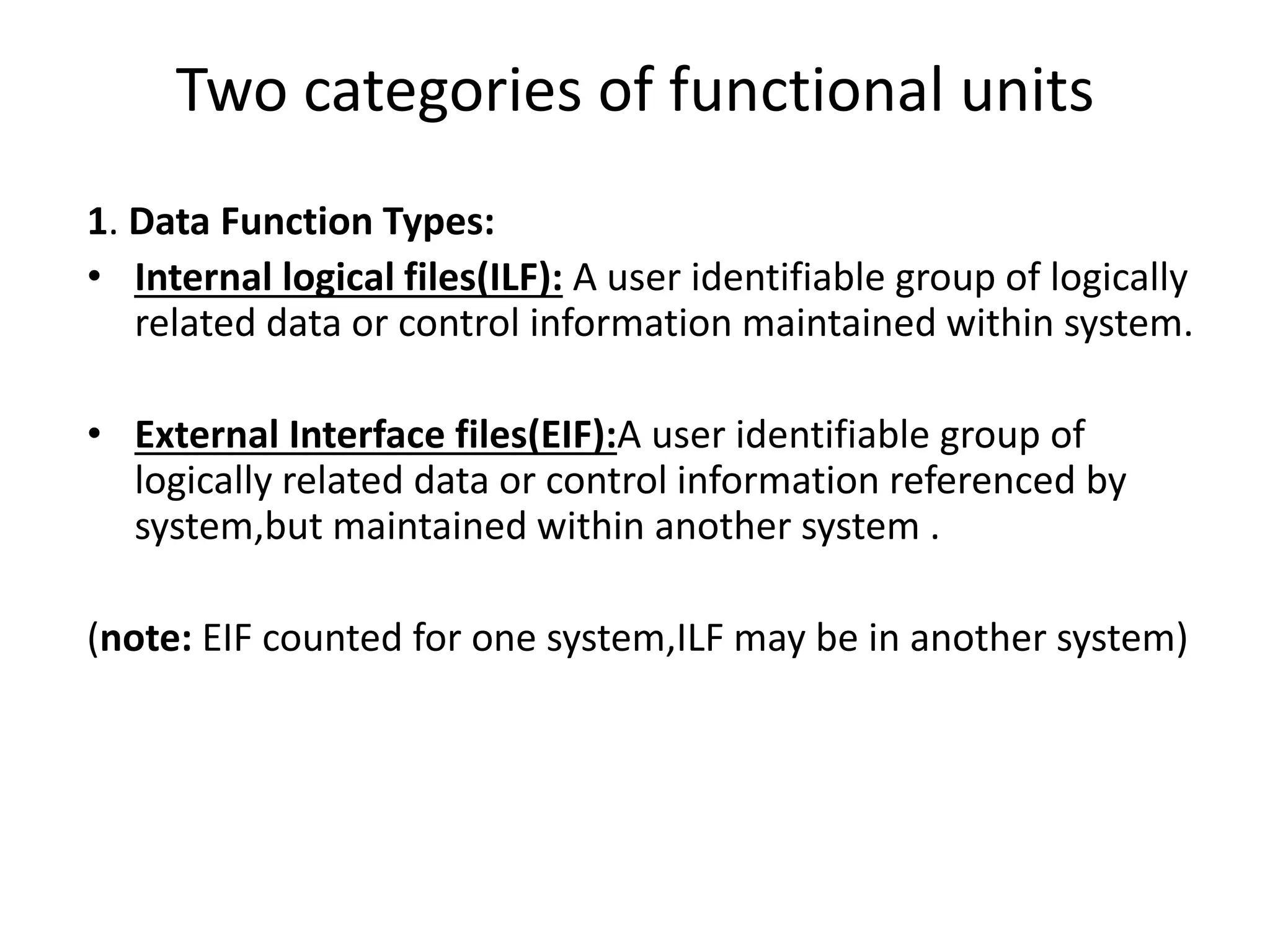
1. Data Function Types:
• Internal logical files(ILF): A user identifiable group of logically
related data or control information maintained within system.
• External Interface files(EIF):A user identifiable group of
logically related data or control information referenced by
system,but maintained within another system .
(note: EIF counted for one system,ILF may be in another system)
Two categories of functional units
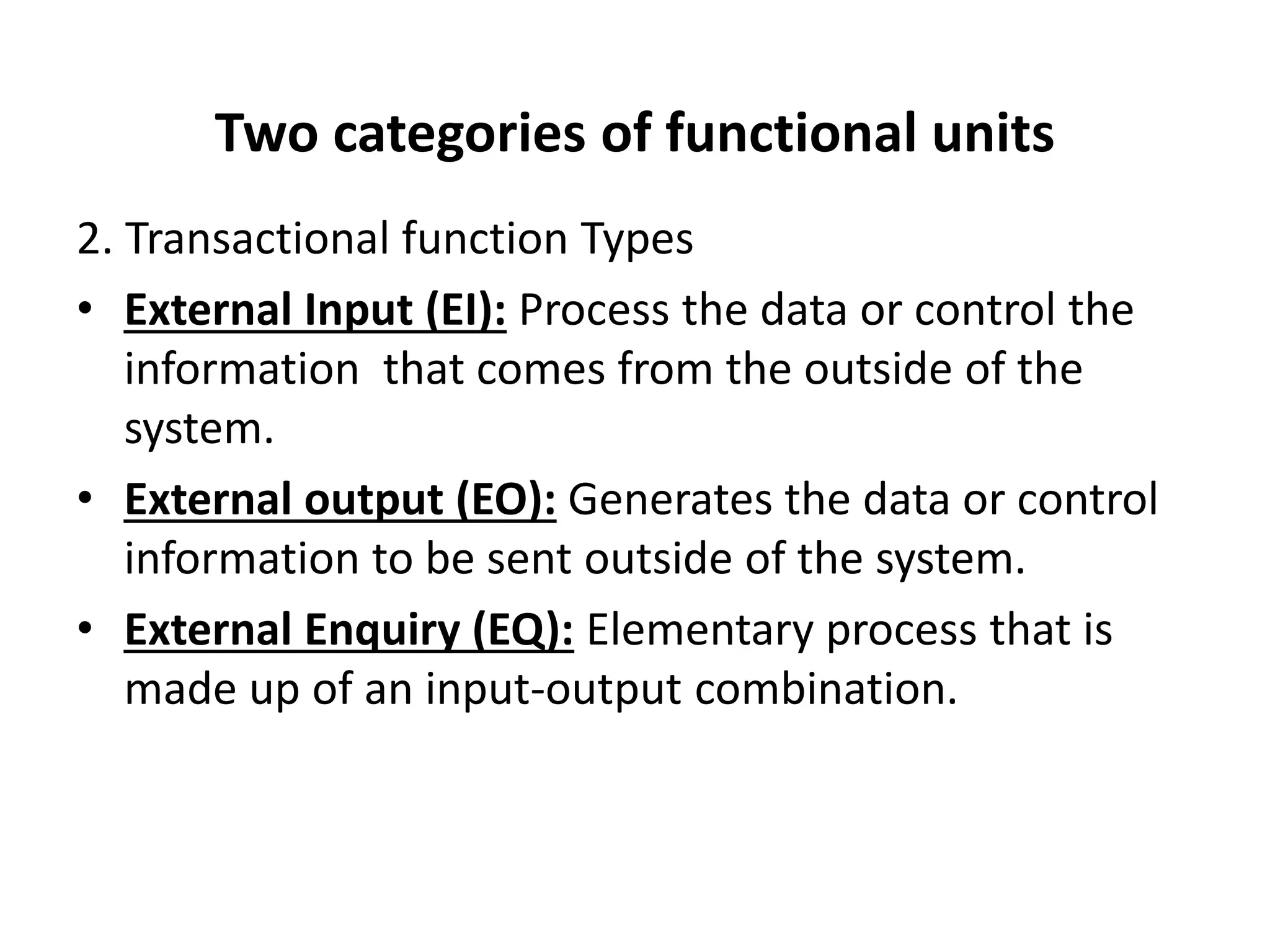
2. Transactional function Types
• External Input (EI): Process the data or control the
information that comes from the outside of the
system.
• External output (EO): Generates the data or control
information to be sent outside of the system.
• External Enquiry (EQ): Elementary process that is
made up of an input-output combination.
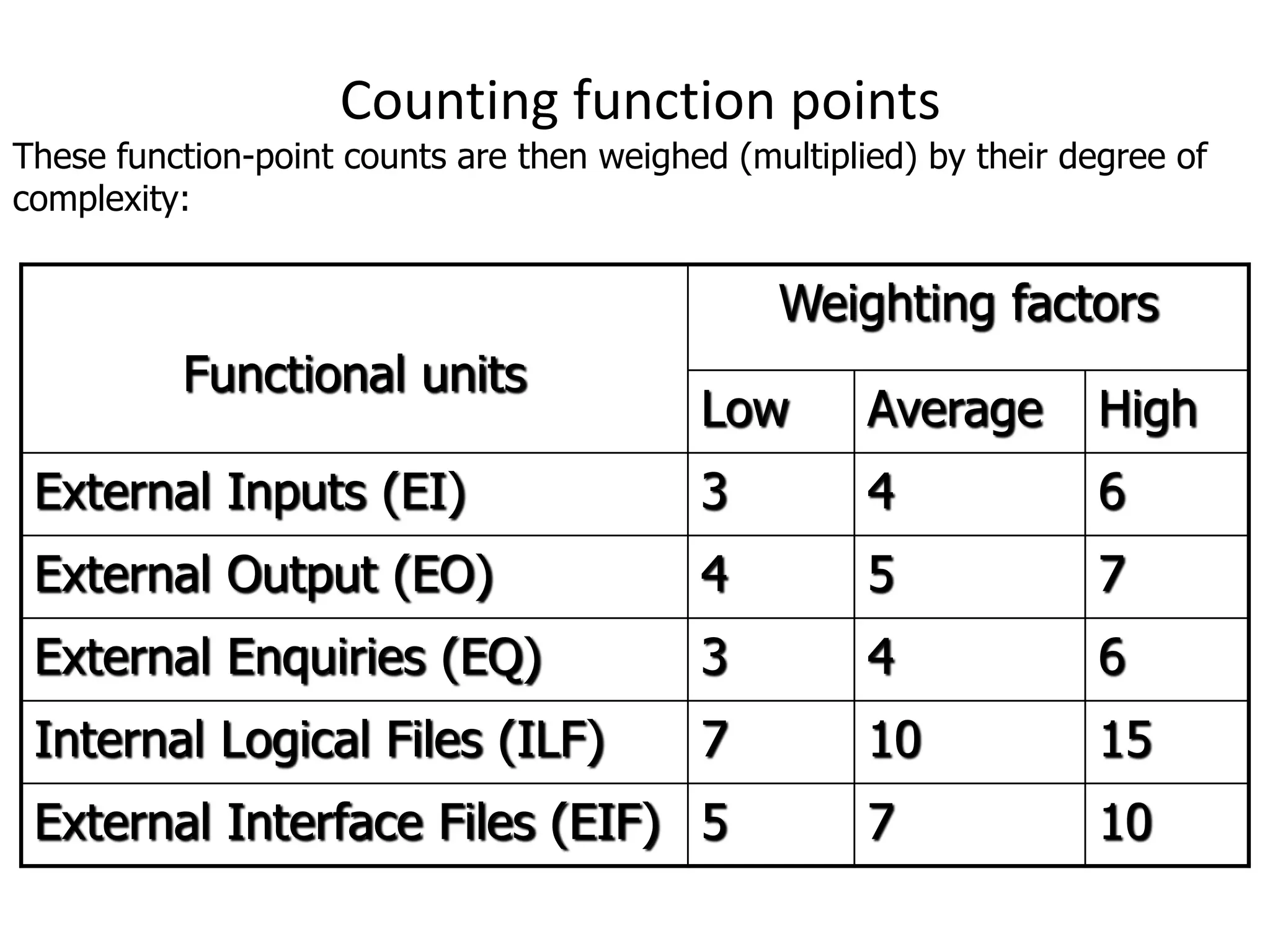
Counting function points
Functional units
Weighting factors
Low Average High
External Inputs (EI) 3 4 6
External Output (EO) 4 5 7
External Enquiries (EQ) 3 4 6
Internal Logical Files (ILF) 7 10 15
External Interface Files (EIF) 5 7 10
These function-point counts are then weighed (multiplied) by their degree of
complexity:
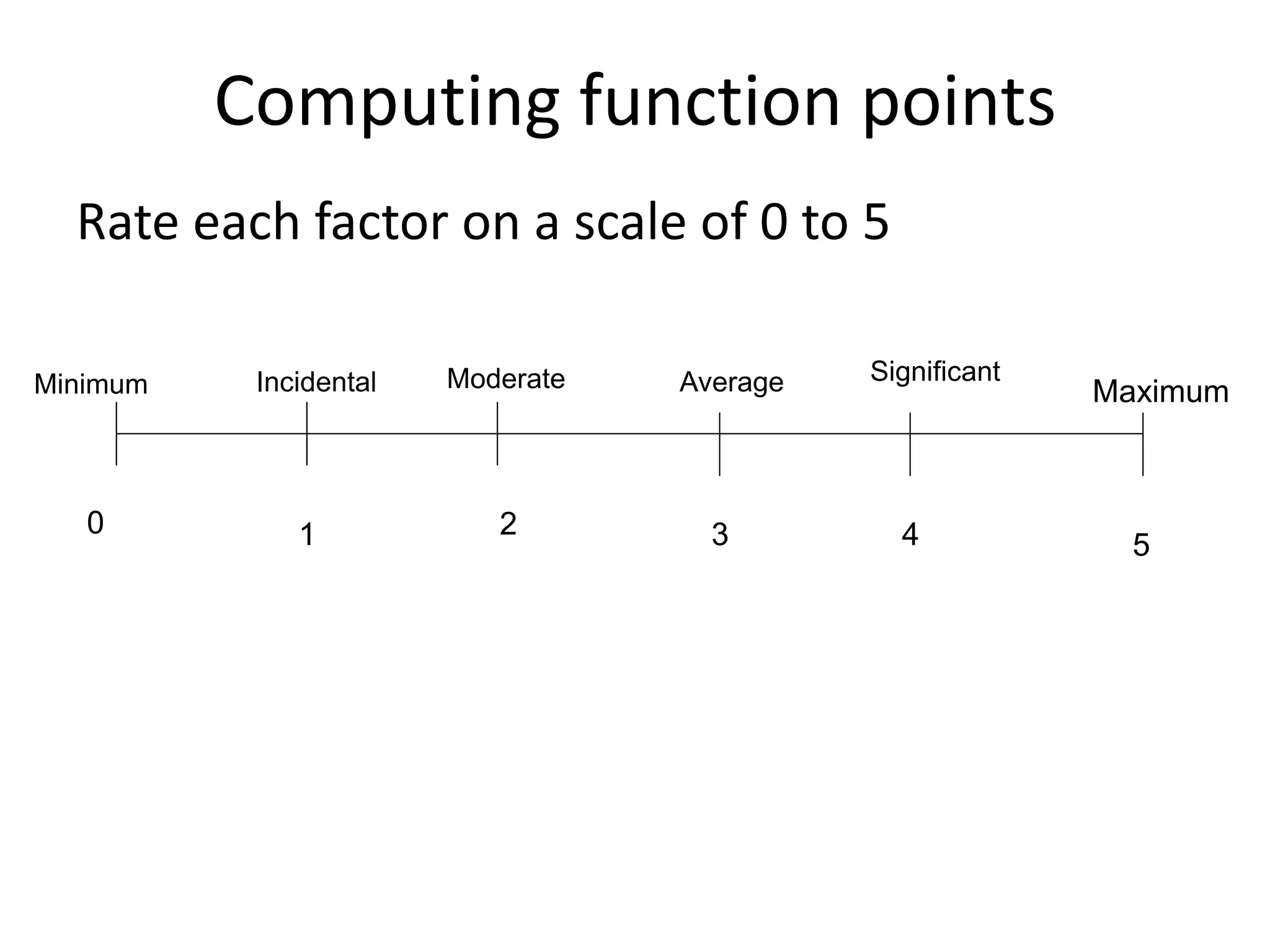
Computing function points
Rate each factor on a scale of 0 to 5
Minimum MaximumIncidental Moderate Average Significant
0 1 2 3 4 5
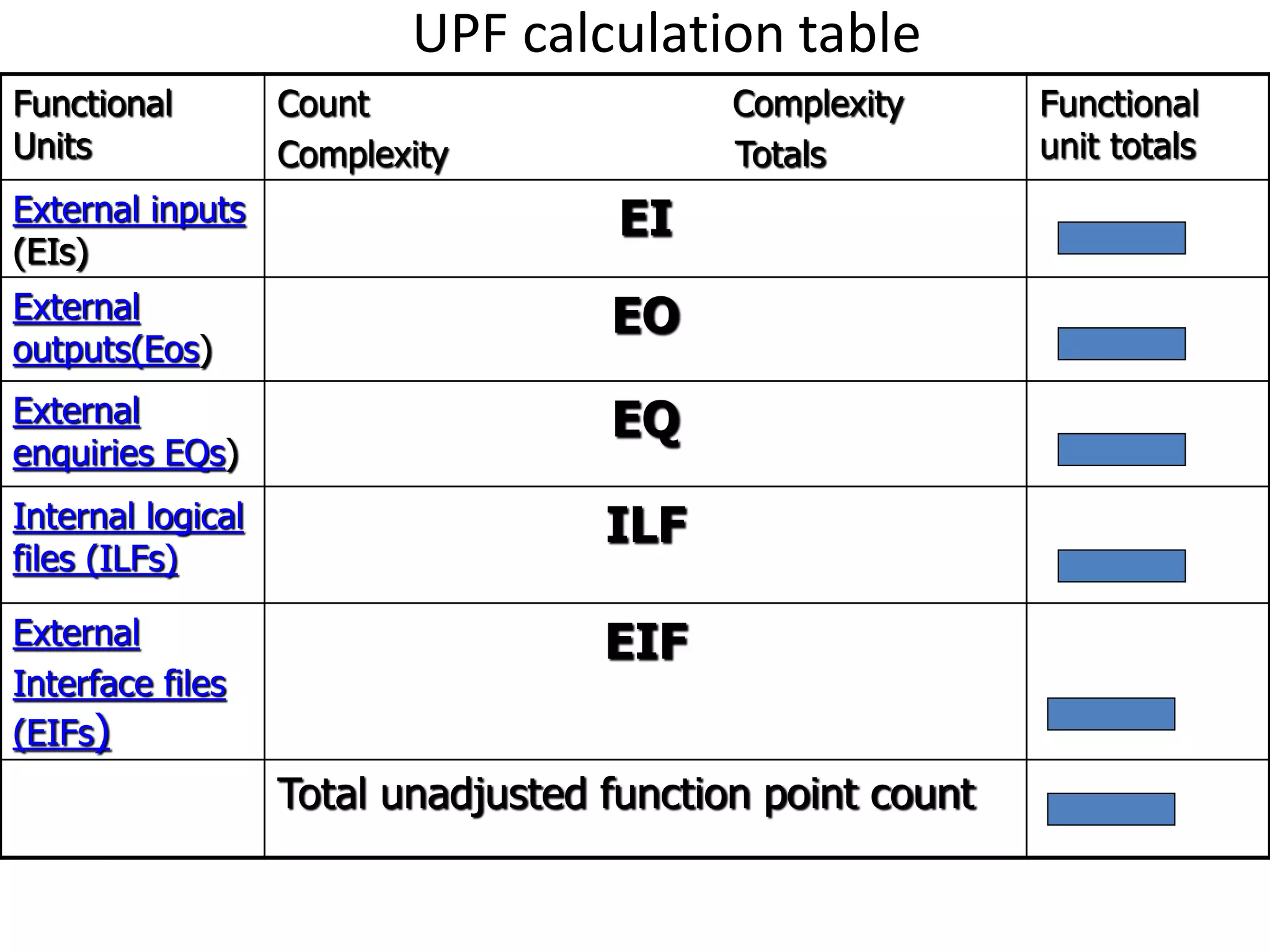
UPF calculation table
Functional
Units
Count Complexity
Complexity Totals
Functional
unit totals
External inputs
(EIs)
EI
External
outputs(Eos)
EO
External
enquiries EQs)
EQ
Internal logical
files (ILFs)
ILF
External
Interface files
(EIFs)
EIF
Total unadjusted function point count
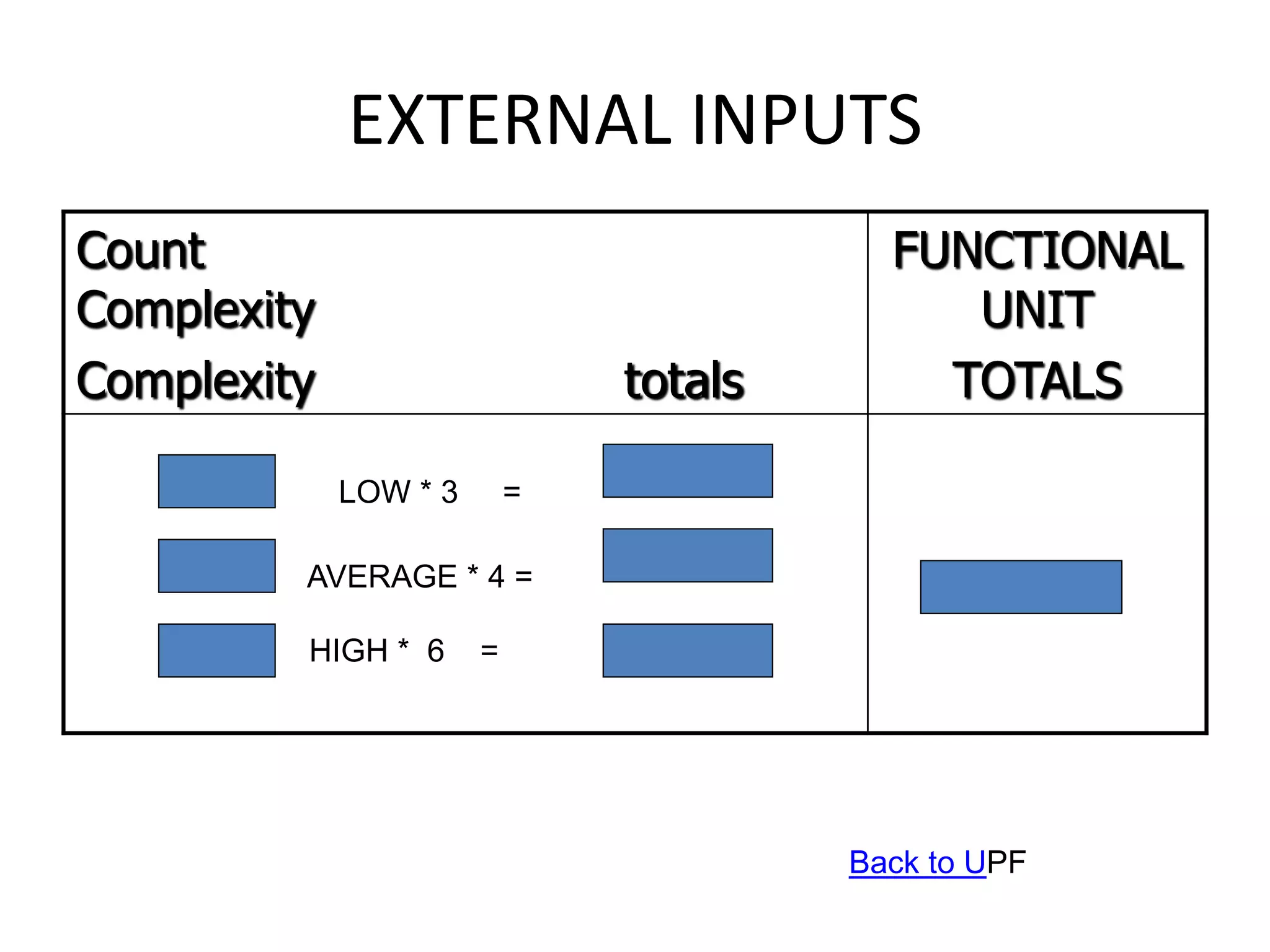
EXTERNAL INPUTS
Count
Complexity
Complexity totals
FUNCTIONAL
UNIT
TOTALS
LOW * 3 =
AVERAGE * 4 =
HIGH * 6 =
Back to UPF
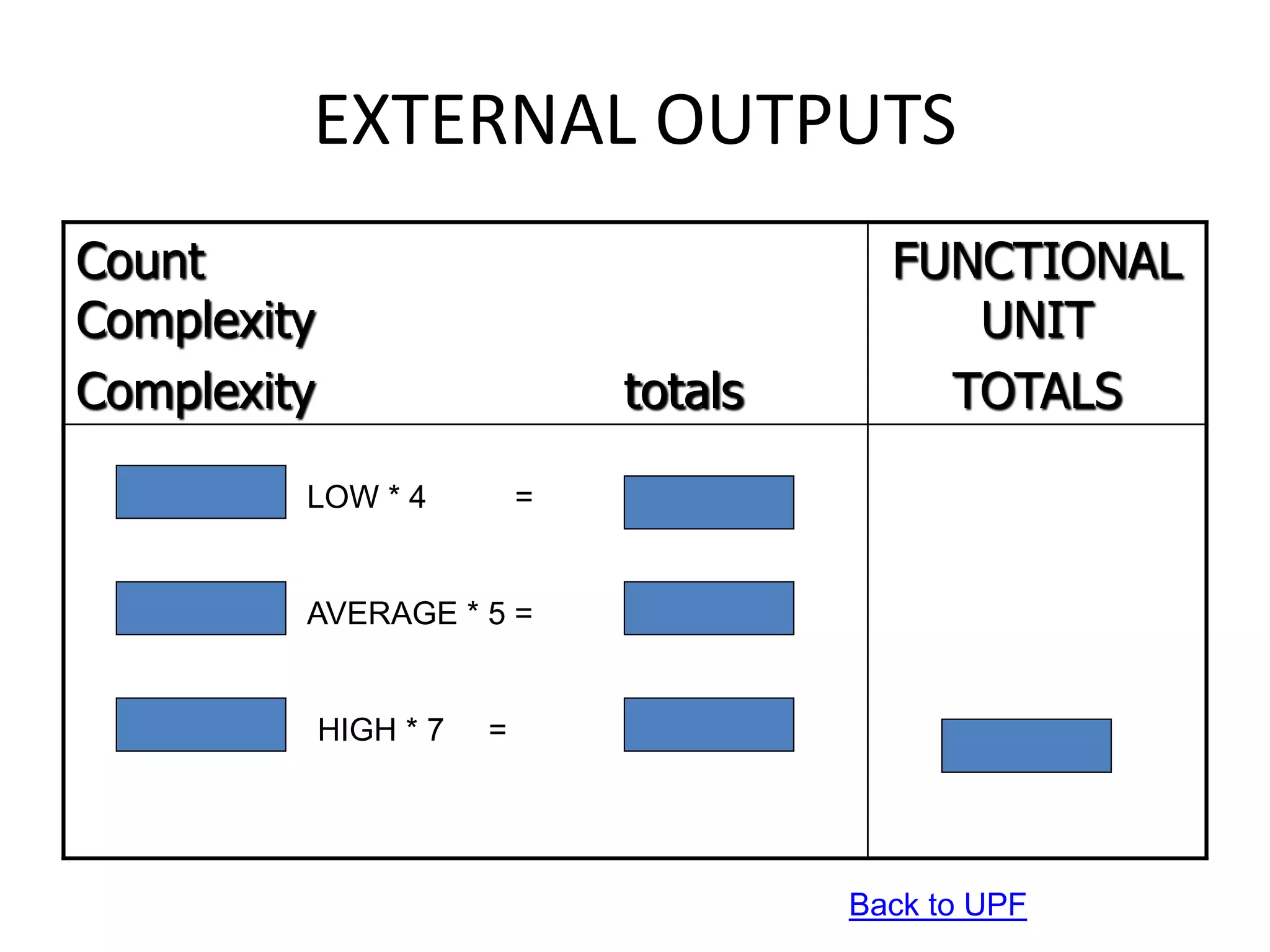
EXTERNAL OUTPUTS
Count
Complexity
Complexity totals
FUNCTIONAL
UNIT
TOTALS
LOW * 4 =
AVERAGE * 5 =
HIGH * 7 =
Back to UPF
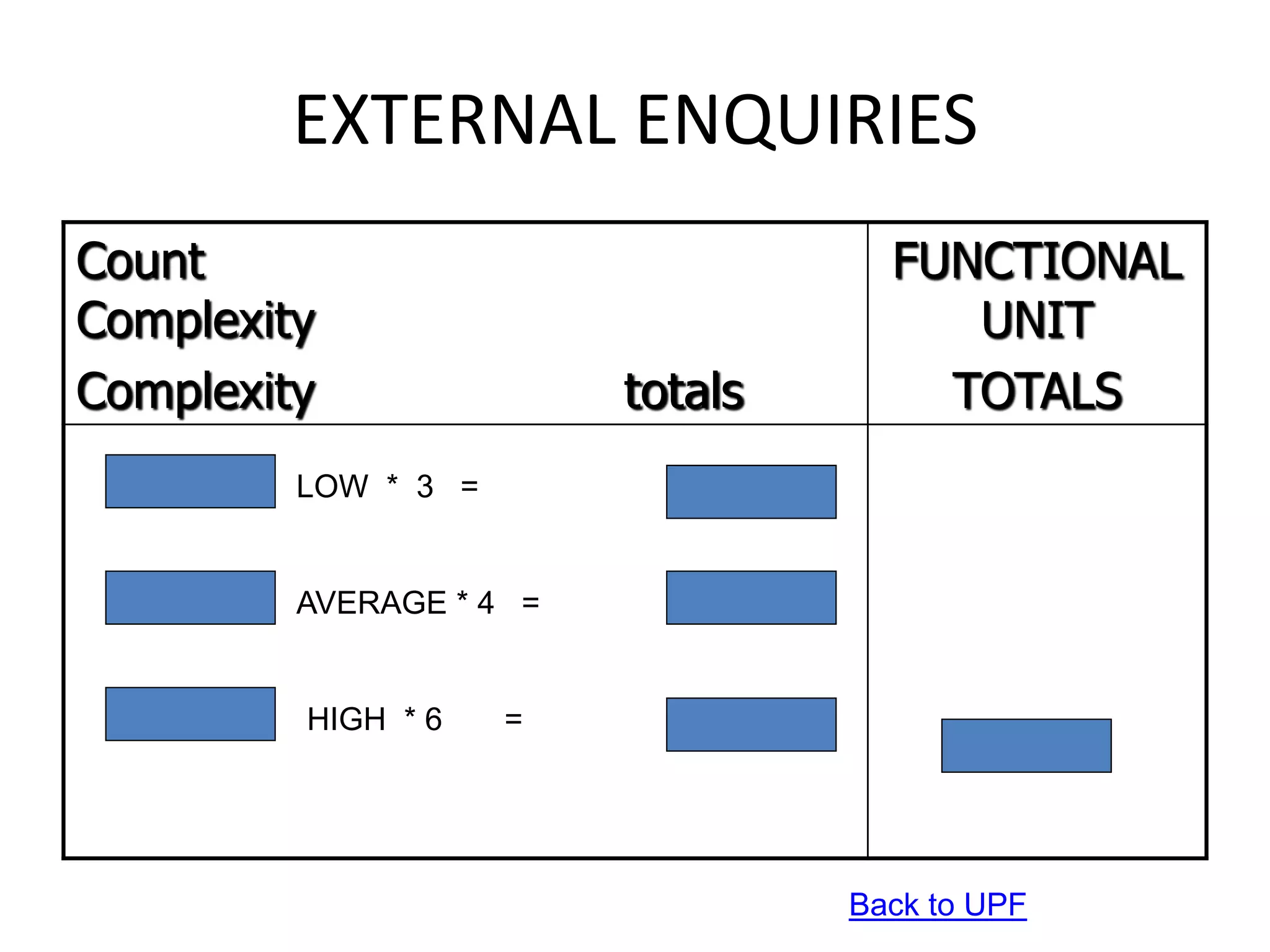
EXTERNAL ENQUIRIES
Count
Complexity
Complexity totals
FUNCTIONAL
UNIT
TOTALS
LOW * 3 =
AVERAGE * 4 =
HIGH * 6 =
Back to UPF
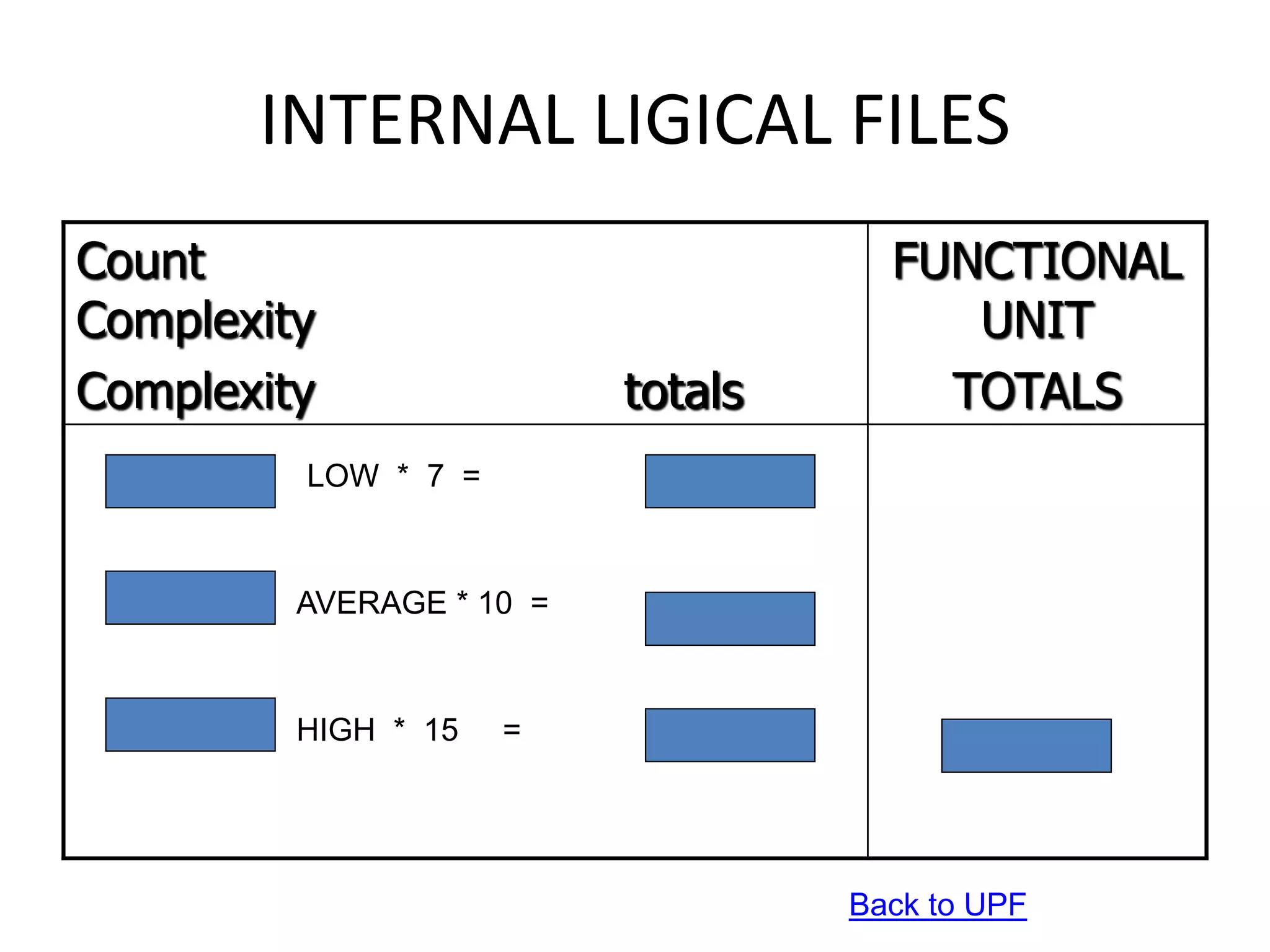
INTERNAL LIGICAL FILES
Count
Complexity
Complexity totals
FUNCTIONAL
UNIT
TOTALS
LOW * 7 =
AVERAGE * 10 =
HIGH * 15 =
Back to UPF
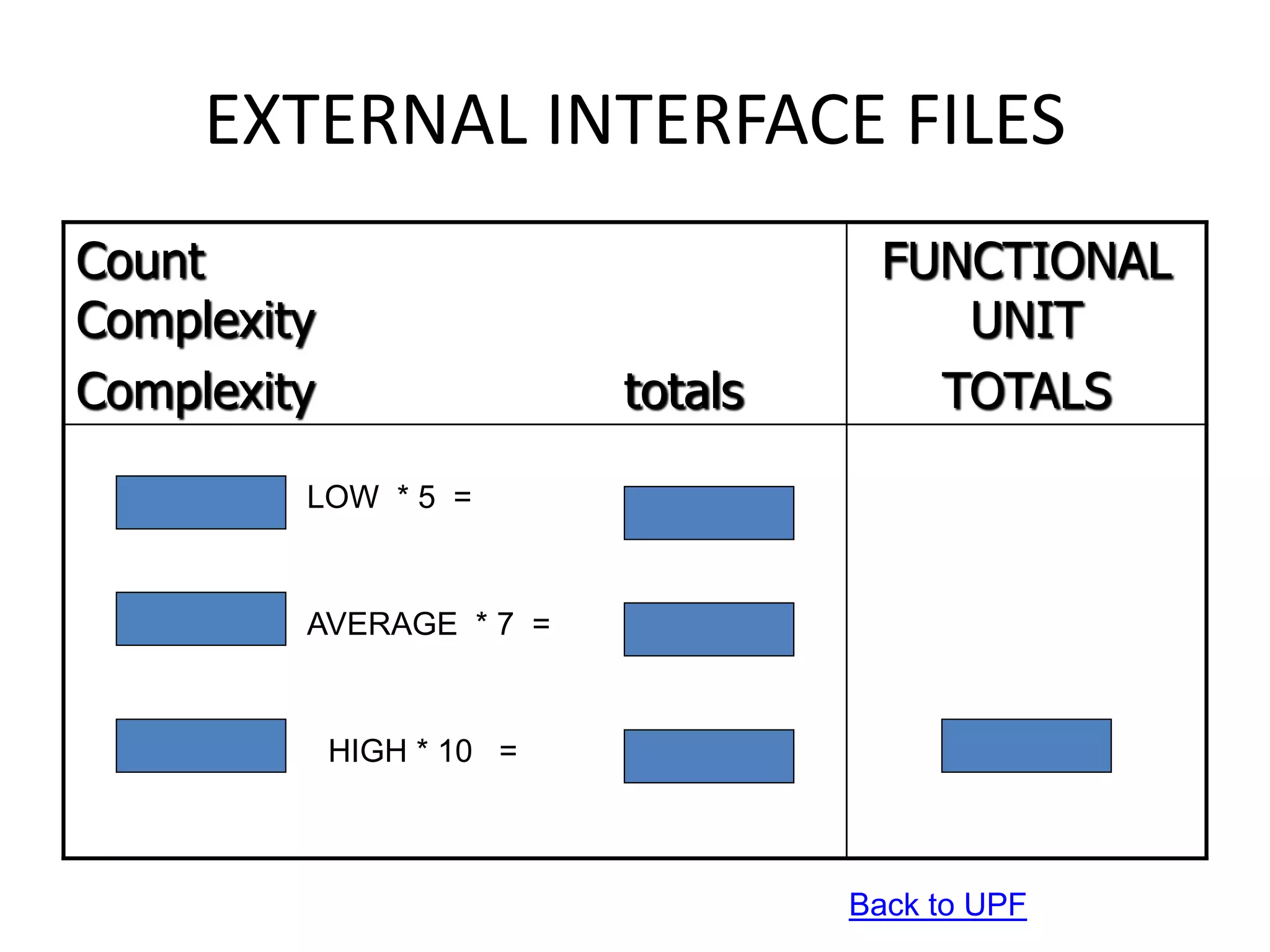
EXTERNAL INTERFACE FILES
Count
Complexity
Complexity totals
FUNCTIONAL
UNIT
TOTALS
LOW * 5 =
AVERAGE * 7 =
HIGH * 10 =
Back to UPF
Function Point Analysis
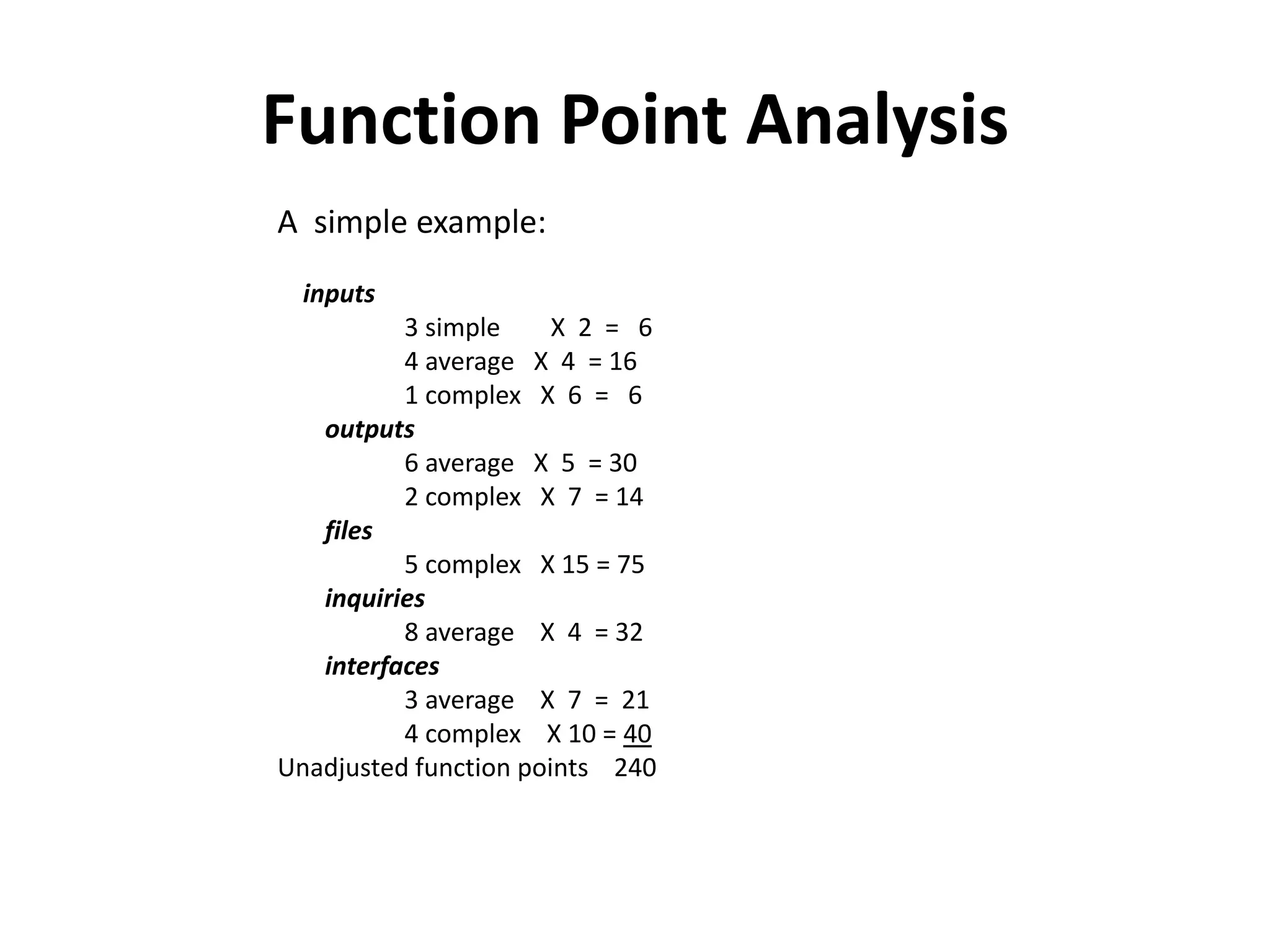
A simple example:
inputs
3 simple X 2 = 6
4 average X 4 = 16
1 complex X 6 = 6
outputs
6 average X 5 = 30
2 complex X 7 = 14
files
5 complex X 15 = 75
inquiries
8 average X 4 = 32
interfaces
3 average X 7 = 21
4 complex X 10 = 40
Unadjusted function points 240
Function Point Analysis
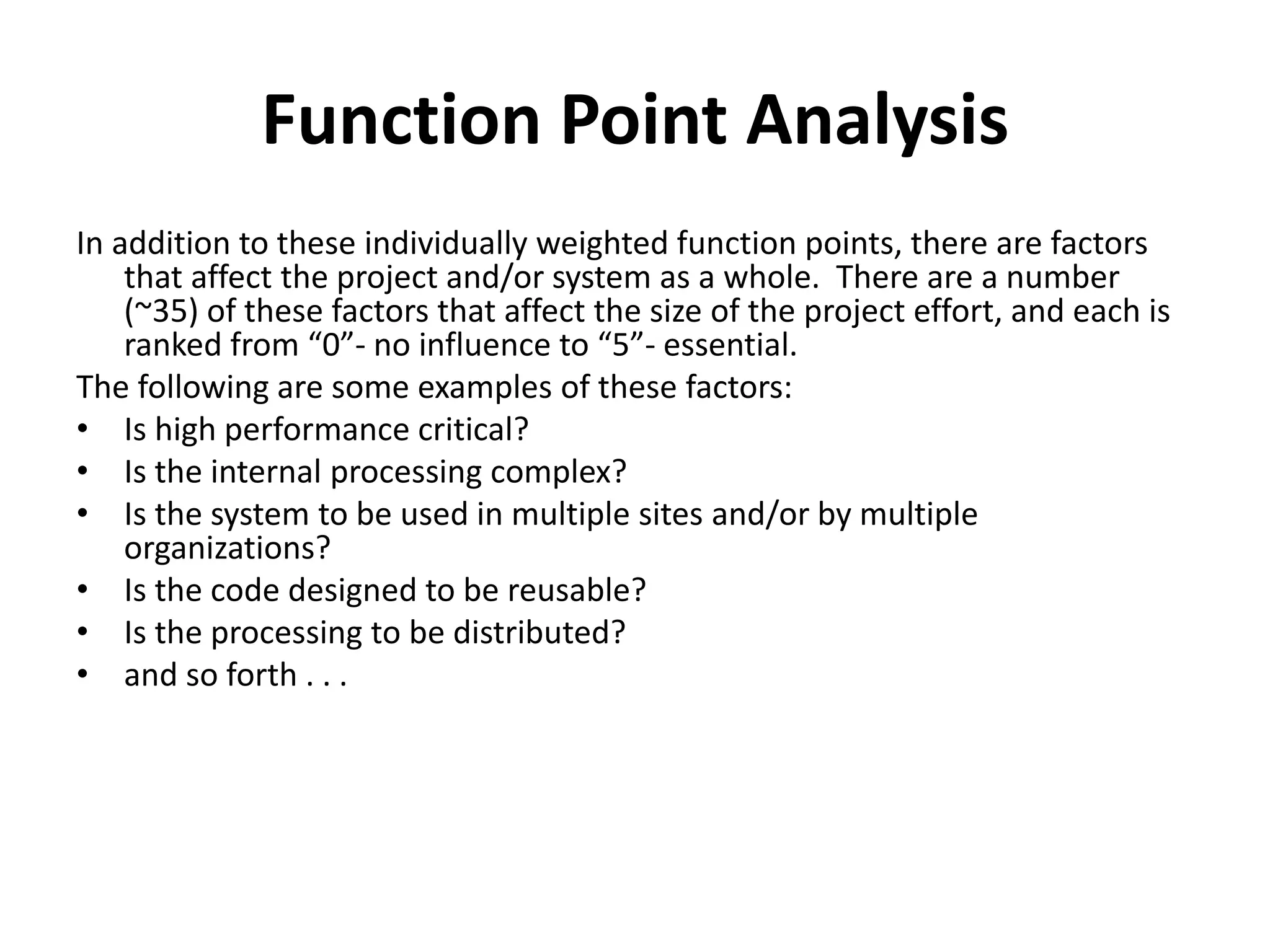
In addition to these individually weighted function points, there are factors
that affect the project and/or system as a whole. There are a number
(~35) of these factors that affect the size of the project effort, and each is
ra ked fro 0 - o i flue ce to 5 - essential.
The following are some examples of these factors:
• Is high performance critical?
• Is the internal processing complex?
• Is the system to be used in multiple sites and/or by multiple
organizations?
• Is the code designed to be reusable?
• Is the processing to be distributed?
• and so forth . . .
Function Point Analysis
Continuing our example . . .
Complex internal processing = 3
Code to be reusable = 2
High performance = 4
Multiple sites = 3
Distributed processing = 5
Project adjustment factor = 17
Adjustment calculation:
Adjusted FP = Unadjusted FP X [0.65 + (adjustment factor X 0.01)]
= 240 X [0.65 + ( 17 X 0.01)]
= 240 X [0.82]
= 197 Adjusted function points
Function Point Analysis
But how long will the project take and how much will it
cost?
• As previously measured, programmers in our
organization average 18 function points per month.
Thus . . .
197 FP divided by 18 = 11 man-months
• If the average programmer is paid $5,200 per month
(including benefits), then the [labor] cost of the
project will be . . .
11 man-months X $5,200 = $57,200
Function Point Analysis
Because function point analysis is independent of
language used, development platform, etc. it can be
used to identify the productivity benefits of . . .
• One programming language over another
• One development platform over another
• One development methodology over another
• One programming department over another
• Before-and-after gains in investing in programmer
training
• And so forth . . .
Function Point Analysis
But there are problems and criticisms:
• Function point counts are affected by project size
• Difficult to apply to massively distributed systems or to
systems with very complex internal processing
• Difficult to define logical files from physical files
• The validity of the weights that Albrecht established – and the
consistency of their application – has been challenged
• Different companies will calculate function points slightly
different, making intercompany comparisons questionable

Function Point Analysis (FPA) by Dr. B. J. Mohite

  • 1.
    Activities During SoftwareProject Management Size Estimation Cost Estimation Development Time Resources Requirements Project Scheduling By. Dr. B. J. Mohite 9850098225
  • 2.
    Process For SuccessfulProjects • Scope of work to be done • The risk to be incurred • The resources required • The task to be achieved • The cost to be expended • The schedule to be followed.
  • 3.
    Size Estimation • ITis beginning step of estimation. • Critical and difficult area of project planning. • Difficult to establish units of size measuring. • It is divided into two types like 1. LOC (Lines of Code) 2. Function Count
  • 4.
    Lines Of Code Aline of code is any line of program text that is not a comment or blank line, regardless of the number of statements or fragments of statements on the line. This specifically includes all lines containing program header, declarations, and executable and non- executable statements.
  • 5.
    Function Count • Developedby Alan Albrecht in 1970 in IBM. • Develop this technique is called as Function Point Analysis. • Used for problem size measurements. • Function point measures functionality from users point of view , that is , on the basis of what the user requests and receives in return from the system.
  • 6.
    FUNCTION POINT ANALYSIS FPAis decomposed into five functional units are • Inputs: Information entering in the system • Outputs: Information leaving in the system • Enquiries: Request to access information • Internal logical files: Information held within the system • External interface files: Information held by other systems that is used by the system being analyzed.
  • 7.
    FPA’s fu ctioal u its SYSTEM OTHER APPLICATION USER EIF USER ILFINPUTS OUTPUTS ENQUIRIES FPA’s functional units
  • 8.
    Two categories offunctional units 1. Data Function Types: • Internal logical files(ILF): A user identifiable group of logically related data or control information maintained within system. • External Interface files(EIF):A user identifiable group of logically related data or control information referenced by system,but maintained within another system . (note: EIF counted for one system,ILF may be in another system)
  • 9.
    Two categories offunctional units 2. Transactional function Types • External Input (EI): Process the data or control the information that comes from the outside of the system. • External output (EO): Generates the data or control information to be sent outside of the system. • External Enquiry (EQ): Elementary process that is made up of an input-output combination.
  • 10.
    Counting function points Functionalunits Weighting factors Low Average High External Inputs (EI) 3 4 6 External Output (EO) 4 5 7 External Enquiries (EQ) 3 4 6 Internal Logical Files (ILF) 7 10 15 External Interface Files (EIF) 5 7 10 These function-point counts are then weighed (multiplied) by their degree of complexity:
  • 11.
    Computing function points Rateeach factor on a scale of 0 to 5 Minimum MaximumIncidental Moderate Average Significant 0 1 2 3 4 5
  • 12.
    UPF calculation table Functional Units CountComplexity Complexity Totals Functional unit totals External inputs (EIs) EI External outputs(Eos) EO External enquiries EQs) EQ Internal logical files (ILFs) ILF External Interface files (EIFs) EIF Total unadjusted function point count
  • 13.
  • 14.
  • 15.
  • 16.
    INTERNAL LIGICAL FILES Count Complexity Complexitytotals FUNCTIONAL UNIT TOTALS LOW * 7 = AVERAGE * 10 = HIGH * 15 = Back to UPF
  • 17.
    EXTERNAL INTERFACE FILES Count Complexity Complexitytotals FUNCTIONAL UNIT TOTALS LOW * 5 = AVERAGE * 7 = HIGH * 10 = Back to UPF
  • 18.
    Function Point Analysis Asimple example: inputs 3 simple X 2 = 6 4 average X 4 = 16 1 complex X 6 = 6 outputs 6 average X 5 = 30 2 complex X 7 = 14 files 5 complex X 15 = 75 inquiries 8 average X 4 = 32 interfaces 3 average X 7 = 21 4 complex X 10 = 40 Unadjusted function points 240
  • 19.
    Function Point Analysis Inaddition to these individually weighted function points, there are factors that affect the project and/or system as a whole. There are a number (~35) of these factors that affect the size of the project effort, and each is ra ked fro 0 - o i flue ce to 5 - essential. The following are some examples of these factors: • Is high performance critical? • Is the internal processing complex? • Is the system to be used in multiple sites and/or by multiple organizations? • Is the code designed to be reusable? • Is the processing to be distributed? • and so forth . . .
  • 20.
    Function Point Analysis Continuingour example . . . Complex internal processing = 3 Code to be reusable = 2 High performance = 4 Multiple sites = 3 Distributed processing = 5 Project adjustment factor = 17 Adjustment calculation: Adjusted FP = Unadjusted FP X [0.65 + (adjustment factor X 0.01)] = 240 X [0.65 + ( 17 X 0.01)] = 240 X [0.82] = 197 Adjusted function points
  • 21.
    Function Point Analysis Buthow long will the project take and how much will it cost? • As previously measured, programmers in our organization average 18 function points per month. Thus . . . 197 FP divided by 18 = 11 man-months • If the average programmer is paid $5,200 per month (including benefits), then the [labor] cost of the project will be . . . 11 man-months X $5,200 = $57,200
  • 22.
    Function Point Analysis Becausefunction point analysis is independent of language used, development platform, etc. it can be used to identify the productivity benefits of . . . • One programming language over another • One development platform over another • One development methodology over another • One programming department over another • Before-and-after gains in investing in programmer training • And so forth . . .
  • 23.
    Function Point Analysis Butthere are problems and criticisms: • Function point counts are affected by project size • Difficult to apply to massively distributed systems or to systems with very complex internal processing • Difficult to define logical files from physical files • The validity of the weights that Albrecht established – and the consistency of their application – has been challenged • Different companies will calculate function points slightly different, making intercompany comparisons questionable