SIMULATION
08/09/2016 1Dr. DEGA NAGARAJU, SMEC
08/09/2016 Dr. DEGA NAGARAJU, SMEC 2
08/09/2016 Dr. DEGA NAGARAJU, SMEC 3
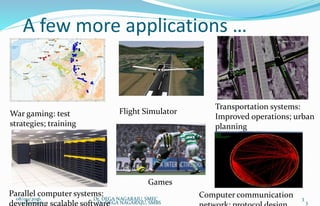
War gaming: test
strategies; training
Flight Simulator
Transportation systems:
Improved operations; urban
planning
Computer communicationParallel computer systems:
Games
A few more applications …
12/22/2016 3Dr. DEGA NAGARAJU, SMBS
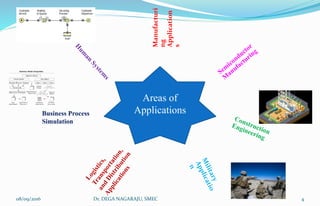
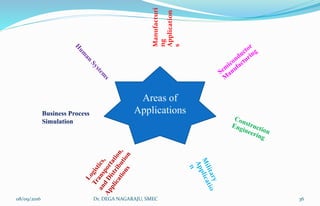
Areas of
Applications
Manufacturi
ng
Application
s
Business Process
Simulation
08/09/2016 4Dr. DEGA NAGARAJU, SMEC
Applications:
 COMPUTER SYSTEMS: hardware components, software
systems, networks, data base management, information
processing, etc..
 MANUFACTURING: material handling systems, assembly
lines, automated production facilities, inventory control
systems, plant layout, etc..
 BUSINESS: stock and commodity analysis, pricing policies,
marketing strategies, cash flow analysis, forecasting, etc..
 GOVERNMENT: military weapons and their use, military
tactics, population forecasting, land use, health care
delivery, fire protection, criminal justice, traffic control, etc..
And the list goes on and on...
08/09/2016 5Dr. DEGA NAGARAJU, SMEC
Examples of Applications at Disney World
 Cruise Line Operation: Simulate the arrival and
check-in process at the dock.
 Private Island Arrival: How to transport passengers
to the beach area? Drop-off point far from the
beach. Used simulation to determine whether
to invest in trams, how many trams to purchase,
average transport and waiting times, etc..
08/09/2016 6Dr. DEGA NAGARAJU, SMEC
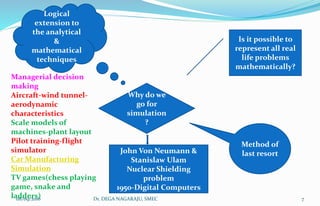
Why do we
go for
simulation
?
Is it possible to
represent all real
life problems
mathematically?
Method of
last resort
Logical
extension to
the analytical
&
mathematical
techniques
John Von Neumann &
Stanislaw Ulam
Nuclear Shielding
problem
1950-Digital Computers
Managerial decision
making
Aircraft-wind tunnel-
aerodynamic
characteristics
Scale models of
machines-plant layout
Pilot training-flight
simulator
Car Manufacturing
Simulation
TV games(chess playing
game, snake and
ladders)08/09/2016 7Dr. DEGA NAGARAJU, SMEC
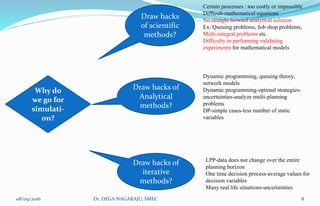
Why do
we go for
simulati-
on?
Draw backs
of scientific
methods?
Draw backs of
Analytical
methods?
Draw backs of
iterative
methods?
Certain processes : too costly or impossible
Difficult-mathematical equations
No straight forward analytical solution
Ex: Queuing problems, Job shop problems,
Multi-integral problems etc.
Difficulty in performing validating
experiments for mathematical models
Dynamic programming, queuing theory,
network models
Dynamic programming-optimal strategies-
uncertainties-analyze multi-planning
problems
DP-simple cases-less number of static
variables
LPP-data does not change over the entire
planning horizon
One time decision process-average values for
decision variables
Many real life situations-uncertainties
08/09/2016 8Dr. DEGA NAGARAJU, SMEC
Webster’s Dictionary:
“ to assume the mere appearance of ,
without the reality”
08/09/2016 9Dr. DEGA NAGARAJU, SMEC
Definition:
Simulation is the process of designing a
model of a real system and conducting
experiments with this model for the purpose
of either understanding the behavior of the
system and/or evaluating various strategies
for the operation of the system.
08/09/2016 10Dr. DEGA NAGARAJU, SMEC
Allows us to:
Model complex systems in a detailed way
Describe the behavior of systems
Construct theories or hypotheses that account for
the observed behavior
Use the model to predict future behavior, that is,
the effects that will be produced by changes in the
system
Analyze proposed systems
08/09/2016 11Dr. DEGA NAGARAJU, SMEC
Brief History Not a very old technique...
 World War II
 “Monte Carlo” simulation: originated with
the work on the atomic bomb. Used to
simulate bombing raids. Given the
security code name “Monte-Carlo”.
 Still widely used today for certain problems
which are not analytically solvable (for
example: complex multiple integrals…)
08/09/2016 12Dr. DEGA NAGARAJU, SMEC
Brief History (cont…..)
 Late ‘50s, early ‘60s
 Computers improve
 First languages introduced: SIMSCRIPT,
GPSS (General purpose simulation system) (IBM)
 Simulation viewed at the tool of “last resort”
 Late ‘60s, early ‘70s
 Primary computers were mainframes: accessibility
and interaction was limited
 GASP IV introduced by Pritsker. Triggered a wave
of diverse applications. Significant in the evolution
of simulation.
08/09/2016 13Dr. DEGA NAGARAJU, SMEC
Brief History (cont…….)
 Late ‘70s, early ‘80s
 SLAM introduced in 1979 by Pritsker and Pegden.
 Models more credible because of sophisticated tools.
 SIMAN introduced in 1982 by Pegden. First language
to run on both a mainframe as well as a
microcomputer.
 Late ‘80s through present
 Powerful PCs
 Languages are very sophisticated (market almost
saturated)
 Major advancement: graphics. Models can now be animated.
08/09/2016 14Dr. DEGA NAGARAJU, SMEC
What can be simulated?
Almost anything can
and
almost everything has...
08/09/2016 15Dr. DEGA NAGARAJU, SMEC
Introduction to Simulation
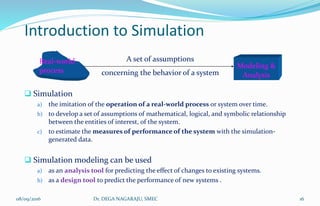
 Simulation
a) the imitation of the operation of a real-world process or system over time.
b) to develop a set of assumptions of mathematical, logical, and symbolic relationship
between the entities of interest, of the system.
c) to estimate the measures of performance of the system with the simulation-
generated data.
 Simulation modeling can be used
a) as an analysis tool for predicting the effect of changes to existing systems.
b) as a design tool to predict the performance of new systems .
Real-world
process concerning the behavior of a system
A set of assumptions
Modeling &
Analysis
08/09/2016 16Dr. DEGA NAGARAJU, SMEC
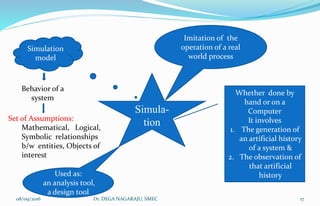
Simula-
tion
Imitation of the
operation of a real
world process
Whether done by
hand or on a
Computer
It involves
1. The generation of
an artificial history
of a system &
2. The observation of
that artificial
history
Simulation
model
Behavior of a
system
Set of Assumptions:
Mathematical, Logical,
Symbolic relationships
b/w entities, Objects of
interest
Used as:
an analysis tool,
a design tool
08/09/2016 17Dr. DEGA NAGARAJU, SMEC
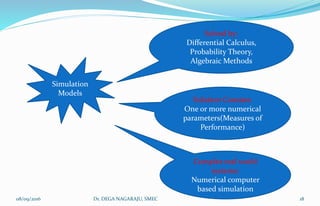
Simulation
Models
Solved by:
Differential Calculus,
Probability Theory,
Algebraic Methods
Solution Consists:
One or more numerical
parameters(Measures of
Performance)
Complex real world
systems:
Numerical computer
based simulation
08/09/2016 18Dr. DEGA NAGARAJU, SMEC
08/09/2016 19Dr. DEGA NAGARAJU, SMEC
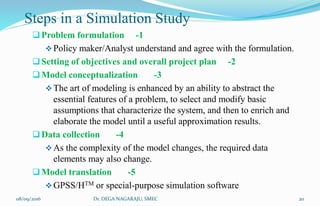
Problem formulation -1
Policy maker/Analyst understand and agree with the formulation.
Setting of objectives and overall project plan -2
Model conceptualization -3
The art of modeling is enhanced by an ability to abstract the
essential features of a problem, to select and modify basic
assumptions that characterize the system, and then to enrich and
elaborate the model until a useful approximation results.
Data collection -4
As the complexity of the model changes, the required data
elements may also change.
Model translation -5
GPSS/HTM or special-purpose simulation software
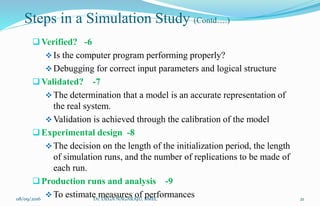
Steps in a Simulation Study
08/09/2016 20Dr. DEGA NAGARAJU, SMEC
Verified? -6
Is the computer program performing properly?
Debugging for correct input parameters and logical structure
Validated? -7
The determination that a model is an accurate representation of
the real system.
Validation is achieved through the calibration of the model
Experimental design -8
The decision on the length of the initialization period, the length
of simulation runs, and the number of replications to be made of
each run.
Production runs and analysis -9
To estimate measures of performances
Steps in a Simulation Study (Contd….)
08/09/2016 21Dr. DEGA NAGARAJU, SMEC
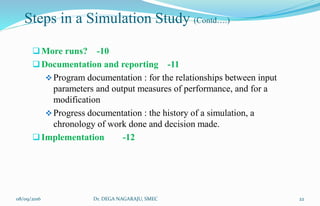
More runs? -10
Documentation and reporting -11
Program documentation : for the relationships between input
parameters and output measures of performance, and for a
modification
Progress documentation : the history of a simulation, a
chronology of work done and decision made.
Implementation -12
Steps in a Simulation Study (Contd….)
08/09/2016 22Dr. DEGA NAGARAJU, SMEC
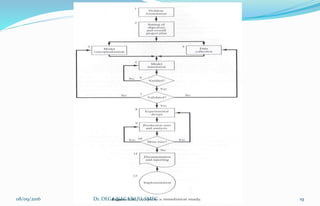
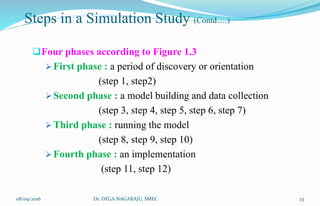
Four phases according to Figure 1.3
First phase : a period of discovery or orientation
(step 1, step2)
Second phase : a model building and data collection
(step 3, step 4, step 5, step 6, step 7)
Third phase : running the model
(step 8, step 9, step 10)
Fourth phase : an implementation
(step 11, step 12)
Steps in a Simulation Study (Contd….)
08/09/2016 23Dr. DEGA NAGARAJU, SMEC
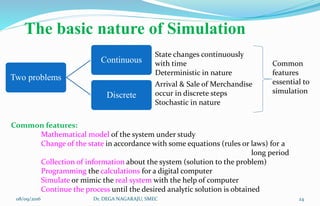
The basic nature of Simulation
Two problems
Continuous
Discrete
State changes continuously
with time
Deterministic in nature
Arrival & Sale of Merchandise
occur in discrete steps
Stochastic in nature
Common
features
essential to
simulation
Common features:
Mathematical model of the system under study
Change of the state in accordance with some equations (rules or laws) for a
long period
Collection of information about the system (solution to the problem)
Programming the calculations for a digital computer
Simulate or mimic the real system with the help of computer
Continue the process until the desired analytic solution is obtained
08/09/2016 24Dr. DEGA NAGARAJU, SMEC
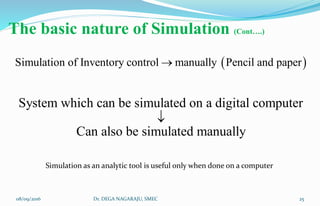
Simulation as an analytic tool is useful only when done on a computer
The basic nature of Simulation (Cont….)
08/09/2016 25Dr. DEGA NAGARAJU, SMEC
 Simulation of Inventory control manually Pencil and paper
System which can be simulated on a digital computer
Can also be simulated manually

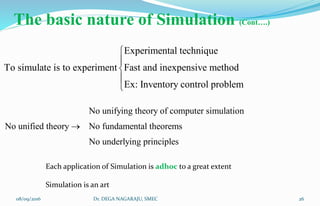
Each application of Simulation is adhoc to a great extent
Simulation is an art
The basic nature of Simulation (Cont….)
08/09/2016 26Dr. DEGA NAGARAJU, SMEC
No unifying theory of computer simulation
No unified theory No fundamental theorems
No underlying principles

Experimental technique
To simulate is to experiment Fast and inexpensive method
Ex: Inventory control problem





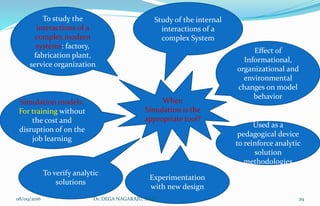
When Simulation is the Appropriate Tool (1)
 Simulation enables the study of, and experimentation with, the internal interactions
of a complex system, or of a subsystem within a complex system.
 Informational, organizational, and environmental changes can be simulated, and the
effect of these alterations on the model’s behavior can be observed.
 The knowledge gained in designing a simulation model may be of great value
toward suggesting improvement in the system under investigation.
 By changing simulation inputs and observing the resulting outputs, valuable insight
may be obtained into which variables are most important and how variables interact.
 Simulation can be used as a pedagogical device to reinforce analytic solution
methodologies.
08/09/2016 27Dr. DEGA NAGARAJU, SMEC
 Simulation can be used to experiment with new designs or policies prior to
implementation, so as to prepare for what may happen.
 Simulation can be used to verify analytic solutions.
 By simulating different capabilities for a machine, requirements can be
determined.
 Simulation models designed for training allow learning without the cost and
disruption of on-the-job learning.
 Animation shows a system in simulated operation so that the plan can be
visualized.
 The modern system (factory, wafer fabrication plant, service organization, etc.)
is so complex that the interactions can be treated only through simulation.
When Simulation is the Appropriate Tool (2)
08/09/2016 28Dr. DEGA NAGARAJU, SMEC
When
Simulation is the
appropriate tool?
Study of the internal
interactions of a
complex System
Effect of
Informational,
organizational and
environmental
changes on model
behavior
Used as a
pedagogical device
to reinforce analytic
solution
methodologies
Experimentation
with new design
To verify analytic
solutions
Simulation models:
For training without
the cost and
disruption of on the
job learning
To study the
interactions of a
complex modern
systems: factory,
fabrication plant,
service organization
08/09/2016 29Dr. DEGA NAGARAJU, SMEC
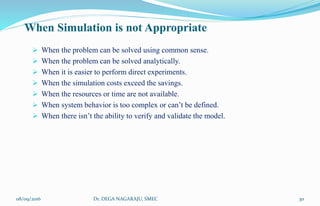
When Simulation is not Appropriate
 When the problem can be solved using common sense.
 When the problem can be solved analytically.
 When it is easier to perform direct experiments.
 When the simulation costs exceed the savings.
 When the resources or time are not available.
 When system behavior is too complex or can’t be defined.
 When there isn’t the ability to verify and validate the model.
08/09/2016 30Dr. DEGA NAGARAJU, SMEC
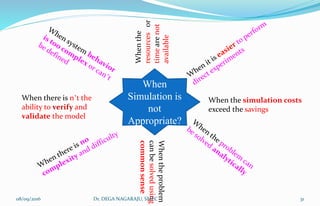
When
Simulation is
not
Appropriate?
Whentheproblem
canbesolvedusing
commonsenseWhenthe
resourcesor
timearenot
available
When there is n’t the
ability to verify and
validate the model
When the simulation costs
exceed the savings
08/09/2016 31Dr. DEGA NAGARAJU, SMEC
Advantages and Disadvantages of Simulation (1)
 Advantages
 New polices, operating procedures, decision rules, information flows, organizational
procedures, and so on can be explored without disrupting ongoing operations of the
real system.
 New hardware designs, physical layouts, transportation systems, and so on, can be
tested without committing resources for their acquisition.
 Hypotheses about how or why certain phenomena occur can be tested for feasibility.
 Insight can be obtained about the interaction of variables.
 Insight can be obtained about the importance of variables to the performance of the
system.
 Bottleneck analysis can be performed indicating where work-in-process, information,
materials, and so on are being excessively delayed.
 A simulation study can help in understanding how the system operates rather than how
individuals think the system operates.
 “What-if” questions can be answered. This is particularly useful in the design of new
system.
08/09/2016 32Dr. DEGA NAGARAJU, SMEC
Advantages and Disadvantages of Simulation (2)
 Disadvantages
 Model building requires special training. It is an art that is learned over time and
through experience. Furthermore, if two models are constructed by two competent
individuals, they may have similarities, but it is highly unlikely that they will be the
same.
 Simulation results may be difficult to interpret. Since most simulation outputs are
essentially random variables (they are usually based on random inputs), it may be
hard to determine whether an observation is a result of system interrelationships or
randomness.
 Simulation modeling and analysis can be time consuming and expensive. Skimping
on resources for modeling and analysis may result in a simulation model or analysis
that is not sufficient for the task.
 Simulation is used in some cases when an analytical solution is possible, or even
preferable, as discussed in Section 1.2. This might be particularly true in the
simulation of some waiting lines where closed-form queueing models are available.
08/09/2016 33Dr. DEGA NAGARAJU, SMEC
1
• New polices, operating procedures, decision rules, information flows, organizational procedures, and so on can be
explored without disrupting ongoing operations of the real system
2
• New hardware designs, physical layouts, transportation systems, and so on, can be tested without committing
resources for their acquisition.
3
• Hypotheses about how or why certain phenomena occur can be tested for feasibility.
4
• Insight can be obtained about the interaction of variables.
5
• Insight can be obtained about the importance of variables to the performance of the system.
6
• Bottleneck analysis can be performed indicating where work-in-process, information, materials, and so on are being
excessively delayed
7
• A simulation study can help in understanding how the system operates rather than how individuals think the system
operates.
8
• “What-if” questions can be answered. This is particularly useful in the design of new system.
Advantages of Simulation
08/09/2016 34Dr. DEGA NAGARAJU, SMEC
1
• Model building requires special training. It is an art that is learned over time and through experience.
Furthermore, if two models are constructed by two competent individuals, they may have similarities,
but it is highly unlikely that they will be the same.
2
• Simulation results may be difficult to interpret. Since most simulation outputs are essentially random
variables (they are usually based on random inputs), it may be hard to determine whether an
observation is a result of system interrelationships or randomness.
3
• Simulation modeling and analysis can be time consuming and expensive. Skimping on resources for
modeling and analysis may result in a simulation model or analysis that is not sufficient for the task.
4
• Simulation is used in some cases when an analytical solution is possible, or even preferable. This
might be particularly true in the simulation of some waiting lines where closed-form queueing
models are available.
Disadvantages of Simulation
08/09/2016 35Dr. DEGA NAGARAJU, SMEC
Areas of
Applications
Manufacturi
ng
Application
s
Business Process
Simulation
08/09/2016 36Dr. DEGA NAGARAJU, SMEC
Why do we
study the
System?
To understand the relationships b/w its
components or to predict how the system will
operate under a new policy
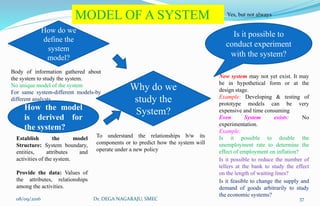
Is it possible to
conduct experiment
with the system?
Yes, but not always
New system may not yet exist. It may
be in hypothetical form or at the
design stage.
Example: Developing & testing of
prototype models can be very
expensive and time consuming
Even System exists: No
experimentation.
Example:
Is it possible to double the
unemployment rate to determine the
effect of employment on inflation?
Is it possible to reduce the number of
tellers at the bank to study the effect
on the length of waiting lines?
Is it feasible to change the supply and
demand of goods arbitrarily to study
the economic systems?
How do we
define the
system
model?
Body of information gathered about
the system to study the system.
No unique model of the system
For same system-different models-by
different analysts
Establish the model
Structure: System boundary,
entities, attributes and
activities of the system.
Provide the data: Values of
the attributes, relationships
among the activities.
MODEL OF A SYSTEM
How the model
is derived for
the system?
08/09/2016 37Dr. DEGA NAGARAJU, SMEC
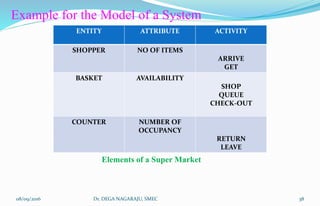
Example for the Model of a System
ENTITY ATTRIBUTE ACTIVITY
SHOPPER NO OF ITEMS
ARRIVE
GET
BASKET AVAILABILITY
SHOP
QUEUE
CHECK-OUT
COUNTER NUMBER OF
OCCUPANCY
RETURN
LEAVE
Elements of a Super Market
08/09/2016 38Dr. DEGA NAGARAJU, SMEC
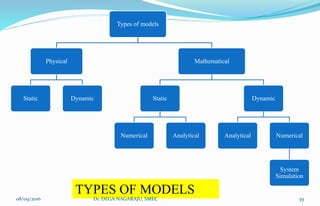
Types of models
Physical
Static Dynamic
Mathematical
Static
Numerical Analytical
Dynamic
Analytical Numerical
System
Simulation
TYPES OF MODELS
08/09/2016 39Dr. DEGA NAGARAJU, SMEC
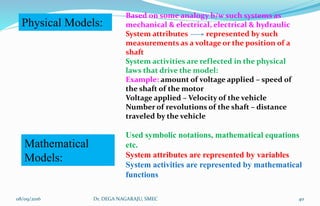
Physical Models:
Based on some analogy b/w such systems as
mechanical & electrical, electrical & hydraulic
System attributes represented by such
measurements as a voltage or the position of a
shaft
System activities are reflected in the physical
laws that drive the model:
Example: amount of voltage applied – speed of
the shaft of the motor
Voltage applied – Velocity of the vehicle
Number of revolutions of the shaft – distance
traveled by the vehicle
Mathematical
Models:
Used symbolic notations, mathematical equations
etc.
System attributes are represented by variables
System activities are represented by mathematical
functions
08/09/2016 40Dr. DEGA NAGARAJU, SMEC
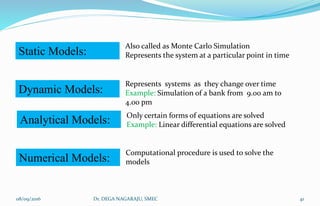
Dynamic Models:
Static Models:
Also called as Monte Carlo Simulation
Represents the system at a particular point in time
Represents systems as they change over time
Example: Simulation of a bank from 9.00 am to
4.00 pm
Numerical Models:
Analytical Models: Only certain forms of equations are solved
Example: Linear differential equations are solved
Computational procedure is used to solve the
models
08/09/2016 41Dr. DEGA NAGARAJU, SMEC
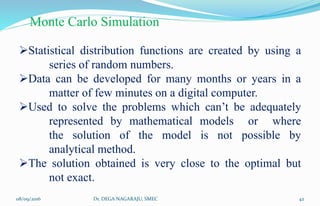
Monte Carlo Simulation
Statistical distribution functions are created by using a
series of random numbers.
Data can be developed for many months or years in a
matter of few minutes on a digital computer.
Used to solve the problems which can’t be adequately
represented by mathematical models or where
the solution of the model is not possible by
analytical method.
The solution obtained is very close to the optimal but
not exact.
08/09/2016 42Dr. DEGA NAGARAJU, SMEC
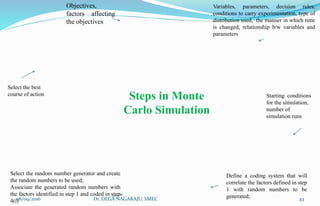
Steps in Monte
Carlo Simulation
Objectives,
factors affecting
the objectives
Variables, parameters, decision rules,
conditions to carry experimentation, type of
distribution used, the manner in which time
is changed, relationship b/w variables and
parameters
Starting conditions
for the simulation,
number of
simulation runs
Define a coding system that will
correlate the factors defined in step
1 with random numbers to be
generated;
Select the random number generator and create
the random numbers to be used;
Associate the generated random numbers with
the factors identified in step 1 and coded in step
4(i)
Select the best
course of action
08/09/2016 43Dr. DEGA NAGARAJU, SMEC
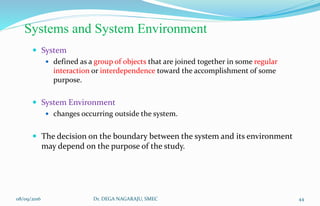
Systems and System Environment
 System
 defined as a group of objects that are joined together in some regular
interaction or interdependence toward the accomplishment of some
purpose.
 System Environment
 changes occurring outside the system.
 The decision on the boundary between the system and its environment
may depend on the purpose of the study.
08/09/2016 44Dr. DEGA NAGARAJU, SMEC
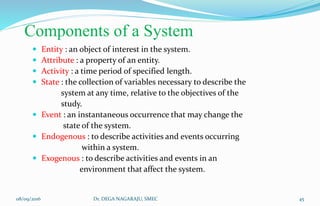
Components of a System
 Entity : an object of interest in the system.
 Attribute : a property of an entity.
 Activity : a time period of specified length.
 State : the collection of variables necessary to describe the
system at any time, relative to the objectives of the
study.
 Event : an instantaneous occurrence that may change the
state of the system.
 Endogenous : to describe activities and events occurring
within a system.
 Exogenous : to describe activities and events in an
environment that affect the system.
08/09/2016 45Dr. DEGA NAGARAJU, SMEC
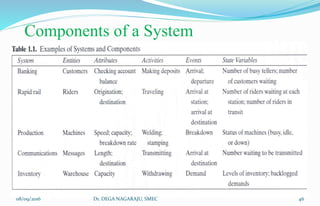
Components of a System
08/09/2016 46Dr. DEGA NAGARAJU, SMEC
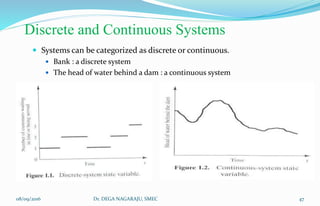
Discrete and Continuous Systems
 Systems can be categorized as discrete or continuous.
 Bank : a discrete system
 The head of water behind a dam : a continuous system
08/09/2016 47Dr. DEGA NAGARAJU, SMEC
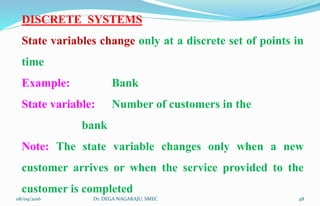
DISCRETE SYSTEMS
State variables change only at a discrete set of points in
time
Example: Bank
State variable: Number of customers in the
bank
Note: The state variable changes only when a new
customer arrives or when the service provided to the
customer is completed
08/09/2016 48Dr. DEGA NAGARAJU, SMEC
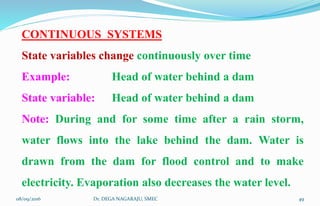
CONTINUOUS SYSTEMS
State variables change continuously over time
Example: Head of water behind a dam
State variable: Head of water behind a dam
Note: During and for some time after a rain storm,
water flows into the lake behind the dam. Water is
drawn from the dam for flood control and to make
electricity. Evaporation also decreases the water level.
08/09/2016 49Dr. DEGA NAGARAJU, SMEC
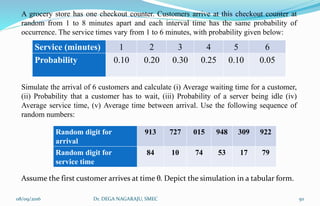
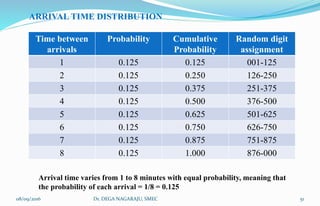
A grocery store has one checkout counter. Customers arrive at this checkout counter at
random from 1 to 8 minutes apart and each interval time has the same probability of
occurrence. The service times vary from 1 to 6 minutes, with probability given below:
Simulate the arrival of 6 customers and calculate (i) Average waiting time for a customer,
(ii) Probability that a customer has to wait, (iii) Probability of a server being idle (iv)
Average service time, (v) Average time between arrival. Use the following sequence of
random numbers:
Assume the first customer arrives at time θ. Depict the simulation in a tabular form.
Service (minutes) 1 2 3 4 5 6
Probability 0.10 0.20 0.30 0.25 0.10 0.05
Random digit for
arrival
913 727 015 948 309 922
Random digit for
service time
84 10 74 53 17 79
08/09/2016 50Dr. DEGA NAGARAJU, SMEC
Time between
arrivals
Probability Cumulative
Probability
Random digit
assignment
1 0.125 0.125 001-125
2 0.125 0.250 126-250
3 0.125 0.375 251-375
4 0.125 0.500 376-500
5 0.125 0.625 501-625
6 0.125 0.750 626-750
7 0.125 0.875 751-875
8 0.125 1.000 876-000
ARRIVAL TIME DISTRIBUTION
Arrival time varies from 1 to 8 minutes with equal probability, meaning that
the probability of each arrival = 1/8 = 0.125
08/09/2016 51Dr. DEGA NAGARAJU, SMEC
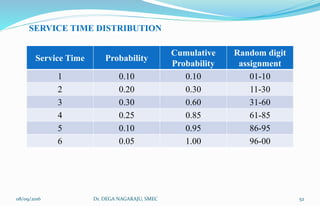
Service Time Probability
Cumulative
Probability
Random digit
assignment
1 0.10 0.10 01-10
2 0.20 0.30 11-30
3 0.30 0.60 31-60
4 0.25 0.85 61-85
5 0.10 0.95 86-95
6 0.05 1.00 96-00
SERVICE TIME DISTRIBUTION
08/09/2016 52Dr. DEGA NAGARAJU, SMEC
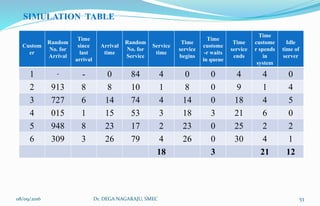
Custom
er
Random
No. for
Arrival
Time
since
last
arrival
Arrival
time
Random
No. for
Service
Service
time
Time
service
begins
Time
custome
-r waits
in queue
Time
service
ends
Time
custome
r spends
in
system
Idle
time of
server
1 - - 0 84 4 0 0 4 4 0
2 913 8 8 10 1 8 0 9 1 4
3 727 6 14 74 4 14 0 18 4 5
4 015 1 15 53 3 18 3 21 6 0
5 948 8 23 17 2 23 0 25 2 2
6 309 3 26 79 4 26 0 30 4 1
18 3 21 12
SIMULATION TABLE
08/09/2016 53Dr. DEGA NAGARAJU, SMEC
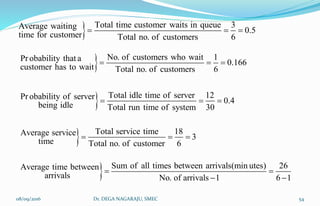
 Total time customer waits in queue 3Average waiting 0.5
time for customer Total no. of customers 6
  
 No. of customers who wait 1Pr obability that a 0.166
customer has to wait Total no. of customers 6
  
 Total idle time of server 12Pr obability of server 0.4
being idle Total run time of system 30
  
 Total service time 18Average service 3
time Total no. of customer 6
  
 Sum of all times between arrivals(min utes) 26Average time between
arrivals No. of arrivals 1 6 1
 
 
08/09/2016 54Dr. DEGA NAGARAJU, SMEC
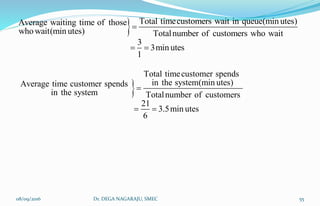
 Total timecustomers wait in queue(min utes)Average waiting time of those
whowait(min utes) Totalnumber of customers who wait
3
3min utes
1

 

Total timecustomer spends
in the system(min utes)Average time customer spends
in the system Totalnumber of customers
21
3.5min utes
6

 
08/09/2016 55Dr. DEGA NAGARAJU, SMEC
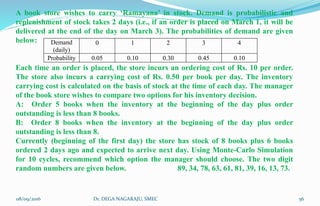
Demand
(daily)
0 1 2 3 4
Probability 0.05 0.10 0.30 0.45 0.10
A book store wishes to carry ‘Ramayana’ in stock. Demand is probabilistic and
replenishment of stock takes 2 days (i.e., if an order is placed on March 1, it will be
delivered at the end of the day on March 3). The probabilities of demand are given
below:
Each time an order is placed, the store incurs an ordering cost of Rs. 10 per order.
The store also incurs a carrying cost of Rs. 0.50 per book per day. The inventory
carrying cost is calculated on the basis of stock at the time of each day. The manager
of the book store wishes to compare two options for his inventory decision.
A: Order 5 books when the inventory at the beginning of the day plus order
outstanding is less than 8 books.
B: Order 8 books when the inventory at the beginning of the day plus order
outstanding is less than 8.
Currently (beginning of the first day) the store has stock of 8 books plus 6 books
ordered 2 days ago and expected to arrive next day. Using Monte-Carlo Simulation
for 10 cycles, recommend which option the manager should choose. The two digit
random numbers are given below. 89, 34, 78, 63, 61, 81, 39, 16, 13, 73.
08/09/2016 56Dr. DEGA NAGARAJU, SMEC
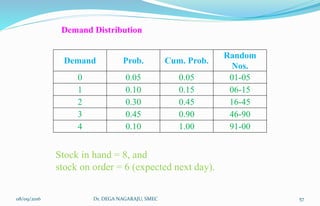
Demand Prob. Cum. Prob.
Random
Nos.
0 0.05 0.05 01-05
1 0.10 0.15 06-15
2 0.30 0.45 16-45
3 0.45 0.90 46-90
4 0.10 1.00 91-00
Stock in hand = 8, and
stock on order = 6 (expected next day).
08/09/2016 57Dr. DEGA NAGARAJU, SMEC
Demand Distribution
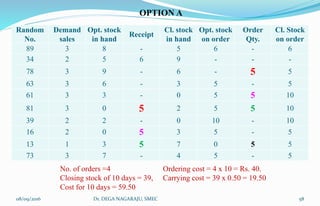
Random
No.
Demand
sales
Opt. stock
in hand
Receipt
Cl. stock
in hand
Opt. stock
on order
Order
Qty.
Cl. Stock
on order
89 3 8 - 5 6 - 6
34 2 5 6 9 - - -
78 3 9 - 6 - 5 5
63 3 6 - 3 5 - 5
61 3 3 - 0 5 5 10
81 3 0 5 2 5 5 10
39 2 2 - 0 10 - 10
16 2 0 5 3 5 - 5
13 1 3 5 7 0 5 5
73 3 7 - 4 5 - 5
No. of orders =4 Ordering cost = 4 x 10 = Rs. 40.
Closing stock of 10 days = 39, Carrying cost = 39 x 0.50 = 19.50
Cost for 10 days = 59.50
OPTION A
08/09/2016 58Dr. DEGA NAGARAJU, SMEC
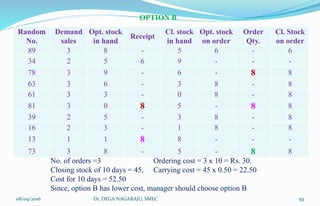
OPTION B
Random
No.
Demand
sales
Opt. stock
in hand
Receipt
Cl. stock
in hand
Opt. stock
on order
Order
Qty.
Cl. Stock
on order
89 3 8 - 5 6 - 6
34 2 5 6 9 - - -
78 3 9 - 6 - 8 8
63 3 6 - 3 8 - 8
61 3 3 - 0 8 - 8
81 3 0 8 5 - 8 8
39 2 5 - 3 8 - 8
16 2 3 - 1 8 - 8
13 1 1 8 8 - - -
73 3 8 - 5 - 8 8
No. of orders =3 Ordering cost = 3 x 10 = Rs. 30.
Closing stock of 10 days = 45, Carrying cost = 45 x 0.50 = 22.50
Cost for 10 days = 52.50
Since, option B has lower cost, manager should choose option B
08/09/2016 59Dr. DEGA NAGARAJU, SMEC
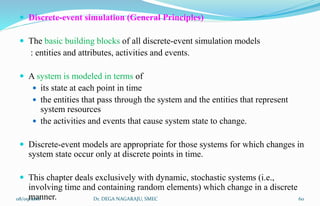
 Discrete-event simulation (General Principles)
 The basic building blocks of all discrete-event simulation models
: entities and attributes, activities and events.
 A system is modeled in terms of
 its state at each point in time
 the entities that pass through the system and the entities that represent
system resources
 the activities and events that cause system state to change.
 Discrete-event models are appropriate for those systems for which changes in
system state occur only at discrete points in time.
 This chapter deals exclusively with dynamic, stochastic systems (i.e.,
involving time and containing random elements) which change in a discrete
manner.08/09/2016 60Dr. DEGA NAGARAJU, SMEC
 System : A collection of entities (e.g., people and machines) that interact
together over time to accomplish one or more goals.
 Model : An abstract representation of a system, usually containing
structural, logical, or mathematical relationships which describe a
system in terms of state, entities and their attributes, sets, processes,
events, activities, and delays.
 System state : A collection of variables that contain all the information
necessary to describe the system at any time.
 Entity : Any object or component in the system which requires explicit
representation in the model (e.g., a server, a customer, a machine).
 Attributes : The properties of a given entity (e.g., the priority of a waiting
customer, the routing of a job through a job shop).
08/09/2016 61Dr. DEGA NAGARAJU, SMEC
 List : A collection of (permanently or temporarily) associated entities, ordered
in some logical fashion (such as all customers currently in a waiting line,
ordered by first come, first served, or by priority).
 Event : An instantaneous occurrence that changes the state of a system
(such as an arrival of a new customer).
 Event notice : A record of an event to occur at the current or some future
time, along with any associated data necessary to execute the
event; at a minimum, the record includes the event type and
the event time.
 Event list : A list of event notices for future events, ordered by time of
occurrence also known as the future event list (FEL).
 Activity : A duration of time of specified length (e.g., a service time or
inter arrival time), which is known when it begins (although it may be
defined in terms of a statistical distribution).
08/09/2016 62Dr. DEGA NAGARAJU, SMEC
 Delay : A duration of time of unspecified indefinite length, which is not
known until it ends (e.g., a customer's delay in a last-in, first-out
waiting line which, when it begins, depends on future arrivals).
 Clock : A variable representing simulated time, called CLOCK in the
examples to follow.
 An activity typically represents a service time, an inter arrival time, or any other
processing time whose duration has been characterized and defined by the modeler.
 An activity's duration may be specified in a number of ways:
 1. Deterministic-for example, always exactly 5 minutes;
 2. Statistical-for example, as a random draw from among 2, 5, 7 with equal
probabilities;
 3. A function depending on system variables and/or entity attributes-for example,
loading time for an iron ore ship as a function of the ship's allowed cargo
weight and the loading rate in tons per hour.
08/09/2016 63Dr. DEGA NAGARAJU, SMEC
08/09/2016 64Dr. DEGA NAGARAJU, SMEC

Simulation UNIT-I

  • 1.
  • 2.
    08/09/2016 Dr. DEGANAGARAJU, SMEC 2
  • 3.
    08/09/2016 Dr. DEGANAGARAJU, SMEC 3 War gaming: test strategies; training Flight Simulator Transportation systems: Improved operations; urban planning Computer communicationParallel computer systems: Games A few more applications … 12/22/2016 3Dr. DEGA NAGARAJU, SMBS
  • 4.
  • 5.
    Applications:  COMPUTER SYSTEMS:hardware components, software systems, networks, data base management, information processing, etc..  MANUFACTURING: material handling systems, assembly lines, automated production facilities, inventory control systems, plant layout, etc..  BUSINESS: stock and commodity analysis, pricing policies, marketing strategies, cash flow analysis, forecasting, etc..  GOVERNMENT: military weapons and their use, military tactics, population forecasting, land use, health care delivery, fire protection, criminal justice, traffic control, etc.. And the list goes on and on... 08/09/2016 5Dr. DEGA NAGARAJU, SMEC
  • 6.
    Examples of Applicationsat Disney World  Cruise Line Operation: Simulate the arrival and check-in process at the dock.  Private Island Arrival: How to transport passengers to the beach area? Drop-off point far from the beach. Used simulation to determine whether to invest in trams, how many trams to purchase, average transport and waiting times, etc.. 08/09/2016 6Dr. DEGA NAGARAJU, SMEC
  • 7.
    Why do we gofor simulation ? Is it possible to represent all real life problems mathematically? Method of last resort Logical extension to the analytical & mathematical techniques John Von Neumann & Stanislaw Ulam Nuclear Shielding problem 1950-Digital Computers Managerial decision making Aircraft-wind tunnel- aerodynamic characteristics Scale models of machines-plant layout Pilot training-flight simulator Car Manufacturing Simulation TV games(chess playing game, snake and ladders)08/09/2016 7Dr. DEGA NAGARAJU, SMEC
  • 8.
    Why do we gofor simulati- on? Draw backs of scientific methods? Draw backs of Analytical methods? Draw backs of iterative methods? Certain processes : too costly or impossible Difficult-mathematical equations No straight forward analytical solution Ex: Queuing problems, Job shop problems, Multi-integral problems etc. Difficulty in performing validating experiments for mathematical models Dynamic programming, queuing theory, network models Dynamic programming-optimal strategies- uncertainties-analyze multi-planning problems DP-simple cases-less number of static variables LPP-data does not change over the entire planning horizon One time decision process-average values for decision variables Many real life situations-uncertainties 08/09/2016 8Dr. DEGA NAGARAJU, SMEC
  • 9.
    Webster’s Dictionary: “ toassume the mere appearance of , without the reality” 08/09/2016 9Dr. DEGA NAGARAJU, SMEC
  • 10.
    Definition: Simulation is theprocess of designing a model of a real system and conducting experiments with this model for the purpose of either understanding the behavior of the system and/or evaluating various strategies for the operation of the system. 08/09/2016 10Dr. DEGA NAGARAJU, SMEC
  • 11.
    Allows us to: Modelcomplex systems in a detailed way Describe the behavior of systems Construct theories or hypotheses that account for the observed behavior Use the model to predict future behavior, that is, the effects that will be produced by changes in the system Analyze proposed systems 08/09/2016 11Dr. DEGA NAGARAJU, SMEC
  • 12.
    Brief History Nota very old technique...  World War II  “Monte Carlo” simulation: originated with the work on the atomic bomb. Used to simulate bombing raids. Given the security code name “Monte-Carlo”.  Still widely used today for certain problems which are not analytically solvable (for example: complex multiple integrals…) 08/09/2016 12Dr. DEGA NAGARAJU, SMEC
  • 13.
    Brief History (cont…..) Late ‘50s, early ‘60s  Computers improve  First languages introduced: SIMSCRIPT, GPSS (General purpose simulation system) (IBM)  Simulation viewed at the tool of “last resort”  Late ‘60s, early ‘70s  Primary computers were mainframes: accessibility and interaction was limited  GASP IV introduced by Pritsker. Triggered a wave of diverse applications. Significant in the evolution of simulation. 08/09/2016 13Dr. DEGA NAGARAJU, SMEC
  • 14.
    Brief History (cont…….) Late ‘70s, early ‘80s  SLAM introduced in 1979 by Pritsker and Pegden.  Models more credible because of sophisticated tools.  SIMAN introduced in 1982 by Pegden. First language to run on both a mainframe as well as a microcomputer.  Late ‘80s through present  Powerful PCs  Languages are very sophisticated (market almost saturated)  Major advancement: graphics. Models can now be animated. 08/09/2016 14Dr. DEGA NAGARAJU, SMEC
  • 15.
    What can besimulated? Almost anything can and almost everything has... 08/09/2016 15Dr. DEGA NAGARAJU, SMEC
  • 16.
    Introduction to Simulation Simulation a) the imitation of the operation of a real-world process or system over time. b) to develop a set of assumptions of mathematical, logical, and symbolic relationship between the entities of interest, of the system. c) to estimate the measures of performance of the system with the simulation- generated data.  Simulation modeling can be used a) as an analysis tool for predicting the effect of changes to existing systems. b) as a design tool to predict the performance of new systems . Real-world process concerning the behavior of a system A set of assumptions Modeling & Analysis 08/09/2016 16Dr. DEGA NAGARAJU, SMEC
  • 17.
    Simula- tion Imitation of the operationof a real world process Whether done by hand or on a Computer It involves 1. The generation of an artificial history of a system & 2. The observation of that artificial history Simulation model Behavior of a system Set of Assumptions: Mathematical, Logical, Symbolic relationships b/w entities, Objects of interest Used as: an analysis tool, a design tool 08/09/2016 17Dr. DEGA NAGARAJU, SMEC
  • 18.
    Simulation Models Solved by: Differential Calculus, ProbabilityTheory, Algebraic Methods Solution Consists: One or more numerical parameters(Measures of Performance) Complex real world systems: Numerical computer based simulation 08/09/2016 18Dr. DEGA NAGARAJU, SMEC
  • 19.
    08/09/2016 19Dr. DEGANAGARAJU, SMEC
  • 20.
    Problem formulation -1 Policymaker/Analyst understand and agree with the formulation. Setting of objectives and overall project plan -2 Model conceptualization -3 The art of modeling is enhanced by an ability to abstract the essential features of a problem, to select and modify basic assumptions that characterize the system, and then to enrich and elaborate the model until a useful approximation results. Data collection -4 As the complexity of the model changes, the required data elements may also change. Model translation -5 GPSS/HTM or special-purpose simulation software Steps in a Simulation Study 08/09/2016 20Dr. DEGA NAGARAJU, SMEC
  • 21.
    Verified? -6 Is thecomputer program performing properly? Debugging for correct input parameters and logical structure Validated? -7 The determination that a model is an accurate representation of the real system. Validation is achieved through the calibration of the model Experimental design -8 The decision on the length of the initialization period, the length of simulation runs, and the number of replications to be made of each run. Production runs and analysis -9 To estimate measures of performances Steps in a Simulation Study (Contd….) 08/09/2016 21Dr. DEGA NAGARAJU, SMEC
  • 22.
    More runs? -10 Documentationand reporting -11 Program documentation : for the relationships between input parameters and output measures of performance, and for a modification Progress documentation : the history of a simulation, a chronology of work done and decision made. Implementation -12 Steps in a Simulation Study (Contd….) 08/09/2016 22Dr. DEGA NAGARAJU, SMEC
  • 23.
    Four phases accordingto Figure 1.3 First phase : a period of discovery or orientation (step 1, step2) Second phase : a model building and data collection (step 3, step 4, step 5, step 6, step 7) Third phase : running the model (step 8, step 9, step 10) Fourth phase : an implementation (step 11, step 12) Steps in a Simulation Study (Contd….) 08/09/2016 23Dr. DEGA NAGARAJU, SMEC
  • 24.
    The basic natureof Simulation Two problems Continuous Discrete State changes continuously with time Deterministic in nature Arrival & Sale of Merchandise occur in discrete steps Stochastic in nature Common features essential to simulation Common features: Mathematical model of the system under study Change of the state in accordance with some equations (rules or laws) for a long period Collection of information about the system (solution to the problem) Programming the calculations for a digital computer Simulate or mimic the real system with the help of computer Continue the process until the desired analytic solution is obtained 08/09/2016 24Dr. DEGA NAGARAJU, SMEC
  • 25.
    Simulation as ananalytic tool is useful only when done on a computer The basic nature of Simulation (Cont….) 08/09/2016 25Dr. DEGA NAGARAJU, SMEC  Simulation of Inventory control manually Pencil and paper System which can be simulated on a digital computer Can also be simulated manually 
  • 26.
    Each application ofSimulation is adhoc to a great extent Simulation is an art The basic nature of Simulation (Cont….) 08/09/2016 26Dr. DEGA NAGARAJU, SMEC No unifying theory of computer simulation No unified theory No fundamental theorems No underlying principles  Experimental technique To simulate is to experiment Fast and inexpensive method Ex: Inventory control problem     
  • 27.
    When Simulation isthe Appropriate Tool (1)  Simulation enables the study of, and experimentation with, the internal interactions of a complex system, or of a subsystem within a complex system.  Informational, organizational, and environmental changes can be simulated, and the effect of these alterations on the model’s behavior can be observed.  The knowledge gained in designing a simulation model may be of great value toward suggesting improvement in the system under investigation.  By changing simulation inputs and observing the resulting outputs, valuable insight may be obtained into which variables are most important and how variables interact.  Simulation can be used as a pedagogical device to reinforce analytic solution methodologies. 08/09/2016 27Dr. DEGA NAGARAJU, SMEC
  • 28.
     Simulation canbe used to experiment with new designs or policies prior to implementation, so as to prepare for what may happen.  Simulation can be used to verify analytic solutions.  By simulating different capabilities for a machine, requirements can be determined.  Simulation models designed for training allow learning without the cost and disruption of on-the-job learning.  Animation shows a system in simulated operation so that the plan can be visualized.  The modern system (factory, wafer fabrication plant, service organization, etc.) is so complex that the interactions can be treated only through simulation. When Simulation is the Appropriate Tool (2) 08/09/2016 28Dr. DEGA NAGARAJU, SMEC
  • 29.
    When Simulation is the appropriatetool? Study of the internal interactions of a complex System Effect of Informational, organizational and environmental changes on model behavior Used as a pedagogical device to reinforce analytic solution methodologies Experimentation with new design To verify analytic solutions Simulation models: For training without the cost and disruption of on the job learning To study the interactions of a complex modern systems: factory, fabrication plant, service organization 08/09/2016 29Dr. DEGA NAGARAJU, SMEC
  • 30.
    When Simulation isnot Appropriate  When the problem can be solved using common sense.  When the problem can be solved analytically.  When it is easier to perform direct experiments.  When the simulation costs exceed the savings.  When the resources or time are not available.  When system behavior is too complex or can’t be defined.  When there isn’t the ability to verify and validate the model. 08/09/2016 30Dr. DEGA NAGARAJU, SMEC
  • 31.
    When Simulation is not Appropriate? Whentheproblem canbesolvedusing commonsenseWhenthe resourcesor timearenot available When thereis n’t the ability to verify and validate the model When the simulation costs exceed the savings 08/09/2016 31Dr. DEGA NAGARAJU, SMEC
  • 32.
    Advantages and Disadvantagesof Simulation (1)  Advantages  New polices, operating procedures, decision rules, information flows, organizational procedures, and so on can be explored without disrupting ongoing operations of the real system.  New hardware designs, physical layouts, transportation systems, and so on, can be tested without committing resources for their acquisition.  Hypotheses about how or why certain phenomena occur can be tested for feasibility.  Insight can be obtained about the interaction of variables.  Insight can be obtained about the importance of variables to the performance of the system.  Bottleneck analysis can be performed indicating where work-in-process, information, materials, and so on are being excessively delayed.  A simulation study can help in understanding how the system operates rather than how individuals think the system operates.  “What-if” questions can be answered. This is particularly useful in the design of new system. 08/09/2016 32Dr. DEGA NAGARAJU, SMEC
  • 33.
    Advantages and Disadvantagesof Simulation (2)  Disadvantages  Model building requires special training. It is an art that is learned over time and through experience. Furthermore, if two models are constructed by two competent individuals, they may have similarities, but it is highly unlikely that they will be the same.  Simulation results may be difficult to interpret. Since most simulation outputs are essentially random variables (they are usually based on random inputs), it may be hard to determine whether an observation is a result of system interrelationships or randomness.  Simulation modeling and analysis can be time consuming and expensive. Skimping on resources for modeling and analysis may result in a simulation model or analysis that is not sufficient for the task.  Simulation is used in some cases when an analytical solution is possible, or even preferable, as discussed in Section 1.2. This might be particularly true in the simulation of some waiting lines where closed-form queueing models are available. 08/09/2016 33Dr. DEGA NAGARAJU, SMEC
  • 34.
    1 • New polices,operating procedures, decision rules, information flows, organizational procedures, and so on can be explored without disrupting ongoing operations of the real system 2 • New hardware designs, physical layouts, transportation systems, and so on, can be tested without committing resources for their acquisition. 3 • Hypotheses about how or why certain phenomena occur can be tested for feasibility. 4 • Insight can be obtained about the interaction of variables. 5 • Insight can be obtained about the importance of variables to the performance of the system. 6 • Bottleneck analysis can be performed indicating where work-in-process, information, materials, and so on are being excessively delayed 7 • A simulation study can help in understanding how the system operates rather than how individuals think the system operates. 8 • “What-if” questions can be answered. This is particularly useful in the design of new system. Advantages of Simulation 08/09/2016 34Dr. DEGA NAGARAJU, SMEC
  • 35.
    1 • Model buildingrequires special training. It is an art that is learned over time and through experience. Furthermore, if two models are constructed by two competent individuals, they may have similarities, but it is highly unlikely that they will be the same. 2 • Simulation results may be difficult to interpret. Since most simulation outputs are essentially random variables (they are usually based on random inputs), it may be hard to determine whether an observation is a result of system interrelationships or randomness. 3 • Simulation modeling and analysis can be time consuming and expensive. Skimping on resources for modeling and analysis may result in a simulation model or analysis that is not sufficient for the task. 4 • Simulation is used in some cases when an analytical solution is possible, or even preferable. This might be particularly true in the simulation of some waiting lines where closed-form queueing models are available. Disadvantages of Simulation 08/09/2016 35Dr. DEGA NAGARAJU, SMEC
  • 36.
  • 37.
    Why do we studythe System? To understand the relationships b/w its components or to predict how the system will operate under a new policy Is it possible to conduct experiment with the system? Yes, but not always New system may not yet exist. It may be in hypothetical form or at the design stage. Example: Developing & testing of prototype models can be very expensive and time consuming Even System exists: No experimentation. Example: Is it possible to double the unemployment rate to determine the effect of employment on inflation? Is it possible to reduce the number of tellers at the bank to study the effect on the length of waiting lines? Is it feasible to change the supply and demand of goods arbitrarily to study the economic systems? How do we define the system model? Body of information gathered about the system to study the system. No unique model of the system For same system-different models-by different analysts Establish the model Structure: System boundary, entities, attributes and activities of the system. Provide the data: Values of the attributes, relationships among the activities. MODEL OF A SYSTEM How the model is derived for the system? 08/09/2016 37Dr. DEGA NAGARAJU, SMEC
  • 38.
    Example for theModel of a System ENTITY ATTRIBUTE ACTIVITY SHOPPER NO OF ITEMS ARRIVE GET BASKET AVAILABILITY SHOP QUEUE CHECK-OUT COUNTER NUMBER OF OCCUPANCY RETURN LEAVE Elements of a Super Market 08/09/2016 38Dr. DEGA NAGARAJU, SMEC
  • 39.
    Types of models Physical StaticDynamic Mathematical Static Numerical Analytical Dynamic Analytical Numerical System Simulation TYPES OF MODELS 08/09/2016 39Dr. DEGA NAGARAJU, SMEC
  • 40.
    Physical Models: Based onsome analogy b/w such systems as mechanical & electrical, electrical & hydraulic System attributes represented by such measurements as a voltage or the position of a shaft System activities are reflected in the physical laws that drive the model: Example: amount of voltage applied – speed of the shaft of the motor Voltage applied – Velocity of the vehicle Number of revolutions of the shaft – distance traveled by the vehicle Mathematical Models: Used symbolic notations, mathematical equations etc. System attributes are represented by variables System activities are represented by mathematical functions 08/09/2016 40Dr. DEGA NAGARAJU, SMEC
  • 41.
    Dynamic Models: Static Models: Alsocalled as Monte Carlo Simulation Represents the system at a particular point in time Represents systems as they change over time Example: Simulation of a bank from 9.00 am to 4.00 pm Numerical Models: Analytical Models: Only certain forms of equations are solved Example: Linear differential equations are solved Computational procedure is used to solve the models 08/09/2016 41Dr. DEGA NAGARAJU, SMEC
  • 42.
    Monte Carlo Simulation Statisticaldistribution functions are created by using a series of random numbers. Data can be developed for many months or years in a matter of few minutes on a digital computer. Used to solve the problems which can’t be adequately represented by mathematical models or where the solution of the model is not possible by analytical method. The solution obtained is very close to the optimal but not exact. 08/09/2016 42Dr. DEGA NAGARAJU, SMEC
  • 43.
    Steps in Monte CarloSimulation Objectives, factors affecting the objectives Variables, parameters, decision rules, conditions to carry experimentation, type of distribution used, the manner in which time is changed, relationship b/w variables and parameters Starting conditions for the simulation, number of simulation runs Define a coding system that will correlate the factors defined in step 1 with random numbers to be generated; Select the random number generator and create the random numbers to be used; Associate the generated random numbers with the factors identified in step 1 and coded in step 4(i) Select the best course of action 08/09/2016 43Dr. DEGA NAGARAJU, SMEC
  • 44.
    Systems and SystemEnvironment  System  defined as a group of objects that are joined together in some regular interaction or interdependence toward the accomplishment of some purpose.  System Environment  changes occurring outside the system.  The decision on the boundary between the system and its environment may depend on the purpose of the study. 08/09/2016 44Dr. DEGA NAGARAJU, SMEC
  • 45.
    Components of aSystem  Entity : an object of interest in the system.  Attribute : a property of an entity.  Activity : a time period of specified length.  State : the collection of variables necessary to describe the system at any time, relative to the objectives of the study.  Event : an instantaneous occurrence that may change the state of the system.  Endogenous : to describe activities and events occurring within a system.  Exogenous : to describe activities and events in an environment that affect the system. 08/09/2016 45Dr. DEGA NAGARAJU, SMEC
  • 46.
    Components of aSystem 08/09/2016 46Dr. DEGA NAGARAJU, SMEC
  • 47.
    Discrete and ContinuousSystems  Systems can be categorized as discrete or continuous.  Bank : a discrete system  The head of water behind a dam : a continuous system 08/09/2016 47Dr. DEGA NAGARAJU, SMEC
  • 48.
    DISCRETE SYSTEMS State variableschange only at a discrete set of points in time Example: Bank State variable: Number of customers in the bank Note: The state variable changes only when a new customer arrives or when the service provided to the customer is completed 08/09/2016 48Dr. DEGA NAGARAJU, SMEC
  • 49.
    CONTINUOUS SYSTEMS State variableschange continuously over time Example: Head of water behind a dam State variable: Head of water behind a dam Note: During and for some time after a rain storm, water flows into the lake behind the dam. Water is drawn from the dam for flood control and to make electricity. Evaporation also decreases the water level. 08/09/2016 49Dr. DEGA NAGARAJU, SMEC
  • 50.
    A grocery storehas one checkout counter. Customers arrive at this checkout counter at random from 1 to 8 minutes apart and each interval time has the same probability of occurrence. The service times vary from 1 to 6 minutes, with probability given below: Simulate the arrival of 6 customers and calculate (i) Average waiting time for a customer, (ii) Probability that a customer has to wait, (iii) Probability of a server being idle (iv) Average service time, (v) Average time between arrival. Use the following sequence of random numbers: Assume the first customer arrives at time θ. Depict the simulation in a tabular form. Service (minutes) 1 2 3 4 5 6 Probability 0.10 0.20 0.30 0.25 0.10 0.05 Random digit for arrival 913 727 015 948 309 922 Random digit for service time 84 10 74 53 17 79 08/09/2016 50Dr. DEGA NAGARAJU, SMEC
  • 51.
    Time between arrivals Probability Cumulative Probability Randomdigit assignment 1 0.125 0.125 001-125 2 0.125 0.250 126-250 3 0.125 0.375 251-375 4 0.125 0.500 376-500 5 0.125 0.625 501-625 6 0.125 0.750 626-750 7 0.125 0.875 751-875 8 0.125 1.000 876-000 ARRIVAL TIME DISTRIBUTION Arrival time varies from 1 to 8 minutes with equal probability, meaning that the probability of each arrival = 1/8 = 0.125 08/09/2016 51Dr. DEGA NAGARAJU, SMEC
  • 52.
    Service Time Probability Cumulative Probability Randomdigit assignment 1 0.10 0.10 01-10 2 0.20 0.30 11-30 3 0.30 0.60 31-60 4 0.25 0.85 61-85 5 0.10 0.95 86-95 6 0.05 1.00 96-00 SERVICE TIME DISTRIBUTION 08/09/2016 52Dr. DEGA NAGARAJU, SMEC
  • 53.
    Custom er Random No. for Arrival Time since last arrival Arrival time Random No. for Service Service time Time service begins Time custome -rwaits in queue Time service ends Time custome r spends in system Idle time of server 1 - - 0 84 4 0 0 4 4 0 2 913 8 8 10 1 8 0 9 1 4 3 727 6 14 74 4 14 0 18 4 5 4 015 1 15 53 3 18 3 21 6 0 5 948 8 23 17 2 23 0 25 2 2 6 309 3 26 79 4 26 0 30 4 1 18 3 21 12 SIMULATION TABLE 08/09/2016 53Dr. DEGA NAGARAJU, SMEC
  • 54.
     Total timecustomer waits in queue 3Average waiting 0.5 time for customer Total no. of customers 6     No. of customers who wait 1Pr obability that a 0.166 customer has to wait Total no. of customers 6     Total idle time of server 12Pr obability of server 0.4 being idle Total run time of system 30     Total service time 18Average service 3 time Total no. of customer 6     Sum of all times between arrivals(min utes) 26Average time between arrivals No. of arrivals 1 6 1     08/09/2016 54Dr. DEGA NAGARAJU, SMEC
  • 55.
     Total timecustomerswait in queue(min utes)Average waiting time of those whowait(min utes) Totalnumber of customers who wait 3 3min utes 1     Total timecustomer spends in the system(min utes)Average time customer spends in the system Totalnumber of customers 21 3.5min utes 6    08/09/2016 55Dr. DEGA NAGARAJU, SMEC
  • 56.
    Demand (daily) 0 1 23 4 Probability 0.05 0.10 0.30 0.45 0.10 A book store wishes to carry ‘Ramayana’ in stock. Demand is probabilistic and replenishment of stock takes 2 days (i.e., if an order is placed on March 1, it will be delivered at the end of the day on March 3). The probabilities of demand are given below: Each time an order is placed, the store incurs an ordering cost of Rs. 10 per order. The store also incurs a carrying cost of Rs. 0.50 per book per day. The inventory carrying cost is calculated on the basis of stock at the time of each day. The manager of the book store wishes to compare two options for his inventory decision. A: Order 5 books when the inventory at the beginning of the day plus order outstanding is less than 8 books. B: Order 8 books when the inventory at the beginning of the day plus order outstanding is less than 8. Currently (beginning of the first day) the store has stock of 8 books plus 6 books ordered 2 days ago and expected to arrive next day. Using Monte-Carlo Simulation for 10 cycles, recommend which option the manager should choose. The two digit random numbers are given below. 89, 34, 78, 63, 61, 81, 39, 16, 13, 73. 08/09/2016 56Dr. DEGA NAGARAJU, SMEC
  • 57.
    Demand Prob. Cum.Prob. Random Nos. 0 0.05 0.05 01-05 1 0.10 0.15 06-15 2 0.30 0.45 16-45 3 0.45 0.90 46-90 4 0.10 1.00 91-00 Stock in hand = 8, and stock on order = 6 (expected next day). 08/09/2016 57Dr. DEGA NAGARAJU, SMEC Demand Distribution
  • 58.
    Random No. Demand sales Opt. stock in hand Receipt Cl.stock in hand Opt. stock on order Order Qty. Cl. Stock on order 89 3 8 - 5 6 - 6 34 2 5 6 9 - - - 78 3 9 - 6 - 5 5 63 3 6 - 3 5 - 5 61 3 3 - 0 5 5 10 81 3 0 5 2 5 5 10 39 2 2 - 0 10 - 10 16 2 0 5 3 5 - 5 13 1 3 5 7 0 5 5 73 3 7 - 4 5 - 5 No. of orders =4 Ordering cost = 4 x 10 = Rs. 40. Closing stock of 10 days = 39, Carrying cost = 39 x 0.50 = 19.50 Cost for 10 days = 59.50 OPTION A 08/09/2016 58Dr. DEGA NAGARAJU, SMEC
  • 59.
    OPTION B Random No. Demand sales Opt. stock inhand Receipt Cl. stock in hand Opt. stock on order Order Qty. Cl. Stock on order 89 3 8 - 5 6 - 6 34 2 5 6 9 - - - 78 3 9 - 6 - 8 8 63 3 6 - 3 8 - 8 61 3 3 - 0 8 - 8 81 3 0 8 5 - 8 8 39 2 5 - 3 8 - 8 16 2 3 - 1 8 - 8 13 1 1 8 8 - - - 73 3 8 - 5 - 8 8 No. of orders =3 Ordering cost = 3 x 10 = Rs. 30. Closing stock of 10 days = 45, Carrying cost = 45 x 0.50 = 22.50 Cost for 10 days = 52.50 Since, option B has lower cost, manager should choose option B 08/09/2016 59Dr. DEGA NAGARAJU, SMEC
  • 60.
     Discrete-event simulation(General Principles)  The basic building blocks of all discrete-event simulation models : entities and attributes, activities and events.  A system is modeled in terms of  its state at each point in time  the entities that pass through the system and the entities that represent system resources  the activities and events that cause system state to change.  Discrete-event models are appropriate for those systems for which changes in system state occur only at discrete points in time.  This chapter deals exclusively with dynamic, stochastic systems (i.e., involving time and containing random elements) which change in a discrete manner.08/09/2016 60Dr. DEGA NAGARAJU, SMEC
  • 61.
     System :A collection of entities (e.g., people and machines) that interact together over time to accomplish one or more goals.  Model : An abstract representation of a system, usually containing structural, logical, or mathematical relationships which describe a system in terms of state, entities and their attributes, sets, processes, events, activities, and delays.  System state : A collection of variables that contain all the information necessary to describe the system at any time.  Entity : Any object or component in the system which requires explicit representation in the model (e.g., a server, a customer, a machine).  Attributes : The properties of a given entity (e.g., the priority of a waiting customer, the routing of a job through a job shop). 08/09/2016 61Dr. DEGA NAGARAJU, SMEC
  • 62.
     List :A collection of (permanently or temporarily) associated entities, ordered in some logical fashion (such as all customers currently in a waiting line, ordered by first come, first served, or by priority).  Event : An instantaneous occurrence that changes the state of a system (such as an arrival of a new customer).  Event notice : A record of an event to occur at the current or some future time, along with any associated data necessary to execute the event; at a minimum, the record includes the event type and the event time.  Event list : A list of event notices for future events, ordered by time of occurrence also known as the future event list (FEL).  Activity : A duration of time of specified length (e.g., a service time or inter arrival time), which is known when it begins (although it may be defined in terms of a statistical distribution). 08/09/2016 62Dr. DEGA NAGARAJU, SMEC
  • 63.
     Delay :A duration of time of unspecified indefinite length, which is not known until it ends (e.g., a customer's delay in a last-in, first-out waiting line which, when it begins, depends on future arrivals).  Clock : A variable representing simulated time, called CLOCK in the examples to follow.  An activity typically represents a service time, an inter arrival time, or any other processing time whose duration has been characterized and defined by the modeler.  An activity's duration may be specified in a number of ways:  1. Deterministic-for example, always exactly 5 minutes;  2. Statistical-for example, as a random draw from among 2, 5, 7 with equal probabilities;  3. A function depending on system variables and/or entity attributes-for example, loading time for an iron ore ship as a function of the ship's allowed cargo weight and the loading rate in tons per hour. 08/09/2016 63Dr. DEGA NAGARAJU, SMEC
  • 64.
    08/09/2016 64Dr. DEGANAGARAJU, SMEC