Introduction to Business Analytics
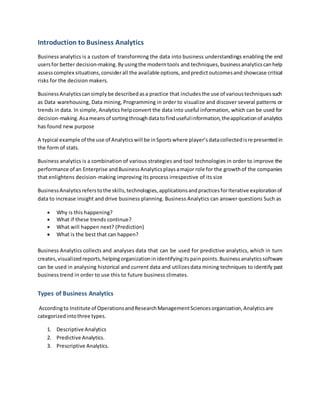
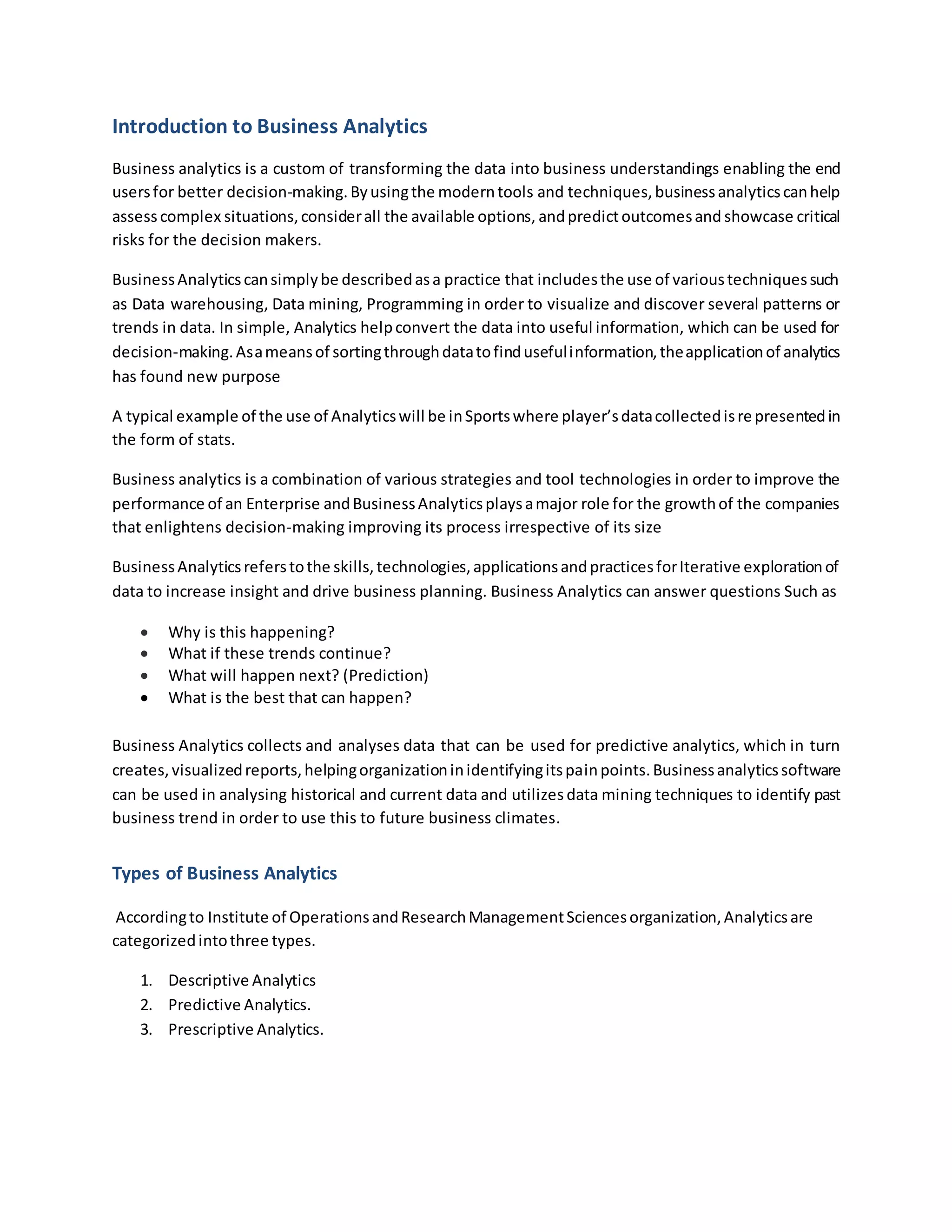
Business analytics is a custom of transforming the data into business understandings enabling the end
usersfor better decision-making.By usingthe moderntools and techniques,businessanalyticscanhelp
assesscomplex situations,considerall the available options, andpredictoutcomesand showcase critical
risks for the decision makers.
BusinessAnalyticscansimplybe describedasa practice that includesthe use of varioustechniquessuch
as Data warehousing, Data mining, Programming in order to visualize and discover several patterns or
trends in data. In simple, Analytics helpconvert the data into useful information, which can be used for
decision-making.Asameansof sortingthroughdatatofindusefulinformation,theapplicationof analytics
has found new purpose
A typical example of the use of Analyticswill be inSportswhere player’sdatacollectedisrepresentedin
the form of stats.
Business analytics is a combination of various strategies and tool technologies in order to improve the
performance of an Enterprise andBusinessAnalyticsplaysamajor role for the growthof the companies
that enlightens decision-making improving its process irrespective of its size
BusinessAnalyticsreferstothe skills,technologies,applicationsandpracticesforIterative explorationof
data to increase insight and drive business planning. Business Analytics can answer questions Such as
 Why is this happening?
 What if these trends continue?
 What will happen next? (Prediction)
 What is the best that can happen?
Business Analytics collects and analyses data that can be used for predictive analytics, which in turn
creates,visualizedreports,helpingorganizationinidentifyingitspainpoints.Businessanalyticssoftware
can be used in analysing historical and current data and utilizes data mining techniques to identify past
business trend in order to use this to future business climates.
Types of Business Analytics
Accordingto Institute of OperationsandResearchManagementSciencesorganization,Analyticsare
categorizedintothree types.
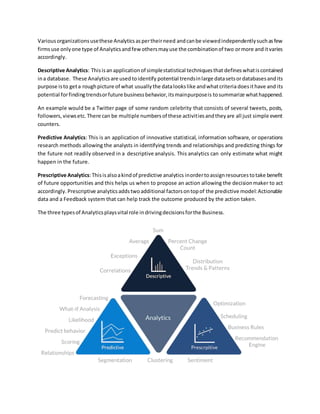
1. Descriptive Analytics
2. Predictive Analytics.
3. Prescriptive Analytics.
Variousorganizationsusethese Analyticsaspertheirneed andcanbe viewedindependentlysuchasfew
firmsuse onlyone type of Analyticsandfew othersmayuse the combinationof two ormore anditvaries
accordingly.
Descriptive Analytics: Thisisan applicationof simplestatistical techniquesthat defines whatiscontained
ina database. These Analytics are usedtoidentify potential trendsinlarge datasetsordatabasesandits
purpose isto geta roughpicture of what usually the datalookslike andwhatcriteria doesithave and its
potential forfindingtrendsorfuture businessbehavior,itsmainpurposeis tosummarize whathappened.
An example would be a Twitter page of some random celebrity that consists of several tweets, posts,
followers,viewsetc.There can be multiple numbersof these activitiesandtheyare all just simple event
counters.
Predictive Analytics: This is an application of innovative statistical, information software, or operations
research methods allowing the analysts in identifying trends and relationships and predicting things for
the future not readily observed in a descriptive analysis. This analytics can only estimate what might
happen in the future.
Prescriptive Analytics:Thisisalsoakindof predictive analytics inordertoassignresourcestotake benefit
of future opportunities and this helps us when to propose an action allowing the decisionmaker to act
accordingly. Prescriptive analyticsaddstwoadditional factorsontopof the predictive model:Actionable
data and a Feedback system that can help track the outcome produced by the action taken.
The three typesof Analyticsplaysvital role indrivingdecisionsforthe Business.
Characteristics of Business Analytics:
Business Analytics and Business Intelligence are closely related to each other but one thing that is very
muchcommonisthat majorcomponentof BIinvolvesstoringanorganization’sdata intoDatawarehouses
or Data Marts. Data warehousing is not a business analytics function, although the data can be used for
analysis. BI is focused on querying and reporting, but it can include reported information from a BA
analysis.BIcan helpanswerquestions suchaswhat ishappeningatthe moment,andalsowhatbusiness
actionsare to be taken basedonpriorexperience.BA,onthe otherhand,can helpanswerquestionssuch
as why is it happening, what are all the new trends that may exist, and what is the best course for the
future. In summary, Business Analytics makes a measurable impact in improving the performance of
Business.
Business Intelligence can generate reports but Business Analytics seeks to explain why the resultsoccur
based on the analysis rather than just reporting and storing the results.
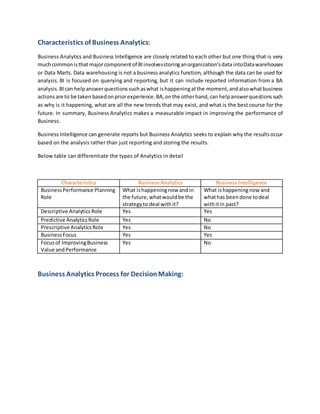
Below table can differentiate the types of Analytics in detail
Characteristics Business Analytics Business Intelligence
BusinessPerformance Planning
Role
What ishappeningnow andin
the future,whatwouldbe the
strategyto deal withit?
What ishappeningnow and
whathas beendone todeal
withitin past?
Descriptive AnalyticsRole Yes Yes
Predictive AnalyticsRole Yes No
Prescriptive AnalyticsRole Yes No
BusinessFocus Yes Yes
Focusof ImprovingBusiness
Value andPerformance
Yes No
Business Analytics Process for DecisionMaking:
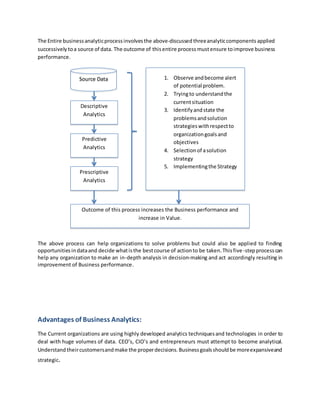
The Entire businessanalyticprocessinvolvesthe above-discussed threeanalyticcomponents applied
successively toa source of data. The outcome of thisentire process mustensure toimprove business
performance.
The above process can help organizations to solve problems but could also be applied to finding
opportunitiesindataand decide whatisthe bestcourse of actionto be taken.Thisfive-stepprocesscan
help any organization to make an in-depth analysis in decision-making and act accordingly resulting in
improvement of Business performance.
Advantages of Business Analytics:
The Current organizations are using highly developed analytics techniquesand technologies in order to
deal with huge volumes of data. CEO’s, CIO’s and entrepreneurs must attempt to become analytical.
Understand theircustomersandmake the properdecisions.Businessgoalsshouldbe moreexpansiveand
strategic.
Source Data
Descriptive
Analytics
Prescriptive
Analytics
Predictive
Analytics
1. Observe andbecome alert
of potential problem.
2. Tryingto understandthe
currentsituation
3. Identifyandstate the
problemsandsolution
strategieswithrespectto
organizationgoalsand
objectives
4. Selectionof asolution
strategy
5. Implementingthe Strategy
Outcome of this process increases the Business performance and
increase in Value.
Top Benefitsof BusinessAnalytics include
 Refiningandspeedingupthe decisionmakingprocess
 Increasingreturns
 Preservinggoverningcompliance
 Realizingcostefficiencies
 Respondingtouserneedsforavailabilityof dataona timelybasis
 Improvingorganization’s effectiveness
 Producinga integratedviewof enterprise wide information
 Coordinatingfinancial andoperational strategies
 Sharinginformationwitha broadrange of audience (e.g.,casual users)
What Business AnalyticsCan Do?
By making use of high-level dataandquantitative analysis,Businessanalytics hasmade decision-making
processes much easier and achieve better results and good output across the organizations irrespective
of the size of the firm from small, mid and Enterprise level.
Harnessingthe powerof mathematical models,businessanalyticsusesadvancedtoolsandtechnologies
in making use of its data to help each organization. The methods and models of analytics draw from
disciplines that include statistics, operations research, information systems, and others.
Organizationscontinue tobe challengedandhave realizedthe needforstrongeranalytics,fasterdelivery,
flexiblechange managementandintelligencearoundtheirbusinessmetricsandreporting.Identifyingthe
key business activities as per the market environment can impact the results that can be significant for
making more informed strategic and operational decisions.
Business analytics allows professionals to take business intelligence and leverage it to the competitive
advantage of the organization and plays a vital role in doing Risk analysis, operation decisions and
Strategic decisions.
Applications of Business Analytics:
In one of the surveys conducted by Bloomberg, Three out of four organizations believe that Business
Analytics has been very effective in decision-making. Few of the key improvementsinclude increased
productivity, reduced cost, and Quick decision-making.
Inthe pastfewyears,the percentageof respondents profitingfrombusinessanalyticshasrisenatadecent
rate evidently highlighting business’s increasing hunger to make sense of its data.
Key Applications of Business Analytics for Businesses to optimize:
 Critical analysis of Products:Helpsinassistingthe studyintrendsandmake changesaccordingly.
 Enhanced customerservice:Cankeeptrackof regularcustomerqueriespreventingorganizations
from repeating errors and enabling customer satisfaction.
 Up-selling opportunities: It helps identify the business needs
 Streamlined inventory management: This can help predict which are getting obsolete reducing
the losses
 Competitive price insights:ThiscanhelpBusinessesmake theirpricescompetitivebytrackingthe
customer trends.
Conclusion:
Organizations that have implemented Business Analytics have seen good amount of success that has
helped them to cut costs, know their Target Audience, Increase in returns. Various organizations that
include Banks, Pharmaceutical companies, Retailers, Insurance companies, Auto manufacturers use
Analytics in their own ways.
These firms have invested across several areas that include Resources, technologies and business
processestomake decisionsthatwillhelp thempredictand answercomplexbusinessproblems.Withthis
analytical approach, companies identify their most beneficial customers, accelerate product innovation
and optimize pricing.
BusinessanalyticsisafastgrowingfieldandInvestinginbusinessanalyticsisalreadyprovedthatitwould
benefitorganizationsinseveralwaysandthere are manytoolsavailableinthe markettoserve the needs
of organizations. The range of analytical software goes from relatively simple statistical tools to
sophisticated business intelligence suites (ex-SAS, Oracle, SAP, IBM among the big players) helping
organizations in increasing productivity, Improve decision-making and profitability management.

Business Intelligence

  • 1.
    Introduction to BusinessAnalytics Business analytics is a custom of transforming the data into business understandings enabling the end usersfor better decision-making.By usingthe moderntools and techniques,businessanalyticscanhelp assesscomplex situations,considerall the available options, andpredictoutcomesand showcase critical risks for the decision makers. BusinessAnalyticscansimplybe describedasa practice that includesthe use of varioustechniquessuch as Data warehousing, Data mining, Programming in order to visualize and discover several patterns or trends in data. In simple, Analytics helpconvert the data into useful information, which can be used for decision-making.Asameansof sortingthroughdatatofindusefulinformation,theapplicationof analytics has found new purpose A typical example of the use of Analyticswill be inSportswhere player’sdatacollectedisrepresentedin the form of stats. Business analytics is a combination of various strategies and tool technologies in order to improve the performance of an Enterprise andBusinessAnalyticsplaysamajor role for the growthof the companies that enlightens decision-making improving its process irrespective of its size BusinessAnalyticsreferstothe skills,technologies,applicationsandpracticesforIterative explorationof data to increase insight and drive business planning. Business Analytics can answer questions Such as  Why is this happening?  What if these trends continue?  What will happen next? (Prediction)  What is the best that can happen? Business Analytics collects and analyses data that can be used for predictive analytics, which in turn creates,visualizedreports,helpingorganizationinidentifyingitspainpoints.Businessanalyticssoftware can be used in analysing historical and current data and utilizes data mining techniques to identify past business trend in order to use this to future business climates. Types of Business Analytics Accordingto Institute of OperationsandResearchManagementSciencesorganization,Analyticsare categorizedintothree types. 1. Descriptive Analytics 2. Predictive Analytics. 3. Prescriptive Analytics.
  • 2.
    Variousorganizationsusethese Analyticsaspertheirneed andcanbeviewedindependentlysuchasfew firmsuse onlyone type of Analyticsandfew othersmayuse the combinationof two ormore anditvaries accordingly. Descriptive Analytics: Thisisan applicationof simplestatistical techniquesthat defines whatiscontained ina database. These Analytics are usedtoidentify potential trendsinlarge datasetsordatabasesandits purpose isto geta roughpicture of what usually the datalookslike andwhatcriteria doesithave and its potential forfindingtrendsorfuture businessbehavior,itsmainpurposeis tosummarize whathappened. An example would be a Twitter page of some random celebrity that consists of several tweets, posts, followers,viewsetc.There can be multiple numbersof these activitiesandtheyare all just simple event counters. Predictive Analytics: This is an application of innovative statistical, information software, or operations research methods allowing the analysts in identifying trends and relationships and predicting things for the future not readily observed in a descriptive analysis. This analytics can only estimate what might happen in the future. Prescriptive Analytics:Thisisalsoakindof predictive analytics inordertoassignresourcestotake benefit of future opportunities and this helps us when to propose an action allowing the decisionmaker to act accordingly. Prescriptive analyticsaddstwoadditional factorsontopof the predictive model:Actionable data and a Feedback system that can help track the outcome produced by the action taken. The three typesof Analyticsplaysvital role indrivingdecisionsforthe Business.
  • 3.
    Characteristics of BusinessAnalytics: Business Analytics and Business Intelligence are closely related to each other but one thing that is very muchcommonisthat majorcomponentof BIinvolvesstoringanorganization’sdata intoDatawarehouses or Data Marts. Data warehousing is not a business analytics function, although the data can be used for analysis. BI is focused on querying and reporting, but it can include reported information from a BA analysis.BIcan helpanswerquestions suchaswhat ishappeningatthe moment,andalsowhatbusiness actionsare to be taken basedonpriorexperience.BA,onthe otherhand,can helpanswerquestionssuch as why is it happening, what are all the new trends that may exist, and what is the best course for the future. In summary, Business Analytics makes a measurable impact in improving the performance of Business. Business Intelligence can generate reports but Business Analytics seeks to explain why the resultsoccur based on the analysis rather than just reporting and storing the results. Below table can differentiate the types of Analytics in detail Characteristics Business Analytics Business Intelligence BusinessPerformance Planning Role What ishappeningnow andin the future,whatwouldbe the strategyto deal withit? What ishappeningnow and whathas beendone todeal withitin past? Descriptive AnalyticsRole Yes Yes Predictive AnalyticsRole Yes No Prescriptive AnalyticsRole Yes No BusinessFocus Yes Yes Focusof ImprovingBusiness Value andPerformance Yes No Business Analytics Process for DecisionMaking:
  • 4.
    The Entire businessanalyticprocessinvolvestheabove-discussed threeanalyticcomponents applied successively toa source of data. The outcome of thisentire process mustensure toimprove business performance. The above process can help organizations to solve problems but could also be applied to finding opportunitiesindataand decide whatisthe bestcourse of actionto be taken.Thisfive-stepprocesscan help any organization to make an in-depth analysis in decision-making and act accordingly resulting in improvement of Business performance. Advantages of Business Analytics: The Current organizations are using highly developed analytics techniquesand technologies in order to deal with huge volumes of data. CEO’s, CIO’s and entrepreneurs must attempt to become analytical. Understand theircustomersandmake the properdecisions.Businessgoalsshouldbe moreexpansiveand strategic. Source Data Descriptive Analytics Prescriptive Analytics Predictive Analytics 1. Observe andbecome alert of potential problem. 2. Tryingto understandthe currentsituation 3. Identifyandstate the problemsandsolution strategieswithrespectto organizationgoalsand objectives 4. Selectionof asolution strategy 5. Implementingthe Strategy Outcome of this process increases the Business performance and increase in Value.
  • 5.
    Top Benefitsof BusinessAnalyticsinclude  Refiningandspeedingupthe decisionmakingprocess  Increasingreturns  Preservinggoverningcompliance  Realizingcostefficiencies  Respondingtouserneedsforavailabilityof dataona timelybasis  Improvingorganization’s effectiveness  Producinga integratedviewof enterprise wide information  Coordinatingfinancial andoperational strategies  Sharinginformationwitha broadrange of audience (e.g.,casual users) What Business AnalyticsCan Do? By making use of high-level dataandquantitative analysis,Businessanalytics hasmade decision-making processes much easier and achieve better results and good output across the organizations irrespective of the size of the firm from small, mid and Enterprise level. Harnessingthe powerof mathematical models,businessanalyticsusesadvancedtoolsandtechnologies in making use of its data to help each organization. The methods and models of analytics draw from disciplines that include statistics, operations research, information systems, and others. Organizationscontinue tobe challengedandhave realizedthe needforstrongeranalytics,fasterdelivery, flexiblechange managementandintelligencearoundtheirbusinessmetricsandreporting.Identifyingthe key business activities as per the market environment can impact the results that can be significant for making more informed strategic and operational decisions. Business analytics allows professionals to take business intelligence and leverage it to the competitive advantage of the organization and plays a vital role in doing Risk analysis, operation decisions and Strategic decisions. Applications of Business Analytics: In one of the surveys conducted by Bloomberg, Three out of four organizations believe that Business Analytics has been very effective in decision-making. Few of the key improvementsinclude increased productivity, reduced cost, and Quick decision-making. Inthe pastfewyears,the percentageof respondents profitingfrombusinessanalyticshasrisenatadecent rate evidently highlighting business’s increasing hunger to make sense of its data. Key Applications of Business Analytics for Businesses to optimize:  Critical analysis of Products:Helpsinassistingthe studyintrendsandmake changesaccordingly.
  • 6.
     Enhanced customerservice:Cankeeptrackofregularcustomerqueriespreventingorganizations from repeating errors and enabling customer satisfaction.  Up-selling opportunities: It helps identify the business needs  Streamlined inventory management: This can help predict which are getting obsolete reducing the losses  Competitive price insights:ThiscanhelpBusinessesmake theirpricescompetitivebytrackingthe customer trends. Conclusion: Organizations that have implemented Business Analytics have seen good amount of success that has helped them to cut costs, know their Target Audience, Increase in returns. Various organizations that include Banks, Pharmaceutical companies, Retailers, Insurance companies, Auto manufacturers use Analytics in their own ways. These firms have invested across several areas that include Resources, technologies and business processestomake decisionsthatwillhelp thempredictand answercomplexbusinessproblems.Withthis analytical approach, companies identify their most beneficial customers, accelerate product innovation and optimize pricing. BusinessanalyticsisafastgrowingfieldandInvestinginbusinessanalyticsisalreadyprovedthatitwould benefitorganizationsinseveralwaysandthere are manytoolsavailableinthe markettoserve the needs of organizations. The range of analytical software goes from relatively simple statistical tools to sophisticated business intelligence suites (ex-SAS, Oracle, SAP, IBM among the big players) helping organizations in increasing productivity, Improve decision-making and profitability management.